





























How Data Analytics in Restaurants Can Save Your Margins in a High-Inflation Era


- Where Inflation Quietly Destroys Restaurant Margins
- The Role of Data Analytics in Restaurants' Margin Preservation
- High-Impact Analytics Use Cases of Restaurant Analytics Platform That Directly Protect Margins
- Analytics Architecture: What Actually Works at Scale
- From Insight to Impact: A Practical Implementation Roadmap
- Margin-Critical Metrics Leaders Should Monitor Consistently
- Why Appinventiv: Turning Restaurant Analytics into Measurable Margin Gains
- Conclusion: Margin Protection Is a Continuous Discipline
- Frequently Asked Questions

- Inflation pressures restaurant margins through unstable food costs, labor inefficiencies, and supplier price drift, not pricing alone.
- Data analytics in restaurants brings clear cost visibility across menus, labor, and inventory, helping leaders act before losses compound.
- Restaurants using analytics commonly recover 3–8 margin points by reducing waste, labour optimization and workforce elasticity, and correcting low-margin menu items.
- The strongest results appear when restaurant POS analytics, inventory data, procurement records, and workforce data are integrated into a single view.
- Margin recovery depends less on tools and more on how analytics is implemented, governed, and used in daily decisions.
Inflation has altered how restaurants experience margin pressure. Costs no longer rise in a predictable pattern. Ingredient prices fluctuate month to month. Labor expenses remain high. Supplier contracts offer less certainty than before.
For restaurant leaders, this means margins are lost quietly. Not through one large decision, but through hundreds of small ones—menu pricing that lags cost changes, schedules that miss demand signals, and inventory ordered on instinct rather than data.
This is where data analytics in restaurants has shifted from a performance enhancer to a financial necessity. Modern analytics for restaurants helps teams see cost movement as it happens, understand where margins are leaking, and respond before losses settle into the P&L.
This article focuses on how data analytics for restaurants directly protects margins in a high-inflation environment. Not at a theoretical level, but through practical use cases that influence daily decisions across menus, labor, inventory, and procurement.

Where Inflation Quietly Destroys Restaurant Margins
Inflation rarely hits margins in one visible moment. The damage accumulates over time. It shows up in routine decisions made without current data. This is where restaurant data analytics software development becomes critical—not to explain inflation, but to expose where it quietly eats away profit.
Food Cost Volatility and Margin Blindness
Ingredient prices now change faster than most menus. Yet many restaurants still rely on static recipes and outdated cost assumptions. A dish that was profitable last quarter may already be underperforming.
Without clear contribution margin data at the dish and category level, teams make decisions based on sales volume, not profitability. Popular items stay on the menu even when margins shrink. This is a common gap addressed by restaurant data analytics solutions, which connect recipe costs with real purchase prices and sales data.
When cost visibility is delayed, margin loss becomes invisible.
Labor Inefficiency Under Demand Uncertainty
Labor remains one of the largest controllable costs. Inflation makes forecasting harder. Demand shifts by daypart, location, and local conditions.
Inaccurate forecasts lead to overstaffing during slow periods and service strain during peaks. Inflexible scheduling compounds the problem. Managers are forced to choose between cost control and guest experience.
Restaurant predictive analytics helps align staffing with actual demand patterns. Without it, labor inefficiency becomes a recurring margin drain rather than a one-time correction.
Inventory Waste and Shrinkage
Inflation increases the fear of stockouts. The usual response is to order more. That reaction often creates a different problem—waste.
Over-ordering leads to spoilage, inconsistent portioning, and higher shrinkage. These losses rarely appear dramatic on their own. They surface gradually across locations and weeks.
Restaurant business analytics brings discipline here. By comparing theoretical usage with actual consumption, teams can see where inventory controls are breaking down and where costs are leaking quietly.
Supplier Price Drift and Contract Leakage
Supplier prices rarely rise in a single step; they drift. Invoices change line by line. Small increases pass unnoticed until margins tighten.
Without structured restaurant data analytics software development, procurement teams struggle to track price variance across suppliers, regions, and contracts. Negotiation power weakens without data-backed evidence.
Over time, this contract leakage becomes embedded in operating costs. By the time it is visible, recovery is harder.
Also Read: What Users Expect in a Restaurant Mobile App?
The Role of Data Analytics in Restaurants’ Margin Preservation
Margin protection today depends on how quickly teams can see cost movement and respond. This is where data analytics for restaurants plays a practical role. Not as reporting, but as an operating layer that supports daily decisions.
At an operational level, restaurant analytics follows a simple cycle:
- Measure continuously: Track food costs, labor hours, inventory usage, and supplier pricing as they change.
- Predict early: Use patterns from historical and current data to anticipate demand, cost spikes, and margin risk.
- Intervene fast: Adjust menus, staffing, purchasing, or pricing before losses compound.
Speed matters. The longer it takes to detect a cost issue, the more expensive it becomes to fix. This delay, often called decision latency, is one of the biggest hidden causes of margin erosion and is the silent killer of restaurant profitability
In a high-inflation era, a 48-hour delay in noticing a protein price spike or a supplier overcharge can result in a 2% margin erosion across a 50-unit estate before a single corrective action is taken. Our approach to restaurant data analytics software development focuses on collapsing the “Data-to-Decision” cycle, ensuring that operational alerts reach managers in hours, not weeks, after the P&L is closed.
The Enterprise Data Stack: From ETL to Prescriptive Insights
For global restaurant groups, margin visibility is a data engineering challenge. To move beyond manual spreadsheets, the architecture must support a seamless flow from raw operational data to executive insights. This requires a robust Data Pipeline (ETL/ELT) that consolidates fragmented sources into a centralized Data Warehouse (such as Snowflake, Google BigQuery, or Amazon Redshift).
Modern restaurant analytics architecture is structured into three specialized layers:
Descriptive Analytics (The Semantic Layer)
- What it is: Using ETL pipelines to clean and categorize historical data from POS and ERP systems.
- Enterprise Use: Standardizing KPIs like Actual vs. Theoretical (AvT) food costs across different regional business units.
Predictive Analytics (The ML Layer)
- What it is: Deploying Machine Learning (ML) models on historical datasets to identify patterns.
- Enterprise Use: Using time-series forecasting to predict labor requirements, accounting for external variables like weather, local events, and historical seasonality.
Prescriptive Analytics (The Decision Support Layer)
- What it is: The most advanced stage, where AI suggests specific optimizations based on predicted outcomes.
- Enterprise Use: Automated alerts that suggest menu price elasticity adjustments or inventory reorder points to prevent capital being tied up in excess stock.
For leadership teams, the value lies in how well these layers are connected. Many restaurants reach this point by working with specialists who understand the realities of food and beverage operations.
When analytics is embedded into workflows, margin preservation becomes proactive rather than reactive.
High-Impact Analytics Use Cases of Restaurant Analytics Platform That Directly Protect Margins
Inflation exposes weak points in restaurant operations quickly. The following use cases show how data analytics in restaurant management software development directly protects margins when costs are unstable. These are not theoretical models. They reflect how leading operators use analytics to correct issues early and sustain profitability.
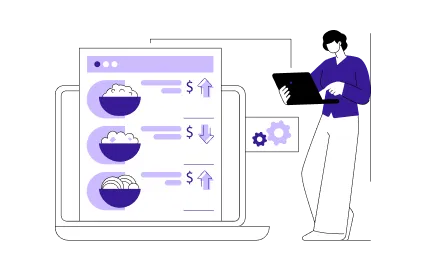
Menu Engineering Based on Contribution Margins
Many menu decisions still rely on sales volume and intuition. That approach breaks down when ingredient prices change frequently.
With data analytics software for restaurants, menus can be evaluated based on contribution margin rather than popularity alone. This shifts attention to what truly drives profit.
Analytics helps teams identify:
- High-volume items with shrinking margins
- Low-visibility items that generate a strong contribution
- Dishes sensitive to ingredient price swings
Once this data is visible, teams can act with precision:
- Adjust pricing selectively instead of across the board
- Rework recipes where costs have crept up
- Remove or reposition items that consistently drain the margin
This is one of the most direct ways data analytics software for restaurants reduces operating costs without hurting demand. Many operators engage analytics consultants and development partners here, as accuracy depends on clean integration between recipes, inventory, and POS data.
Expert Insight:
Bridging the “Normalization Gap” for KFC (Americana Group)
While many brands attempt menu engineering, they often stumble on the normalization gap—where ingredient names from suppliers (e.g., “Case of Tomatoes”) don’t match POS recipe units.
In our work with KFC (Americana Group), we didn’t just track sales; we engineered a Master Data Management (MDM) layer that automatically mapped disparate procurement records to a centralized recipe schema. This allowed leadership to identify “Price Drift” across thousands of locations in real-time, moving from reactive monthly reviews to proactive, data-backed menu adjustments.
Demand Forecasting and Labor Optimization
Labor inefficiency often stems from poor forecasting, not poor management. Inflation amplifies the cost of those errors.
Using historical sales data alongside variables like daypart trends, seasonality, and local events, restaurant predictive analytics creates realistic demand forecasting. These forecasts guide staffing decisions at a granular level.
The impact is measurable:
- Labor cost as a percentage of revenue stabilizes
- Overtime and idle hours decline
- Service quality improves during peak periods
This use case relies heavily on restaurant POS analytics and workforce data working together. When systems are disconnected, forecasts remain unreliable. Many restaurant groups seek external support to design forecasting models that reflect real operating conditions.
In Appinventiv’s engagement with Domino’s, behavioral and transactional data were used to refine the digital ordering experience. The resulting improvements increased conversion rates by 23%, indicating stronger alignment between demand signals and customer intent.
Inventory Optimization and Waste Reduction
Inventory decisions are often driven by fear of stockouts. In an inflationary environment, this leads to over-ordering and waste.
Restaurant business analytics replaces buffer-based ordering with forecast-driven purchasing. It aligns inventory levels with expected demand instead of worst-case scenarios.
Key analytics signals include:
- Theoretical vs actual ingredient usage
- Spoilage trends by location and category
- Portion variance across shifts
The margin impact is immediate:
- Lower spoilage and shrinkage
- Reduced cash tied up in excess stock
- Better consistency across locations
This is a common entry point for restaurant data analytics solutions, especially when teams want fast cost control wins without changing guest-facing operations.
Supplier Analytics and Procurement Intelligence
Supplier costs rarely increase all at once. They drift. Small changes across invoices compound over time.
With structured development, procurement teams can compare contracted prices against actual invoice data. This creates visibility into where margin leakage occurs.
Analytics supports:
- Early detection of price deviations
- Supplier performance benchmarking
- Smarter negotiation based on usage and trends
Over time, this strengthens cost control and reduces exposure to supply shocks. Many operators involve analytics consultants here to ensure procurement data is normalized and audit-ready.
Pricing and Promotion Analytics
Blanket price hikes are risky in an inflationary market. They often reduce traffic without fixing margin issues.
Pricing analytics evaluates elasticity at the dish, category, and location level. It shows where price sensitivity is low and where demand drops quickly.
This enables:
- Targeted price adjustments
- Promotions focused on high-margin items
- Better balance between volume and contribution
Customer analytics for restaurants also plays a role here, helping teams understand how different segments respond to price and promotion changes.
When pricing decisions are guided by data rather than instinct, margin protection becomes sustainable rather than reactive.
Appinventiv builds analytics systems that turn restaurant data into measurable financial decisions.

Analytics Architecture: What Actually Works at Scale
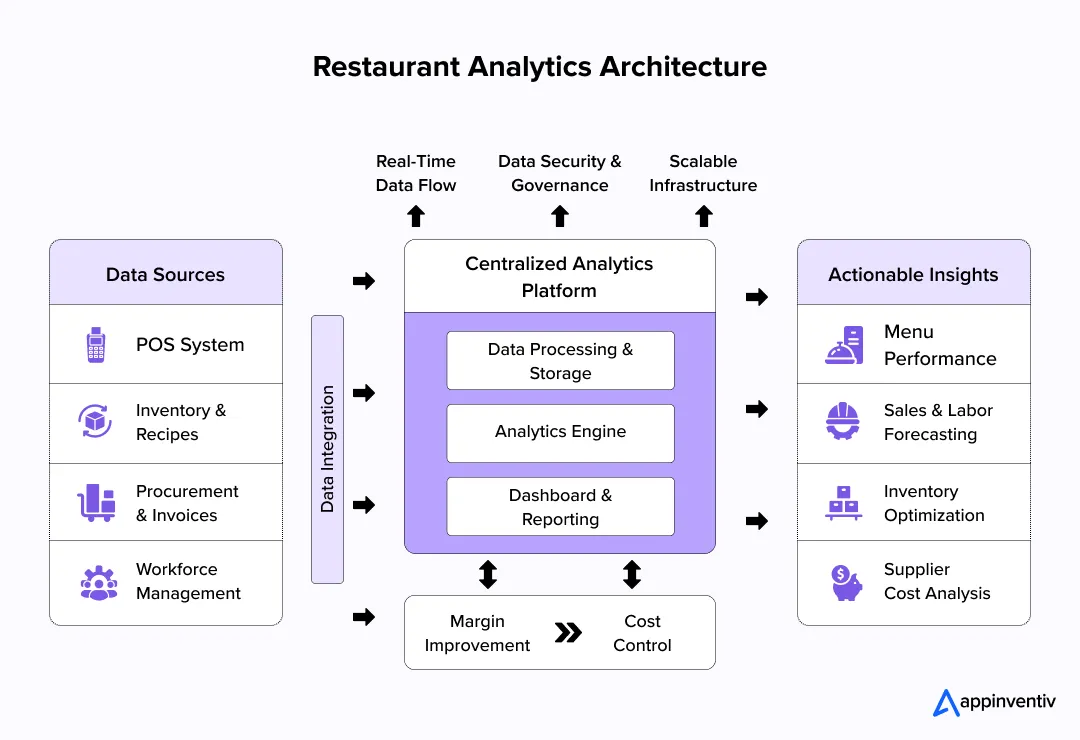
For analytics to protect margins consistently, the architecture matters as much as the insights themselves. Many restaurant groups struggle not because analytics is missing, but because data is fragmented, delayed, or unreliable. A practical architecture focuses on integration, clarity, and trust.
Data Sources That Must Be Integrated
Margin decisions cut across functions. Analytics only works when these systems interact with each other:
POS systems
Sales data by item, time, and location. This is the foundation for most restaurant POS analytics.
Inventory and recipe management
Ingredient usage, yield, and theoretical food cost.
Procurement and invoicing
Actual supplier prices, contract terms, and price variance.
Workforce management
Staffing levels, labor hours, and scheduling patterns.
When these data sources remain isolated, insights arrive late or contradict each other. This is often where teams seek external help, especially to clean, map, and align data across systems.
Centralized vs Federated Analytics Models
There is no single right model. The choice depends on scale, geography, and operating autonomy.
Centralized analytics works well when:
- Menu standards are consistent
- Procurement is largely centralized
- Leadership needs a single financial view
Federated analytics is useful when:
- Regions operate with local suppliers
- Menus vary by market
- Local teams need decision flexibility
In practice, many groups adopt a hybrid approach. Core metrics are standardized, while regional data layers remain flexible. Designing this balance often benefits from consultation, as it affects governance and long-term scalability.
Governance, Accuracy, and Trust
Data analytics in the food and beverage industry fails quickly if leaders do not trust the numbers. Strong governance prevents that risk.
Effective restaurant business analytics frameworks include:
- Consistent definitions for costs, margins, and KPIs across locations
- Audit-ready data pipelines for finance and compliance teams
- Role-based access, so each team sees what they need and nothing more
Trust grows when reports match operational reality. This usually requires ongoing refinement, not a one-time setup. Many organizations consult development teams for a strategy of restaurant analytics implementation to ensure accuracy as systems and processes evolve.
Scalable analytics requires systems that perform consistently across markets. Appinventiv supported Pizza Hut by modernizing its digital platforms across regions, resulting in a 30% increase in conversions. The outcome reflected stable performance under scale, supported by integrated data flows and cloud-based architecture.
A well-designed architecture turns analytics from a reporting layer into a daily decision system.
From Insight to Impact: A Practical Implementation Roadmap
Analytics software for restaurants only protects margins when it is translated into action. Dashboards alone do not change outcomes. What matters is how insights move into daily decisions across finance, operations, and procurement.
The roadmap below reflects how data analytics in the food and beverage industry is typically implemented without disrupting ongoing operations.
Phase 1: Diagnostic and Data Readiness
This phase focuses on establishing a reliable foundation. Many analytics initiatives fail because data quality issues surface too late.
Key activities include:
- Reviewing POS, inventory, procurement, and labor data for gaps and inconsistencies
- Aligning the cost of restaurant analytics software across teams and locations
- Establishing baseline metrics such as food cost percentage, labor cost ratio, and waste levels
At this stage, several restaurant groups choose to involve external teams with experience to accelerate data alignment and avoid rework later.
Phase 2: Pilot Analytics Use Cases
Once data is stable, the focus shifts to impact. Rather than rolling out analytics everywhere, successful teams start small.
Typical pilot actions:
- Selecting a few locations, brands, or regions with clear margin pressure
- Applying priority use cases of the restaurant analytics platform, such as menu margin analysis or labor forecasting
- Tracking early results, including cost reduction and decision adoption
This phase answers a critical leadership question: Does analytics influence behavior? Clear results here build confidence for broader rollout.
Phase 3: Scale and Automate (90–180 Days)
With proven results, the benefits of using data analytics in the restaurant industry move from pilot to standard practice.
This phase usually includes:
- Rolling out consistent dashboards across locations
- Automating alerts for cost spikes, waste thresholds, or forecast deviations
- Reducing manual reporting and spreadsheet dependency
At scale, restaurant business analytics becomes part of daily operations. Many teams seek advisory support here to ensure scalability, performance, and long-term maintainability.
Phase 4: Continuous Margin Governance (Ongoing)
Margin protection is not a one-time initiative. Inflation makes cost structures dynamic.
Ongoing practices include:
- Monthly margin and variance reviews
- Regular refinement of forecasts and thresholds
- Controlled experimentation with pricing, staffing, and procurement strategies
At this stage, analytics functions as a governance layer. It supports disciplined decision-making even as conditions change.
With a step-by-step strategy for implementing restaurant analytics, solutions move from insights to measurable financial impact.
Also Read: 5 Ways Restaurant Technology Is Transforming the Industry
Margin-Critical Metrics Leaders Should Monitor Consistently
Analytics delivers value only when it is tied to the right metrics. For restaurant leaders, the focus should remain on indicators that directly reflect margin health, not vanity numbers or isolated operational stats. These metrics help connect restaurant data analytics to financial outcomes.
Below are the indicators most leadership teams track once analytics for restaurants is embedded into operations.
Food Cost Percentage (Actual vs Theoretical)
This metric highlights the gap between what food should cost and what it actually costs.
- Theoretical cost reflects recipe and portion standards
- Actual cost reflects real purchasing and usage
A widening gap points to waste, over-portioning, or pricing drift. Beyond simple percentages, the primary technical challenge for enterprise restaurants is quantifying the variance between what should have happened and what actually happened. Our systems are engineered to minimize this variance (Δ) by integrating live procurement data with precise recipe builds:
Δ=CostActual – CostTheoretical
Where CostTheoretical is not a static number, but a dynamic value derived from real-time weighted average ingredient costs across all active recipes and inventory cycles. By isolating this Δ, leadership can distinguish between “inflationary price increases” and “operational waste,” allowing for surgical rather than blanket cost-cutting measures.
Many teams rely on restaurant data analytics solutions to surface these variances early, before they become systemic.
Contribution Margin per Dish and Category
Revenue alone does not tell the full story. Contribution margin shows which items truly support profitability.
This metric helps leaders:
- Identify dishes that look successful but erode margins
- Protect high-margin items during pricing or promotion decisions
- Guide menu engineering with financial clarity
Accurate contribution analysis often requires restaurant analytics software development that connects POS data with real-time ingredient costs.
Labor Cost per Cover
Labor cost percentage can be misleading when demand fluctuates. Labor cost per cover offers a clearer view.
It reveals:
- Whether staffing aligns with actual demand
- Where overstaffing or underutilization occurs
- How scheduling decisions affect margin, not just service levels
This metric is closely tied to restaurant predictive analytics and forecast accuracy.
Inventory Turnover and Waste Percentage
Inventory efficiency affects both cash flow and margin.
Key signals include:
- How often inventory cycle through the system
- The percentage lost to spoilage or shrinkage
Low turnover and rising waste usually indicate forecasting or ordering issues. Restaurant business data analytics in the food and beverage industry helps determine whether the problem lies in demand planning, supplier reliability, or in-store execution.
Supplier Price Variance
Small supplier price changes add up quickly.
Tracking price variance helps teams:
- Compare contracted prices with invoiced rates
- Identify cost drift by supplier or category
- Support data-backed negotiations
This metric is a core component of mature restaurant data analytics solutions, especially for multi-location operations.
Forecast Accuracy
Forecast Accuracy measures how closely demand predictions match reality.
Low accuracy affects:
- Labor scheduling
- Inventory purchasing
- Service quality
Improving this metric reduces both cost overruns and operational stress. Many organizations involve analytics specialists here to refine models and improve reliability over time.
When these metrics are reviewed consistently, data analytics in restaurants becomes a financial control system rather than a reporting exercise.
Why Appinventiv: Turning Restaurant Analytics into Measurable Margin Gains
Protecting margins in an inflationary environment requires more than dashboards. It requires systems that work under real operating pressure. This is where Appinventiv differentiates itself.
Our work in restaurant data analytics services is built around execution. The goal is not to show data, but to make it usable across finance, operations, and procurement teams.
Appinventiv’s experience in the food and restaurant sector is grounded in execution. Across engagements with KFC, Domino’s, and Pizza Hut, the focus has remained consistent—building analytics-ready digital systems that improve conversion, operational visibility, and performance at scale.
Built on Strong Engineering Foundations
Appinventiv designs analytics software for restaurants using a combination of data analytics, AI, ML, and cloud-native architectures. Each layer is built to support scale, speed, and accuracy.
Also Read: AI in Restaurants: Benefits, Use Cases, and More
Key technical strengths include:
- Custom analytics architectures aligned to existing POS, inventory, procurement, and workforce systems
- Predictive models using ML to improve demand forecasting, labor planning, and inventory accuracy
- Cloud-based data pipelines for near real-time reporting across locations
- Secure-by-design frameworks, with cybersecurity controls and role-based access built in
This approach reduces dependency on manual reporting and fragmented tools. It also ensures analytics remains reliable as operations grow.
Designed for Real-World Restaurant Operations
Restaurants operate with thin margins and little room for error. Analytics must reflect that reality.
Our restaurant app developer team focuses on:
- Connecting data across systems rather than replacing them
- Embedding analytics into daily workflows, not parallel processes
- Supporting multi-location governance without slowing local decisions
For organizations dealing with complex supplier networks or cross-region operations, we also incorporate blockchain-backed audit trails where traceability and data integrity are critical.
Strategy, Engineering, and Long-Term Support
Successful analytics adoption requires more than implementation. It requires ongoing refinement.
Appinventiv supports clients through:
- Analytics strategy and roadmap design
- Restaurant analytics software development tailored to business priorities
- Continuous optimization as cost structures, menus, and demand patterns evolve
Many leadership teams engage Appinventiv as a long-term technology partner to ensure analytics continues to deliver value, not just insights.
Understand where your data supports margins—and where it falls short.

Conclusion: Margin Protection Is a Continuous Discipline
Inflation is no longer a temporary disruption. It has changed how margins behave.
Restaurants that rely on intuition or static reports struggle to respond in time. Those who invest in data analytics in restaurants gain visibility, control, and consistency.
When implemented correctly, analytics becomes:
- A daily cost control system
- A safeguard against margin erosion
- A foundation for disciplined decision-making
For leaders evaluating their next step, the path forward often begins with a focused assessment. Understanding where margins leak is the first move toward protecting them—today and over the long term.
Frequently Asked Questions
Q. What are the key benefits of using data analytics in the restaurant industry?
A. The main benefit is control. Data analytics in restaurants helps leaders see cost movement early and respond before margins erode.
Other benefits include:
- Better visibility into food, labor, and inventory costs
- More accurate demand forecasting
- Reduced waste and over-ordering
- Clearer understanding of which menu items drive profit
Many restaurat groups adopt analytics to shift from reactive fixes to structured cost management.
Q. What are the essential features of restaurant analytics software?
A. Effective restaurant analytics software focuses on accuracy and usability, not volume of reports.
Core features of restaurant analytics software typically include:
- POS analytics with item-level performance tracking
- Real-time food and labor cost monitoring
- Inventory usage and waste analysis
- Supplier price variance tracking
- Role-based dashboards for finance and operations teams
Organizations with complex operations often choose custom development or consultation services to ensure these features align with real workflows.
Q. What are the main challenges in restaurant analytics software development?
A. The biggest challenges are rarely technical alone. They usually involve data quality and integration.
Common challenges include:
- Inconsistent data across POS, inventory, and procurement systems
- Poor data definitions that lead to conflicting reports
- Delayed insights due to manual processing
- Low adoption when analytics is not embedded into daily operations
These issues are why many teams seek experienced partners for restaurant analytics software development, especially during the early stages.
Q. What are the current trends in restaurant analytics?
A. Restaurant analytics is becoming more predictive and integrated.
Key trends in restaurant analytics include:
- Greater use of AI for demand forecasting and anomaly detection
- Cloud-based analytics platforms for multi-location visibility
- Deeper integration between procurement, inventory, and finance data
- Increased focus on cost governance rather than reporting
As inflation continues to affect margins, these trends point toward analytics becoming a core operational system rather than a support tool.
Q. How do restaurants use data analytics?
A. Restaurants use analytics to guide daily and strategic decisions. Common applications include:
- Tracking food and labor cost trends
- Identifying low-margin menu items
- Forecasting demand to plan staffing and inventory
- Monitoring supplier pricing and contract compliance
As operations grow, many teams adopt restaurant business analytics platforms or work with analytics specialists to ensure data is accurate and actionable.
Q. What are the types of analytics used in restaurants?
A. Most restaurants rely on three types of analytics:
- Descriptive analytics: Explains what has already happened, such as last month’s food cost variance
- Predictive analytics: Estimates what is likely to happen next, based on demand and cost patterns
- Prescriptive analytics: Recommends actions, such as adjusting prep levels or staffing plans
Together, these form the foundation of modern analytics for restaurants.
Q. How much does restaurant analytics software cost?
A. The cost of restaurant analytics software varies widely. It depends on scale, data complexity, and integration needs.
- Basic analytics tools may start in the lower five figures annually
- Custom restaurant analytics software development for multi-location operations can range significantly higher
Many organizations begin with a pilot or assessment to understand requirements before committing to a full rollout.
Q. How does restaurant analytics help reduce operating costs?
A. Restaurant analytics reduces operating costs by improving visibility and timing.
It helps teams:
- Detect food waste and over-portioning early
- Align staffing with actual demand
- Avoid over-ordering inventory
- Catch supplier price drift before it compounds
This is why data analytics for restaurants is often introduced as a cost-control initiative rather than a reporting project.
Q. How is AI used in restaurant analytics?
A. AI is used selectively within restaurant analytics to improve accuracy and speed.
Common uses include:
- Demand forecasting based on historical and real-time data
- Pattern detection in waste, shrinkage, or pricing trends
- Anomaly detection in supplier invoices or labor costs
When applied correctly, AI supports better decisions without replacing human judgment. Many teams seek advisory support to apply AI where it delivers clear value.
Q. How long does it take to implement restaurant analytics?
A. Implementation timelines depend on data readiness and scope.
- Initial diagnostics and data alignment typically take 2–4 weeks
- Pilot use cases often run for 60–90 days
- Full rollout across locations may take several months
Working with teams experienced in restaurant data analytics solutions can shorten timelines and reduce rework during scaling.

- In just 2 mins you will get a response
- Your idea is 100% protected by our Non Disclosure Agreement.

Build Your Own: A Complete Guide to Menu Engineering Software Development (2026)
Key takeaways: Menu engineering works best when treated as a decision system, not a one-time analysis exercise. Accurate menu decisions depend on real cost data, clean POS mappings, and continuous analysis. Building custom menu engineering software makes sense when complexity, scale, and control matter. Most menu engineering software built in 2026 falls between $40,000 to…

How to Build a Custom Restaurant Management Software? Features, Process, Costs
Key takeaways: Custom restaurant management software turns scattered tools into one operational backbone. The real ROI comes from reduced waste, better staffing, and faster decisions, not just “going digital.” Restaurants use these systems daily for menu control, inventory, workforce planning, and loyalty, not just reporting. Features only work when they match real workflows for guests,…
10 Innovative Restaurant Business Ideas That Are Disrupting the Industry
Key takeaways: The success of modern restaurants depends on the adoption of top advanced technologies like AI, AR, IoT, and others, which can simplify operations and increase profitability. Emerging ideas like cloud kitchen, food trucks, and immersive experiences will suit changing consumer needs of convenience, customization, and sustainability. The correct technology infrastructure, a good business…









