






























FinTech Leaders’ Guide to Crypto Payment Gateway Development in the UAE


- Why the UAE Has Become a Key Market for Crypto Payment Gateway Development
- Compliance and Regulatory Considerations: Navigating the UAE and Middle East Legal Landscape
- Crypto Payments in Action: Use Cases and Industry Examples
- How to Build a Crypto Payment Gateway in the UAE
- How Much Does it Cost to Build a Crypto Payment Gateway in the UAE?
- Future Outlook: What’s Next for Crypto Payments in the UAE?
- Build a Future-Ready Crypto Payment Gateway with Appinventiv in the ME
- FAQs

Key takeaways:
- The UAE has emerged as one of the most active crypto payment markets in the Middle East driven by clear regulations and strong government support.
- Building a compliant crypto payment gateway in the UAE requires careful alignment with regulatory bodies like VARA and the Central Bank.
- Integration with local banking rails, robust AML/KYC controls, and secure custody solutions are essential for success.
- Real-world use cases in retail, real estate, travel, and B2B show that crypto payments are moving from pilot projects to mainstream adoption.
- Development costs and timelines vary widely, but investing in compliance and security from the start ensures scalability and regulatory approval.
Crypto is rarely out of the UAE news cycle. From an Emirati firm acquiring a 49% stake in World Liberty Financial in 2025 to Emirates signing a 2024 agreement with Crypto.com to enable digital payments, the signal is unmistakable.
Digital assets are no longer peripheral to the region’s financial strategy. They are entering boardrooms, airline payment systems, and sovereign investment portfolios, accelerating serious investment in crypto payment gateway development in the UAE.
This momentum is unfolding within a defined regulatory structure. When the Central Bank of the UAE introduced its Payment Token Services Regulation and Dubai established VARA, it formalized crypto payments within supervised boundaries. The framework did not restrict growth, but it provided legitimacy.
Today, the UAE stands among the most active crypto markets globally, with rising participation from both retail users and institutions. The emphasis has shifted from experimentation to infrastructure. For FinTech leaders, this means building payment gateways that integrate with domestic banking rails, embed transaction monitoring, support stablecoins, and remain adaptable as oversight evolves.
Scalability and compliance now move together. That alignment will shape the next generation of crypto payment platforms in the region.
Position your crypto payment strategy now, before the next wave of expansion peaks
Why the UAE Has Become a Key Market for Crypto Payment Gateway Development
The United Arab Emirates did not arrive at this position by chance. Over the past few years, the groundwork for crypto payment gateway development in the UAE has been laid through specific, enforceable regulations rather than policy headlines. The Central Bank of the UAE issued the Payment Token Services Regulation to govern stablecoins used in payments.
In Dubai, the Virtual Assets Regulatory Authority (VARA) began licensing and supervising virtual asset service providers under a defined rulebook. Inside Abu Dhabi Global Market, the Financial Services Regulatory Authority (FSRA) built its own framework for digital asset activity. For FinTech builders, that clarity matters.
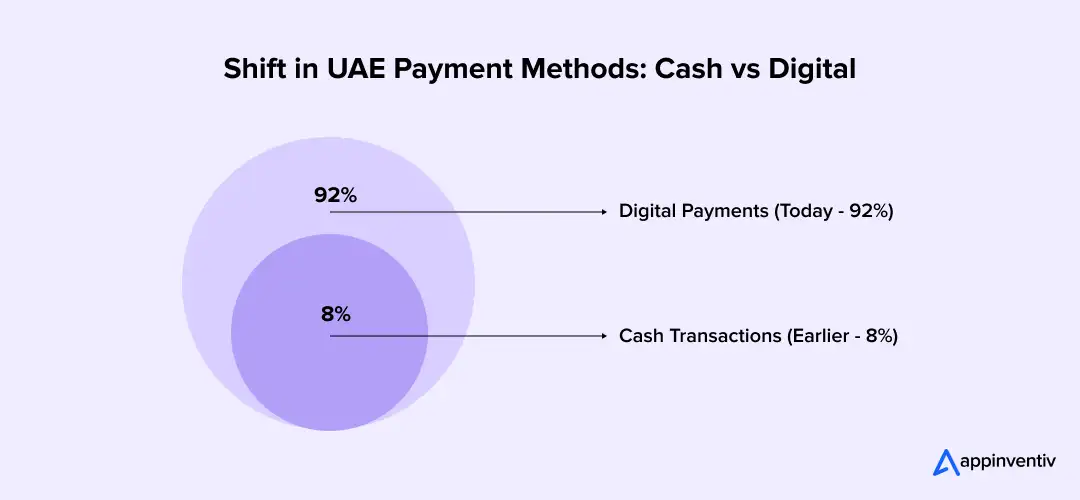
At the same time, consumer behaviour has shifted sharply. A few years back, cash represented about 67% of transactions in the UAE, and today, nearly 92% of payments move through digital channels (Source: En.Aletihad.ae).
Cards are standard, and mobile wallets are routine across the UAE. Buy Now Pay Later apps such as Tabby, Tamara, and Postpay are now common at checkout, both online and in stores. In parallel, crypto payments are no longer unusual in select sectors, particularly real estate, luxury retail, and cross-border services.
This context changes the conversation around crypto payment gateway development Dubai. The market is already comfortable with digital rails. The regulatory perimeter is defined. So the real work is architectural. Payment gateways must connect to banks, screen transactions properly, reconcile stablecoin flows, and scale without creating compliance gaps. In the UAE, growth and supervision are unfolding together, not in opposition.
Compliance and Regulatory Considerations: Navigating the UAE and Middle East Legal Landscape
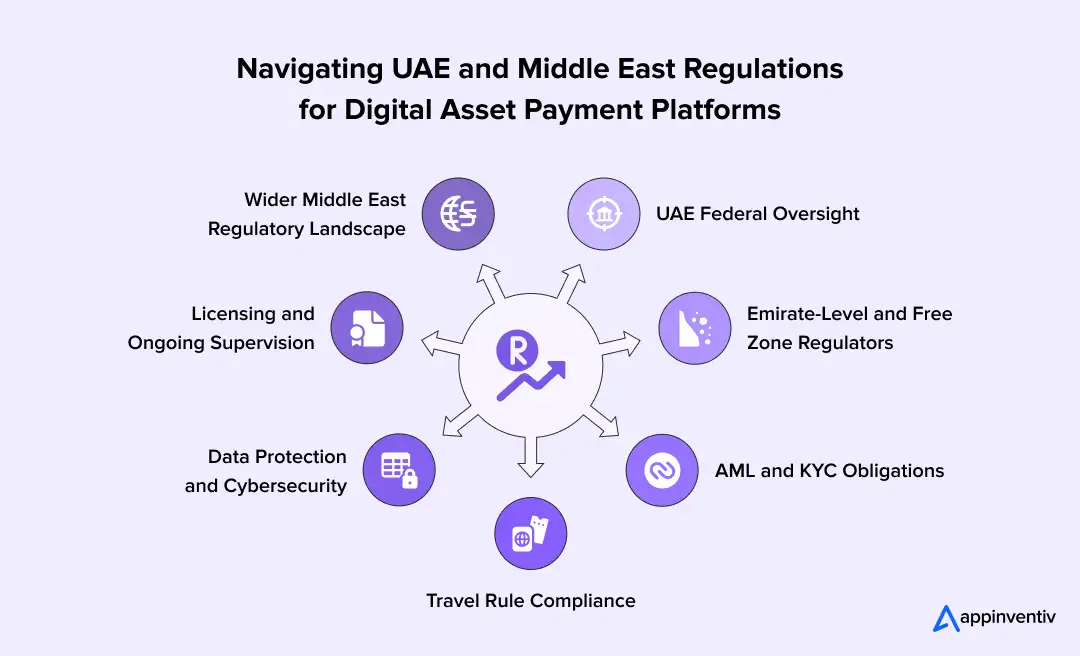
For companies focused on crypto payment gateway development in the UAE, compliance defines market access and product scope. The regulatory structure is layered across federal authorities and financial free zones, and each layer carries licensing, reporting, and governance obligations that directly shape platform design.
UAE Federal Oversight
The Central Bank of the UAE (CBUAE) regulates payment systems and introduced the Payment Token Services Regulation for stablecoins used in payments. It sets licensing requirements, capital standards, safeguarding rules, and operational controls for payment token providers.
The Securities and Commodities Authority (SCA) supervises crypto assets classified as securities. Where tokens function as investment instruments, disclosure, conduct, and investor protection rules apply.
Emirate-Level and Free Zone Regulators
Dubai’s Virtual Assets Regulatory Authority (VARA) licenses and supervises virtual asset service providers operating outside DIFC. Its scope includes exchanges, broker-dealers, custody, and certain payment activities. The VARA compliance requirements for blockchain or crypto payment platforms include prior approval, capital adequacy, governance standards, and ongoing reporting.
Within Abu Dhabi Global Market, the Financial Services Regulatory Authority (FSRA) regulates exchanges and custodians under a structured digital asset regime, with prudential, cybersecurity, and client asset protection obligations.
In DIFC, the Dubai Financial Services Authority (DFSA) oversees recognized crypto and investment tokens. Licensing applies where gateway activity intersects with regulated financial services.
AML and KYC Obligations
The UAE’s AML framework, aligned with FATF standards, applies fully to crypto payment operators. Firms must conduct customer verification before onboarding and apply enhanced due diligence for higher-risk profiles.
Ongoing transaction monitoring, sanctions screening, suspicious transaction reporting, and record retention are mandatory. These controls are central to operating a compliant crypto payment gateway UAE regulators will approve.
Travel Rule Compliance
Where thresholds apply, providers must comply with FATF Travel Rule requirements. Originator and beneficiary data must be collected and transmitted securely for qualifying transfers. Systems must support compliant information exchange between counterparties.
Compliance teams should monitor cross-border transfers, retain standardized reporting formats, and ensure alignment with regulator-specific thresholds across UAE jurisdictions. Failure to operationalize Travel Rule workflows can result in licensing scrutiny or transaction restrictions.
Data Protection and Cybersecurity
The UAE Personal Data Protection Law governs personal data handling. Platforms must implement encryption, access controls, incident response protocols, and audit logging. Cybersecurity governance is a supervisory expectation, not a discretionary safeguard.
Data localization considerations, secure cloud configurations, and defined data retention policies must be documented and defensible during regulatory reviews. Digital immunity through cyber resilience is evaluated as part of operational soundness, not merely IT hygiene.
Licensing and Ongoing Supervision
Regulated entities must secure licensing before launch. Senior management may be subject to fit and proper assessments. Periodic reporting, compliance attestations, and independent audits may follow.
Material changes in ownership or business model typically require regulatory notification. Internal compliance oversight is expected.
Wider Middle East Regulatory Landscape
In Saudi Arabia, the Saudi Central Bank (SAMA) licenses payment service providers and operates a regulatory sandbox, with strict AML and counter-terrorist financing controls. Bahrain’s Central Bank of Bahrain (CBB) regulates crypto assets under its Volume 6 Rulebook, imposing capital, governance, and client asset segregation standards.
Within the Qatar Financial Centre, the QFC Regulatory Authority supervises licensed digital financial services and enforces AML compliance within defined boundaries.
Crypto Payments in Action: Use Cases and Industry Examples
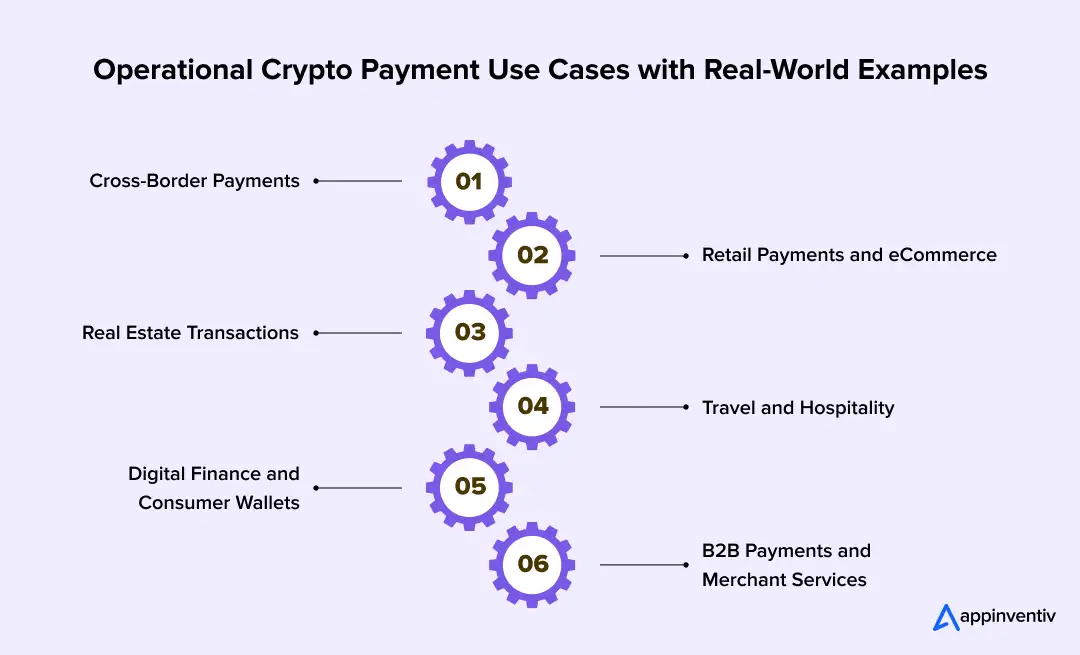
Crypto payment gateway development in the UAE is moving from experimentation to real-world adoption across the UAE and the Middle East, enabling faster and transparent transactions for businesses and consumers.
Cross-Border Payments
The cross-border transfer is sluggish and costly due to middleman banks and exchange rates. Crypto gateways simplify these payments by using stablecoins or regulated digital assets, which offer near-instant settlement and lower transaction costs.
Indicatively, Network International, which is a Fortune 500-supported FinTech, has adopted crypto rails to support global settlements of businesses operating in the UAE. Their system allows companies to transfer money to associates or suppliers overseas without paying a lot of banking charges, and this saves a lot of time.
Retail Payments and eCommerce
Crypto gateways are used to expand payment options for retailers and e-commerce platforms. This will enable the customers to use stablecoins or cryptocurrencies to pay and still keep the card and wallet services.
Noon Pay, backed by major UAE investors, is integrating a crypto payment gateway development Dubai to enable online shopping in digital assets. Users will be able to pay in digital currency, providing flexibility for tech-savvy consumers and reaching a rapidly expanding number of crypto users in the region.
Also Read: Cost to Develop an eCommerce App Like Noon
Real Estate Transactions
There are usually cross-border clients and complicated banking procedures with property purchases. Crypto payments make transactions easier, and international buyers can pay without delays or currency conversion issues.
Emirates NBD’s FinTech projects are currently accepted by developers in Dubai for property purchases using stablecoins. This is a method of reducing transaction friction, accelerating settlements, and attracting foreign investors who favor using digital assets for payments.
Travel and Hospitality
Reservation of flights, hotels, or tours across borders is usually associated with currency exchange costs and processing delays. Travelers can pay immediately with digital assets, enhancing the convenience and efficiency of the payment process via crypto payment gateways.
Premises that are related to Flydubai Pay incorporate crypto ticket and hotel bookings. Tourists and business travelers can make purchases using stablecoins or common cryptocurrencies, bypassing conversion costs and time waste, and enriching the travel experience.
Digital Finance and Consumer Wallets
Digital wallets like Payit use cryptocurrency gateways to enable users to pay bills, transfers, and tokenized loyalty or subscriptions. This will enhance the acceptance of digital assets in everyday financial operations.
ADIB has introduced digital wallet options that allow clients to pay for utilities and subscriptions, and to transfer money internationally using crypto. This functions as a robust crypto payment processing solution for UAE businesses, supporting buy-now-pay-later services and tokenized loyalty programs.
B2B Payments and Merchant Services
Companies need an efficient way to process payments through invoicing and clear cheques to merchants. A crypto payment gateway can bridge tokenized transactions to fiat accounts, enhancing liquidity management and transparency.
The Mashreq NeoBiz, an institutional investor-sponsored UAE FinTech platform operated by Mashreq Bank, invoices via crypto payment gateways in B2B. Firms can pay bills using stablecoins as the system balances payment with the traditional bank, lowers transaction fees and enhances visibility of cash flows.
These use cases demonstrate that crypto payment gateway development in UAE and Dubai is actively solving real business problems. These platforms are increasingly becoming part of the retail, enterprise, and cross-border financial activities by integrating speed, transparency, and compliance.
Also Read: Cost to Build a Digital Banking App Like Mashreq NEOBiz
How to Build a Crypto Payment Gateway in the UAE
Building a crypto payment gateway in the UAE requires coordinated execution across regulation, banking integration, and technical architecture. The process is structured. Skipping steps creates licensing delays or operational risk.
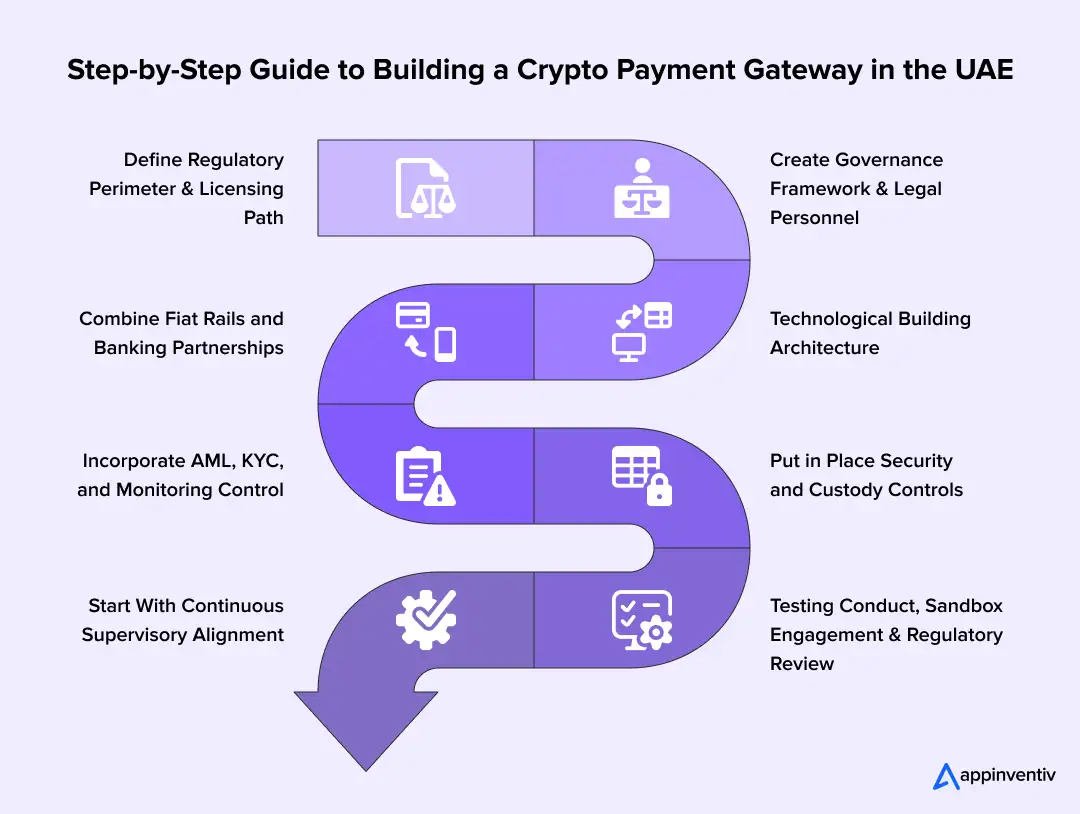
Define Regulatory Perimeter and Licensing Path
Start with a regulatory classification exercise. Establish which activity constitutes Central Bank of the UAE Payment Token Services Regulation, VARA supervision in Dubai or FSRA regulations in ADGM.
The capital requirements, services that can be conducted, scope of reporting and governance are determined by the licensing category. Technical deployment must be structured beforehand in the law.
Create Governance Framework and Legal Personnel
Incorporate under the right jurisdiction and appoint senior management that meets the fit and proper criterion. The regulators anticipate documented compliance policies, risk schemes, in-house controls, and an independent compliance role prior to approval.
Technological Building Architecture
Use an API-first architecture that is capable of supporting multi-chain transactions and settlement of stablecoins. Develop wallet management modules, blockchain monitoring modules, transaction reconciliation module, and real-time reporting module. To minimize operational risk, the system should divide custody, transaction processing and compliance layers.
Combine Fiat Rails and Banking Partnerships
Establish trustworthy relations with licensed banking partners to allow on-ramp and off-ramp. Reconciliation of crypto transactions against the fiat accounts should be done in real-time. The liquidity management systems should deal with fluctuations and differences in settlement dates.
Incorporate AML, KYC, and Monitoring Control
Introduce identity check processes at the onboarding stage. Combine sanctions screening, transaction monitoring engines and suspicious activity reporting mechanisms. Data handling in Travel Rule data should be supported where necessary. The logic of compliance should be operating and not a batch review mechanism.
Put in Place Security and Custody Controls
Implement physical encryption of data at rest and data in transit. Employ secure key management procedures and, where applicable, multi-party computation or regulated custody solutions. Have unchangeable audit logs and monitoring of access to all system layers.
Testing Conduct, Sandbox Engagement and Regulatory Review
Join regulatory sandbox initiatives in case they exist, including those conducted by the UAE authorities. Conduct stress testing, security testing and third-party audits prior to commercial introduction. Supervisory approval can be subject to the display of operational preparation.
Start With Continuous Supervisory Alignment
After licensing, ensure that there is orderly reporting, compliance certifications and review of risks. Keep track of the regulatory circulars and revise policies in time. In the UAE, the evolution of products and regulatory dialogue usually occurs in parallel to each other.
Building a crypto payment gateway in the UAE is not necessarily a technical task. It is a regulated, monetary and architectural project. Companies that coordinate licensing, infrastructure and compliance upfront are in a better position to scale in a regulated digital payment environment.
Let us guide you through each step to create a reliable, market-ready solution

How Much Does it Cost to Build a Crypto Payment Gateway in the UAE?
Development of a crypto payment gateway is a variable cost that may cost a lot depending on scope, regulatory preparedness, security requirements, and complexity of integration. The basic solutions in the UAE market range from AED 500,000 to AED 1,200,000 ($136,000- $327,000).
Further, higher-performance and more enterprise-oriented platforms, including banking-integrated, multi-chain, and compliance-automatable platforms, may cost between AED 1,200,000 to AED 3,000,000 and beyond (approximately $327,000- $817,000 and above).
Here are some of the factors influencing the overall cost of crypto payment gateway development in UAE:
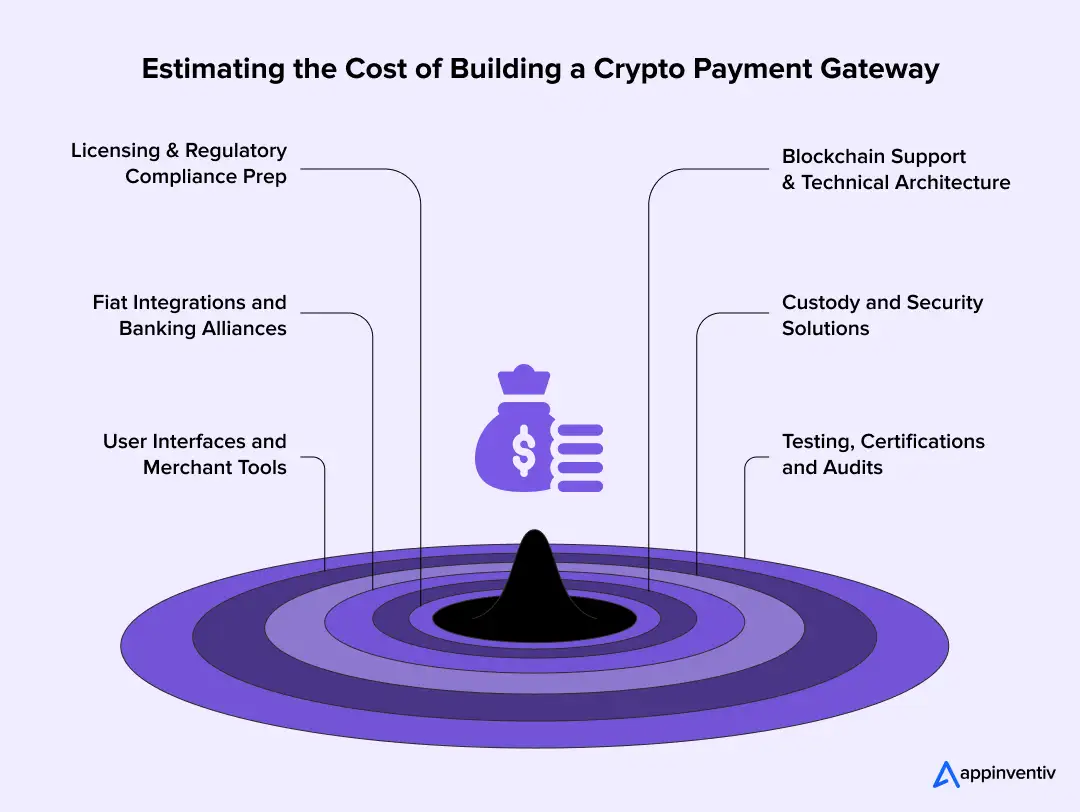
Licensing and Regulatory Compliance Prep
To create a compliant crypto payment gateway UAE, an architecture that will be built must be based around AML/KYC, sanctions screening, audit logging, and Travel Rule support. It is more expensive to implement compliance checks in the primary working process and to generate documents to submit to licensing bodies such as VARA or FSRA.
Blockchain Support and Technical Architecture
An entry-level gateway supporting one or two blockchains will be cheaper than a multi-chain one. The complexities and supplementary hours in development are added by adding stablecoin settlement, wallet management, and reconciliation modules.
Fiat Integrations and Banking Alliances
Real-time settlement systems and enterprise ERP systems are both expensive to connect to local banking rails. Custom middleware and security measures are needed in order to integrate with acquiring banks and payment switches.
Custody and Security Solutions
Enterprise-grade encryption technology, multi-party control (MPC or HSM-based) keys and third-party custody are vital in securing digital assets. All these elements increase initial and operational costs. Other factors to consider include disaster recovery arrangements, secure backup measures, multi-layer authentication, and compliant audit trails, which are more secure but require specialized skills.
User Interfaces and Merchant Tools
Front-end development and UX design are needed on custom merchant dashboards, reporting portals, and developer APIs. It becomes complicated when integrated with POS or e-commerce systems or even mobile applications, and it needs constant maintenance. Additional functions, such as real-time analytics and multi-currency, are also expensive to design, test, and maintain.
Testing, Certifications and Audits
Penetration testing, stress testing and independent security audits are required to make the gateway production-ready. It might also be mandatory to participate in regulatory sandboxes or certification programs. These activities not only raise initial spending but also give confidence to partners, regulating bodies and end-users that the platform has been built to standards of operation, security and compliance.
Also Read: Cost to Develop a Crypto Payment Gateway like BitPay
Future Outlook: What’s Next for Crypto Payments in the UAE?
UAE is no longer in pilot projects and initial exploration. The current state of crypto payments is functioning in a specific regulatory framework, and the next step will be related to an institutional scale, interweaving with banks and the infrastructure of sovereign digital currencies.
As blockchain payment gateway development UAE accelerates, platforms will need to balance innovation with regulatory precision.
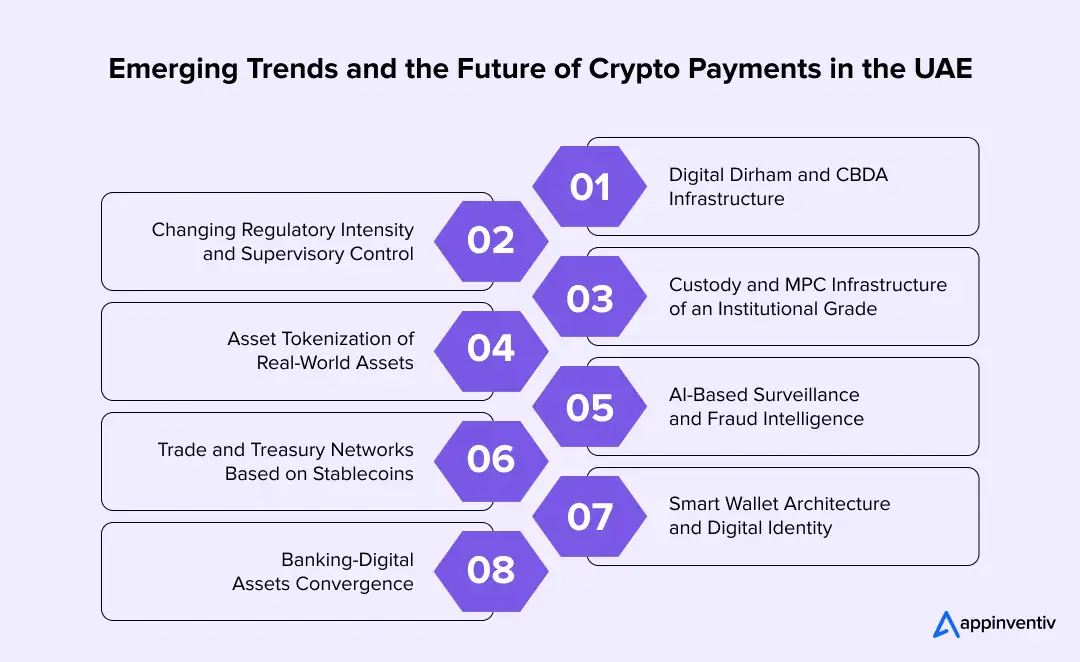
Digital Dirham and CBDA Infrastructure
The Digital Dirham project initiated by the Central Bank will change both local and international settlements. A retail and wholesale CBDC system can decrease the time between clearing, decrease remittance, and legitimize blockchain innovation and settlements into the national payment system. Next-generation gateways will require the connectivity of CBDCs, stablecoins and traditional banking rails.
Changing Regulatory Intensity and Supervisory Control
The regulators are also likely to bring in more specific operational requirements, including custody controls, reserve disclosure, reporting level and capital protection. The fast adjustment of revised compliance with VARA to platforms providing crypto payments is going to be an ongoing burden instead of a licensing achievement.
Custody and MPC Infrastructure of an Institutional Grade
HSM, MPC, and SC models will become the norm. Competitive platforms will be characterized by insured storage, real-time risk monitoring, and audited control environments as institutional capital gets into the ecosystem.
Asset Tokenization of Real-World Assets
Sukuk instruments, commodities, and tokens in private equity are attracting policy interest. Instead of being simple transaction-processing tools, payment gateways will become tokenized asset settlement systems that will require integration with smart contracts, identity-based wallets, and on-chain reporting.
Smart Wallet Architecture and Digital Identity
Decentralized identity systems and programmable wallets can simplify the onboarding process without reducing regulatory visibility. The biometric authentication and tokenized credentials may help cut down the friction without affecting auditability.
For Slice, a fractional real estate investment platform in the UAE, our experts at Appinventiv engineered the launch-ready financial core. This included a multi-wallet system for users and properties, automated dividend calculation and distribution, and an admin panel to manage transactions. The result is a secure, scalable backend ready for market deployment.
Partner with us to design your FinTech platform with the same market-ready architecture

AI-Based Surveillance and Fraud Intelligence
AI innovations in Dubai will be at the center of transaction surveillance. Real-time AML scoring, anomaly detection, and automated suspicious activity reporting will assist the platforms in handling increased levels of transaction volumes without compromising compliance levels.
Trade and Treasury Networks Based on Stablecoins
Considering the fact that the UAE is a regional and trading hub, the settlement of B2B transactions and treasury operations via stablecoins will continue to grow. The use of multi-currency liquidity pools and automatic FX will enable quicker regional trade routes in GCC, Asia, and Africa.
Banking-Digital Assets Convergence
Digital asset capacity is gradually increasing in traditional financial institutions. Eventually, crypto gateways and banking APIs will merge, with digital assets and fiat accounts managed by the same treasury and settlement system.
Build a Future-Ready Crypto Payment Gateway with Appinventiv in the ME
With the pace of crypto adoption growing in the market and the regulatory environment still undergoing additional improvements, the future of digital payments in the UAE will be tied to the need to have a secure, flexible, and fully compliant infrastructure. Blockchain payment gateway development UAE does not rely on the speed of transactions anymore to be successful.
Platforms should also be connected and have stringent monitoring controls, and should develop in alignment with the standards of VARA compliance of crypto payment platforms. Scalability and supervision are now together.
As a reputed blockchain development company in the UAE, Appinventiv has a key role to play in facilitating this change. We develop and build FinTech operating systems that are under regulatory environments and technical standards.
In the case of Edfundo, a financial literacy application targeting young people in the UAE, our experts at Appinventiv established a secure mobile ecosystem comprising interactive learning modules and prepaid card services, supplemented by parental controls. Our efforts facilitated flawless card integrations, user-friendly workflows, and a scalable back end that positioned the platform for initial funding and local expansion.
For Slice, a real estate investment platform, we developed a powerful backend that supports fractional ownership, digital wallets, automated dividend payments, and secure transaction processing.
The regulatory trend is apparent, and market adoption is on the rise. Architectural discipline is what will make durable platforms and short-lived experiments different. The UAE requires crypto payment compliance foresight, banking interoperability, and infrastructure that can sustain the level of transactions and regulatory oversight.
This is the step to establish a crypto payment gateway in the Middle East, either planned for launch or in the process of modernization. Get in touch with us to evaluate your technical and regulatory roadmap and proceed with clarity.
FAQs
Q. Is crypto payment legal in the UAE?
A. Crypto payments are legal in the UAE, but they are regulated. The activities of virtual assets are regulated by such authorities as VARA in Dubai and the Central Bank of the UAE. Cryptocurrencies allow businesses and consumers to conduct transactions, though it is necessary to comply with AML/KYC regulations and receive approvals from the corresponding regulatory authorities.
Q. What is VARA regulation for crypto payments?
A. Crypto service providers are regulated by the Virtual Assets Regulatory Authority (VARA) in Dubai. A VARA-compliant crypto payment platform would guarantee that all the transactions of the virtual assets are approached in accordance with the requirements of licensing, governance, AML, and KYC.
The framework encompasses exchanges, wallets, custodial operations, and payment-related operations, which foster transparency, consumer protection and operational integrity in the regulated ecosystem of Dubai.
Q. Do crypto payment gateways require a license in Dubai?
A. Yes, all crypto payment platforms operating in Dubai must meet licensing requirements for crypto payment gateway in the UAE. Depending on the jurisdiction, licenses are issued either by VARA or by the free zone regulators, such as DFSA/FSRA.
Q. What is the difference between custodial and non-custodial crypto gateways?
A. Custodial gateways are in charge of the management of the private keys of users and storing digital assets on behalf of customers. They deal with security and wallet handling, and execution of transactions, which are convenient but with high regulatory requirements and risk management.
Non-custodial gateways, on the other hand, allow users to manage their own keys. The transactions are made directly with the user’s wallet, eliminating the risks of intermediaries but leaving the responsibility for security with the user. These gateways are generally transaction process ones that do not store money.
Q. How to integrate AML in crypto payment systems?
A. Here’s how you can integrate AML in crypto payment systems:
- Introduce identity verification (KYC) in the process of onboarding
- Check the customers against the sanctions and PEP lists
- Monitor transactions with suspicious patterns with automated tools
- Raise a flag and inform regulators about suspicious activity
- Keep records of transactions together with audit trails to verify compliance
Q. Which blockchain is best for payment gateway development?.
A. The optimal blockchain is one that relies on the speed, cost, and security specifications. Ethereum 2.0 is popular for tokenized assets, whereas Solana and Polygon offer fast, inexpensive transactions.
For stablecoins or cross-border payments, Binance Smart Chain and Stellar are very popular. Scalability and payment flexibility are often cited as reasons to use these blockchain platforms for payment support.
Q. How long does it take to develop a crypto payment platform?
A. Development timelines for crypto payment gateway development in the UAE typically range from 4 to 9 months for a standard solution. The timeline can be increased by complexity, multi-chain integration, regulatory compliance, wallet modules and banking connections. Enterprise-grade multi-jurisdictional, advanced-analytics, and security platforms can take 10-12 months to roll out.

- In just 2 mins you will get a response
- Your idea is 100% protected by our Non Disclosure Agreement.
Crypto Banking Software Development: Core Architecture for Digital Asset Banking
Key takeaways: Crypto banking software bridges traditional finance and digital assets, enabling banks to offer secure, compliant, and scalable crypto services. Modern crypto banking platforms feature robust custody, multi-asset wallets, real-time compliance, and seamless blockchain integration. Adopting crypto banking solutions accelerates cross-border payments, reduces costs, and enhances financial inclusion. Security, regulatory compliance, and modular architecture…

Step-by-Step Guide to Crypto Trading Bot Development in 2026
Key takeaways: Crypto trading bot development in 2026 functions as full-scale trading systems, not experimental scripts. They require the same engineering discipline as any financial platform. Execution quality drives results more than strategy logic. Latency control, order handling, and risk limits shape real-world performance. AI-based strategies work only when supported by reliable data flows, controlled…

Decentralized Exchange (DEX) Development: Features, Implementation Cost, and Enterprise ROI
Key Takeaways The development of a decentralized exchange will enable businesses to provide secure and user-controlled trading, improve transparency, and minimize the use of intermediaries. The cost of DEX development can vary depending on the platform's features, the chosen network, and regulatory requirements, and the approximate cost is about $50,000, with higher costs for customization,…









