

























IoT in Wearables: An Enterprise Guide to Architecture, Integration, and Scalable Deployment


- Enterprise Expansion of IoT Wearables
- Key Components and Functionality of Wearables in IoT
- Architecture Deep Dive: How IoT Wearables Work
- Benefits of IoT Wearables for Enterprises
- IoT Wearables in Healthcare: Core Enterprise Adoption
- Wearables IoT Applications Beyond Healthcare
- Wearable Devices Examples in Real-World Enterprise Use
- AI Integration With Wearables IoT
- Challenges of Wearable IoT Devices
- From Concept to Consumer: Enterprise Development Roadmap
- Build vs Buy vs Partner: Choosing the Right Approach for Enterprise IoT Wearables
- Future of IoT and Wearables in Healthcare
- Why Enterprises Partner With Appinventiv for Wearable Solutions
- Frequently Asked Questions

Key Takeaways
- IoT wearables are shifting from pilot projects to enterprise infrastructure across the healthcare, industrial, and logistics sectors.
- Secure integration, compliance readiness, and data architecture determine wearable success more than device hardware alone.
- Continuous wearable data enables predictive healthcare, workforce safety optimization, and new enterprise operational intelligence capabilities.
- AI-driven analytics are transforming wearable data into actionable insights, improving decision-making across multiple enterprise functions.
- A strategic implementation roadmap is critical for scaling wearable solutions from the concept stage to enterprise-grade deployment.
Most teams exploring IoT in wearables are past the curiosity stage. The conversations now sound more practical. Someone asks how reliable the device data really is. Another person brings up compliance. Then the discussion turns to integration, budgets, and timelines. That shift usually signals the move from experimentation to serious deployment.
IoT wearable technology has quietly become part of enterprise infrastructure. Hospitals use smart wearable IoT devices to track patients’ vital signs outside clinical settings. Industrial firms monitor worker safety conditions in real time. Insurance providers analyze behavioral data to refine risk models. These are not pilot ideas anymore. They are operational systems feeding live enterprise data streams.
If your organization is evaluating smart IoT wearables, the technical questions start stacking up quickly. How will the device connect securely? Where will the data be processed? Can it integrate with existing enterprise platforms without creating another silo? And just as important, how will you maintain accuracy, battery efficiency, and regulatory compliance once these devices scale?
This is where many initiatives slow down. Building Internet of Things wearables for enterprise use is not just about sensors or apps. It involves architecture decisions, data governance, lifecycle planning, and alignment with real business outcomes. The sections ahead break down what it actually takes to move from early concept to enterprise-ready wearable IoT devices that deliver measurable value rather than just interesting data.
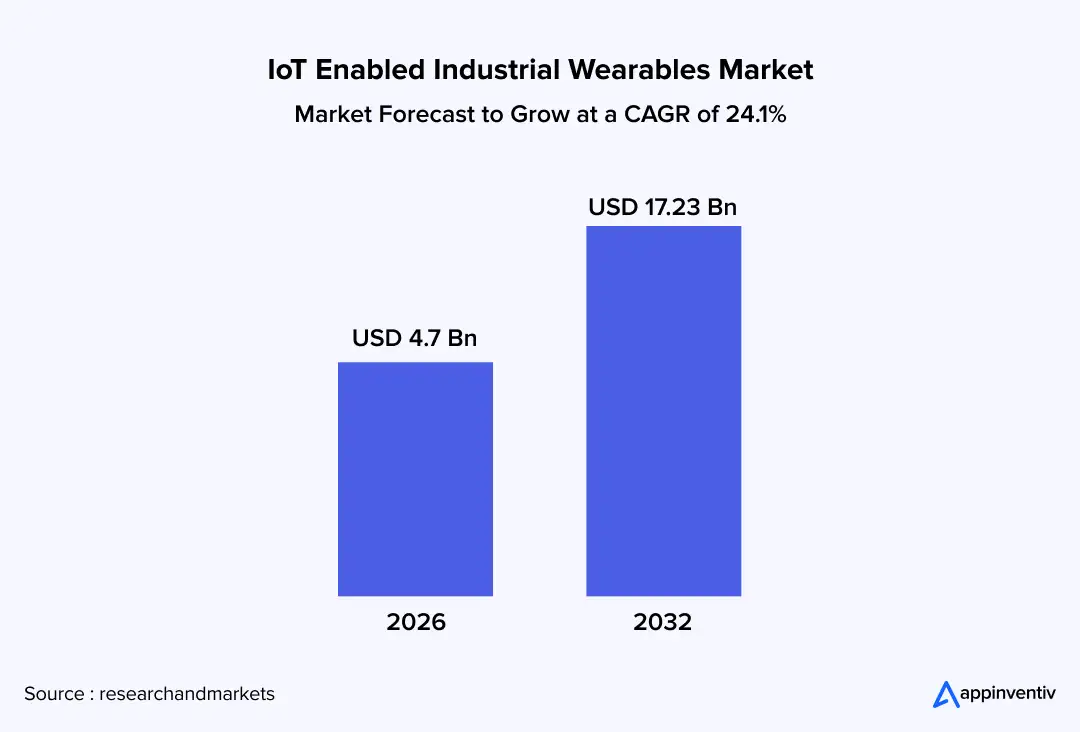
The IoT-enabled industrial wearables market is projected to reach $4.70 billion globally in 2026.
Enterprise Expansion of IoT Wearables
Most enterprise wearable initiatives do not begin with a grand rollout. They usually start with a focused operational need. A hospital team pilots remote vitals monitoring after discharge. A manufacturing unit tests fatigue detection bands during late shifts. The pilot works, data flows reliably, and expansion quickly becomes a serious discussion.
Across the U.S., IoT in wearables is transforming industries from experimentation to enterprise infrastructure. Healthcare is leading this shift. IoT wearables in healthcare now feed continuous biometric data into clinical platforms using BLE or cellular IoT connectivity, often integrating directly with EHR systems through FHIR-based APIs. That allows care teams to monitor chronic conditions without relying only on in-person visits.
Other industries are expanding IoT deployment in enterprise environments as well:
- Manufacturing uses smart wearable IoT devices with environmental sensors and edge processing for real-time safety alerts
- Logistics firms combine GPS, biometric sensors, and LPWAN connectivity to track driver fatigue and exposure risks
- Insurance providers analyze long-term behavioral datasets generated by Internet of Things wearables for underwriting insights, similar to how IoT is used in banking and finance.
- Scaling these systems introduces technical complexity that your team will need to plan for early.
Key architecture considerations include:
- Secure device identity using certificate-based authentication
- Edge filtering to reduce latency and bandwidth load befvfore cloud ingestion
- Encrypted data transmission with TLS or DTLS protocols
- Scalable ingestion pipelines using event streaming platforms like MQTT brokers or Kafka that deliver the benefits of IoT connectivity solutions
- Integration layers connecting wearable data to enterprise analytics, EHRs, or operational dashboards
Compliance adds another dimension. HIPAA-aligned encryption, audit logging, and strong access control models often shape architecture decisions from the very first prototype. Broader market dynamics also reflect this shift. The IoT-enabled industrial wearables market is projected at about $4.70 billion in 2026 and is expected to reach roughly $17.23 billion by 2032, showing how quickly enterprise adoption is expanding.
When smart IoT in wearables integrates cleanly with enterprise platforms, they stop feeling experimental. They start functioning as dependable operational inputs that support clinical, safety, and business decisions instead of simply generating isolated data streams.
Key Components and Functionality of Wearables in IoT
When teams first prototype IoT wearable devices, attention usually goes straight to the hardware. Someone is validating sensor accuracy, and another engineer is testing connectivity stability. During one hospital pilot, for example, early heart rate readings kept fluctuating until firmware filtering was adjusted. That moment usually shifts the focus from the device itself to the full architecture behind it.
Understanding the key components and functionality of wearables in IoT helps prevent those early surprises. Enterprise deployments depend on multiple interconnected layers working reliably together.
Hardware and Sensor Layer
This layer captures raw physical or biometric data and prepares it for processing. This is where data originates. Typical components include:
- Biometric sensors tracking heart rate, SpO2, ECG, temperature, or motion
- Environmental sensors measuring humidity, gas exposure, or workplace conditions
- Embedded microcontrollers running firmware and managing power consumption
Firmware design often determines accuracy. Sampling frequency, filtering logic, and battery optimization all affect performance.
Modern enterprise wearables increasingly rely on sensor fusion rather than single sensor inputs. Combining accelerometer, gyroscope, biometric, and environmental data often improves accuracy and reduces false alerts, especially in safety monitoring and healthcare tracking scenarios.
Connectivity Stack
This layer ensures consistent, secure transmission of wearable data to enterprise systems. Data movement must remain stable across environments. Common connectivity options include:
- Bluetooth Low Energy for short-range, low-power transmission
- LTE-M or NB-IoT for wide area cellular coverage
- Wi-Fi where higher throughput is required
Connectivity Protocol Comparison Table
| Protocol | Typical Range | Power Use | Best Enterprise Use Case |
|---|---|---|---|
| BLE | Short range | Very low | Clinical wearables, indoor industrial monitoring |
| NB-IoT | Wide area | Low | Remote patient monitoring, asset tracking |
| LTE-M | Wide area | Moderate | Mobile workforce monitoring, logistics |
| LoRaWAN | Long range | Very low | Industrial sites, environmental sensing |
Edge gateways frequently aggregate device data, handle authentication, and reduce latency before cloud ingestion.
Data Infrastructure and Analytics Layer
This layer converts device signals into usable insights through scalable data processing. Once data leaves the device, scalability becomes essential. Typical infrastructure includes:
- MQTT brokers or event streaming pipelines for ingestion
- Edge analytics to filter noise and reduce bandwidth load
- AI inference pipelines supporting anomaly detection or predictive alerts through IoT data analytics
This stage often determines whether Internet of Things wearables produce actionable intelligence or just raw data.
Enterprise Application Layer
This layer integrates wearable data into operational workflows and business systems. Here is where business value becomes visible:
- Real-time dashboards for clinicians, safety teams, or operations managers
- API integrations with EHR, ERP, or analytics platforms during wearable application development
- Automation triggers generating alerts, workflows, or compliance reports
When these layers connect smoothly, IoT wearable devices move from experimental technology to reliable enterprise intelligence tools.
Architecture Deep Dive: How IoT Wearables Work
Most teams don’t run into problems with the device first. Issues usually appear once data begins moving through the system. In one remote monitoring rollout, readings were accurate, but alerts arrived late because an edge gateway buffered data longer than expected. A small configuration detail affected clinical response time. This pattern appears frequently in IoT wearable deployments.
If you are looking at how IoT in wearables works at an enterprise level, the architecture matters more than the gadget.
Sensor Capture
Reliable wearable data starts with calibrated sensors, stable firmware, and consistent sampling logic.
Smart wearable IoT devices use biometric sensors such as ECG electrodes, photoplethysmography sensors for heart rate, temperature probes, or accelerometers. Firmware manages sampling rates, signal conditioning, and local storage. Even small firmware tuning changes can affect accuracy, battery life, and downstream analytics quality.
Edge Processing
Local processing reduces latency, bandwidth usage, and unnecessary cloud load.
Modern smart IoT wearables often include edge computing capabilities. Microcontrollers or gateways handle noise filtering, data compression, and threshold detection. Some deployments run lightweight ML inference models locally to flag anomalies before transmission, IoT in healthcare, which can mean earlier detection of irregular vitals.
Connectivity Transmission
Secure, resilient connectivity keeps enterprise wearable systems reliable.
BLE works well for short-range communication with mobile hubs. LTE-M and NB-IoT support low-power wide-area connectivity. Wi-Fi handles higher throughput scenarios. Security protocols like TLS encryption, certificate-based authentication, and device identity management protect sensitive health or operational data.
Cloud Analytics
Scalable ingestion and analytics transform wearable data into usable insights.
Data pipelines typically use MQTT brokers, REST APIs, or event streaming platforms. Storage layers support time series processing, while AI models perform anomaly detection, predictive analytics, or trend analysis. This stage often defines whether wearable data produces operational intelligence.
Enterprise Integration
Enterprise integration determines whether wearable data drives decisions or just accumulates.
Standards like FHIR, HL7 messaging frameworks, and secure RESTful APIs often determine whether wearable data integrates smoothly with clinical systems. Interoperability planning usually becomes as critical as device engineering in healthcare deployments.
FHIR APIs often connect IoT wearables in healthcare with EHR systems. Other deployments integrate with ERP platforms, workforce safety dashboards, or insurance analytics tools. When integration works smoothly, wearable infrastructure becomes part of operational decision-making rather than a standalone data stream.
In our experience working on enterprise wearable deployments, latency rarely comes from the sensor itself. It usually shows up at the edge gateway or ingestion pipeline stage. Small configuration adjustments, especially around buffering and transmission intervals, often make a measurable difference in response time.
Benefits of IoT Wearables for Enterprises
Most enterprise teams don’t get excited about the device itself for very long. The novelty fades quickly. What keeps the discussion alive is whether the data actually helps operations run better. In one safety deployment review, the conversation shifted away from sensors toward fewer delayed incident reports and clearer visibility into worker conditions.
That is usually where the benefits of IoT wearables start showing up in practical terms.
Predictive Healthcare Insights
Continuous data helps clinicians notice patterns earlier. Smart wearables IoT setups often stream patient vitals into monitoring systems around the clock. For chronic care or recovery monitoring, this steady flow can highlight subtle changes that occasional checkups might miss.
Safety Risk Reduction
Real-time data supports faster intervention. Smart wearable IoT devices in industrial environments can track fatigue indicators, heat exposure, or movement irregularities. Alerts coming in early give supervisors time to act before problems escalate.
Operational Productivity Gains
Better data visibility usually improves coordination. Field operations, logistics teams, and clinical staff sometimes use wearable inputs to understand workflow bottlenecks. It is rarely dramatic, yet incremental efficiency gains add up.
Compliance Automation
Automatic logging reduces manual reporting burden. Many enterprises use wearables to capture safety or health data continuously. That information can feed compliance documentation without additional manual entry.
Data Monetization Potential
Some organizations find secondary value in aggregated insights. When privacy safeguards are respected, anonymized wearable datasets may support wellness programs, insurance modeling, or operational analytics initiatives. Over time, following emerging IoT trends, the data itself can become as valuable as the device generating it.
Wearable insights require a secure architecture, integrated planning and scalable analytics infrastructure.

IoT Wearables in Healthcare: Core Enterprise Adoption
Most healthcare teams do not start with the device. They start with a care gap. Remote monitoring backlogs, delayed follow-ups, or limited visibility into patient recovery usually trigger the first wearable discussions.
In some hospitals, overnight cardiac data is now reviewed digitally during rounds, whereas previously it required multiple visits or manual reporting.
That shift explains why wearable technology in healthcare is moving from pilot programs to operational infrastructure.
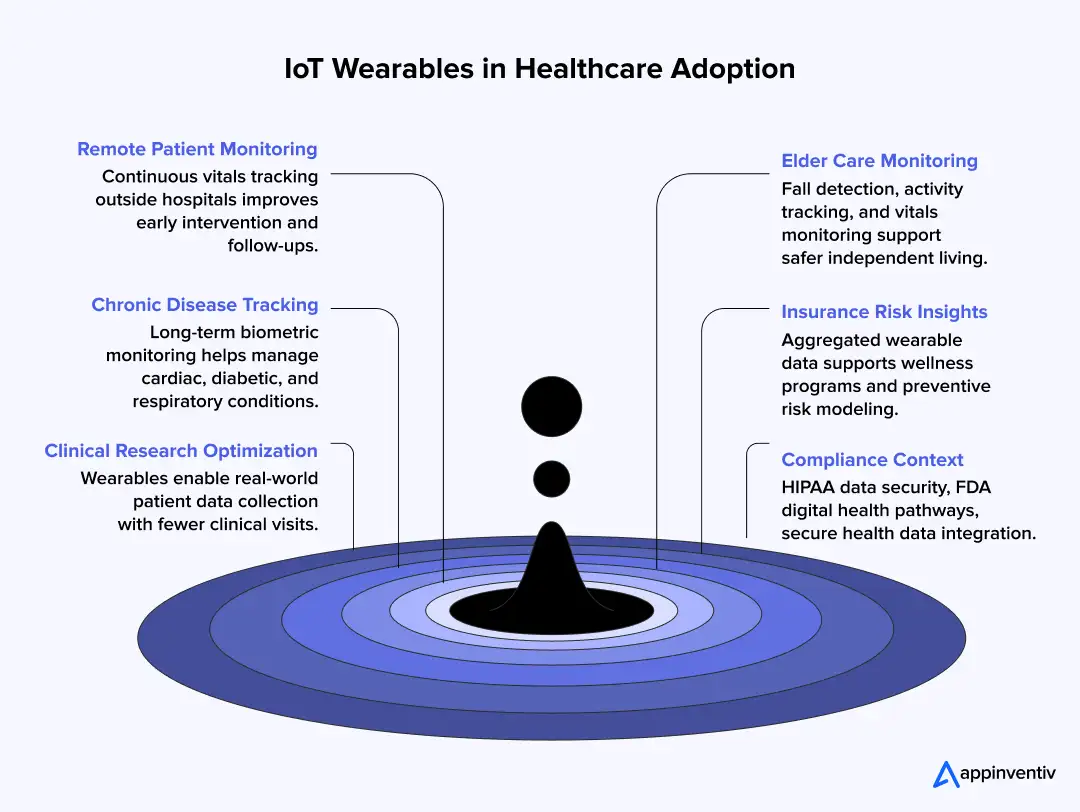
Remote Patient Monitoring
Continuous vitals streaming helps clinicians act sooner, not later. IoT wearables for health often combine biometric sensors, mobile gateways, and cloud ingestion pipelines. Typical technical elements include:
- Bluetooth Low Energy transmission from wearable to mobile hub
- Secure API ingestion using FHIR-compatible healthcare interfaces
- Real-time alert thresholds configured through clinical dashboards
The technology is straightforward. Reliability and integration are what usually take time.
Chronic Disease Tracking
Longitudinal data changes how chronic conditions are managed. Smart wearable IoT devices increasingly support:
- ECG signal capture with onboard filtering algorithms
- Continuous glucose monitoring linked to cloud analytics platforms
- Oxygen saturation tracking with edge-level preprocessing
This steady data flow helps clinicians see trends instead of isolated readings.
Clinical Research Optimization
Wearables reduce friction in real-world clinical data collection. Research teams often use IoT and wearables in healthcare to:
- Stream anonymized patient telemetry into secure research environments
- Capture higher frequency data without extra clinic visits
- Improve trial adherence through passive monitoring
Data integrity and secure transmission protocols are key here.
Elder Care and Home Health Monitoring
Remote visibility helps balance independence and safety. Typical deployments include:
- Fall detection using accelerometer fusion algorithms
- Continuous vitals monitoring with automated alert escalation
- Integration with telehealth platforms for rapid follow-up
Battery efficiency and connectivity stability matter a lot in home settings.
Insurance Underwriting Insights
Wearable datasets are influencing preventive health strategies. Some insurers explore aggregated, consent-driven wearable data for:
- Wellness incentive modeling
- Predictive risk analytics
- Population health insights
Strict privacy safeguards and anonymization pipelines are essential.
Regulatory Context in the United States
Compliance considerations shape architecture early:
- HIPAA influences encryption, identity management, and audit logging
- FDA digital health pathways may apply if wearables function as medical devices
- Secure cloud hosting, data residency, and access governance often become board-level concerns
When IoT wearables healthcare programs align with both technical architecture and regulatory requirements, they move beyond experimentation. They become dependable clinical data sources that support real operational decisions.
In several healthcare wearable implementations, integration with existing EHR systems turned out to be the longest phase. Data standardization, API alignment, and compliance validation often take more effort than the device engineering itself.
Wearables IoT Applications Beyond Healthcare
Healthcare may dominate early adoption, but it is far from the only sector exploring wearables IoT applications. Once organizations see continuous data improving visibility, other operational teams start asking how the same approach could work for them.
In logistics environments, fatigue tracking data has highlighted patterns behind late-night delivery delays, prompting broader wearable deployment discussions across operational functions.
Below are some areas where wearable device examples are showing real enterprise value outside clinical environments.
Industrial Workforce Safety
Wearables help monitor environmental risk and worker health in real time. Typical enterprise deployments include:
- Smart helmets with gas detection and temperature sensors
- Biometric bands track fatigue, hydration, or heart rate
- Edge alerts are triggered when exposure thresholds are crossed
Connectivity usually relies on LPWAN or BLE gateways inside facilities, with cloud dashboards supporting safety teams.
Logistics and Transportation Monitoring
Driver health and environmental monitoring are gaining traction. Common implementations:
- Fatigue detection wearables for long-haul drivers
- GPS-enabled health trackers linked to fleet management systems
- Environmental exposure monitoring for hazardous transport roles, similar to applications in IoT for energy management
Stable connectivity, leveraging advances in IoT in the telecommunication industry, and battery optimization often become the biggest engineering focus here.
Defense Readiness Tracking
Operational awareness increasingly includes physiological monitoring. Some defense programs explore:
- Stress and fatigue monitoring during training
- Environmental exposure tracking in field operations
- Real-time vitals dashboards for command-level visibility
Security architecture and encrypted transmission protocols are critical in these deployments.
Retail Workforce Optimization
With IoT transforming the retail industry, wearables are slowly entering frontline retail operations. Examples include:
- Smart badges for staff location awareness
- Movement analytics supporting workflow optimization
- Health monitoring in physically demanding roles
Integration with workforce management platforms and systems like IoT in robotics determines real impact..
Sports Analytics
Performance data collection has moved beyond elite training labs. Wearable IoT deployments often include:
- Motion tracking sensors for performance analysis
- Physiological monitoring during training sessions
- Recovery analytics through continuous vitals tracking
Data interpretation usually matters more than the device itself.
Wearable Devices Examples in Real-World Enterprise Use
Sometimes, the easiest way to understand IoT in wearables is to look at where they are already working. Not prototypes, not concept decks, but actual deployments generating operational data. These wearable device examples show how different industries are using connected wearables in practical settings.
Examples worth noting:
- Healthcare monitoring wearables: Devices like Apple Watch or Fitbit track heart rate, oxygen levels, and activity data, supporting remote patient monitoring and preventive care programs.
- Industrial safety wearables: Smart helmets equipped with environmental sensors can monitor hazards and send real-time alerts to safety teams, improving worker protection.
- Fitness and wellness trackers: Wrist-worn trackers monitor activity, sleep, and vitals, often syncing with enterprise wellness platforms or insurance programs.
- Smart clothing and body sensors: Sensor-embedded garments or body-mounted devices can transmit physiological data for healthcare, sports analytics, or workplace monitoring.
These examples show a common pattern. The wearable itself matters less than how well its data connects with enterprise platforms through essential wearable device app features.
Working on wearable-connected platforms often means balancing device constraints, voice interaction design, and seamless mobile integration. Appinventiv collaborated with Innovative Eyewear to build Vyrb, a voice-first social media app designed for Bluetooth wearables. The project focused on hands-free interaction, voice messaging workflows, and wearable compatibility within a social media environment.
AI Integration With Wearables IoT
Most wearable deployments collect plenty of data. The real challenge is figuring out what to do with it. Operations teams reviewing months of wearable safety data often find patterns only after applying analytics or AI models. This is one reason enterprises are increasingly exploring AI integration with IoT wearables to turn continuous signals into actionable intelligence.
AI and wearable technology work together, AI does not replace wearable infrastructure but helps interpret the continuous signals these devices generate.
Predictive Health and Risk Insights
AI models help identify patterns that are difficult to spot manually. Common enterprise implementations include:
- Time series analysis for early anomaly detection
- Predictive risk scoring based on behavioral data
- Continuous vitals trend monitoring in IoT wearables healthcare programs
This often shifts healthcare monitoring from reactive to preventive.
Edge AI Processing
Processing data closer to the device reduces latency and bandwidth load. Typical technical approaches:
- Lightweight inference models embedded in firmware or edge gateways
- Real-time threshold detection without constant cloud transmission
- Data compression before ingestion into analytics pipelines
This becomes useful where connectivity is inconsistent or response speed matters.
Enterprises often balance edge and cloud processing depending on latency, bandwidth, and compliance needs. Edge processing supports faster alerts and reduced transmission load, while cloud analytics enable large-scale pattern detection and long-term predictive modeling.
Operational Intelligence and Automation
AI can turn wearable data into workflow triggers. Examples include:
- Automated safety alerts in industrial environments
- Workforce optimization insights in logistics or retail
- Performance analytics in sports monitoring setups
Integration with enterprise platforms determines how actionable these insights become.
Data Governance and Model Reliability
AI introduces its own operational considerations. Enterprises deploying AI with smart IoT wearables usually focus on:
- Model explainability and auditability
- Data privacy safeguards
- Continuous model retraining as data evolves
Without governance, AI insights can become unreliable quickly. When implemented carefully, AI turns wearable data into something more useful than dashboards. It becomes decision support. That shift is often what finally convinces enterprises that wearable investments are worth scaling.
Also Read: AI and IoT: Two Powerful Entities That Will Change the Way You Do Business
Challenges of Wearable IoT Devices
Most enterprise wearable projects look straightforward at the concept stage. A device collects data, sends it to the cloud, and teams act on insights. Reality tends to be messier. Connectivity fluctuations, calibration issues, or environmental factors frequently surface outside controlled environments.
These challenges usually fall into three broad areas: security, technical constraints, and enterprise integration.
Security and Privacy Considerations
Sensitive data handling makes security architecture non-negotiable. Enterprises working with IoT wearable devices, especially in healthcare, often face:
- HIPAA compliance requirements shaping storage, access, and transmission controls
- End-to-end encryption using TLS or similar protocols
- Device identity management through certificate-based authentication
- Audit logging and access governance for regulatory visibility
Security planning needs to start early. Retrofitting controls later often slows deployments.
Technical Barriers
Hardware limitations still influence reliability and user adoption. Common technical issues include:
- Battery efficiency constraints affecting continuous monitoring
- Sensor calibration challenges impacting data accuracy
- Connectivity instability across varied operational environments
- Firmware update management for distributed devices
These issues do not stop adoption, but they require ongoing engineering attention.
Enterprise Integration Challenges
Integration often determines whether wearable data becomes actionable. Organizations frequently encounter:
- Legacy system interoperability issues, particularly with older EHR or ERP platforms
- Data governance complexity when multiple data sources converge
- API standardization challenges across vendors
- Ensuring consistent data quality for analytics pipelines
Without careful integration planning, wearable initiatives risk becoming isolated data streams rather than operational assets.
Understanding these constraints early helps enterprises design more resilient wearable ecosystems. The technology is mature enough for large-scale deployment, yet successful implementation still depends on thoughtful architecture, governance, and operational alignment.
One consistent pattern we have observed is that enterprises underestimate data governance early on. Device deployment moves quickly, but aligning security policies, audit requirements, and data ownership models often requires additional planning.
From Concept to Consumer: Enterprise Development Roadmap
Most wearable ideas sound compelling during early discussions. A prototype gets approved, sensors are tested, and a basic dashboard comes together. Then, real deployment questions appear. How will the device scale?.
Can it pass compliance review? Will it integrate with existing enterprise systems without creating another silo? Projects slow down at this stage simply because the roadmap was not clear from the start.
Moving IoT wearable devices from concept to consumer-ready solutions usually follows a structured path. Not always linear, but predictable enough if planned early.
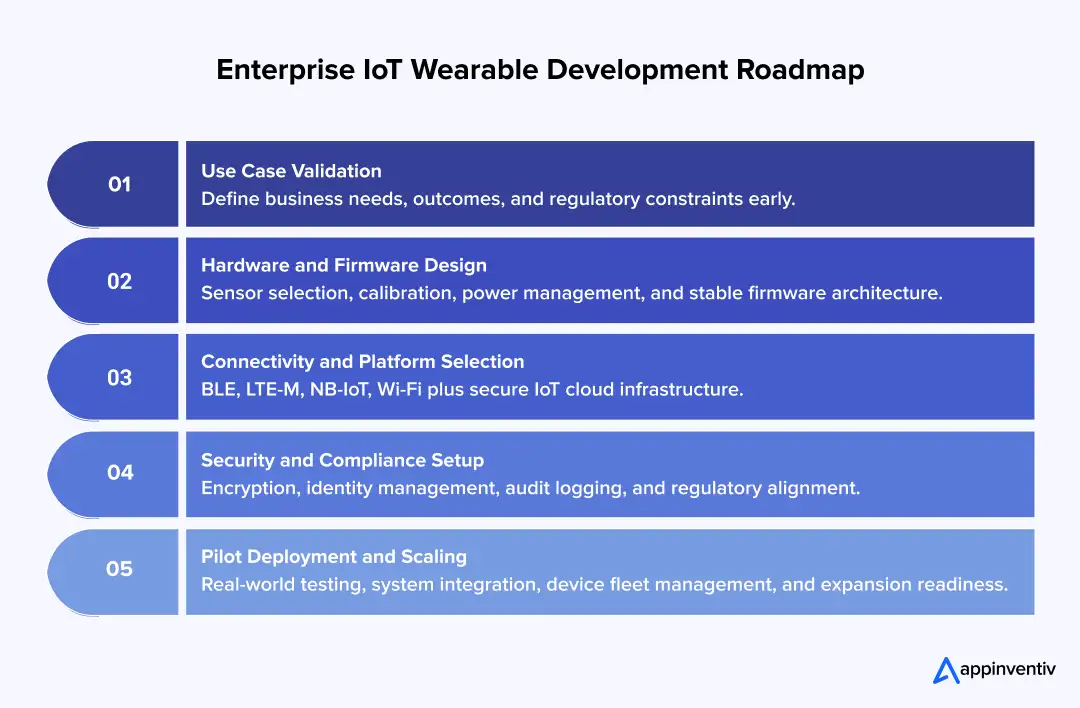
1. Use Case Validation
Clear business alignment prevents wasted engineering effort. Teams typically start by confirming:
- Operational or clinical need
- Expected measurable outcomes
- Regulatory constraints in the target market
Without this clarity, development can drift.
2. Hardware Prototyping and Firmware Design
Device reliability begins at the hardware level. Key considerations include:
- Sensor selection and calibration
- Power management strategies
- Firmware architecture for stable sampling and filtering
Prototype testing often reveals early limitations.
3. Connectivity and IoT Platform Selection
Stable data transmission underpins the entire system. Enterprises usually evaluate:
- BLE, LTE-M, NB-IoT, or Wi-Fi connectivity
- Cloud IoT platforms supporting secure ingestion
- Edge gateway requirements for latency control
This stage often shapes scalability.
4. Security and Compliance Architecture
Regulatory alignment influences deployment speed. Typical priorities:
- Data encryption and identity management
- HIPAA or industry-specific compliance considerations
- Secure API integration strategies
Security decisions rarely stay isolated. They affect every layer.
5. MPV Deployment and Scaling
Real-world testing exposes operational realities. Enterprises usually focus on:
- Connectivity stability across environments
- User adoption and device usability
- Integration with analytics or operational systems
Scaling follows once reliability is proven.
Understanding how wearable technology is shaping enterprise app development, a structured roadmap does not eliminate challenges but does reduce surprises. That alone often determines whether wearable initiatives move beyond pilots into sustainable enterprise solutions.
From implementation experience, pilot success does not automatically translate into scalable deployment. Factors like firmware update strategy, device fleet management, and long-term data storage planning usually determine whether expansion remains sustainable.
Build vs Buy vs Partner: Choosing the Right Approach for Enterprise IoT Wearables
Most organizations exploring IoT in wearables initiatives eventually face this decision. Building offers control, buying offers speed, and partnering often balances both. The right choice usually depends on internal expertise, regulatory complexity, and how quickly you need a reliable enterprise deployment.
| Approach | Advantages | Limitations | Best Fit Scenario |
|---|---|---|---|
| Build Internally | Full control, deep customization | High cost, longer timelines | Strong in-house engineering teams |
| Buy Ready-Made | Quick deployment, predictable costs | Limited flexibility | Standard use cases, fast rollout |
| Partner With Specialists | Faster scaling, domain expertise | Vendor coordination needed | Compliance-heavy or complex deployments |
Architecture decisions, compliance readiness, and integration planning shape successful wearable deployments.

Future of IoT and Wearables in Healthcare
The conversation around healthcare wearables has changed quietly. Earlier, teams asked whether these devices were worth trying. Now the question sounds more practical, usually about how dependable the data is and whether it fits smoothly into care workflows. That shift says a lot about where things are heading.
- Preventive healthcare ecosystems: Continuous wearable data is helping clinicians notice gradual health changes earlier, which can reduce sudden hospital visits in some monitoring programs.
- Continuous diagnostics: Instead of relying only on periodic checkups, some healthcare providers are using wearable streams to keep a closer, ongoing view of patient conditions.
- Edge AI wearables: Processing some data directly on devices or nearby gateways helps when connectivity is inconsistent and can shorten response time for critical alerts.
- Integrated health platforms: Wearable data is increasingly being connected with clinical dashboards, telehealth systems, and analytics platforms, so it becomes part of everyday decision-making.
Why Enterprises Partner With Appinventiv for Wearable Solutions
Most enterprises exploring IoT in wearables already have an idea in mind. The gap usually appears when it comes to execution, integration, and scaling. That is where experienced engineering support starts making a difference.
Appinventiv’s wearable app development services focus on building production-ready solutions rather than experimental prototypes. Teams work across device firmware, mobile interfaces, cloud infrastructure, and enterprise system integration so that data actually becomes usable inside existing workflows.
A quick snapshot of current capability:
- 30+ wearable technology experts working across hardware, firmware, cloud, and AI layers
- 120+ wearable app projects delivered across healthcare, fitness, enterprise safety, and consumer ecosystems
- 10M+ app downloads achieved globally for client wearable applications
- 95% client satisfaction rate across digital product engagements
Alongside wearable engineering, Appinventiv’s broader IoT app development services support secure connectivity architecture, analytics pipelines, and integration with enterprise platforms such as EHRs, operational dashboards, and analytics systems.
For enterprises, the goal is rarely just launching a wearable product. It is making sure the data flows reliably, securely, and at scale. That is typically where the right engineering partner becomes essential.
Frequently Asked Questions
Q. Why do wearable IoT devices collect the human body’s vitals?
A. Smart wearable IoT devices collect body vitals mainly to give continuous health visibility rather than occasional snapshots. For example, heart rate, oxygen levels, or activity trends help clinicians spot gradual changes early. Your care team can respond sooner, support preventive care, and sometimes reduce emergency interventions or unnecessary hospital visits.
Q. What are IoT wearables?
A. IoT in wearables are connected devices designed to collect data from the body or environment and send it to digital platforms for analysis. Think of smart health bands, industrial safety helmets, or clinical monitoring patches. They are not just gadgets anymore. Many enterprises use them as ongoing data sources for operational and healthcare decisions.
Q. How do IoT wearables work?
A. Most IoT wearables follow a simple flow. Sensors capture data such as vitals or movement, firmware filters it, and connectivity, like Bluetooth or cellular, sends it to cloud platforms. From there, analytic systems interpret data. When integrated properly, your teams can use those insights directly in clinical, safety, or operational workflows.
Q. What are the different types of wearable IoT devices in Healthcare?
A. Healthcare wearable IoT devices generally fall into biometric monitoring, chronic disease tracking, rehabilitation support, and safety monitoring categories. Examples include heart rate and ECG monitors, continuous glucose monitors, smart patches, fall detection wearables, and fitness-linked clinical trackers. These devices feed continuous patient data into clinical platforms, supporting preventive care, remote monitoring programs, and improved treatment decision-making.
Q. What is the realistic ROI timeline for wearable IoT products?
A. Enterprise wearable IoT ROI usually appears in phases rather than immediately. Initial pilot validation may take 6–12 months, followed by integration, compliance alignment, and scaling over 12–24 months. Tangible ROI often emerges through operational efficiency, reduced incident risks, better patient outcomes, or data-driven decision support once systems are fully integrated into enterprise workflows.
Q. How do we ensure secure device-to-cloud communication for IoT wearables?
A. Secure communication requires a layered architecture starting with device identity management, certificate-based authentication, and encrypted transmission protocols like TLS or DTLS. Edge filtering reduces exposure risks before data is ingested into the cloud. Enterprises typically combine secure APIs, audit logging, and strict access controls with compliance frameworks such as HIPAA. Continuous monitoring and firmware update management help maintain long-term security in the wearable ecosystem.

- In just 2 mins you will get a response
- Your idea is 100% protected by our Non Disclosure Agreement.

IoT In Education for Enterprises: Financial Impact, Risks, and Roadmap
Key takeaways: Integrating IoT in education becomes an infrastructure investment as operational costs, compliance pressures, and visibility gaps intensify. Five-year ROI depends on baseline operational data, disciplined architecture, and structured financial modeling. Predictable TCO requires upfront planning across hardware, connectivity, cloud, maintenance, and governance costs. Secure IoT deployments demand zero-trust architecture, strong device identity, and…

IoT in Mining: Modernizing Operations for Enterprise Efficiency and Safety
Key takeaways: The Internet of Things in mining turns scattered operational signals into live, decision-ready visibility across fleets, fixed plants, people, and the environment. The biggest wins usually show up first in uptime, then in safety response, and finally in energy and process stability. “More data” does not automatically mean better performance. Value comes when…

IoT in Banking Industry: Use Cases, Examples, ROI
Key takeaways: IoT in banking creates real value only when it is treated as a software and integration problem, not a hardware initiative. Security, governance, and audit readiness determine whether IoT programs scale or quietly stall in regulated environments. IoT implementation in banking typically ranges from $40,000 to $600,000+, with cost driven more by integration…