































AR VR Innovations in Dubai: Real Costs, Business Use Cases, Implementation Steps

 Share -


- 01What UAE Businesses and Government Are Actually Building in AR VR
- 02Real-World AR and VR Use Cases in Dubai
- 03How to Implement AR VR in the UAE: A Practical Approach
- 04AR/VR Development Costs in Dubai: A Practical Breakdown
- 05Factors Affecting the AR VR Development Cost in Dubai
- 06Initiate Your AR VR Initiatives in Dubai with Appinventiv
- 07FAQs

Key takeaways:
- Dubai enterprises are adopting AR/VR at scale, driving real business value across sectors like real estate, healthcare, tourism, and retail.
- AR/VR development costs in Dubai range from AED 80,000 to AED 500,000+ ($40,000 to $400,000), depending on features and complexity.
- Compliance with UAE data protection laws (PDPL) is a must for all AR/VR projects handling user data.
- Success starts with a clear use case, phased rollout, and strong post-launch support.
- Choose development partners with proven expertise, local compliance knowledge, and scalable solutions.
Enterprises exploring AR VR app development in Dubai are increasingly asking a practical question: what does the investment actually cost, and what measurable business value will it deliver? For decision-makers, the concern is no longer the technology itself, but how immersive systems can be integrated into operations to solve real business challenges.
Across the UAE, government initiatives and enterprise innovation programs are accelerating interest in AR and VR technologies. While many discussions still focus on immersive customer experiences, the real transformation begins when these technologies become part of operational workflows, improving service delivery, training, collaboration, and decision-making.
The most recent case is the Dubai Digital Twin in which city planners and transport authorities can simulate infrastructure situations in real-time in 3D and test them before applying them. It will not be an ideal way to visualize, but a practical system that will show traffic flows, construction impact, and energy use in real time.
That shift is significant. Initial AR/VR projects were mostly experiential, as they provided virtual tours or product demonstrations. The current day, spatial computing and operational analytics are supporting feasible deployments. This change is evidenced in the Dubai Metaverse Strategy, where immersive technology has ceased to be a novelty and has become enterprise-scale infrastructure to alter the services of the citizens as well as the activities of the companies.
The outcome is a tidal wave of deployments that not only engage customers but also transform how work is done, the operations of the cities, and the way in which data is used to take action, both in the public and private sectors.
Be at the forefront of this immersive innovation

What UAE Businesses and Government Are Actually Building in AR VR
AR and VR implementation in the UAE is no longer treated as isolated innovation exercises. They are evaluated in terms of business impact, lifecycle value, and long-term viability, especially when assessing the AR VR development cost in Dubai against measurable outcomes. Let’s see how the UAE enterprises are utilizing the AR VR technology:
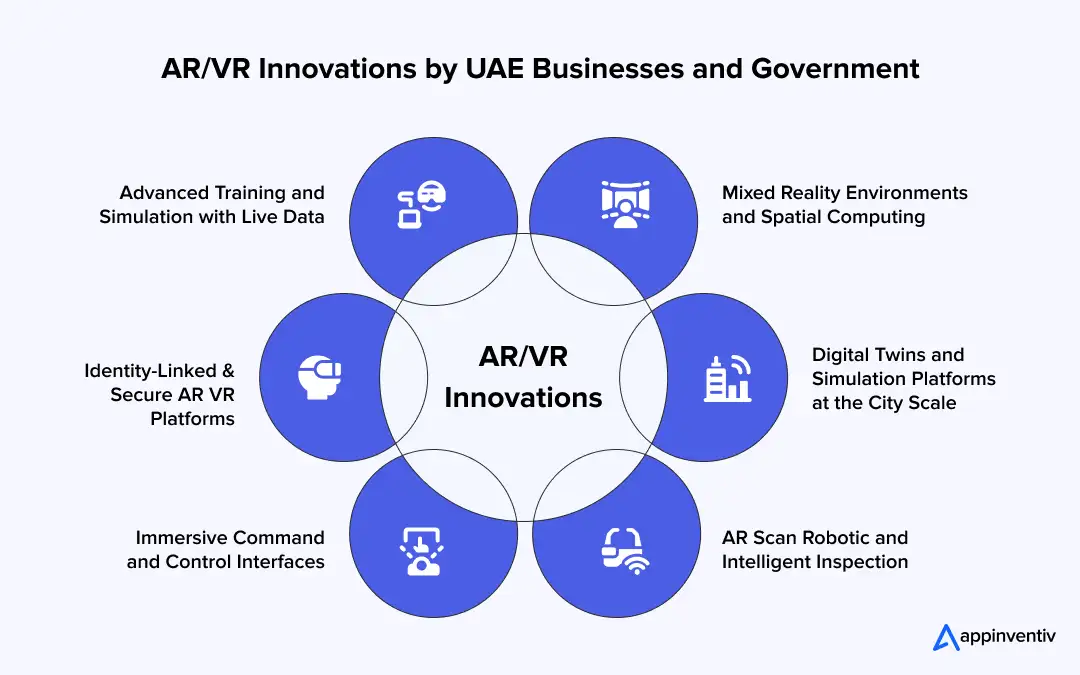
Mixed Reality Environments and Spatial Computing
The trend is clearly moving to spatial computing in UAE environments, and in these cases, digital content is integrated into the physical environment to facilitate real-time communication. It is being applied in industries like construction, engineering and urban planning where teams must read elaborate models in real site conditions.
Simultaneously, a higher level of spatial accuracy for the structures under analysis, modification, and validation is provided through collaborative design reviews implemented in the context of mixed and extended reality applications, which enable distributed teams to interact.
Digital Twins and Simulation Platforms at the City Scale
The digital twin projects in the UAE are increasing in size and expanse in functionality. These systems are increasingly associated with live operational data, enabling the continuous simulation of infrastructure performance across transport, utilities, and urban networks.
The use of deployed data repositories like Azure UAE North gives evidence to a rise in importance attributed to data locality and system responsiveness. In this respect, AR VR in Dubai setup is slowly being incorporated in wider smart city plans, in which it aids planning, surveillance, and predictive analytics.
AR Scan Robotic and Intelligent Inspection
Robotic scanning systems with AR overlays are being integrated into industrial applications to enhance inspection accuracy and reduce the need for manual intervention. The solutions are especially applicable in sectors with complex or dangerous environments.
They assist in more coherent assessment processes and respond to safety issues that are challenging to address with traditional means by capturing spatial data and providing guided insights to operators.
Immersive Command and Control Interfaces
Operational control environments are being restructured through the use of immersive visualization layers. Instead of relying solely on traditional dashboards, organizations are introducing three-dimensional interfaces that present interconnected data streams in a more interpretable format.
This shift has direct implications for response time and situational awareness, which contribute to the broader objective of improving AR VR RoI Dubai enterprises are working to justify large-scale deployments.
Identity-Linked and Secure AR VR Platforms
As immersive applications become integrated into regulated environments, security and compliance considerations have gained prominence. Solutions are increasingly incorporating UAE Pass AR integration to support authenticated access within virtual environments.
At the same time, adherence to frameworks such as UAE PDPL compliance is essential, particularly in scenarios involving biometric or behavior-based data. These requirements influence both system architecture and deployment timelines.
Advanced Training and Simulation with Live Data
Training systems are evolving toward environments that reflect current operational conditions rather than predefined scenarios. By incorporating live or near-real-time data inputs, these platforms allow personnel to engage with situations that closely resemble actual workflows.
In several cases, delivery through WebXR enterprise frameworks supports broader accessibility while maintaining functional consistency across devices. The emphasis remains on practical readiness and sustained performance rather than visual complexity alone.
Real-World AR and VR Use Cases in Dubai
AR and VR adoption in Dubai is driven by sector-specific needs, with organizations focusing on use cases that improve operations, engagement, and efficiency. Many AR VR use cases Dubai enterprises invest in are outcome-focused, spanning both customer-facing and backend applications aligned with clear business goals.
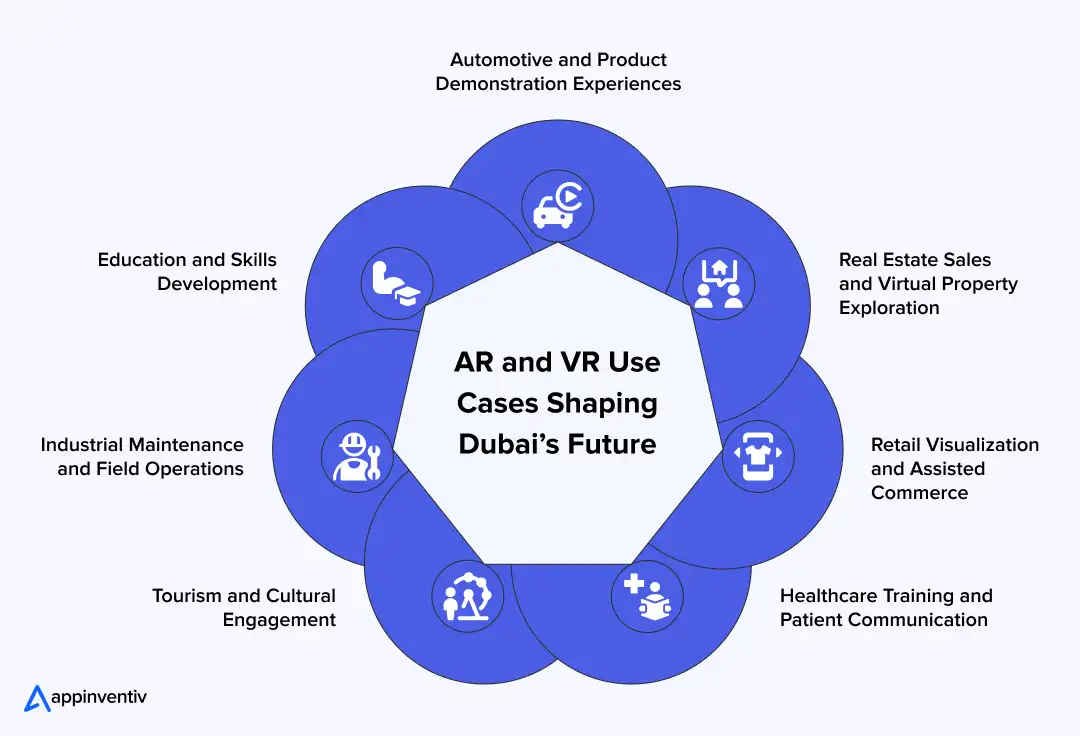
Real Estate Sales and Virtual Property Exploration
Brokerage firms in Dubai are leveraging AR and VR to showcase properties before construction is complete. Buyers are able to move through spaces, review layouts, and form a clear impression without visiting the site. This has influenced how off-plan sales progress, particularly where early-stage commitment and overseas interest play a role.
Some of the major developers, including Emaar Properties, apply VR walkthroughs to provide buyers with the opportunity to view under-construction properties remotely. These AR/VR solutions enhance layout evaluation, decision-making, and off-plan sales processes.
Retail Visualization and Assisted Commerce
Retail environments are gradually incorporating AR-based visualization so customers can examine products within their own surroundings. Furniture placement and virtual try-ons are common examples. The effect is more visible in higher-value purchases, where uncertainty tends to delay decisions. With AR VR in Dubai becoming more established, such features are appearing more regularly within everyday retail processes.
International retail stores such as IKEA, have also spread their AR applications to the UAE market to allow customers to visualize the placement of the furniture in their homes before making the purchase.
Healthcare Training and Patient Communication
Hospitals and training institutions are using simulation-led environments, often structured as VR training solutions, to support procedural learning. Augmented reality healthcare initiatives in Dubai are also enhancing patient communication, as visual explanations often make more sense than verbal guidance. In these cases, DHA AR compliance requirements are taken into account, especially when clinical data is involved.
To illustrate this, procedural practice in a controlled environment is used in medical institutions such as Mohammed Bin Rashid University of Medicine and Health Sciences, which use VR training solutions in the UAE.
These solutions are also implemented by the staff of the public service entities to train employees in utilities and infrastructure, aiming at enhancing preparedness and minimizing operational risk.
Tourism and Cultural Engagement
Tourism authorities are presenting landmarks and heritage locations through immersive formats that allow remote exploration. On-site, AR overlays provide additional context without altering the physical setting. This reflects a broader pattern in how AR VR in Dubai is being used to extend access while maintaining the integrity of existing spaces.
AR/VR is used in entertainment centers such as VR Park in Dubai Mall and production firms that provide 360-degree tours of historical areas to involve visitors in an interactive manner. Culture tourism is being seen by visitors in the virtual world, and venues have boosted the experience with the use of immersive rides and experiences.
Industrial Maintenance and Field Operations
In utilities and manufacturing, AR-based guidance is used during maintenance work. Visual instructions are layered onto equipment, and remote experts may assist when required. The outcome is a more consistent approach to task execution, with fewer interruptions. These systems are often part of wider enterprise AR VR solutions, where standardization across operations is a key requirement.
One example that can be considered relevant is DEWA, which has adopted AR to support engineers in infrastructure monitoring and maintenance by leveraging field operations and a digital twin environment.
Education and Skills Development
Educational institutions are incorporating immersive modules into selected areas of study, particularly where practical exposure is difficult to arrange. Simulations allow learners to engage with scenarios that would otherwise remain theoretical. In some implementations, WebXR enterprise platforms are used to enable cross-device access, helping maintain continuity without relying on specialized hardware.
AR/VR has been applied to engage audiences in the form of multi-sensory, narrative-based exhibitions in venues like the Theatre of Digital Art (ToDA) and Infinity des Lumieres. These immersive installations restructure the traditional art and museum experiences into interactive and engaging experiences for the visitors.
Automotive and Product Demonstration Experiences
Automotive companies are using VR-based showrooms and AR configuration tools to present vehicles in detail. Customers can review specifications, adjust features, and examine design elements without depending on physical inventory. This approach is most visible in premium segments, where purchase decisions tend to involve careful evaluation rather than immediate availability.
In Dubai, automobile companies like Audi and BMW have launched digital showroom experiences where they enable their customers to build vehicles with customizable interfaces. The layouts are commonly used at malls and flagship stores, where there is not enough room to physically show all model lines.
Partner with us to create AR VR applications aligned with your strategic goals

How to Implement AR VR in the UAE: A Practical Approach
Implementing AR and VR in the UAE follows a structured approach, though execution often shifts as requirements evolve. Clear objectives keep projects aligned, as even strong builds can lose direction without them. Most successful AR/VR in Dubai initiatives start with a focused use case and expand once the core application proves effective.
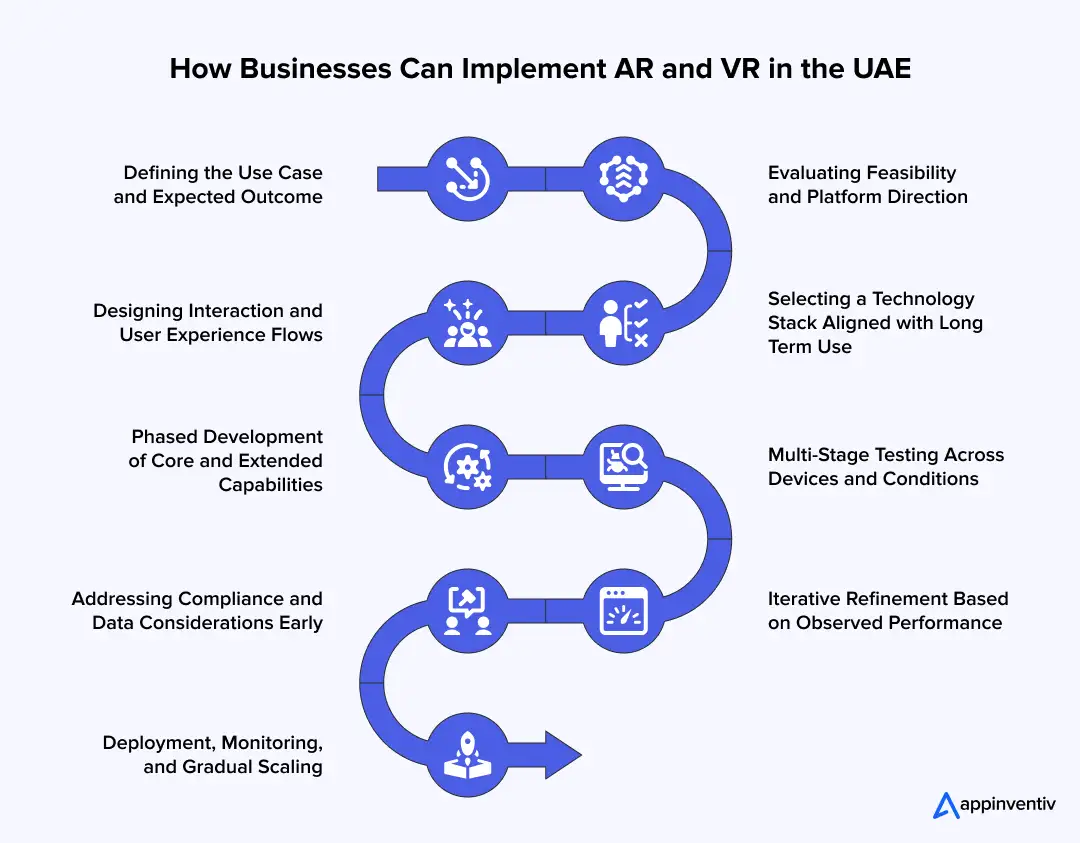
Defining the Use Case and Expected Outcome
The starting point is a clear statement of purpose. This is not a broad intention but a specific outcome. For instance, improving training accuracy or supporting property visualization. When the objective is stated in concrete terms, decisions around scope and functionality become easier to manage. If this step is rushed, revisions tend to surface later.
Evaluating Feasibility and Platform Direction
Feasibility assessment follows, and it often reveals practical constraints early. Device access, user environment, and performance expectations all influence whether the solution should be mobile-based, headset-driven, or a combination. In some cases, teams begin with one approach and adjust after initial testing.
Selecting a Technology Stack Aligned with Long-Term Use
Technology choices are usually shaped by how long the application is expected to remain in use. Short-term builds may tolerate limited flexibility, but custom enterprise app development requires tools that can be maintained and extended. This becomes relevant when planning the development of AR & VR solutions in Dubai, where applications often continue to evolve after deployment.
Designing Interaction and User Experience Flows
Designing interaction in AR and VR introduces its own set of challenges. Users do not follow fixed screens; they move, look around, and interact with objects in space. This requires careful mapping of actions and responses. Small inconsistencies here can affect usability more than anticipated.
Phased Development of Core and Extended Capabilities
Development generally progresses in layers. Core features are built first, then expanded. This allows teams to review stability before adding complexity. It also provides an opportunity to adjust direction if early assumptions do not hold.
Multi-Stage Testing Across Devices and Conditions
Testing is not confined to a single phase. It runs alongside development. Different devices, environments, and user conditions are considered. Some issues only appear outside controlled settings, so repeated validation becomes necessary.
Iterative Refinement Based on Observed Performance
Refinement takes place after each testing cycle. Adjustments are made, sometimes minor, sometimes structural. This stage continues until the application performs reliably under expected conditions. It is not always predictable, which is why time buffers are often built in.
Addressing Compliance and Data Considerations Early
Where user data is involved, compliance requirements must be addressed from the beginning. Retrofitting these elements later can disrupt both architecture and timelines. Early planning avoids that disruption.
Deployment, Monitoring, and Gradual Scaling
Once deployed, the application enters a different phase. Performance is monitored, usage patterns are observed, and updates are introduced as needed. Scaling does not happen all at once. It is usually gradual, based on demand and system readiness. This completes the cycle of how to implement AR VR in the UAE, where initial deployment is only one part of the overall process.
AR/VR Development Costs in Dubai: A Practical Breakdown
Understanding the augmented & virtual reality development cost Dubai requires more than a single figure. Costs vary based on complexity, platform, features, and compliance requirements. A clear view of these factors helps businesses plan budgets effectively and align investment with expected outcomes.
Breakdown of Costs by Levels of Complexity
The price of creating an AR/VR app is highly dependent on volume, capabilities, and technical sophistication. Using industry and UAE market trends, the following is the practical breakdown:
Simple Apps: The simplest apps, having the simplest functionality, the simplest interface, and the simplest backend, typically cost AED 60,000 – AED 120,000 ($40,000 – $100,000). They are best used with light-weight AR/VR experiences that have little or no interactivity.
Mid-Level Apps: Apps that have custom UI/UX, API connectors, average interactivity, and scalable backends will typically cost between AED 120,000 and AED 240,000 ($100,000 to $200,000). These are far more interactive and powerful.
High-Complexity Apps: Multi-platform and real-time capable, AI/ML integration, complex platforms with higher requirements can be higher than AED 240,000+ ($200,000 – $400,000+), depending on the needs of the enterprise and the complexity of the 3D content.
The table below gives a quick overview of the cost comparison as per the app complexity:
| Level of Complexity | Scope and Features | Estimated Cost (AED) | Estimated Cost (USD) |
|---|---|---|---|
| Basic App | Simple UI, minimal features, minimal backend, no advanced integrations | 60,000 – 120,000 | 40,000 – 100,000 |
| Mid-Level App | Custom UI/UX, API integrations, moderate interactivity, scalable backend | 120,000 – 240,000 | 100,000 – 200,000 |
| High-Complexity App | Real-time capabilities, AI/ML, advanced security, multi-platform, large data processing | 240,000+ | 200,000 – 400,000+ |
Cost Breakdown by Stages of Development
The contribution of each stage towards the total budget is different. The cost of planning and requirement analysis normally takes up 10% to 15%, which includes research and technical feasibility, especially when aligning with initiatives like the Dubai Metaverse Strategy. The design process occupies about 15% to 20%, covering UI and user experience mapping that directly affects the augmented reality development cost UAE based on design depth and interaction quality.
Development is the largest share at 40% to 55%, where core engineering occurs, often involving advanced frameworks used in Unity development environments. Launch activities, such as testing and deployment, require approximately 10% to 15%. Continued maintenance usually adds 15% to 20% annually to support updates, fixes, and performance improvements over time.
| Development Stage | Main Activities | Cost Allocation (Percentage) |
|---|---|---|
| Planning | Requirement gathering, research, feasibility analysis | 10% – 15% |
| Design | UI design, UX flows, prototyping | 15% – 20% |
| Development | Frontend and backend development, integrations, core features development | 40%- 55.% |
| Launch | Testing, QA, deployment, submission to app store | 10% – 15% |
| Maintenance | Bug fixes, performance optimization (annual cost) | Not Fixed |
Cost Estimation Formula For Developing AR VR Apps in Dubai
One method of estimating cost is to plot total development hours against the hourly rate. This is a common technique of projecting the virtual reality development cost Dubai because it is flexible in accordance with the scope and technical depth. The common formula is:
Cost = Number of Hours of Development x Hourly Rate
As an illustration, a project with 1,000 hours at a rate of AED 150 per hour would amount to approximately AED 150,000. It is used to make adjustments in projections in terms of scope, team size and technical complexity.
Time and Effort Estimates
Timelines vary based on the depth of features and the requirement to integrate. It can be a simple application that a small team can develop in 2-3 months. The mid-level applications usually take 4-6 months and are cross-functional.
Complex platforms may also take between 6 and 12 months or beyond, particularly where iterative testing, compliance, and scaling are needed, such as integrations, like UAE Pass AR integration. Effort, features are not the only factors that raise, but also the necessity to have stability, security, and long-term maintenance.
We help you estimate accurately, streamline planning, and ensure your project delivers value
Factors Affecting the AR VR Development Cost in Dubai
AR and VR development costs in Dubai do not stay within a fixed bracket. They shift with scope, design depth, and how the application is expected to behave in real use. Here are some of the key factors that you need to consider for estimating the overall app development cost in the UAE:
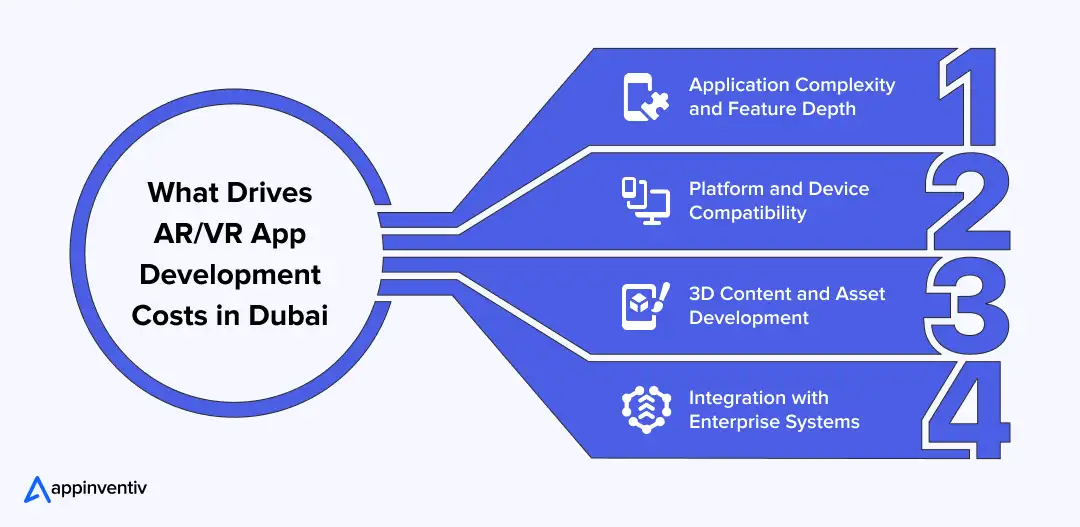
Application Complexity and Feature Depth
Complexity sets the direction for cost. A basic application with limited interaction is relatively contained. Once real-time environments, shared user spaces, or spatial computing UAE scenarios come into play, the effort rises. Teams usually start here when working out the cost to build AR VR app UAE, since feature depth tends to influence every later decision.
Platform and Device Compatibility
Platform choice shapes development, with mobile AR following one path and headset VR taking another. When the application is built for devices such as HoloLens 2 enterprise in the UAE, more time goes into calibration, testing, and adjustment. That added effort is reflected in both cost and delivery timelines.
3D Content and Asset Development
The visual layer often takes more time than expected. Simple models are manageable, but detailed environments, lifelike textures, and smooth animations require steady design work. Many teams use Unity development UAE pipelines for this, though the real cost depends on how refined the final output needs to be. This is where the augmented reality development cost UAE can move up without being obvious at first.
Integration with Enterprise Systems
Most applications do not run in isolation. They connect with existing systems, data sources, or internal tools. Each integration point introduces its own complexity. When real-time data flow is involved, the work increases further, and so does the time needed to stabilise the system. This impacts the total cost to build AR VR app UAE.
Initiate Your AR VR Initiatives in Dubai with Appinventiv
The future of AR VR in Dubai can be implemented against the backdrop of the government’s strategic support and the rapid development of technologies. Through efforts such as the growth of city digital twins, immersive training platforms in public services, and regulatory regimes that promote trial, everything is becoming more and more common in the UAE as organizations start to view immersive systems as an infrastructure and not a niche tool.
Spatial computing, mixed reality environments, and real-time simulation systems are now being integrated into long-term planning in healthcare, construction, logistics, and smart city programmes. As these ecosystems evolve, the focus will remain on solutions that enhance operational results, evidence-based and informed decision-making, and alignment with the broader national objectives of digital transformation.
The right development partner is very important in this landscape. Appinventiv, as a trusted AR VR app development company, has a strong background in developing enterprise AR and VR applications tailored to complex environments. Since the initial refinement of concepts and feasibility evaluation, Appinventiv aids organizations across all aspects of the immersive technology process. We operate in various fields, and our strategy is geared towards deliverables that have quantifiable outcomes.
We would like you to view our client testimonials and our portfolio to see how we have helped others meet their strategic goals through immersive solutions.
To have a more in-depth discussion on how Appinventiv can assist in your AR and VR vision, get in touch with us today.
FAQs
Q. How much does AR VR development cost in Dubai?
A. The AR VR development cost in Dubai typically ranges between AED 80,000 and AED 500,000, with the scope, platform and complexity varying. Simple AR applications are less expensive, whereas those that are immersive VR, with backend architecture, 3D resources, and immersive capabilities, are much more expensive.
Also Read: How Much Does Augmented Reality App Development Cost?
Q. What is the ROI of AR VR investment for UAE enterprises?
A. AR VR investments in the UAE businesses are usually accompanied by quantifiable benefits to the companies in terms of better training efficiency, fewer operational errors, and increased customer interaction.
Other industries that record quicker decision cycles and lower costs in the long run are the real estate, retail and healthcare industries. Initial investment is high, but long-term benefits usually involve productivity and enhanced retention of users and a differentiated customer experience.
Q. Does AR VR need PDPL compliance in the UAE?
A. Indeed, the implementation of AR VR in Dubai must be in accordance with the UAE Personal Data Protection Law. Any application of AR or VR that gathers user information like location, biometrics or behavioral inputs should be guided by PDPL. This entails clear user consent, data safety and purpose of processing. Failure to do so might result in legal and monetary fines.
Q. How long does it take to build an AR VR app in the UAE?
A. AR VR apps development in the UAE usually takes between 3 to 9 months. The implementation of a basic app with fewer functionalities might take approximately 10 to 12 weeks, but more elaborate solutions with a 3D model, real-time interaction, and back-end systems can take longer cycles. Timelines also require testing, trial and error and regulation.
Hire our Dubai-based mobile app developers to know the exact timeline for your project.
Q. What is the Dubai Metaverse Strategy?
A. The Dubai Metaverse Strategy is a project by the Government of Dubai to make the city one of the leading metaverse economies in the world. It will generate more than 40 000 virtual positions and add billions to the economy. The plan is based on innovation in AR, VR, blockchain, and digital twins, where it helps startups and enterprises to develop immersive digital ecosystems.
Q. How do I choose an AR VR development partner in Dubai?
A. Here’s how you can choose your AR VR development partner in Dubai:
Evaluating Technical Expertise: Analyze legal experience in providing enterprise AR VR solutions UAE across industries.
Portfolio and Use Case Depth: Examine previous projects of the same scale and complexity. Look for quantifiable results, not mere demonstrations.
Laws and Security Preparedness: Make sure you are familiar with UAE laws and data protection regulations. Evaluate the method of obtaining security on the architecture and user data treatment.
Scalability and Support: Ascertain the scalability of solutions after deployment and learn if they provide maintenance and optimization support services.
Q. Can AR VR apps be integrated with UAE Pass?
A. Here’s how you can integrate your AR VR apps with UAE Pass:
- Define Identity Use Case: Determine the points of secure login or verification in the AR VR flow.
- Access UAE Pass APIs: Create an account and get authentication credentials.
- Include Secure Authentication Layer: Implement the sign-in processes in the virtual world.
- Compliance and Data Management: Meet national standards of identity and data protection.
- Test and Deploy: Pre-launch user acceptance and security.


Fast 2-minute response, fully NDA-protected.

How to Integrate AR/VR into Your Fitness Offerings for Business Growth?
Key Takeaways AR/VR in fitness is transforming exercise with engaging, interactive, and custom workouts that enhance engagement and retention. It is estimated that the global AR/VR market will reach $589 billion by 2035. AR/VR helps companies to go international with online classes and personalized distance training. AR/VR contributes to better outcomes and user satisfaction in…

10 Use Cases and Examples of How Extended Reality (XR) is Driving Innovation Across Industries
Imagine a factory where engineers diagnose machinery issues using 3D holograms or a hospital where surgeons rehearse complex procedures in a fully immersive virtual space before operating on a real patient. These scenarios are not distant possibilities - they are happening today and are powered by Extended Reality - XR use cases. As a convergence…

13 Use Cases and Examples of How Adaptive AI is Transforming Industries
Slashing downtime, boosting margins, automating workflow, and stealing your market share. You must be thinking that these buzzwords are Silicon Valley’s hype. No, these are the silent revolutions hitting Main Street industries. From manufacturing deploying demand forecasting to controlling production lines, healthcare tailoring predictive care and driving better outcomes. The success mantra—these industries are quietly…