























A Practical Guide to AI-Powered Hospitality Software Development

 Share -


- 01AI-Based Hospitality Software Development: Step-by-Step Guide
- 02Cost for AI Hospitality Software Development
- 03Key Benefits of AI in Hospitality
- 04Practical AI Use Cases Shaping Modern Hospitality Operations
- 05Real-World Examples of Businesses Leveraging AI in Their Hospitality Operations
- 06What are some Key Considerations When Implementing AI for Hotels?
- 07How to Overcome Hospitality Challenges with AI
- 08Impact of AI in the Hospitality Industry
- 09Future Trends of AI in Hospitality
- 10Harness the power of AI in the hospitality industry by partnering with Appinventiv.
- 11FAQs

Key takeaways:
- AI in hospitality is transforming hotel operations by streamlining workflows and enhancing guest experiences through smarter automation.
- AI-powered hospitality software enables highly personalized stays, from customized room settings to tailored dining and activity recommendations.
- Automation driven by AI helps hotels save time and reduce costs by optimizing pricing, staff scheduling, and daily operations.
- The future of AI in hospitality looks promising, with 2026 set to bring more intelligent systems that further elevate personalization and guest satisfaction.
- Leading brands like Hilton and Marriott are already proving the real-world value of AI by improving service quality and operational efficiency.
If you’ve ever watched a hotel lobby shift from calm to crowded in a matter of seconds, you know how quickly the smallest things start to matter. A guest who checks in without a long wait, a room that feels just right, or a staff member who remembers something from a past stay. These small moments decide how welcome a guest feels, even before they reach their room.
To keep those moments smooth, hotels are starting to bring in AI in hospitality as a quiet helping hand. Hilton’s use of Connie is a simple but telling example. A guest can walk over, ask about a good dinner spot or the gym timings, and get an answer right away. No waiting at the front desk and no digging for information. It clears small roadblocks and gives your team the breathing room to focus on guests who need real attention.
Behind the scenes, AI technology in the hospitality industry picks up on patterns that are easy to miss when operations get busy. It helps adjust schedules, sends helpful updates, and surfaces insights that usually take hours to notice. When it all blends naturally into daily work, your service feels more personal without asking your staff to stretch themselves thin. The real advantage is how it helps you deliver a stay that feels easy, thoughtful, and genuinely cared for.
If your teams are juggling peak-hour pressure, staffing gaps, and rising guest expectations, AI can quietly handle the small things so your people can focus on what really matters
AI-Based Hospitality Software Development: Step-by-Step Guide
Most hospitality leaders don’t wake up wanting “AI software.” They want fewer guest complaints during peak hours, cleaner handovers between shifts, and systems that stop lagging when the property is full. AI enters the picture only when existing processes start to strain.
This is how AI-based hospitality software is typically planned, built, and rolled out in real hotel environments.
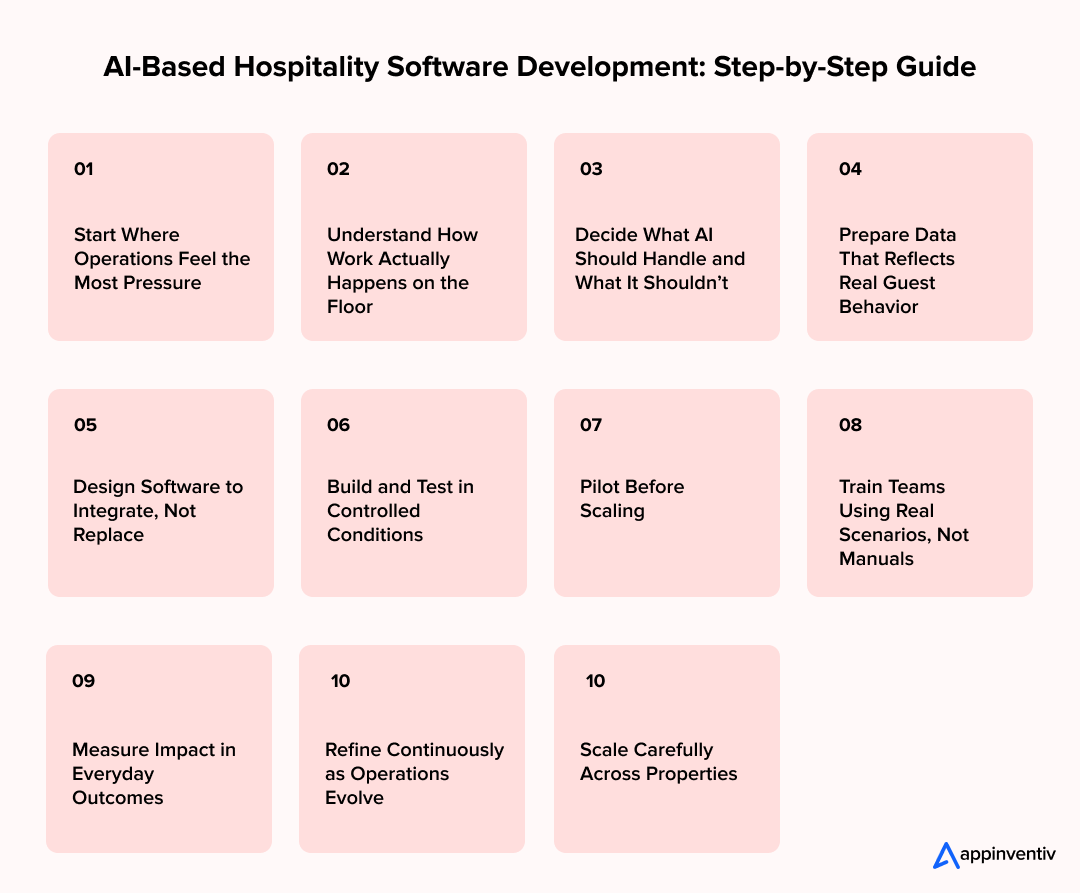
1. Start Where Operations Feel the Most Pressure
The first step is not choosing tools. It’s listening. AI projects usually begin when teams repeatedly hit the same friction points:
- Front desks are overwhelmed during arrivals
- Guest messages are tracking up across channels
- Pricing and staffing decisions are reacting too late
These moments tell you where AI can help without disrupting service.
2. Understand How Work Actually Happens on the Floor
Before defining features, development teams need a clear picture of day-to-day reality.
This means observing:
- How staff reprioritize rooms when checkouts shift
- How guest requests move between systems and shifts
- Where manual decisions slow things down under pressure
AI software only works when it supports these real workflows, not idealized ones.
3. Decide What AI Should Handle and What it Shouldn’t
Not every task should be automated. Some need visibility, others need support, and a few can run on their own.
Clear boundaries matter:
- AI can predict, suggest, and surface risks
- Humans retain control over judgment-heavy decisions.
- Escalation rules stay explicit
This clarity prevents AI from feeling intrusive and builds trust early.
4. Prepare Data that Reflects Real Guest Behavior
Hotels already generate more data than they realize. The challenge is structure, not volume.
Development focuses on:
- Aligning PMS, POS, CRM, and service data
- Cleaning inconsistencies without flattening real patterns
- Using historical behavior instead of theoretical assumptions
AI trained on realistic data adapts better to changing conditions.
5. Design Software to Integrate, Not Replace
Most hospitality environments rely on long-standing systems. Replacing them introduces risk.
AI-based hospitality software is built to:
- Sit alongside existing platforms
- Feed insights into familiar dashboards
- Avoid adding new screens or steps for staff
If teams have to “switch contexts,” adoption drops quickly.
6. Build and Test in Controlled Conditions
AI models are introduced gradually. One property, one department, one use case.
This phase helps teams:
- See how recommendations behave in live conditions
- Catch edge cases before they affect guests.
- Adjust confidence thresholds and response timing
Early success is about stability, not sophistication.
7. Pilot Before Scaling
A focused pilot shows whether AI genuinely reduces pressure or just shifts it elsewhere.
Common pilot areas include:
- Guest communication triage
- Pricing and Demand forecasting
- Predictive maintenance alerts
Pilots create evidence that leaders can trust before a wider rollout.
8. Train Teams Using Real Scenarios, Not Manuals
AI adoption improves when staff understand why the system behaves the way it does.
Training works best when it:
- Uses live examples from the property
- Shows when overrides are expected
- Explains limits, not just capabilities
Confidence grows when teams feel in control.
9. Measure impact in Everyday Outcomes
Success rarely shows up first in dashboards. It shows up in shifts.
Look for:
- Fewer escalations during peak hours
- Less rework across departments
- More predictable staffing and service levels
These changes signal real operational value.
10. Refine Continuously as Operations Evolve
Guest mix changes. Seasons shift. Events disrupt patterns. AI-based hospitality software needs:
- Regular tuning of models and rules
- Feedback loops from frontline teams
- Ongoing review of edge cases
AI stays useful only when it evolves alongside the business.
11. Scale Carefully Across Properties
Once proven, the system can expand. But no two hotels run exactly alike. Successful scaling keeps:
- Core intelligence consistent
- Local behavior influencing outputs
- Central visibility without micromanagement
This balance preserves both efficiency and flexibility.
Cost for AI Hospitality Software Development
The cost of building AI software for hospitality usually depends less on the idea and more on how deeply it needs to fit into daily operations. A simple system that handles a single function, such as guest communication or demand forecasting, sits at the lower end. Platforms that connect multiple departments and properties naturally cost more.
In most cases, AI hospitality software development falls between $40,000 and $400,000.
What typically shapes the cost:
- Scope of use: A single use case costs far less than a system spanning front desk, housekeeping, and revenue management.
- Integrations: Connecting AI with PMS, POS, CRM, and legacy tools adds effort but avoids operational risk later.
- Data readiness: Clean, well-structured data reduces development time. Fragmented data increases it.
- Level of customization: Off-the-shelf models cost less than solutions trained around your property’s behavior.
- Scale: One property is simpler than rolling out across a portfolio.
Most hotels start small, prove value, and then expand. That approach keeps costs under control while ensuring the investment actually improves operations rather than adding complexity.
Key Benefits of AI in Hospitality
Most of the value AI brings to hospitality shows up in moments guests never think about. A shorter wait at the front desk. A room that’s ready when promised. A request that gets handled before it turns into a complaint. None of this feels like technology at work. It just feels like the hotel is running well.
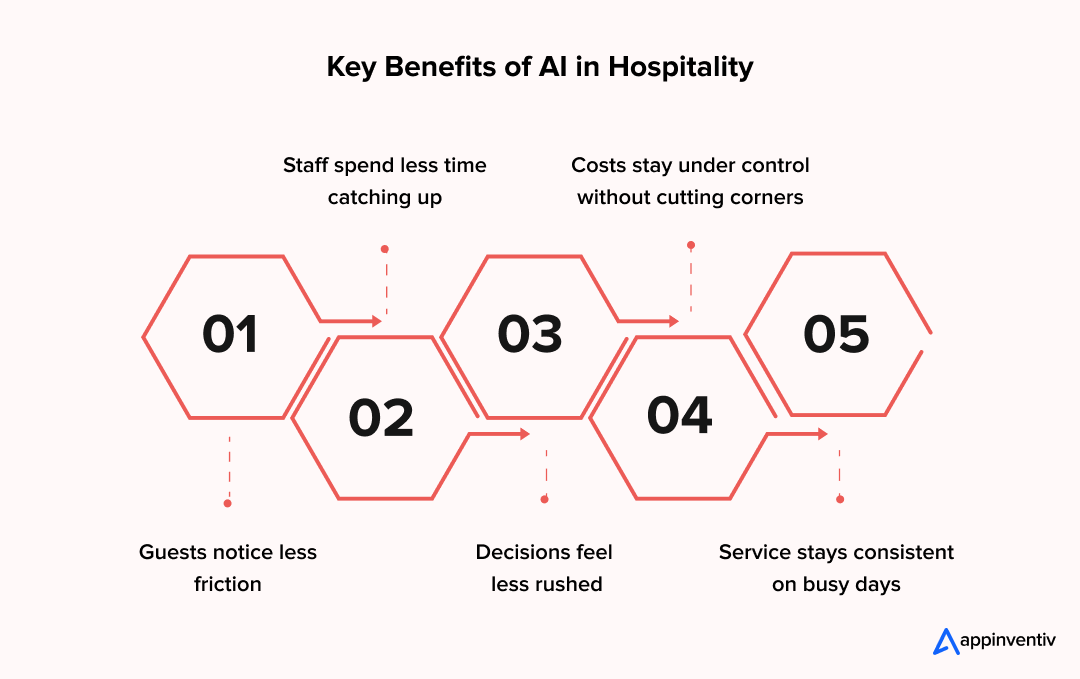
That’s where AI tends to help the most.
- Guests notice less friction: Things move along without repeated questions or delays. Check-ins feel calmer, service requests don’t disappear, and small issues get resolved before they spoil the stay.
- Staff spend less time catching up: When schedules, housekeeping priorities, and guest messages line up with real demand, teams stop firefighting and start focusing on the people in front of them.
- Decisions feel less rushed: Instead of reacting late, teams see patterns forming earlier. That makes planning feel steadier, even on days when the hotel is full.
- Costs stay under control without cutting corners: Energy use, supplies, and staffing adjust quietly based on how the property is actually being used, not on rough estimates.
- Service stays consistent on busy days: When demand spikes, the experience doesn’t fall apart. Guests feel the same level of care whether the hotel is half full or fully booked.
AI doesn’t change what hospitality is about. It simply helps the operation hold together when things get busy, which is usually when it matters most.
Practical AI Use Cases Shaping Modern Hospitality Operations
During peak hours at the front desk, operational pressure builds quickly. Check-ins overlap with guest requests, housekeeping coordination, and performance tracking. It’s in these moments that teams realize their current setup may not scale.
Below is the refined and expanded set of 30 AI use cases in hospitality, written in a grounded, practical tone so leaders can see how each one plays out in real operations.
1.Predictive Maintenance
AI-powered software for hospitality learns how equipment behaves before it fails through predictive analytics. Subtle changes in usage patterns or sensor data flag issues long before a guest reports a problem. This gives engineering teams time to intervene quietly rather than respond to urgent calls during busy periods.
The result is fewer service disruptions reaching guests. Maintenance becomes planned work instead of emergency work, which also reduces staff burnout. Over time, assets last longer, and maintenance costs become more predictable.
2.Personalized Recommendations
AI in hospitality monitors how guests respond during their stay. Dining choices, amenity usage, and timing all shape what gets recommended next. Suggestions change as the stay progresses rather than being fixed at booking.
Guests experience these recommendations as thoughtful rather than scripted. A well-timed suggestion often leads to a small but memorable moment. That sense of being understood is what drives repeat visits.
3.On-the-spot language support
Conversational AI in hospitality removes friction in multilingual environments. Staff and guests communicate clearly in real time, even during high-pressure moments like billing questions or service recovery. Nothing gets lost in translation.
This builds confidence on both sides of the conversation. Staff do not hesitate or escalate unnecessarily, and guests feel respected. The experience stays calm, even when the situation is not.
4. Intelligent Housekeeping Routing
AI in the hospitality industry tracks how the day unfolds. Early departures, extended stays, last-minute service requests, and delayed arrivals are all factored in as they happen. Room priorities shift automatically, instead of being locked into a morning plan that becomes outdated by noon.
For housekeeping supervisors, this removes constant firefighting. Teams spend less time walking back and forth or redoing schedules, and more time finishing rooms on time. Turnover stress during peak checkout windows drops because priorities stay aligned with reality.
5. Guest Sentiment Tracking
AI-powered software for hospitality does not wait for post-stay surveys to surface problems. It reads in-stay messages, reviews drafts, and feedback signals as they form. When frustration starts to build, teams catch it early rather than discover it after checkout.
This allows service recovery to happen while it still matters. Small gestures or quick fixes often prevent negative reviews entirely. Guest experience management becomes proactive rather than damage control.
5. Faster Guest Check-in
AI simplifies check-in by learning which steps slow guests down and which ones are usually repeated. Routine details are handled automatically, so arrivals move faster without losing personalization. The process feels smoother, not robotic.
For front desk teams, this changes the pace of the shift. Instead of rushing through forms, staff can focus on welcoming guests and answering real questions. Peak arrival periods feel more controlled and less chaotic.
6. Targeted Marketing Triggers
AI in marketing watches how guests interact across booking, pre-arrival, and in-stay touchpoints. It learns what a guest responds to and when, instead of blasting the same message to everyone. Communication is triggered by behavior, not calendars.
Guests notice when messages feel relevant. Engagement improves because timing makes sense. Marketing stops feeling noisy and quietly supports the guest journey in the background.
7. Smarter Inventory Control
AI-powered inventory management in hospitality systems learn consumption patterns across food, linens, amenities, and supplies. Instead of fixed reorder points, inventory decisions adjust based on upcoming demand and historical usage.
This reduces waste without risking shortages. Storerooms stay lean, and operations remain uninterrupted. Procurement becomes more predictable and less reactive. Nd less time fixing yesterday’s numbers and more time understanding today’s priorities.
8.AI-powered virtual tours
It allows hospitality brands to showcase rooms, venues, and amenities through immersive, interactive experiences. Guests can explore spaces before booking, reducing uncertainty and improving decision-making.
When combined with AI-powered chatbots in hospitality, these tours deliver real-time, personalized assistance answering questions about pricing, availability, and amenities instantly. With AI automating 360-degree tour creation and chatbot-driven interactions, virtual tours become a powerful tool to boost engagement and drive bookings
9.Revenue Forecast Updates
AI in hospitality updates revenue forecasts as booking behavior shifts throughout the week. Cancellations, pickup speed, and pricing changes are reflected in near real time, not at fixed reporting intervals.
Leadership decisions stay aligned with reality. Pricing, staffing, and marketing adjust based on current signals instead of outdated assumptions. Forecasts become tools for action, not just reporting.
10. In-Room Voice Assistants
Most guests don’t want to learn another system when they enter a room. They just want things to work. Voice assistants fit naturally into that expectation. A guest can dim the lights while unpacking, adjust the temperature without getting out of bed, or ask for towels without calling the front desk.
It feels less like using technology and more like speaking to the room itself. For hotel teams, this quietly cuts down routine calls and lets staff focus on requests that actually need attention.
11. Contactless Guest Experiences
Long lines at check-in are rarely about impatience. They’re about fatigue. After travel, guests want to get to their room without friction. Contactless check-in, including facial recognition where appropriate, helps remove that last hurdle. Returning guests are recognized, details are confirmed, and access is granted with minimal interaction.
The experience feels smoother and more respectful of a guest’s time, while staff can shift their energy from processing paperwork to actually welcoming people.

12. Workforce Optimization
Staffing is one of those things that looks simple on a schedule but feels very different on the floor. Some days, the lobby stays quiet longer than expected. Other days, arrivals pile up all at once. AI in the workforce helps by spotting these patterns early and adjusting schedules before teams feel the strain. Shifts line up more closely with how busy the hotel actually gets, not how busy it was supposed to be.
The result is fewer rushed moments, less overstaffing during slow hours, and teams that feel better supported when things pick up.
13. Housekeeping Automation
Housekeeping plans can fall apart quickly when guests check out early, extend their stay, or request service at odd times. AI helps keep things on track by updating room priorities as the day unfolds. Cleaners know which rooms matter most right now, not just what was planned in the morning.
Alerts surface when a room needs attention, and nothing gets missed between shifts. It doesn’t replace the team’s judgment. It simply keeps everyone aligned when the pace changes.
14. Smart Surveillance
Security in a hotel is mostly about awareness, not confrontation. AI-powered surveillance or monitoring helps teams notice when something feels off without constantly watching screens. Unusual movement patterns, restricted-area access, or behavior that doesn’t match the time or location are quietly flagged for review. This gives security staff a heads-up early, while guests go about their stay without feeling observed or disrupted.
15. Fraud Detection
Fraud rarely announces itself. It shows up in small inconsistencies, unusual booking patterns, or transactions that don’t quite add up. AI in fraud detection helps spot these signs early by comparing activity against normal behavior across channels. Legitimate guests move through without friction, while suspicious bookings are reviewed before they turn into chargebacks or losses. For finance teams, this means fewer surprises after the stay is over.
Taken together, these AI use cases show how hospitality operations are becoming more adaptive, coordinated, and guest-focused without adding complexity. The value lies in removing friction from daily work while making decisions faster and more reliably.
Let’s move on to some real-world examples show how hospitality businesses are already applying these systems in live operations, where outcomes matter more than theory.
Real-World Examples of Businesses Leveraging AI in Their Hospitality Operations
As the hospitality industry embraces digital transformation, AI in hospitality is playing a vital role in reshaping services and operations. Here are some real-world AI in the hospitality industry examples of leading brands that are successfully leveraging this technology to enhance their services and streamline their operations.
1. Hilton’s AI Concierge and Smart Service
Hilton has been one of the more public examples with its AI-powered solutions in hospitality, including robotics like Connie at concierge desks that help answer guest questions and provide recommendations around the clock. This is part of a broader move to speed up responses and enrich guest experiences.
2. Marriott’s Personalization and Analytics Engines
Marriott uses AI-powered software for hospitality, chatbots, and analytics to handle routine inquiries and tailor recommendations based on guests’ past stays. This helps not only in creating a smoother guest journey but also in boosting direct bookings and loyalty.
3. InterContinental Hotels Group (IHG) Digital Concierge Tools
IHG has expanded its digital concierge and voice assistant offerings. Their platforms provide real-time travel help, smart room controls, and personalized suggestions that keep guests engaged and serviced through mobile apps.
4. Singapore Hotels Using AI for Back-Office and Energy Efficiency
In markets like Singapore, hotels are integrating AI in hospitality management across guest communications, housekeeping, predictive maintenance, and energy management. Some properties use IoT sensors and AI technology in the hospitality industry together to lower HVAC costs by up to 30 percent and free teams from manual monitoring.
5. Travel Operators Using AI to Aid Planning and Engagement
It’s not just hotels. Travel firms like Tui are leveraging AI in travel and hospitality to generate engaging content, such as “inspirational” travel videos and voice/chat agents to support trip planning, bringing personalized, AI-powered solutions in hospitality into the broader travel journey.

What are some Key Considerations When Implementing AI for Hotels?
When a hotel decides to bring AI into daily operations, a few practical checks can make the rollout much smoother.
- Data readiness: AI in the hospitality industry only works well when your data is organized. Make sure your PMS and guest profiles are clean and complete.
- System compatibility: Confirm that the AI-powered software for hospitality connects easily with your existing platforms. Smooth integrations keep the front desk and back office running without headaches.
- Team comfort: Your staff needs to feel confident using the new tools. A little upfront training helps everyone understand how AI technology in the hospitality industry supports their work.
- Guest privacy: Be clear about how guest data is used. Simple transparency builds trust and avoids concerns about personalization going too far.
- Security and compliance: Check that your vendor follows strong security practices and meets industry requirements. Hotels cannot take chances with sensitive data.
- Budget and long-term value: Look beyond the subscription. Factor in training, support, and future upgrades so you know the real cost.
- Scalability: If you manage multiple properties, choose a system that can expand as you grow without starting over.
- Ongoing optimization: AI in the hospitality industry improves over time. Regular reviews help you adjust settings and keep the system aligned with guest expectations.
Also Read: AI for Enterprise – Transforming Business with Intelligence
How to Overcome Hospitality Challenges with AI
When a hotel starts exploring AI in hospitality, the first reaction is usually a mix of curiosity and a little excitement. Then reality steps in. Anyone who has tried introducing a new system during a fully booked week knows how quickly one small hiccup can slow down an entire shift. None of these challenges is a deal-breaker, but they do need a bit of attention before teams dive in.
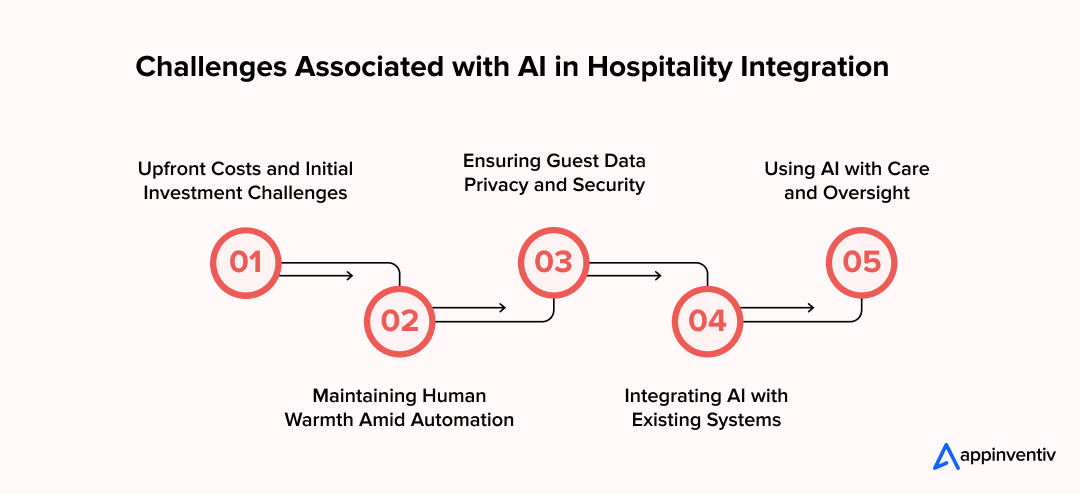
- Upfront costs feel heavy: New tech almost always comes with a noticeable price tag. Software, setup, training, it all adds up. Many hotels soften the impact by starting with subscription-based tools. It gives them room to test what works without committing to a large investment on day one.
- Keeping the human warmth intact: Guests still want eye contact, a smile, and a sense that someone is paying attention to them. If too much gets automated, the stay can feel oddly distant. A simple way around this is to let AI-powered software for hospitality take care of routine tasks, so your staff has more space for the conversations that actually build relationships.
- Protecting guest information: AI in the hospitality industry works with sensitive data, and guests expect you to keep that information safe. Robust data privacy, security, and regular checks go a long way. It also reassures your team that the system is behaving the way it should behind the scenes.
- Fitting AI into older systems: Most hotels rely on platforms that have been around for years. Adding something new can feel like trying to plug modern equipment into an outlet that doesn’t quite match. Choosing tools that integrate cleanly, or using a hotel management system software that helps systems communicate, keeps things from breaking during a busy day.
- Using AI with care: AI technology in the hospitality industry needs guidance just like any new team member. It must be checked for fairness and trained on varied, accurate data. Small adjustments over time help it stay balanced and useful.
A growing number of hotels are managing costs by adopting AI as a Service (AIaaS) models that allow gradual scaling without heavy upfront investment. At Appinventiv, similar flexibility is achieved by designing customised AI engagements that let hospitality teams start small, validate value early, and scale capabilities in line with operational readiness.
Impact of AI in the Hospitality Industry
The impact of AI in hospitality doesn’t show up as a dramatic change overnight. It shows up in how smoothly a hotel runs on busy days and how little guests notice when things could have gone wrong. When AI is used thoughtfully, it becomes part of the rhythm of daily operations rather than a visible layer of technology.
Some of the most meaningful impacts are easy to spot in practice:
- Guest experiences feel more effortless: Fewer delays, quicker responses, and service that adapts as the stay unfolds.
- Teams work with less pressure: Staffing, housekeeping, and service requests align better with actual demand.
- Decisions improve without slowing teams down: Patterns surface earlier, helping managers act before small issues grow.
- Operations stay steady during peak periods: Service quality holds even when occupancy spikes or schedules shift.
The real impact of AI in hospitality is quiet. Guests feel looked after. Teams stay focused. And the operation holds together when it matters most.
Future Trends of AI in Hospitality
Spend a little time with a hotel team, and you can sense a quiet shift happening. Guests expect things to feel smoother, a little more personal, and far less manual. AI in hospitality is slowly finding its place in that world, not as something flashy, but as a set of tools that help properties deliver those small touches guests remember.
Here is how this evolution is starting to show up in real ways:
Generative AI Integration
Picture a room that adjusts itself without a guest touching a thing. Lights soften in the evening, playlists change with the weather, and dining ideas pop up that actually match what the guest likes. Generative AI in hospitality is bringing that level of intuition into hotels. It can even help create custom travel guides or make conversations easier for guests who prefer a different language.
IoT Integration for Smart Hotel Rooms
With IoT devices quietly talking to each other, hotels don’t need to ask guests about every preference. Temperature, lighting, and even blinds can shift based on patterns the system notices. The goal isn’t to impress guests with gadgets. It’s to make the room feel comfortable without effort. The amalgamation of IoT and artificial intelligence in the hospitality industry will help enhance the overall comfort without guest intervention.
AR and VR are helping guests with an experience before they book
More travelers want certainty when choosing a room. Virtual walk-throughs give them a sense of space, views, and amenities long before they arrive. It feels a bit like visiting the property early, just enough to build confidence in their choice.
Advanced Data Analytics for Operational Efficiency
Behind the scenes, hotels deal with constant changes. Occupancy rises, and dips, staff availability shifts, and operational costs move with it. AI in the hospitality industry can keep track of all this in real time and highlight what needs attention. A small suggestion at the right time can save hours of scrambling later.
Voice-Activated Assistants for In-Room Services
As guests grow more comfortable talking to voice assistants at home, using one in a hotel room feels natural. Asking for towels, adjusting the temperature, or getting a quick answer becomes easier. And it frees up staff for things that need a personal touch.

Personalized Marketing
Instead of sending broad offers, AI in hospitality can help hotels understand what past guests actually enjoyed. Messages feel more tailored and less like a blast sent to everyone.
Real-Time Feedback and Reputation Management
Hotels often discover issues after a guest has left. With AI tools watching reviews and comments in real time, teams can step in while the guests are still on the property. Fixing something immediately often turns a neutral stay into a memorable one.
Harness the power of AI in the hospitality industry by partnering with Appinventiv.
We hope our blog helped you understand the importance of AI for your hospitality business. As a dedicated AI software development company, we can help you enhance your hospitality services with artificial intelligence, drawing on our robust experience and portfolio of successful AI projects. Our team is proficient in the latest AI trends and technologies, designing solutions that integrate seamlessly into your existing operations to boost both efficiency and guest satisfaction.
Additionally, our healthcare AI development services experts are skilled in deploying AI applications that can transform guest experiences and streamline backend operations for your business. We can help you develop smart systems for personalized room environments, efficient data-processing software for strategic decision-making, and AI chatbots for real-time customer service enhancements.
S Our AI work spans industries where reliability, personalization, and real-time decision-making are critical. For flynas, we built AI-led data-driven systems to support operational intelligence and customer experience at scale. With MyExec and VYRB, we delivered AI-powered solutions that streamline workflows and enable intelligent, personalized engagement, demonstrating our ability to deploy AI systems in live, complex environments.
Get in touch to equip your hospitality business with software that meets current technological standards and sets new benchmarks for personalized service.
FAQs
Q. Which AI agents are top in hospitality?
A. Some of the best AI agents in hospitality applications today are designed to make guest experiences smoother and more personalized. Take Hilton’s Connie, for example. It’s an AI-powered concierge that’s available 24/7 to help guests with everything from restaurant suggestions to local activities. These kinds of AI applications in the hospitality industry are popping up everywhere, from chatbots answering common questions to voice-activated systems enhancing in-room services.
Q. How Appinventiv Helps Hospitality Brands Build Tailored AI Solutions
A. At Appinventiv, we specialize in custom AI software development for the hospitality industry. We help hospitality brands develop AI-powered solutions in hospitality that elevate guest experiences, streamline operations, and improve business efficiencies. Our expertise extends to AI in Hospitality app development and AI-based Hospitality Software Development, ensuring seamless integration of conversational AI in hospitality to enhance guest interactions and back-end processes.
Q. How is AI used in the hospitality industry?
A. The use of AI in the hospitality industry is growing rapidly, and its applications are varied. From AI customer service in hospitality, like chatbots and AI-driven concierge services, to AI automation in hospitality, AI is used for managing operations, guest preferences, and dynamic pricing. AI in the hospitality industry helps hotels improve operational efficiency and deliver personalized services that make guests feel valued.
Q. How to choose AI Tools for Your Hospitality Business?
A. When selecting AI tools for your hospitality business, it’s crucial to focus on solutions that align with your operational needs. Tools like AI-powered software for hospitality automate everything from check-ins to personalized guest interactions. Integrating AI into hospitality software development is a smart move, allowing you to optimize processes, increase engagement, and improve guest satisfaction with minimal effort.
Q. How Appinventiv’s Enterprise AI Platform Is Powering the Future of Hospitality?
A. Appinventiv’s enterprise AI platform for hospitality helps businesses build AI-powered solutions in hospitality that scale effectively. With our expertise in AI in Hospitality app development and AI-based Hospitality Software Development, we ensure smooth integration of AI automation in hospitality to enhance guest interactions and streamline hotel operations. Our platform provides smart solutions that meet the evolving demands of the hospitality industry.
Q. How much does it cost to develop an AI Hospitality Software app?
A. The cost of developing an AI Hospitality app can vary depending on complexity, features, and integrations. Typically, developing AI-powered hospitality software can range anywhere from $40,000 to $400,000. The investment depends on what you need whether it’s AI-driven customer service, predictive maintenance, or personalized guest experiences, AI in hospitality can offer significant ROI in the long run.
Q. Can AI replace human employees in the hospitality industry?
A. While AI in hospitality can automate routine tasks, like guest check-ins, inquiries, and room adjustments, it doesn’t replace the need for human interaction. Instead, AI automation in hospitality frees up hotel staff to focus on more personal guest experiences. AI tools like conversational AI in hospitality help guests while supporting staff in delivering better service.
Q. How can AI improve guest experiences in hotels?
A. AI-powered solutions in hospitality can improve guest experiences by offering personalized recommendations based on past stays and preferences. Through the use of AI in the hospitality industry, guests can enjoy smart room features, personalized dining suggestions, and efficient check-ins. AI in the hospitality industry ensures every aspect of the stay feels seamless and tailored.
Q. What to expect from AI in the hospitality industry in 2026?
A. In 2026, AI in hospitality is expected to be fully integrated into the guest experience. AI trends in the hospitality industry in 2026 will center on improving personalization and operational efficiency. Expect AI to play an even larger role in AI-powered software for hospitality, including AI-driven automation of housekeeping and maintenance schedules. The future of AI in hospitality will also see advancements in AI-based Hospitality Software Development and AI in Hospitality app development, further enhancing the guest experience.


Fast 2-minute response, fully NDA-protected.
AI Governance in Healthcare: Framework, Development Process, Costs & ROI
Key takeaways: Only 29% of surveyed health systems enforce inventory tracking, data lineage, and sign-off policies, revealing a governance maturity gap. Regulatory registries recorded 1,430 artificial intelligence medical devices authorized through 2025, with 331 clearances granted during 2025 alone. Risk-tiered governance matches oversight directly to clinical impact, software autonomy, data sensitivity, model risks, and vendor…
AI Agents vs. Agentic AI: How AI Is Moving from Automation to Autonomy
Key takeaways: AI agents and agentic AI overlap, with agentic behavior defined by how systems plan, adapt, and pursue broader goals. Enterprise agentic architectures add orchestration, state management, tool routing, durable execution, evaluation, and policy controls. Production AI development requires LLMOps, model routing, fallback strategies, deterministic services, observability, and failure recovery. Multi-agent architecture is one…
Key Takeaways Design your system architecture around clean sensor data, hybrid edge-cloud computing, medical record connections, and continuous algorithm monitoring. Handle diverse wearable devices using unified data schemas, real-time message channels, signal filters, and dedicated hardware adapters. Stream wearable metrics into hospital databases using FHIR standards, HL7 protocols, identity matching, and background middleware. Test AI…