































AI Solutions for Enterprise: How Businesses Are Scaling Intelligence Across Operations

 Share -


- 01Why the Enterprise AI Market Is Accelerating Faster Than Expected
- 02Enterprise AI Development Process That Scales Beyond Pilots
- 03Build vs Buy Decisions for AI in the Enterprise
- 04Selecting Enterprise AI Platforms That Support Long-Term Scale
- 05AI Architecture for Enterprise Applications at Scale
- 06End-to-End Enterprise AI Solutions That Drive Business Outcomes
- 07Benefits of Enterprise AI: Measurable Impact Across Operations, Decisions, and Growth
- 08High-ROI AI Applications Your Enterprise Should Prioritize
- 09Why Generative AI Is Becoming a Business Priority for Enterprises
- 10Real-World Enterprise AI Use Cases: Driving Business Transformation
- 11Calculating Total Investment and Expected ROI
- 12Enterprise AI Implementation Challenges That Stall Scale
- 13The Future of AI in Enterprise Solutions
- 14How Appinventiv Powers AI Innovation for Enterprises and Custom Development
- 15FAQs

Key takeaways:
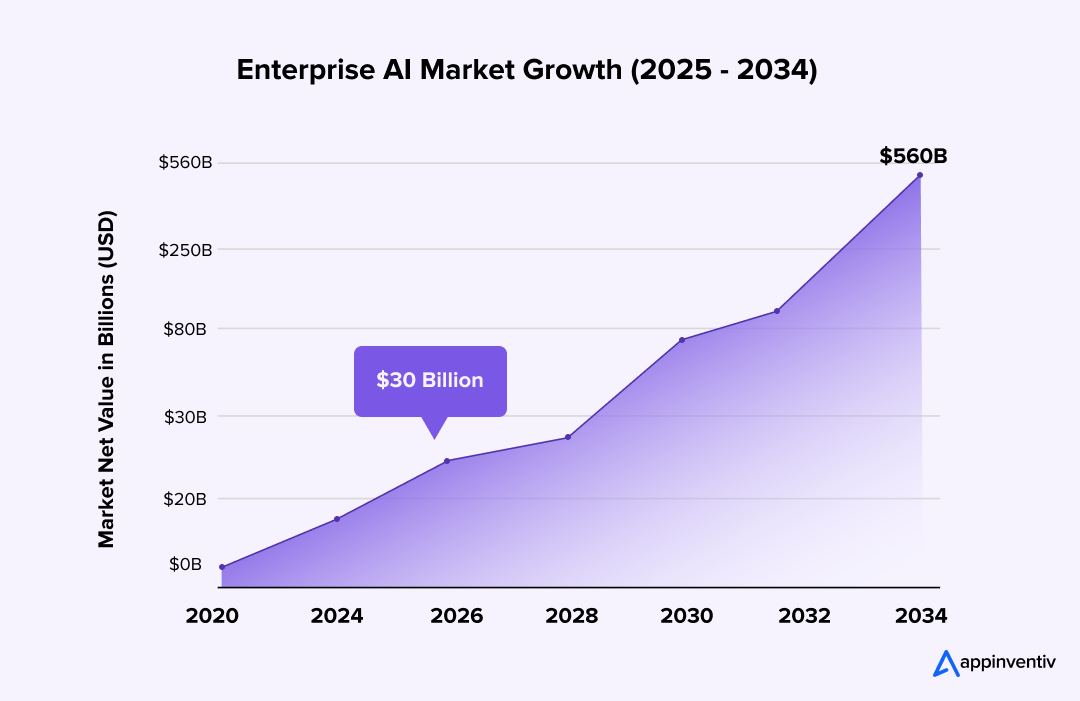
- Enterprise AI will grow from $20B to $560B by 2034, yet only 15% scale successfully despite widespread pilots.
- An execution-focused roadmap for moving enterprise AI from pilots to production, covering build-vs-buy decisions, platform selection, governance, and ROI tracking.
- Core enterprise AI challenges, including data quality, skills gaps, legacy systems, and governance, with practical fixes.
- Custom AI results include 10,000 hours saved at Toyota, 400 maintenance tasks avoided at Rolls-Royce, and 40% higher occupancy at Ility.
Listen to how enterprise teams talk about AI today and one thing stands out. This is no longer a future bet sitting with innovation groups. AI is already shaping how decisions are made, how teams operate, and how competitive advantage is created.
The market reflects that reality. Adoption of AI for the enterprise is accelerating, with the market valued at $30 billion in 2026 and projected to reach $560 billion by 2034. What enterprises are buying now is not experimentation. It is execution that leads to measurable outcomes.
Yet execution is where most efforts slow down. Nearly 90% of organizations are experimenting with AI for enterprise, but only about 15% have scaled it successfully. The cracks usually appear after pilots. Models that look strong in isolation struggle once real data, legacy systems, compliance rules, and everyday workflows enter the picture. ROI expectations often fall apart late, when changes become harder to fix. Off-the-shelf platforms rarely help at this stage. Built for general use, they seldom match how large organizations actually operate or support artificial intelligence for enterprise applications at production scale. That is why many teams move toward custom approaches, including generative AI for enterprises, designed around proprietary data and real processes.
This guide breaks down how to approach enterprise AI development with clarity, from build-versus-buy decisions to scaling AI without disrupting day-to-day business.
Nearly 90% of enterprises are experimenting with AI, but only 15% scale successfully. Build AI solutions designed for production, adoption, and measurable ROI.
Why the Enterprise AI Market Is Accelerating Faster Than Expected
If you listen to how budgets are discussed today, AI no longer comes up as a side experiment. It shows up as a commitment. Something teams are expected to deploy, scale, and justify.
Enterprise AI spending is moving fast. Faster than almost any other software category. What began as limited pilots has turned into real ownership across product, IT, and leadership teams.
According to a recent report, enterprise generative AI spend reached about $37 billion in 2025. That is more than 3× year-over-year growth, a pace rarely seen in enterprise software.
In just three years, enterprise AI now accounts for roughly 6% of total global software spend. At this point, AI is no longer treated as an add-on. It is becoming a core layer of enterprise software strategy.
Where the money is going matters:
How enterprises are allocating AI spend
- Over $19 billion, more than half of total enterprise AI spend, is going into AI applications rather than experimentation.
- The fastest growth is tied to productivity use cases like coding assistants, customer support automation, sales enablement, and knowledge management
- Infrastructure investment continues, but buyers are prioritizing tools that show immediate operational impact
What stands out is intent. Enterprises are funding AI systems that can be deployed, measured, and tied to real workflows.
In the end, enterprise AI is moving from optional innovation to foundational capability, reshaping how organizations plan, spend, and achieve long-term competitiveness.
Enterprise AI Development Process That Scales Beyond Pilots
Most enterprises do not fail at AI because they lack ideas. They stall because pilots never turn into something people actually use. With North America remaining the largest AI market and Asia emerging as the fastest-growing, the pressure to move beyond experimentation and into real adoption is becoming more pronounced.
The teams that succeed follow a clear process from the first conversation to daily AI adoption in the enterprise, making sure it fits real work instead of sitting idle on computer servers.
A structured approach keeps everyone aligned. It reduces guesswork, avoids rework, and makes it easier to see what value AI is creating as it moves across the organization.
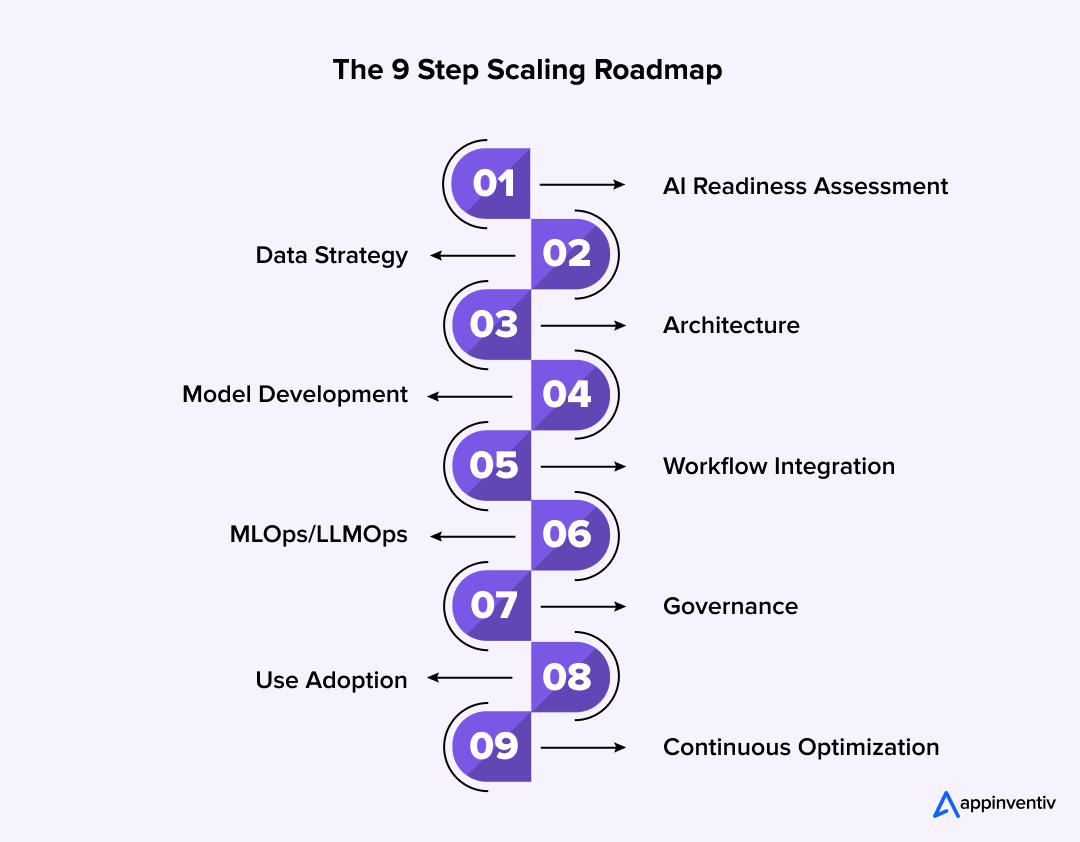
Step 1: Business Problem Definition & AI Readiness Assessment
AI works best when it starts with an actual problem someone feels every day.
- Look for workflows that slow teams down, drive up costs, or create risk
- Agree on what success means, such as faster turnaround, fewer errors, or clear ROI
- Check whether the right data exists and if compliance rules affect usage
Outcome: Clear use cases tied to business results people care about
Step 2: Data Strategy & Foundation Setup
This is often where momentum slows, even if no one expects it.
- Review where data lives across teams and systems
- Clean and prepare the datasets that matter most
- Set rules for who owns the data and who can access it
- Decide if updates need to happen in real time or in batches
Outcome: Data that teams can trust and models can rely on
Step 3: Architecture & Platform Design
Early choices around AI tools for enterprise software development tend to stay around longer than planned.
- Decide between cloud, on-prem, or hybrid based on security and scale needs
- Select platforms like AWS, Azure, GCP, Databricks, or Snowflake
- Plan how AI integrates with ERP, CRM, and older systems
- Factor in cost control, scalability, and vendor flexibility
Outcome: A foundation that supports growth without constant rework
Step 4: Model Development & Customization
This phase of AI development in enterprises is where artificial intelligence starts to feel specific to your business.
- Choose the right approach, from ML to LLMs or agents
- Train models using your own data, not just generic examples
- Add safeguards for accuracy, bias, and explainability
- Test models using real scenarios that teams deal with every day
Outcome: Models that reflect how the business actually operates
Step 5: Application Development & Workflow Integration
AI only matters when it shows up where work happens.
- Embed AI into tools people already use
- Build simple interfaces, dashboards, or chat-based access
- Respect approval steps and role-based permissions
- Design experiences that feel clear and predictable
Outcome: AI that supports work instead of interrupting it
Step 6: MLOps/LLMOps & Production Deployment
This step decides whether AI holds up under real use.
- Set up pipelines to deploy and update models safely
- Monitor accuracy, speed, and cost as usage grows
- Enable rollback when changes do not behave as expected
- Keep logs for visibility and accountability
Outcome: AI systems that stay stable after launch
Step 7: Governance, Security & Compliance Controls
Trust matters more at scale than speed.
- Control who can access models and data
- Use explainability and human review where needed
- Align with GDPR, HIPAA, SOC 2, and industry rules
- Keep documentation ready for audits and reviews
Outcome: AI leaders feel comfortable scaling
Step 8: Change Management & User Adoption
People decide whether AI succeeds.
- Train teams on how AI fits into their day
- Be clear that AI supports roles rather than replacing the
- Roll out gradually, starting with teams open to change
- Listen to feedback and adjust
Outcome: Adoption that grows instead of fading
Step 9: Optimization, Scaling & Continuous Improvement
AI does not stay still, and neither should the business.
- Extend AI into related workflows
- Improve performance, cost efficiency, and accuracy
- Add automation and agent-based processes over time
- Review ROI and impact regularly
Outcome: AI that evolves alongside the organization, not behind it
Build vs Buy Decisions for AI in the Enterprise
Strategic AI development for enterprise solutions becomes essential when AI is central to the competitive edge. Others buy to move quickly. Most adopt a hybrid approach, using platforms for standard needs while building proprietary models where differentiation truly matters.
Choosing the Right AI Development Model for Enterprises
| Factor | Build | Buy | Hybrid |
|---|---|---|---|
| Time-to-Value | Slower start, long-term payoff | Fastest to deploy | Fast early, scalable later |
| Data Sensitivity | Full control (on-prem/private cloud) | Vendor-controlled | Sensitive data stays internal |
| Long-Term TCO | High upfront, lower over time | Low upfront, rising long-term | Balanced and predictable |
| Competitive Differentiation | High (proprietary models) | Low (shared capabilities) | High where it matters |
| Compliance Risk | Lowest (custom governance) | Higher (vendor-dependent) | Controlled and manageable |
Selecting Enterprise AI Platforms That Support Long-Term Scale
The best AI platforms for enterprise work are those that fit how teams already operate, rather than those with the longest feature lists.
Below is a clear look at the best AI platforms for enterprise development, shaping today’s landscape.
A. Hyperscaler Cloud AI Solutions for Enterprise
For many organizations, cloud providers are the natural starting point.
- AWS gives teams SageMaker for building and managing models, while Bedrock offers access to foundation models from providers like Anthropic and Meta.
- Microsoft Azure combines Azure OpenAI Service for GPT models with Azure Machine Learning to support deployment and monitoring.
- Google Cloud focuses on Vertex AI, with AutoML tools that help teams move faster when deep ML expertise is limited.
B. Unified Data and AI Platforms
When data is spread across systems, these platforms reduce friction.
- Databricks brings data engineering, analytics, and AI together through its lakehouse approach.
- Snowflake allows teams to run machine learning directly where data already lives using Snowpark, with Cortex supporting LLM-based workloads.
- Confluent focuses on streaming data, which supports time-sensitive use cases like fraud detection and pricing updates.
C. Specialized AI Development Platforms
Some AI software for enterprise vendors narrow their focus to model development.
- DataRobot automates model selection and tuning to shorten experimentation cycles.
- H2O.ai supports automated machine learning with strong operational controls.
- Scale AI concentrates on data labeling, which is critical for supervised learning projects.
D. Low-Code and No-Code AI Platforms
These tools are built for speed and accessibility.
- Stack AI helps business users create AI agents and workflows without writing code.
- Obviously, AI offers a simple interface for building predictive models.
E. AI Agent and Automation Platforms
Newer agentic AI for enterprise platforms focus on orchestration.
- LangChain supports AI for enterprise applications development with large language models.
- Temporal helps coordinate AI agents and external systems over long-running processes.
Also Read: How AI Agents are Driving True Value in the Enterprise
When evaluating AI for enterprise platforms, organizations typically map tools against four decision pillars: scalability, data gravity, governance maturity, and total cost of ownership over 3 to 5 years.
Although in practice, many enterprises discover that buying a platform is only part of the solution. Once real workflows and real data come into play, off-the-shelf tools often stop short of what the business actually needs.
That is where custom software development services for AI fit. Instead of reshaping processes to match a product, AI is built around how your teams already work and how your systems are structured.
At Appinventiv, we focus on making AI work inside existing environments. Our teams design and integrate solutions that scale with the business, stay flexible as priorities change, and meet enterprise security expectations from the start.
Whether the work involves custom models, complex data integration, or enterprise-specific tuning, the goal stays simple. Build AI systems that deliver value today and continue to support growth over time.
Move beyond pilots with AI solutions built around your data, workflows, and business goals.
AI Architecture for Enterprise Applications at Scale
AI infrastructure planning rarely stays confined to IT. It touches how money is spent, which vendors the company depends on, how audits are handled, and how quickly teams can respond when priorities change. That is why these conversations usually work best when leadership is involved early, before timelines and contracts harden decisions.
Cloud, Hybrid, or On-Premise
The infrastructure model you choose quietly shapes the entire AI journey.
- Cloud infrastructure is often the fastest way to get moving. Platforms like AWS, Azure, and Google Cloud make it possible to spin up environments quickly, scale when demand rises, and reach users across regions without building everything from scratch. The tradeoff shows up later in operating costs and long-term dependence on vendor pricing and product direction.
- On-premise deployment still plays a role in many organizations. Strict data residency rules, regulatory pressure, or internal security policies can rule out cloud processing altogether. This is common in financial services, healthcare, and government, where tighter control outweighs higher costs and longer setup times.
- Hybrid architectures sit between the two. Sensitive data and core systems remain on-premise, while cloud resources handle development work, testing, and less sensitive workloads. This approach adds coordination overhead, but it gives teams control where it matters and flexibility where it helps.
Data Architecture Requirements
AI outcomes are only as good as the data feeding the system.
- Unified data platforms that bring information together from multiple systems and reduce silos
- Data governance frameworks that define ownership, quality standards, and access rules before training begins
- Real-time data pipelines so models act on current information, not outdated reports
- Version control and lineage tracking to understand how data flows into models and how decisions are formed
When these foundations are weak, even strong models struggle to perform.
MLOps for Continuous Improvement
AI in the real world behaves differently from traditional software and needs tighter operational discipline.
- Automated retraining pipelines that refresh models as business conditions shift
- Performance monitoring to catch accuracy drift, bias, and unusual edge cases early
- Model versioning and rollback options so teams can recover quickly if updates cause issues
- Cost tracking to prevent inference and compute spend from creeping up unnoticed
Without these practices, confidence in AI systems erodes over time.
Also Read: Scaling AI Initiatives: Why MLOps Matters More Than DevOps
Responsible AI in the Enterprise and Governance Controls
The best enterprise data security solutions for AI work only when governance controls and responsible AI principles are built in from the start.
- Access controls that define who can use models, view training data, or change behavior.
- Audit trails that record model decisions for compliance checks and internal reviews
- Explainability tools that translate outputs into reasoning that business teams can understand
- Compliance automation that supports GDPR, HIPAA, SOC 2, and industry-specific standards
Adding these later usually slows progress and increases risk.
Platform Selection Criteria for AI Solutions for Enterprise
Choosing between AWS SageMaker, Azure Machine Learning, Google Vertex AI, or platforms like Databricks and Snowflake comes down to alignment, not popularity.
- How well the platform fits into your existing technology and data stack
- Support for the AI frameworks and model types your use cases require
- Geographic availability that matches where data and users actually sit
- Vendor stability and flexibility to avoid long-term lock-in
- Total cost of ownership across compute, storage, data movement, and support
The right architecture is not the most advanced on paper. It is the one that fits your organization’s risk tolerance, budget realities, technical maturity, and timeline, while leaving room to adjust as AI capabilities and business needs continue to evolve.
Also Read: AWS Vs Azure Vs Google Cloud – Which cloud platform should you choose for your enterprise?
AI Innovation for Enterprises Through a Modern Stack
Teams implementing AI in the enterprise quickly learn that it is not plug-and-play. Legacy systems, sensitive data, and audit requirements leave little room for shortcuts. To work at scale, AI needs strong governance, clean integration, and secure handling of proprietary data.
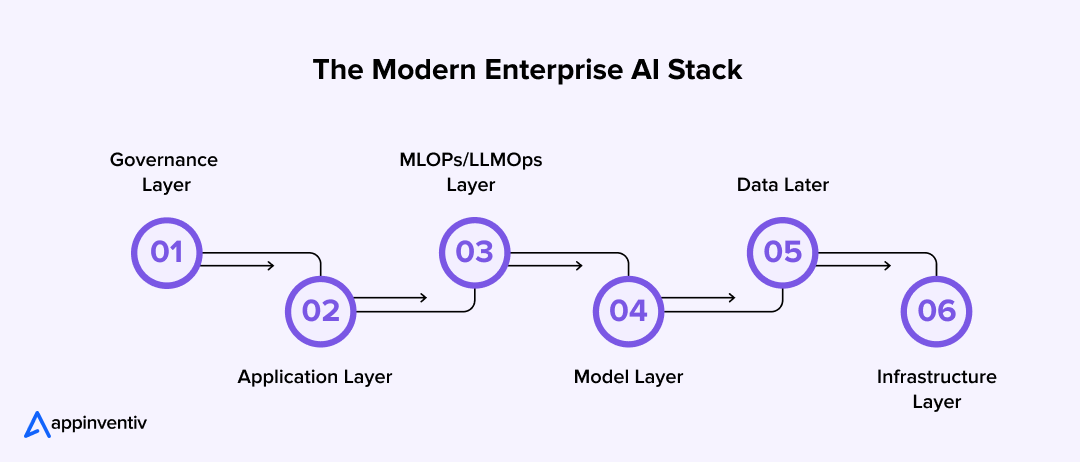
Modern enterprise AI is built in clear layers, each with a specific role:
- Infrastructure Layer: GPU-based compute, specialized hardware like NPUs and TPUs, and cloud environments that support training and real-time inference.
- Data Layer: Unified platforms, lakehouses, and vector databases that bring together structured and unstructured data from long-standing systems.
- Model Layer: Foundation models, domain-specific LLMs, and custom generative models tuned on enterprise data to reflect real operations.
- MLOps and LLMOps Layer: Tools that manage model versions, monitor performance, detect drift, handle retraining, and control costs once models are live.
- Application Layer: AI embedded into business tools, including enterprise chatbots, voice assistants, and conversational AI used by employees and customers.
- Governance Layer: Controls that ensure privacy, security, and compliance through audit trails, access management, explainability, and alignment with standards like GDPR, SOC, and HIPAA.
Together, these layers allow enterprises to scale AI confidently while staying compliant and in control.
End-to-End Enterprise AI Solutions That Drive Business Outcomes
Most enterprises do not invest in AI out of curiosity. They do it because something needs to move faster, cost less, or scale without adding friction.
When AI is built the right way, it shows up in everyday work. Decisions happen sooner. Operations run more smoothly. Teams stop relying on manual workarounds. AI development for enterprise growth focuses on building systems that operate reliably in real production environments, not controlled experiments.
Core AI Development Services for Enterprises
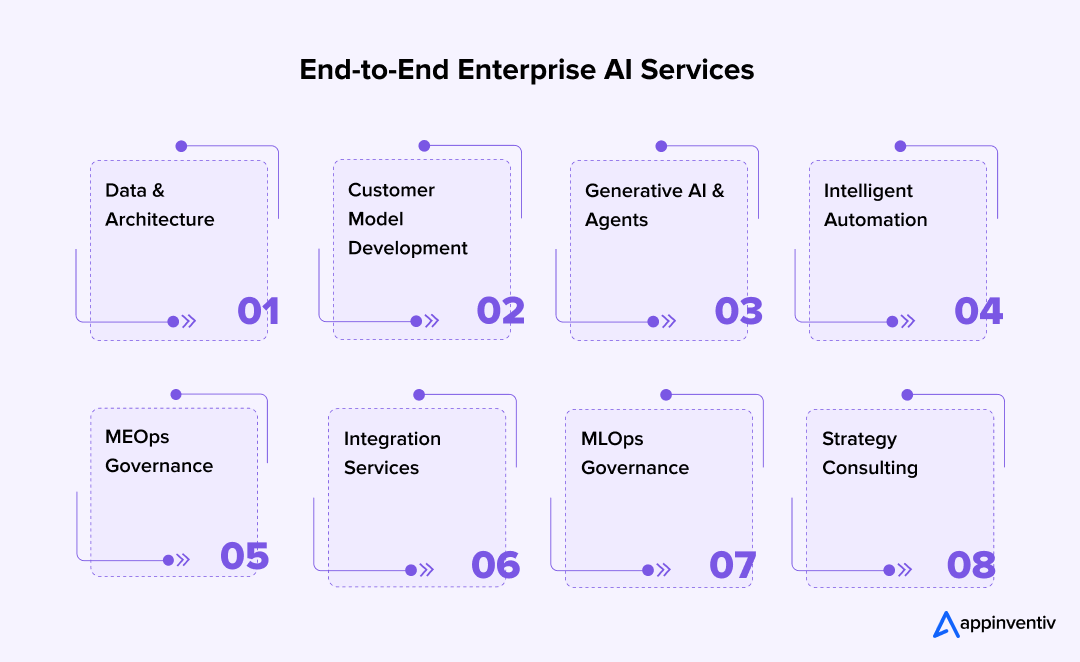
Enterprise AI programs usually combine several services, based on business goals, data readiness, and operating scale.
Custom AI Model Development
AI model development for enterprise environments focuses on training models with proprietary data so they reflect how the business actually operates. This improves forecasting accuracy, surfaces insights earlier, and helps teams act without waiting on static reports.
Also Read: How to Build an Intelligent AI Model: An Enterprise Guide
Generative AI for Enterprise Applications
Generative AI in business environment supports knowledge-heavy workflows. Chatbots, copilots, and internal assistants connected to enterprise systems reduce repetitive tasks, speed up responses, and scale expertise without increasing headcount.
Intelligent Automation and Agentic AI
These systems go beyond basic rules. AI agent development for enterprise environments enables intelligent automation, allowing agents to handle workflows that require context and judgment, adapt over time, and lower operational costs while improving consistency.
AI Integration with Enterprise Systems
Most enterprises keep their existing stack. AI integration examples include embedding AI into ERPs, CRMs, data platforms, and internal tools, extending value without disrupting daily operations.
AI Strategy, Consulting, and Governance
Clear strategy and governance address security, compliance, explainability, and risk early, giving leadership confidence to scale AI responsibly.
Capabilities Delivered Through Enterprise AI
Depending on industry and use case, enterprise AI services typically result in solutions such as:
- Generative AI and LLMs for copilots, agents, enterprise search, and knowledge automation
- NLP for chatbots, document analysis, summarization, and sentiment detection
- Machine learning for forecasting, classification, and pattern discovery
- Computer vision for inspection, monitoring, OCR, and visual analysis
- AI-ready data foundations that support secure, scalable AI operations
- MLOps and LLMOps for deployment, monitoring, retraining, and governance
Also Read: Why MLOps Matters More Than DevOps
Benefits of Enterprise AI: Measurable Impact Across Operations, Decisions, and Growth
Artificial intelligence for enterprise stops being a concept worth debating the moment it starts fixing things that have been broken for years. Decisions that took days because no one had a clean view of the data. Processes that moved slowly because three systems needed to be reconciled before anyone could act.
Teams spending real hours on work that should not require human attention at all. When AI gets embedded into how the business actually operates rather than sitting adjacent to it, that is when organizations begin to see returns worth talking about.
Accelerated Decision-Making Across the Enterprise
The challenge most leadership teams face is not a shortage of information. Reports exist. Dashboards exist. The gap is between what the data contains and what reaches a decision-maker in time to matter.
AI closes that gap by working across operational systems, transaction records, documents, and external signals at the same time, identifying what is shifting before it becomes a problem that needs managing rather than a trend worth acting on.
- Real-time analysis across enterprise data sources
- Predictive insights for planning and resource allocation
- Faster response to operational and market changes
Greater Operational Efficiency Through Intelligent Automation
Walk through any large enterprise and a pattern shows up fast: skilled people spending meaningful parts of their week on approvals, reconciliations, support queues, and status reporting.
None of it is unnecessary, but very little of it requires the judgment those people were hired to apply. AI-driven workflows handle the execution layer, route exceptions to the right teams, and free up human attention for decisions that actually warrant it.
- Reduced manual effort across business functions
- Faster process execution with fewer operational bottlenecks
- Improved productivity without proportional headcount growth
Higher Value From Enterprise Data Investments
The investment is already on the books. ERP systems, CRM platforms, data lakes, analytics infrastructure, most large organizations have spent years and significant budget building these out. What they often lack is a way to make these systems useful together.
Data sits in one place, context lives in another, and the people who need both to make a call have neither in one view. AI brings those layers together, fills the gaps between systems, and turns fragmented records into something a decision-maker can actually work with.
- Improved utilization of existing enterprise data assets
- Better visibility across business operations
- More accurate forecasting and performance analysis
Enhanced Customer and Employee Experiences
Friction in enterprise digital experiences tends to be invisible to the people who build systems and very visible to the people who use them. Customers who cannot find answers quickly. Employees running searches that return the wrong documents.
Support interactions that feel generic regardless of history. AI built into existing tools rather than added as a separate product changes that, making responses faster, search more precise, and interactions more relevant to the person on the other end.
- Personalized customer engagement at scale
- Faster access to enterprise knowledge and support
- Reduced friction across digital experiences
Stronger Risk Management and Business Resilience
Most operational and financial risk does not arrive as a single event. It builds slowly through patterns that only become obvious once the damage is done. A transaction cluster that sits just outside normal ranges.
A process that keeps running late in ways that individually look minor. A compliance posture that has drifted without anyone noticing. Continuous AI monitoring picks up those signals earlier, giving teams the chance to respond while the situation is still manageable.
- Early identification of operational and financial risks
- Improved fraud detection and anomaly monitoring
- Better support for governance and compliance initiatives
Scalable Innovation Without Replacing Existing Systems
Rebuilding the technology stack from scratch is not a realistic option for most enterprises, nor should it be. The systems running the business today took years to implement and still carry critical institutional logic.
The smarter path is layering intelligence on top of what already exists, connecting AI to the ERP, CRM, and legacy environments in place, and extending capability without requiring the business to pause while new infrastructure is stood up.
- AI integration across ERP, CRM, and legacy systems
- Faster adoption without large-scale system replacement
- A scalable foundation for agentic AI, machine learning, and future intelligent applications
The organizations getting the most from enterprise AI are not the ones running the most visible pilots. They are the ones that quietly rebuilt how decisions get made, how work moves through the business, and how their existing systems finally start working together.
High-ROI AI Applications Your Enterprise Should Prioritize
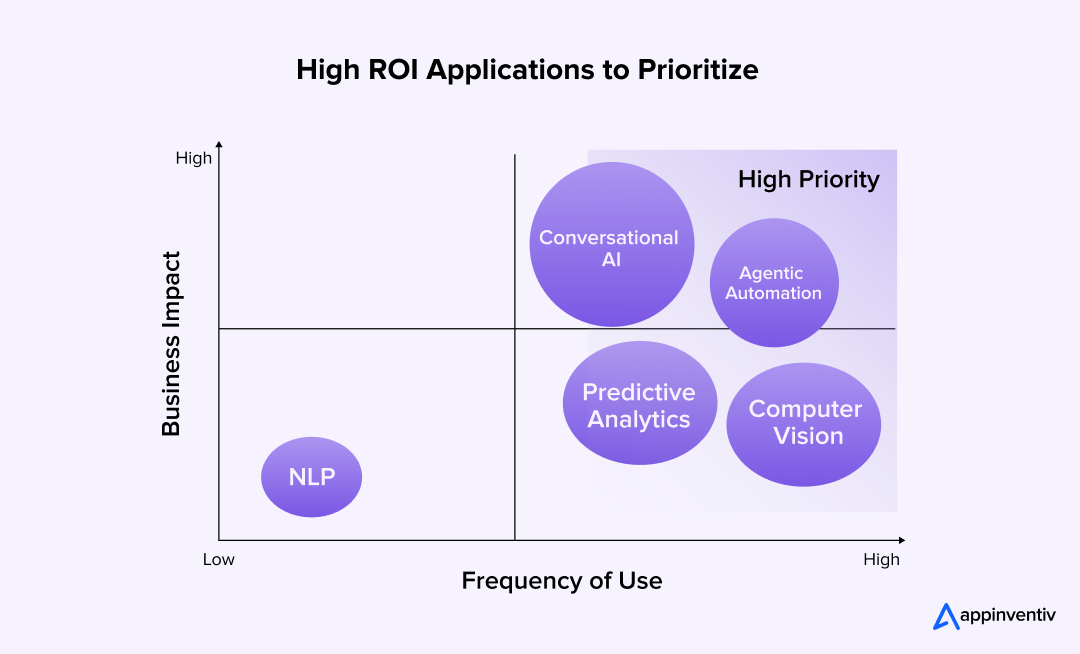
AI-powered solutions for enterprise deliver the strongest returns when investments follow measurable outcomes, not hype. In fact, 75% of workers report that using AI at work has improved either the speed or quality of their output, reinforcing why productivity-led use cases continue to win leadership buy-in.
The enterprise use cases for generative AI that consistently pay off share a few clear traits. They solve problems that occur frequently, fit naturally into existing workflows, and produce outcomes that leaders can measure with confidence. Across industries, the benefits of enterprise AI for organizations are most visible in three areas.
A. Conversational AI for Enterprise Customer Experience
An AI chatbot for enterprise environments is no longer a simple FAQ tool. When built properly, custom generative AI solutions for enterprise can handle back-and-forth conversations, pull live data, and hand off to a human only when needed.
Customer-Facing Applications
On the customer side, this reduces support load while improving experience. The best AI chatbots for enterprise customer support now resolve 60% to 70% of questions for enterprise support teams, around the clock and across languages. The real lift comes when chatbots connect directly to CRM systems, order platforms, and internal knowledge bases, so responses reflect the customer’s actual situation.
eCommerce Implementation
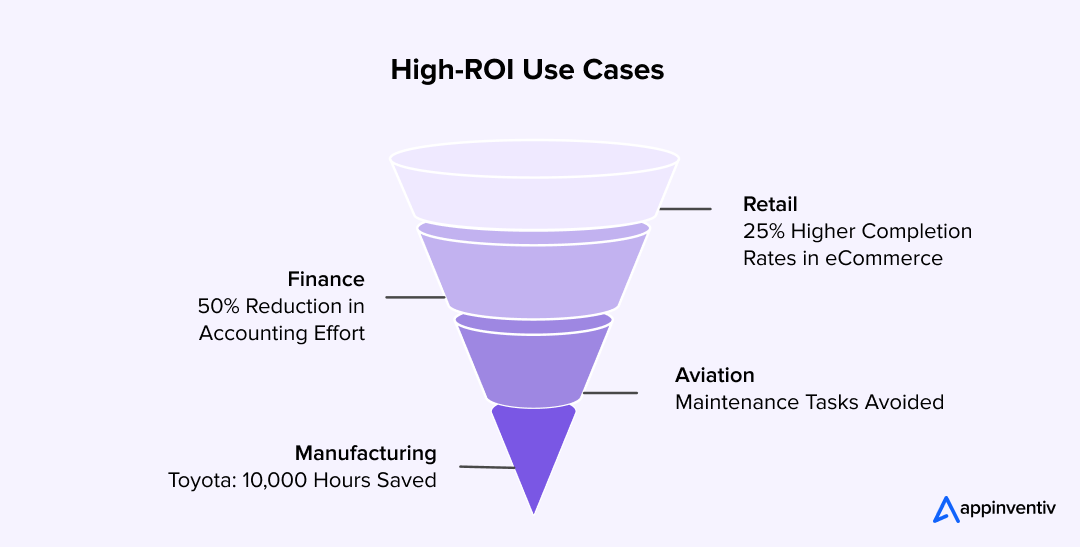
Strategic enterprise AI chatbot development for eCommerce delivers measurable revenue impact. An enterprise AI chatbot solution for websites answers product questions while customers browse, suggests alternatives when items are unavailable, and helps smooth checkout issues. Teams often see 15% to 25% higher completion rates when AI engages at the right moment.
Integral Operations
Inside the business, conversational AI for enterprise tools help employees move faster. Voice assistants and chat interfaces reduce time spent navigating complex systems. IT requests, HR questions, and internal knowledge searches become quicker when AI handles the routine questions that usually slow experts down.
B. Agentic AI for Enterprise Task Automation
An AI agent for enterprise environments goes beyond basic automation. Instead of following fixed rules, these agents make decisions based on context, handle exceptions, and manage multi-step processes with limited oversight.
Finance Automation
The best AI agents for enterprise finance solutions deliver fast returns for teams. AI agents can process invoices, reconcile expenses, and prepare regulatory reports continuously. Month-end close cycles shrink from weeks to days, and organizations report 40% to 50% reductions in accounting effort while improving accuracy.
Task Orchestration Platforms
The best AI agents for enterprise task automation help across departments through sophisticated orchestration. They route requests, collect approvals, and track progress without endless email threads. These systems learn from past actions, follow business rules, and escalate only when human judgment is required.
When evaluating the best enterprise AI agents for large businesses, the key question is timing. AI agents justify their higher upfront cost when processes involve messy data, require judgment, or change often. In those cases, maintaining rule-based automation becomes harder than letting agents adapt.
C. AI-Based Strategic Insights for Enterprises
AI-driven insights help organizations move from reacting to anticipating.
AI-Driven Business Insights for Enterprises
It changes how leaders plan. Models trained on internal data and market signals forecast demand, surface risks, and test scenarios. This allows teams to adjust sooner when conditions shift and commit with confidence when they hold steady.
Computer Vision Applications
Computer vision improves quality and compliance in manufacturing, logistics, and retail. Systems inspect products, verify steps, and monitor safety continuously. They catch issues humans often miss during long or repetitive shifts.
Natural Language Processing
Natural language processing unlocks value hidden in documents. Contracts, regulations, and customer feedback can be analyzed quickly. AI flags risks, extracts key terms, and routes information without manual review.
The AI applications that succeed tend to solve problems that are both costly and frequent. When that balance exists, automation compounds its value over time, and ROI becomes clear rather than theoretical.
Focus on intelligence-driven use cases that solve frequent, high-cost problems and scale cleanly across teams.
Why Generative AI Is Becoming a Business Priority for Enterprises
In many organizations, conversations about delayed decisions and overloaded teams now lead to the same place. Generative AI. It is no longer viewed as an experiment, but as a practical way to reduce manual work, bring consistency to outputs, and help teams move faster without adding complexity.
Generative AI for enterprises has become a priority because it works when applied to real workflows and proprietary data. With the right controls, it supports everyday decisions, scales knowledge across teams, and operates within existing governance models. The focus has shifted from testing ideas to delivering systems that hold up in production.
The next challenge is introducing generative AI into enterprise environments without disrupting how people already work.
Deploying Generative AI for Enterprises Without Disruption
Deploying generative AI in an enterprise is usually an incremental process shaped by security reviews, legacy systems, and operational constraints. Successful deployments treat generative AI as part of the enterprise stack rather than a standalone tool.
Production architectures typically combine retrieval-augmented generation, selective fine-tuning, encrypted vector stores, and autoscaled inference to balance accuracy, performance, and compliance.
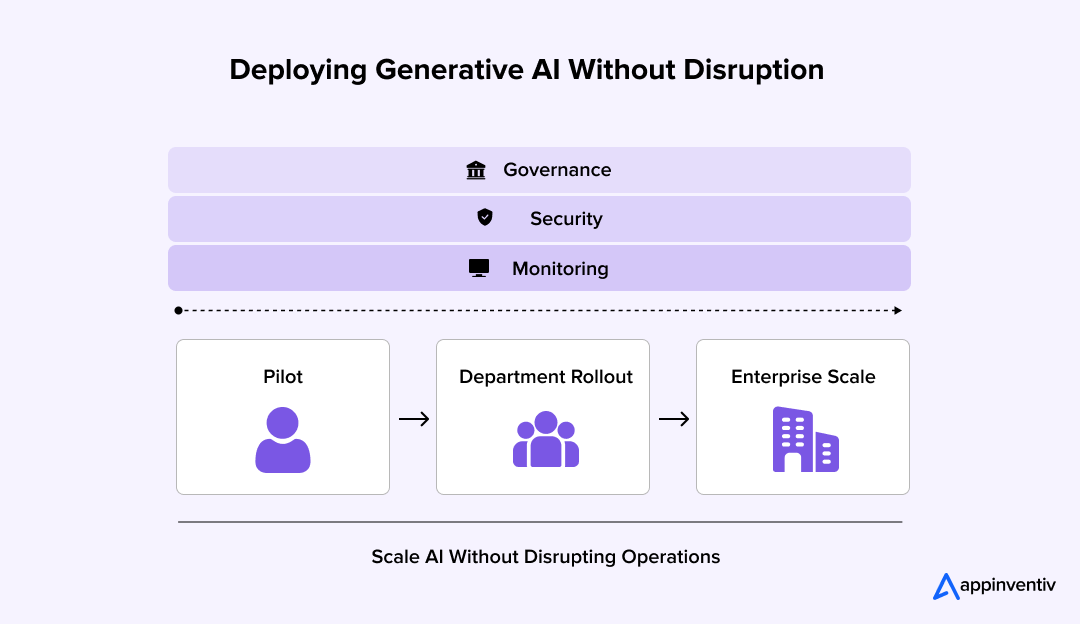
Key considerations to ensure smooth Generative AI deployment in your business:
- Integrating through APIs and modular services so conversational AI for enterprises fits into existing tools and approval flows.
- Selecting a generative AI platform for enterprise use that supports data lineage, provenance, and retrieval-augmented generation.
- Applying security and responsible AI principles with role-based access controls, encrypted vector databases, audit logging, and compliance automation aligned with GDPR, HIPAA, and SOC 2.
- Rolling out in phases, starting with small teams and validating accuracy, latency, and cost before expanding.
- Operating with MLOps and LLMOps practices that monitor drift, performance, and retraining needs.
- Supporting adoption through explainability tools and human review loops.
- Using hybrid on-premise and cloud setups where data residency or latency requirements apply, supported by cost controls such as inference caching.
Handled this way, enterprises move beyond pilots and implement the best enterprise solutions for generative AI that scale reliably and deliver sustained value.
Also Read: How to develop an LLM model? A comprehensive guide for enterprises
Real-World Enterprise AI Use Cases: Driving Business Transformation
AI is now a part of how real-world problems are being solved, not just a part of strategy presentations. The enterprise AI examples given below show how big companies are using artificial intelligence.
1. Toyota: AI for Operational Efficiency
Toyota launched an AI solutions platform on Google Cloud to make its production facilities smarter. AI-powered machine learning algorithms were used for predictive maintenance, identifying anomalous behavior, and making in-process adjustments on a real-time basis. Eventually, this led to minimizing over 10,000 man-hours of labor annually.
2. Coca-Cola: AI-Driven Supply Chain and Logistics Automation
A case in point is how Coca-Cola utilizes AI in an attempt to introduce predictability in its supply chain. The functions of demand forecasting, inventory management, and route optimization are performed through AI algorithms that can adjust according to varying circumstances. As a consequence, this has assisted in reducing operating expenses and maintaining product alignment with demand.
3. JPMorgan Chase: AI in Fintech Analysis
JPMorgan Chase employs an AI in fintech for their investment research and financial analysis. IndexGPT utilizes natural language processing to read news sources, detect themes, and pick companies associated with these themes. Such an approach gives financial analysts a well-rounded perspective of the market, without having to focus on the conventional names that always attract major attention.
4. ASOS: Personalizing Customer Experience with AI
ASOS uses AI technology to make online shopping more relevant to consumers. Recommendation systems analyze shopping behavior to suggest goods based on individual consumers’ preferences. Additionally, AI-powered chatbots assist consumers with their queries, ensuring quick responses from support during peak hours.
5. Rolls-Royce: Predictive Analysis in Manufacturing
Rolls-Royce utilizes AI technology in order to watch over engine performance in real time in aviation and industrial settings. The algorithms developed by AI technology have prevented up to 400 unplanned maintenance tasks a year, which translates into millions saved. AI technology has increased machine usage by 30%, with fault resolution taking from days to near real-time.
6. Beth Israel Lahey Health: AI-Powered Healthcare Innovation
To achieve quicker decisions, Beth Israel Lahey Health integrates AI systems right into healthcare work processes. AI systems can sift through patient medical records and medical images, leading to earlier and more accurate patient diagnoses by medical staff.
7. Ility: AI-Enabled SaaS Platform Transforming Real Estate Management
Managing multiple commercial properties sounds straightforward until you deal with disconnected tools, manual rent tracking, and tenant data spread across systems. Ility was built to fix exactly that. Developed by Appinventiv, this white-label SaaS platform helps property owners run large portfolios with less friction by bringing AI, automation, and analytics into one place.
What We Built
- A scalable, white-label SaaS platform designed specifically for commercial property portfolios.
- Automated revenue and payment workflows that simplify rent collection and reduce delays.
- A microservices-based backend built for reliability, uptime, and long-term growth.
- User-focused capabilities like role-based access and tools for engaging multiple tenants.
- Cloud-native deployment that supports consistent performance and protects data integrity.
Business Impact
- A 40% increase in occupancy, reflecting stronger asset utilization across properties.
- A 20% improvement in landlord ROI driven by automation and clearer operational insights.
- Lower infrastructure costs and reduced manual effort through backend automation and cloud optimization.
Why It Matters
Ility is a clear example of how custom AI development delivers practical results in complex industries. By removing manual work and turning scattered data into usable insight, the platform changed how property portfolios are managed at scale. The outcome is not just efficiency, but a system built to grow alongside the business.
Calculating Total Investment and Expected ROI
When teams estimate AI budgets, they often focus on tools and models. The bigger gaps usually come from the work around them. Data preparation, system integration, ongoing upkeep, and internal effort all shape what it really takes to get AI into production.
Understanding the cost factors for enterprise generative AI, or any AI, is essential. The breakdown below reflects realistic cost ranges based on project complexity and organizational readiness.
Enterprise AI Development Cost Breakdown
| Cost Factor | Simple Projects | Medium Complexity | Complex Systems |
|---|---|---|---|
| Data Preparation & Quality | $25K – $75K | $75K – $200K | $200K – $500K+ |
| Model Development & Training | $50K – $150K | $200K – $500K | $500K – $1M+ |
| Integration & Deployment | $30K – $100K | $100K – $300K | $300K – $750K+ |
| Testing & Validation | $15K – $50K | $50K – $150K | $150K – $300K |
| Annual Maintenance & Retraining | 15% of dev cost | 20% of dev cost | 25% of dev cost |
| Total Initial Investment | $120K – $375K | $425K – $1.15M | $1.15M – $2.5M+ |
| Typical Timeline | 3-6 months | 6-9 months | 9-18 months |
Enterprise AI Implementation Challenges That Stall Scale
In most large organizations, AI does not fail because the technology is weak. It slows down because real-world conditions get in the way. Data lives in too many places. Systems were built long before AI was a priority. Teams are unsure who owns what.
Understanding these friction points early helps enterprises move from experiments to systems that hold up under daily use.
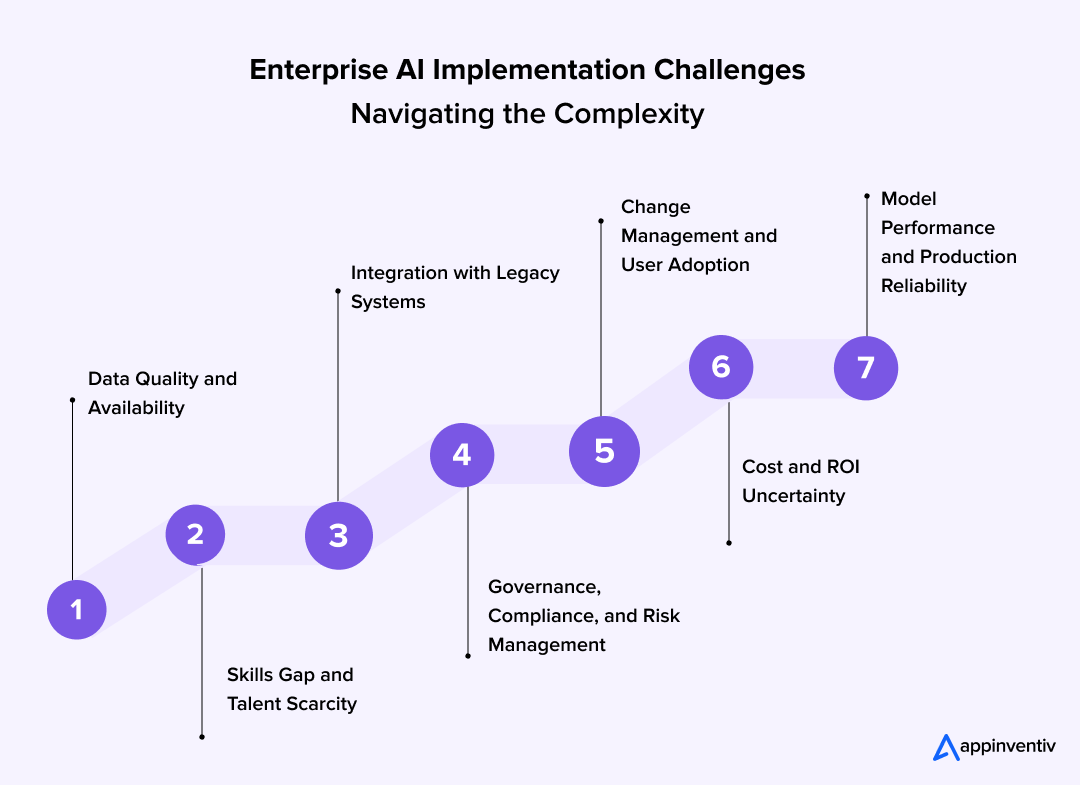
1. Data Quality and Availability
Teams often discover that their biggest blocker is not the model, but the data feeding it. Information is fragmented across departments, formatted differently, or missing context. It is common for data preparation to take most of the project time.
Solution:
- Bring data together gradually using shared platforms
- Improve quality in stages instead of aiming for perfection
- Use synthetic data when access to real data is limited
2. Skills Gap and Talent Scarcity
Many enterprises want AI outcomes without having enough people who know how to build or maintain them. Hiring specialists is difficult, and relying only on external help rarely scales.
Solution:
- Train internal teams who already know the business
- Build long-term pipelines with academic partners
- Hire specialist agencies with a large portfolio of work behind them, like Appinventiv
3. Integration with Legacy Systems
Older systems were not designed to work with AI for enterprises. Connecting them can feel like retrofitting a modern engine into an aging vehicle.
Solution:
- Add API layers to reduce direct dependencies
- Use data virtualization to simplify access
- Start AI projects on systems that allow modular change
4. Governance, Compliance, and Risk Management
As AI decisions influence more outcomes, questions around fairness, privacy, and accountability surface quickly.
Solution:
- Define review and ethics processes early
- Use explainable models and regular audits
- Treat compliance as part of design, not a final step
5. Change Management and User Adoption
People often resist AI because they do not understand how it affects their role.
Solution:
- Include users early in testing and feedback
- Be clear about how AI supports, not replaces, teams
- Offer reskilling where workflows change
6. Cost and ROI Uncertainty
AI investments rarely follow a straight line, and returns can feel distant without checkpoints.
Solution:
- Start with use cases that show value quickly
- Pilot before scaling
- Measure progress continuously
7. Model Performance and Production Reliability
Models change as data changes. Without oversight, accuracy drops quietly.
Solution:
- Monitor performance in production
- Roll out changes in stages
- Build MLOps capabilities for long-term stability
The Future of AI in Enterprise Solutions
If you sit in on leadership conversations today, AI comes up in a very different way than it used to. It shows up when people talk about teams being stretched thin, processes slowing things down, or decisions needing to happen faster than the calendar allows.
As we move toward 2026 and beyond, AI for enterprise is starting to feel less like a separate program and more like part of the wiring that keeps the business running day to day.
- Agentic and Autonomous AI
AI is beginning to carry work forward on its own. Instead of waiting for constant direction, these systems can decide what the next step should be and act on it. In real settings, that often means routine work keeps moving in the background, while people step in only when something unexpected shows up or judgment is required.
- Shift to Proactive, Integrated AI Strategies
Many organizations have already learned that isolated AI tools create more noise than value. The shift now is toward AI that is built directly into core workflows. When that happens, teams stop talking about the tool and start focusing on outcomes.
- Multimodal Intelligence
Enterprise data rarely arrives neatly packaged. It lives in meeting recordings, scanned documents, dashboards, emails, and video feeds. AI systems that can connect these formats help teams see patterns they would otherwise miss.
- Specialized Small and Composable Models
Not every task needs a massive model. Many enterprises are finding success with smaller, focused models that solve specific problems well. These systems are easier to maintain and simpler to adapt as needs change.
- AI Governance and Responsible Design
As AI takes on more responsibility, trust becomes central. Governance is no longer something reviewed after deployment. It is built into how systems are designed, monitored, and corrected over time.
Organizations that move early are not chasing hype. They are building AI foundations that can absorb change quietly, without forcing constant reinvention.
Also Read: Top AI Trends in 2026: Transforming Businesses Across Industries
The future of enterprise AI is evolving rapidly. Are you ready to integrate advanced AI solutions into your core workflows? Let Appinventiv guide you to the next level.

How Appinventiv Powers AI Innovation for Enterprises and Custom Development
Most enterprises do not adopt AI because it sounds promising. They do it because existing ways of working start to strain. Decisions slow down, systems stop scaling cleanly, and teams spend too much time stitching things together. That is typically the point where Appinventiv, a top enterprise software development company, gets involved, helping turn AI from an idea into ai-powered enterprise software that works inside real operations.
What this looks like in practice
- Delivering more than 300 AI solutions, many of them custom-built rather than adapted from generic tools
- Designing and deploying 150+ bespoke AI models and LLMs, trained on enterprise data and tuned for specific business use cases
- Supporting 75+ enterprise AI integrations, often alongside legacy systems that cannot be replaced overnight
- Working with a team of 200+ AI engineers and data scientists who stay involved from early design through production rollout
- Helping organizations reach outcomes like 75% faster decision-making, 98% prediction accuracy, and up to 40% reduction in operational costs
- Applying delivery experience gained from projects with brands such as Adidas, IKEA, KFC, Pizza Hut, 6thStreet, and Edamama
The work rarely ends at deployment. Most value shows up after AI becomes part of daily workflows and starts compounding over time. With experience across more than 35 industries and recognition from Deloitte Fast 50 India and APAC high-growth rankings, Appinventiv, an artificial intelligence development company, focuses on building AI systems that stay useful as priorities change.
The goal is simple. Deliver results today and create a foundation that continues to support growth tomorrow.
FAQs
Q. What are the biggest challenges of implementing enterprise AI?
A. Enterprises usually struggle with fragmented data, limited AI talent, and legacy systems that were never designed for intelligence layers. Governance is another hurdle. Without clear ownership and compliance processes, projects stall. Successful organizations plan for these issues early and use phased rollouts, custom development, and strong internal alignment to reduce risk.
Q. What are the key components of an enterprise AI architecture?
A. A modern enterprise AI architecture typically includes a data layer, AI and machine learning models, MLOps or LLMOps pipelines, integration services, governance controls, and user-facing applications. These components work together to ensure AI systems remain scalable, secure, explainable, and aligned with business objectives as adoption grows.
Q. How to evaluate AI solutions for your enterprise’s needs?
A. Start with business reality, not demos. Check how well the solution scales, integrates with your current stack, and meets security and compliance requirements. Look closely at explainability and MLOps support. If a platform cannot fit into existing workflows or grow with demand, long-term value will be limited.
Q. What Is Enterprise AI?
A. Enterprise AI refers to artificial intelligence systems designed to operate at an organizational scale, integrating with core business systems, proprietary data, governance frameworks, and compliance requirements to deliver measurable business outcomes.
Q. Why is enterprise generative AI different from consumer AI?
A. The difference becomes clear the moment AI moves inside real business systems. Enterprise generative AI is not built for casual use or quick answers. It has to be reliable, secure, and predictable. It works with proprietary data, follows strict access rules, and fits into existing workflows. Teams also need to understand why the system responds the way it does, control who can use it, and manage costs over time. These requirements rarely exist in consumer tools, but they are unavoidable in enterprise environments.
Q. Why is generative AI important for the enterprise?
A. For most enterprises, the value is practical. Generative AI helps teams handle work that depends on knowledge, documents, and analysis without adding more people. When it is connected to core systems, it reduces time spent writing, reviewing, searching, and summarizing information. Decisions happen faster, outputs stay consistent, and productivity improves across departments, all while keeping governance, security, and control firmly in place.


Fast 2-minute response, fully NDA-protected.

Automated Decision-Making in Australia: Benefits, Cost and Implementation
Key takeaways: Automated decision-making combines rules, algorithms, AI and human oversight to improve high-volume decisions. ADM programmes require privacy, security, auditability and accountability to be designed into architecture. ADM implementation costs typically range from AUD 70,000 to AUD 700,000 or more. Implementation starts with decision mapping, then moves through development, testing, controlled pilots and monitoring.…
AI Red Teaming Attack Strategies: Jailbreak, Crescendo, Base64 & More Explained
Key takeaways: Jailbreak testing must follow the full execution path from prompt and context to retrieval, tools, and enterprise APIs. Crescendo and adaptive attacks expose failures that single-turn testing misses by exploiting conversation history and model feedback loops. Base64 and Unicode tests probe gaps in normalization, tokenization, filtering, and decoding before adversarial input reaches model…

AI Agent Protocols: MCP, A2A, ACP & More Explained
Key takeaways: MCP connects agents to enterprise tools, while A2A lets independent agents delegate tasks without exposing internal logic. The protocol stack now spans agent access, collaboration, UI interaction, open networking, commerce, and machine-to-machine payments. A2A had support from 150+ organizations by April 2026, with 22,000+ GitHub stars and five production-ready SDK languages. Enterprise agent…