


































Open Finance Platform Development in the UK: A Complete Guide for Enterprises
 Share -



- 01Open Banking vs Open Finance: What’s Changing for UK Businesses?
- 02UK Open Finance Regulations: What Enterprises Need to Prepare for in 2026 and Beyond
- 03Why Are Businesses Investing in Open Finance Platform Development in the UK?
- 04What Are the Business Benefits of Open Finance Platforms?
- 05Enterprise ROI Beyond Compliance
- 06Core Features Every Open Finance Platform Should Include
- 07Enterprise Architecture for Open Finance Platforms in the UK
- 08Choosing the Right Technology Stack for Open Finance Platform Development in the UK
- 09How to Build an Open Finance Platform in the UK: Step-by-Step Development Process
- 10Key Challenges in Open Finance Platform Development and How to Overcome Them
- 11How Much Does Open Finance Platform Development Cost in the UK?
- 12How AI and Tokenisation Are Shaping the Future of Open Finance
- 13How Appinventiv Can Accelerate Your Open Finance Journey
- 14FAQs

Key takeaways:
- Open Finance in the UK extends Open Banking’s principles from payment accounts to mortgages, pensions, insurance and investments under the FCA’s phased 2026 to 2030 roadmap.
- McKinsey and Open Banking Limited estimates place the economic upside at 1 to 1.5% of UK GDP or up to £7.4 billion annually, but only for enterprises ready to act.
- SME lending and mortgages are the near-term priority use cases, making them the logical starting point for platform investment.
- The cost to build an open finance platform in the UK ranges from £30,000 to £400,000 or more.
UK financial institutions operate in a market where customers demand connected, proactive financial experiences rather than isolated banking products. Open Banking successfully solved payment and account aggregation. Now, enterprises face the next structural shift. They need to bring insurance, pensions, investments, mortgages, savings, lending, and broader datasets into a single, governed view of the customer. That gap is what Open Finance is built to close, and it is why Open Finance Platform Development in the UK has moved from a research topic to a board-level priority.
On 14 April 2026, the FCA published its open finance roadmap, setting out a path to extend the principles of Open Banking, which remains limited to payment accounts, across mortgages, SME lending, pensions, insurance and investments under the UK’s broader Smart Data agenda. The roadmap is structured, not theoretical: it names SME lending and consumer mortgages as the two priority use cases for 2026, and it commits to a discussion paper on the first Open Finance scheme by the fourth quarter of the year.
It simply means that enterprises across lending, wealth management, and property technology face an urgent imperative to break down fragmented data silos. Relying on legacy infrastructure limits product personalisation and slows down risk assessments. Moving to a unified data architecture is no longer just a regulatory exercise. It is a commercial requirement.
This blog is written for CTOs, product owners and fintech founders navigating Open Finance in the UK. It covers the regulatory sequencing, the architecture, the cost drivers and the delivery risks that decide whether a platform is audit ready on day one or rebuilt within eighteen months.
Moving from Open Banking to Open Finance requires more than new APIs. It calls for a platform strategy that aligns with your products, regulatory obligations, and long-term growth objectives.

Open Banking vs Open Finance: What’s Changing for UK Businesses?
Understanding where Open Banking ends and Open Finance begins determines which data contracts, consent models and integration layers an enterprise needs to plan for now rather than retrofit later.
Understanding the Scope
Open Banking mandated the sharing of current account and payment data under the PSD2 and CMA Order framework. Open Finance extends these exact principles of secure, permissioned data sharing to the rest of a consumer’s or business’s financial footprint. This includes mortgages, SME lending, pensions, insurance, investments, and savings. It operates under the emerging UK Smart Data framework, utilising the Data (Use and Access) Act to facilitate broader sector interoperability.
The Enterprise Opportunity
This transition moves enterprises from basic account aggregation to holistic financial management. Lenders can view a complete liability profile before issuing credit. Wealth managers gain real-time visibility into held-away assets. The depth of data available allows organisations to transition from reactive service providers into proactive financial partners.
Authoritative forecasts underline the scale of this opportunity. According to independent economic analysis by EY and Open Banking Limited, the annual economic benefits of data sharing could reach £7.4 billion within five years. Similarly, McKinsey estimates that Open Finance could support a 1% to 1.5% growth in UK GDP by 2030.
Both figures depend on adoption, which is precisely where platform architecture, consent design and delivery discipline determine whether an enterprise captures the upside or watches competitors capture it first.
Key Differences Between Open Banking vs. Open Finance
| Feature | Open Banking (PSD2 / CMA Order) | Open Finance (Smart Data Framework) |
|---|---|---|
| Data Scope | Payment accounts only | Mortgages, SME lending, pensions, insurance, investments, savings, debt |
| Primary Use Cases | Payments, account aggregation | Affordability, underwriting, embedded finance, portfolio views |
| Regulatory Driver | PSD2, CMA Order 2017 | Data (Use and Access) Act 2025, FCA Smart Data roadmap |
| Enterprise Focus | Transaction visibility | Holistic financial risk and product personalisation |
UK Open Finance Regulations: What Enterprises Need to Prepare for in 2026 and Beyond
Aligning platform architecture with the FCA timeline prevents costly remediation later. Enterprises must design systems that handle upcoming mandates for cross-sector data sharing while maintaining strict adherence to consumer protection standards.
FCA’s 2026 Smart Data Future
The FCA published its Open Finance Roadmap in April 2026. This document outlines a phased strategy to facilitate the expansion of data sharing up to 2030. Rather than imposing immediate sweeping mandates, the FCA favors an evidence-led approach, utilizing TechSprints and structured experiments to identify high-impact use cases before drafting permanent frameworks.
Immediate 2026 Priorities
Lending to SMEs and consumer mortgages are the two use cases the FCA is prioritising for early delivery. This follows TechSprints run between November 2025 and February 2026 on synthetic data, which produced working concepts for AI-enhanced affordability tools and reusable data packages for loan applications. A PRISM taskforce, reporting by the third quarter of 2026, will formally assess which further use cases deliver the most consumer and competitive benefit.
The 2027 to 2030 Horizon
Beyond the initial use cases, the FCA intends to work with HM Treasury on the long-term regulatory framework, with a discussion paper on the first formal Open Finance scheme due in Q4 2026, followed by framework design work through 2027. Live, scaled schemes are not expected before 2029 or 2030, which several industry commentators consider slow relative to the pace of AI-led product change.
Compliance Action Items
Enterprises do not need to wait for a finalised scheme to begin work. What matters now is establishing clear data governance, mapping which product lines will fall under future Open Finance Regulations in the UK, and preparing infrastructure that can absorb new data categories without a rebuild once the first discussion paper lands.
Why Are Businesses Investing in Open Finance Platform Development in the UK?
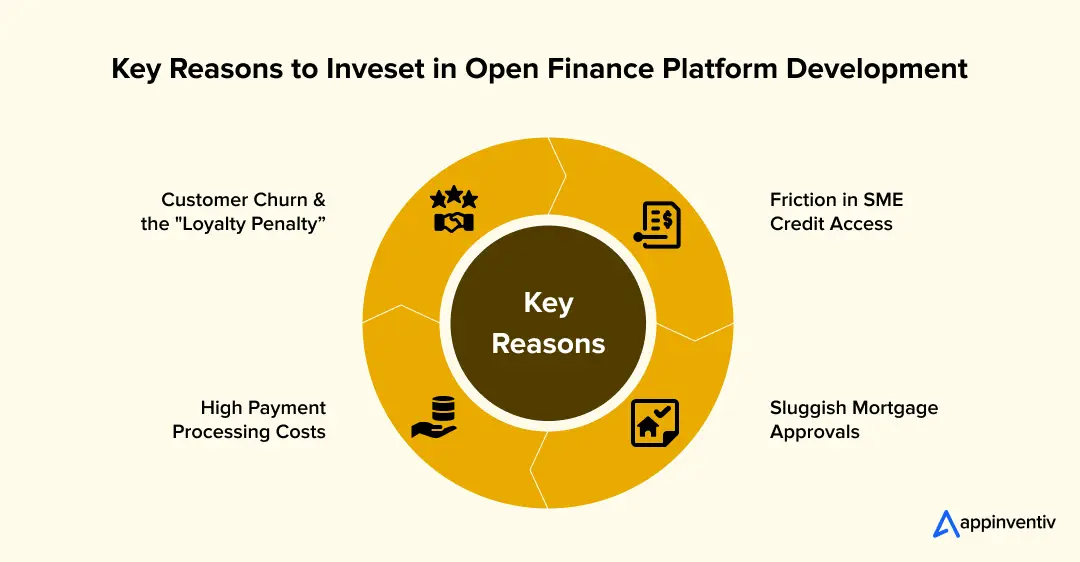
Replacing fragmented manual processes with unified data pipelines drives immediate operational efficiency. Open Finance infrastructure directly targets bottlenecks in credit decisioning, payment processing, and customer retention. Here are some vital reasons that push UK organisations to invest in open finance platform development:
Friction in SME Credit Access
Traditional underwriting relies on outdated credit scoring and manual document verification. Data silos prevent lenders from seeing a real-time picture of a business’s cash flow. Open Finance infrastructure enables real-time, automated risk assessments by pulling live data from accounting software, tax records, and existing credit facilities. This results in faster lending decisions and lower default rates.
Sluggish Mortgage Approvals
Mortgage underwriting suffers from poor interoperability and fragmented customer journeys. Brokers and lenders spend weeks manually verifying income, assets, and liabilities. By utilising reusable data packages, a UK Open Finance Platform consolidates a holistic financial profile instantly, reducing manual underwriting delays and drastically improving the onboarding experience.
High Payment Processing Costs
Legacy infrastructure and heavy interchange fees eat into profit margins for recurring collections. The integration of Sweeping Variable Recurring Payments (VRPs) allows enterprises to initiate seamless, cost-effective transfers between accounts. This circumvents traditional card networks entirely, lowering transaction costs and reducing failed payment rates.
Customer Churn & The “Loyalty Penalty”
Banks and insurers struggle to retain customers who feel penalised by static pricing. Open Finance solves this by enabling proactive, hyper-personalised product switching. If a wealth management platform detects idle cash in a low-yield account, it can automatically prompt the user to move funds to a higher-yield savings product, actively improving user retention.
What Are the Business Benefits of Open Finance Platforms?
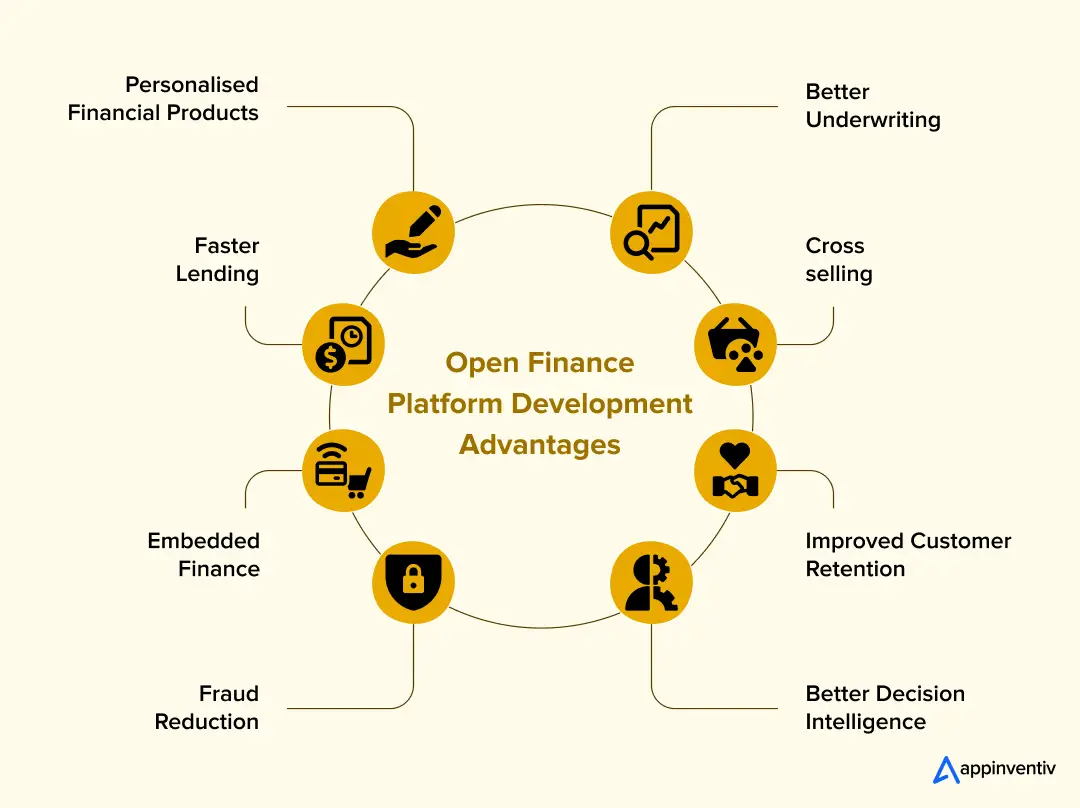
Transitioning to an open data architecture delivers immediate operational leverage by replacing manual workflows with real-time pipelines. Enterprises that modernise their infrastructure unlock the ability to issue faster credit decisions, hyper-personalise customer experiences, and significantly lower transaction overheads. Some most remarkable benefits include:
Personalised Financial Products
Platforms extract granular data across insurance, wealth portfolios, and pensions to construct bespoke offerings that map directly to real-time individual risk profiles and unique cash flow requirements.
Better Underwriting
Access to comprehensive financial footprints replaces speculative historical credit scoring with real-time affordability assessments, drastically lowering non-performing loan ratios and improving capital allocation accuracy across portfolios.
Faster Lending
Automated data aggregation pipelines eliminate physical document uploads and manual validation queues, compressing complex enterprise loan approval timelines from several working weeks down to mere minutes.
Cross-selling
Predictive analytics engines scan consolidated consumer asset profiles to identify precise lifecycle trigger events, allowing relationship management teams to pitch relevant secondary financial services exactly when required.
Embedded Finance
Modern open APIs allow organisations to inject hyper-relevant banking, lending, and insurance products directly into external third-party digital ecosystems, capturing commercial customers at the exact point of transaction intent.
Improved Customer Retention
Platforms shift consumer relationships from transactional interactions to proactive advisory experiences, offering automated yield optimisation and cost-switching options that mitigate the traditional industry loyalty penalty.
Fraud Reduction
Cross-referencing immutable identity data across multiple verified financial institutions provides immediate protection against synthetic identity creation, account takeover attempts, and sophisticated corporate payment fraud.
Better Decision Intelligence
Consolidating multi-sector data feeds provides internal business intelligence units with clean, high-fidelity data arrays required to train proprietary machine learning models for accurate market forecasting.
Enterprise ROI Beyond Compliance
Viewing regulatory shifts purely as a compliance burden ignores the immense commercial upside of data interoperability. Modern open finance infrastructure serves as a revenue engine, allowing institutions to monetise their API real estate, forge lucrative partnerships, and capture greater customer lifetime value.
Revenue Generation
Launching net-new premium advisory services built on aggregated holistic data allows enterprises to transition from providing basic utility functions to delivering high-margin and proactive wealth and liability management solutions.
API Monetisation
Instead of merely consuming data, enterprises can charge verified third-party providers tiered access fees for querying their enriched data insights, proprietary predictive scorings, and secure payment initiation gateways.
Operational Efficiency
Integrating real-time financial data feeds permanently eliminates thousands of hours wasted on manual compliance tasks, physical document reviews, and repetitive back-office underwriting workflows, directly improving the bottom line.
Customer Lifetime Value
Deepening engagement through consolidated and multi-product ecosystem offerings makes it incredibly difficult for customers to leave, dramatically extending relationship lifespans and increasing overall profitability per acquired user.
Ecosystem Partnerships
A robust platform architecture facilitates rapid technical integration with insurtechs, property portals, and digital wealth managers, enabling the co-creation of targeted and highly specialised financial products that capture niche market segments.
Core Features Every Open Finance Platform Should Include
A robust platform requires more than basic connectivity to external institutions. It demands enterprise-grade modules for dynamic consent, AI-driven insights, and strict auditability to meet both commercial expectations and intense regulatory scrutiny from the FCA.
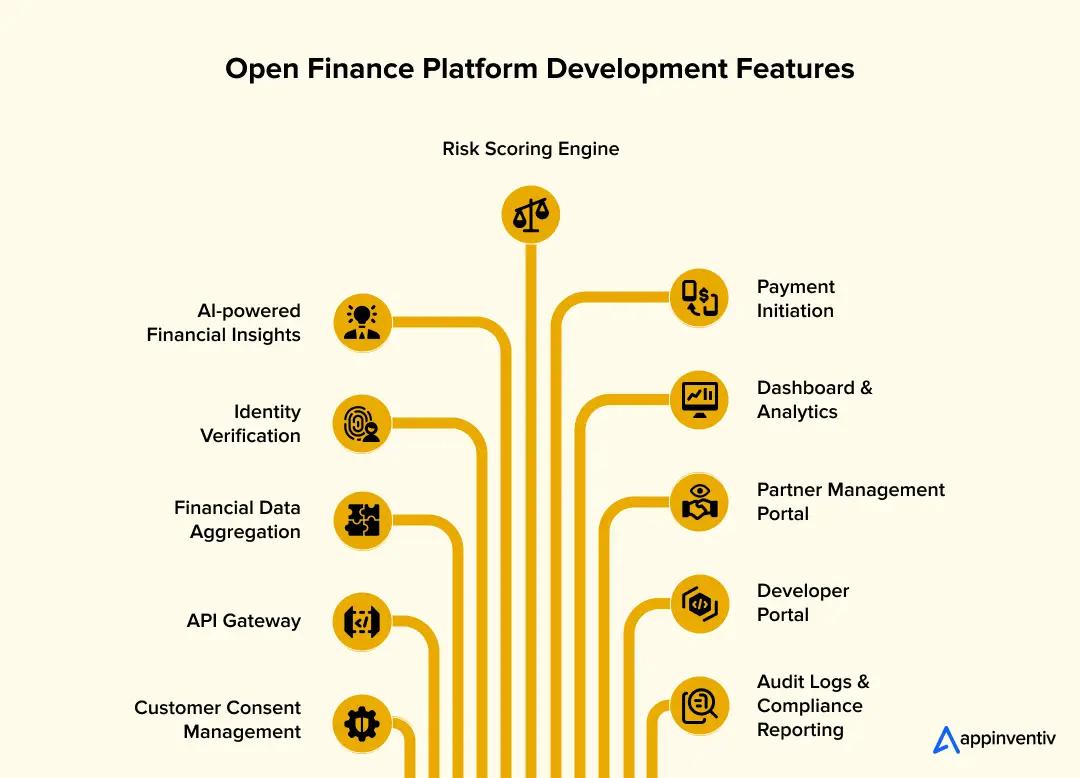
Customer Consent Management
Users must have granular control over what data they share, who they share it with, and for how long. The platform needs dynamic dashboards allowing users to revoke access instantly.
API Gateway
The core routing mechanism that handles requests between third-party applications and your internal systems. It manages rate limiting, threat protection, and traffic routing to ensure high availability during peak transaction volumes.
Financial Data Aggregation
This engine connects to external banks, pension providers, and investment platforms. It fetches raw data and standardises it into a unified schema, ensuring consistency regardless of the source institution.
Identity Verification
A mandatory module that integrates with external KYC providers. It cross-references banking identity data with official documents to prevent fraud during onboarding and high-value transactions.
AI-powered Financial Insights
Raw data holds little value without interpretation. This feature applies machine learning to categorise transactions, predict future cash flow bottlenecks, and trigger personalised product recommendations for the end user.
Risk Scoring Engine
Vital for lending and insurance use cases. The engine evaluates aggregated data against predefined enterprise risk models to generate instant affordability scores and creditworthiness profiles.
Payment Initiation
Allows the platform to execute account-to-account payments directly. It supports both single domestic payments and Variable Recurring Payments for automated fund transfers.
Dashboard and Analytics
A centralised interface for internal enterprise teams. It provides visibility into platform usage, API performance metrics, user adoption rates, and overall system health.
Partner Management Portal
An administrative interface for onboarding third-party providers. It manages their credentials, tracks their API consumption, and monitors their compliance status within your ecosystem.
Developer Portal
External developers need clear documentation, sandbox environments, and easy integrations. This portal accelerates third-party adoption and encourages external innovation on top of your platform.
Audit Logs and Compliance Reporting
Automated logging of all data requests, consent changes, and system access. This feature is critical for demonstrating compliance during FCA audits and internal risk reviews.
Enterprise Architecture for Open Finance Platforms in the UK
Enterprise architecture must prioritise zero-trust security, real-time data normalisation, and massive scalability. As API calls continue to grow exponentially across the country, brittle legacy systems will fail under the load and compromise the user experience.
Below is a structural overview of a high-performance Open Finance Platform Architecture for the UK.
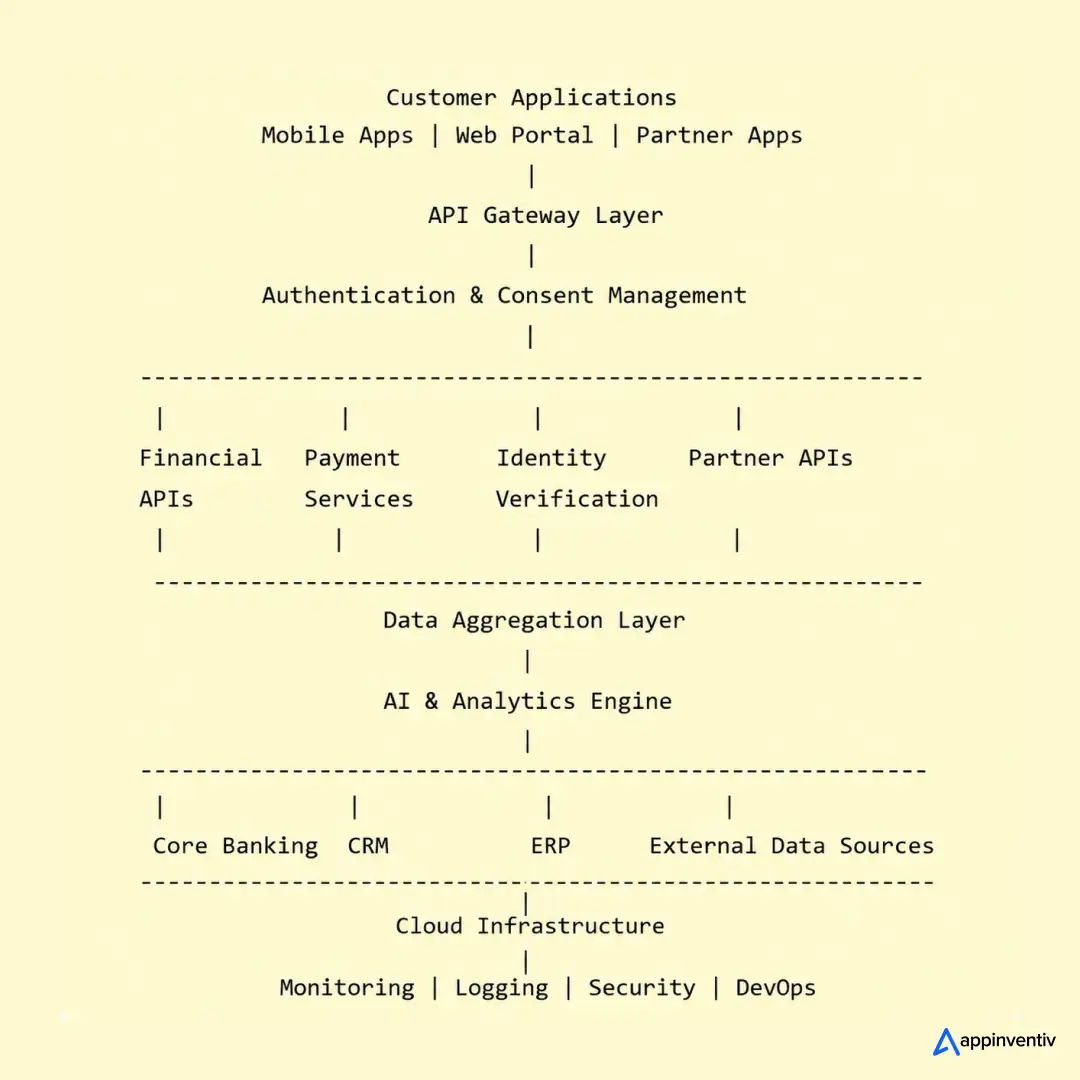
- API Gateway and Integration Layer
Open banking infrastructure processed 24 billion API calls in 2025. Your gateway must handle millions of secure concurrent calls without latency. It serves as the primary ingress point, validating tokens and routing traffic securely to the appropriate microservices.
- Consent and Identity Management
This layer implements Financial-grade API security profiles and OAuth 2.0. It acts as the gatekeeper, ensuring that every data request matches an active and user-approved consent mandate before any internal system is queried.
- Data Standardisation and Enrichment
Data arrives in various formats from different institutions. This microservice normalises unstructured data into a common schema. An enrichment layer then applies machine learning algorithms to categorise transactions, recognise merchants, and build actionable financial profiles.
- Zero-Trust Security Architecture
Every internal service request requires authentication. This architecture limits lateral movement in the event of a breach. It includes strict adherence to the Data Protection and Digital Information frameworks, utilising encryption at rest and in transit.
- Core Banking and Internal Systems Integration
The platform must connect bidirectionally with your existing infrastructure. This includes syncing with Core Banking ledgers, feeding data into CRM systems for relationship managers, and updating ERP systems for corporate treasury reconciliation.
Choosing the Right Technology Stack for Open Finance Platform Development in the UK
Selecting the right technology stack ensures system resilience, developer velocity, and regulatory alignment. Enterprises must prioritise cloud-native tools capable of distributed scaling, advanced threat detection, and seamless third-party developer integration.
| Domain | Recommended Technologies |
|---|---|
| Frontend | React, Next.js, Angular (for responsive, complex data visualisation). |
| Backend | Node.js, Go, Java, Python (for AI service layers). |
| Cloud | AWS, Microsoft Azure, Google Cloud (leveraging multi-region serverless architectures). |
| Security | Auth0, Ping Identity, HashiCorp Vault (for secrets management). |
| API Standards | REST, GraphQL, gRPC, adherence to FAPI profiles. |
| Identity | OAuth 2.0, OpenID Connect, eIDAS compliant certificates. |
| AI and Data | TensorFlow, PyTorch, OpenAI API (for natural language querying and categorisation). |
| Data Management | PostgreSQL, MongoDB, Apache Kafka (for real-time event streaming). |
| Monitoring | Datadog, Prometheus, Grafana, ELK Stack. |
| DevOps | Kubernetes, Docker, Terraform, GitLab CI/CD, ArgoCD. |
A robust Open Finance Technology Stack acts as the foundation for future-proofing your business against rapid regulatory shifts and evolving consumer demands.
How to Build an Open Finance Platform in the UK: Step-by-Step Development Process
Execution requires disciplined technical governance. Moving from legacy environments to an open API ecosystem involves rigorous discovery, secure integration, continuous compliance validation, and scalable deployment methodologies that protect core banking systems.
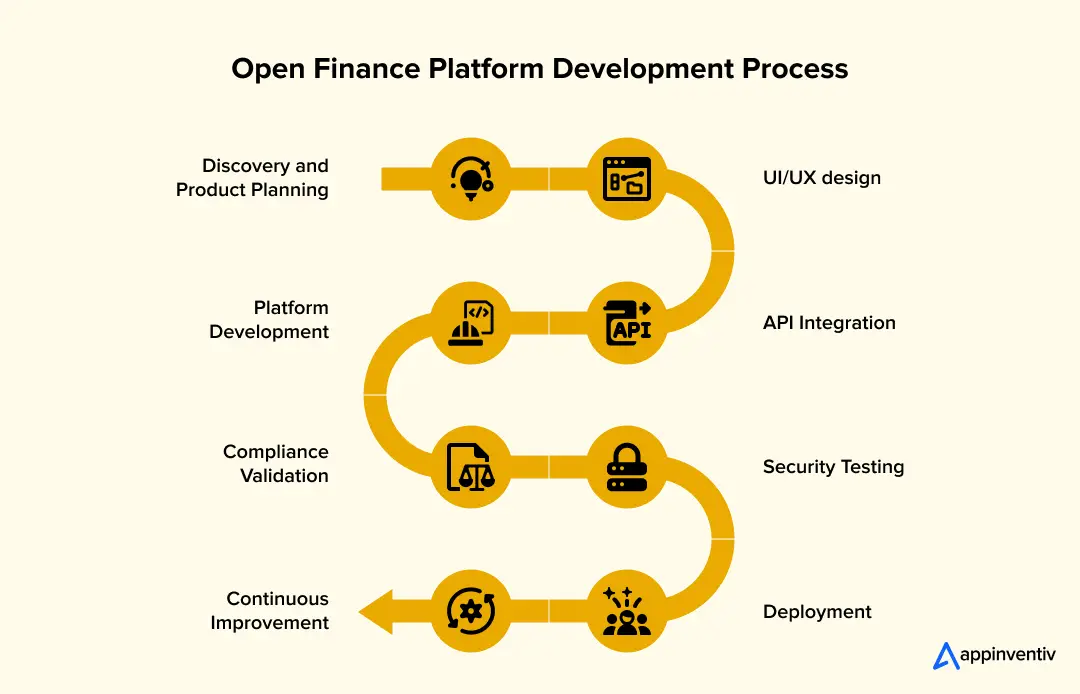
Discovery and Product Planning
Map out the exact business use cases. Define target user personas, establish data requirements, and outline the Open Finance Use Cases for UK markets you intend to support first (for example, SME credit versus retail wealth).
Key activities at this stage include:
- Business objective alignment
- Regulatory assessment
- Market opportunity analysis
- Architecture planning
- Risk identification
UI and UX Design
Design frictionless consent flows. Users must easily understand what they are sharing. Complex financial data requires intuitive and accessible visualisation to build trust.
Design priorities include:
- Consent journeys
- Customer onboarding
- Financial dashboards
- Mobile-first experiences
- Trust-building interfaces
API Integration
Build the connectivity layer. This involves setting up open finance API integration to securely fetch data from third-party aggregators, credit bureaus, and legacy core systems.
Typical integrations include:
- Banks
- Pension providers
- Insurance platforms
- Mortgage providers
- Credit agencies
- Payment networks
- Internal enterprise systems
Platform Development
Engineer the core microservices. Develop the aggregation engine, risk scoring models, and internal dashboards using cloud-native deployment strategies.
Typical workstreams include:
- Backend development
- Frontend development
- Security implementation
- Data aggregation services
- Data Analytics engines
- Reporting capabilities
Compliance Validation
Conduct rigorous audits against FCA standards. Ensure consent mechanisms comply with UK GDPR and that security profiles meet necessary requirements.
Validation typically covers:
- Data protection controls
- Consent frameworks
- Audit logging
- Access management
- Data retention policies
- Regulatory reporting requirements
Security Testing
Execute penetration testing and vulnerability scanning. Implement continuous threat monitoring to protect against data exfiltration or credential stuffing attacks.
The testing phase includes:
- Penetration testing
- Vulnerability assessments
- API security reviews
- Identity management validation
- Infrastructure security testing
- Third-party dependency reviews
Deployment
Roll out the platform using a phased approach. Start with internal beta testing, move to a controlled sandbox with selected partners, and finally execute a full public launch.
Typical deployment activities include:
- Infrastructure provisioning
- Data migration
- Environment validation
- Performance testing
- Monitoring setup
- Disaster recovery preparation
Continuous Improvement
Monitor API performance metrics constantly. Use production data to train AI models further and iterate on feature sets based on user adoption patterns.
Post-launch priorities include:
- Feature enhancement
- AI model optimisation
- Security updates
- API expansion
- Compliance adaptation
- Performance tuning
Map your target use cases, integration priorities, governance model, and delivery roadmap with Appinventiv’s fintech engineering and compliance specialists.

Key Challenges in Open Finance Platform Development and How to Overcome Them
Enterprise leaders must anticipate technical and commercial roadblocks during implementation. Mitigating vendor lock-in, overcoming API fragmentation, and ensuring customer trust are critical to successful deployment and long-term ecosystem viability.
| Challenge | Impact | Solution |
|---|---|---|
| Legacy systems | Slows integration and increases delivery risk | Wrap legacy cores with API layers rather than forcing a full replacement |
| API fragmentation | Inconsistent data formats across providers | Adopt standardisation middleware aligned to Open Banking specifications |
| Consent fatigue | Users abandon journeys with repeated permission requests | Design single, clear consent flows with transparent renewal cycles |
| Security | Expanded data scope widens the attack surface | Zero-trust architecture with continuous monitoring |
| Open Finance Compliance | Regulatory scope is still evolving through 2026 to 2030 | Build modular compliance layers that can absorb new rules |
| Customer trust | Sharing wider financial data raises consumer caution | Transparent data use policies and visible security certification |
| Vendor lock-in | Dependence on a single provider limits flexibility | Favour open standards and portable data models |
| Interoperability | Data does not move cleanly across institutions | Align early with emerging Open Finance schemes and shared schemas |
How Much Does Open Finance Platform Development Cost in the UK?
On average, the cost to build an open finance platform in the UK ranges between £30,000 and £400,000 or more, depending on several factors.
Factors affecting the FinTech app development cost include:
- Number of API integrations across banking, insurance, pension and investment providers
- Depth of compliance and audit reporting required
- Extent of AI and risk-scoring capability built in
- Cloud infrastructure and scaling requirements
- Security certification and third-party penetration testing
- Overall platform complexity and number of user journeys supported
Estimated Cost Table
| Platform Tier | Profile and Scope | Estimated Cost Range (£) |
|---|---|---|
| MVP | Basic data aggregation, single use case (such as affordability checking), limited third-party integrations. | £30,000 to £100,000 |
| Growth Platform | Multiple use cases, robust AI categorisation, automated consent management, advanced dashboards. | £100,000 to £200,000 |
| Enterprise Platform | Deep core integration, predictive risk scoring, multi-product orchestration (mortgages, SME credit). | £200,000 to £400,000+ |
These ranges are indicative and vary with existing core system maturity, the number of third-party data sources and the compliance scope agreed with legal and risk teams.
How AI and Tokenisation Are Shaping the Future of Open Finance
Combining enriched financial data with predictive AI and digital assets unlocks entirely new business models. Enterprises that master these synergies will define the next generation of automated wealth management, seamless credit services, and decentralised asset integration.
AI-Enhanced Affordability Tools
Predictive AI models in UK perform significantly better when fed broad and real-time financial data. The FCA recent TechSprints heavily featured AI layers generating instant affordability assessments for complex lending scenarios. These tools analyse historical spending, predict future liabilities, and dynamically adjust risk thresholds.
Agentic Commerce
Open finance sets the foundation for autonomous financial agents. Operating on user-permissioned data, these AI agents can actively manage wealth. They monitor market rates to execute utility switching, deploy excess capital into automated investing strategies, or restructure debt balances without manual user intervention.
Tokenised Assets
The line between traditional finance and digital assets continues to blur. Modern platforms must integrate tokenisation dashboards. Giving users and advisors a unified view of traditional equities, pensions, and tokenised real-world assets provides a comprehensive wealth overview previously impossible to achieve.
How Appinventiv Can Accelerate Your Open Finance Journey
Appinventiv is a leading FinTech software development company in the UK, with 11+ years of delivery experience across regulated industries. Supported by our 5+ Innovation Hubs across London, Berlin, and Amsterdam, our team of 1600+ tech experts brings deep domain knowledge in building compliant, high-performance financial software. We work end to end, from technical discovery and API architecture through to compliance testing and post-launch scaling for prominent fintech clients such as Mudra and Edfundo.
Our delivery record includes 300+ digital assets deployment in the UK, a 97% client retention rate, and enterprise transformation work across 35+ industries. The platforms we build have delivered measurable efficiency gains of up to 45% for enterprise clients.
If your organisation is assessing open finance platform development in the UK, we recommend starting with a technical discovery session to map data scope, compliance obligations and integration priorities against the FCA’s 2026 roadmap. Book a consultation with our team to scope your platform strategy.
FAQs
Q. How much does it cost to build an enterprise open finance platform in the UK?
A. Custom open finance platform development in the UK typically ranges from £30,000 for a foundational MVP to over £300,000 for a complex ecosystem-scale banking architecture. Final costs depend on legacy system integration depth, AI requirements, and the number of bespoke API connections needed.
Q. How long does open finance platform development take?
A. An initial minimum viable product focused on a single use case usually takes four to six months to deploy. A comprehensive enterprise solution, requiring deep core integration and extensive regulatory auditing, requires nine to eighteen months of structured development phases.
Q. How do you ensure security and compliance in open finance applications?
A. Security requires implementing zero-trust architectures, Financial-grade API profiles, and OAuth 2.0 for robust consent management. Continuous vulnerability scanning, encryption of all personally identifiable information, and immutable audit logs ensure the platform adheres strictly to UK GDPR and FCA expectations.
Q. How does open finance enable embedded finance and BaaS?
A. Secure data sharing allows brands to seamlessly integrate financial products into non-financial journeys. By securely sharing aggregated customer data via APIs, retailers, property platforms, and SaaS providers can offer instant credit, insurance, or payment options precisely at the point of need.
Q. What are the FCA priority use cases for Open Finance?
A. According to the April 2026 Smart Data roadmap, the FCA is currently prioritising initiatives that improve SME lending access and streamline consumer mortgage applications. These areas demonstrate the highest immediate potential for boosting competition and improving market efficiency.


Build a Future-Ready Open Finance Platform with Appinventiv

Fast 2-minute response, fully NDA-protected.

With a forecasted market size of $13 billion by the year 2025, the adoption of Business Intelligence (BI) across industries is becoming extremely widespread and urgent. Right from traditional sectors like banking and healthcare to flourishing domains like Edtech and InsurTech, business intelligence has found a use case in every sector you can think of.…

Key takeaways: With 6.05 billion users expected by 2028, social media apps are growing fast, creating opportunities for new entrants. Essential and advanced features for social media apps include profiles, feeds, media sharing, messaging, notifications, security, AR filters, and analytics. AI-driven personalization, social commerce, and AR/VR experiences are some of the emerging trends in social…

Key takeaways: Dating app success depends more on early product decisions than flashy features or quick monetization. A strong MVP focuses on matching, messaging, and trust before advanced functionality. Monetization works best when introduced after users see real value, not at first interaction. Safety, privacy, and data protection directly impact retention and willingness to pay.…