































Top UK Software Development Trends Shaping 2026: Insights for Business Leaders


- Market Overview: The UK Software Market Heading into 2026
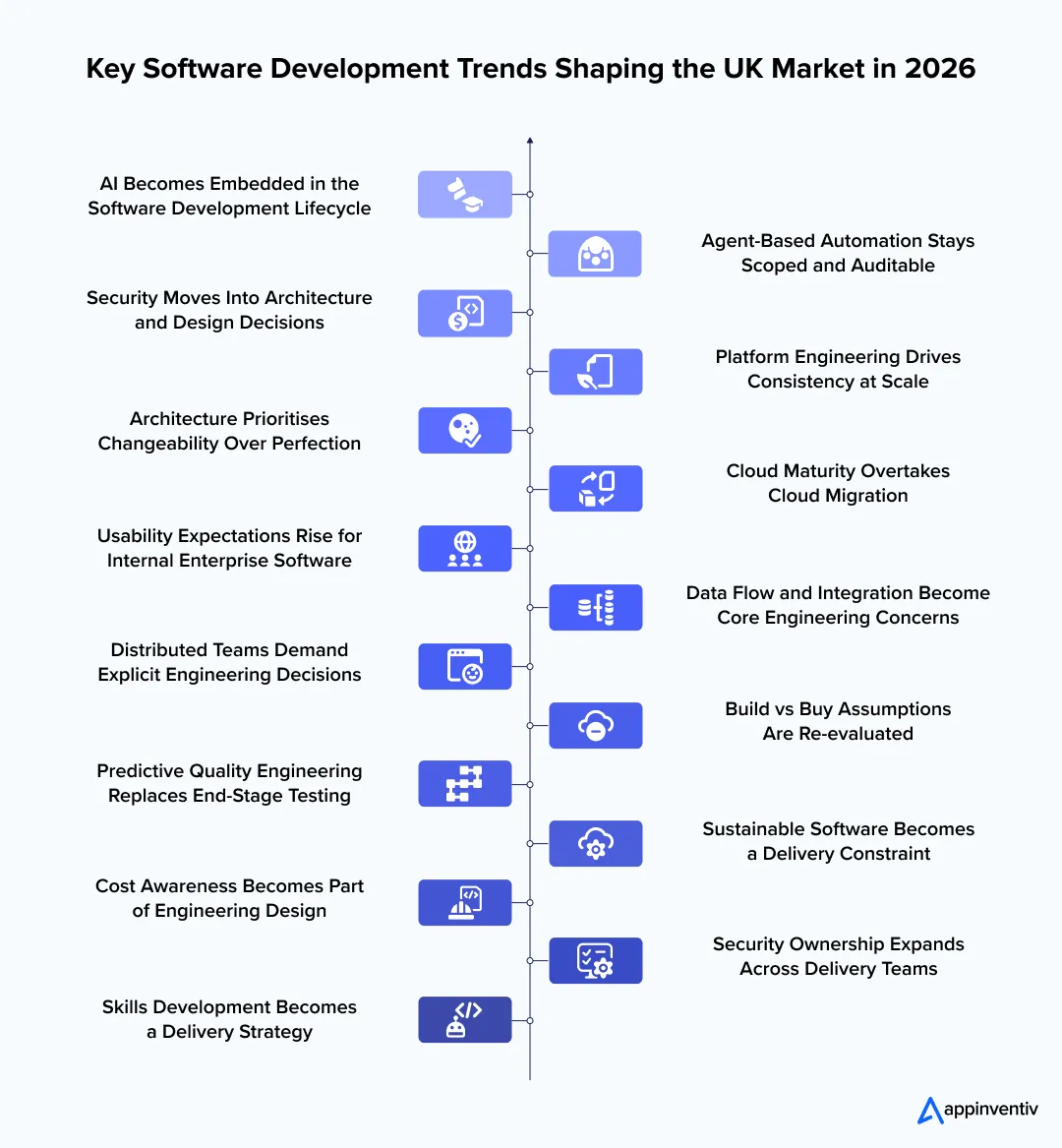
- Key Software Development Trends Shaping the UK Market in 2026
- How UK Software Development Trends Will Affect Enterprises and SMEs in 2026
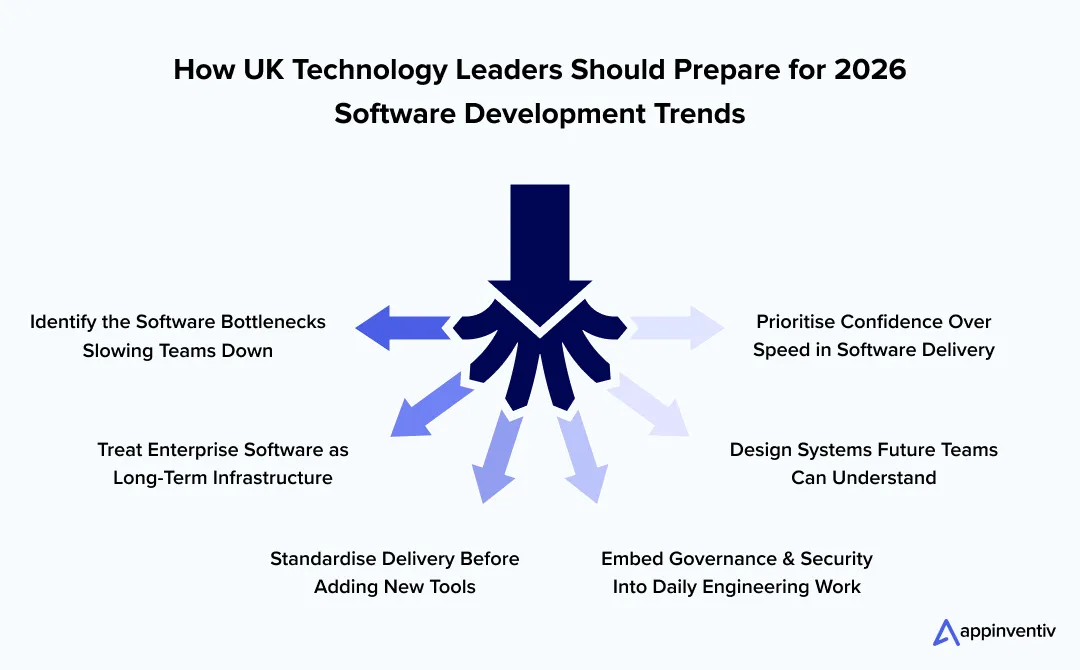
- How UK Technology Leaders Should Prepare for 2026 Software Development Trends
- How Appinventiv Helps UK Enterprises Navigate Software Development Trends in 2026

Key takeaways:
- 2026 is about fixing friction, not chasing trends. UK software teams are prioritising reliability, clarity, and systems that are easier to change over flashy new tooling.
- AI is becoming background support, not the main act. Its value shows up in routine work like testing, reviews, and documentation, while people still make decisions.
- Architecture and delivery choices matter more than languages. Modular design, clear ownership, and practical modernisation are shaping long-term outcomes.
- Cost, security, and sustainability are now engineering concerns. UK teams are designing software with financial predictability, resilience, and efficiency in mind from day one.
- The teams that win in 2026 build confidence, not just speed. Software that holds up under pressure is becoming the real competitive advantage.
For many UK organisations, software development has stopped being a growth experiment and started becoming an operational responsibility. Systems that once supported the business are now the business. When they fail, stall, or become too expensive to change, the impact is immediate.
The UK software development trends for 2026 reflect this shift in mindset. Technology leaders are spending less time debating what is new and more time questioning what is dependable. Can this system be updated without disruption? Can it scale without ballooning costs? Can it meet regulatory expectations without slowing delivery to a crawl?
This is why many of the enterprise software trends for 2026 are not about flashy innovation. They are about fixing long-standing friction. Legacy platforms that are hard to modernise. Architectures that slow teams down. Delivery models that no longer work with distributed teams or evolving security demands.
As a result, the software trends in the UK for 2026 are practical by nature. They focus on building software that can be maintained, secured, and adapted without constant rework. The sections that follow look at the custom software development trends in the UK for 2026 that are already influencing how serious teams plan, build, and run software today
Most UK teams discover risk only after delivery slows or costs spike. A short assessment can surface what will hold you back before 2026 arrives.

Market Overview: The UK Software Market Heading into 2026
Right now, software conversations in the UK feel more cautious than they used to. Not pessimistic, just more honest. Teams still want to move quickly, but there is far less tolerance for systems that need constant fixing or expensive workarounds six months later.
That mindset lines up with where the market is heading. Data from Grand View Research shows the UK software market at around USD 41.9 billion in 2024, with steady growth expected through 2030, reaching roughly USD 63.6 billion at an annual growth rate of about 7 percent.
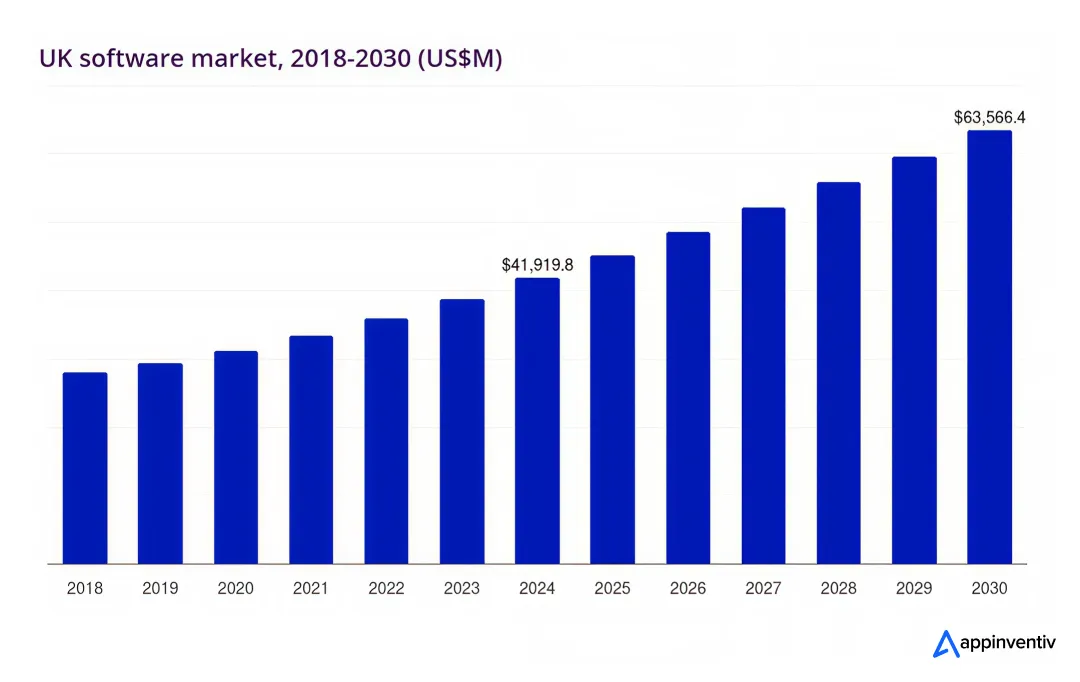
What matters more than the growth figure is the behaviour behind it. UK organisations are becoming selective. They are spending on software they expect to live with for a long time. Custom builds, long-delayed modernisation work, and cloud-ready platforms are getting priority. Short-term tools that add complexity later are being challenged earlier in the process.
As 2026 gets closer, software investment is still happening, but the bar is higher. Systems are expected to scale cleanly, meet regulatory needs without constant adjustments, and stay manageable as teams change. This shift in thinking sets the scene for the UK software development trends shaping 2026. The focus is no longer on what is new. It is on what will still work when pressure builds.
Key Software Development Trends Shaping the UK Market in 2026
If you listen closely to UK engineering teams right now, the language has changed. There is less talk about disruption and more about stability. Fewer conversations about tooling choices, more about system behaviour under pressure. The trends shaping 2026 are not about what is technically possible. They are about what is operationally sensible in a regulated, cost-aware UK market.
Below are the key trends that are already influencing how serious teams are building and running software.
1. AI Becomes Embedded in the SDLC, Not the Product
In the UK, AI in businesses is rarely being pushed directly into production systems without guardrails. Instead, it is settling into the software development lifecycle itself, where the risk is lower, and the payoff is immediate.
Engineering teams are using AI in very specific, controlled ways:
- Code completion and refactoring for well-understood components
- Test case generation based on existing coverage gaps
- Documentation support for APIs, internal tools, and legacy modules
What is notable is what teams are not doing. AI is rarely trusted with business logic, regulatory decisions, or irreversible actions. In regulated sectors like finance, healthcare, and public services, human ownership remains explicit. This reflects the UK’s cautious approach to AI-driven software development trends, shaped by auditability, accountability, and regulatory maturity.
2. Agent-Based Automation is Confined to Narrow, Auditable Use Cases
Agent-based systems are appearing across UK enterprises, but quietly. They are not being given autonomy over production workflows. Instead, they are used as assistants inside tightly scoped boundaries.
Common use cases include:
- Supporting regression testing and release validation
- Correlating alerts across observability tools
- Pre-triaging incidents before human escalation
From a technical standpoint, these agents are usually stateless, heavily logged, and easy to disable. This reflects a UK preference for operational resilience over experimentation. Trust is earned through predictability, not novelty. This cautious adoption aligns with the broader future of software engineering in the UK, where explainability matters as much as capability.
3. Security Moves into Architecture and Design Decisions
Security is no longer something UK teams expect to “add later.” The cost of late fixes has become too visible, both financially and reputationally.
What has changed technically:
- Threat modelling is happening during system design
- Dependency management and SBOM reviews are part of CI pipelines
- Security requirements are influencing architecture choices, not just tooling
Rather than relying on a central security function, many teams are adopting security-first engineering practices where responsibility sits with delivery teams. DevSecOps in the UK context is less about tooling and more about shared accountability, especially as regulatory expectations continue to rise.
4. Platform Engineering Becomes Necessary for Delivery Consistency
As UK organisations scale, inconsistency becomes expensive. Different CI pipelines, deployment paths, and environment setups slow everything down. Platform engineering is emerging as a response to that fragmentation.
Technically, this looks like:
- Internal developer platforms with opinionated “golden paths.”
- Standardised environments across cloud accounts and regions
- Centralised control over secrets, observability, and compliance tooling
For organisations managing distributed development teams in the UK, this approach reduces cognitive load and onboarding time. It also shortens procurement and approval cycles, which matters in enterprises with complex governance structures.
Also Read: SRE vs DevOps vs Platform Engineering
5. Architecture Decisions Prioritise Changeability Over Elegance
UK engineering discussions are becoming more pragmatic. Teams are less concerned with ideal architectures and more focused on how safely systems can evolve.
Key architectural shifts include:
- Modular and service-based designs over tightly coupled monoliths
- Incremental replacement strategies rather than full rewrites
- Clear separation between core systems and customer-facing layers
This approach reflects real business constraints. Procurement cycles are long. Regulatory reviews are unavoidable. Teams need software modernisation strategies that reduce risk, not amplify it. This is where software architecture innovation in 2026 is actually happening in the UK market.
6. Cloud Maturity Overtakes Cloud Migration
For most UK organisations, the cloud conversation has moved on. Cloud migration is largely done. What remains is the harder work of managing what was built in a hurry.
The technical focus has shifted to:
- Rationalising environments that sprawl across regions and accounts
- Reducing over-provisioned services that quietly inflate monthly spend
- Standardising deployment and monitoring across cloud-native workloads
In practice, cloud-native development in the UK is now judged by how predictable it is under load, audit, and cost pressure. Teams that rushed early migrations are spending 2026 cleaning up the complexity they created rather than adding features. Maturity, not adoption, is the differentiator.
7. Internal Enterprise Software Finally Has Usability Expectations
UK enterprises tolerated clunky internal systems for years. That tolerance is disappearing. The reason is not design trends. It is costly. Poor usability shows up in training time, operational errors, and employee frustration. In large organisations, those costs compound quickly.
What teams are changing:
- Moving internal tools toward lighter web-based interfaces
- Adopting progressive web apps in enterprise systems for consistency
- Designing workflows around how people actually work, not org charts
Not every system is being redesigned, but usability is now treated as a delivery requirement rather than a “nice to have.”
8. Data Flow and Integration Become Primary Engineering Concerns
Across UK platforms, delivery delays are increasingly caused by integration issues rather than feature complexity. Data moves through too many layers, often in ways no one fully owns.
As systems grow, this becomes fragile. Engineering teams are responding by:
- Simplifying data contracts between services
- Reducing tight coupling between applications and shared databases
- Treating integration logic as core architecture, not glue code
This shift is particularly visible in regulated sectors where reporting, audit trails, and traceability are non-negotiable. Once addressed, this trend quietly saves teams hours every week.
9. Distributed Teams Force Explicit Engineering Decisions
Remote and hybrid work are no longer temporary arrangements in the UK. They are the default for many engineering organisations. This reality exposes weak systems quickly. When context lives in people’s heads or hallway conversations, delivery breaks down.
What is changing technically:
- Clearer ownership boundaries between services
- Better documentation because it must stand on its own
- Fewer clever shortcuts that only one person understands
For organisations running distributed development teams in the UK, clarity has become a delivery constraint rather than a preference. Systems now need to explain themselves.
10. Build vs Buy Decisions Are Being Reopened
UK enterprises are revisiting assumptions they made years ago. Tools that once looked cheaper now create friction. Platforms that promised speed are slowing teams down.
As a result, build vs buy discussions are back on the table.
Teams are asking:
- Where bespoke software development in the UK still delivers long-term value
- When off-the-shelf platforms restrict necessary change
- How to avoid deep customisation that locks teams into vendor roadmaps
This reassessment is shaped by cost pressure, regulatory requirements, and longer procurement horizons. The goal is flexibility, not feature count.
Also Read: Build vs Buy Software in 2025: Cost, ROI and Decision Guide
11. Predictive Quality Engineering Replaces “Test at the End.”
UK teams are moving away from the old pattern where testing ramps up right before release. That model collapses quickly when systems are complex, regulated, or constantly changing. In 2026, quality is being treated as something you engineer into the workflow, not something you inspect later.
What this looks like technically:
- Risk-based testing driven by change impact, not just test suites
- Contract testing for services so integrations break less often
- CI pipelines that surface likely failure points earlier in the sprint
- More use of AI-assisted test generation for coverage gaps
This is showing up strongly in custom software development trends in the UK (2026), especially where downtime triggers commercial or regulatory escalation.
Also Read: AI-powered Quality Assurance – The Next Stage of Automation
12. Green Software Moves from “Nice Idea” to Delivery Constraint
Sustainability is landing in engineering conversations because it links to real costs and governance. UK organisations are being asked to report more clearly on operational footprint, and software-heavy estates are impossible to ignore.
How teams are responding:
- Measuring resource usage per workload and per feature
- Reducing always-on compute where event-driven patterns work better
- Designing systems that degrade gracefully instead of scaling wastefully
- Optimising data storage and retention policies to cut unnecessary load
This trend is not separate from architecture. It is increasingly part of software architecture innovation 2026, especially in cloud-heavy estates.
13. Engineering Teams Start Treating Cost as a Design Input
By 2026, cost conversations are moving closer to engineering. Not because finance wants more reports, but because cloud and AI workloads make spending unpredictable if it is not managed early.
What changes in day-to-day delivery:
- Cost budgets and alerts tied to environments and services
- Architecture reviews that include cost, not just performance
- Forecasting spend when planning new features, not after launch
- Decisions to simplify services where complexity adds little value
This trend sits at the heart of practical software modernisation strategies, especially in UK organisations dealing with multi-cloud estates or rising usage volumes.
14. Security Shifts from a Specialist Function to Team Ownership
In UK enterprises, security is expanding beyond central review gates. That model struggles when releases are frequent and systems are distributed. Teams are moving toward shared ownership because it reduces bottlenecks and improves response time.
What’s changing technically:
- Secure defaults baked into templates and platform tooling
- Shared controls for secrets, permissions, and dependency hygiene
- Security checks are triggered automatically during build and deploy
- “Security champions” inside squads to keep standards practical
This is a more mature form of cybersecurity integration, DevSecOps, and it fits the UK’s growing expectations around resilience and accountability.
15. Skills Growth Becomes a Delivery Strategy, Not a HR Initiative
Hiring alone is not enough to close the gap, especially when demand for cloud, security, and platform skills remains strong. UK organisations are treating capability building as a delivery requirement because systems are too complex to rely on a small group of experts.
What teams are doing in practice:
- Pairing junior engineers with senior staff on real work, not training tracks
- Running internal enablement around platform usage and patterns
- Documenting decisions so knowledge survives team changes
- Designing systems that are easier to operate for distributed teams
This has become a quiet but important part of the UK tech outlook for business leaders, particularly for organisations running distributed development teams in the UK and scaling delivery across multiple squads.
Taken together, these patterns explain the UK software development trends shaping 2026. They are not dramatic shifts. They are course corrections. Teams are building software that is easier to change, easier to secure, and easier to live with. That is what the market is rewarding now.
Not every trend applies to every organisation. The real advantage comes from knowing which changes to act on and which to ignore.

How UK Software Development Trends Will Affect Enterprises and SMEs in 2026
If you listen closely to how people talk about software right now, the tone is different. There’s less excitement, but more care. Teams are thinking about what happens after launch. After the first update. After the original software developers move on.
That shift is shaping how both large organisations and smaller businesses approach software going into 2026.
1. Impact on UK Enterprises
In large organisations, software issues are rarely caused by a lack of skill. More often, they come from fragmentation. Different teams solve similar problems in slightly different ways. Over time, those differences create friction. Delivery slows down and ownership becomes unclear. Fixing one thing breaks another.
This is why many enterprise software trends for 2026 are less about new capability and more about alignment.
What enterprises are putting real effort into now:
- Reducing the number of ways the same work gets done
- Addressing systems that everyone relies on but no one truly owns
- Treating security, regulations and compliance as part of everyday engineering, not a final gate
- Choosing architectures that allow change without large-scale rewrites
These shifts are not always visible from the outside, but they directly affect delivery speed, risk, and cost. For enterprises, progress in 2026 is less about adding features and more about removing long-standing friction.
2. Impact on UK SMEs
Smaller teams experience pressure much sooner. There’s less buffer when software becomes hard to change. The impact shows up quickly. Roadmaps slip. Costs rise. Teams lose time navigating around tools instead of using them.
That reality explains why many software innovation trends for UK SMEs are rooted in restraint rather than ambition.
Common patterns among SMEs include:
- Building software in small, replaceable components
- Avoiding platforms designed for scale they may never need
- Being careful with automation that adds complexity behind the scenes
- Choosing tools they can realistically operate and support themselves
For SMEs, flexibility is the advantage. The goal is to stay adaptable without creating systems that are harder to manage than the business itself.
3. Challenges Shared by Enterprises and SMEs
Despite differences in size, many problems look the same once you zoom out.
Across both groups, teams are dealing with:
- Systems that slowly become harder to understand over time
- Distributed teams working across locations and time zones
- Security and compliance expectations that increase every year
- Costs creeping up in areas no one initially planned for
These shared challenges are shaping the UK tech outlook for business leaders. Confidence no longer comes from believing systems work. It comes from understanding them well enough to change them safely.
What This Signals About the Future of Software Engineering in the UK
One trend cuts across everything else. Software is no longer treated as a short-term project. It’s increasingly viewed as core infrastructure. Once it’s in place, it has to last, evolve, and remain understandable long after the original decisions were made.
This is the real future of software engineering in the UK:
- Designing with change as a constant
- Making decisions future teams won’t struggle to undo
- Valuing clarity and maintainability over clever design
The teams that succeed in 2026 won’t necessarily be the fastest movers. They’ll be the ones whose software still makes sense when the business, the team, and the rules around them change.
Also Read: AI-powered Software Development: UK Growth vs. Risk Guide
How UK Technology Leaders Should Prepare for 2026 Software Development Trends
Getting ready for 2026 usually does not start with a shiny plan. It starts with a few awkward conversations. The kind that surfaces in late meetings or after another release slips. Conversations about what keeps breaking, what everyone works around, and what no one really wants to own anymore.
For most UK leaders, preparation is not about predicting trends. It is about strengthening the foundations behind the UK software development trends that 2026 will demand.
1. Identify the Software Bottlenecks Slowing UK Teams Down
Most organisations already know where the trouble spots are. You see them in delayed releases, recurring incidents, or systems that only a handful of people feel confident enough to touch.
A useful place to begin is simply asking:
- Which systems are hardest to change
- Where teams lose the most time working around limitations
- Which decisions keep getting postponed because the risk feels too high
These questions matter more than any discussion about software trends 2026 UK. Progress starts when these issues are named.
2. Treat Enterprise Software as Long-Term Infrastructure
Short-term thinking becomes expensive very quickly. Many problems in large organisations can be traced back to software built quickly and never properly revisited.
Leaders preparing for 2026 are starting to treat software differently:
- Funding modernisation as ongoing work, not one-off cleanups
- Expecting systems to be maintained, not just delivered
- Supporting teams that improve foundations, even when the benefits take time
This mindset aligns closely with the enterprise software trends 2026, where durability matters as much as delivery speed.
3. Standardise Software Delivery Before Adding New Tools
When teams work in too many different ways, even small changes become difficult. Before adopting new platforms or frameworks, it helps to simplify what already exists.
That often means:
- Standardising how software is built, tested, and released
- Agreeing on shared approaches to architecture
- Reducing duplicated tools across teams
These steps support healthier software modernisation strategies and make future change less risky.
4. Build Governance and Security Into Everyday Engineering Work
Governance works best when it feels ordinary. When it becomes a separate process, it usually slows things down or gets skipped altogether.
Teams preparing well are:
- Embedding security checks and cybersecurity integration into DevSecOps practices into normal workflows
- Treating documentation as part of the job, not an afterthought
- Making ownership clear so decisions do not stall
This approach reduces friction as expectations rise across regulated and enterprise environments.
5. Design Software That Future UK Teams Can Understand
One overlooked question is whether teams hired a year from now will understand today’s systems. Clear design choices tend to matter more than clever solutions.
Leaders planning ahead often:
- Ask how quickly new engineers could become productive
- Avoid designs that only current teams can explain
- Prioritise clarity over complexity
This thinking reflects the future of software engineering in the UK, where systems need to outlast individual teams.
6. Prioritise Confidence Over Raw Speed in Software Delivery
Speed still matters, but confidence matters more. Confidence that changes will not break critical systems. Confidence that issues can be fixed quickly. Confidence that costs are visible and understood.
The organisations best prepared for the UK tech outlook for business leaders heading into 2026 are not moving the fastest. They are the ones who understand their software well enough to move without fear.
Modernising software is rarely about rebuilding everything. It’s about making the right moves, in the right order, with confidence.

How Appinventiv Helps UK Enterprises Navigate Software Development Trends in 2026
Most organisations do not decide to change their software all at once. It happens in small moments. A release that slips again. A system no one wants to touch. A growing sense that things are harder than they should be. That is usually when Appinventiv comes into the picture, not to overhaul everything, but to help teams steady what they already have.
Over the years, Appinventiv has worked on 300+ projects across the UK and Europe, many of them on systems that could not afford downtime or disruption. That experience has shaped how we approach bespoke software development in the UK. The work is rarely about big rebuilds. It is about understanding the software as it exists today, making careful improvements, and leaving teams with systems they are comfortable supporting. With over 10 years of delivery experience across Europe, this approach has helped maintain a 97% client satisfaction rate in the EU market.
As 2026 approaches, most leaders are not asking how to move faster. They are asking how to move without breaking things. They want fewer surprises and more confidence in what they already run. Appinventiv helps organisations get there by keeping decisions practical and grounded.
If you are deciding what needs attention before 2026, a short, honest conversation can help you see where to focus.
FAQs
Q. What are the top software development trends in the UK for 2026?
A. The biggest UK software development trends for 2026 are not about chasing new tools. They are about fixing what slows teams down. Businesses are focusing on software modernisation strategies, clearer architecture, steady cloud-native development in the UK, and more disciplined delivery. The goal is software that can change without becoming fragile.
Q. How is AI changing software development for UK businesses in 2026?
A. For most teams, AI is changing the pace of everyday work, not the role of engineers. In line with AI-driven software development trends, it is being used to speed up routine tasks like testing, reviews, and documentation. What matters is restraint. UK businesses are careful about where AI fits and where human judgment still needs to lead.
Q. Which programming languages are trending in the UK tech market for 2026?
A. There is no rush toward a single “new” language. Most UK teams are sticking with technologies they trust and understand. Within the wider discussion of software trends 2026 in the UK, the focus is less on languages and more on how systems are designed, especially when working with microservices architecture and modular design.
Q. How should UK business leaders invest in software for 2026?
A. Leaders are investing more thoughtfully. Instead of large, one-off builds, spending is shifting toward bespoke software development in the UK that supports long-term change. The smartest investments are those that reduce business risk, improve maintainability, and keep future options open.
Q. What business benefits come from adopting new software development trends?
A. The benefits are mostly practical. Teams see fewer disruptions, more predictable delivery, and lower long-term costs. Many of the enterprise software trends 2026 help organisations improve reliability and confidence, rather than just shipping features faster.
Q. How are distributed teams transforming UK software delivery?
A. With distributed development teams in the UK now common, unclear systems are exposed quickly. Teams are simplifying architecture, writing things down more clearly, and standardising how work gets done. This has made software easier to support across locations and less dependent on individual knowledge.
Q. What technologies will shape enterprise software development in 2026?
A. The technologies shaping enterprise software trends 2026 are not always new. Cloud platforms, generative AI tools for development, and modern integration approaches are already in use. What separates strong teams is how carefully these technologies are applied, not how quickly they are adopted.
Q. What skills and education will future developers need to succeed?
A. Future developers need strong coding fundamentals and problem-solving skills, supported by cloud expertise, working with APIs, and solid cybersecurity skills. As teams become more distributed, remote collaboration, project management, and clear communication matter just as much. Familiarity with AI tools, accessibility standards, and responsive design, combined with continuous learning, will define long-term success.
Q. How are regulation, security, and compliance shaping software development in the UK for 2026?
A. Regulation is now shaping how UK software is designed, not just how it is audited. Expectations around security-by-design principles, tighter incident reporting obligations, and deeper scrutiny of third-party dependencies mean compliance has moved into architecture and delivery decisions. Laws and standards such as UK GDPR, the proposed UK Cyber Security and Resilience Bill, and the critical third parties regime are pushing organisations to plan for failure, resilience, and accountability much earlier.
In parallel, regulated industries are aligning systems with frameworks like FCA operational resilience requirements, ISO 27001, and SOC 2 compliance. Growing focus on concentration risk, third-party risk frameworks, and post-Brexit data sovereignty is also changing how vendors and infrastructure are selected. By 2026, UK teams that embed governance and explainability, especially around AI, into everyday engineering will reduce risk and move faster than those treating compliance as an afterthought.

- In just 2 mins you will get a response
- Your idea is 100% protected by our Non Disclosure Agreement.

Maritime Insurance Claim Software Development for UAE Ports, Insurers, and Logistics Networks
Key takeaways: Manual claims management is too slow for the UAE’s high-volume ports; digital solutions streamline processes and reduce errors. Maritime insurance claim software centralizes data, automates workflows, and ensures compliance with UAE regulations and Takaful principles. Real-time integration with port and vessel systems enables faster claim registration, validation, and settlement. Advanced analytics and risk…

How to Build a Student Management System in Australia?
Key takeaways: Australia’s tightening regulatory landscape (TEQSA, ASQA, CRICOS) makes student management system development in Australia a compliance-driven necessity, not just a digital upgrade. Monetisation models such as SaaS subscriptions, institutional licensing, white-label partnerships, and hybrid pricing offer scalable commercial opportunities in Australia’s expanding EdTech market. Addressing challenges early - data privacy, legacy migration, multilingual…

Guide to Software Risk Management: Identifying and Mitigating Key Risks in Software Development
Key takeaways: Risk management is no longer a peripheral activity; it is a core component of Enterprise Risk Governance (ERG) that ensures software ROI. Successful projects define their risk appetite—the level of risk an organization is willing to accept—before the first line of code is written. By integrating risk assessment into the early discovery phase,…