

































Sports Betting App Development: A Complete Guide for Entrepreneurs

 Share -


- 01Benefits of Sports Betting App Development
- 02Features of Mobile Sports Betting App
- 03Cost to Develop a Sports Betting App: Enterprise-Level Breakdown
- 04Compliance, Licensing, and Responsible Gambling Requirements
- 05Popular Types of Sports Betting Apps
- 06How to Develop a Sport Betting App?
- 07Market Entry and Growth Strategy for Sports Betting Apps
- 08Monetization Models for Sports Betting Apps
- 09Challenges of Developing a Sports Betting App for Businesses
- 10Partner with Appinventiv for Sports Betting App Development Services
- 11FAQs

- Sports betting app development requires more than core features. Compliance, scalability, and real-time performance shape long-term success.
- Development cost varies widely based on app complexity, regulatory scope, platform choice, and live betting requirements.
- Compliance with KYC, AML, age verification, and responsible gambling is essential for licensing, payments, and market expansion.
- Monetization models such as odds margins, in-play betting, and premium users must be planned at the architecture level.
- A well-built betting platform balances speed to market with future-ready design, risk control, and operational visibility.
Sports betting apps are rapidly gaining popularity, transforming the way users engage with sports betting through mobile technology. This shift from traditional betting shops to digital platforms offers the users with much-needed convenience, allowing them to place bets, stream live events, and interact within the app. This evolution is further fueled by the widespread adoption of smartphones, which are enriching the overall betting experience with features that cater to the modern user’s need for immediate and interactive services.
The current market conditions present a favorable environment for businesses to invest in sports betting app development. According to the reports, the online gambling and betting market is expected to expand significantly, reaching a valuation of $133.59 billion by 2029. This growth is supported by the legalization of sports betting across various regions of the globe, enhancing the market’s potential. For businesses looking for a lucrative opportunity, this is the right time to develop innovative betting apps that can cater to a growing audience seeking digital betting solutions.
This blog will serve as an in-depth guide for businesses looking to explore the sports betting app market. We will look into the essential aspects of developing a successful sports betting app, including understanding regulatory requirements, incorporating key technological features, and employing effective market entry strategies. By the end of this blog, you will have a thorough understanding of what it takes to successfully navigate the competitive landscape of the sports betting industry.

Benefits of Sports Betting App Development
Online sports betting mobile apps offer a number of advantages to gamers and entrepreneurs alike. DraftKings and FanDuel applications are the best example of it, which have transformed the industry in a significant way. Here are some of the main benefits of sports betting apps:
Also Read: A Brief Look at eSports – the Future of Sports Industry

1. Convenience
One of the main reasons people use their smartphones for sports betting is convenience. Since mobile phones can be accessed even on the go and don’t require any additional device to run gaming applications, it has revolutionized the overall betting experience while allowing users to place bets from any corner of the world.
2. User Experience
There is no doubt that all sports betting platforms are very responsive. Responsive websites are designed to be compatible with a variety of devices, but they don’t provide the desired betting or user experience. Consequently, many sports betting platforms have shifted to mobile online betting apps in order to offer users the best gaming experience. It is why people increasingly turn to fantasy sports apps to get started with sports betting. All of these apps are compatible with various devices, ensuring that users can easily access their favorite sports betting platforms.
Related Article: How Much Does it Cost to Build a Fantasy Sports App?
3. Access to Diverse Games
What’s the best thing about various smartphones with gaming access? It provides a great gaming experience even on small screens while allowing players to access a wide variety of slots, esports, professional sports, casinos, and more. So, the players can choose the sport that best suits their betting style.
4. 24/7 Access
The sport betting apps give access to various betting markets, allowing you to bet anywhere, anytime, while providing users the more convenient betting conditions and more. In simple terms, sports betting applications allow users to place bets 24 hours a day, 7 days a week.
5. Enhanced Privacy
Many people want to explore the betting markets, but privacy concerns prevent them from visiting physical betting clubs and exploring options. Mobile gambling apps allow users to research the betting markets, the types of bets, the sports they can bet on, and more while protecting their privacy.
6. Practice and Free Play
Various online betting apps allow players to practice and hone their betting skills by offering free and low-cost practice games. It enables players to try out new games, bet types, betting markets, and more without any financial commitment.
7. Mobile Bonus
Mobile sports betting has been around for quite some time, and many professional gamers have taken advantage of the convenience that mobile sports betting apps provide. Most mobile sports betting apps offer subscription bonuses for downloads and mobile sports betting, making it a rewarding experience for users to engage in betting activities. Not only does this make it lucrative for users to download the app, but it also ensures a great user experience.
Features of Mobile Sports Betting App
With the enormous benefits mobile sports betting apps offer, they have become increasingly popular in recent years. These apps, developed through advanced sports betting software development, come with a range of features designed to enhance the user experience and provide a seamless betting experience. Some of the key features of mobile sports betting apps are:

1. User Interface and Navigation
A well-designed user interface that is easy to navigate is one of the most vital and fundamental features of any mobile sports betting app. Users should be able to easily access the different betting markets, browse through odds, and place bets without any hassle. The interface should be visually appealing, with a clean layout and user-friendly menus.
2. Multiple Betting Options
A good mobile app for sports betting should offer users a wide range of betting options. These include moneyline bets, spread bets, over/under bets, parlays, teasers, and more. The more betting options available, the more engaged users will be to the application. Read to know the role of AI in the sports industry.
3. Live Betting
Live betting is a popular feature of mobile sports betting apps that allows users to place bets on an event while it is in progress. The app should have a reliable live betting feature that gives users real-time updates on the game’s progress and odds.
4. Real-Time Odds
Mobile sports betting apps should provide users with up-to-date odds that are updated in real-time. This feature enables users to make informed decisions when placing bets, as they can view the latest odds for each market.
5. Payment Options
A good mobile sports betting app should also offer users a range of payment options to choose from. These include credit cards, e-wallets, and bank transfers. The app should also have a secure payment gateway that protects users’ personal and financial information.
Also read: How Much Does it Cost to Develop a Sports Betting App Like Melbet
6. Bonuses and Promotions
Many mobile sports betting apps offer users bonuses and promotions to attract new users and retain existing ones. These may include free bets, deposit bonuses, and loyalty programs. The app should have clear terms and conditions for these bonuses and promotions.
7. Customer Support
A good mobile sports betting app should provide users with reliable customer support. This may include email, live chat, and phone support. The support team should be responsive, knowledgeable, and available 24/7 to assist users with any queries or issues.
8. Security and Safety
Security and safety are critical features of any mobile sports betting app. The app should use encryption to protect users’ personal and financial information, have strong password policies, and be regularly updated to address security vulnerabilities.
9. Access to Diverse Games
Being able to access diverse games from the betting app for sports is one of the most fundamental features every betting gaming app should have. It will allow users to place bets on popular sports like football, basketball, and soccer, as well as niche sports like darts and snooker.
Also Read: How to create a successful gaming app?
10. Privacy and Control
Betting apps should provide complete privacy and control to the users. Online gamers are no different from people who prefer transparency and privacy regarding users’ consent. Therefore, ensure your betting app allows users to place bets from anywhere without revealing their identity or personal information.
Overall, mobile sports betting apps should offer users a range of features that provide a seamless betting experience and ensure the safety and security of users’ personal and financial information.

Cost to Develop a Sports Betting App: Enterprise-Level Breakdown
The cost to develop a sports betting app is not fixed. It depends on how the platform is designed, where it will operate, and how much control the business wants over risk, compliance, and growth. For regulated markets, cost planning is as much a business decision as it is a technical one.
At a high level, sports betting app development typically ranges from $40,000 to $400,000+. The variation exists because betting platforms are not built as simple consumer apps. They are operational systems that must handle real-time data, financial transactions, and regulatory oversight.
Below is a practical breakdown to help decision-makers estimate investment more accurately.
Cost Based on App Complexity
| MVP Sports Betting App | $40,000–$70,000+ |
|---|---|
| Advanced Sports Betting App | $70,000–$150,000+ |
| Enterprise-Grade Betting Platform | $150,000-$400,000+ |
MVP Sports Betting App: $40,000–$70,000+
Designed for early validation or regional launches.
- Core betting flows
- Limited sports and markets
- Basic odds integration
- Wallet and payment setup
- Standard admin panel
This model suits startups or operators testing a specific market or sport before scaling further.
Advanced Sports Betting App: $70,000–$150,000+
Built for active user growth and competitive positioning.
- Live and in-play betting
- Real-time odds updates
- Multiple sports and leagues
- User analytics and reporting
- Enhanced admin and risk controls
This level is common for businesses entering regulated markets with growth plans.
Enterprise-Grade Betting Platform: $150,000-$400,000+
Designed for multi-region operations and long-term scalability.
- Multi-country compliance readiness
- AI-based risk and fraud monitoring
- High-concurrency architecture for peak traffic
- Advanced odds and exposure management
- Custom dashboards for operations and finance teams
Such platforms are typically developed with long-term licensing, partnerships, and market expansion in mind.
Key Cost-Driving Features
Certain features significantly impact development cost because they affect system architecture and compliance readiness.
Live and in-play betting engines
Require low-latency systems and real-time data processing.
Odds management and data feeds
Integration with reliable odds providers increases cost but is essential for accuracy.
Security, KYC, and AML workflows
Identity checks, transaction monitoring, and audit trails add both development and testing effort.
Admin, risk, and control systems
Operator dashboards for exposure control, user management, and reporting are critical for regulated operations.
Scalability and performance engineering
Systems must handle traffic spikes during major sporting events without failure.
These elements are often underestimated during early planning, which is why many businesses seek technical consultation before locking budgets.
Platform-Wise Cost Considerations
The choice of platform directly affects cost and timeline.
- iOS or Android (single platform): Lower initial cost, faster launch
- Native iOS + Android: Higher cost, better performance and control
- Cross-platform development: Balanced approach for speed and reach
- Web + Mobile ecosystem: Necessary for operators managing users, odds, and reporting centrally
Platform decisions should align with market strategy, not just development budgets.
Regional and Global Cost Factors
Geography plays a major role in cost planning.
US, UK, and EU markets
Higher costs due to strict compliance, licensing support, and security standards.
Emerging or offshore markets
Lower initial compliance overhead but limited long-term flexibility.
Businesses targeting global expansion often invest more upfront to avoid costly rework later.
Why Cost Planning Should Start Early
Sports betting platforms are long-term revenue systems. Decisions made during architecture and compliance planning directly affect future operating costs, regulatory approvals, and scalability.
Many businesses involve experienced betting app development partners early to:
- Validate scope and feasibility
- Identify hidden compliance costs
- Align technology decisions with business goals
This approach reduces risk and helps ensure that development spend supports growth, not just launch.
Generally, the cost of developing a sports betting app can range from a $40,000 to $400,000+.
Compliance, Licensing, and Responsible Gambling Requirements
Compliance is not a checkbox in sports betting. It is a core system requirement. Regulators, payment providers, and app stores expect betting platforms to be built with control, transparency, and user protection from day one. Without this foundation, scaling becomes difficult and, in many regions, impossible.
For business leaders, compliance directly affects market access, brand trust, and long-term operating stability.
Why Compliance Matters in Sports Betting
Strong compliance frameworks support more than legal approval.
- Licensing approvals depend on how well controls are built into the platform
- Payment providers require strict identity and transaction safeguards
- App stores assess betting apps for user protection and regulatory alignment
- Scalability becomes smoother when systems are designed for audits and rule changes
Platforms that treat compliance as an afterthought often face delays, rework, or market restrictions later.
Core Compliance Requirements
Every regulated sports betting app must support the following controls at a system level.
KYC (Know Your Customer)
Identity verification ensures users are who they claim to be.
- Document checks
- Address verification
- Ongoing user validation
AML (Anti-Money Laundering)
Financial oversight is mandatory for betting platforms handling real money.
- Transaction monitoring
- Detection of unusual betting patterns
- Audit-ready reporting
Age Verification
Underage access is a major regulatory risk.
- Mandatory age checks at registration
- Ongoing validation for repeat users
Responsible Gambling Controls
User protection is now enforced across most regulated markets.
- Self-exclusion options
- Deposit and betting limits
- Session time reminders and alerts
These controls are not optional. They influence licensing decisions and platform credibility.
Region-Wise Regulatory Overview
Compliance requirements vary by geography. Planning for this early reduces future friction.
United States
- State-level licensing frameworks
- Strict KYC and AML enforcement
- Data storage and reporting requirements
United Kingdom
- UK Gambling Commission regulations
- Affordability checks
- Strong responsible gambling obligations
European Union
- GDPR compliance for user data
- Country-specific gambling authorities
- Player protection and transparency rules
Global and Offshore Markets
- Offshore licensing models
- Increasing scrutiny from payment partners
- Evolving expectations around user safety
Businesses planning multi-region launches often need compliance frameworks that can adapt without major redevelopment.
Compliance Should Be Built, Not Added
Sports betting platforms perform best when compliance is part of the product architecture. Retrofitting controls later increases cost and operational risk. It can also delay approvals and partnerships.
Many operators choose to involve experienced betting app development and compliance consultants early. This helps align technology decisions with regulatory expectations across regions.
A compliance-first approach does not slow growth. It supports it.
Popular Types of Sports Betting Apps
There are several types of sports betting apps, including crypto sports betting, straight bets, moneyline, teaser, parlays, prop bets, and so on. Each type of app caters to a specific audience and offers unique features and betting options. Let’s discuss in detail some of the most common types of apps for betting on sports:

1. Crypto Sports Betting
If you are looking for higher bonuses with secured withdrawal options, cryptocurrency betting is your best bet. This type of sports betting application, which is mostly based on bitcoin and altcoins, is very popular these days.
2. Straight Bets
This is the most common type of bet available for sports bettors, especially when it comes to sports such as football and basketball. In Straight Bets, you place bets on the total amount of points scored by both teams collectively.
3. Point Spreads
Point spread betting is the most popular form of sports betting in the US. It is designed to create an even playing field between two teams in a given contest by assessing their relative strength against each other. The point spread involves the scoring units in each sport, such as points, goals, or runs, and is used to project a margin of victory.
4. Total Line Bets
This bet offers an alternative way to place bets on your soccer and basketball teams. It is determined by the sum of the points of the two groups.
5. Moneyline
Money line bets are a type of wager where you only bet on who will win. Depending on whether the winner is the favorite or the underdogs, you will either get a higher or lower payout. Favorites are represented with a minus sign, and underdogs have a plus sign. For example, a team with a -100 Moneyline is the favorite, and a team with a +100 Moneyline is the underdog.
Also read: How Do Sports Betting Apps Make Money? Revenue Models and Monetization Strategies
6. Teasers
A teaser is a parlay bet variation that offers small prizes for big changes in the distribution of points in your favor. In this, basketball and soccer games programs get the most out of the additional teaser betting options.
7. Prop Bets
Prop betting is a fun and easy betting app for beginner-friendly sports, attracting users who have never bet before. In this type of sports betting, bets are made on event details that do not require knowledge of the team you are playing on.
8. Head-to-Head Bets
Head-to-head bets, also known as two-way betting, is a type of match in which two individuals or teams compete against each. In this type of sports betting, users place their bets on the outcome of the match, either win or lose.
9. Parlays
Parley, also known as stack bets, combines multiple bets into one bet. The more bets are added to the pool, the higher the probability of winning. However, if you lose one of your bets, you will lose your entire bet.
You May Like Reading: A comprehensive guide to understand the play-to-earn blockchain gaming model for businesses
Let us now move ahead and look into the detailed process of how to make a gambling app.
How to Develop a Sport Betting App?
Developing a sports betting app that captures user interest and stands out in a competitive market requires careful planning and execution. Here’s a guide on how to make a betting app that not only meets but exceeds user expectations.
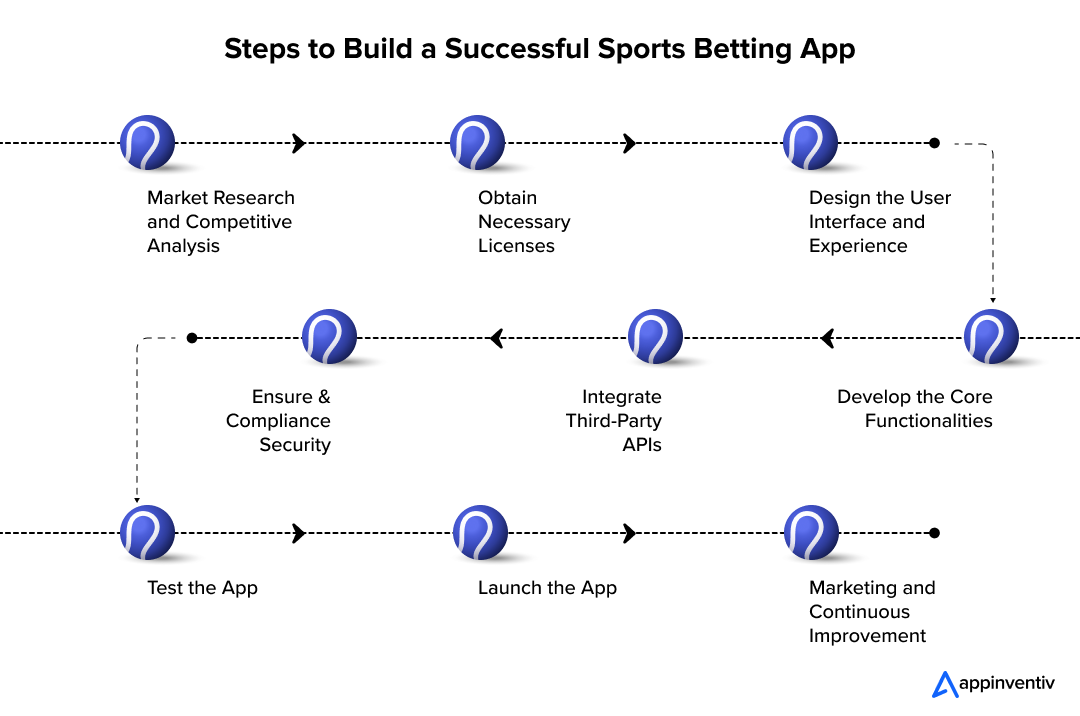
Market Research and Competitive Analysis
By understanding the market trends, user preferences, and your competitors, you can identify unique features that can differentiate your app from others.
Obtain Necessary Licenses
Sports betting is heavily regulated. Ensure you comply with all legal requirements and obtain necessary licenses before launching your app.
Design the User Interface and Experience
Focus on creating a user-friendly interface that caters to your target audience. Designing an intuitive UX/UI will ensure users can navigate the app easily and enjoy the betting process.
Develop the Core Functionalities
Begin coding the primary features based on your requirements specification. This includes setting up user accounts, bet placing mechanisms, payment integration, and real-time updates of betting odds.
Integrate Third-Party APIs
For live updates, payments, and more, integrate reliable third-party services. APIs for data feeds, payment gateways, and social media can enhance the app’s functionality and user experience.
Ensure Compliance and Security
Implement robust security measures to protect user data and transactions. Make sure the app complies with all regulatory requirements for all regions it operates in.
Test the App
Conduct thorough testing, including functional testing, usability testing, and security testing. This step is crucial to ensure the app is bug-free, user-friendly, and secure before launch.
Launch the App
Deploy your app on the appropriate platforms. Make sure you follow all guidelines for app stores to ensure smooth acceptance and availability.
Marketing and Continuous Improvement
After launching, focus on marketing strategies to attract users to your app. Analyze user feedback and app performance regularly to make necessary improvements and updates to enhance functionality and user satisfaction.
After looking into the process of how to make a betting app, let’s now move ahead and understand in detail the challenges of developing a sports betting app.
Market Entry and Growth Strategy for Sports Betting Apps
Launching a sports betting app is not only a technical effort. It is a business decision that depends on timing, regulation, and product focus. A clear strategy helps reduce risk and supports sustainable growth.
How to Launch
Successful launches start with focus.
- Begin with a defined region and clear regulatory scope
- Limit initial sports, markets, and features
- Prioritize compliance, payments, and core betting flows
- Validate performance under real betting traffic
Many operators choose to work with experienced development partners at this stage to avoid delays linked to licensing, integrations, or system readiness.
How to Scale
Scaling is planned early, not after launch.
- Design systems for traffic spikes during live events
- Prepare compliance frameworks for new regions
- Expand sports, leagues, and payment options gradually
- Strengthen admin, risk, and reporting controls
Platforms built with flexible architecture scale faster and cost less over time.
How to Stand Out
Differentiation in betting markets is product-led.
- Faster live and in-play betting experiences
- Better odds accuracy and risk control
- Localized UX, payments, and sports coverage
- Stronger user protection and transparency
Standing out often comes down to backend decisions made during development, not surface-level features.
A well-planned launch, scalable foundation, and clear product positioning create long-term value. Many businesses seek strategic and technical guidance early to align these elements before entering competitive betting markets.
Monetization Models for Sports Betting Apps
Monetization is a core design decision in sports betting platforms. Revenue models affect product structure, compliance scope, and long-term profitability. Platforms that plan monetization early avoid rework and regulatory friction later.
Below are the most common and proven models used across global betting markets.
Primary Revenue Streams
These models form the financial backbone of most sports betting platforms. They are tightly linked to odds management, risk control, and real-time system performance.
Odds Margin
This is the primary revenue driver. Operators earn the margin built into betting odds. Accuracy, speed, and risk control directly affect returns.
In-Play Betting Revenue
Live betting generates higher volume and frequency.
- Real-time odds updates
- Faster bet placement
- Higher engagement during live events
VIP Subscriptions and Premium Access
High-value users often pay for:
- Early odds access
- Higher betting limits
- Priority withdrawals and support
Advanced Monetization Models
These models are typically adopted once the platform reaches scale. They require stronger backend controls, compliance alignment, and flexible system design.
Affiliate Partnerships
Revenue is generated through user referrals and partner promotions. This model works well in regulated markets with clear attribution rules.
White-Label Platform Licensing
Some operators monetize by offering their betting infrastructure to regional brands or new entrants.
Data and Analytics Services
Aggregated betting insights and performance data can be monetized through partnerships, subject to regulatory approval.
Monetization Depends on Geography
Revenue models vary by region.
- Some markets restrict advertising or affiliate income
- Others limit odds structures or bonus strategies
- Payment and taxation rules also affect margins
This makes backend flexibility critical. Monetization logic must adapt without changing the core platform.
Monetization Should Be Built Into the Platform
Successful betting products treat monetization as part of system architecture, not a post-launch add-on. Many operators work with experienced sports betting app development teams to align revenue models with compliance, performance, and growth goals from the start.
A well-designed monetization strategy supports predictable revenue and long-term market expansion.
Challenges of Developing a Sports Betting App for Businesses
Developing a sports betting app comes with its own set of challenges that businesses must navigate to launch a successful product.
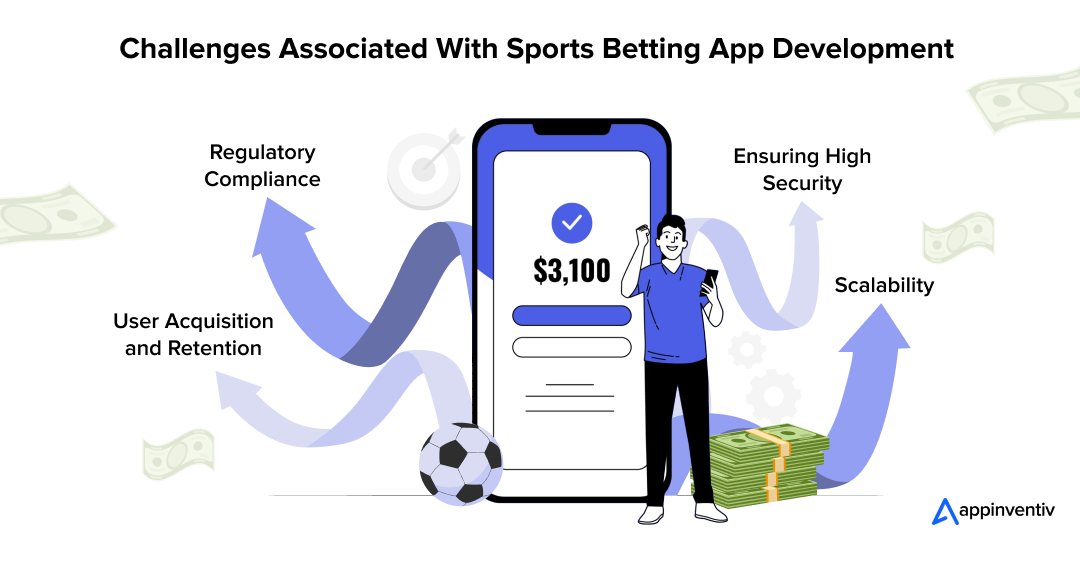
Regulatory Compliance
Navigating the complex and varied legal landscape of sports betting can be daunting.
Solution: Collaborate with legal experts to understand and implement compliance requirements effectively.
Ensuring High Security
Protecting sensitive user information and financial transactions is paramount but challenging.
Solution: Invest in state-of-the-art security technologies and protocols, and regularly update them to ward off potential threats.
User Acquisition and Retention
Attracting and retaining users in a competitive market requires significant effort.
Solution: Offer unique features, reliable customer support, and attractive bonuses to keep users engaged and loyal.
Scalability
The app should be able to handle increasing loads of data and user numbers without performance hitches.
Solution: Use scalable architecture and cloud solutions to ensure your app can grow without compromising on performance.
Partner with Appinventiv for Sports Betting App Development Services
Gone are the days when people used to depend on gambling clubs and agents to bet on their favorite sporting events. The rise of sports betting mobile app development has augmented the accessibility of betting, allowing people to bet even on the go. Indeed, sports betting app development has made life incredibly easier and fun for bettors and investors alike, enabling them to win a huge amount of money and generate higher revenue respectively.
So, if you are ready to reap the significant benefits that sport betting apps offer, it is time to get started with the sports betting mobile app development process and hire a reputed sports betting app development company like Appinventiv.
We at Appinventiv have a team of professionals with in-depth knowledge and expertise who are dedicated to the sports betting app development project. We understand the process, from the initial concept creation to the final product delivery and ongoing maintenance. Our proficient team provides guidance and support throughout the process, ensuring that the app meets the highest quality and performance standards.
Additionally, as a trusted sports betting app development services provider, we stand by you during the testing and deployment process to identify any potential problems and provide solutions to ensure that the app is successful.
FAQs
Q. How to make a sports betting app?
A. To create a sports betting app, begin with market research to understand user needs and compliance requirements. Develop a detailed plan that includes essential features such as live betting, secure payment options, and user profiles. Partner with a reliable app development firm that can help you build an app as per your requirements while offering you a quick estimate of the cost to build a sports betting app like sportsbet. Make sure the development firm ensures strong security measures and conducts thorough testing before launching the app .
Q. How much does it cost to develop a sports betting app?
A. The cost of developing a sports betting game app can vary greatly depending on the features and complexity of the app. Generally, the cost of developing a sports betting app can range from a $40,000 to $400,000+. Factors such as the number of features, the complexity of the app, the platform the app will be built on, the number of sports betting app developers needed, and the amount of time needed to develop the app can all affect the overall cost. Additionally, the cost of marketing the app and any ongoing maintenance costs should also be taken into consideration.
Q. How do sports betting apps make money?
A. Betting apps make money by taking a cut of the bets made through their platform. This cut, usually referred to as a “rake,” is taken from the winnings of each bet. The amount of rake taken by the app varies depending on the type of bet and the amount wagered. Additionally, betting apps may make money through advertising or by offering additional services such as tips or advice to users. Connect with a reputed sports betting app development services provider like Appinventiv, to learn more about app monetization strategies.
Q. What factors do you need to consider for building a sports betting app?
A. Here are some of the important factors to consider for sports betting app development:
Robust Security Measures: Implement strong security protocols to safeguard user data and transactions.
Real-Time Data Feeds: Integrate live betting features with up-to-date data streams.
Multiple Payment Gateways: Provide various payment options for user convenience.
Legal Compliance: Ensure adherence to gambling regulations in the app’s target regions.
User-Friendly Design: Develop an intuitive and engaging interface for a seamless user experience.
Customer Support: Offer responsive and accessible support to handle user inquiries and issues.
Scalability: Design the app to handle traffic spikes during major sporting events.
Q. How to integrate AI in sports betting app development?
A. Here is a structured, step-by-step process you can follow to implement AI in sports betting app development:
- Use machine learning models to analyze historical and real-time data for predictions.
- Implement AI-driven features like personalized betting recommendations and real-time odds.
- Integrate fraud detection algorithms to enhance security.
- Leverage tools like TensorFlow or PyTorch for building predictive models.
- Ensure seamless AI integration with backend systems for smooth app performance.
Q. What technologies are used in sports betting app development?
A. Sports betting apps use several key technologies to work smoothly and securely. Here’s a simple list of what’s often used:
- Native or Cross-platform Development Frameworks: Utilize tools like React Native and Flutter to build apps that can operate across multiple mobile platforms.
- Backend Development Languages: Employ programming languages such as Python, Node.js, or Ruby to handle the server-side functions of the app.
- Real-time Data Integration: Use APIs to fetch and display live data within the app, crucial for updating odds and results.
- Cloud Infrastructure: Implement cloud solutions like AWS or Google Cloud to ensure the app can scale and handle high user volumes reliably.
- Payment Gateway Integration: Incorporate payment services like Stripe or PayPal to process transactions securely.
- Database Management Systems: Manage large sets of data efficiently using databases such as MySQL or PostgreSQL.
- Push Notifications: Engage users with timely updates and alerts using services like Firebase Cloud Messaging.


Fast 2-minute response, fully NDA-protected.

How Do Sports Betting Apps Make Money? Revenue Models and Monetization Strategies
Technology in sports betting is at its pinnacle. With this penetration, sports betting apps have become a crucial resource for players to access value and versatility instantly. That’s why the U.S. has seen more than $408 billion in bets at legal sportsbooks since the Professional and Amateur Sports Protection Act (PASPA) was repealed in 2018.…

How Much Does it Cost to Develop a Sports Betting App Like Melbet?
Key takeaways: The cost to build a sports betting application such as Melbet can be between $40,000 and $300,000, depending on features and complexity. Its main characteristics are live betting, real-time odds, secure payment gateways, and multi-platform support. Revenue can be generated via in-app betting expenses, subscription plans, affiliate marketing, and premium functionality. Ensuring the…

How Much Does It Cost to Build a Lottery App Like The Lott?
Key takeaways: Developing a lottery app like The Lott typically ranges from AUD 62,000 to AUD 465,000+, depending on features and complexity. Feature scope, platform support, UI/UX quality, development team location, and regulatory compliance significantly affect costs. As of 30 June 2025, The Lottery Corporation reported AUD 3.75 billion in revenue, reflecting industry dynamics in…