




















Doctor On-Demand App Development: Enterprise Architecture, Technology Stack, and Development Cost

 Share -



- 01Types of Doctor-On-Demand Apps Enterprises Can Build
- 02Core Features Every Enterprise Doctor-On-Demand App Should Include
- 03Step-by-Step Doctor-On-Demand App Development Process
- 04Enterprise Architecture for Doctor-On-Demand App Development
- 05Technology Stack for Doctor-On-Demand App Development
- 06Healthcare Compliance and Security Standards for Doctor-On-Demand Apps
- 07Common Challenges in Doctor-On-Demand App Development and How to Overcome Them
- 08How Much Does Doctor-On-Demand App Development Cost?
- 09Revenue Models for Doctor-On-Demand Apps
- 10Future Trends Shaping Doctor-On-Demand App Development
- 11Why Choose Appinventiv for Doctor-On-Demand App Development
- 12Frequently Asked Questions

Key Takeaways
- Build enterprise telehealth platforms using cloud architecture, AI, FHIR/HL7 data links, and strict security tools.
- Compare build costs, tech stacks, and project timelines to plan app investments accurately.
- Address EHR integration, growth, security, and compliance challenges before they delay product launches.
- Review monetization models that help hospitals, insurers, and health firms drive long-term profit.
- Examine key engineering choices behind secure, scalable doctor apps that support growth.
Healthcare delivery no longer starts at the hospital door. Patients expect doctor-on-demand app development to let them book appointments, see specialists, get prescriptions, and track care on their phones. At the same time, health systems face clinician shortages, high costs, fragmented care, and strict privacy laws. Virtual care is no longer a convenience. It is a business necessity.
The shift is accelerating, with the global telehealth market projected to grow from $87.7 billion in 2026 to $187.5 billion by 2033. On-demand doctor apps drive this shift. Modern platforms do more than run video calls. They connect directly to Electronic Health Records (EHRs) and support FHIR and HL7 standards.
They connect clinical workflows, patient engagement, and secure data exchange into a single digital platform. This guide outlines the build process for an enterprise doctor app. It covers architecture, technology choices, compliance rules, cost factors, and core engineering decisions.
Enterprise healthcare is already digital-first. Launch your doctor-on-demand platform before falling further behind market leaders.

Types of Doctor-On-Demand Apps Enterprises Can Build
The right doctor-on-demand app development approach aligns with your business goals, target patients, and delivery model, decided after a competitive analysis of the market. Hospital systems need different features than health startups or insurance carriers.
Today, 76% of U.S. hospitals use telehealth to connect clinicians and patients remotely, making enterprise-ready virtual care platforms, including specialized formats like urgent care apps, a strategic priority. The table lists the primary platforms and their core functions.
| App Type | Primary Users | Core Use Cases |
|---|---|---|
| B2C Consultation Apps | Patients, Primary Care Doctors, Specialists | Lets patients book visits, consult doctors by video or chat, get digital prescriptions, and manage follow-up care on one platform. |
| Hospital-Owned Platforms | Hospitals, Health Systems, Patients | Expands outpatient care, connects directly to current EHR systems, manages virtual clinics, reduces hospital readmissions, and runs hybrid care models. |
| Specialist Consultation Platforms | Specialists, Referring Doctors, Patients | Directs patient referrals, second opinions, and team consultations for fields like cardiology, oncology, dermatology, and neurology. |
| Mental Health Apps | Psychiatrists, Therapists, Patients | Delivers private video counseling, behavioral health tests, medication tracking, crisis response, and long-term therapy plans. |
| Chronic Care Platforms | Patients, Care Teams, Physicians | Tracks long-term conditions like diabetes, high blood pressure, and heart disease with continuous tracking, medication alerts, and custom care plans. |
| Remote Patient Monitoring Apps | Patients, Clinicians, Care Coordinators | Gathers live health data from connected devices, monitors vital signs, triggers alerts, and supports early clinical action. |
| Corporate Health Platforms | Employers, Staff, Healthcare Providers | Offers primary care, preventive health programs, mental wellness, work-site health consultations, and health tracking through corporate benefits. |
Core Features Every Enterprise Doctor-On-Demand App Should Include
Successful doctor-on-demand app development balances patient convenience with clinical speed. Each user group interacts with the system differently. The features must support every stage of care, from booking to follow-ups.
Patient App Features
Patients expect digital medical care to run as smoothly as online banking. This expectation is reflected in adoption trends, with telehealth satisfaction reaching 83% among patients. A clear patient app lets people get care quickly without extra steps.
- Secure login with multi-factor authentication or biometrics
- Doctor search with filters for specialty, availability, language, and experience
- Online booking and calendar sync
- High-definition video, audio, and in-app chat visits
- Digital prescriptions and medication logs
- Secure payment processing and insurance checks
- Access to visit history and medical records
- Appointment alerts and follow-up reminders
- Provider ratings and review tools
- Multi-language options and accessibility settings
Doctor App Features
Physicians need tools that fit their daily routines. The software cuts administrative work and displays patient records instantly during visits.
- Profile and credential verification management
- Calendar and availability controls
- Virtual visit dashboard
- Patient records and history access
- Digital prescription generation
- Clinical note tools
- Lab report and medical image review
- Private patient messaging
- Visit history and earnings tracking
Admin Panel Features
The admin portal gives management total oversight of users, daily operations, and financial performance.
- Patient and doctor account controls
- Live appointment and visit tracking
- Role-based user permissions
- Billing, payments, and refund processing
- Performance dashboard for operational metrics
- Content and alert management
- Detailed audit logs and activity tracking
- Dispute resolution tools
- Customer support management
Also Read: How Payment Gateway Integration Works in Mobile Apps
AI Capabilities
Artificial intelligence in doctor-on-demand app development solutions cuts repetitive tasks, improves patient response rates, and supports clinical teams without replacing medical decisions.
| AI Feature | Operational Value |
|---|---|
| AI symptom assessment | Directs patients to the right level of care before booking. |
| Smart doctor matching | Pairs patients with doctors based on specialty, language, and schedule. |
| AI appointment scheduling | Suggests open time slots and prevents double-booking. |
| AI medical scribe | Converts patient conversations directly into clinical notes. |
| AI chatbot | Answers common questions, books visits, and sends follow-up steps. |
| Personal health guidance | Sends reminders, preventive tips, and wellness alerts based on records. |
This kind of personal health guidance reflects a wider shift toward personalization in healthcare delivery
Step-by-Step Doctor-On-Demand App Development Process
Building an enterprise doctor-on-demand app requires a structured engineering approach. From business discovery to deployment, every phase ensures the platform remains scalable, secure, compliant, and ready for healthcare integrations.
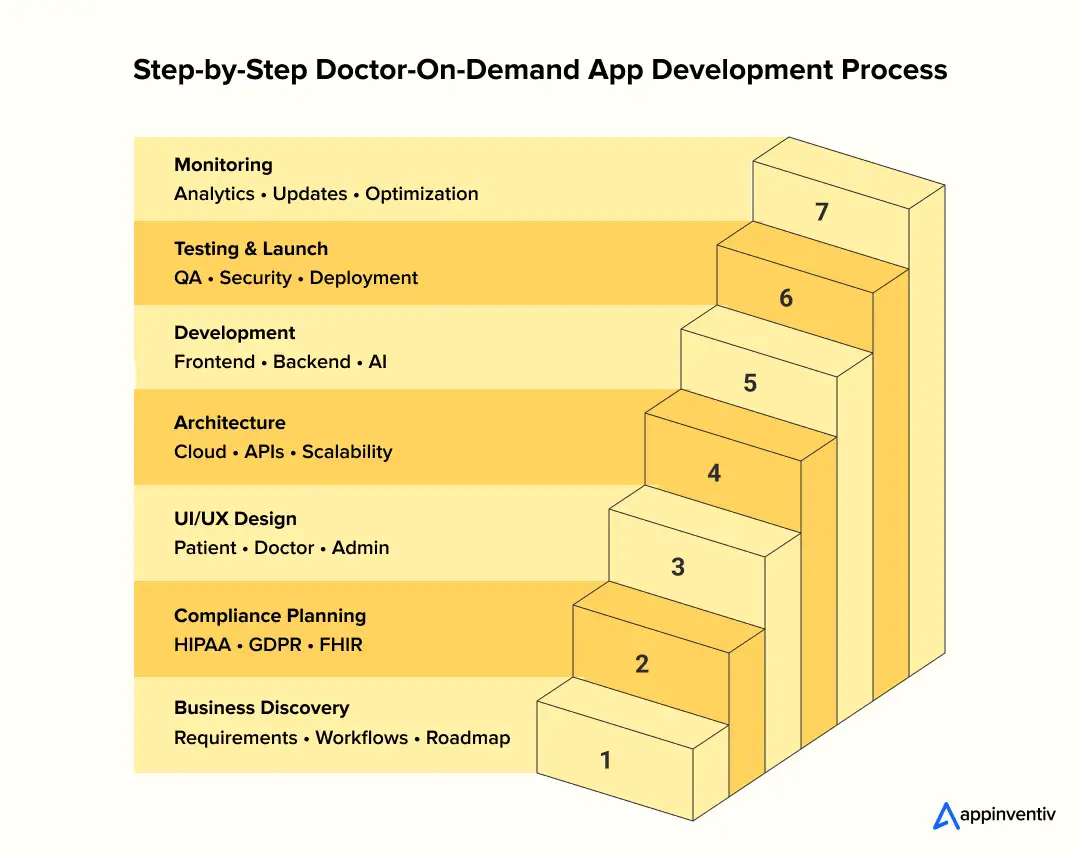
Business Discovery and Requirements
Every on-demand doctor app development project begins by defining clear business goals and mapping user actions. Choices made here shape the system architecture, feature roadmap, and launch schedule.
- Map user roles and workflows: Identify patients, doctors, specialists, and care teams. Map how each user moves through the system during care.
- Chart clinical processes: Document workflows for bookings, visits, prescriptions, billing, and follow-up care to fix operational gaps early.
- List system integrations: Identify every external platform the software must connect to, including health records, pharmacies, labs, and payment tools.
- Rank core features: Separate mandatory features from future updates to build a practical product roadmap.
- Choose the delivery model: Decide if the software supports one medical group, multiple hospital networks, or a white-label service model.
- Deliverables: Business requirements document, product spec, user maps, feature backlog, and launch timeline.
Regulatory and Compliance Planning
Doctor-on-demand app development services handle sensitive records continuously, so compliance planning, guided by a clear healthcare compliance framework, starts before writing code, since privacy laws shape every technical decision.
- Identify regional regulations: Define compliance rules like HIPAA or GDPR based on your target geographic markets.
- Establish data governance: Write policies for collecting, storing, saving, and deleting patient data safely.
- Define access levels: Set permissions using Role-Based Access Control so staff only see data tied to their duties.
- Plan data standards: Build support for HL7 and FHIR formats to share records with established medical networks.
- Track audit logs: Build tools to log activity and track system access for future security audits.
- Deliverables: Compliance plan, security rules, interoperability plan, and governance policies.
Design and User Experience
On-demand doctor app development must save time for patients and medical staff. Every layout should help users act quickly without unnecessary steps, balancing user experience vs customer experience across the whole care journey.
- Build clear user paths: Create direct navigation routes for booking visits, starting video calls, paying bills, and viewing medical records.
- Create clinician workspaces: Put patient histories, visit details, notes, and prescriptions on clean screens for fast decision-making.
- Build design standards: Create reusable interface parts to keep patient, doctor, and admin tools uniform.
- Meet accessibility standards: Follow standard accessibility guidelines to help users with physical or visual limits.
- Test layouts with users: Run prototypes with real users to find and fix usability problems early.
- Deliverables: Wireframes, interactive prototypes, design kits, and usability reports.
Also Read: The Role of Wireframes in Mobile App Development
System Architecture and Infrastructure
This phase defines the technical blueprint for on-demand doctor app development, covering infrastructure, integrations, scalability, and deployment requirements.
- Design system layout: Choose architecture patterns that support modular code, independent services, and future growth across hospital groups.
- Select cloud resources: Define compute, storage, networking, backup, and disaster recovery requirements based on projected demand.
- Map data transfers: Plan how data flows between internal systems and external software using secure application interfaces.
- Plan for heavy traffic: Add load balancers and auto-scaling rules to maintain fast load times during peak hours.
- Set up health monitoring: Pick logging tools and performance metrics to track system stability after launch.
- Deliverables: System architecture diagrams, infrastructure blueprint, deployment plan, and capacity estimates.
Development and Integration
Engineers build individual modules and link them through secure connections once stakeholders approve the architecture. Teams usually work in two-week agile development cycles with daily code checks.
- Build core application modules: Code separate interfaces for patients, doctors, and administrators with clear business logic.
- Connect healthcare databases: Link medical record platforms, pharmacy tools, labs, insurance databases, and payment processors through standard connections.
- Build real-time media tools: Add private video calls, clear audio links, and text messaging for uninterrupted visits.
- Add artificial intelligence tools: Insert automated symptom checks, smart scheduling, medical dictation, or patient help bots where needed.
- Secure access points: Safeguard connections and user logins using standard authentication and encrypted channels.
- Deliverables: Code modules, software interfaces, integration layers, technical documentation, and working software updates.
Testing and Quality Assurance
On-demand doctor app development requires strict testing strategies before going live. A single error during a live visit or record lookup disrupts patient care and clinical operations.
- Test core functions: Check bookings, video visits, payments, prescriptions, and alerts across every user flow.
- Verify data integrations: Confirm data moves accurately between health records, payment systems, and external tools without errors or duplicates.
- Run security checks: Perform vulnerability scans and penetration tests to find weak points before production.
- Test under heavy load: Simulate high numbers of concurrent users to test response speed and system stability.
- Verify compliance readiness: Review system operations against privacy regulations before releasing the software.
- Deliverables: Test summaries, security audit reports, bug logs, and launch readiness documents.
Deployment and Launch
Releasing a medical platform requires more than launching an app store download. Infrastructure, databases, software links, and tracking tools must work together before patients enter the platform.
- Set up production cloud tools: Configure cloud servers, networks, databases, and security settings for the live environment.
- Automate code releases: Use automated deployment pipelines to release updates consistently without manual mistakes.
- Run live system checks: Test connections, login features, push alerts, and payment gateways right before launching to users.
- Train operational staff: Teach administrators and health teams how to use the software before the public launch.
- Build fallback options: Prepare backup processes to return to a previous code version if issues pop up after launch.
- Deliverables: Live production release, operational guides, training materials, and launch checklists.
Monitoring and Future Expansion
Launching software starts a process of ongoing refinement. User feedback, changing laws, and new medical technologies shape future software updates.
- Track system performance: Monitor uptime, server response speeds, video quality, and system health with centralized tracking tools.
- Study user behavior: Review feature usage, completed appointment numbers, and patient retention rates to pinpoint design needs using predictive analytics in healthcare to anticipate patient behavior ahead of time.
- Keep systems secure: Install security patches, review access logs, and perform regular compliance checks as regulations change.
- Expand application features: Add new clinical options, artificial intelligence tools, device integrations, or specialty features based on strategic priorities.
- Measure business metrics: Track patient retention, consultation volume, doctor schedules, and operational costs to guide future spending.
- Deliverables: Performance reports, product roadmap updates, compliance audits, and release schedules.
Enterprise Architecture for Doctor-On-Demand App Development
Enterprise doctor-on-demand app development relies on a cloud-native, layered design. This structure separates presentation, business logic, integrations, video calls, artificial intelligence, cloud tools, and security. A modular setup improves uptime and system growth, and it lets software services evolve independently.
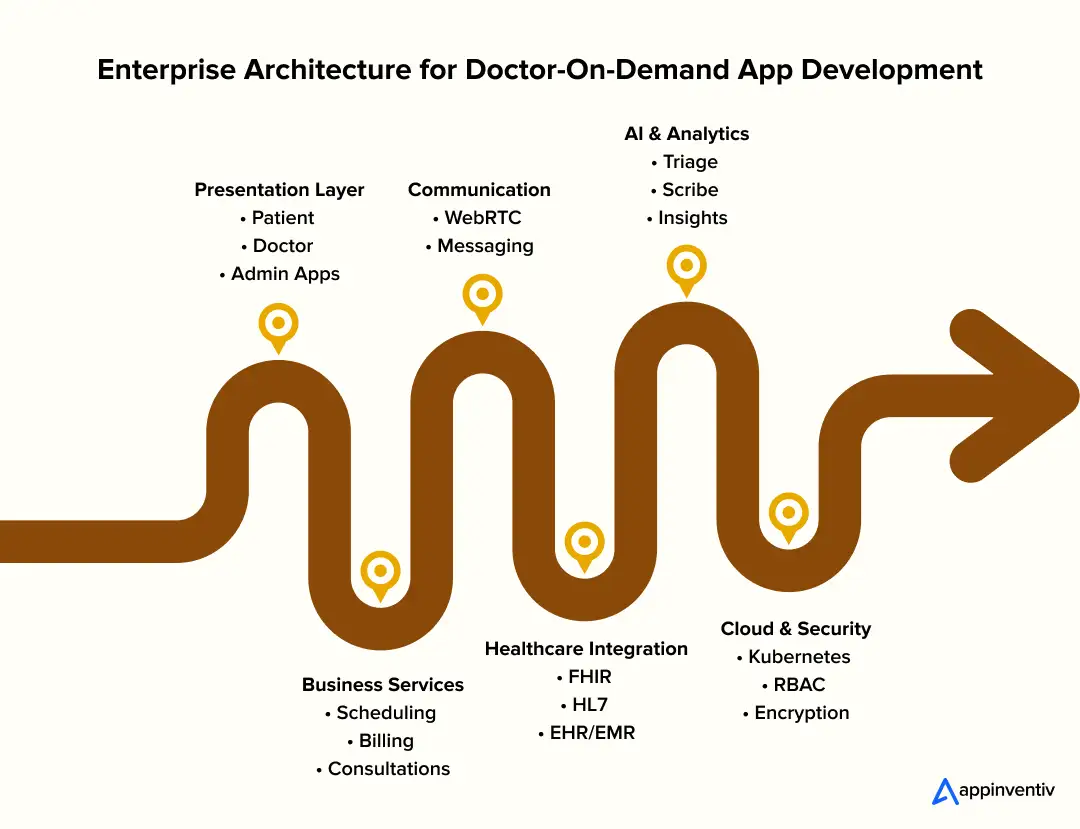
Presentation Layer
The presentation layer powers patient apps, doctor portals, admin dashboards, and web interfaces. It validates user inputs, renders data, and connects to backend services through secure REST or GraphQL APIs, ensuring consistent clinical workflows across mobile and desktop devices.
Application & Microservices Layer
This layer manages core business logic through independent microservices for scheduling, billing, authentication, notifications, and visit management. Services scale and deploy independently while communicating through REST APIs, gRPC, or Apache Kafka, improving resilience and reducing downtime.
Communication & Video Infrastructure
Live communication powers virtual care, with web and mobile platforms accounting for 79% of the telehealth market. Enterprise systems use WebRTC to deliver low-latency audio and video, a key factor influencing overall video conferencing app costs. STUN and TURN servers maintain call stability behind NATs and firewalls, while signaling servers establish, manage, and terminate secure sessions between patients and care teams.
Healthcare Integration Layer (FHIR/HL7)
The integration layer uses HL7, FHIR, and SMART on FHIR to connect EHRs, EMRs, laboratories, pharmacies, insurers, and diagnostic systems, enabling secure real-time interoperability and reducing duplicate records.
AI & Analytics Layer
The AI layer supports AI in medical diagnosis through symptom assessment, ambient clinical documentation, doctor matching, and patient risk analysis. More than 38% of healthcare institutions use AI-driven analytics for digital patient monitoring, with dashboards tracking visits, provider availability, patient satisfaction, and platform performance.
Cloud Infrastructure & DevOps
Cloud infrastructure, following broader cloud computing in healthcare practices, uses containers, Kubernetes, API gateways, load balancers, and caching tools to deliver high uptime and elastic scaling. CI/CD pipelines, centralized logging, and monitoring tools support reliable deployments and system tracking.
Security & Identity Management
Security is embedded across every layer using OAuth 2.0, OpenID Connect, MFA, SSO, and RBAC for identity and access management. TLS and AES-256 secure data, while key management, audit logs, and SIEM provide continuous threat detection and monitoring.
Technology Stack for Doctor-On-Demand App Development
The technology stack determines how your doctor-on-demand app development performs, scales, and exchanges data with other health systems. The table lists standard tools engineering teams use to build enterprise virtual care platforms.
| Technology Layer | Recommended Technologies |
|---|---|
| Frontend Technologies | React Native, Flutter, Swift, Kotlin, React.js, Next.js |
| Backend Technologies | Node.js, Java (Spring Boot), .NET Core, Python (FastAPI/Django), Go |
| Cloud Infrastructure | Amazon Web Services (AWS), Microsoft Azure, Google Cloud Platform (GCP) |
| Database Technologies | PostgreSQL, MySQL, MongoDB, Redis, Elasticsearch |
| Video Consultation Technologies | WebRTC, Twilio Video, Agora, Vonage Video API, Daily |
| AI & Machine Learning Stack | TensorFlow, PyTorch, OpenAI API, Google Vertex AI, Azure AI Services, LangChain |
| DevOps & Monitoring Tools | Docker, Kubernetes, GitHub Actions, Jenkins, Terraform, Prometheus, Grafana, ELK Stack |
| Third-Party Integrations | Epic, Oracle Health (Cerner), athenahealth, Stripe, PayPal, Twilio, Firebase, SendGrid, FHIR APIs, HL7 Interfaces |
Also Read: Choosing the Right Technology for Mobile App Development
The right engineering partner transforms modern architecture into secure, scalable doctor-on-demand platforms built for enterprise healthcare.

Healthcare Compliance and Security Standards for Doctor-On-Demand Apps
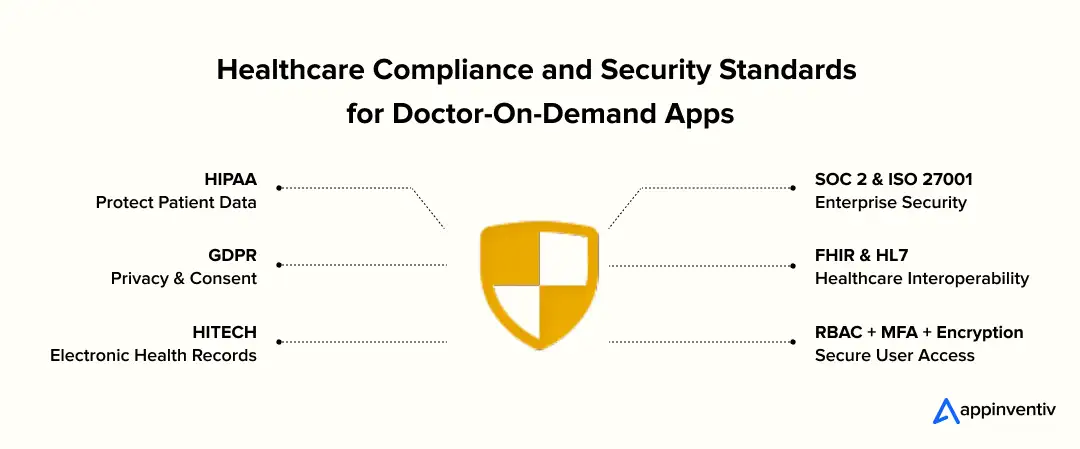
Compliance is a core requirement for enterprise doctor-on-demand app development. Building security, privacy, and interoperability into the application from the start helps organizations meet regulatory obligations while protecting sensitive patient data.
HIPAA
The Health Insurance Portability and Accountability Act (HIPAA) regulates how systems store and send Protected Health Information (PHI) in the United States. Doctor apps need physical, technical, and administrative controls. These include strict access limits, audit trails, encrypted messaging, and Business Associate Agreements (BAAs) with cloud vendors.
GDPR
Systems serving European Union patients must follow the General Data Protection Regulation (GDPR). The law demands explicit patient consent, minimal data collection, direct user access to records, and fast breach reporting. Apps must also support local data storage rules when required.
HITECH
The Health Information Technology for Economic and Clinical Health (HITECH) Act strengthens HIPAA rules for electronic records. It holds healthcare systems and software vendors accountable for reporting security breaches, securing health records, and logging access history.
SOC 2 & ISO 27001
SOC 2 proves that security controls protect user data across system performance, privacy, and uptime. ISO 27001 supplies a global standard for running an Information Security Management System (ISMS). Enterprise health networks often demand proof of compliance with these standards before signing contracts.
FHIR & HL7 Interoperability
Health systems rely on steady data transfers between clinical software. HL7 structures messages between health apps. FHIR uses standard RESTful APIs to share patient files, schedules, prescriptions, and lab results. Using these standards removes setup hurdles and links software across medical groups.
Identity & Access Management
Strong identity controls block unauthorized access to private health data. Enterprise platforms use Multi-Factor Authentication (MFA), Single Sign-On (SSO), OAuth 2.0, OpenID Connect, and Role-Based Access Control (RBAC). These tools verify user logins and restrict file access to specific job duties.
Data Encryption & Audit Logging
Platforms must safeguard sensitive health data during transfer and storage. Systems use TLS 1.2 or TLS 1.3 for data in transit and AES-256 encryption for data at rest. Complete audit logs track user actions, login attempts, file views, and admin changes to support compliance audits and security reviews.
Secure API & Infrastructure Practices
Apps use APIs to talk to EHR software, payment processors, pharmacies, and lab systems. Securing these pathways requires API keys, rate limits, secrets management, Web Application Firewalls (WAFs), routine security scans, and penetration tests. Cloud security controls and continuous server tracking protect the system from cyber threats.
Common Challenges in Doctor-On-Demand App Development and How to Overcome Them
Doctor-on-demand app development involves more than design work. Platforms must run without drops, share medical data safely, connect with older systems, and follow regional laws. Fixing these problems early reduces launch risks and keeps systems dependable as user traffic grows.
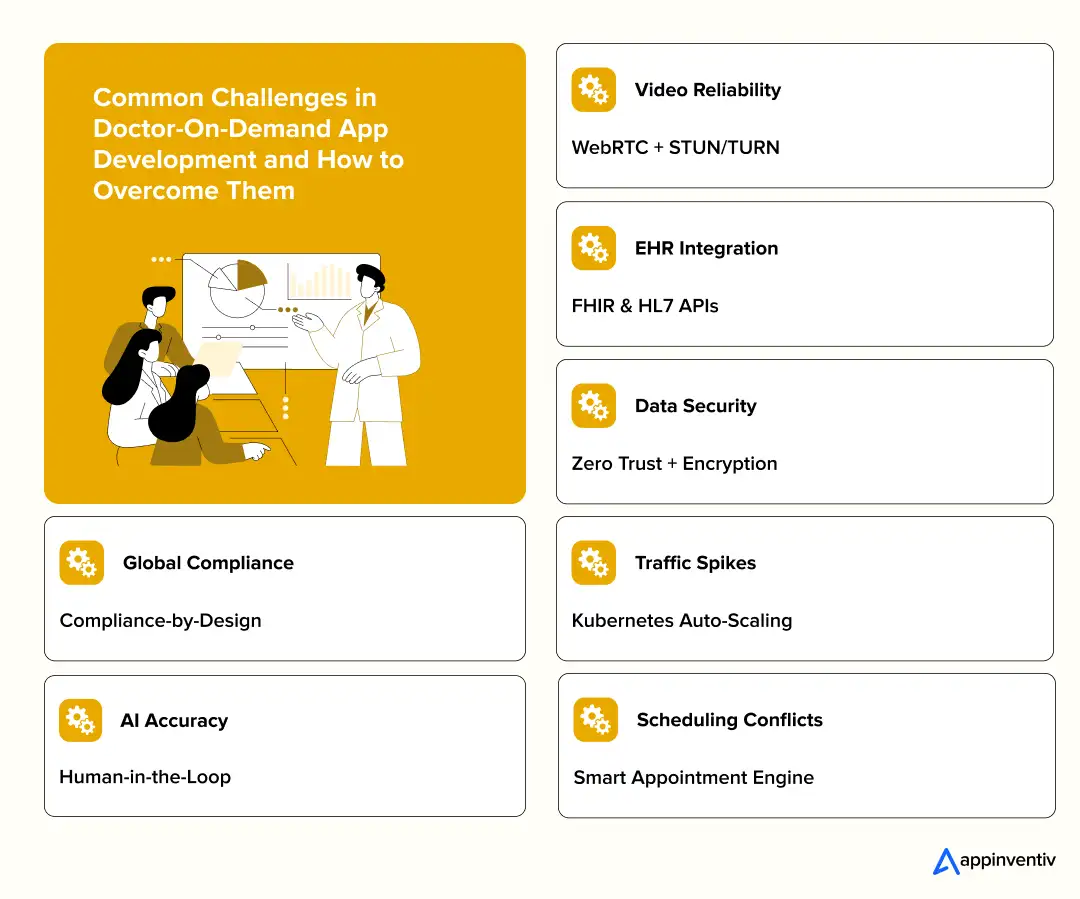
Real-Time Video Performance
High-quality video is essential for virtual care. Weak signals, lag, or dropped calls disrupt consultations, affect clinical workflows, and reduce patient trust.
Solution: Use WebRTC for fast communication, backed by STUN and TURN servers for reliable links across networks. Adaptive bitrate streaming, global media servers, and continuous connection tracking keep video calls stable.
EHR & EMR Integration Complexity
Hospitals run multiple software platforms. Connecting a virtual care app with EHRs, EMRs, labs, pharmacies, and insurance systems creates technical friction, especially with mixed data formats.
Solution: Build an API integration layer using FHIR and HL7 formats. An integration engine connects legacy software with modern APIs to keep patient files accurate.
Protecting Sensitive Health Data
Doctor on-demand platforms manage sensitive patient and financial data, making security and privacy critical.
Solution: Apply a Zero Trust security design with Role-Based Access Control, Multi-Factor Authentication, end-to-end encryption, key management, audit logs, and routine penetration tests, aligned with broader mobile app security best practices. Put security controls on every software layer rather than relying on firewalls alone.
Scaling for Peak Consultation Demand
Consultation volumes can rise unexpectedly, making scalability essential for maintaining performance and availability.
Solution: Deploy the platform on cloud infrastructure using Kubernetes, auto-scaling groups, load balancers, caching, and message queues. This setup spreads workloads evenly during sudden traffic spikes.
Cross-Platform Performance
Users expect a consistent experience across mobile, web, and desktop platforms.
Solution: Build responsive layouts using modern multi-platform frameworks or native code. Test functionality across systems, browsers, screen sizes, and network speeds before every release.
Appointment & Scheduling Conflicts
Scheduling conflicts in on-demand doctor appointment app development reduce operational efficiency and negatively affect the patient experience.
Solution: Build centralized calendar tools with live syncing, automated alerts, overlap checks, waiting lists, and smart booking tips. These tools raise doctor availability and drop no-show rates.
Global Compliance Requirements
Medical providers operating in multiple countries face different privacy laws, consent rules, and data storage requirements. Meeting one set of rules does not meet another, which is why understanding legal issues in mobile app development matters early.
Solution: Design compliance into the application structure from day one. Support custom consent options, regional data storage setups, detailed audit logs, and security controls matching HIPAA, GDPR, and HITECH rules.
AI Reliability & Clinical Safety
Artificial intelligence speeds up symptom checks and clinical notes, part of a much larger shift driven by AI in healthcare. Incorrect outputs or bad recommendations create clinical risks.
Solution: Keep physicians in control of every medical decision. Use AI strictly as a supporting tool. Check models with verified medical datasets, track performance after launch, and set clear rules for model updates.
How Much Does Doctor-On-Demand App Development Cost?
Doctor-on-demand app development cost varies based on feature depth, integrations, compliance rules, and delivery models, similar to general healthcare app development cost drivers. A basic initial product costs far less than an enterprise system with artificial intelligence, electronic health record links, and multi-region support.
Cost by Platform Complexity
| Platform Type | Estimated Cost (USD) | Typical Timeline |
|---|---|---|
| MVP with Core Features | $40,000 – $80,000 | 3–5 Months |
| Mid-Level Platform | $80,000 – $180,000 | 5–8 Months |
| Enterprise Platform | $180,000 – $400,000 | 8–14 Months |
| AI-Powered Multi-Hospital Platform | $400,000 – $800,000+ | 12–18 Months |
Factors Affecting Development Cost
Several technical choices in doctor-on-demand mobile app development shape the final budget:
- Number of supported platforms, including iOS, Android, and web apps
- Complexity of video call and text messaging features
- Integrations with medical records, labs, pharmacies, and insurance systems
- Artificial intelligence tools for medical notes and symptom checks
- Compliance rules, including HIPAA and GDPR standards
- User interface design detail and custom branding
- Cloud infrastructure setup and server capacity plans
Revenue Models for Doctor-On-Demand Apps
The right revenue model for on-demand doctor app development matches your delivery strategy and target audience. Growing consumer demand, particularly among millennials, 74% of whom prefer teleconsultations, is driving new digital healthcare business models in line with current healthcare app trends. Many enterprise platforms combine multiple models to secure steady income while expanding patient care.
| Revenue Model | How It Works |
|---|---|
| Pay-Per-Consultation | Patients pay a set fee for every virtual visit with a doctor or specialist. |
| Subscription Plans | Patients pay monthly or yearly fees for unlimited care or advanced features. |
| Commission-Based Marketplace | The platform takes a percentage fee from visits hosted by independent doctors. |
| Enterprise Licensing | Hospitals, clinics, and insurers license the platform through yearly or multi-year enterprise contracts. |
| Insurance Reimbursement | Platforms bill visit costs directly to insurance carriers using approved coverage policies. |
| Corporate Healthcare Programs | Companies pay for virtual care packages as part of employee health benefits. |
| Premium AI Services | Providers charge extra fees for AI tools like symptom checks, auto-notes, and health tracking. |
Healthcare leaders are already scaling enterprise telehealth. Launch your doctor-on-demand platform before competitors dominate digital patient engagement.

Future Trends Shaping Doctor-On-Demand App Development
Virtual care platforms are turning into connected, AI-driven health systems. Organizations building virtual care software today must pick technologies that support long-term growth, regulatory compliance, and clinical speed.
- Ambient AI & Medical Scribes: Run AI-powered documentation using large language models (LLMs) to draft clinical notes, summarize visits, and cut administrative paperwork for doctors.
- SMART on FHIR & FHIR R5: Move past basic HL7 connections by using SMART on FHIR authorization and FHIR R5 APIs. These standards share data securely across EHRs, labs, pharmacies, and insurance systems.
- Remote Patient Monitoring (RPM): Connect IoMT devices using Bluetooth Low Energy (BLE), MQTT, Apple HealthKit, or Google Health Connect. These connections track patient health constantly outside clinic walls.
- Cloud-Native & Kubernetes Architecture: Use containerized microservices, Kubernetes orchestration, service meshes, and Apache Kafka messaging. This structure improves system growth, resilience, and software update speeds.
- Zero Trust Security & AI Governance: Protect platforms using Zero Trust Architecture, confidential computing, passkeys, live identity checks, and clear AI governance rules. These security controls build compliant and dependable AI tools for clinical teams.
Why Choose Appinventiv for Doctor-On-Demand App Development
Healthcare organizations choose Appinventiv, a trusted healthcare app development company, to build secure, enterprise-grade doctor-on-demand platforms that combine AI, interoperability, cloud engineering, and compliance expertise. From product strategy to deployment, we help providers, hospitals, insurers, and digital health companies accelerate virtual care with confidence.
Our engineering team has delivered over 500 digital health platforms. These systems process more than 10M healthcare data points annually and support over 120K virtual care interactions. Our platforms help clients reach a 92% appointment attendance rate. They cut care coordination delays by 45% using smart scheduling, automated workflows, and system interoperability.
We deliver end-to-end product engineering, including FHIR and HL7 interoperability, AI-powered capabilities, cloud-native architecture, and HIPAA and GDPR-compliant development. We update current telehealth tools and build new virtual care platforms.
Appinventiv supplies the technical execution behind doctor-on-demand app development, turning your vision into a secure, future-ready healthcare platform. Let’s connect and build an enterprise telemedicine platform now.
Frequently Asked Questions
Q. How long does a doctor-on-demand app development take?
A. Doctor-on-demand app development timelines depend on platform features, system integrations, and compliance rules. A simple initial product takes 3 to 5 months. An enterprise platform with AI tools, EHR links, and custom security takes 8 to 18 months.
Q. How much does it cost to build a doctor-on-demand app?
A. Doctor-on-demand app development solutions cost between $40,000 and over $800,000, depending on feature depth, supported operating systems, AI features, third-party connections, cloud tools, and privacy rules.
Q. Which compliance standards should a telehealth platform meet?
A. Platforms must follow laws tied to their target regions. Key standards include HIPAA, GDPR, HITECH, SOC 2, and ISO 27001. System builds also require HL7 and FHIR protocols to exchange medical data safely.
Q. Can a doctor-on-demand app integrate with existing EHR/EMR systems?
A. Yes. Enterprise platforms connect to EHR and EMR software using FHIR APIs, HL7 messaging, or SMART on FHIR protocols. Doctors view patient files, prescriptions, and health histories directly without changing apps.
Q. Which technologies are best for secure video consultations?
A. WebRTC is the top choice for live video calls. It offers low latency and native encryption. Engineering teams pair WebRTC with tools like Twilio Video, Agora, or Vonage to manage large call volumes reliably.
Q. How can AI improve doctor-on-demand applications?
A. AI runs automated symptom checks, doctor matching, calendar bookings, clinical notes, and health alerts. These tools cut desk work, boost patient responses, and help doctors make swift care decisions.
Q. What factors influence the scalability of a telehealth platform?
A. Scalability relies on cloud resources, microservices, load balancers, fast databases, caching rules, and auto-scaling setups. These tools let platforms handle surging visit numbers without losing speed or dropping calls.
Q. How do healthcare organizations monetize doctor-on-demand apps?
A. A doctor-on-demand app development company helps health systems make money through visit fees, subscription packages, enterprise licenses, and marketplace commissions. They also use insurance billing, corporate health contracts, and add-on fees for advanced AI features.
Q. What are the best practices for successful doctor-on-demand app development?
A. Start with MVP development to test core features before expanding. Focus on clear UI/UX design, role-specific interfaces, and cross-platform flexibility. Include doctor verification, real-time messaging, matching algorithms, and patient ratings to improve care. Build on a cloud technology stack with HIPAA compliance from day one. Finally, use performance dashboards and ongoing staff training to drive adoption and steady performance.
Q. What is driving the growth of the doctor-on-demand app market?
A. Higher consumer adoption, strong demand for remote care, and fast technological shifts drive growth in the global online doctor consultations market. The expanding mHealth apps market, IoT connections, and new doctor-on-demand business models help providers add users. These factors raise provider activation rates, improve marketplace fill rates, and expand telemedicine applications smoothly.


Fast 2-minute response, fully NDA-protected.

Wearable Data Integration: Connecting Multiple Devices to a Unified Health Platform
Key takeaways: Device support should reflect the measurements your service needs, the people using it, and the decisions those readings inform. A unified health data platform must preserve source, timing, and measurement context while resolving duplicate records. Phone health platforms, manufacturer APIs, and direct device connections serve different integration needs. Clinical workflows require agreed review…
Sleep Tracker App Development: Features, Wearable Integration, AI, and Compliance
Key takeaways: Sleep tracking presents opportunities across consumer wellness, fitness, healthcare, employee wellness, senior care, and infant-care markets. Successful products combine actionable insights, wearable connectivity, user-friendly reports, privacy controls, and clearly differentiated experiences. HealthKit, Health Connect, and direct device APIs provide different data depths, costs, limitations, and maintenance requirements. AI supports sleep-stage estimation and personalization,…
Diet and Nutrition App Development: Process, Features, Cost, and Technology Stack
Key Takeaways Diet and nutrition tracking app development goes past basic calorie counters with verified food databases, custom meal schedules, AI tools, wearable device links, and corporate manager tools. Structure database models around raw food items, serving portions, nutrient facts, recipes, software links, and regional diet rules. Pair computer vision models, recommendation algorithms, language engines,…