































A Clear Breakdown of Custom Software Development Costs for Businesses in Canada


- Cost Factors That Shape Custom Software Development in Canada
- How to Create a Cost Estimation for Your Custom Software
- Regional Cost Variation of Custom Software Development in Canada
- Cost Tiers and Realistic Pricing for Custom Software Development in Canada
- Cost Differences by Software or App Type
- Cost Drivers Many Businesses Miss in Canada
- Long-Term Total Cost of Ownership for Custom Software in Canada
- Regulated Industry Considerations in Canada
- Build, Buy, or Hybrid? A Decision Framework for Canadian Businesses
- Practical Strategies to Control Development Costs in Canada
- How Appinventiv Supports Canadian Enterprises
- FAQs

Key takeaways:
- Custom software in Canada typically ranges from CAD 55,00 to 550,000 ($40,000 to $400,000), depending on scope, integrations, and compliance.
- Costs rise in regulated sectors due to PHIPA, PCI DSS, AML rules, and strict Canadian data residency requirements.
- Planning, modular architecture, and cloud native services help control the software development cost in Canada long-term.
- Most builds take 8 weeks to 12 months, influenced by complexity and industry standards.
- Maintenance usually adds 15 to 25 percent annually, covering updates, security, and performance improvements.
Canada is entering a strong digital growth phase. According to Grand View Research, the custom software development market in Canada is projected to reach multiple billions of dollars by 2030, supported by a compound annual growth rate of 22.1 percent. This trend shows that more businesses across finance, logistics, healthcare, and retail are evaluating the software development cost in Canada as part of a long-term digital strategy.
Most organizations assume they can look at one flat number to understand the cost to develop a software in Canada, but the real picture is layered. A credible software development cost breakdown should include feature complexity, data architecture decisions, compliance requirements, and plans for scaling. Without this level of detail, cost planning often leads to inaccurate budgets and delayed launches.
The goal of this article is to give Canadian decision makers clear and realistic guidance. You will find CAD based ranges, technical cost drivers, compliance details, and long-term budgeting considerations for those planning to build software in Canada or modernize existing systems. This helps teams approach investment decisions with confidence and clear expectations.

Cost Factors That Shape Custom Software Development in Canada
Planning a realistic software development cost estimate begins with understanding the elements that influence budget. Every Canadian project brings its own requirements, but the following categories appear in almost every discussion of software development cost in Canada.
Project Scope and Complexity
The size of the project and how many moving parts it includes remain the biggest cost drivers. A basic internal tool costs significantly less than a platform with automation, reporting, or multi-user features. Breaking down scope early removes confusion and supports accurate planning.
Typical elements that increase scope include:
- Number of user roles
- Volume of screens or modules
- Workflow automation
- Reporting and dashboard requirements
Architecture Choices
Choosing the right architecture is the technical blueprint of an enterprise software. Decisions made here affect both immediate development costs and long-term maintenance. Choosing scalable architecture makes later updates easier, especially if the goal is to build a software in Canada that supports multi-region use.
Common architecture considerations include:
- Monolith or microservices
- Cloud native build or hybrid setup
- Use of container services such as Kubernetes
- API gateway and event-driven data flow
Security and Compliance Requirements
Canadian regulations often influence project costs more than expected. Any discussion of custom software development cost in Canada should cover privacy, data storage, encryption, and audit logging. For many teams, compliance is not optional and must be built into the architecture from the beginning.
Key compliance items to consider include:
- PIPEDA personal data protection
- PCI DSS for payment handling
- PHIPA for Ontario healthcare data
- Data residency for public sector records
Integration with Existing Systems
Technology integrations can significantly increase development time. Connecting new systems with legacy tools, databases, or external services is one of the main factors influencing software development cost in Canada because each integration requires testing, data mapping, and error handling.
Common integration targets include:
- ERP platforms
- CRM systems
- Payment gateways
- Document storage and search tools
- Real-time analytics systems
Design and UX
Good software must be usable, not just functional. UX planning reduces rework and supports a predictable timeline. Many Canadian businesses list poor user experience as one of their major challenges for making software in Canada because redesigns can impact budget.
Core UX related cost components include:
- Wireframes
- Prototypes
- Interaction mapping
- Accessibility and WCAG testing
How to Create a Cost Estimation for Your Custom Software
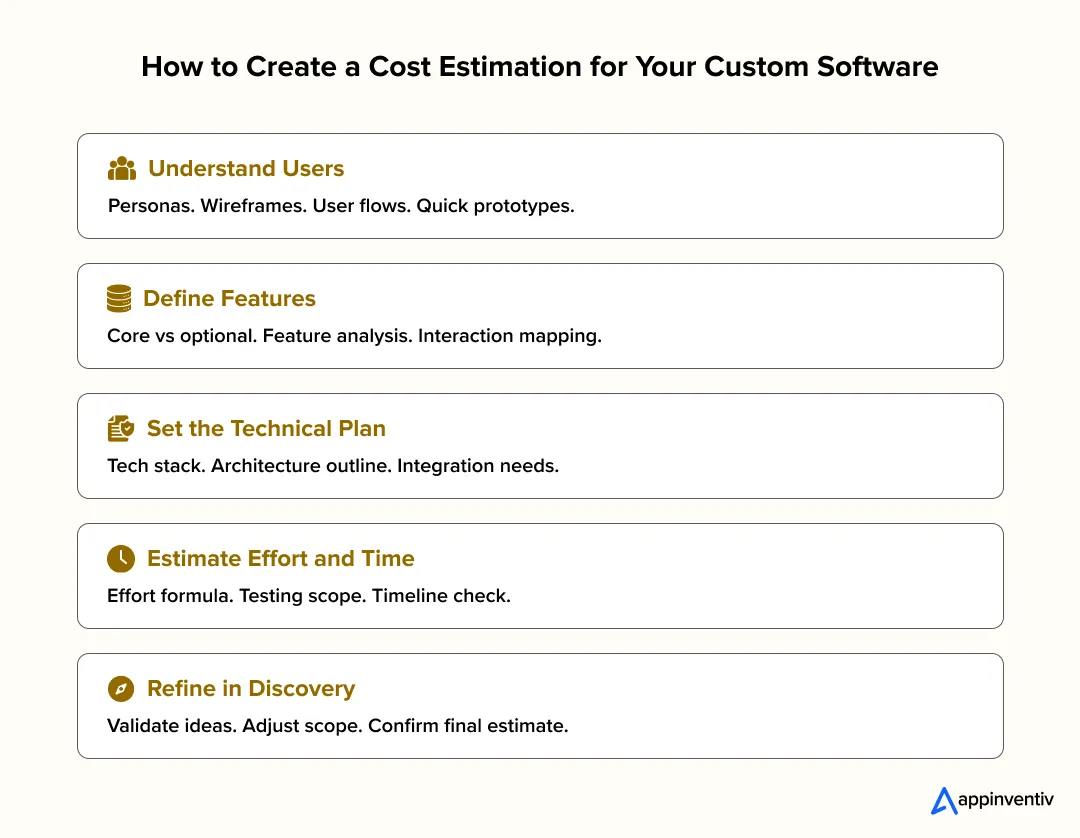
Estimating the cost of custom software accurately requires a clear understanding of users, workflows, architecture, and testing needs. A structured process helps Canadian businesses avoid budget overruns and build a preliminary cost estimate that reflects real project complexity instead of assumptions.
Understanding Users and Workflows
Teams begin by defining who the system serves and how they will use it. Early clarity prevents rework and strengthens the foundation of the estimate.
Key activities include:
- Creating detailed user personas
- Mapping experience through wireframes and user flow diagrams
- Designing UI layouts and interactive prototypes to validate assumptions
Breaking Down the Feature Set
Clear documentation of feature behavior allows developers to calculate time, effort, and technical depth.
Feature planning often involves:
- Separating core features from optional enhancements
- Conducting structured feature analysis
- Reviewing user actions and system responses
Planning the Technical Foundation
Architecture and technology choices influence project effort more than most teams expect.
Technical planning covers:
- Selecting the technology stack
- Outlining technical architecture planning
- Identifying integration points and constraints
Calculating Effort and Timeline
Once workflows and technical expectations are defined, engineering teams estimate development hours and testing cycles.
Estimation typically includes:
- Applying a standard cost estimation formula for effort
- Reserving time for manual and automated testing
- Conducting timeline analysis based on team size and complexity
Refining Estimates During Discovery
Estimate accuracy improves as the discovery process progresses. This phase validates assumptions, clarifies open questions, and aligns stakeholders on scope. A strong discovery cycle significantly improves forecasting accuracy for Canadian businesses.
Regional Cost Variation of Custom Software Development in Canada
Custom software pricing varies widely across Canadian regions based on talent availability, demand, and industry focus. Understanding these differences helps companies get a realistic software development cost breakdown before committing to a timeline or team.
Major Canadian tech regions
Top Canadian software hubs include Toronto, Vancouver, Montreal, and Calgary. Each city has unique strengths, talent pools, and hourly rates for development services.
Typical hourly rate ranges for development talent include:
- Junior developer: CAD 70 to 90 per hour ($51 to $66)
- Mid-level developer: CAD 100 to 130 per hour ($73 to $95)
- Senior developer: CAD 140 to 160 per hour ($102 to $117)
- Solution architect or DevOps engineer: CAD 160 to 200 per hour ($117 to $147)
Typical project cost ranges by region
Regional talent density directly impacts Canadian software development cost and total project budgeting. Larger metropolitan areas tend to have higher rates due to demand and specialization.
General project estimates across regions:
- Toronto-based projects: CAD 80,000 to 240,000 ($59,000 to $176,000)
- Vancouver projects: CAD 70,000 to 200,000 ($51,000 to $147,000)
- Montreal projects: CAD 60,000 to 180,000 ($44,000 to $132,000)
- Calgary projects: CAD 50,000 to 160,000 ($37,000 to $117,000)
Remote and hybrid team impact
Companies sometimes explore remote or outsourced teams to reduce the cost of outsourcing software development. However, savings must be balanced against communication challenges, delivery timelines, and compliance standards.
Consider these factors when evaluating remote development:
- Time zone alignment
- Communication practices
- Cultural fit with product teams
- Data security and privacy policies
- Contract terms and SLA clarity
Cost Tiers and Realistic Pricing for Custom Software Development in Canada
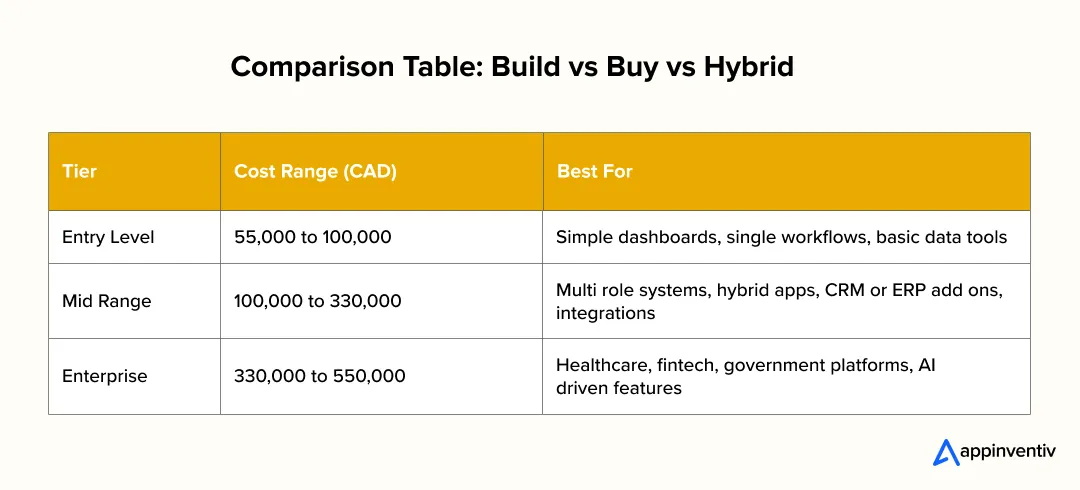
Understanding the cost of software development starts with recognizing common pricing tiers. Instead of one single number, it is more practical to approach budgeting in three levels based on feature scope, compliance needs, integrations, and long-term maintenance expectations. These ranges reflect average custom software development cost in Canada when working with professional teams.
Entry Level Projects
Entry level (or MVP project development) focus on essential functions and limited user roles. This tier is ideal for internal tools or proof of concept applications. Teams new to software budgeting often begin here when evaluating the cost to develop a software in Canada.
Typical pricing: CAD 55,000 to 100,000 (USD 40,000 to 90,000)
Best for:
- Simple dashboard apps
- Single module workflow systems
- Basic form processing or data collection tools
Mid Range Business Applications
Mid range builds allow companies to plan for future growth, add reporting, and include external integrations. Most Canadian businesses fall in this bracket because it balances features and cost control.
Typical pricing: CAD 100,000 to 330,000 (USD 90,000 to 240,000)
Best for:
- Multi-role access systems
- Mobile web hybrid platforms
- CRM or ERP feature extensions
- Integration with third-party services
This tier is where a detailed software development cost breakdown becomes valuable since integrations and design decisions influence hours and complexity.
Enterprise Grade Software
Enterprise software requires robust architecture, advanced permissions, compliance controls, and scaling options. Teams often need clear planning and phased delivery when estimating the cost to build enterprise software in Canada at this level.
Typical pricing: CAD 330,000 to 550,000 (USD 240,000 to 400,000)
Best for:
- Healthcare platforms needing PHIPA compliance
- Fintech products processing sensitive transactions
- Government digital transformation projects
Enterprise builds often include artificial intelligence features. When planning budgets, it is smart to consider AI tools early since the AI integration cost in custom software Canada can influence both development and maintenance phases.

Cost Differences by Software or App Type
The total cost of custom software in Canada varies based on the type of application being built. Each category comes with its own technical depth, hosting needs, user expectations, and compliance obligations, which all influence the final budget.
Enterprise Software
Tools like ERP software, CRM software, and supply chain management software require complex backend systems, multi-user access, and extensive reporting. Their deeper technical architecture and integration requirements place them at the higher end of the cost spectrum.
SaaS Products
SaaS software development involves multi-tenancy, subscription billing, and continuous onboarding. These platforms demand scalable hosting and refined UX flows, which increases planning and long-term operational cost.
Mobile and Cross-Platform Apps
Costs vary based on platform choice and performance needs. Cross-platform solutions reduce development effort, while native builds usually suit gaming apps, social media apps, or on demand apps that require high responsiveness.
Industry Specific Applications
Fintech apps and healthcare apps often require compliance with HIPAA, PIPEDA, GDPR, or PCI DSS. These checks increase testing, encryption effort, and documentation needs, making regulated apps more expensive than general-purpose builds.
eCommerce and Retail Apps
Ecommerce apps involve catalog logic, checkout flows, and third-party gateways. Backend depth and secure hosting drive cost compared to basic content driven tools.
Cost Drivers Many Businesses Miss in Canada
Teams often make room in the budget for development work but forget to plan for infrastructure and long-term upkeep. The difference between software maintenance cost vs development cost can be substantial in Canada, especially when compliance and security are involved. Accounting for these elements early protects timelines and avoids urgent spending later in the project.
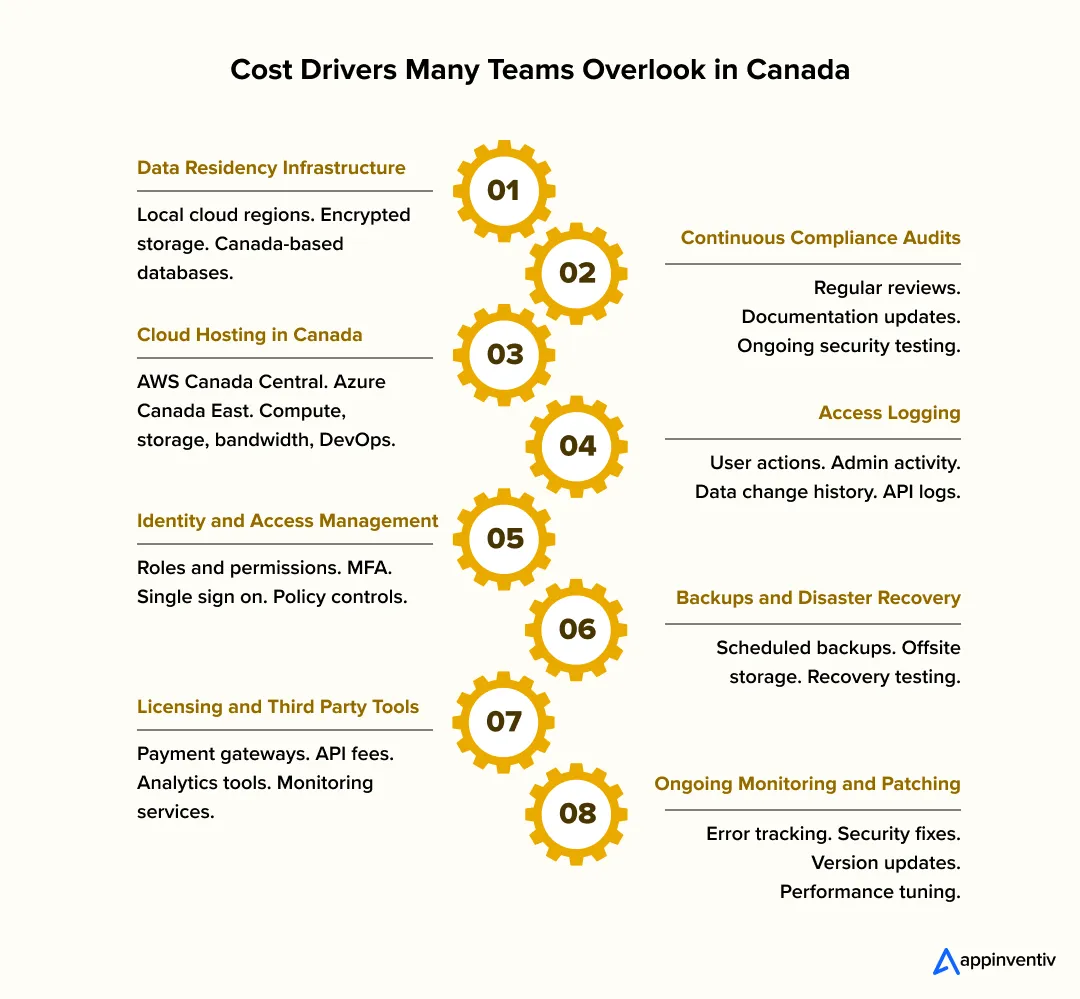
Data Residency Infrastructure
Canadian organizations face unique data requirements for sensitive information. Any solution storing personal or financial data must comply with regional policies, not just global standards. This often means choosing cloud regions located physically in Canada or setting up secure storage that keeps data inside the country.
Typical cost considerations:
- Dedicated Canadian data centers
- Storage region configuration
- Encryption for data-at-rest and in-transit
- Database hosting location planning
Continuous Compliance Audits
Compliance is not a one time task. For regulated sectors, proving ongoing adherence to privacy rules is essential. This is one of the most overlooked custom software development benefits in Canada because companies protect themselves long-term by planning audits in advance rather than reacting to failures.
Ongoing audit activities include:
- Scheduled policy reviews
- Internal documentation updates
- Vulnerability testing
- Third-party assessments
Cloud Hosting on AWS Canada Central or Microsoft Azure Canada East
Choosing cloud regions in Canada helps maintain data residency while improving latency for local users. Hosting adds recurring fees that should be part of your software development cost breakdown, not an afterthought once the application goes live.
Key hosting cost drivers include:
- Compute resources
- Database storage
- Bandwidth and load scaling
- DevOps setup and automation
Access Logging
Access logging tracks user behavior and system interactions. It supports compliance, helps identify fraud, and protects operations. Many teams underestimate storage needs for logs, which grow quickly and add to software development costs over time.
Important logging components:
- User authentication events
- Administrative actions
- Data change history
- API request logs
Identity and Access Management
Identity controls and permission levels affect security, user experience, and internal governance. This is a mandatory cost in many regulated projects due to custom software development compliance requirements for Canada.
Identity related features often include:
- Role based access
- Multi-factor authentication
- Single sign-on integration
- Password policy enforcement
Backups and Disaster Recovery
Planning for system failure is part of responsible engineering. Backups and recovery processes become essential once applications handle critical data. This is one of the hidden areas where the cost of outsourcing software development may actually save money, since experienced teams already have disaster recovery frameworks.
Core backup and recovery elements:
- Scheduled backups
- Offsite storage
- Recovery time objectives
- Data restoration testing
Licensing and Third-Party Tools
Applications rarely run in isolation. External services, SaaS tools, analytics platforms, and plug-ins often come with monthly subscriptions. Licensing needs to be part of early budgets when reviewing the cost to develop a software in Canada.
Typical external expenses include:
- Payment gateway fees
- API subscription charges
- Reporting dashboards
- Monitoring services
Ongoing Monitoring and Patching
After launch, teams must track performance, address bugs, and update security patches. This is why planning is important when comparing software maintenance cost vs development cost because maintenance remains active for the entire life of the application.
Monitoring priorities:
- Real-time error reporting
- Security updates
- Framework version upgrades
- Performance optimization
Long-Term Total Cost of Ownership for Custom Software in Canada
Planning for long-term spending is one of the most effective ways to manage software development costs realistically. Many teams only focus on launch day pricing and ignore ongoing work. In Canada, compliance, feature expansion, hosting, and security updates continue throughout the life of the system. Understanding total ownership reduces risk and keeps budgets predictable.
Initial Build Phase
A reliable software development cost breakdown always starts with the first development phase. Planning, UX, engineering, and testing make up the core work in this stage. Clear scope documentation is one of the most important early process steps to develop a software without delays.
Initial build activities include:
- Requirement gathering and scope planning
- UX design
- Development and integration
- Quality assurance and testing
Typical pricing for an initial build ranges from CAD 55,000 to 330,000 (USD 40,000 to 240,000) depending on complexity and team structure.
Maintenance and Routine Updates
After launch, teams shift from building features to making sure everything runs smoothly. This period is where many companies first see the difference between software maintenance cost vs development cost. Maintenance becomes a recurring investment rather than a single one.
Maintenance considerations include:
- Bug fixes and hot patches
- API integration, updates and security patches
- Customer feedback fixes
- Minor UX improvements
Expected annual maintenance can reach 15 to 25 percent of initial development cost.
Scaling and Feature Growth
As users increase, performance and new requirements emerge. Scaling decisions are common cost drivers in custom software development cost in Canada because infrastructure and architecture plans need to evolve.
Scaling tasks may include:
- Database optimization
- Load balancing upgrades
- Cloud resource expansion
- Caching and performance tuning
When upgrading systems, teams often need to increase monthly infrastructure spending to support consistent performance.
AI Integration Costs
Artificial intelligence features are becoming more common across Canadian software projects. Yet teams rarely plan for this in the original budget, but can’t not ignore the AI integration. Understanding AI integration cost in custom software Canada helps leaders make informed decisions about advanced capabilities.
Typical AI features include:
- Automated recommendations
- Sentiment and behavior analysis
- Document and image classification
- Predictive analytics
AI functions usually add separate development cycles and model training hours, which can raise long-term spending even after launch.
Compliance and Documentation
Compliance is not a one time task. Policies change, and documentation must remain updated for audits or reports. Teams often under estimate custom software development compliance requirements for Canada especially in healthcare and finance.
Ongoing compliance work includes:
- Policy updates and review
- Audit documentation
- Penetration testing
- User data reporting
Compliance spending varies based on sector, but all regulated projects require annual review and documentation.
Regulated Industry Considerations in Canada
Regulated industries in Canada face stricter rules that influence architecture, hosting choices, and long-term operating costs. These requirements directly shape how teams plan, design, and deploy custom software.
Healthcare Projects
Healthcare systems must follow PHIPA guidelines, which govern how personal health information is collected, stored, and shared. Any application handling medical records requires secure storage, controlled data access, and complete audit trails to ensure every interaction can be verified. These expectations influence infrastructure and often increase planning and testing requirements.
Also Read: CTO’s Take on Complying with HealthTech Regulations: Navigating HIPAA, HITECH, and Beyond
Finance and Payments
Financial platforms must align with PCI DSS standards to protect payment data and reduce fraud risks. Systems also need AML transaction monitoring capabilities and strong encryption for data in transit and at rest. Retention rules determine how long records must be stored, which affects storage strategy and long-term infrastructure cost.
Government and Public Sector
Government applications must comply with strict data residency rules that keep information within Canadian boundaries. Cloud solutions must align with municipal and provincial cloud policies, which define approved regions and storage practices. These projects require greater transparency, documented workflows, and controlled access environments to meet public sector standards.
Build, Buy, or Hybrid? A Decision Framework for Canadian Businesses
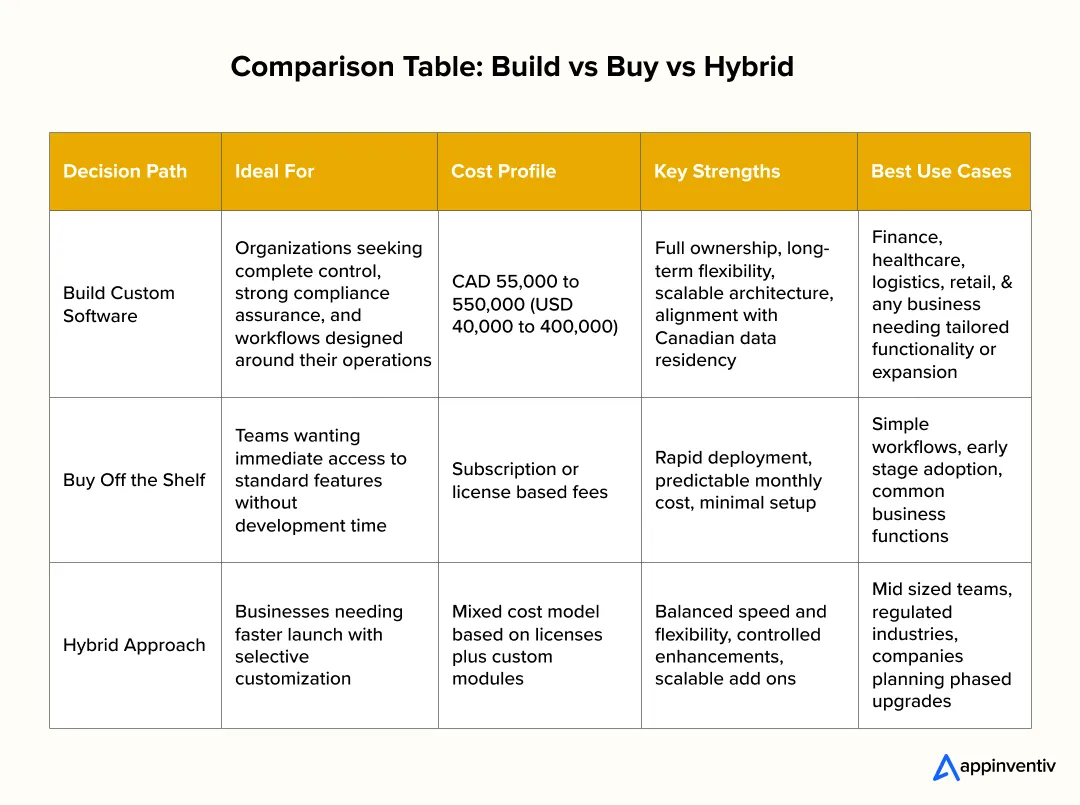
Canadian organizations have three clear paths when planning a new digital solution. Each path offers different levels of control, speed, and flexibility. This framework helps teams compare options through software development pricing models for Canadian businesses and select the model that aligns with long-term goals.
Build Custom Software
Building custom software gives companies complete ownership over architecture, workflows, data flow, and integrations. It is a strong option for teams that want systems designed around their exact process rather than adjusting their process to fit a tool.
This model supports long-term adaptability and ensures the solution grows with business needs.
Ideal for:
- Custom workflows and integration heavy environments
- Regulated sectors needing strict compliance
- Teams planning long-term digital maturity
Buy Off the Shelf
Buying an existing product is usually the fastest way to get operational. Businesses adopt pre built features without waiting for development time, which works well for standard use cases or early stage teams validating ideas.
This option reduces upfront investment and simplifies early decisions.
Ideal for:
- Teams needing immediate deployment
- Standardized workflows
- Businesses preferring predictable subscription fees
Hybrid Approach
The hybrid model blends both worlds. You keep the speed of an off the shelf platform but add custom modules where differentiation or compliance matters. It is a balanced model for Canadian businesses wanting control without building the entire system from scratch.
This option is especially helpful for feature expansion and phased growth.
Ideal for:
- Mid sized teams planning upgrades
- Companies balancing cost and customization
- Regulated industries requiring selective enhancements
Quick Decision Checklist
Before selecting a path, answer these questions:
- How unique is your workflow
- What compliance rules apply to your data
- How fast do you need the first rollout
- Will the system evolve often
- Do you require Canadian data residency
- Are AI driven features included in future plans
These questions simplify planning and improve accuracy when estimating the long-term cost of software development.
Practical Strategies to Control Development Costs in Canada
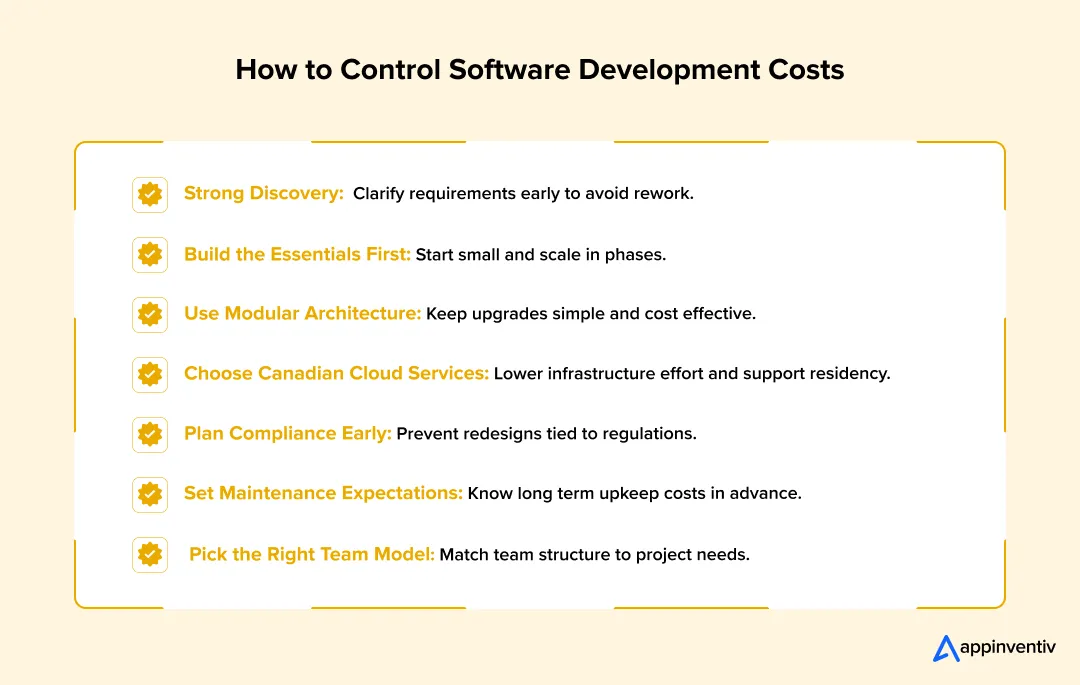
Managing software development costs in Canada becomes much easier when teams make deliberate decisions early. The goal is not to cut corners but to reduce uncertainty, improve clarity, and prevent avoidable rework across the project lifecycle.
Treat Discovery as a Cost Saving Phase
Many teams underestimate how influential discovery is in shaping budgets. A clear discovery process results in a stronger software development cost estimate because it defines workflows, identifies compliance needs, and uncovers integration complexity before any coding begins. When requirements are documented early, development proceeds with fewer assumptions and significantly fewer revisions.
Build Only What You Need First
The fastest way to control the cost to develop a software in Canada is to avoid building features that are not required for the initial launch. Prioritizing core workflows allows teams to release value early and reduce pressure on the first phase. This approach helps distribute investment across stages rather than committing the full budget upfront.
Adopt a Modular Architecture Strategy
Modular systems allow teams to add, update, or retire features without disrupting the entire codebase. This approach protects the long-term cost of software development, especially when new functionalities or integrations are expected in the future. When architecture is flexible, upgrades become smaller, more predictable investments.
Leverage Canadian Cloud Native Services
Using managed cloud services available in Canada reduces the operational burden of managing servers, scaling systems, and maintaining infrastructure. Platforms such as AWS Canada Central and Azure Canada East automate many backend tasks while supporting data residency needs. This approach lowers both development and operational overhead.
Plan Compliance Before Writing Code
Compliance requirements influence data flow, architecture, storage, and logging. By addressing regulatory expectations during planning, teams avoid late stage redesigns that increase custom software development cost in Canada. Early compliance mapping helps align the product with PIPEDA, PHIPA, PCI DSS, or any industry specific rules that apply.
Structure Maintenance Expectations Early
Maintenance often becomes a larger long-term investment, which makes it important to understand the difference between software maintenance cost vs development cost. Establishing expectations for updates, bug handling, and performance reviews protects budgets from growing unexpectedly and keeps the system stable post launch.
Choose a Development Model That Fits the Scope
Whether a company chooses an in-house team, an outsourced model, or a blended approach, the decision directly influences cost, speed, and compliance alignment. The best model is the one that fits the project’s complexity and regulatory environment while supporting realistic timelines. This choice helps improve long-term visibility into custom software development costs in Canada.

How Appinventiv Supports Canadian Enterprises
Canadian businesses evaluating the software development cost in Canada often look for a partner with proven experience in building large scale, operationally critical systems. Our work on solutions like Sonny’s Alfred ecosystem, where we supported automation across multi-location operations and improved business workflows at scale, reflects the depth of our engineering capabilities. With more than 2000 software products delivered and a 95 percent on time delivery record, our teams help enterprises build with confidence.
We design software development solutions in Canada that support regulated industries, data residency needs, and enterprise grade performance expectations. Our teams have successfully transformed more than 500 legacy processes, earning 15 global recognitions and awards for innovation, reliability, and delivery excellence. With engineering hubs across 5 international offices, we support cross regional builds while maintaining local compliance expectations.
Our approach focuses on long-term value creation through scalable architecture, secure development practices, and structured delivery workflows. Whether the goal is modernization, process automation, or building a new platform from the ground up, our experience in handling multi-module, integration heavy projects helps Canadian organizations accelerate their digital roadmap with clarity and speed.
Talk to our team to explore a clear and transparent path for your next software initiative.
FAQs
Q. How do you make software in Canada?
A. Most teams start with a simple step. They sit down and figure out what the software should do and who it is meant for. That early clarity helps everyone understand the software development cost in Canada before any real work begins. From there, the process moves through design, development, testing, and finally launch. After that, the product gets regular care and updates.
Q. How much does custom software development cost in Canada?
A. Costs shift a lot from project to project. A straightforward build may sit near the lower end, while something heavier with AI or many connected parts can climb higher. Most companies end up somewhere between CAD 55,000 and 550,000 (USD 40,000 to 400,000) once they factor in features, data rules, and industry standards.
Q. How long does it take to build custom software in Canada?
A. Smaller projects might be done in a couple of months. Bigger ones, especially those with detailed workflows or compliance steps, can take several months more. Eight to twelve weeks for simple builds is common. Six to twelve months for larger systems also happens often.
Q. How much does software maintenance cost in Canada?
A. Maintenance usually sits at about one fifth of the original cost each year. It goes toward keeping the product stable, secure, and updated. Most of that work involves fixes, performance checks, and version upgrades.
Q. What industries in Canada most commonly invest in custom software?
A. Healthcare groups, financial firms, logistics networks, retailers, energy providers, and government teams rely on custom tools often. Many of them deal with sensitive data or complex processes, so ready made software does not always fit.
Q. Do Canadian developers support post launch enhancements?
A. Yes. Most teams stay involved long after the first release. They help tune features, handle scale, and make sure the product keeps up with new rules or business changes. Many companies treat this as an ongoing partnership.
Q. How does developer location and team structure affect software development costs in Canada?
A. Location changes the price. Local teams cost more because of living and labor rates. Nearshore teams can be more affordable and still close in time zones. Offshore teams cost the least but need more coordination. Costs also shift depending on whether you hire in house staff, an agency, or individual freelancers. Team size and skill level play a part too.

- In just 2 mins you will get a response
- Your idea is 100% protected by our Non Disclosure Agreement.

Maritime Insurance Claim Software Development for UAE Ports, Insurers, and Logistics Networks
Key takeaways: Manual claims management is too slow for the UAE’s high-volume ports; digital solutions streamline processes and reduce errors. Maritime insurance claim software centralizes data, automates workflows, and ensures compliance with UAE regulations and Takaful principles. Real-time integration with port and vessel systems enables faster claim registration, validation, and settlement. Advanced analytics and risk…

How to Build a Student Management System in Australia?
Key takeaways: Australia’s tightening regulatory landscape (TEQSA, ASQA, CRICOS) makes student management system development in Australia a compliance-driven necessity, not just a digital upgrade. Monetisation models such as SaaS subscriptions, institutional licensing, white-label partnerships, and hybrid pricing offer scalable commercial opportunities in Australia’s expanding EdTech market. Addressing challenges early - data privacy, legacy migration, multilingual…

Guide to Software Risk Management: Identifying and Mitigating Key Risks in Software Development
Key takeaways: Risk management is no longer a peripheral activity; it is a core component of Enterprise Risk Governance (ERG) that ensures software ROI. Successful projects define their risk appetite—the level of risk an organization is willing to accept—before the first line of code is written. By integrating risk assessment into the early discovery phase,…