






























Software Development Costs in 2026: Explore Factors, Hidden Budgets, and Range


- Key Factors Influencing Software Development Cost
- The Hidden Costs of Software Development
- Appinventiv Helps Prevent Scope Creep, and Budget Overruns
- Software Development Pricing Models and Trends
- Methods to Calculate Software Development Costs
- Strategies to Optimize and Reduce Development Costs
- Enough Theory. Let’s Lock Down Your Actual Bill
- Additional FAQs

Key takeaways:
- Software development costs $40,000–$600,000+ typically, while complex AI platforms can exceed $1.5M.
- Architecture, features, and integrations are the biggest drivers of software development costs.
- Developer location affects pricing — from about $25/hour offshore to $200+/hour onshore.
- Post-launch costs matter: DevOps, cloud infrastructure, and licensing create ongoing expenses.
- Structured estimation methods like WBS, COCOMO, and PERT help calculate realistic budgets.
How to estimate software development costs?
Itemize every technical requirement and strictly enforce a 15% to 20% contingency buffer to handle the unknowns. Surprises happen; the trick is making sure they don’t bankrupt the project.
Core features rarely drain the bank account. Budgets actually die by a thousand cuts: third-party API licensing fees, sudden security audits, and data migration nightmares. That 20% buffer isn’t optional fluff. It’s a mandatory shock absorber.
How much does it cost to maintain software?
Annual maintenance reliably consumes 15% to 20% of the initial development cost. Launching the app is strictly the down payment, while keeping it functional acts as a perpetual tax. This budget extends far beyond basic cloud hosting.
It pays to patch zero-day security exploits, replace deprecated code libraries, and force the app to keep working whenever iOS or Android pushes a major system update.
Do software development costs vary by location?
Yes, geographic location heavily dictates hourly software development rates, with offshore teams offering massive cost reductions compared to local hires.
Zip codes dictate burn rates. Hiring locally forces you to absorb cutthroat US market salaries well over $100 an hour. Tapping offshore tech hubs like Noida unlocks elite agencies billing between $25 and $49 an hour. That massive arbitrage slashes your dev costs, freeing up capital for aggressive user acquisition.
How do companies like Appinventiv estimate software development costs?
Top firms like Appinventiv mandate a rigorous discovery phase to map infrastructure and feature scope before quoting a price.
Guesses bankrupt startups while elite agencies refuse blind quotes. Instead, their engineers interrogate your business logic, audit your API needs, and lock down exact cloud requirements. This mandatory upfront consultation grounds the final estimate in strict architectural reality, leaving zero room for optimistic fluff.
Custom software development costs typically range from $40,000 for a basic application to $600,000 for an enterprise-grade ecosystem, with complex, AI-powered solutions frequently exceeding the $1.5 million mark.
However, nailing down an accurate budget demands ruthless clarity. To get a real number, you have to lock down a highly granular project roadmap, make a definitive call on your engineering team model (in-house versus outsourcing), and define the absolute scale of your target market.
We are killing the generic fluff like “in this blog we will.” Below is the unvarnished breakdown of the core parameters that actually dictate your spend. Here, you will find tentative and even formulas to answer your questions, like ‘how to calculate your software development cost without stepping on the financial landmines’.
Now, let’s begin with the critical factors first.
Our engineers will estimate cost, architecture, and risks.

Key Factors Influencing Software Development Cost
This is where the planning really falls apart. Depending on what you’re going for, the number of features, security measures, design complexity, performance requirements, the development team you’re hiring, and much more, the cost varies. But based on market standards and our analysis, we can give you some tentative.
Here are some examples of how the type of software can influence the cost:
| Software Type | Estimated Cost | Core Characteristics |
|---|---|---|
| Simple Solutions | $40,000 – $120,000 | Core functionality, single platform, basic API integrations. |
| Enterprise SaaS | $250,000 – $800,000 | Multi-tenant architecture, complex roles/permissions, heavy third-party integrations. |
| AI-Driven Platform | $500,000 – $1.5M+ | Custom model training, LLM orchestration, heavy vector database infrastructure. |
And now, some other parameters that are actively going to eat your budget:
| Key Factor | Cost |
|---|---|
| Discovery and Planning | $10,000 – $100,000 (Upfront) |
| Project Complexity | Exponential Multiplier |
| UI/UX Design | Variable Front-Loaded Premium |
| Team Geography | $25/hr (Offshore) to $250+/hr (Onshore) |
| Technology Stack | Sustained Recurring Overhead |
| Data Architecture and Integration | 1x to 2x Frontend Build Costs |
| AI and Automation Infrastructure | Continuous Compute & Token Cycles |
| Scaling Costs and Performance Engineering | Multiplies Baseline Estimates |
| Compliance with Data Privacy Laws | High Specialized Audit & Implementation Fees |
| Security Engineering | Heavy Premium & Ongoing Retainers |
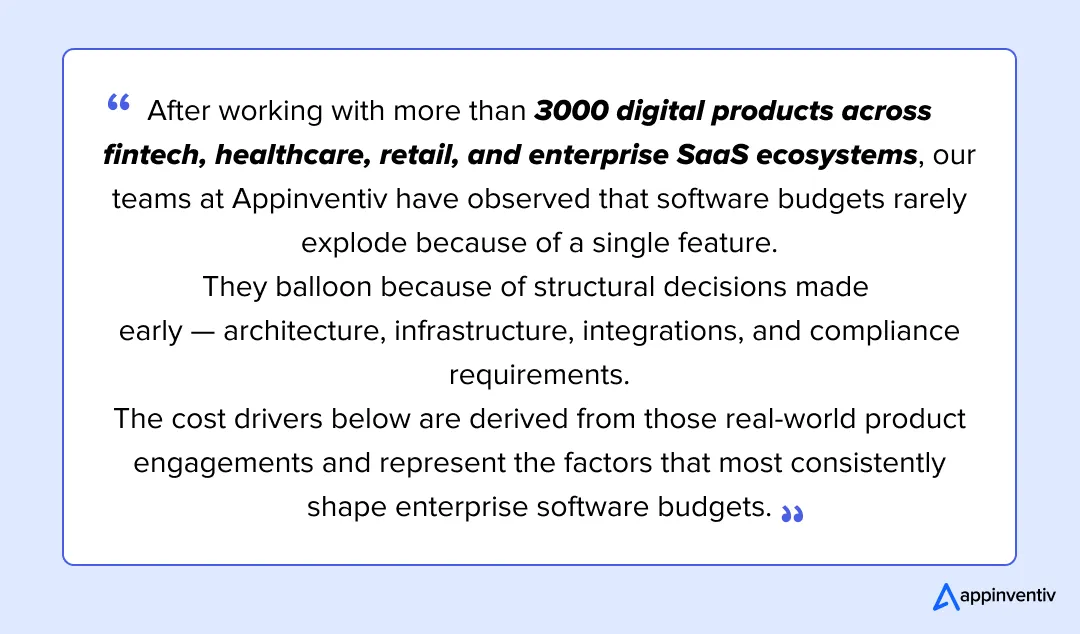
Let’s break down the cost drivers in a little detail that repeatedly determine the final price of enterprise software projects.
Product Discovery and Technical Planning
Enterprise software projects don’t start with code; they start with friction. Before development even begins, you will need to spend heavily on product strategy, UX research, prototyping, and technical architecture planning.
Skipping this phase to “save money” is financially risky. A structured product discovery workshop often costs $10,000 to $100,000, but it prevents you from building a $500,000 product that nobody wants.
Project Complexity and Feature Set
Every button, API call, and backend workflow adds hours. A monolithic architecture with basic CRUD operations is relatively cheap. But a microservices-based architecture requiring real-time data streaming?
That will exponentially increase your average software development costs. Choosing the right enterprise architecture from day one, especially before you sign up for software development services, is the only way to prevent your codebase from turning into an expensive liability.
UI/UX Design and Psychological Frameworks
Exceptional interfaces aren’t just a pretty coat of paint; they are heavily researched psychological frameworks designed to manipulate user behavior. Custom animations, intricate user journeys, and accessibility compliance require rigorous testing.
Skimping on establishing a proper design process might save you a few thousand upfront, but it invariably bleeds your bottom line through higher customer acquisition costs and alarming app abandonment rates.
Types of Software Development Providers
Your choice of software development professionals fundamentally alters your execution speed and financial exposure. Let’s compare the landscape objectively:
| Provider Type | Typical Hourly Rate | Best Suited For |
|---|---|---|
| Boutique Agencies | $70 – $120 | Niche, localized projects requiring highly specific domain knowledge. |
| Mid-Market Custom Software Companies | $50 – $150 | Mid-to-large platforms, scaling startups, comprehensive end-to-end builds. |
| Enterprise-Class Software Companies | $150 – $300+ | Massive legacy system overhauls, highly regulated industries (banking, healthcare). |
To accurately model total engineering spend, businesses should first understand the cost to hire software developers in 2026, including how hourly rates vary by region, seniority, and engagement model.
Team Geography and Sourcing Models
The stark reality of global economics dictates that team location drastically alters the final invoice. Hiring exclusively in Silicon Valley will devour your budget ten times faster than hiring offshore development teams in Eastern Europe or Asia.
| Region | Hourly Rate |
|---|---|
| North America | $100 to $200/hour |
| Western Europe | $70 to $150/hour |
| Eastern Europe | $40 to $80/hour |
| Asia | $25 to $50/hour |
| Latin America | $30 to $70/hour |
| MENA | $50 to $120/hour |
| Australia | $90 to $180/hour |
Your sourcing model directly defines your burn rate and the kind of ROI you’re going to unlock.
Technology Stack and Cloud Infrastructure
Legacy modernization demands premium, hard-to-find skills. Conversely, forcing the newest, unproven frameworks into your product just for the sake of novelty introduces massive technical debt.
You aren’t just paying for the initial code; you are funding the underlying software development costs of the server architecture required to sustain that specific tech stack for the next decade.
Data Architecture and Integration Costs
APIs are just the tip of the iceberg. Modern platforms are data-hungry, and building scalable data infrastructure significantly impacts budgets. When you factor in data warehouses (like Snowflake or BigQuery), complex ETL pipelines, and real-time data streaming, your backend data infrastructure can easily exceed the cost of the actual user-facing application.
AI and Automation Infrastructure Layer
Welcome to software reality in 2026. If you are building enterprise software, AI integration is no longer optional—and it isn’t cheap. AI-driven features introduce massive additional AI SaaS development costs tied to model training, LLM API consumption, vector databases, inference hosting, and specialized prompt engineering talent. Decision-makers evaluating AI software development costs must budget for these continuous compute cycles.
However, alongside rising AI SaaS development costs, enterprises must also account for emerging risks highlighted in Claude Mythos AI security risks, where model behavior, prompt inputs, and integrations can silently expose sensitive systems.
Scaling Costs and Performance Engineering
Building an app that works for 100 users is easy. Engineering a system that doesn’t collapse under the weight of 100,000 concurrent users requires an entirely different financial commitment.
Scalability engineering—load balancing, database sharding, caching layers, and distributed systems architecture—can dramatically multiply your initial estimates.
Compliance with Data Privacy Laws
Regulatory frameworks like HIPAA, GDPR, and SOC2, as well as financial compliance like PCI-DSS, are massive, non-negotiable line items. Software compliance requires specialized audits, robust encryption methodologies, and rigorous architectural constraints that aggressively stretch the overall scope.
Trying to bolt compliance onto a finished product rather than engineering it from the foundation is a guaranteed way to trigger crippling fines and lead yourself towards compliance pitfalls.
Security Engineering
Do not confuse compliance with security. Compliance is a legal framework; security engineering is the hard technical implementation keeping you out of the headlines.
Real security costs include penetration testing, threat modeling, aggressive vulnerability scanning, and complex Identity and Access Management (IAM) systems. Enterprise buyers absolutely care about this, and hackers don’t give discounts.
The Hidden Costs of Software Development
The initial build is just the down payment. Treating software development as a one-time capital expenditure is exactly how enterprise budgets hemorrhage cash post-launch. Here are the high-burn financial realities most executives ignore until the invoices hit:
| Parameter | Financial Reality |
|---|---|
| Post-Launch Platform Operations (DevOps) | $2,000 – $20,000+ / month |
| Third-Party Licensing & Vendor Lock-in | Perpetual Monthly Drain |
| Organizational Drag & Adoption | Unpredictable Overhead |
| Data Migration & Legacy Sunsetting | Massive Capital Expenditure |
| Technical Debt Refactoring | Compounding Interest |
| App Ecosystem & Platform Taxes | 15% to 30% of Gross Revenue |
Post-Launch Platform Operations (DevOps)
Continuous integration pipelines, log aggregation, and incident response tooling introduce massive recurring costs. Ensuring uptime SLAs and performance optimization in production environments can easily add $2,000 to $20,000+ per month, depending on your scale.
Total Cost of Ownership (TCO) is the only metric that matters here, and it is heavily dictated by the efficiency of the DevOps automation tools managing your infrastructure.
Third-Party Licensing and Vendor Lock-in
Enterprise software does not exist in a vacuum; it frequently relies on licensed SDKs, enterprise tool subscriptions, and external SaaS platforms. Cloud vendor lock-in and brutal API consumption fees act as recurring, inescapable taxes on your product’s mere existence.
Organizational Drag
Building the tool is only half the battle. You must budget heavily for onboarding engineers, writing exhaustive technical documentation, retraining internal teams on the new system, and funding customer support tooling to handle the post-launch influx.
This overhead depends entirely on the scale of your project and can only be calculated once you have a granular structural breakdown.
Data Migration and Legacy Sunsetting
Extracting, scrubbing, and mapping decades of fractured legacy data into a modern architecture is a bloodbath of billable hours. Shutting down the old system safely without corrupting active records requires a surgical cloud data migration strategy that almost always costs more than stakeholders initially project.
Technical Debt Refactoring
Taking aggressive shortcuts to launch a minimum viable product means you are borrowing time against your future stability. A rigorous enterprise software audit will invariably reveal that you must pay a heavy financial toll to rewrite that fragile code before it collapses under the weight of real-world market scale.
App Ecosystem and Platform Taxes
If you plan to operate within Apple or Google’s walled gardens, they will forcefully extract a massive 15% to 30% slice of your transaction volume. It is a fundamental, non-negotiable cost of doing business in mobile, significantly inflating your baseline app maintenance costs year over year.
Appinventiv Helps Prevent Scope Creep, and Budget Overruns
Investing in premium software engineering isn’t a sunk cost; it is an aggressive revenue engine. At Appinventiv, we do not just write code; we architect solutions that pay for themselves and we ensure full transparency from the very beginning.



- Conversion rate increased by 22%
- 50%+ orders shifted away from aggregators
- Handles 30,000+ direct orders daily

- 2M+ downloads
- 500K+ new users acquired in-region

- 2M+ downloads
- 50K+ active companies
- 150K+ job seekers placed
- Raised $52M (Series B)
The best part? Our experts aren’t just evolving, but leading the tech landscape. While our competitors were catching up with prompt engineering, we had already deployed smart AI use cases in product development environments, giving us great control over speed, product quality, testing environments, and much more.
As a result, we have built teams perfectly capable of delivering you high-quality, competitive digital solutions within timelines that do not delay your business goals.
We don’t build standard apps. We build platforms that dominate markets.
Schedule a slot with our experts for a free consultation!

Software Development Pricing Models and Trends
How you pay is just as critical as what you pay. Understanding software development cost estimation models is your first defense against budget overruns. Let’s look at the practical details:
Time & Material (T&M) Model
This is the reality of agile software engineering. You pay for the actual hours worked and materials used. While it requires strict project management oversight to prevent scope creep, it offers absolute flexibility. If the market shifts mid-build, you can alter the feature set without triggering punishing change request fees.
Fixed Price Model
This model offers the illusion of safety. You agree on a set cost to build software for a defined scope. However, because the agency assumes all the risk, they inherently pad their estimates by 20% to 30%. It strictly prohibits mid-flight pivoting, making it suitable only for small projects with rigid, unchanging requirements.
Staff Augmentation vs. Dedicated Team
Scaling an internal R&D center takes months of recruitment. Opting for IT staff augmentation lets you plug specialized talent directly into your existing cross-functional teams instantly. A dedicated team acts as an autonomous unit managing the entire product lifecycle, bypassing brutal market salary trends and internal overhead.
Value-Based Pricing Models
We are witnessing a monumental shift. As AI-assisted coding tools commoditize boilerplate code generation, value is shifting rapidly from raw coding hours toward architectural genius. Increasingly, elite firms are charging based on the business outcome and ROI generated, rather than the raw hours logged.
Methods to Calculate Software Development Costs
Guesswork is not a strategy. Calculating software development costs requires mathematical rigor. Professionals reconcile estimates across methods to uncover the truth hidden between optimistic projections and worst-case scenarios.
Work Breakdown Structure (WBS)
You cannot estimate what you haven’t defined. This bottom-up approach breaks the software platform into smaller tasks until each component becomes measurable.
Each task is assigned estimated hours, and the total development cost becomes the sum of all task costs.

Where:
- n = total number of tasks
- Task Hours = estimated time for each task
- Hourly Rate = cost of the team assigned
Analogous (Top-Down) Estimation
This method leverages historical project data. If we built a similar custom CRM last year for $150,000, we would use that baseline, adjusting for specific integrations to provide a rapid, ballpark figure.

Where the Adjustment Factor reflects complexity, additional features, or new integrations.
Parametric Models (COCOMO II)
The Constructive Cost Model uses mathematical algorithms based on historical data. It calculates effort based on the size of the program, typically measured in thousands of lines of code (KLOC), adjusting for an Effort Adjustment Factor (EAF).

Where:
- E = estimated effort (person-months)
- a,b = constants derived from historical data
- KLOC = thousands of lines of code
- EAF = Effort Adjustment Factor based on project attributes
Three-Point Estimation (PERT)
Never trust a single number. The Program Evaluation and Review Technique calculates the Expected Estimate ($E$) by weighing the Optimistic ($O$), Most Likely ($M$), and Pessimistic ($P$) scenarios:

Where:
- O = Optimistic estimate
- M = Most likely estimate
- P = Pessimistic estimate
This method reduces estimation bias by emphasizing the most realistic scenario.
Use Case Points (UCP)
This process evaluates the system’s functional requirements by assigning weights to various actors and use cases, adjusting for technical complexity to derive total effort and duration.

Where:
- UAW = Unadjusted Actor Weight
- UUCW = Unadjusted Use Case Weight
- TCF = Technical Complexity Factor
- ECF = Environmental Complexity Factor

Strategies to Optimize and Reduce Development Costs
You can manage the cost to build enterprise software without cannibalizing the product’s integrity. Here is how we aggressively optimize budgets in the real world:
- Cloud-Native Development & Smart Migration: Leverage serverless architectures so your compute costs scale precisely with user demand. Furthermore, if you are modernizing legacy systems, aggressively audit your cloud migration costs before pulling the trigger—blind “lift-and-shift” operations are notorious for duplicating licensing fees and creating runaway cloud bills.
- Ruthless Scope Management: Scope creep is the silent killer. Lock down the requirements early. Any new feature request must be swapped out with an existing one to maintain the baseline custom software development cost breakdown.
- Leverage Third-Party Integrations: Do not reinvent the wheel. Instead of spending $40,000 building a custom payment gateway or charting library, integrate existing APIs to reduce technical debt.
- Implement QA Automation Early: Fixing a bug in production is 100x more expensive than catching it during the design phase. Embedding automated testing into your CI/CD pipeline drastically reduces long-term maintenance expenses.
Enough Theory. Let’s Lock Down Your Actual Bill
Understanding the anatomy of custom software development costs is merely baseline survival. Actual execution requires transforming mathematical projections into a resilient, scalable reality. Unchecked cloud migration costs, ignored technical debt, and misaligned software development pricing models will drain your runway long before deployment.
This is where your financial exposure requires clinical intervention.
Appinventiv does not deal in tentative estimates or bloated vendor lock-ins. We deploy seasoned engineers to audit your blueprints, identify infrastructure vulnerabilities, and lock down an uncompromising execution strategy. We calculate the brutal reality of your enterprise software budgets so you don’t have to learn the hard way.
Your Next Move
Don’t let bad architecture dictate your market ceiling. Hand over your product requirements, and our technical leads will execute a relentless teardown of your proposed tech stack, timeline, and budget.

Additional FAQs
Q. How much does it cost to develop software?
A. A basic internal app runs around $40,000, while high-availability fintech platforms routinely top $600,000. Custom software simply lacks a retail price tag. Want a real number? Lock down a brutal, line-by-line feature breakdown first.
Otherwise, it’s all just guesswork. A simple staff portal sits at the lower end, but introduce massive concurrency or banking-grade security and that budget skyrockets. Scope dictates the spend.
Q. How long does it take to build a software application?
A. Plan for 3 to 4 months to launch a single-feature MVP, and 12+ months for complex enterprise platforms. You cannot rush architecture. A raw MVP requires about a fiscal quarter of heavy lifting.
But if the project means ripping out legacy databases to wire up a massive new ecosystem? That is a year-long slog. Squeezing a 12-month build into six just guarantees severe technical debt and a highly fragile product.
Q. Outsourcing vs. in-house: Which is cheaper?
A. Outsourcing provides a lower initial cost by completely bypassing local salary premiums, headhunter fees, and mandatory benefit packages. Hiring locally means paying a massive premium purely for geography.
Trying to build an internal team from scratch forces a company into bidding wars for talent. Outsourced agencies skip that entire circus. You get the product without the massive payroll overhead, freeing up cash flow for actual user acquisition.

- In just 2 mins you will get a response
- Your idea is 100% protected by our Non Disclosure Agreement.

Custom Digital Asset Management Software Development in Australia: Features, Benefits, and Use Cases
Key takeaways: Australia's DAM market is growing at 16.52% CAGR. But market growth does not solve the underlying problem of content sprawl. Architecture does. Traditional and Off-the-shelf DAM platforms introduce data sovereignty risks that are structurally incompatible with APRA, Privacy Act, and sector-specific compliance obligations for many Australian enterprises. Custom digital asset management software development…
How Much Does It Cost to Develop an Energy Management System in Australia in 2026?
Key takeaways: Energy management system development cost in Australia ranges from AUD $70,000 for an MVP to over $800,000 for enterprise or utility-grade platforms. AI-powered energy optimisation, predictive analytics, and real-time monitoring are now standard requirements in competitive enterprise EMS builds. Regulatory compliance, including the NER/NERR metering framework, AEMO DER Register, Privacy Act, and Consumer…

A Complete Guide to Compliance Management Software Development in Australia: Features, Cost & More
Key takeaways: Australia's regulatory landscape is becoming more complex across privacy, cyber, ESG, workforce, financial, and critical infrastructure compliance. Compliance management software is moving from document tracking to AI-enabled operational risk management. Industries such as healthcare, BFSI, mining, government, retail, and critical infrastructure are accelerating adoption. New Australian regulations and reforms are reshaping enterprise compliance…