

























Understanding RPA in Real Estate: Challenges, Applications and Costs

- What Are the Key Applications of RPA in the Real Estate Industry?
- What Are the Strategic Benefits of RPA for Enterprise Real Estate?
- What Are the Challenges for RPA in Real Estate at Enterprise Scale?
- What Is the Cost of RPA Implementation in Real Estate for Enterprises?
- What Technology Stack and Enterprise Architecture Power RPA in Real Estate?
- Real-Life RPA Examples in Real Estate and Automation
- What Will the Next Generation of RPA in Real Estate Look Like?
- Why Appinventiv Is the Right Strategic Partner for RPA in Real Estate
- FAQs

Key takeaways:
- Manual real estate operations quietly erode margins as volume scales across leases, payments, compliance, and reporting workflows.
- Enterprise RPA delivers measurable gains, including 30% to 40% cost reduction and faster processing without proportional headcount growth.
- High-ROI RPA use cases cluster around leasing, finance, maintenance, compliance, and portfolio analytics across large property portfolios.
- Successful RPA adoption depends on enterprise architecture, system integration, governance, and security, not bots alone.
- Real estate automation investments typically start around $80K, with phased scaling and payback often achieved within twelve months.
- Organizations that delay automation risk falling behind as competitors operationalize RPA across portfolios and acquisitions.
Most property teams reach a point where the volume simply becomes unmanageable. When you are handling thousands of lease agreements a year, even small inefficiencies start piling up. Each lease passes through five to eight systems by hand, and every manual step quietly drains time, budget, and Net Operating Income (NOI).
Day-to-day operations make the case for RPA in real estate obvious. Your teams spend hours on data entry, document reviews, payment checks, and compliance reports. It is repetitive work, and it adds up fast. At the same time, competitors are automating these workflows. Many are already seeing 30% to 40% cost reductions and productivity gains of around 15%.
The shift is already underway. JLL is using RPA for lease abstraction and property valuation. CBRE has automated parts of leasing and tenant management. Large REITs are rolling automation out across entire portfolios. In one recent case, tenant applications that once took weeks were completed in days. More than 8,400 applications moved through the system at roughly twice the previous speed.
This is not about experimenting with new tools. It is about staying operationally competitive.
This analysis covers robotic process automation in real estate for C-suite leaders who need clarity, not hype. It breaks down the 10 RPA use cases in real estate that deliver the highest returns today.
It lays out real investment expectations, including enterprise implementations starting at $80,000 and the payback periods teams are actually seeing. It also walks through seven common implementation challenges and practical ways organizations have solved them in production.
Above all, it gives you a decision framework. The question is no longer whether RPA fits your business. The real question is how to deploy it successfully at enterprise scale.
The gap between automated and manual real estate operations grows wider every quarter. The only thing left to decide is where your organization sits on that curve.
59% of organizations report measurable cost reductions after adopting RPA across enterprise operations.
What Are the Key Applications of RPA in the Real Estate Industry?
Many enterprise RPA real estate teams do not wake up planning automation initiatives. They reach a point where manual processes begin to slow decision-making, frustrate teams, and quietly increase risk. That pressure is not unique to real estate.
The global RPA market is projected to reach $30.85 billion by 2030, growing rapidly, reflecting how widely organizations are turning to automation as scale becomes unavoidable.
The use cases below show where real estate teams usually start, with workflows that consume time every day, break under volume, and deliver clear returns when automated across large portfolios.
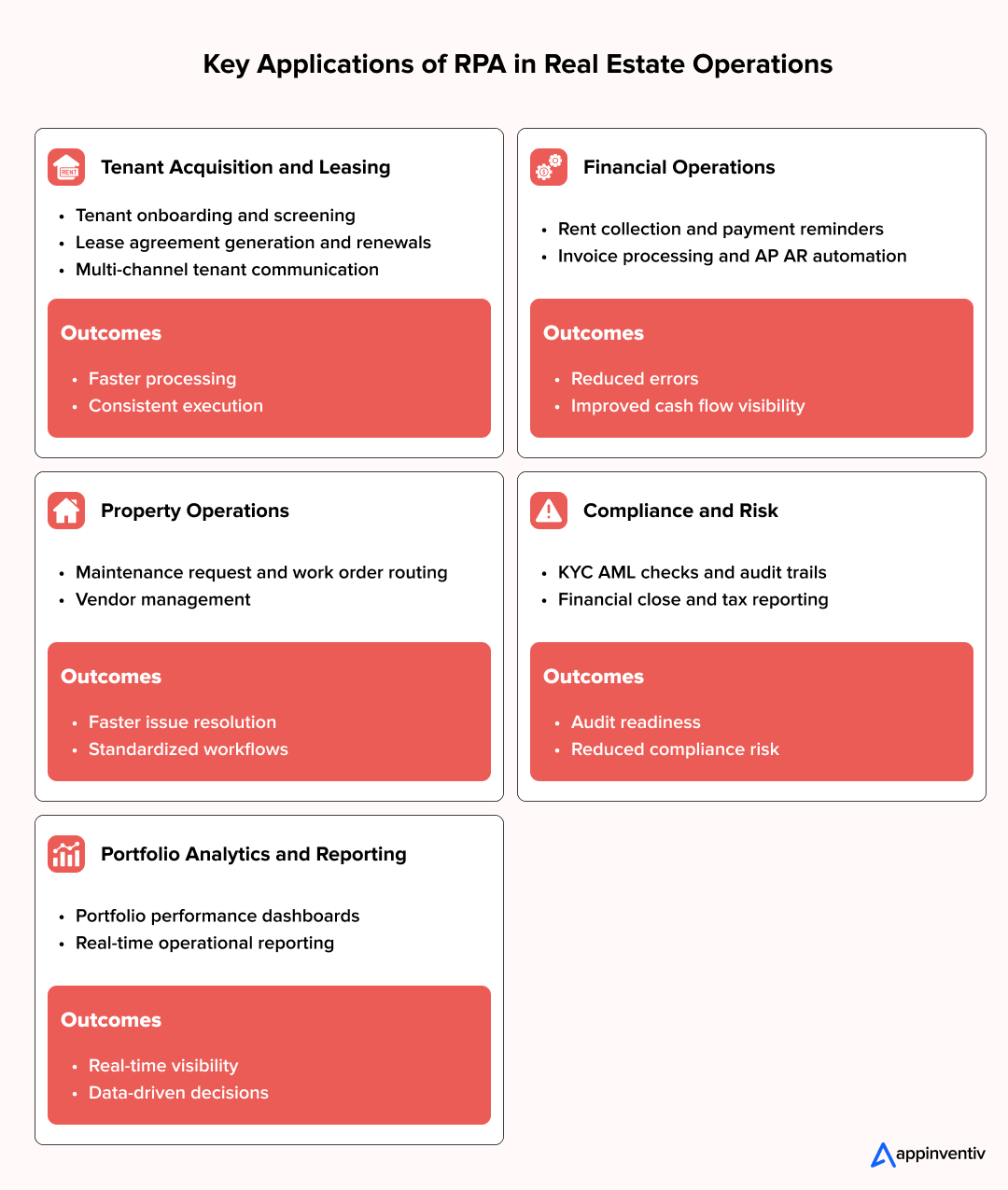
Tenant Onboarding and Screening Automation
Robotic process automation for real estate tenant onboarding feels manageable until leasing volume spikes. That is when applications pile up, checks fall out of sequence, and approvals slow down. Teams end up jumping between systems just to keep things moving.
RPA restructures the flow. Bots handle intake, checks, and routing in parallel rather than waiting for manual handoffs.
- Pulls application data from forms, PDFs, and email attachments
- Triggers background, credit, and history checks at the same time
- Applies consistent screening rules across all applicants
- Records every step for compliance and review
The biggest shift is speed without shortcuts. Decisions arrive faster, and teams stop adding temporary staff during peak seasons.
Lease Agreement Processing and Management
Robotics process automation in real estate lease processing rarely fails loudly. Problems show up weeks later when a number is wrong or a clause is missing. Fixing those issues costs time and pulls legal teams into avoidable cleanup.
Automation removes guesswork. Bots assemble leases using approved templates, populate data directly from source systems, and move documents through signature workflows without manual edits.
- Selects the right lease template by property and location
- Fills tenant, unit, and pricing data automatically
- Routes documents for review and signature
- Stores executed leases with searchable records
Over time, portfolios benefit from consistency. Legal teams handle exceptions instead of routine work, and renewals stop slipping through the cracks.
Rent Collection and Payment Reminder Automation
Robotic process automation in the estate industry rent collection shows that late rent affects more than revenue. It creates extra work for property managers and leads to uneven communication with tenants. Manual follow-ups also vary by individual, which creates risk.
With automation, rent tracking becomes predictable. Bots check payment status daily and handle reminders based on clear rules.
- Monitors rent payments across all units
- Sends reminders through email or text automatically
- Applies late fees based on lease terms
- Flags account for escalation when needed
Cash flow becomes easier to predict. Managers spend less time chasing payments and more time improving tenant experience.
Multi-Platform Property Listing Management
Listing management breaks down quickly at scale. Pricing gets out of sync, availability lags, and descriptions differ across platforms. Prospects notice.
RPA keeps listings aligned. Updates happen once and reflect everywhere.
- Publishes listings across major platforms at the same time
- Updates availability immediately after lease execution
- Keeps pricing consistent across channels
- Tracks listing performance centrally
Faster updates mean units hit the market sooner. Vacancy days shrink without adding work for marketing teams.
Invoice and Document Processing (AP and AR)
Invoice processing often becomes a monthly fire drill. Different formats, missing references, and manual entry slow payments and strain vendor relationships.
RPA in finance simplifies the workflow. Bots extract invoice data, validate it, and move it through approvals with minimal intervention.
- Reads invoice data from any document type
- Matches invoices to purchase orders and receipts
- Routes exceptions for quick review
- Posts approved data to finance systems
Processing costs drop, payment timing improves, and finance teams gain breathing room at month’s end.
Maintenance Request and Work Order Management
Maintenance teams deal with constant interruptions. Requests arrive by phone, email, and portals, often without enough detail to prioritize correctly.
RPA centralizes intake and coordination. Requests are captured, categorized, and routed automatically.
- Collects requests from all communication channels
- Assigns urgency based on issue type
- Routes work orders to qualified vendors
- Tracks progress and costs in real time
Response times improve, tenants receive automatic updates, and leadership gains visibility into maintenance spending patterns.
Financial Reporting and Tax Compliance Automation
Financial reporting slows down when data is scattered across too many systems. Beyond consolidation, bots handle CAM Reconciliation (Common Area Maintenance) and Escrow processing. These bots ensure 100% accuracy in expense recovery, directly impacting the bottom-line NOI across global portfolios.
- Pulls financial data from multiple systems
- Consolidates results across properties
- Applies tax rules by jurisdiction
- Prepares audit-ready documentation
Shorter close cycles give executives earlier insight. Audit preparation becomes less disruptive and predictable.
KYC, AML Compliance, and Audit Trail Generation
Compliance risk often comes from inconsistency, not intent. Manual checks miss updates, and documentation gaps appear over time.
RPA enforces discipline. Every check follows the same process and gets recorded automatically.
- Verifies identities using approved data sources
- Screens tenants against updated watchlists
- Maintains time-stamped compliance records
- Flags unusual activity for review
Compliance teams gain confidence that controls stay current. Audits become easier to manage without scrambling for documentation.
Portfolio Performance and Analytics Aggregation
Portfolio decisions suffer when reports arrive late or use different metrics. Manual aggregation limits comparison across assets.
Automation creates a shared view. Data updates continuously, and KPIs stay consistent.
- Aggregates operational data across properties
- Calculates standardized performance metrics
- Updates dashboards automatically
- Highlights underperforming assets early
Executives see issues sooner. Investment discussions shift from data validation to decision-making.
Multi-Channel Tenant Communication
Tenant expectations have shifted. Waiting for replies no longer feels acceptable, especially when dealing with leasing or maintenance issues.
Automation supports faster responses. Bots handle routine communication while routing complex questions to staff.
- Responds instantly through email, text, and portals
- Sends proactive updates during leasing and renewals
- Schedules tours automatically
- Routes exceptions to the right teams
Satisfaction improves, reviews stabilize, and teams handle higher volumes without growing headcount.
What Are the Strategic Benefits of RPA for Enterprise Real Estate?
Most executives first feel the impact of robotic process automation in real estate when routine questions stop turning into fire drills. Month-end numbers come faster. Compliance checks hold up under scrutiny. Growth discussions move from operational limits to strategic choices. As automation expands across the portfolio, the benefits compound in ways that directly matter to the C-suite.
Financial Performance and Cost Control
The role of RPA in the real estate industry includes reducing costs in areas that rarely appear as single-line items but quietly erode margins. High-volume work moves off payroll, and errors that once required rework largely disappear.
- Lowers direct labor and rework costs across core operations
- Improves EBITDA margins through predictable cost structures
- Supports growth without proportional increases in headcount
- Creates more reliable forecasting and budget control
Scalable Operations for Growth and M&A
Manual processes do not scale cleanly. They slow down outside business hours and vary by property or team. Automation removes those constraints.
- Enables continuous operations without downtime
- Maintains consistent execution across all properties
- Accelerates integration of acquired portfolios
- Allows portfolio growth without linear OpEx expansion
Enterprise Risk and Compliance Control
Risk often accumulates through inconsistency rather than intent. RPA enforces standard processes and records every action.
- Reduces operational and compliance error rates
- Applies regulatory rules uniformly across transactions
- Produces audit-ready documentation by default
- Lowers exposure to litigation, penalties, and audit overruns
Tenant Experience and Revenue Stability
Service quality directly affects retention, reputation, and long-term revenue. Automation improves responsiveness without adding staff.
- Delivers immediate responses regardless of time or volume
- Ensures consistent service quality across locations
- Improves retention and tenant lifetime value
- Strengthens online reputation and brand perception
Real-Time Visibility and Strategic Decision Support
Strategic decisions depend on current, trusted data. RPA shifts reporting from retrospective to real-time.
- Provides continuous visibility into portfolio performance
- Speeds acquisition analysis with standardized data
- Surface trends and underperformance earlier
- Enables board discussions focused on strategy, not data validation
What Are the Challenges for RPA in Real Estate at Enterprise Scale?
Most real estate robotic process automation initiatives struggle not because the technology fails, but because enterprise realities surface late. Budget scrutiny, legacy systems, and organizational friction all show up once execution begins.
For C-suite leaders, understanding these challenges for RPA in real estate early makes the difference between stalled pilots and scalable results.
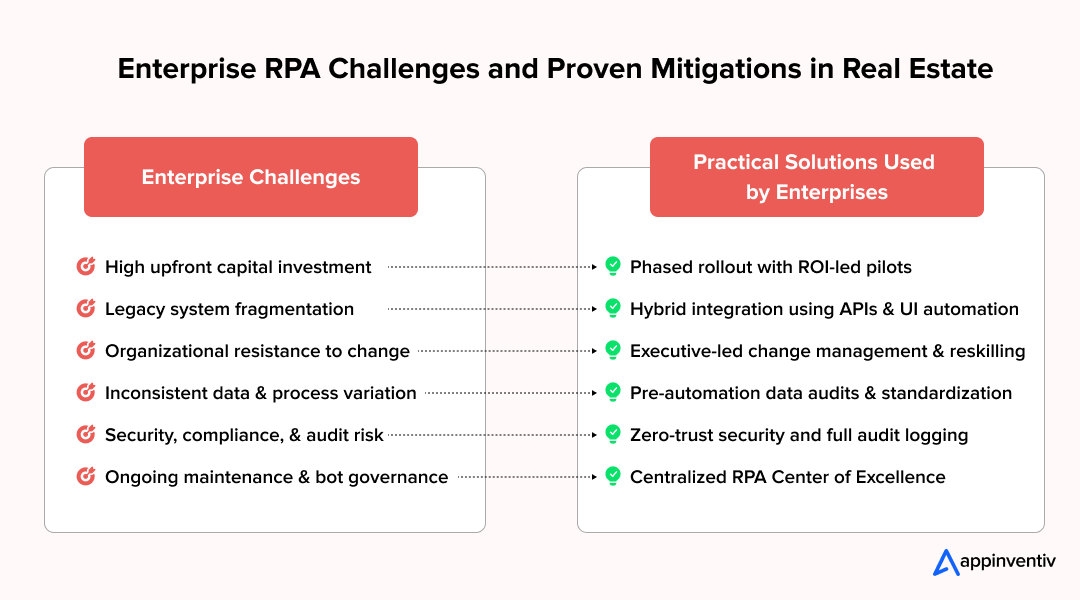
Significant Capital Investment
Large RPA programs compete directly with other strategic priorities. Board approval depends on confidence in timing, scale, and payback.
- Requires upfront investment that often reaches six figures
- CFOs need clear, defensible ROI timelines
- Capital allocation competes with growth and modernization initiatives
What works in practice: Start with a phased rollout. Fund high-ROI pilots first, validate results using conservative assumptions, then release additional capital once early gains are visible.
Legacy System Integration
Enterprise real estate portfolios rarely run on a single system. Acquisitions introduce fragmented platforms, many of which lack clean APIs.
- Integration effort can drive a large share of the total cost
- Older systems lack documentation or modern interfaces
- Replacing core systems is rarely feasible midstream
What works in practice: Use a hybrid integration approach. Apply APIs where possible and UI automation where necessary. Phase integrations start with the most modern systems and expand gradually.
Organizational Change Management
Automation changes how work gets done, which triggers concern across teams. Resistance often stems from uncertainty, not opposition.
- Employees worry about job security
- Regional leaders fear loss of autonomy
- Short-term productivity dips during transition
What works in practice: Lead with transparency from the C-suite. Pair automation with reskilling programs that shift roles toward oversight and analysis. Appoint internal change champions to strengthen ground-level adoption.
Data Quality and Standardization
Automation exposes data issues that manual work has quietly absorbed for years. Inconsistent formats and missing fields slow execution.
- Variations across properties disrupt standard workflows
- Unstructured documents complicate extraction
- Manual exceptions reduce automation effectiveness
What works in practice: Run a data audit before deployment. Invest in data cleansing and define enterprise-standard processes early. Combine RPA with AI-based extraction to handle variability where structure cannot be enforced.
Enterprise Security and Compliance
Bots operate at scale, often across sensitive systems. Without proper controls, access risk increases quickly.
- Credential management becomes complex
- Multi-jurisdiction compliance adds layers of oversight
- Audit expectations rise with automation scale
What works in practice: Design security in from day one. Apply least-privilege access, encrypted credential vaults, and full activity logging. Align automation with existing compliance frameworks and regularly test controls.
Ongoing Maintenance and Governance
Automation is not a one-time build. Systems change, interfaces evolve, and unmanaged bots create operational noise.
- UI or system updates can break workflows
- Bot sprawl reduces visibility and control
- Performance degrades without monitoring
What works in practice: Establish a centralized RPA Center of Excellence. Monitor bots in real time, enforce change-management protocols, and standardize development with reusable components.
Strategic Partner Selection
Selecting the best RPA platforms for real estate success depends heavily on who helps you build and scale them. The wrong partner creates long-term constraints.
- Platform lock-in limits flexibility
- Total cost of ownership can be unclear
- Enterprise experience varies widely among vendors
What works in practice: Evaluate partners beyond tooling. Prioritize real estate domain knowledge, enterprise deployment experience, financial stability, transparent pricing, and long-term support capability.
See how enterprises overcome integration, security, and governance barriers without stalling automation programs.

What Is the Cost of RPA Implementation in Real Estate for Enterprises?
RPA for real estate pricing is shaped less by tools and more by how far you plan to take automation. That matters even more as the real estate sector itself is expected to grow steadily at around 2.69% annually through 2029, pushing total market volume to roughly $727.80 trillion.
A small proof of value looks very different from an enterprise platform running across thousands of units. Understanding these tiers upfront helps you plan capital realistically and avoid under-scoping the effort.
Cost by Type of RPA Software
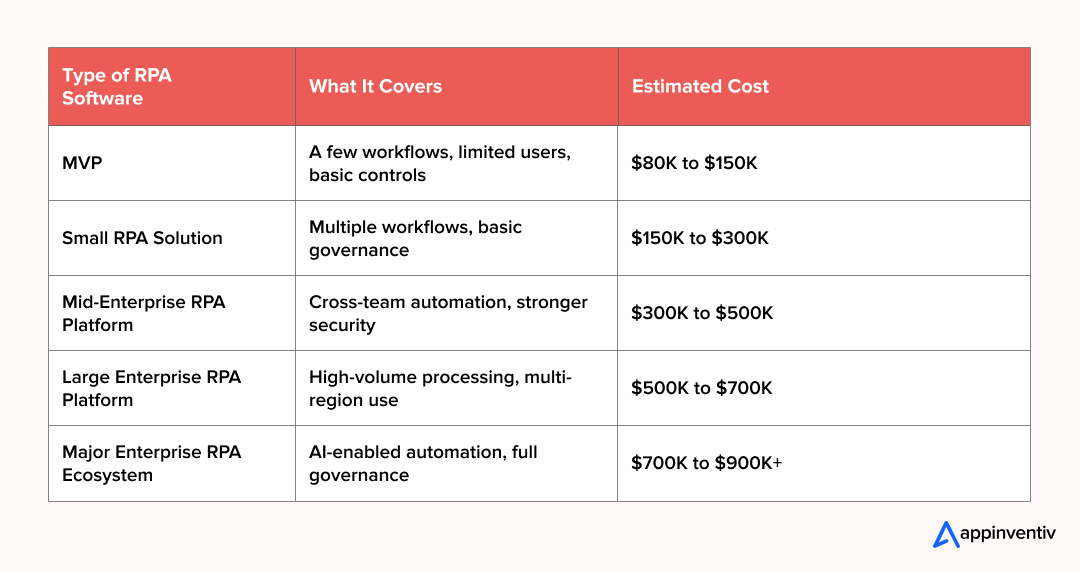
Most organizations start small, then expand once leadership sees stable results in live operations.
Cost of RPA Implementation in Real Estate Enterprises
When you commit to an enterprise-grade RPA platform, costs tend to fall into a few predictable buckets. These are the areas that determine whether automation scales smoothly or stalls after initial success.
| Cost Area | Typical Cost |
|---|---|
| Strategy and Process Assessment | $50K to $100K |
| RPA Bot Development | $20K to $40K per bot |
| System Integration | $50K to $150K |
| Security and Access Controls | $30K to $70K |
| AI-Enhanced Automation | $40K to $120K |
| Testing and Quality Assurance | $25K to $60K |
| Training and Enablement | $20K to $50K |
| Governance and CoE Setup | $30K to $80K |
| Infrastructure and Tooling | $50K to $150K |
These components often show up gradually. For example, many teams first feel the need for stronger governance after a few bots are already live, and business users want more.
Cost discussions often surface a related reality. In real estate, automation budgets rarely exist in isolation. Many enterprises first invest in secure, transaction-heavy platforms that can support scale, compliance, and financial complexity. Automation then builds on top of that foundation. The example below shows what that foundational work looks like in practice.
Appinventiv designed and developed a secure, scalable backend for Slice, enabling fractional real estate investments with automated transaction handling, dividend calculations, and administrative controls. The platform was built to support financial accuracy, audit readiness, and growth from launch.
Also Read: How much does it cost to build a property and lease management software?
What Technology Stack and Enterprise Architecture Power RPA in Real Estate?
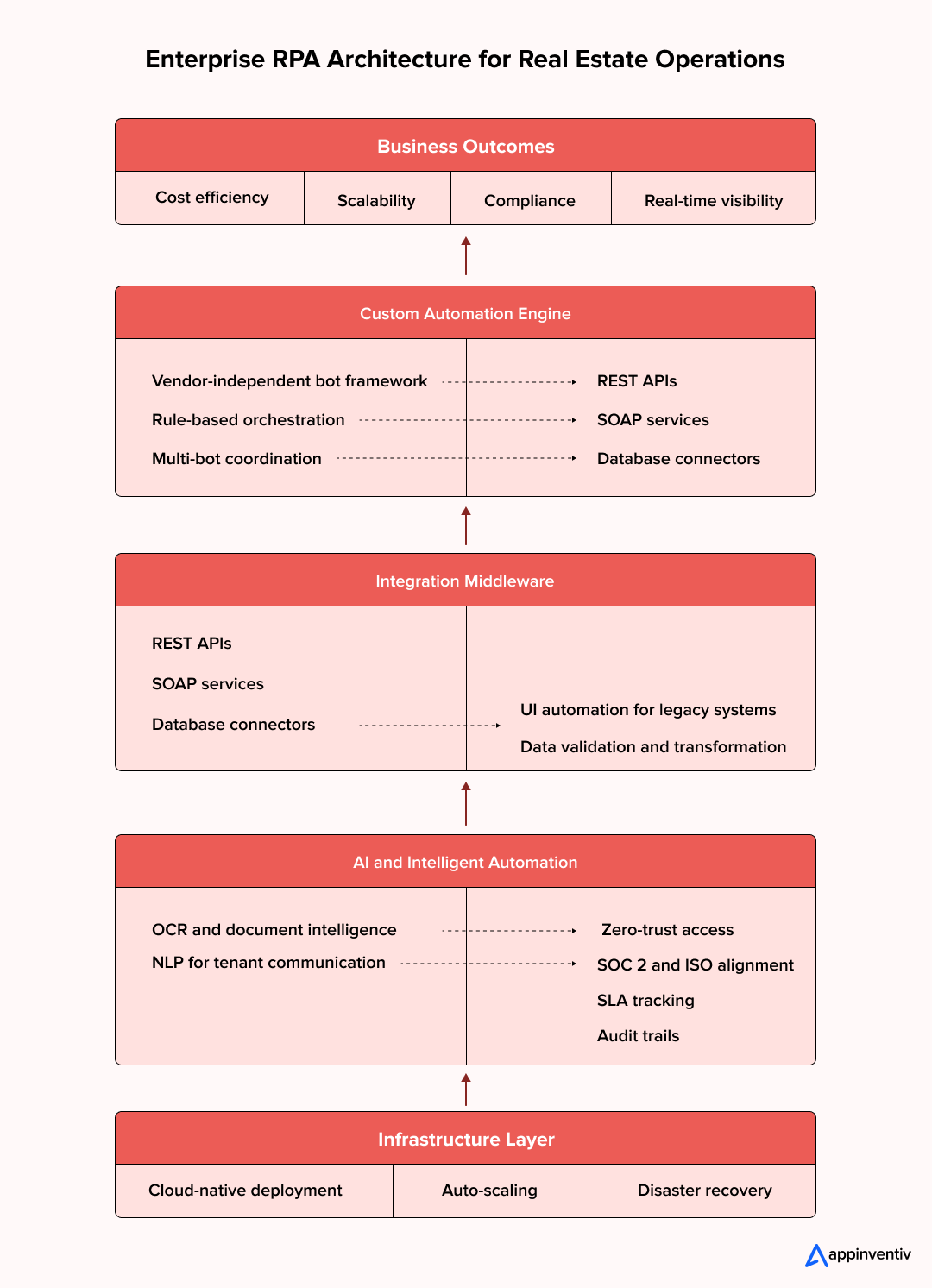
Enterprise RPA real estate succeeds or fails based on architectural decisions made early. Once automation moves beyond pilots, the stack must support scale, security, and reliability without constant manual intervention. This architecture reflects how large enterprises deploy RPA as a core operating capability.
Custom Automation Engine
At enterprise scale, the best RPA platforms for estate require a flexible automation engine that is not tightly coupled to a single vendor platform. This avoids lock-in and supports long-term extensibility.
- Proprietary bot framework independent of RPA platforms
- Rule-based workflow orchestration for deterministic execution
- Multi-bot coordination with load balancing
- Centralized exception handling and escalation logic
- Designed to support 100+ concurrent bots
- High availability architecture targeting 99.9 percent uptime
This layer ensures automation remains stable as transaction volumes grow.
Integration Middleware Layer
Real estate enterprises operate across fragmented technology stacks. The integration layer abstracts this complexity and keeps automation resilient as systems evolve.
- RESTful API integrations as the primary approach
- SOAP service support for legacy enterprise platforms
- Approved direct database connections for high-volume workloads
- UI automation for systems without API access
- Message queue management for asynchronous processing
- Data transformation and validation across systems
In practice, 70% to 80% of integrations are API-based, with UI automation limited to unavoidable legacy systems.
AI and Intelligent Automation (IPA)
As RPA and AI in real estate mature, intelligence becomes essential, especially for document-heavy and judgment-driven workflows.
Document Intelligence
- OCR with 95% or higher accuracy
- Intelligent document processing for leases and invoices
- Unstructured data extraction
- Handwriting recognition and multi-language support
Cognitive and Decision Capabilities
- Natural language processing for tenant communications
- Sentiment analysis for escalation detection
- Computer vision for property images
- Machine learning for exception handling
- Predictive analytics for maintenance and churn
- Business rules engines and risk scoring models
Also Read: Real Estate Chatbot Development: Adoption and Use Cases
Enterprise Platform Integration
RPA works directly with core real estate and enterprise systems. It integrated directly with ERP’s property management platforms, listing services, payment processors, maintenance systems, CRMs, document management systems, and communication tools. A consistent abstraction layer ensures stability as systems change.
Security Architecture
Enterprise RPA environments require stricter controls than human users.
- Zero-trust security model with least-privilege access
- Encrypted credential management using enterprise vaults
- Network segmentation for bot execution environments
- Multi-factor authentication for bot administration
- SOC 2 Type II and ISO 27001 alignment
- Quarterly penetration testing
- GDPR and CCPA compliance by design
Scalability, Monitoring, and Operations
Enterprise RPA must perform reliably under sustained load.
- Cloud-native deployment across AWS, Azure, or GCP
- Horizontal scaling and load balancing
- Multi-region deployment with disaster recovery
- RTO under four hours and RPO under fifteen minutes
- Capacity to process 100,000+ transactions per day
- Real-time monitoring, alerting, and SLA tracking
- Full audit trails, version control, and environment management
- 24/7 operations, proactive maintenance, and controlled change management
Enterprise RPA relies on systems that are already unified and structured. Before automation accelerates operations, many real estate organizations first modernize fragmented tools into a single operational layer. That groundwork is critical for scalability and governance.
Appinventiv built Ility as a cloud-native SaaS platform that unifies billing, tenant engagement, and portfolio analytics across multiple properties. The solution replaced disconnected systems with a centralized, scalable architecture designed for long-term operational efficiency.
Real-Life RPA Examples in Real Estate and Automation
Most enterprise leaders pause before greenlighting automation. You want proof that it works in environments that look like yours, with real scale, real constraints, and real risk. The examples below show how real estate organizations have used RPA to address a range of challenges, from managing cross-border operations to handling intense seasonal demand.
Case Study 1: Sunway Group (Malaysia)
Company Context: Sunway Group operates a large, diversified real estate portfolio across residential, commercial, and hospitality assets in multiple countries. Shared services teams support complex, cross-border operations.
Business Challenge: As the portfolio expanded, operational strain became visible.
- More than 35 core processes are handled manually
- Different execution models across regions
- Slow reporting and limited executive visibility
RPA Solution: Sunway implemented an AI-powered RPA program across shared services.
- Automated repetitive, rules-based workflows
- Integrated data from multiple enterprise systems
- Introduced centralized analytics dashboards
Results Achieved
- Faster processing across all automated operations
- Consistent execution across geographies
- Real-time visibility for leadership
- Foundation created for broader digital transformation
C-suite Takeaway: RPA can scale across complex, multi-national real estate operations without forcing system replacement.
Case Study 2: Foundation for Student Housing in the Helsinki Region (HOAS)
Company Context: HOAS is the primary student housing provider in the Helsinki region, managing thousands of residential units with demand driven by the academic calendar.
Business Challenge: Application volume peaks sharply each year sharply.
- 8,400+ applications processed annually
- The majority arrive between August and September
- Manual workflows caused delays and inconsistency
RPA Solution: HOAS deployed RPA to automate end-to-end application processing.
- Automated verification and validation steps
- Integrated with housing systems and applicant portals
- Reduced manual handoffs during peak periods
Results Achieved
- Around 50% reduction in processing time
- Seasonal spikes handled without temporary staff
- Faster and more predictable applicant outcomes
COO Takeaway: RPA provides the operational flexibility needed to manage extreme variability in volume without increasing headcount.
What Will the Next Generation of RPA in Real Estate Look Like?
Think about your next portfolio review. Reports are still being consolidated. Maintenance updates arrive in fragments. Compliance checks wait on manual validation. The next generation of RPA in real estate is designed to remove these pressure points, not just accelerate them.
Early automation eliminated repetitive tasks. What comes next blends RPA, AI, and enterprise data platforms to build systems that sense events, apply logic, and trigger actions with minimal human intervention. For large portfolios, this means automation layers that scale reliably across properties, systems, and regions.
Key shifts shaping this evolution include:
- LLM-powered document intelligence for lease abstraction, compliance interpretation, and contract risk identification across unstructured real estate documents.
- Autonomous operations frameworks where predictive maintenance engines generate work orders, assign vendors, and update financial systems automatically.
- Process mining–led continuous optimization, analyzing workflow execution data and surfacing new automation opportunities in real time.
- Regulation-ready automation architectures embedding zero-trust security models, immutable audit trails, and real-time compliance rule updates into every transaction.
- Unified data and automation layers connecting property management systems, ERPs, CRMs, and tenant platforms into a single decision-ready ecosystem.
The result is clear. Real estate enterprises move from task automation to self-optimizing operations built for resilience, compliance, and sustained portfolio growth.
Learn how similar enterprises moved from isolated automation wins to sustained operational advantage.

Why Appinventiv Is the Right Strategic Partner for RPA in Real Estate
Most enterprises reach this stage after one clear realization. RPA in real estate is no longer the question. Execution is. The partner you choose determines whether RPA becomes a lasting capability or a short-lived initiative.
Appinventiv, a top robotic process automation services company, brings experience working with global enterprises such as IKEA, Americana, Adidas, Edamama, and 6th Street. While these engagements were not limited to RPA, they shaped how the team designs and delivers complex systems that must operate reliably at scale.
What Appinventiv Brings to Enterprise RPA Programs
- 1,600+ technologists supporting enterprise-scale delivery
- Experience across 35+ industries with complex operating models
- 3,000+ solutions designed and delivered globally
- 500+ legacy processes successfully modernized
- 10+ years of experience delivering large enterprise systems
- 95% client satisfaction rate & 90& repeat clientele across long-term engagements
For real estate enterprises, this translates into a practical advantage. You work with a partner that understands governance, integration, and scale from day one. Appinventiv builds RPA solutions that fit within enterprise architecture, support growth, and continue to deliver value long after initial deployment.
FAQs
Q. What is RPA in real estate?
A. Most teams start looking at RPA when everyday tasks begin to slow things down. In real estate, RPA uses software bots to handle repetitive, rules-based work across property operations. These bots work with the systems you already use, like Yardi, MRI, CRMs, and ERPs, through APIs or screen-level automation. You cut manual effort, reduce errors, and keep operations running around the clock without replacing core platforms.
Q. What real estate workflows can be automated with RPA?
A. If a task follows clear steps and is high-volume, it is usually a strong candidate for RPA in real estate. Real estate teams automate tenant onboarding, lease processing, rent collection, invoice handling, maintenance requests, vendor coordination, financial reporting, and compliance checks. Most enterprises start with 15 to 25 processes, then expand as teams see stable results across regions and departments.
Q. What are the key applications of RPA in real estate?
A. RPA delivers the most value where speed and consistency matter. Common high-impact applications include tenant onboarding, lease generation, invoice automation, rent tracking, compliance verification, portfolio reporting, and maintenance coordination. In practice, these use cases drive measurable efficiency gains and often reach payback within a year, depending on volume and integration complexity.
Q. Can RPA integrate with real estate CRMs and ERPs?
A. Yes, and this is where RPA fits well into enterprise environments. RPA integrates with property systems, CRMs, ERPs, and document tools via APIs, databases, web services, or UI automation as needed. This lets you standardize workflows across modern and legacy systems while maintaining security controls, validation, and audit trails.

- In just 2 mins you will get a response
- Your idea is 100% protected by our Non Disclosure Agreement.

How to Hire RAG Architects for Enterprise AI
Key takeaways: Define your RAG architecture scope to avoid misaligned hiring decisions Identify end-to-end architectural ownership across retrieval, governance, and scaling Evaluate deep technical capabilities beyond prompt engineering and tools Validate governance and compliance readiness at the retrieval layer Test system-level thinking through real-world failure scenarios Choose the right hiring model based on scale, risk,…

Key Takeaways: Healthcare chatbots in the UAE are moving beyond queries to support triage, patient communication, and real clinical workflows across hospitals. Effective healthcare chatbot development depends on clean data, strong system integrations, and alignment with regulations like DHA, DOH, and MOHAP. Development costs typically range from AED 147,000 to AED 1,470,000+, depending on complexity,…

Hire Computer Vision Engineers: Reduce AI Development Costs by 45%
Key takeaways: Start with the problem first. Define the use case, data, and deployment needs before hiring. Choose the right role mix. Algorithm engineers, ML engineers, and developers handle different parts of the system. Look beyond tools. Strong engineers focus on data quality, evaluation, and real-world performance. Follow a practical hiring flow. Define → map…