






























Real-Time Transaction Monitoring Software Development in the UAE: AML Systems, Integration, and Risk Detection


- Step-by-Step Development of a Real-Time Transaction Monitoring System
- Core Architecture of a Real-Time Transaction Monitoring System
- Key Features of a Transaction Monitoring System
- UAE Regulatory Framework: What Your Monitoring System Must Comply With
- Key Challenges in Developing Real-Time AML Monitoring Systems
- Build vs Buy AML Transaction Monitoring in the UAE
- Cost to Build AML Transaction Monitoring Software in the UAE
- Future Trends in AML Monitoring Systems (UAE & ME)
- Why Appinventiv for AML Transaction Monitoring Development
- Frequently Asked Questions

Key takeaways:
- Real-time AML systems detect and act on suspicious transactions within seconds, reducing financial risk across high-volume, cross-border environments in the UAE.
- Event-driven architectures with AI models improve detection accuracy while reducing false alerts, enabling faster investigations and better operational efficiency.
- UAE compliance demands audit-ready systems with explainable decisions, real-time reporting, and alignment across CBUAE, DIFC, and ADGM frameworks.
- Hybrid build models allow faster deployment while retaining control over risk logic, critical for complex transaction ecosystems in enterprise environments.
- Scalable AML platforms handle millions of transactions daily, combining streaming pipelines, dynamic scoring, and automated reporting to meet regulatory expectations.
Real-time transaction-monitoring software development in the UAE is reshaping how institutions track each transaction as it occurs. The system reads events from payment rails, banking systems, and digital channels, then evaluates risk within seconds. This is different from batch-based AML systems that review data hours or days later.
Legacy monitoring systems fail in fast-moving financial environments. Many still rely on T+1 or T+2 processing cycles. Suspicious activity often gets flagged after funds have already moved across accounts or borders. Static rule sets add another limitation. These rules do not adapt to new fraud patterns or evolving customer behavior. The result is delayed detection and a high volume of false alerts.
The UAE handles large volumes of cross-border transactions across banking, fintech, and remittance networks, with non-oil trade alone reaching AED 1.24 trillion in recent years. This scale puts pressure on systems that cannot process data in real time.
Regulators now expect faster and more accurate detection from AML transaction-monitoring software in the UAE, supported by a rapidly evolving AML ecosystem. The UAE’s Central Bank has strengthened AML expectations. Global standards from the Financial Action Task Force reinforce the same direction.
AML monitoring is no longer a back-office control. It now acts as a real-time risk intelligence system that protects transactions as they happen.
High transaction volumes expose gaps in legacy systems. Build detection that acts before funds move across borders.

Step-by-Step Development of a Real-Time Transaction Monitoring System
Real-time transaction-monitoring software development in the UAE must account for high transaction volumes, cross-border flows, and strict reporting requirements. The system reads events from banking systems, remittance platforms, and payment networks, then evaluates risk within seconds. Each layer must support low latency and full auditability.
The design must reflect how financial activity works in the region, where thousands of regulated entities operate under AML supervision. UAE institutions process large volumes of remittances, trade payments, and multi-currency transactions. This shapes how data flows, how risk is scored, and how alerts are generated.
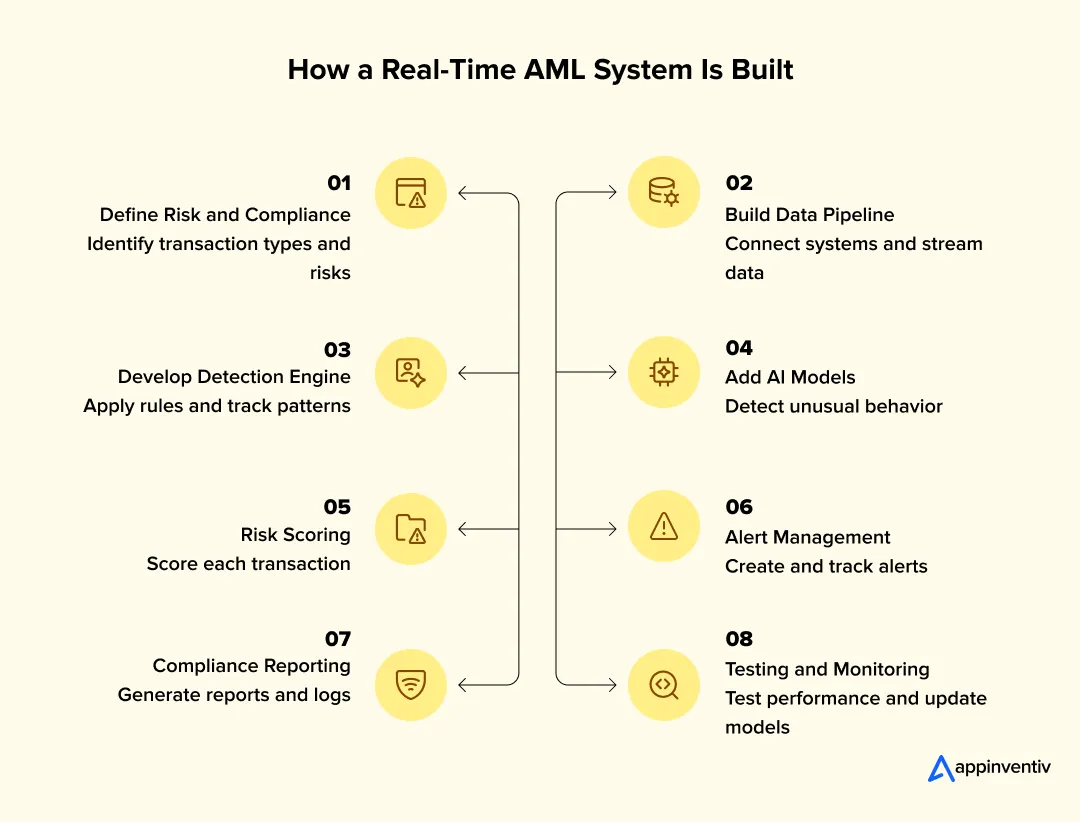
Step 1: Define Risk Models, Compliance Scope, and Detection Objectives
Transaction monitoring system development in Dubai starts with a clear view of what needs to be detected.
List transaction categories common in the UAE:
- domestic bank transfers
- international remittances
- card payments and POS activity
- digital wallet and fintech transactions
Map risk typologies:
- structuring to stay below reporting limits
- layering across accounts and jurisdictions
- sudden spikes in transaction velocity
- transfers linked to high-risk corridors
Align each risk type with reporting rules set by the Central Bank of the UAE and guidance from the Financial Action Task Force.
Clear detection objectives reduce gaps during audits.
Also Read: AML Software Development: Features, Costs & Best Practices
Step 2: Build the Data Ingestion and Streaming Pipeline
Anti-money laundering software development in Dubai depends on continuous and reliable data flow at the ingestion stage.
Connect to core sources used across UAE financial systems:
- Core banking platforms
- Payment processors and card networks
- SWIFT messaging for cross-border transfers
- Exchange houses handling remittances
Use event streaming platforms such as Kafka to move data in real time. Create topics based on transaction type, channel, or region. Partition topics to support parallel processing across high volumes.
Normalize all incoming data into a standard schema:
- Transaction ID
- Timestamp
- Sender and beneficiary details
- Currency and amount
- Origin and destination country
Multi-currency normalization is critical in the UAE, where AED, USD, and other currencies flow together.
Also Read: Enterprise Fintech App Development: A Middle East Guide
Step 3: Develop the Detection Engine (Rules + Stream Processing)
The detection engine processes live transaction streams.
Start with rule-based checks:
- Threshold rules for large transactions
- Velocity rules for rapid transfers within short windows
- Pattern rules for repeated behavior across accounts
Run these rules using stream processing engines such as Flink or Spark Streaming. Use stateless checks for simple validation.
Use stateful processing to track sequences, such as multiple transfers within minutes across linked accounts.
This layer must process events within seconds, even during peak transaction periods.
Step 4: Integrate AI and Machine Learning Models for Intelligent Risk Detection
Rules cannot detect all patterns in complex transaction networks. Effective financial crime detection software in the UAE adds machine learning models alongside KYC automation to detect anomalies. Unsupervised models can flag activity that deviates from normal customer behavior.
Build behavioral profiles based on:
- Transaction frequency
- Transaction size distribution
- Common counterparties
Cluster customers into peer groups. Compare each transaction against group behavior to detect outliers.
Deploy models in real-time inference pipelines. Each transaction must pass through the model before scoring.
Include regional features:
- Cross-border transaction routes
- High-risk geographies
- Currency switching patterns
These signals are common in UAE financial activity.
Step 5: Build Dynamic Risk Scoring and Decision Engine
Each transaction must receive a risk score in real time, marking the point where AI in risk management moves from concept to execution.
Combine:
- Rule outputs
- Model predictions
- Customer risk profile
Use weighted scoring logic. Adjust weights based on risk category and regulatory focus.
Define clear actions:
- Low-risk transactions proceed
- Medium-risk transactions trigger alerts
- High-risk transactions trigger escalation or blocking
The scoring system must adapt as transaction patterns change across regions and corridors.
Step 6: Develop Alert Management and Case Investigation Workflows
High alert volumes are common in AML systems. Prioritize alerts using risk scores and confidence levels. Remove duplicate alerts that originate from the same pattern.
Build a case management system:
- Assign alerts to investigators
- Track investigation steps
- Log decisions and evidence
Each case must maintain a full audit trail.
Create feedback loops. When investigators label alerts as valid or false, feed that data back into detection models. This improves accuracy over time.
Step 7: Compliance Reporting and goAML Integration
Regulatory reporting must be automated and accurate. Generate STR and SAR reports from flagged transactions. Format reports based on UAE FIU requirements.
Integrate directly with the goAML systems used across UAE institutions.
Each report must include:
- Transaction details
- Risk indicators
- Investigation notes
Maintain detailed logs for every decision. Regulators expect clear explanations for flagged and cleared transactions.
Step 8: Testing, Deployment, and Continuous Monitoring
Test the system with real-world scenarios before deployment.
Simulate cases common in the region:
- Rapid remittance chains
- Cross-border fund movement across multiple jurisdictions
- Unusual spikes in transaction volume
Run load tests to validate performance under peak conditions.
After deployment, monitor:
- System latency
- Alert accuracy
- Model performance
Track model drift as transaction behavior changes. Retrain models using new data and investigator feedback.
A real-time AML system in the UAE must evolve with transaction patterns, regulatory updates, and emerging risks.
Core Architecture of a Real-Time Transaction Monitoring System
Real-time transaction-monitoring software development in the UAE follows a clear architectural flow. Data enters from multiple sources, moves through streaming pipelines, passes detection logic, receives a risk score, and triggers alerts or reports. Each layer must process events within seconds and keep a full audit trail.
In the UAE, this architecture must support cross-border payments, remittance flows, and multi-currency transactions at scale.
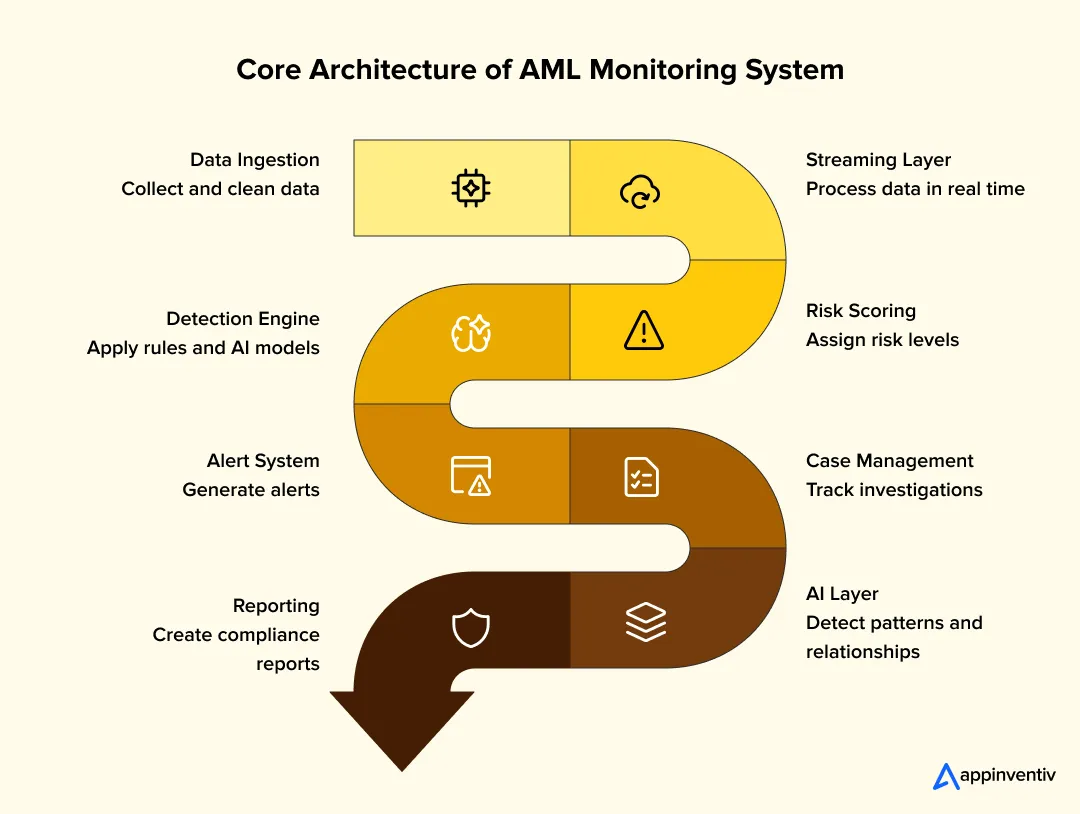
Data Ingestion Layer
The system starts with data collection from multiple sources:
- Core banking platforms
- Payment gateways and card networks
- APIs from fintech apps
- SWIFT and remittance systems used by exchange houses
Each source sends events in different formats. The ingestion layer standardizes this data into a unified schema.
Validation checks run at this stage:
- Missing fields
- Incorrect formats
- Duplicate transactions
Clean and consistent data is critical. Errors at this stage affect every downstream decision.
Stream Processing Layer
This layer moves and processes data in real time.
The system uses event-driven pipelines where each transaction triggers processing as it arrives. Stream processors such as Flink or Spark handle continuous data flow with low latency.
Processing guarantees matter here.
- At-least-once processing may duplicate events, but avoids data loss
- Exactly-once processing avoids duplication but adds system overhead
The choice depends on regulatory expectations and system design. Financial systems in the UAE often favor accuracy over speed for reporting layers.
Detection and Decision Engine
This layer evaluates each transaction against defined rules and models.
Rule-based checks handle known patterns:
- Large value transfers
- Rapid transaction bursts
- Repeated transfers across linked accounts
Machine learning models detect patterns that rules miss.
Stateful processing tracks behavior across time. For example, it can detect five transactions across different accounts within minutes.
Each transaction moves through a decision pipeline that determines whether to pass, flag, or escalate.
Risk Scoring Engine
Every transaction receives a risk score based on multiple inputs.
The system combines:
- Rule triggers
- Model outputs
- Customer profile data
Context matters. A high-value transfer from a low-risk customer may score lower than a smaller transfer linked to a high-risk corridor.
The scoring engine must update scores in real time as new data arrives.
Alert and Case Management Layer
Flagged transactions generate alerts.
The system prioritizes alerts based on risk score and confidence level. It routes high-risk alerts to investigators first.
Case management systems support:
- Assignment of alerts
- Tracking of investigation steps
- Storage of notes and evidence
Each action must be logged. Audit trails are required for regulatory review.
Compliance and Reporting Layer
This layer handles regulatory reporting and audit requirements.
The system generates STR and SAR reports from flagged cases. These reports must follow the formats required by UAE regulators.
Integration with goAML platforms allows direct submission to financial intelligence units.
The system must record:
- Why was a transaction flagged
- What data was used
- What decision was taken
Explainability is a requirement, not a feature.
AI and Machine Learning in AML Transaction Monitoring
Modern AML systems combine rules with machine learning and network analysis.
Graph models, increasingly integrated with blockchain, detect relationships among accounts and identify mule networks or coordinated activity across entities. They can identify mule networks or coordinated activity across entities.
Behavioral models track normal activity for each customer. The system flags deviations from that baseline.
Model governance is critical. Each model must provide clear reasoning for its output. Regulators expect transparency in how decisions are made.
Designing for Scale: Performance, Latency, and Reliability
Real-time systems must process transactions within seconds, even at peak load.
Large UAE institutions handle millions of transactions each day, operating in a banking sector assessed at medium-high to high risk. The system must scale without slowing down.
Key design factors include:
- Distributed processing across multiple nodes
- Failover systems to prevent downtime
- Event replay mechanisms to recover missed data
- Backpressure handling to manage traffic spikes
- Partitioning strategies in streaming platforms to balance load
A system that cannot scale will miss critical events during peak periods.
Reducing False Positives Without Increasing Risk
High false alert rates slow down investigations.
The system must reduce noise without missing real threats.
Use context-aware detection:
- Include customer profile data
- Include transaction history
- Include geographic risk
Segment customers into risk tiers. Apply stricter rules to high-risk segments.
Use layered detection:
- Rules for known patterns
- Machine learning for anomalies
- Graph analysis for network risk
Investigator feedback improves the system. Each reviewed alert adds training data.
Balance precision and recall. A system that flags everything creates overload. A system that flags too little increases risk.
Continuous tuning of thresholds keeps detection accurate as transaction patterns evolve.
Key Features of a Transaction Monitoring System
A production-ready AML system must detect risk, support investigation, and meet reporting requirements without delay. These are the core capabilities expected in UAE financial systems:
- Real-time monitoring across banking, card, and remittance channels
- Combined rule-based and AI-driven detection
- Risk scoring based on transaction and customer behavior
- Alert generation with investigation workflows
- Audit-ready logs and regulatory reporting (goAML compatible)
- Multi-currency and cross-border transaction support
UAE Regulatory Framework: What Your Monitoring System Must Comply With
AML compliance software development in the UAE must account for more than one regulator, with over 80 authorities involved across the national AML framework. Each one sets its own rules for monitoring, reporting, and data control. These rules affect how the system is built from the start.
Core Regulatory Bodies And Jurisdictions
The Central Bank of the UAE oversees banks, exchange houses, and payment firms on the mainland. It defines how transactions must be monitored and when suspicious activity must be reported.
The Dubai International Financial Centre runs as a separate financial zone. Firms here follow DFSA rules, which focus on risk-based monitoring and clear internal controls.
The Abu Dhabi Global Market has a similar setup with FSRA oversight. It places strong focus on transaction tracking, governance, and record keeping.
All three follow global standards set by the Financial Action Task Force.
What This Means For System Design
These rules are not abstract. They directly shape financial software compliance at every layer of the system.
- Monitoring must happen in real time. A delayed check is not enough when funds move across borders within seconds.
- Every decision must leave a trace. If a transaction is flagged, the system should show what triggered it and which data points were used.
- Models must be clear to read. If a system cannot explain why it raised an alert, it creates problems during audits.
- Data handling must follow strict controls. Financial data cannot move freely across systems without checks. Access, storage, and processing must follow defined boundaries.
- Reporting must be fast and accurate. Suspicious activity reports should move from detection to submission without manual steps. Integration with goAML is part of this flow.
- A system built around these rules does more than meet compliance. It reduces friction during audits and keeps operations stable under regulatory review.
Key Challenges in Developing Real-Time AML Monitoring Systems
Teams undertaking real-time transaction-monitoring software development in the UAE run into the same set of issues, especially at a scale where thousands of firms operate under AML oversight.
The system has to plug into older banking stacks, process heavy cross-border traffic, and still pass strict audits. Each problem shows up early in development.
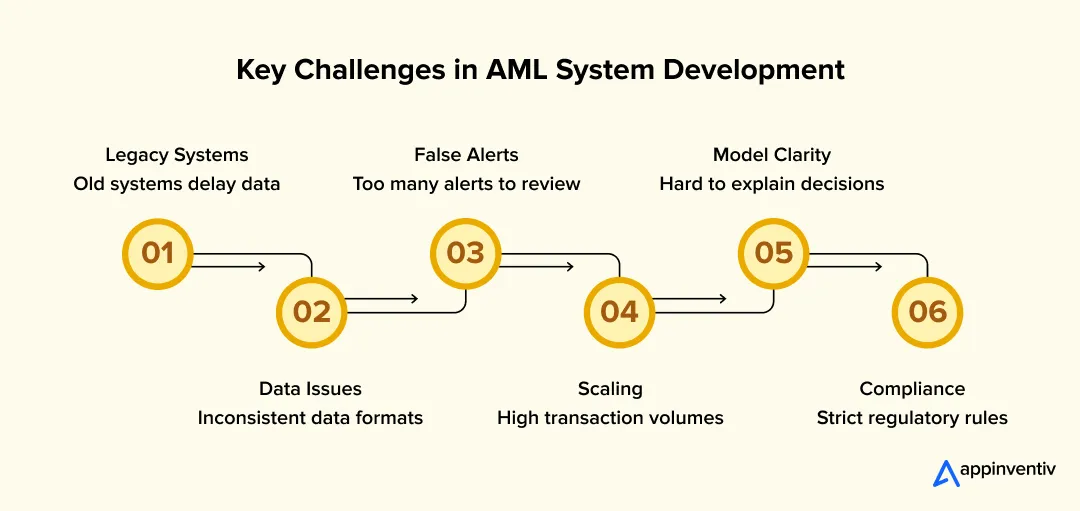
Integration With Legacy Core Banking Systems
Many core systems still move data in batches. Real-time pipelines need a steady event stream, not delayed files.
Teams usually add a middleware layer that listens to core systems and pushes events into a queue or stream. This sits between old systems and new services, so you avoid a full replacement.
Also Read: ERP Software for Businesses in Dubai
Fragmented And Inconsistent Data Sources
Data rarely looks the same across systems. One platform stores full names in one field. Another splits them. Timestamps and currencies often follow different formats.
Create a standard schema at the ingestion stage. Map every incoming field to that format. Reject or fix bad records early, before they reach detection logic.
High False Positives Leading To Alert Fatigue
Rule-heavy systems flag too many transactions. Investigation teams spend hours closing alerts that lead nowhere.
Layer detection logic. Start with rules, then add behavior-based checks. Feed investigator decisions back into the system so it learns what to ignore over time.
Real-Time Processing Constraints At Scale
Transaction spikes are common in the UAE, especially during remittance cycles. Systems slow down if they are not built for load.
Distribute processing across nodes. Split data streams into partitions. Add controls that slow intake if the system gets overloaded, instead of dropping events.
Balancing Model Accuracy With Explainability
Advanced models pick up subtle patterns. Auditors still ask a simple question. Why was this flagged?
Log every input used in scoring. Keep models simple where possible. Pair them with clear rules so each decision can be traced.
Compliance-Driven Architectural Limitations
Rules around data access and reporting shape the system from day one. You cannot treat compliance as a later step.
Build audit logs, access controls, and reporting flows into the core design. This avoids rework when systems go live.
Most teams face these issues at the same stage. The difference lies in how early they plan for them.
Legacy systems block real-time data flow. Use API-led architecture to unlock faster detection pipelines.

Build vs Buy AML Transaction Monitoring in the UAE
This decision shapes how fast you go live and how much control you keep over your AML transaction monitoring software in the UAE. Large banks and payment firms often deal with high transaction volumes and cross-border risk. That makes the choice more critical.
| Approach | What it offers | Trade-offs |
|---|---|---|
| Build | Full control over system design and detection logic. Teams can tailor models to specific transaction patterns seen in remittances and cross-border flows. | High cost and longer timelines. Requires strong engineering and compliance expertise in-house. |
| Buy | Quick setup with ready AML features. Pre-built rules aligned with regulatory expectations. Lower effort at the start. | Limited flexibility. Harder to adapt models for unique risk patterns or business needs. |
| Hybrid | Combines a vendor platform with custom detection layers. Teams can launch faster and still build their own intelligence over time. | Needs careful integration. Teams manage both external tools and internal systems. |
Most large enterprises in the UAE lean toward a hybrid setup, often working with an IT consulting partner to reduce time to deployment while retaining control over risk models.
Cost to Build AML Transaction Monitoring Software in the UAE
The transaction monitoring system development cost in Dubai and across the UAE depends on system scope, integrations, and compliance needs. Understanding the broader software development cost in Dubai helps set the right budget expectations before scoping an AML build.
Most enterprise builds fall between AED 183,000 and AED 1,836,000+.
| Component | Estimated Cost (AED) |
|---|---|
| Data ingestion and pipeline setup | AED 36,000 – AED 220,000 |
| Rule-based detection engine | AED 36,000 – AED 185,000 |
| AI and machine learning models | AED 73,000 – AED 440,000 |
| Risk scoring and decision engine | AED 36,000 – AED 147,000 |
| Alert management and workflows | AED 36,000 – AED 185,000 |
| Compliance reporting and goAML integration | AED 36,000 – AED 147,000 |
| Integration with legacy systems | AED 73,000 – AED 367,000 |
| Testing and deployment | AED 36,000 – AED 147,000 |
These figures reflect the range of custom AML compliance software cost in the UAE, depending on the depth of integrations and regulatory scope required.
Future Trends in AML Monitoring Systems (UAE & ME)
RegTech software development in the UAE is moving toward faster AML monitoring systems that act during the transaction, not after it, with the regional AML market projected to grow at 13.5% CAGR through 2032.
Financial institutions now deal with constant cross-border movement, high transaction volumes, and stricter regulatory checks. This is changing how systems are designed.
From our experience of working in the Middle East for over a decade and delivering 1000+ digital projects, the direction is clear. Systems are becoming more automated, more connected, and easier to audit. The focus is shifting from reactive checks to continuous monitoring built into the transaction flow.
Key trends shaping this shift:
- AI-first AML systems
Driven by AI innovations in Dubai, detection systems now rely on models that learn from transaction behavior. These systems adjust risk scoring without constant rule updates. - Graph intelligence for network detection
Systems map relationships between accounts to detect coordinated activity, mule networks, and hidden links across entities. - Federated AML systems for cross-border intelligence
Institutions are exploring ways to share risk signals across regions without exposing raw customer data. - Real-time compliance ecosystems
AI agents in Middle Eastern finance are making this possible by running monitoring, alerting, and reporting now run in a single pipeline. This reduces delays between detection and regulatory reporting. - Stronger push for explainable AI
Regulators expect clear reasoning behind every alert. Systems must show how each decision was made using traceable inputs.
These trends point toward AML systems that are faster, more accurate, and easier to validate during audits.
Also Read: Applications & Benefits of Blockchain Technology for KYC
Delayed adoption increases both risk and compliance pressure. Build systems that detect and act in real time.

Why Appinventiv for AML Transaction Monitoring Development
When you hire AML compliance software developers in the UAE, real-time AML systems still fail at the same points without the right architecture. Legacy cores block data flow. Data arrives in mixed formats. Alert volumes rise fast. Audits demand clear, traceable decisions.
As a leading AML software development company in the UAE, Appinventiv has worked through these constraints across high-transaction systems in the Middle East.
With 10+ years of software development in the Middle East, the focus has been on systems that process data in real time and withstand regulatory review.
What this looks like in practice:
- Event-driven systems that process transactions within seconds
- Experience with regulated environments and compliance-first design
- AI and ML models that reduce false alerts and improve detection
- Cloud-native builds that sustain high volumes with 99.90% SLA uptime
- API-led layers that connect legacy systems with modern pipelines
Regional delivery metrics:
- 1000+ digital projects delivered
- 95% client satisfaction
- 500+ enterprise workflows modernized
- 20+ UAE partnerships and 12+ compliance programs executed
- Up to 40% cost savings through system modernization
These capabilities address core challenges. False alerts drop through better modeling. Integration gaps close through structured data pipelines. Audit readiness is built into every layer.
Proven High-Scale System Development & Implementations
- Flynas: 3M+ downloads, 40% higher engagement, real-time booking and payments
- Americana Restaurants: 50% higher conversion, multi-brand ordering at scale
- Edamama: 2X retention, high-volume transaction handling
AML systems in the UAE are moving fast. Delays in adoption increase both risk and compliance pressure. Now is the time to invest in real-time transaction-monitoring software development in the UAE and build systems that detect and act in real time.
Frequently Asked Questions
Q. Can one AML system meet CBUAE, DIFC, and ADGM rules?
A. Yes, but the system must treat each jurisdiction separately at the logic level. Each regulator sets its own thresholds, reporting formats, and audit expectations. A single platform can support all three if it allows configurable rules, separate reporting workflows, and clear audit trails for each entity. Without this separation, compliance gaps appear during audits.
Q. What is goAML, and should the system connect to it?
A. goAML is the platform used by UAE authorities to receive suspicious transaction and activity reports. Financial institutions must submit reports through it. A direct system integration reduces manual work and speeds up submission. It also lowers the risk of formatting errors and missed deadlines, which are common in manual reporting processes.
Q. How much does AML software development cost in the UAE?
A. The cost depends on system scope and complexity. A basic setup with core detection features may start around AED 183,000. Enterprise AML software development cost in AED can cross 1,836,000+ for systems with real-time streaming, AI models, and multiple integrations. Integration with legacy systems and compliance requirements often drives a large share of the total cost.
Q. What is the difference between building AML software and buying a SaaS tool?
A. Building gives full control over detection logic, data flow, and system behavior. This suits banks with complex transaction patterns. SaaS tools reduce setup time and include ready compliance features. Many UAE enterprises choose a hybrid model. They use a platform for faster launch, then add custom detection layers for better control.
Q. Why do enterprises choose Appinventiv for AML systems?
A. Enterprises choose Appinventiv for its experience with high-scale systems in regulated environments. The team has spent over 10 years in the Middle East and delivered 1000+ digital projects. The focus stays on real-time processing, low false alerts, and systems that meet audit requirements. This helps teams handle both performance and compliance without trade-offs.

- In just 2 mins you will get a response
- Your idea is 100% protected by our Non Disclosure Agreement.

Maritime Insurance Claim Software Development for UAE Ports, Insurers, and Logistics Networks
Key takeaways: Manual claims management is too slow for the UAE’s high-volume ports; digital solutions streamline processes and reduce errors. Maritime insurance claim software centralizes data, automates workflows, and ensures compliance with UAE regulations and Takaful principles. Real-time integration with port and vessel systems enables faster claim registration, validation, and settlement. Advanced analytics and risk…

How to Build a Student Management System in Australia?
Key takeaways: Australia’s tightening regulatory landscape (TEQSA, ASQA, CRICOS) makes student management system development in Australia a compliance-driven necessity, not just a digital upgrade. Monetisation models such as SaaS subscriptions, institutional licensing, white-label partnerships, and hybrid pricing offer scalable commercial opportunities in Australia’s expanding EdTech market. Addressing challenges early - data privacy, legacy migration, multilingual…

Guide to Software Risk Management: Identifying and Mitigating Key Risks in Software Development
Key takeaways: Risk management is no longer a peripheral activity; it is a core component of Enterprise Risk Governance (ERG) that ensures software ROI. Successful projects define their risk appetite—the level of risk an organization is willing to accept—before the first line of code is written. By integrating risk assessment into the early discovery phase,…