




























15+ Striking Mobile App Development Trends for 2026


- 1. Double Down on Motion Design
- 2. AI: The Mainstream Design Tool
- 3. Smart and Inclusive UX App Designs
- 4. Touchless UI
- 5. Camera-focused mobile apps
- 6. Low code/No code
- 7. New Audio-Focused Social Media Platform
- 8. Apps for Foldable and Wearable Devices
- 9. Predictive Analytics
- 10. Extended Reality (XR)
- 11. On-Demand Apps
- 12. 5G Technology
- 13. Beacon Technology
- 14. Chatbots
- 15. Cloud Computing
- 16. Progressive Web Apps (PWAs)
- 17. App Security & Privacy by Design
- 18. Instant Apps (Try-Before-Install Experiences)
- 19. Sustainable / Green App Development
- How Can Appinventiv Help You Stay Ahead With Mobile App Trends?
- FAQs

Key takeaways:
- User experience takes center stage: Motion design, AI-driven personalization, and touchless interfaces are reshaping how users connect with apps.
- AI and 5G fuel next-gen innovation: Smarter algorithms and lightning-fast networks are driving real-time, data-powered mobile experiences.
- Design beyond the screen: Foldables, wearables, and AR devices are pushing developers to create fluid, cross-device app ecosystems.
- On-demand and cloud-first apps dominate: With PwC and IDC projecting rapid market expansion, scalability and accessibility are the new non-negotiables.
- Sustainability and security define the future: Green app practices, privacy-by-design, and PWAs are setting the benchmark for responsible digital growth.
Building a solid digital presence isn’t just about having an app anymore. It’s about having the right one, a piece of software that actually fits your audience and your goals. The way a business grows today often starts with how well its app connects with people, simplifies operations, and keeps things moving in a fast-paced market.
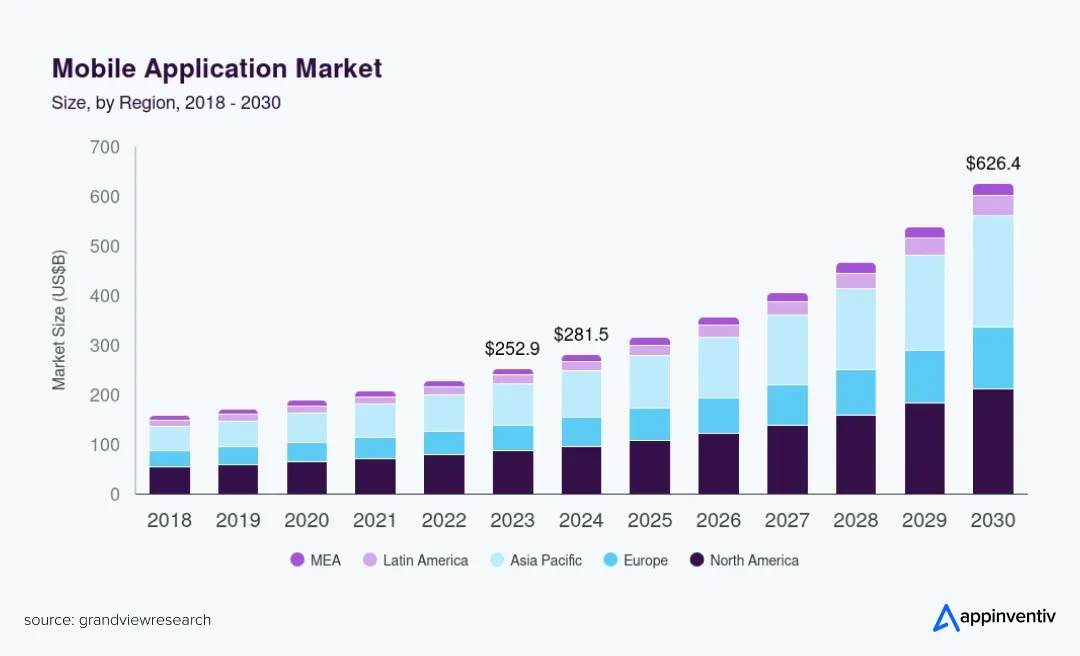
The mobile app world itself is booming. Grand View Research reports that it was worth around $228.9 billion in 2023 and could reach $567.2 billion by 2030. That’s not just growth on paper; it shows how deeply mobile experiences now shape the way businesses run and how people interact with brands every day.
Users, too, have raised the bar. They don’t just want an app that “works.” They want something that feels personal, quick, and smooth, using AI, AR/VR, 5G, and cloud technology to make every tap feel effortless.
So, if you’re planning to grow your digital footprint, this is the right time to dive in. In this guide, we’ll walk through the biggest mobile app development trends for 2026 and what they mean for businesses looking to stay ahead.
With thorough, fact-based research, here is a comprehensive list of top mobile app development trends, segmented into UX app design trends, Android and iOS app development trends, and the latest mobile app development trends.
Let’s begin with a few UX based app design trends:
1. Double Down on Motion Design
Your app users might get impatient with complex, static designs that offer no engagement. To resolve this, one solution is Motion Design. The idea is to “grab down” your user’s attention. Motion design icons enhance interactivity, engagement, animated scrolling, and macro interaction.
For instance, the digital product design company Appinventiv incorporated refined motion design features into Domino’s app, leading to a 23% increase in conversion rate.
Motion design features in apps also save users time and deliver a remarkable experience.

2. AI: The Mainstream Design Tool
It would be rather strange to discuss the latest mobile UI design trends without mentioning Artificial Intelligence. AI introduces the concept of “computational design,” meaning your app interfaces can be generated by automated programs rather than by designers crafting them.
In other words, AI and ML speed up the design process, with the likelihood of major changes minimal.
AI design programs are set with clear parameters for mimicking the human decision-making process, so the results may not vary much. Moreover, beyond the basics, AI is also slowly advancing in UX design iterations.
For example, AI can quickly design numerous versions of a single landing page.
3. Smart and Inclusive UX App Designs

You cannot make your users feel that your app is built for them if they don’t see themselves in the Design. For instance, the makers of a survival game “Rust” made headlines in every news piece for their decision to randomize every player’s skin color.
This UX design decision represented every demographic and, therefore, was a hit. Hence, one of the hottest mobile UX app design trends, alongside emerging artificial intelligence trends in mobile app experiences, accessibility, and inclusivity, is central to your app users.
4. Touchless UI
According to recent studies, 43% of UK consumers are open to using touchless technologies in their daily lives. This transition is evident as customers continue to prioritize touchless interfaces, such as facial recognition and touchless apps, even post-pandemic, reflecting a fundamental shift in consumer behavior and preferences.
Many users are already familiar with touchless UI, such as signing in to or identifying users in the app using biometrics. As a second authentication factor, finance or payment apps ask users to verify their identity with biometrics.
Another recent mobile app UI trend is gesture control, which lets you control apps by simply moving your head or the screen. Up-and-coming mobile apps can also track eye movements to help with scrolling. All these innovations are shaping current trends in mobile app development, setting the stage for a more intuitive, hands-free user experience.
From simplified mobile app design to trending AR/VR app interfaces, the next few years are bound to bring exciting transformations to the app design and development space. Let’s move on to the iOS and Android mobile app development trends.
5. Camera-focused mobile apps
Businesses choosing video conference app development have seen skyrocketing revenue, especially since the rise of remote work. Users can’t get enough of the apps that let them broadcast videos, connect with friends, and build a social network.
This is probably why TikTok is one of the most popular streaming apps. TikTok counted approximately 1.7 billion users worldwide.
To understand how usage scale and monetization patterns compare across categories, review these mobile app usage benchmarks for 2026.
Camera-based mobile application development trends are also moving into the streaming entertainment, broadcasting, and social media niches.
6. Low code/No code
Low-code and no-code platforms let non-technical employees build their own tools. Customer service reps, warehouse managers, and analysts now create solutions in hours instead of waiting months for IT.
The upside is clear. People closest to problems can fix them directly. Operations managers build inventory systems. HR automates paperwork. Marketing connects tools—all without developers.
The downside gets overlooked. Uncontrolled building creates chaos: shadow IT nobody tracks, data trapped in silos, security gaps, and integration nightmares across fragmented department tech stacks.
Smart companies set boundaries. Clear data access rules, mandatory security reviews, and integration standards. Enable building without breaking operations.
7. New Audio-Focused Social Media Platform
Video- and camera-based social media mobile application development trends may be the next “big” thing; however, the traditional audio-based format is getting plenty of attention in the social space as well.
Clubhouse offers a spontaneous experience, allowing users to switch into any chat room and join the conversation. This innovative voice-based app has seen 100% growth in the past four years, making audio a “meta-trend” that goes far beyond social media apps.
As audio continues to gain traction, we can expect to see further innovation and expansion in this space, with new platforms and features emerging to cater to evolving user preferences.
You may also explore: 7 Underpinning wearable trends for businesses to gain more insights.
8. Apps for Foldable and Wearable Devices
Samsung’s Galaxy Fold launch in 2019 wasn’t just another product release; it signaled a fundamental shift in mobile hardware. What started with foldable screens has expanded into an entire ecosystem: smartwatches handling tasks once reserved for phones, AR glasses moving from concept to reality, and fitness trackers becoming standard equipment for health-conscious consumers.
As these devices become more mainstream, mastering wearable application development will be essential for creating seamless cross-device experiences.
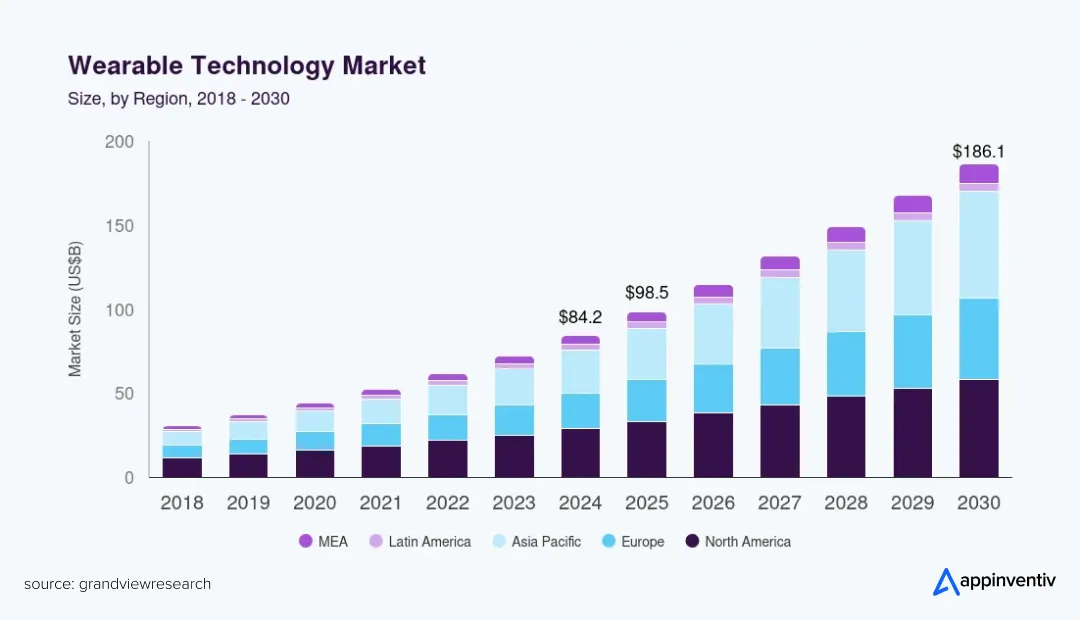
The market data backs this up. According to Grand View Research, the global wearable technology market is projected to grow at a CAGR of 13.6% from 2025 to 2030. For businesses, this creates a genuine challenge: how do you serve users across devices with vastly different screen sizes and interaction models?
Consider the practical implications. A professional needs to review a complex spreadsheet on their foldable’s expanded display during their morning commute. That same person wants quick message alerts on their smartwatch during a client meeting. Later, they might use AR glasses for turn-by-turn directions while keeping their hands free. Each scenario demands a different interface approach, yet users expect consistency.
The companies winning in this space aren’t treating these devices as afterthoughts. They’re designing experiences from the ground up to work naturally across form factors. Split-screen layouts that actually make sense. Notifications refined for a one-inch display. Voice commands that don’t require you to look like you’re talking to yourself.
Getting this right means staying relevant as hardware continues to fragment. Miss it, and you risk becoming invisible to an increasingly diverse device landscape.
9. Predictive Analytics
We have certainly talked about this mobile app development trend on more than one occasion. Predictive analytics can forecast events using data by leveraging technologies such as machine learning, AI, data mining, and modeling.
The most common example of predictive analytics in mobile apps is Netflix offering shows based on what users have previously watched. However, in 2023, predictive analytics will be adopted on a mainstream level to enhance the customer experience. The idea is that no two users should have the same experience in the app.
You may also present your product suggestions and services based on each user’s behavior history.
Now, coming to general mobile app development trends, we have on-demand apps and Extended Reality (XR) changing the landscape of mobile app development.
10. Extended Reality (XR)
Extended reality technology is popular in mobile apps through AR filters and gaming interfaces (e.g., Pokémon Go).
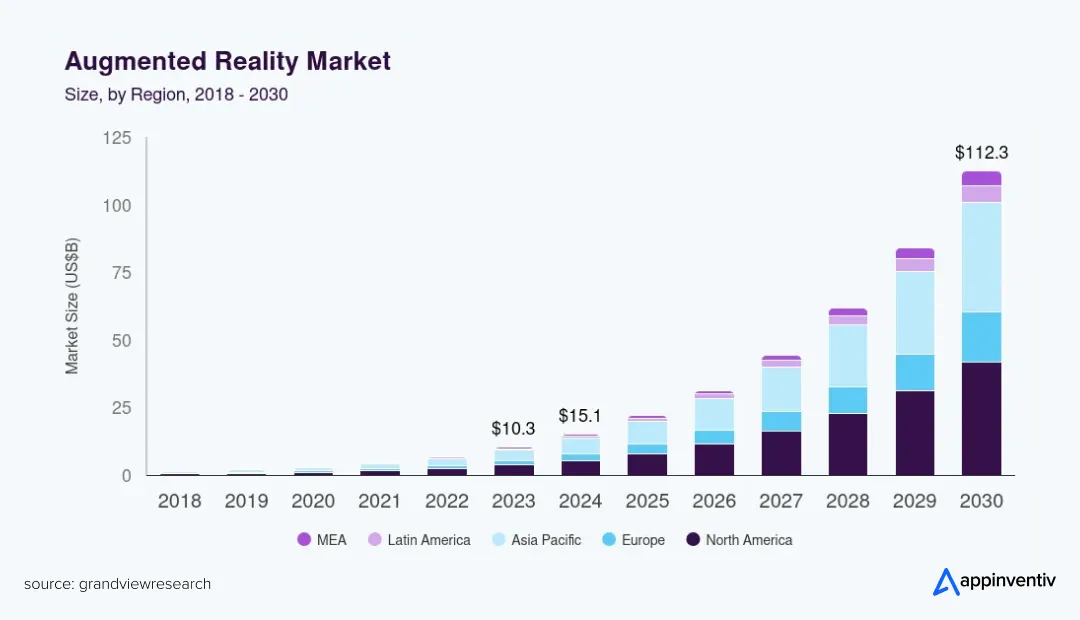
Major enterprises have also begun using XR for virtual training and onboarding. According to Grandview Research, the Extended Reality market is projected to reach USD 599.59 billion by 2030. On top of that, Augmented and Virtual Reality are already widely accepted as the new marketing strategy for businesses. This makes it easy for new product owners to introduce and enhance their services using XR to capture maximum attention and drive conversions.
11. On-Demand Apps
Based on a PwC report, the on-demand economy is projected to surge, reaching an impressive $335 billion by the year 2025. The report further establishes on-demand apps as the future of application development, highlighting that the on-demand economy will continue to grow.
What does this mean for app developers and business owners? You can leverage on-demand app development to offer a range of features and functionalities to meet your audience’s evolving needs.
It is also highly likely that on-demand apps will simplify the entire mobile app development process, given the platforms they use.
The right app development trend can make your business more visible and accessible to your target audience. Aside from the revenue benefits, the above-mentioned mobile app trends can help you foster brand awareness and reach potential customers, establishing your niche.
One way to get started with your favorite mobile app trend is partnering with an experienced Mobile app development company.
12. 5G Technology
The game-changer in mobile app development is no exaggeration, as the 5G technology has transformed it. The ability to connect faster, reduce lag, and increase bandwidth is giving developers the space to dream bigger and build better.
We now have apps that can deliver ultra-high-definition video, support real-time collaboration, and provide natural AR experiences rather than unnatural ones. For businesses, it translates into novel avenues for reaching users, such as instant telehealth consultations, smarter supply chain monitoring, and more.
5G isn’t just about speed. It’s about possibility. It is what is making the everyday mobile app into the intelligent interactive systems that will become the decade of innovation. The following advantage underscores the potential applications of 5G to businesses to expand in this dynamic world.
13. Beacon Technology
Beacon technology is an unobtrusive redefinition of the intersection of digital and physical experiences. These miniature devices can sense nearby smartphones and trigger precisely timed messages or actions via Bluetooth Low Energy (BLE) signals.
Consider coming to a store and being offered a personalized offer immediately, or a program at an airport that helps you get directly to the gate. That’s beacon tech in action. To developers, it is a tool that can make apps seem almost intelligent: they are cognizant of their environment, sensitive to context, and capable of delivering meaningful experiences.
14. Chatbots
Consider the last time you contacted a brand. Most likely, it was not a human being who responded first, but it was a chatbot. The change is indicative of the evolution of online discussions.
Gartner estimates that most customer interactions in the industries will be performed by chatbots by 2027. And honestly, that tracks. They can move very quickly, they do not sleep, and they have now learned to sound like humans in an astonishingly good manner.
What seemed robotic yesterday seems natural today. Chatbots are also getting smarter and more efficient due to the development of Natural Language Processing (NLP) and machine learning, which makes interactions smoother and more satisfying to the users in mobile apps.
In the case of mobile apps, chatbots are not really a pleasant addition, but the new frontier of customer experience. They release support teams, provide users with real-time answers, and bring apps to life and make them more personal.
15. Cloud Computing
According to IDC, global investment in cloud infrastructure is expected to hit $1.35 trillion by 2027. That’s not hype—it’s proof that nearly every business now depends on the cloud to stay efficient and accessible.
For developers, it’s a game-changer. No more cramming data into a phone’s storage or worrying about crashes under heavy use. The cloud handles the heavy lifting—storage, processing, syncing—so users get speed and reliability without the clutter.
It’s fair to say cloud computing has become the silent backbone of modern apps. You don’t notice it working—but you’d definitely notice if it stopped.
16. Progressive Web Apps (PWAs)
Native apps still dominate, but Progressive Web Apps are steadily gaining ground. These run straight through web browsers—no app store downloads, no installation friction.
PWAs sit between websites and traditional apps. Users get offline access, push notifications, and quick loading, all without taking up phone storage. Twitter saw engagement climb after launching its PWA. Starbucks reported similar gains. The pattern holds across industries.
The economics matter here. Developing a PWA costs considerably less than building and maintaining separate iOS and Android versions. It works across devices without custom coding for each platform. Connection quality matters less; PWAs handle spotty networks better than most web experiences.
For companies weighing options, PWAs solve a specific problem: reaching more users without doubling development budgets. They won’t replace native apps in every scenario, but they’ve earned their place in the conversation. Many businesses now treat PWAs as a legitimate path forward, particularly when testing markets or serving users who hesitate to download yet another app.
17. App Security & Privacy by Design
Data breaches make headlines. Users delete apps they don’t trust. Regulators hand out fines that can sink businesses. Security isn’t a feature you bolt on at the end anymore—it needs to be part of the foundation.
Users expect their information to stay protected. Governments require it. Competitors who get it right pull ahead.
Encrypted connections, multi-factor logins, and adherence to standards like GDPR, HIPAA, and CCPA have moved from nice-to-have checkboxes to baseline requirements. For companies building apps that rely on cloud infrastructure or artificial intelligence, locking down privacy controls from day one matters more than ever.
This goes double for sectors handling sensitive material—such as financial services, patient records, and supply chain data. One security gap can cost customer trust, revenue, and regulatory standing all at once.
18. Instant Apps (Try-Before-Install Experiences)
Android’s Instant Apps feature has reshaped how people discover and test applications. Instead of downloading first, users can explore core functionality immediately through their browser.
This approach solves a real problem, i.e., hesitation. Most people won’t install an app unless they’re confident it delivers value. Instant Apps remove that uncertainty by providing hands-on experience upfront.
The business impact is measurable. Conversion rates improve when users can interact with your product instantly, rather than going through the typical install-and-setup process. There’s less resistance, fewer abandoned downloads, and faster decision-making.
Several industries have effectively adopted this model. Retail brands let customers browse catalogs and check prices without any download commitment. Event platforms provide instant access to agendas, speaker information, and ticket purchases. Educational services offer course previews and lesson samples via direct links, providing clear examples of mobile app trends prioritizing accessibility and user convenience.
The underlying principle is straightforward: eliminate barriers between interest and action. When someone clicks a link and immediately experiences what your app does, rather than waiting through downloads and permissions, they’re substantially more likely to become active users. It’s a fundamental shift from “download to try” to “try to download.”
19. Sustainable / Green App Development
Sustainability has moved from trend to necessity. As brands focus on reducing their digital footprint, green app development is becoming part of every serious tech strategy.
The goal is simple: build smarter apps that use fewer resources. From cleaner code and optimized servers to energy-saving features like dark mode, developers are rethinking efficiency at every layer. Even Google’s 2024 guidelines recognize sustainable design as a factor that can boost Play Store visibility.
Beyond compliance, this shift directly ties to ESG goals, helping companies demonstrate that profitability and responsibility can go hand in hand. In 2025 and beyond, building sustainable apps won’t just be good ethics; it’ll be good business sense.
How Can Appinventiv Help You Stay Ahead With Mobile App Trends?
Appinventiv is a leading digital web and mobile app development company known for its defined approach and step-by-step process, delivering beyond expectations. We believe in keeping your app’s user process at the forefront of its systems with our top-notch development practices.
Our 1000+ mobile app development experts have conceptualized, designed, and developed solutions for some of the most popular global brands in multiple industry verticals, including KFC, Adidas, Pizza Hut, and IKEA. Additionally, we have helped numerous startups raise over $950 million through our mobile app development services.
Whether you’re exploring AI-driven analytics, foldable-ready design, or low-code app modernization, our team helps you navigate the challenges of mobile app trends while ensuring your business stays miles ahead in the evolving app ecosystem.
So what are you waiting for? Get in touch with our experts to discuss your next app idea and get started.
FAQs
Q. What are some notable trends in mobile app development?
A. Some notable mobile app market trends in mobile app development include the rise of artificial intelligence (AI), extended reality (XR), and blockchain technology. Additionally, there’s a growing emphasis on 5G technology, Internet of Things (IoT) integration, and cloud-based solutions.
Q. How can these trends impact mobile app development projects?
A. These iOS and android app development trends can significantly impact mobile app development projects by influencing design considerations, development strategies, and user experience enhancements. For example, integrating AI can enable personalized app experiences, while AR can enhance engagement through immersive features.
Q. What steps can businesses take to stay updated on these trends?
A. To stay updated on mobile development trends, businesses can follow industry news and blogs, attend relevant conferences and webinars, and engage with professional networks. Additionally, collaborating with an experienced mobile application development company in Melbourne can provide valuable insights and guidance on effectively implementing industry trends in mobile app development technologies.
Q. Which technologies are shaping the future of mobile app development?
A. The future trends in mobile app development are being defined by technologies like Artificial Intelligence (AI), Augmented Reality (AR), Virtual Reality (VR), and 5G connectivity. These advancements are enabling developers to build apps that are faster, smarter, and more immersive. AI-driven personalization, AR-based retail experiences, and real-time data streaming powered by 5G are just a few ways these technologies are reshaping how users interact with apps.
Q. How are AI and machine learning influencing mobile app trends?
A. AI and machine learning sit at the center of the latest app trends. From predictive analytics that anticipate user needs to chatbots that offer real-time support, AI is transforming how apps function and engage. In 2026, we’re also seeing AI being used to automate UI/UX design, improve fraud detection, and enhance content recommendations—making mobile apps more intuitive and responsive than ever before.
Q. How are iOS and Android app trends evolving in 2026?
A. The emerging trends in mobile app development for iOS and Android are focused on performance, personalization, and privacy. Apple is pushing deeper into on-device AI processing for security and efficiency, while Android continues to refine its Instant Apps ecosystem and optimize app experiences for foldable and wearable devices. Both platforms are prioritizing accessibility and sustainability, setting new standards for developers worldwide.
Q. What emerging technologies will impact mobile app development in the next few years?
A. The next wave of innovation will be driven by technologies such as edge computing, blockchain, Internet of Things (IoT), and extended reality (XR). These emerging trends in mobile app development will allow businesses to build apps that are not only faster but also more connected and secure. For example, IoT-based apps will enhance automation in healthcare and logistics, while XR will redefine digital training, gaming, and retail experiences.
Q. What are the latest innovations in mobile app development?
A. Some of the latest innovations in mobile app development include low-code/no-code platforms, AI-driven analytics, and cross-platform frameworks like Flutter and React Native. Developers are also focusing on building sustainable apps that use fewer device resources and support dark mode to reduce energy use. These innovations reflect the industry’s ongoing shift toward efficiency, inclusivity, and environmentally conscious design.

- In just 2 mins you will get a response
- Your idea is 100% protected by our Non Disclosure Agreement.

How Much Does It Cost to Develop an App Like Herfy in 2026?
Key takeaways: Herfy-like app development costs SAR 150,000 to SAR 1,500,000 ($40,000 to $400,000). Costs rise with rider tracking, POS sync, kitchen displays, loyalty, and branch controls. Saudi apps need Arabic UX, Mada, STC Pay, VAT, and ZATCA-ready invoice flows. Peak loads during Ramadan, Eid, and weekends need strong backend and load testing. A phased…

Key takeaways: The operating model determines survival. The code does not. Compliance under PDPL in the UAE and SDAIA in Saudi Arabia must be engineered into architecture, not added before launch. A serious build costs between AED 147,000 and AED 1,470,000 (USD 40,000 to USD 400,000), depending on scope. The single largest cost most operators…
Key takeaways: You don’t “add” Shariah later. In Shariah-Compliant platform development, the ledger, screening engine, and contracts are the product—not the UI. Start with scholars, not screens. Lock AAOIFI-aligned logic + SSB workflows before writing core APIs, or you’ll rebuild half the system. Build compliance as infrastructure. Product layer, screening layer, ledger, and governance all…