
































How Much Does It Cost to Build a Mobile App in Saudi Arabia? A 2026 Enterprise Cost Guide

 Share -


- 01What Factors Affect Mobile App Development Cost in Saudi Arabia?
- 02Platform Choice and Its Impact on Development Cost
- 03Complete Mobile App Development Cost Breakdown
- 04How Do Mobile App Development Costs Differ Across Saudi Cities?
- 05Localization Cost Considerations
- 06How Development Process and Timelines Influence App Cost
- 07Build vs Customize: Enterprise Cost Implications
- 08Hidden and Ongoing Costs Enterprises Often Overlook
- 09Understanding Total Cost of Ownership (TCO)
- 10How Enterprises Optimize App Development Costs Without Increasing Risk
- 11How Appinventiv Delivers Secure Development Platforms at Scale
- 12Frequently Asked Questions

Key Highlights
- Mobile app costs in Saudi Arabia vary widely based on integrations, compliance, and scalability requirements.
- Early architecture planning and PDPL compliance from the outset help control long-term enterprise mobile development costs while reducing redesign and regulatory risks.
- Localization, security standards, and infrastructure readiness significantly influence total ownership cost over time.
- Smart city initiatives and Vision 2030 are accelerating investment decisions for enterprise mobile platforms.
- Long-term ROI depends on scalability, operational efficiency, and alignment with core business workflows.
Most enterprise app conversations do not start with a large strategy deck. They usually begin when something starts feeling inefficient. A delayed approval because someone was not near a laptop. A customer asking why a service still needs multiple steps. Small moments like that tend to trigger bigger digital discussions.
Saudi Arabia’s broader transformation has made such talk frequent. Vision 2030 has pushed organizations to modernize how they operate and engage customers. At the same time, projects like NEOM and other smart city initiatives are quietly shaping expectations. Mobile access is no longer seen as an extra feature. People assume it is part of the experience.
If you are considering building an app, understanding the mobile app development cost in Saudi Arabia usually becomes an early priority. Platform choices, Arabic language support, system integrations, and regulatory considerations all influence investment levels. Many teams only see the full picture once planning is already underway.
Getting clarity early helps avoid those mid-project surprises. It also makes budgeting discussions far more practical. This blog looks at what actually drives app costs in Saudi Arabia, so your team can plan realistically before you move ahead to build an app.
Mobile app market projected to reach about $2.3 billion by 2030

What Factors Affect Mobile App Development Cost in Saudi Arabia?
Cost estimates often look stable early on. Then technical realities show up. Integration constraints, regulatory requirements, localization effort, and infrastructure planning. That is usually where the mobile app development cost in Saudi Arabia starts shifting.
With the mobile app market projected to reach about $9.5 billion by 2033, investment activity is accelerating. Regional patterns show similarities with UAE app development costs, though local factors influence final investment levels. If you are assessing the cost to develop a mobile app, these are the areas that most often influence the final number.
Feature Scope and Technical Complexity
This is typically the first place budgets expand. Advanced functionality demands deeper engineering, more testing cycles, and stronger backend architecture. Teams sometimes realise this mid-planning, when prototype features begin to touch real data or live workflows.
- Real-time capabilities such as messaging, tracking, or streaming data
- AI-powered features such as intelligent recommendations, copilots, agentic AI workflows, predictive analytics, document processing, or conversational assistants that require custom model integration, orchestration, and ongoing optimization
- Regional payment integrations like Mada, STC Bank, and local banking APIs
- Offline sync logic for field operations or intermittent connectivity
Enterprise Integrations and Backend Systems
Enterprise apps rarely operate in isolation. They usually connect to existing systems, and that integration effort often takes longer than expected, especially when legacy platforms or fragmented data environments are involved.
- CRM and ERP integrations through REST, GraphQL, or event-based APIs
- Middleware layers, microservices, or API gateway architecture
- Legacy database cleanup, migration, or synchronization workflows
- Identity federation, SSO, and enterprise authentication systems
Security, Compliance, and Data Sovereignty
Security discussions in Saudi projects begin early because organizations must comply with the fully enforceable Saudi Personal Data Protection Law (PDPL). Data privacy, governance, and hosting requirements now directly shape infrastructure and application architecture from day one.
- PDPL-compliant data governance, consent management, privacy controls, and data lifecycle management
- Local data hosting or regional cloud deployment expectations
- Strong identity management, encryption, and audit logging setups
- Security testing, threat modeling, and compliance validation cycles
UI/UX Expectations and App Design and Development Standards
Localization goes beyond translation. Interface structure, usability expectations, and cultural context all influence design effort. Many teams notice this when Arabic interface testing begins.
- Arabic language support with accurate RTL layout handling
- Multilingual navigation, content management workflows
- Accessibility and device compatibility testing
- Iterative design refinement based on real user feedback
Cloud Infrastructure and Scalability
Infrastructure planning shapes both performance and long-term operating cost. Decisions here often affect reliability, latency, and future expansion capability.
- Deployment on AWS Middle East regions, Azure Saudi cloud, or private cloud
- Containerization, CI/CD pipelines, scalable backend architecture
- Load balancing, CDN strategies, performance optimization
- Monitoring, backup planning, and disaster recovery readiness
AI Integration and Intelligent Automation
Modern enterprise apps increasingly incorporate AI to automate workflows, improve decision-making, and personalize user experiences.
Whether integrating foundation models via APIs or developing custom AI capabilities, these features entail additional costs for model selection, prompt engineering, orchestration, security, testing, and ongoing monitoring.
Key cost drivers:
- LLM and AI API integration
- AI agents for workflow automation
- Retrieval-Augmented Generation (RAG)
- Vector databases
- AI governance and monitoring
- Model fine-tuning where applicable
- GPU infrastructure for custom deployments
Cost Impact Overview
| Factor | Technical Cost Driver | Cost Impact Range |
|---|---|---|
| Feature Complexity | AI modules, real-time processing, advanced backend logic | Medium to High |
| Enterprise Integrations | ERP/CRM APIs, middleware layers, legacy data sync | Medium to High |
| Security and Compliance | PDPL controls, encryption, identity access systems, and audit logging | Medium to High |
| Localization and UX | Arabic language support, RTL layout engineering, usability testing | Medium |
| Cloud Infrastructure | Regional hosting, auto scaling, monitoring, and disaster recovery | Medium to High |
| AI Integration | LLM APIs, AI agents, RAG pipelines, model orchestration, inference infrastructure | Medium to High |
Platform Choice and Its Impact on Development Cost
Platform decisions usually look simple early on. Then practical tradeoffs appear. Performance expectations, maintenance effort, security standards, and user experience goals all begin to influence the direction. When estimating the cost to develop a mobile app in Saudi Arabia, platform strategy is often one of the first major budget drivers.
Cost Impact Overview
| Factor | Technical Cost Driver | Cost Impact Range |
|---|---|---|
| Native Development | Separate iOS and Android codebases, platform-specific testing | High |
| Cross-Platform Frameworks | Shared codebase, framework optimization, plugin dependencies | Medium |
| Progressive Web Apps | Browser compatibility layers, offline caching, performance tuning | Low to Medium |
| Device and OS Optimization | Screen variations, OS updates, performance tuning cycles | Medium |
| Long Term Maintenance | Version upgrades, security patches, framework lifecycle management | Medium to High |
Also Read: React Native vs Native: What to choose for App Development
Most enterprises balance cost, performance, and long-term flexibility here. Native builds often deliver stronger performance and tighter security control. Cross-platform approaches can reduce initial costs and accelerate launch timelines. The right choice usually depends on business goals, user expectations, and the criticality of the mobile experience to your operations.
Also Read: Redefining Mobile App Development Success in the Middle East – 6 Business Case Studies
Complete Mobile App Development Cost Breakdown
Once teams move past the idea stage, cost discussions usually get more grounded. Someone asks what the first version will really cost. Another stakeholder wants to know how much scaling later will add. That is where a clear mobile app development cost breakdown helps. It gives you a realistic sense of the average cost of mobile app development before budgets get locked.
App Complexity vs Cost Range
| Complexity Level | Typical Features | Estimated Cost Range (SAR) |
|---|---|---|
| MVP Development | Core workflows, basic UI, limited integrations, standard security | 187K to 375K |
| Mid Complexity | Custom UI, multiple integrations, analytics dashboards, stronger security | 375K to 937K |
| Enterprise Grade | AI-powered features, intelligent automation, agentic workflows, and advanced analytics, along with deep integrations, advanced security, and scalable infrastructure | 937K to 1.87 million+ |
These ranges reflect typical business app development cost patterns. Comparing Egypt’s development costs can provide additional regional context for budgeting.
The exact number usually depends on how deeply the app connects with existing systems and how future-ready the architecture needs to be.
Core Cost Components
Even within one complexity level, costs spread across several stages. Teams sometimes focus only on coding effort, then realise later that design refinement, compliance checks, or ongoing support also carry weight. Breaking costs into components makes planning easier.
| Cost Component | Typical Cost Range (SAR) |
|---|---|
| Discovery and Consulting | 37K to 112K |
| UI/UX Design | 56K to 187K |
| Development and Integrations | 300K to 1.2 million |
| Testing, QA, and Compliance | 75K to 262K |
| Deployment and Ongoing Support | 37K to 187K annually |
Most organizations treat these as directional benchmarks. Final costs usually settle once the technical scope, integrations, and rollout timelines become clearer.
Appinventiv partnered with KFC to enhance its mobile food ordering experience across Middle East markets, focusing on performance, localization, and seamless ordering flows. The engagement centered on improving customer convenience while supporting scalable digital ordering infrastructure aligned with regional expansion.

How Do Mobile App Development Costs Differ Across Saudi Cities?
Once planning moves beyond rough budgeting, location often starts to influence costs more directly. Talent availability, enterprise demand, infrastructure maturity, and industry concentration all play a role. When internal capacity is tight, organizations often consider hiring Saudi’s mobile app developers to maintain continuity while aligning with local compliance and infrastructure requirements.
Even within the landscape of mobile app development in Saudi Arabia, costs can vary depending on which city anchors the project. Below is a practical view across three major Saudi hubs where enterprise app development activity is most visible.
Riyadh
Typical cost positioning: Upper range within the Saudi market
Riyadh leads most enterprise digital initiatives in the country. Government programs, large enterprises, and funded digital transformation projects tend to cluster here. That concentration usually pushes demand for experienced developers, architects, and compliance specialists slightly higher.
Key cost drivers:
- Strong enterprise demand concentration
- Mature developer and consulting ecosystem
- Higher expectations around security and compliance
- Larger-scale infrastructure and integration projects
Jeddah
Typical cost positioning: Balanced to moderately competitive
Jeddah’s commercial character shapes its digital projects. Retail, logistics, tourism, and service sector apps are common, which often keep development cycles practical and cost structures competitive compared to Riyadh.
Key cost drivers:
- Commercial and trade-driven app demand
- Competitive development vendor landscape
- Strong focus on customer-facing mobile experiences
- Payment, logistics, and commerce integrations
Dammam
Typical cost positioning: Competitive, sector-driven
Dammam and the Eastern Province bring an industrial perspective. Energy, logistics, and manufacturing companies often prioritize operational apps, workforce mobility, and field data platforms. The ecosystem is growing, which can keep costs relatively competitive.
Key cost drivers:
- Industrial and energy sector mobility needs
- Operational apps for field teams and logistics
- Emerging but expanding tech ecosystem
- Integration with enterprise operational systems
City-Based Cost Snapshot
| City | Cost Impact | Typical Development Signal |
|---|---|---|
| Riyadh | Higher within the Saudi market | Enterprise-scale, compliance-heavy apps |
| Jeddah | Moderate | Commercial, customer-facing platforms |
| Dammam | Competitive | Industrial, operational mobility apps |
City choice does not just affect hourly rates. It can influence compliance exposure, integration complexity, and long-term operational planning as well.
Localization Cost Considerations
Localization usually looks simple until the first real design review happens. A button shifts because of the right-to-left layout. Copy expands in Arabic. Testing takes longer than expected. These details quietly shape the Arabic mobile app development cost, especially when the product targets enterprise users or regulated industries.
Below is a practical view of how localization typically affects budgets.
Arabic Mobile App Development Cost
Typical cost positioning: Moderate to high, depending on depth
Arabic app localization involves more than translation. Interface structure, usability expectations, and testing cycles all adjust when an RTL app becomes part of the scope. Many teams notice the impact once design validation begins.
Key cost drivers and Arabic app development challenges:
- Right-to-left layout, engineering, and UI adjustments
- Cultural UX considerations for navigation and visuals
- Arabic NLP or voice interface requirements, where applicable
- Dedicated testing across language scenarios
Multi-Language App Development Cost
Typical cost positioning: Moderate, rising with language count
Adding multiple languages introduces workflow complexity. Content updates, version control, and testing cycles expand. This becomes more visible in enterprise apps with frequent updates or large user bases.
Key cost drivers:
- Structured translation workflows and content pipelines
- Content management system adjustments
- Additional QA cycles for each language version
- Ongoing localization maintenance post-launch
Localization Cost Snapshot
| Localization Scope | Cost Impact | Typical Development Signal |
|---|---|---|
| Arabic Only (RTL) | Moderate to High | UI restructuring, RTL design, language testing |
| Multi-Language Support | Moderate | Translation workflows, QA expansion |
| Arabic plus Multi-Language | Higher | Combined RTL, localization management, and ongoing updates |
Localization costs rarely come from translation alone. Interface engineering, testing effort, and content management usually shape the final investment.
Appinventiv worked with Adidas to strengthen its mobile ecommerce presence through a localized shopping platform designed for performance, usability, and regional consumer expectations. The collaboration supported digital commerce growth while maintaining a consistent brand experience across mobile channels.

How Development Process and Timelines Influence App Cost
Process decisions often shape costs as much as features do. Architecture choices, compliance alignment, infrastructure readiness, and regional regulatory expectations can all shift budgets. When enterprises plan to build an app in Saudi Arabia, factoring in technical and regional realities early usually prevents costly course corrections later.
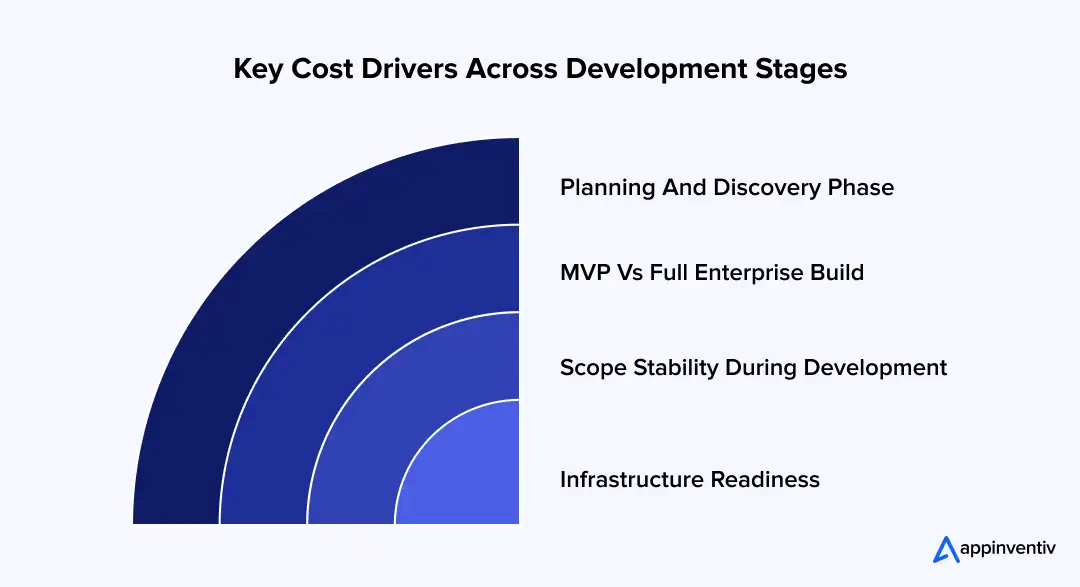
Planning and Discovery Phase
This is where business goals, technical architecture, compliance obligations, and regional deployment considerations are defined before development begins. In Saudi projects, this stage often includes data residency planning and Arabic localization scope.
How it affects cost:
- Building PDPL compliance into the architecture from the beginning minimizes costly security redesigns, regulatory remediation, and deployment delays.
- Architecture validation prevents scalability rework
- Regional hosting decisions affect infrastructure pricing
- Integration mapping avoids unexpected backend effort
- Arabic localization planning prevents UI redesign cycles
MVP vs. Full-Scale Development
This stage determines whether the product launches with core functionality or as a fully scaled enterprise platform aligned with regional regulatory expectations.
How it affects cost:
- MVP approach lowers initial spend but may delay compliance readiness
- Enterprise builds require security, scalability, and governance upfront
- AI features, analytics pipelines, or smart city integrations increase cost
- Early cloud architecture choices affect future expansion spend
Scope Stability During Development
This reflects how consistently requirements remain aligned once development begins. Regional compliance reviews or integration updates sometimes influence this stage.
How it affects cost:
- Regulatory updates can trigger additional validation cycles
- Integration changes increase engineering effort
- Feature expansion extends testing timelines
- Multilingual support additions affect design and QA cycles
Infrastructure Readiness
This stage covers cloud environments, backend services, data pipelines, and operational readiness. In Saudi Arabia, regional hosting and latency considerations often shape infrastructure choices.
How it affects cost:
- Middle East cloud region selection influences hosting cost
- Container orchestration and CI/CD setup add engineering effort
- High availability and disaster recovery planning increase spend
- Monitoring, security logging, and compliance reporting add operational cost
Structured planning across these stages usually keeps costs predictable. Delayed compliance alignment, unclear architecture, or shifting infrastructure plans tend to increase overall investment.
Build vs Customize: Enterprise Cost Implications
When enterprise mobility discussions begin, the build vs customize decision usually comes up quickly. Custom development can feel heavier upfront. Customizing an existing platform often looks faster. The cost picture tends to shift once scalability, integrations, and governance requirements become clearer in enterprise mobile app development.
Most organizations evaluating enterprise mobility solutions end up weighing these two paths.
| Approach | Upfront Cost | Long-Term Cost | Cost Risk |
|---|---|---|---|
| Build (Custom Development) | Higher | Controlled | Predictable at scale |
| Customize Existing Platform | Medium | Variable | Integration and flexibility constraints |
Custom development typically gives stronger control over architecture, compliance alignment, and future scaling. It also allows deeper integration with enterprise systems without structural limitations.
Understanding marketplace platform costs helps with platform decisions. Platform customization usually speeds initial deployment. Still, limitations in flexibility, licensing costs, and integration constraints sometimes surface later. These can increase maintenance complexity or restrict expansion.
Key Takeaway: Faster launch savings may look appealing early. Long-term cost stability often depends on how much architectural control your enterprise retains.
Architecture decisions influence long-term scalability, integration flexibility, and enterprise mobile costs

Hidden and Ongoing Costs Enterprises Often Overlook
Most teams estimate what it takes to launch. Fewer plan with the same detail for what happens once real usage begins. Traffic grows, compliance expectations tighten, and infrastructure evolves. That is usually when the true cost to develop a mobile app becomes clearer over time, not just at launch.
Post-Launch Cost Snapshot
| Hidden Cost Area | Why It Adds Cost Over Time |
|---|---|
| Maintenance and Updates | OS upgrades, device compatibility fixes, and feature refinement cycles |
| Security Audits and Compliance Checks | Regular penetration testing, PDPL alignment reviews, and security patching |
| Cloud Hosting and Infrastructure Scaling | Increased traffic, storage growth, and performance optimization needs |
| Licensing and Third-Party Integrations | API subscriptions, payment gateways, analytics tools, SaaS dependencies |
| Customer Support Ecosystems | Support tooling, chatbot automation, and service operations expansion |
These costs rarely appear prominently in early estimates. Still, they tend to shape long-term operational spending once the app moves from launch to real-world usage.
Understanding Total Cost of Ownership (TCO)
Initial build estimates usually get the most attention. The bigger financial picture often appears after launch. Real users arrive, infrastructure grows, compliance cycles repeat. That is when total ownership cost starts taking shape. When evaluating the mobile app development cost in Saudi Arabia, looking beyond launch gives a far more realistic financial view.
3-Year Cost Ownership Snapshot
A practical TCO view separates early build investment from ongoing operational commitment. This helps enterprises plan budgets with fewer surprises as adoption grows.
| TCO Phase | Cost Behavior Range |
|---|---|
| Year 1, Build and Launch | Around 40–50% of the total 3-year investment |
| Year 2 to Year 3, Operate and Scale | Around 50–60% of the total 3-year investment |
How TCO typically evolves:
- Build cost covers engineering, architecture, and compliance setup
- Operational cost includes hosting, security, updates, and optimization
- Early spend focuses on product creation
- Later spend focuses on stability, scale, and performance
Enterprises that account for this shift early usually avoid reactive redesigns, unexpected infrastructure spending, or rushed compliance adjustments as usage grows.
How Enterprises Optimize App Development Costs Without Increasing Risk
Cost optimization rarely means cutting corners. Most enterprises focus on timing investments correctly and building flexibility into the architecture. With enterprise mobility solutions, thoughtful planning often reduces rework, prevents compliance surprises, and keeps mobile app design and development aligned with long-term business goals.
Below are practical approaches enterprises commonly use.
| Strategy | How It Controls Cost | Risk Reduction Impact |
|---|---|---|
| Phased Development Strategy | Releases core features first, delays noncritical capabilities | Limits on overbuilding and unnecessary early spending |
| Cloud-Native Architecture Adoption | Scalable infrastructure, containerization, automated deployment | Prevents costly infrastructure rebuilds later |
| Governance-First Engineering | Early compliance planning, security frameworks, and audit readiness | Reduces regulatory and security rework |
| Strategic Development Partnerships | Experienced vendors improve delivery efficiency | Minimizes execution risk and project delays |
These approaches usually shift spending from reactive fixes toward planned expansion. Enterprises that follow this path often see steadier budgets, fewer redesign cycles, and stronger operational stability as their mobile platforms grow.
Structured engineering strategies help control cost while protecting scalability and operational stability

How Appinventiv Delivers Secure Development Platforms at Scale
Enterprise mobile projects rarely stay simple for long. Security reviews increase, integrations deepen, and scalability becomes a real concern once usage grows. That is where practical regional experience helps. As a mobile app development company in Saudi Arabia, Appinventiv focuses on building platforms that stay stable as adoption expands.
Regional Delivery Snapshot
- 1000+ digital projects delivered across the Middle East
- 10+ years of regional experience
- 35+ industries supported
- 500+ enterprise workflows modernized
- 12+ government and compliance programs executed
Operational Impact Overview
| Metric | Business Impact |
|---|---|
| SLA uptime | 99.90% for mission-critical platforms |
| Cost optimization | Up to 40% savings via digital transformation |
| Strategic partnerships | 20+ regional collaborations |
| Excellence centers | 3+ regional delivery hubs |
How Platforms Stay Scalable
- Compliance-ready architecture planning from day one
- Security-first engineering practices
- Scalable cloud native infrastructure
- Enterprise-focused mobile app design and development
The focus remains straightforward: secure platforms that scale without constant redesign or operational disruption.
Frequently Asked Questions
Q. How to choose the best app development firm in Saudi Arabia?
A. Look for regional experience, compliance awareness, and proven enterprise delivery. Review past projects, especially regulated or large-scale platforms. Evaluate security practices, Arabic localization capability, and post-launch support. A firm that understands Saudi infrastructure, data expectations, and enterprise integrations usually delivers more predictable outcomes.
Q. How long does it take to build a mobile app in Saudi Arabia?
A. Typical timelines range from 3 to 6 months for an MVP and 9 to 12 months or longer for enterprise-grade platforms. Integrations, Arabic localization, compliance validation, and infrastructure readiness often influence schedules more than coding alone.
Q. Does Saudi data privacy law affect mobile app development cost?
A. Yes. Because PDPL is now fully enforceable, organizations must incorporate privacy, consent management, data governance, encryption, audit logging, and secure data processing into application architecture from the outset. These requirements influence both development effort and long-term operational costs.
Q. What ROI can businesses expect from mobile apps in Saudi Arabia?
A. ROI often comes through operational efficiency, customer engagement, and faster service delivery. Enterprises frequently report workflow optimization, improved customer retention, and cost reductions through digital transformation. Actual returns depend on adoption levels, integration depth, and how well the app supports core business processes.
Q. How much does post-launch app maintenance cost in Saudi Arabia?
A. Maintenance typically ranges from 15% to 25% of the initial development cost annually. This includes updates, security patches, infrastructure scaling, compliance reviews, and performance optimization. Costs vary depending on traffic growth, integrations, and regulatory requirements.
Q. Do Saudi regulations require local data hosting for mobile apps?
A. Not always mandatory, but many sectors prefer or require regional hosting for compliance and latency reasons. Government, finance, and healthcare projects often prioritize local or Middle East cloud regions to align with data governance expectations and regulatory frameworks.
Q. How do smart city initiatives like NEOM impact mobile app demand?
A. Smart city programs increase demand for connected mobile platforms across services, infrastructure, logistics, and customer engagement. Enterprises supporting these ecosystems often invest in scalable mobile solutions to integrate data, streamline operations, and meet rising digital experience expectations.
Q. How does app complexity affect mobile app development cost estimates?
A. App complexity directly shapes development cost. Basic apps with simple UI, authentication, and limited APIs cost less. Medium complexity apps involve integrations, payment gateways, and custom UI. Complex apps with real-time synchronization, AR features, or advanced integrations typically require larger budgets and specialized development expertise.
Q. How do app development costs vary across different industries?
A. Costs vary by industry needs and technical depth. A food delivery app or grocery app typically requires payment gateways, real-time synchronization, and user authentication. Ecommerce apps often involve custom design and cloud infrastructure. SaaS apps emphasize scalability, while healthcare apps or telemedicine platforms may include AR features, 3D graphics, and stricter compliance requirements.
Q. What strategies help reduce mobile app development costs without increasing risk?
A. Cost control often starts with building an MVP before full-scale development. Cross-platform frameworks like Flutter or React Native reduce duplication. Using open source tools, third-party APIs, modular architecture, and focused UI/UX planning helps manage costs while keeping scalability and performance intact.


Fast 2-minute response, fully NDA-protected.

How Much Does It Cost To Build a Chat App Like Arattai?
Key takeaways: Creating a chat app like Arattai will cost you anywhere from $40,000 to $400,000, depending on how complex you want it to be. The essential features you need are real-time messaging, multimedia sending, and user authentication. Layering advanced features such as voice/video calls, group messaging, AI-driven bots, and end-to-end encryption takes the app…

How Much Does It Cost to Build a Car Rental App like Hertz?
Key takeaways: The cost to build a Hertz-like app ranges roughly $40,000–$300,000+. Complexity, automation, and scale matter more than just the number of features. Real costs continue after launch: infra, maintenance, support, and compliance. Smart planning and MVP-first approach help keep budgets under control. Revenue comes from rentals, add-ons, subscriptions, partnerships, and fleet sales. You…

How Much Does It Cost to Build a Route Planning App Like Komoot
Europe doesn’t just love the outdoors- it thrives on it. From the Alps to Amsterdam’s bike lanes, cycling and hiking fuel an industry worth $53.3 billion in 2024, projected to grow at nearly 11% CAGR through 2033, as reported by GrandViewResearch. And leading this charge is Komoot, the route-planning app trusted by 40+ million users.…