




























Build Your Own: A Complete Guide to Menu Engineering Software Development (2026)


- How Menu Psychology Drives Profitable Choices
- What Menu Engineering Software Solves and Why It Matters
- Core Capabilities of Menu Engineering Software Development
- How Accurate Menu Decisions Are Calculated
- How to Build Menu Engineering Software: A Practical Development Process
- Menu Engineering Software Tech Stack: What to Use and Why
- Understanding the Cost of Menu Engineering Software in 2026
- Compliance and Governance in Menu Engineering Software
- Common Challenges in Menu Engineering Software and How to Overcome Them
- Build vs Buy: Choosing the Right Path for Your Business
- Future Trends of Menu Engineering Software
- How Appinventiv Helps in Menu Engineering Software Development

- Menu engineering works best when treated as a decision system, not a one-time analysis exercise.
- Accurate menu decisions depend on real cost data, clean POS mappings, and continuous analysis.
- Building custom menu engineering software makes sense when complexity, scale, and control matter.
- Most menu engineering software built in 2026 falls between $40,000 to $400,000, driven by integrations and depth of analytics.
- The real value of restaurant profit optimization software shows up in faster decisions, stronger margins, and long-term consistency.
Menu decisions today are no longer driven by intuition or static reports. Ingredient price volatility, complex modifiers, and multi-location operations have made menu performance harder to control. This is why restaurant menu engineering software development is becoming central to how restaurants manage profitability, rather than a supporting analytics exercise.
For many operators, restaurant menu engineering has moved beyond periodic reviews and manual calculations. Pricing, portioning, and positioning now depend on actual sales behavior and cost movements, especially in menu engineering for food and beverage businesses operating at scale. Relying on spreadsheets or manual menu engineering analytics often leads to delayed decisions and missed margin opportunities.
As a result, more brands are investing in restaurant engineering software development to create systems that continuously monitor performance and support faster, data-backed actions. Understanding the benefits of menu engineering at the software level and knowing how to build menu-engineering software that fits real operational workflows have become strategic priorities.
This guide explains what it takes to build such a system in 2026, covering capabilities, integrations, cost, and ROI.
Get early clarity on feasibility, integrations, and long-term value before making a build decision.

How Menu Psychology Drives Profitable Choices
Menu psychology influences how guests notice, compare, and select items, often within seconds. Placement, price framing, and visual hierarchy all affect ordering behavior, especially on busy or crowded menus. When these factors are overlooked, even well-designed menus can underperform.
When supported by menu engineering and detailed analysis, these behavioral patterns become measurable. Tools like the menu engineering matrix and defined menu engineering categories help teams understand which items attract attention and which actually drive profit.
Applied through menu engineering software features, menu psychology becomes practical:
- Highlighting high-margin items based on performance data
- Testing price anchoring and decoy strategies using real orders
- Identifying weak performers through repeat analysis and menu engineering examples
- Scaling consistent changes across locations using menu re-engineering software
When combined with AI menu engineering strategies for restaurants, these insights adapt continuously. This turns menu design into one of the most reliable benefits of menu engineering for improving order profitability without forcing choices.
Also Read: 10 Innovative Restaurant Business Ideas That Are Disrupting the Industry
What Menu Engineering Software Solves and Why It Matters
Restaurant profit optimization software automates the reconciliation of real-time ingredient costs with POS sales data to identify margin leakage before it impacts profitability. This software exists to fix a gap that most restaurants feel every day. Teams know which items sell, but not always which ones truly make money. Costs change, portions drift, modifiers complicate pricing, and insights arrive too late to act on. This is where menu engineering shifts from theory to execution.
At its core, software development integrates recipes, real costs, and sales behavior into a single decision layer. Instead of relying on periodic reports, teams can run continuous menu engineering and respond before margins slip. This matters even more in menu engineering in food and beverage operations, where scale amplifies small errors.
What the menu engineering software features help solve in practice:
- Lack of clarity on true contribution margins across menu items
- Slow reaction to supplier price changes and cost inflation
- Inconsistent decisions across locations and teams
- Overreliance on static menu engineering matrix reviews
- Difficulty proving the real benefits of menu engineering over time
By centralizing data and standardizing analysis, restaurant engineering software development gives operators confidence in everyday decisions. It turns menu performance into something teams can manage actively, not review after the damage is done.
Core Capabilities of Menu Engineering Software Development
A reliable menu engineering platform is not just a reporting tool. It is a decision system that sits between operations, finance, and culinary teams. To work in real restaurant environments, the software needs a set of tightly connected capabilities that go beyond basic charts or static frameworks.
Below are the core capabilities that define effective software development in 2026.
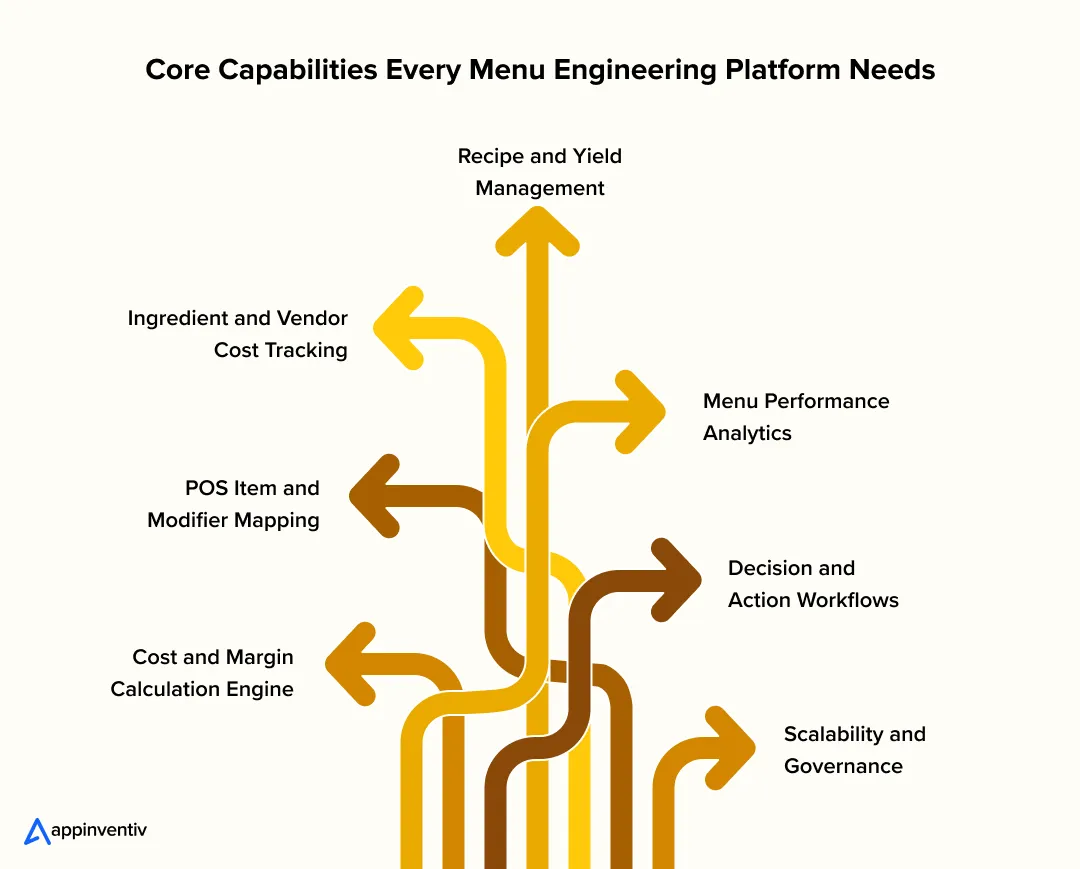
1. Recipe and Yield Management
Everything starts with recipes. The platform must support detailed recipe structures, including sub-recipes, portion sizes, and yield loss from trimming or cooking. Without this layer, even advanced menu-engineering analysis rests on weak assumptions. Accurate yield tracking is critical for menu engineering in food and beverage businesses with tight margins.
2. Ingredient and Vendor Cost Tracking
A strong platform continuously tracks ingredient costs at the vendor and SKU level. It should handle pack-size conversions, invoice-based price updates, and cost variance over time. This capability is central to menu engineering, where supplier prices fluctuate frequently, and outdated costs distort profitability insights.
3. POS Item and Modifier Mapping
Menus rarely map cleanly to recipes. Combos, sizes, add-ons, and substitutions all affect margins. A core capability of menu re-engineering software is a mapping layer that connects POS items and modifiers to the right recipes and ingredients. Without this, even a well-built menu engineering matrix becomes unreliable.
3. Cost and Margin Calculation Engine
This is the backbone of the platform. The system must calculate contribution margins using time-based costing,g so historical performance does not change when today’s prices update. This engine supports accurate menu engineering categories, allowing teams to compare items fairly and make confident decisions.
4. Menu Performance Analytics
Beyond the matrix, platforms should provide trend views, item-level breakdowns, and location comparisons. These analytics turn raw data into usable menu engineering examples that teams can act on. Over time, this visibility reinforces the long-term benefits of menu engineering, especially when decisions are reviewed regularly.
5. Decision and Action Workflows
Insights only matter if they lead to action. Effective platforms support workflows for repricing, recipe adjustments, menu repositioning, approvals, and tracking. This is where restaurant profit optimization software development moves from analysis to execution.
6. Scalability and Governance
For multi-location operators, consistency matters. The platform should allow centralized standards with controlled local flexibility, ensuring decisions scale without losing accuracy. This capability serves as a foundation for advanced, future-ready approaches, including the future of restaurant menu engineering software development powered by intelligent automation and AI.
Together, these capabilities define a system that does more than visualize data. They form the technical and operational core of the menu profitability system features that support real-world restaurant decision-making at scale.
How Accurate Menu Decisions Are Calculated
Accurate menu decisions depend on how well data from across the business comes together. Sales volume alone is not enough. Real insight comes from connecting what was sold, how it was prepared, and what it actually cost at that moment. This is the foundation for a reliable menu profitability system.
At the calculation level, modern platforms move beyond static formulas and manual menu engineering. They rely on time-based costing, clean mappings, and repeatable logic to ensure decisions hold up as conditions change.
Key elements behind accurate calculations include:
- Recipe-to-sale alignment: Every menu item, size, and modifier is mapped back to its recipe and ingredients. This prevents distorted margins caused by untracked add-ons and substitutions, a common challenge in menu engineering for restaurants.
- Time-based cost tracking: Ingredient prices change frequently. Calculations must lock margins to the cost valid at the time of sale, so historical results stay accurate. This approach protects the integrity of the menu engineering over time.
- Contribution margin logic: Profitability is measured using contribution margin, not just food cost percentage. This allows correct placement into menu engineering categories and supports meaningful comparisons across items.
- Popularity weighted analysis: Sales volume is factored alongside margin to avoid over-optimizing low-volume items. This keeps menu engineering balanced and commercially relevant.
- Continuous recalculation: As sales, costs, and recipes change, the system recalculates automatically. This enables practical menu-reengineering software that supports ongoing decision-making rather than one-off reviews.
When these elements work together, menu decisions are based on consistent logic instead of assumptions. That accuracy is what turns menu engineering into a dependable, repeatable process rather than a periodic exercise.
How to Build Menu Engineering Software: A Practical Development Process
Building restaurant menu engineering software development is less about writing code and more about structuring decisions. The development process must account for messy data, operational workflows, and the pace at which restaurants operate. Without a disciplined approach, even well-funded software development efforts fail to deliver usable insights.
Building software is about structuring decisions, not screens. The goal is to ensure cost, sales, and recipe data stay aligned as the business scales. Below is a practical menu profitability system development process, with each phase focused on accuracy, adoption, and long-term value.
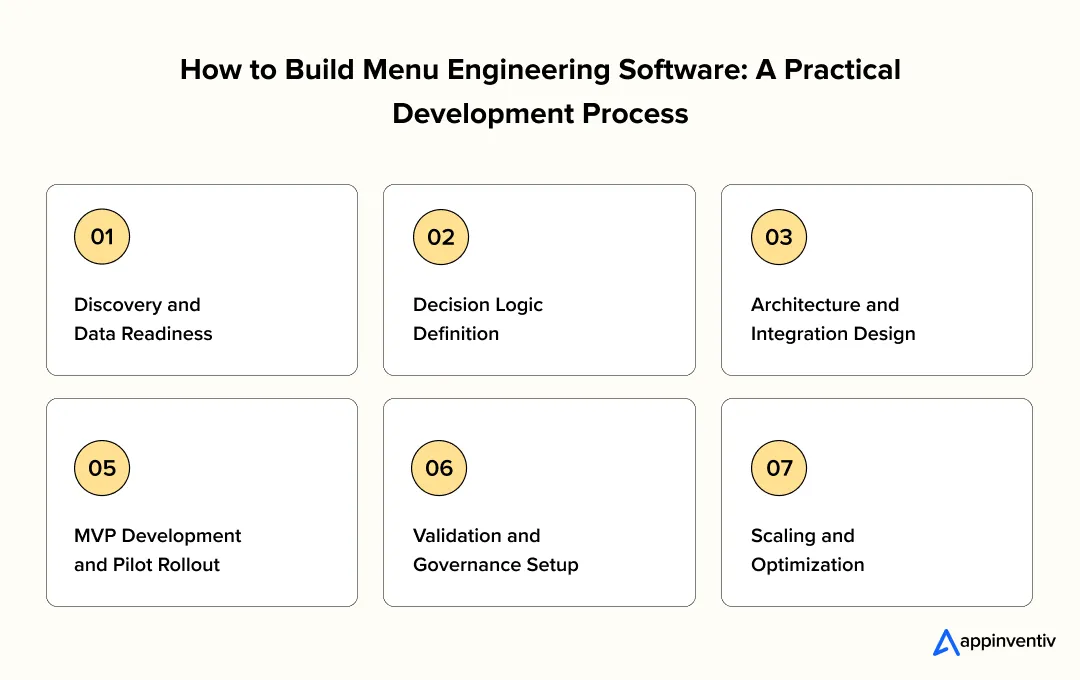
1. Discovery and Data Readiness
In multi-location brands, this phase often uncovers hundreds of duplicate or inconsistently named POS items that must be normalized before analysis is even possible. Before any design or development work begins, teams need clarity on their existing data.
- Review POS item structures, modifiers, and naming inconsistencies
- Validate recipe accuracy, portions, and yield assumptions
- Assess inventory and procurement data reliability
2. Decision Logic Definition
Instead of starting with screens, the focus should be on the decisions the software must support.
- Rules that assign items to menu engineering categories
- Triggers for repricing or recipe review
- Frequency of recalculation and review cycles
Clear logic ensures the menu profitability system features map to real operational needs.
3. Architecture and Integration Design
This phase defines how data moves through the system.
- Selection of event-driven or batch ingestion
- Canonical data models for recipes, items, and vendors
- POS, inventory, and procurement integration planning
Strong design is critical for the scalable development of a restaurant POS-integrated intelligence platform. For brands operating across regions, POS data normalization across 300–500 locations becomes one of the most time-consuming and risk-prone parts of the build.
4. MVP Development and Pilot Rollout
The first build should focus on core value rather than completeness.
- Contribution margin and popularity calculations
- A functional menu engineering
- Basic dashboards and validation workflows
A controlled pilot helps validate assumptions before scaling.
5. Validation and Governance Setup
Once real data begins to flow in, the system must be tuned.
- Margin reconciliation with finance teams
- Adjustment of yield and cost assumptions
- Approval flows and audit controls
This phase protects trust and demonstrates early benefits of menu engineering.
6. Scaling And Optimization
After validation, the platform can evolve.
- Advanced data analytics and menu engineering strategies for restaurants
- Multi-location governance and controls
- Automation of recurring reviews and alerts
This final stage supports the future of a POS-integrated restaurant intelligence platform, where decisions become faster and more consistent.
A structured development process ensures the platform becomes part of daily operations rather than a one-off reporting tool. That is what separates successful menu engineering systems from tools that never gain adoption.
Validate your architecture, development approach, and cost assumptions with experts who’ve built restaurant platforms at scale.

Menu Engineering Software Tech Stack: What to Use and Why
A solid restaurant profit optimization software tech stack is less about picking trendy tools and more about building a system that stays accurate under messy restaurant data. You are pulling sales from POS, costs from procurement, recipes from culinary teams, and inventory signals from operations. The tech stack has to keep those streams clean, auditable, and fast enough for decision-making.
Below is a practical stack breakdown for POS-integrated restaurant intelligence platform development in 2026.
1) Frontend and Experience Layer
This is where ops, finance, and culinary teams interact with insights. It needs to feel simple even when the data behind it is complex.
- Web app: React/Next.js: Strong for dashboard-heavy interfaces and role-based views.
- Mobile (optional): React Native or Flutter: Useful for managers who need quick approvals, alerts, and KPI snapshots.
- UI components: Tailwind / MUI / Chakra: Helps ship quickly while keeping the interface consistent.
What matters most here is speed and clarity. People should be able to answer: “What changed?” and “What should we do next?” in minutes.
2) Backend Services and API Layer
Menu engineering platforms usually work best as modular services rather than as a single monolith. You will need clean boundaries around recipes, costing, analytics, and integrations.
- API: Node.js (NestJS), Python (FastAPI), or Java (Spring Boot): Node.js is great for integration-heavy workloads, Python for analytics, and Java for strict enterprise environments.
- Architecture style: Monolith vs Microservices– Modular monolith for MVP, evolve into microservices as scale grows
Many teams start modular to move faster, then split services once usage and integrations expand. - API style: REST for most operations, GraphQL for complex dashboards. REST keeps things simple, and GraphQL helps when dashboards need many related data points.
This is where your restaurant profit optimization software features come to life: recipe updates, item mapping, approvals, matrix calculations, and audit logs.
3) Data Storage
Most restaurant systems fail because they use a single database for everything. You need an operational store for transactions and an analytics store for fast reporting.
- Operational database: PostgreSQL- Strong relational model for recipes, ingredients, vendors, locations, and permissions.
- Caching: Redis- Useful for dashboard performance and frequently used reference data.
- Search (optional): Elasticsearch / OpenSearch- Helpful for searching items, ingredients, vendor SKUs, and audit history.
- Analytics warehouse: BigQuery / Snowflake / Redshift- This is where fast menu engineering happens at scale.
- Time-series or metric store (optional): TimescaleDB (on Postgres)- Useful if you store time-versioned costs and margin histories heavily.
A key design point here is time-based costing. You want historical margins to stay stable even when today’s supplier prices change.
4) Handling Price Volatility Without Breaking Historical Margins
Here’s the real problem most teams discover too late. Ingredient prices change faster than menus do. If chicken prices spike for seven days and then normalize, your software must reflect the spike only during that period, without rewriting historical margins or distorting long-term performance trends.
This is where many menu engineering tools fail.
How enterprise-grade systems handle it:
- Costs are stored using Slowly Changing Dimensions (SCD Type 2)
- Every ingredient price change creates a new time-bound record, not an overwrite
- Contribution margins are calculated using the cost version valid at the time of sale
- Historical reports remain stable even as today’s prices fluctuate
5) Data Ingestion and Integration Layer
This layer determines whether your menu engineering is trustworthy. The goal is to ingest, normalize, validate, and reconcile data from multiple sources.
- Integration patterns:
- Webhooks/event streaming where available
- Scheduled sync (batch) where systems are limited
- Message broker: Kafka or RabbitMQ- Useful for reliable ingestion and retry mechanisms.
- ETL/ELT tools: Airbyte / Fivetran (where applicable) + dbt for transformations- Great for building repeatable pipelines and clean models.
- API gateways/integration services: Kong / Apigee (enterprise setups)
You’ll also need a reconciliation workflow in the product:
- Unmapped items and modifiers go into a queue
- Teams resolve mappings once, and then the system stays accurate
This mapping layer is essential for real-world menu engineering for restaurants, where combos, substitutions, and add-ons are common.
6) Calculation Engine
This is where platforms differentiate. The engine must be explainable, versioned, and consistent, not just “smart.”
- Computation service: Python (pandas) or Spark for heavy workloads
Python works for many teams. Spark helps if you run high-volume chains with frequent recalculation. - Rules framework (optional): Custom rules engine or something lightweight like Drools (Java ecosystems)
Useful for pricing rules, category thresholds, and approvals. - Core calculations include:
- Contribution margin per item
- Popularity scoring
- Assignment into Menu Engineering categories
- Scenario modeling (price change, portion change, supplier swap)
Even with AI features, your core math should be deterministic. Finance teams need to trust the numbers.
7) AI Layer
AI should support decisions, not replace them. In 2026, the more realistic approach is “assistive AI.”
- AI use cases:
- Anomaly detection (sudden margin drop, unusual sales shifts)
- Recommendation support (items to reprice, rework, promote)
- Forecasting and seasonality signals
- Models: Gradient boosting (XGBoost/LightGBM), time-series models, or lightweight ML pipelines
- LLM support (optional): Useful for explaining insights, generating action summaries, or “why this item moved categories.”
This aligns with menu engineering strategies for restaurants without creating black-box decisions.
8) Security, Governance, and Compliance
Menu engineering touches pricing, supplier costs, and operational performance. Access control and auditability matter.
- Auth: OAuth 2.0 / OpenID Connect
- RBAC: Chef, ops manager, finance, admin, franchise manager roles
- Audit logs: Immutable logging of recipe edits, price changes, and approvals
- Secrets management: Vault / AWS Secrets Manager
- Data protection: Encryption at rest and in transit, environment segregation
This is often the difference between a tool people “use” and a system leadership trusts.
9) DevOps and Observability
Restaurants run every day. Your platform must be stable, monitored, and easy to evolve.
- Cloud: AWS / Azure / GCP
- Containers: Docker + Kubernetes
- CI/CD: GitHub Actions / GitLab CI
- Monitoring: Prometheus + Grafana
- Logging: ELK stack / OpenSearch + Kibana
- Tracing: OpenTelemetry
Also read: 5 Ways Restaurant Technology Is Transforming the Industry
Understanding the Cost of Menu Engineering Software in 2026
The cost of restaurant profit optimization software is driven less by UI complexity and more by data normalization, integrations, and the depth of decision logic. The cost to build varies widely based on scope, integrations, and decision complexity. In 2026, most builds fall within a $40,000 to $400,000 range. The spread exists because menu engineering systems are not genericmenu engineering software apps. They are data-heavy decision platforms.
At a high level, Menu Engineering Software Development cost is driven by a few core factors:
- Data complexity: Modifier-heavy menus, combo items, and multi-location pricing increase build effort.
- Integrations required: POS, inventory, and procurement integrations significantly influence the scope and testing time.
- Analytics depth: Basic reporting costs less than continuous menu engineering with time-based costing and automation.
- Workflow and governance needs: Approval flows, audit logs, and role-based access add enterprise-grade effort.
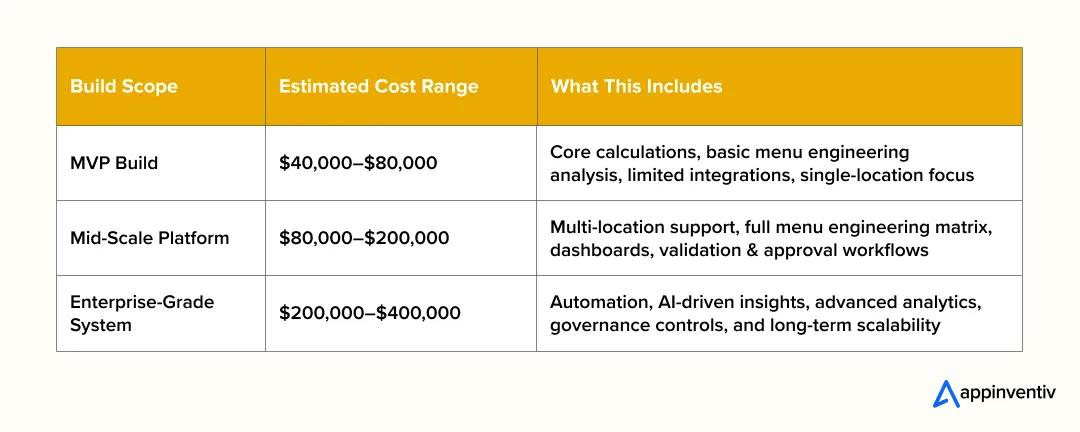
While upfront costs matter, teams should evaluate spend against the long-term benefits of menu engineering, including margin protection, waste reduction, and faster decision-making cycles. In most cases, the right build pays for itself through improved menu performance rather than feature volume.
Also read: Restaurant App Development Cost: Factors Explained
Compliance and Governance in Menu Engineering Software
Menu engineering software influences pricing, margins, and internal decision-making more than most teams expect. Because of that, compliance is less about ticking regulatory boxes and more about whether the numbers can be trusted when challenged.
In practice, teams want to know one thing. Can we explain how this margin was calculated using the data available at the time?
1. Financial Traceability and Audit Confidence
Strong menu engineering systems do not overwrite history. Ingredient prices change, recipes evolve, and menus shift. The software must preserve past cost versions so historical margins stay intact.
This allows finance teams to:
- Reconcile menu performance with POS and procurement records
- Review pricing decisions made weeks or months earlier
- Audit recipe or portion changes without chasing spreadsheets
When historical numbers remain stable, trust in the system grows quickly.
2. Access Control and Decision Ownership
Menu data reflects a sensitive commercial strategy. Not every user should be able to edit recipes or approve price changes.
Well-governed platforms separate responsibilities by:
- Limiting who can change costs, recipes, or pricing
- Requiring approvals for high-impact decisions
- Allowing local flexibility without breaking central standards
This structure reduces risk while keeping teams aligned.
3. Pricing Integrity Over Time
One of the most common risks in menu management is undocumented pricing drift. Changes happen fast, but reasons are forgotten. Menu engineering software protects pricing integrity by:
- Recording why an item was repriced or repositioned
- Showing before-and-after margin impact
- Linking decisions to performance data, not instinct
This creates accountability without slowing teams down.
4. Data Privacy and Regional Regulations
While menu engineering software does not typically process customer PII directly, it often integrates with POS systems that do. That makes baseline data protection non-negotiable.
Depending on geography, platforms should align with:
- GDPR and regional privacy frameworks for data handling
- Secure API integrations with POS and procurement systems
- Encryption of sensitive cost and pricing data at rest and in transit
- Environment segregation between development, testing, and production
For global brands, compliance is less about any single regulation and more about consistent operational discipline across markets.
5. Explainability Builds Adoption
As AI-driven recommendations become more common, explainability becomes a compliance issue rather than just a technical one. Finance and operations teams need to understand why a system suggests a change, not just what it suggests.
Responsible menu engineering platforms ensure:
- AI assists detection and recommendation, not final execution
- Decision logic remains visible and configurable
- Automated insights can be traced back to the underlying data
- Humans retain final approval authority
This balance keeps the system usable, trusted, and defensible.
Common Challenges in Menu Engineering Software and How to Overcome Them
Building and using restaurant profit optimization software is rarely a straight line. Most challenges come from data gaps, process mismatches, and unrealistic expectations rather than the technology itself. Addressing these early makes software development far more effective.
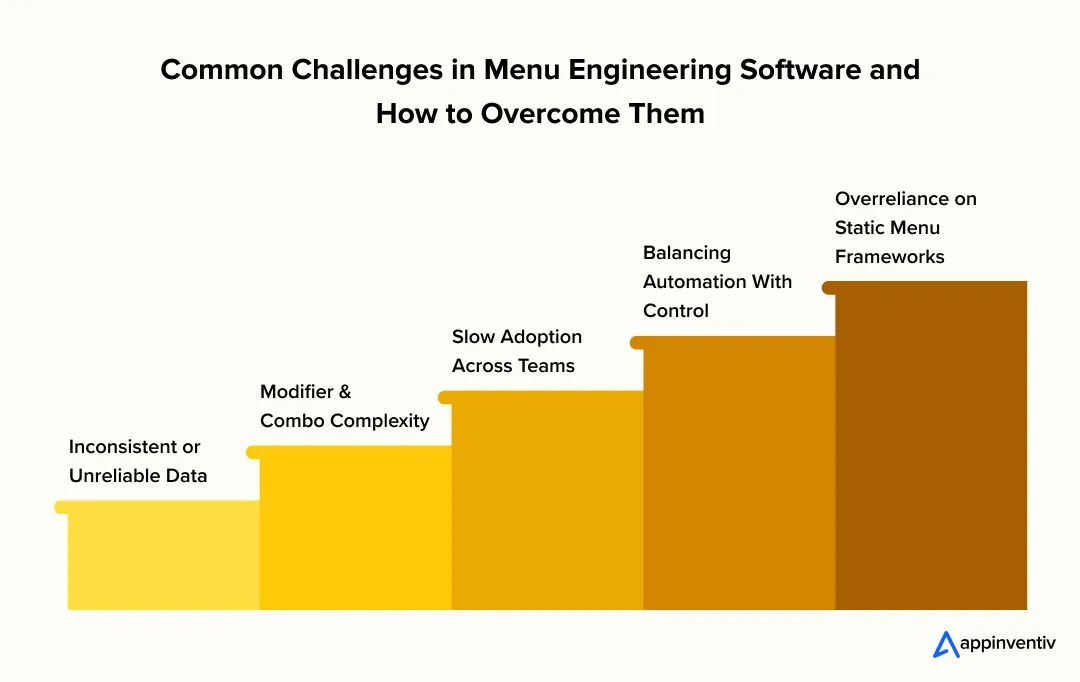
- Inconsistent or Unreliable Data
Menus, recipes, and POS items are often maintained by different teams, which leads to mismatches. This weakens menu engineering and undermines confidence in the results.
How to overcome it: start with a data audit, standardize naming conventions, and introduce validation rules before scaling the system.
- Modifier-Heavy Menus are Distorting Margins
Add-ons, substitutions, and combos make accurate costing difficult, especially in menu engineering for restaurants with flexible ordering.
How to overcome it: use proper POS-to-recipe mapping and treat modifiers as first-class cost components within the platform.
- Overdependence on Static Frameworks
Relying too heavily on a fixed menu engineering can cause teams to miss changing trends and seasonal behavior.
How to overcome it: run continuous analysis and review items in context, not just by category.
- Slow adoption across teams
Even strong tools fail if teams don’t trust or use them. This limits the real benefits of menu engineering.
How to overcome it: keep outputs simple, focus on decisions rather than dashboards, and involve operations and finance early.
- Balancing automation with control
Advanced tools and AI menu engineering strategies for restaurants can feel risky if teams lose visibility into decisions.
How to overcome it: use automation for detection and recommendations, while keeping approvals and final actions human-led.
Handled well, these challenges don’t block progress. They shape a more reliable, practical system that supports everyday menu decisions instead of complicating them.
Also Read: 5 Ways Restaurant Technology Is Transforming the Industry
Build vs Buy: Choosing the Right Path for Your Business
Choosing between building or buying a solution depends on how complex your menu operations really are. Off-the-shelf tools can work well for straightforward setups, but they often struggle once menus, modifiers, and supplier structures grow more complex. This is where restaurant profit optimization software development becomes a strategic consideration rather than a technical one.
Buying makes sense when:
- You operate a single brand or limited locations
- Menu structures are simple with minimal modifiers
- Standard menu engineering reporting meets your needs
- Speed to adoption matters more than customization
In these cases, ready-made tools can support basic menu engineering for restaurants without heavy investment.
Building is the better choice when:
- You manage multiple brands or locations
- Modifiers, combos, and regional pricing are common
- You need deeper menu engineering tied to real costs
- Custom workflows, governance, or integrations are required
Custom restaurant software development enables teams to design around their data and processes rather than forcing workarounds. Over time, this flexibility unlocks stronger benefits of menu engineering, especially as the business scales.
The right choice comes down to control, longevity, and the degree to which menu decisions are central to profitability. For many growing brands, building becomes less about technology ownership and more about protecting margins at scale.
Future Trends of Menu Engineering Software
Restaurant profit optimization software is moving beyond static analysis toward systems that adapt to changing conditions. In the coming years, the focus will shift less toward reporting and more toward supporting daily decisions.
- Continuous, real-time analysis: Instead of periodic reviews, platforms will run ongoing menu engineering analysis as sales and costs change.
- Smarter use of AI: Expect more practical AI menu-engineering strategies for restaurants, such as early margin-risk detection and recommendation support, rather than full automation.
- Deeper POS and cost integration: Tighter integrations will improve accuracy across modifiers, combos, and regional pricing, strengthening menu engineering at scale.
- Decision-first dashboards: Interfaces will shift from dense charts to clear actions tied to the menu engineering and business goals.
- Greater focus on governance and trust: As systems grow, auditability and explainable logic will define the future of menu engineering software, especially for multi-location brands.
These trends point toward software that feels less like a reporting tool and more like a reliable partner in everyday menu decisions.
Design a future-ready menu engineering platform that adapts to cost volatility, AI insights, and multi-location growth.

How Appinventiv Helps in Menu Engineering Software Development
Building menu engineering software is rarely just a technical exercise. Most of the complexity comes from aligning data, workflows, and real operational habits that already exist inside a restaurant business. As a restaurant app development company, Appinventiv starts by understanding how menu decisions are made today, where data breaks down, and what teams actually trust when margins are under pressure.
Our experience with large-scale restaurant platforms means we’re used to dealing with messy realities. Menus change often. Modifiers don’t map cleanly. Costs move faster than reports. While working on platforms for brands like Domino’s, KFC, and Pizza Hut, we’ve built systems that handle high order volumes, complex menus, and performance expectations without cutting corners on accuracy. These platforms required handling high-order volumes, complex modifier logic, and near-zero tolerance for reporting errors, conditions that closely mirror the demands of enterprise menu engineering systems. That experience directly informs how we approach restaurant profit optimization software development, especially when reliability matters more than surface-level features.
If you’re considering a custom approach, the first step is usually clarity, not commitment. A short discussion around data readiness, integrations, and goals often answers whether building makes sense and what it would realistically take. If you want an honest view on scope, timelines, and cost, our team can help you evaluate the path forward before you invest further. Let’s connect!
FAQs
Q. What is menu engineering?
A. Menu engineering is the process of understanding how menu items perform based on popularity and profitability. Instead of focusing solely on what sells most, it considers contribution margins and ordering behavior together, often using a menu engineering matrix to guide pricing, placement, and menu decisions.
Q. How does menu engineering improve profitability?
A. Menu engineering improves profitability by helping restaurants focus attention on items that drive real margin, not just volume. Through regular menu engineering analysis, teams can adjust pricing, portion sizes, and promotions to protect margins, especially during cost fluctuations. Over time, this leads to more predictable profits and fewer reactive decisions.
Q. What are the advantages of menu engineering?
A. The key benefits of menu engineering include better cost control, faster pricing decisions, reduced food waste, and clearer insight into which items deserve promotion or rework. When supported by software, it also brings consistency across locations and removes guesswork from menu changes.
Q. How long does it take to build menu engineering software?
A. The timeline depends on the scope and integrations. A basic MVP focused on core calculations can take 8 to 12 weeks, while a more advanced software development process with multiple integrations and workflows may take 4 to 6 months. Data readiness often influences timelines as much as development effort.
Q. What problem does menu engineering software solve for restaurants?
A. This software helps restaurants move beyond delayed or incomplete insights. It connects recipes, real costs, and sales data so teams can see true performance in near real time. For many operators, it solves the problem of knowing what sells but not knowing what actually makes money.
Q. What are the core components of menu engineering software?
A. Core components typically include recipe and yield management, cost and margin calculations, POS item mapping, performance dashboards, and workflow support. Together, these software features allow consistent analysis, action, and review across the business.
Q. How does menu engineering software integrate with POS systems?
A. Integration usually involves pulling sales data, items, and modifiers from the POS into the platform. This allows accurate mapping between what was ordered and how it was prepared. Strong POS integration is essential for reliable menu engineering, especially when modifiers and combos play a big role in pricing and margins.

- In just 2 mins you will get a response
- Your idea is 100% protected by our Non Disclosure Agreement.

How Data Analytics in Restaurants Can Save Your Margins in a High-Inflation Era
Key takeaways: Inflation pressures restaurant margins through unstable food costs, labor inefficiencies, and supplier price drift, not pricing alone. Data analytics in restaurants brings clear cost visibility across menus, labor, and inventory, helping leaders act before losses compound. Restaurants using analytics commonly recover 3–8 margin points by reducing waste, labour optimization and workforce elasticity, and…

How to Build a Custom Restaurant Management Software? Features, Process, Costs
Key takeaways: Custom restaurant management software turns scattered tools into one operational backbone. The real ROI comes from reduced waste, better staffing, and faster decisions, not just “going digital.” Restaurants use these systems daily for menu control, inventory, workforce planning, and loyalty, not just reporting. Features only work when they match real workflows for guests,…
10 Innovative Restaurant Business Ideas That Are Disrupting the Industry
Key takeaways: The success of modern restaurants depends on the adoption of top advanced technologies like AI, AR, IoT, and others, which can simplify operations and increase profitability. Emerging ideas like cloud kitchen, food trucks, and immersive experiences will suit changing consumer needs of convenience, customization, and sustainability. The correct technology infrastructure, a good business…