
























Machine Learning in Healthcare: Applications, Benefits, and the Future of Medical Innovation

 Share -


- 01How is Machine Learning Used in Healthcare?
- 02Understanding the ML Foundation: Data, Models, and How It All Works
- 03Top Applications and Use Cases of Machine Learning in Healthcare
- 04How ML Is Transforming Key Areas of Healthcare
- 05What are the Benefits of ML in Healthcare?
- 06Challenges of Adopting Machine Learning in the Healthcare Industry
- 07Steps Hospitals Follow to Use ML Effectively Into Their Operations
- 08The Future of Machine Learning for Healthcare
- 09How Can Appinventiv Help You Adopt ML in Healthcare?
- 10FAQs

Key Takeaways
- ML helps doctors catch issues earlier and handle growing patient data without slowing down.
- Hospitals use ML for quick diagnosis support, fraud checks, and smoother day to day workflows.
- The biggest hurdles are messy data, bias, and old systems, but all of them can be fixed with the right setup.
- The future is heading toward faster tests, more connected hospital systems, and early alerts through wearables.
- Teams that adopt ML early see clearer decisions, lower costs, and better patient care.
Healthcare has always been quick to try anything that helps people get better care, but the last few years have changed the pace completely. Hospitals are handling more patients, medical teams are stretched, and everyone is dealing with far more data than they can go through on their own. In the middle of all this, machine learning in healthcare has quietly become something most providers depend on. It helps them spot early signs of trouble, sort through complex medical records, and make decisions with a little more confidence and a lot less guesswork.
You can see machine learning for healthcare at work in simple, everyday moments. A system gives a doctor an early alert based on a small shift in a patient’s vitals. A radiologist gets a second pair of eyes on a tricky scan. A lab speeds up research by testing countless drug possibilities through models instead of running every experiment by hand. Even these small touches show how ML in healthcare has grown from being a “future technology” to something that’s quietly shaping the way care is delivered.
A recent report from Bain & Company reflects this shift. In their Healthcare AI Adoption Index, almost 95% of healthcare leaders said they expect AI to transform the industry, although less than half of current AI projects have moved beyond early testing. It shows where the industry is heading and how much room there is for machine learning to support better, faster, and safer patient care.
All of this sets the stage for a larger question: why is machine learning becoming such an essential part of modern healthcare in the first place? This shift also shows how quickly the machine learning in the healthcare industry is moving from early experiments to practical, everyday use.
If you’re planning to move, this is the moment.
How is Machine Learning Used in Healthcare?
Healthcare has been moving through a lot of change, and most teams simply do not have the time or the people to keep up with everything coming their way. That is one big reason machine learning in healthcare is becoming hard to ignore. It helps doctors and nurses deal with the growing amount of information without feeling overwhelmed. It is one of the clearest signs that the machine learning in the healthcare industry is maturing fast.
Here is what is pushing this shift forward:
- It looks through huge medical records and picks up patterns people might miss on a busy day.
- It cuts down the waiting that usually comes with manual checks or slow reporting.
- It supports early diagnosis and helps design treatment plans that fit each patient better.
- It gives hospitals a clearer idea of risk, demand, and resource needs.
- It takes some of the routine pressure off clinical teams by handling smaller repetitive tasks.
Machine learning for healthcare is not replacing anyone. It is simply helping the system work at a pace that matches the real world, and that is why ML in healthcare is becoming such an important part of everyday medical work.
Related Article: How is Artificial Intelligence Transforming the Healthcare Industry
Understanding the ML Foundation: Data, Models, and How It All Works
Before exploring the major machine learning healthcare applications, it helps to understand what makes these systems work in the first place. Healthcare produces a huge amount of information every day, and machine learning in healthcare helps bring order to it. The table below breaks down the basics in a simple way.
| Foundation Element | What It Means in Real Healthcare Settings |
|---|---|
| Different Types of Data | Hospitals work with a mix of structured data and unstructured information like notes, scans, lab reports, and wearable readings. Machine learning for healthcare helps pull all of this together so patterns are easier to understand. |
| Deep Learning for Harder Tasks | Some tasks need more advanced analysis. Reading MRI scans, spotting tumors in images, or studying pathology slides often rely on deep learning because it can catch very small details. |
| Data Cleaning and Standards | ML models only work well when the data is clean and in the right format. Many healthcare teams use HL7 or FHIR standards to keep records aligned. Without this step, MLin healthcare cannot deliver reliable results. |
| Trust and Explainability | Doctors want to know why a model suggested something, not just what it suggested. Explainable ML helps them understand the reasoning, which builds trust in medical machine learning tools. |
| Fit Within Daily Workflows | Machine learning models for healthcare perform best when they support daily routines instead of interrupting them. The goal is to help care teams do their work more smoothly. |
All of these pieces form the backbone of the growing machine learning in the healthcare industry. And together these foundations help readers see how these systems function before exploring the real world use cases.
Top Applications and Use Cases of Machine Learning in Healthcare
From maximizing hospital efficiency to making an accurate diagnosis, the role of machine learning in medicine and healthcare has proven to be a boon for medical professionals and patients alike. The role of machine learning in healthcare becomes even clearer when you look at how often it supports everyday clinical decisions. The integration of AI and machine learning in healthcare has catalyzed major benefits, reinforcing its essential role in the future of medical science. Below are some of the healthcare use cases for machine learning that are already proving valuable across hospitals and research labs.
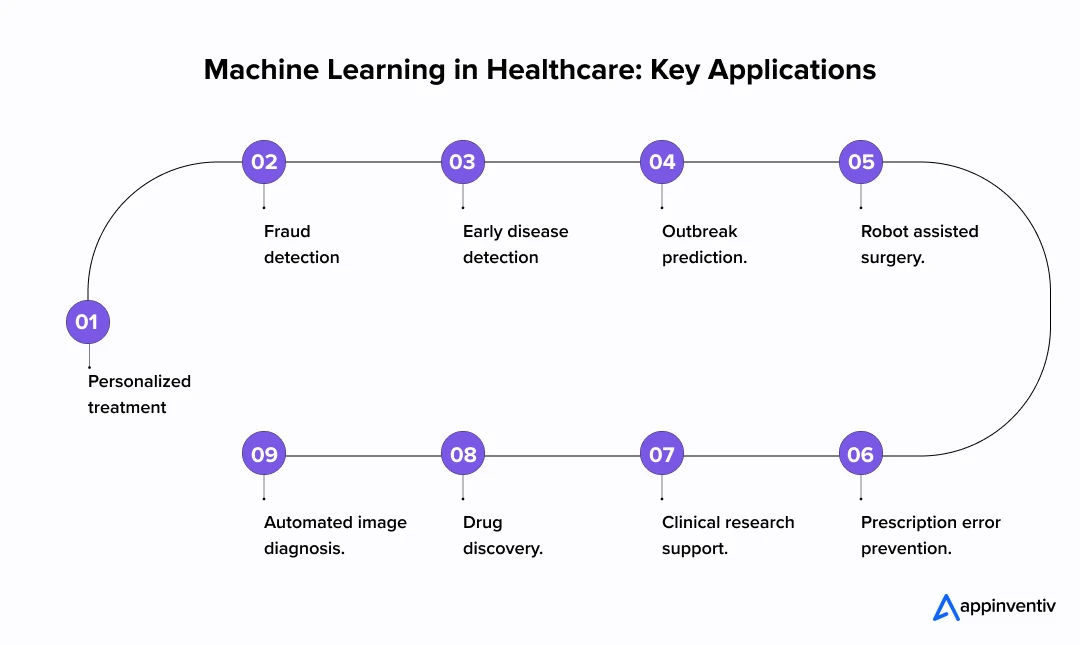
Personalized Treatment
Offering personalized treatments is one of the key machine learning use cases in healthcare. It allows healthcare organizations to deliver personalized care by analyzing patients’ medical history, symptoms, and tests. Doctors can use ML in medicine and healthcare to develop customized treatments and prescribe medicines that target specific diseases in each patient.
Additionally, machine learning for healthcare can assist doctors in determining if the patient is ready for necessary changes in medication. It helps induce the right treatment from the beginning.
Fraud Detection and Prevention
According to NHCAA (National Health Care Anti-Fraud Association), healthcare frauds cause billions of dollars of financial loss yearly, which is approximately 3 to 10% of annual healthcare expenditures. This converts into around $300 billion loss annually.
Using medical machine learning, businesses can detect invalid insurance claims before they are paid for and speed up approval, processing, and payment of valid ones. Besides detecting insurance fraud, the application of machine learning in healthcare can also prevent the theft of patient data.
For example, a leading healthcare organization, Harvard Pilgrim Health, embraces AI and ML technologies to root out healthcare fraud. It leverages ML-based fraud detection systems to identify claims and detect suspicious behavior.
Detecting Diseases in Early Stages
Healthcare providers need to detect many diseases in the early stages to identify the best treatment plan and help patients secure a good way of living. Among the critical uses of machine learning in healthcare is its ability to improve the early detection of diseases, which is vital for timely and effective treatment. Based on data comparison, doctors can make informed decisions and design the best treatment plans accordingly.
Disease Outbreak Prediction and Public Health Surveillance
Trying to guess when an outbreak might hit is one of the toughest parts of public health. Most of the time, the information comes from different places and at different times, which makes it hard to see the full picture. This is where machine learning in healthcare has quietly become helpful. It looks at large amounts of scattered data and pieces it together in a way that gives teams an early sense of what might be coming.
Machine learning for healthcare can notice small shifts that people usually miss. Maybe it is a rise in certain symptoms across clinics or changes in community behavior that hint at something spreading. When these patterns show up early, public health teams get a little more room to breathe. Hospitals can prepare beds and supplies, and communities can be warned before things get out of hand. Even a short head start makes a difference, and that is exactly what ML in healthcare offers in moments like these.
Robot-Assisted Surgery
As one of the top machine learning in healthcare examples, ML-powered surgical robots have revolutionized surgical processes in terms of accuracy and speed. These systems can perform complicated surgical procedures with reduced risk of blood loss, side effects, and pain. Additionally, post-surgery recovery is much faster and easier.
Maastricht University Medical Center’s surgical robot uses an ML-powered surgical robot to suture small blood vessels; no thicker than 0.03 millimeters.
Read here to know how the future of work will be molded by robots.
Analyzing Errors in Prescriptions
Prescription errors are one of the most fatal medical mistakes that lead to patient deaths in many instances. It involves prescribing the wrong drug or dose or failing to account for drug interactions. In the US alone, around 7,000 to 9,000 patients die annually because of prescription errors.
To reduce such medical mistakes, solutions powered by healthcare machine learning in medicine can be a savior.
Machine learning models for healthcare analyze historic EHR data and compare new prescriptions against it. Those prescriptions that deviate from typical patterns get flagged so that doctors can review and adjust them.
For instance, Brigham and Women’s Hospital uses an ML-powered system to pinpoint prescription errors. Over a year, the system identified 10,668 potential errors, and 79% of them were clinically valuable, so the hospital managed to save $1.3 million in healthcare-related costs. Along with cost savings, an ML-powered error detection system increases the quality of care by preventing drug overdosing and health risks.
Also Read: EHR Optimization Guide to Make Your Healthcare Offering Efficient
Assisting in Clinical Research and Trials
One of the highly beneficial machine learning healthcare applications is the assistance to clinical researchers in identifying patterns, predicting outcomes, and accelerating drug discovery. Clinical research and trials are costly and lengthy processes that ensure the safety and effectiveness of medical solutions. However, there are cases when the solution needs to be released quickly – like the vaccines for COVID-19.
Machine learning for healthcare can shorten this process. These algorithms can help determine the best sample for the trial, gather more data points, analyze the ongoing data from the trial participants, and reduce data-based errors.
Drug Discovery and Development
It is one of the main benefits of machine learning in healthcare. ML can discover new drugs that offer great economic value for pharmaceuticals, hospitals, and new treatment avenues for patients. It also makes the process of drug creation faster and extremely cost-effective.
For example, Atomwise is a pharmaceutical company that uses supercomputers, which roots out therapy from molecular structure databases. In 2015, Atomwise used its deep learning technology to discover the current market medicines that could be redesigned for treating the Ebola virus. They successfully found two drugs that could help reduce the risks of the epidemic.
The analysis that would have taken several years happened in one day through Atomwise ML-based technology.
Also Read: How digital transformation is reshaping the healthcare industry?
Automating Image Diagnosis
Hospitals and clinics use ML to recognize abnormalities in medical images, such as MRI or radiology scans that are managed through a radiology information system. Image recognition assists doctors in diagnosing liver and kidney infections, identifying tumors, improving cancer prognosis, and more.
The best example of ML-powered visual perception is the tool utilized by the UVA University Hospital. By harnessing the capabilities of ML algorithms, the tool analyzes biopsy images of children to differentiate between celiac disease and environmental enteropathy, doing it as reliably as doctors do.
How ML Is Transforming Key Areas of Healthcare
Machine learning in healthcare can feel like a big idea, but it makes more sense when you look at what it is doing in a few real areas. Two places where you can actually see the change happening are cancer care and long term disease management. These are tough fields, and even a small improvement can mean a lot for patients.
Oncology and Precision Medicine
Cancer hardly ever follows the same pattern twice. One person’s scan can look completely different from someone else’s. ML gives doctors a little more clarity by taking a closer look at scans, biopsy results, and genetic information. It sometimes notices details the human eye can miss on a busy day. With that extra insight, doctors can choose treatments that fit the patient better instead of relying only on broad guidelines. Researchers also use these patterns to understand tumors a bit more deeply and explore newer options.
Chronic Disease Management
Chronic conditions like diabetes or heart issues tend to creep up slowly, and the early signs are easy to brush off. Machine learning for healthcare goes through long term data from checkups and devices and points out small changes that might matter later. This gives care teams a chance to step in sooner. For a lot of patients, that small nudge can help them avoid complications and manage their condition with less stress.
These examples show something simple. ML in healthcare is not just about speed or automation. It is about helping doctors see things a little earlier and a little clearer so patients get the kind of care that feels right for them.
What are the Benefits of ML in Healthcare?
Many of the advantages of machine learning in healthcare appear quietly in routine workflows, long before anyone notices the bigger impact. Machine learning in healthcare doesn’t feel impressive only because it’s “advanced technology.”
Its value shows up in small, practical moments that make a doctor’s day a bit easier or help a patient avoid a scare. Most of the benefits come from reducing the weight of everyday work and giving care teams a clearer sense of what is happening behind all the numbers.
Over time, these small lifts turn into bigger results. Workflows get lighter, decisions feel more confident, and patients get care that feels more personal. That is where ML in healthcare shows its real strength.
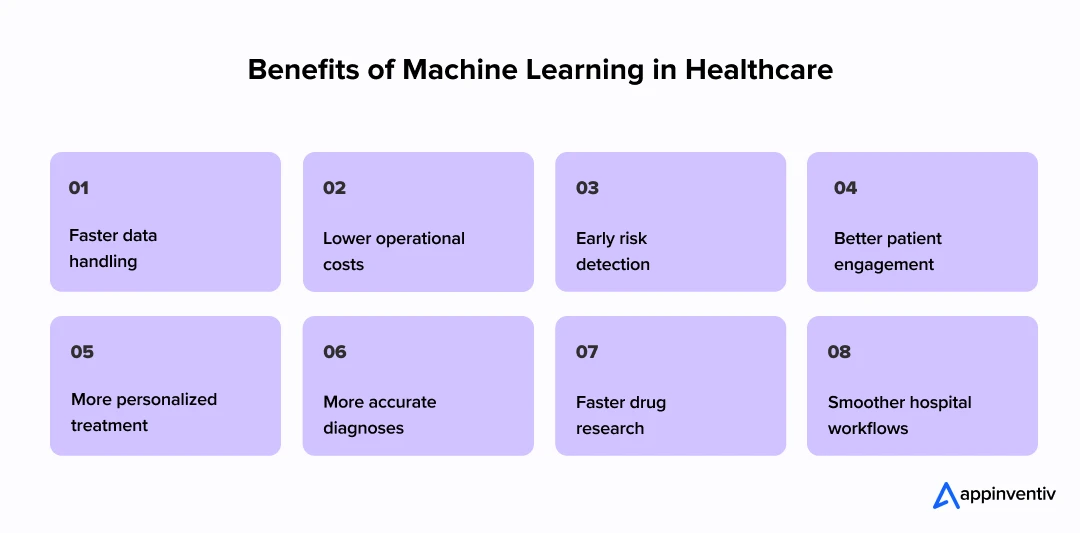
Faster and Cleaner Data Handling
Hospitals collect so much information that it’s almost impossible to review it all without help. ML steps in sorts through reports, notes, and charts in a way humans simply don’t have time for. It highlights what might matter first, which saves doctors from digging through piles of data.
Because everything is clearer, decisions become less stressful. Machine learning for healthcare doesn’t take over the doctor’s role, but it tidies the information so the important things stand out instead of getting lost in the noise.
Cost Savings Without Cutting Corners
A surprising amount of hospital spending goes into small, repetitive tasks. Filing. Recording. Checking the same details again and again. ML handles a portion of this background work, which means teams spend fewer hours on tasks that drain time without adding value.
This naturally reduces operational costs. Not because resources are cut, but because they’re used more sensibly. It’s one of the benefits of machine learning in healthcare that quietly improves the financial side without compromising patient care.
Also Read: Machine Learning App Development Cost: A Complete Guide
Better Predictions and Early Warnings
Sometimes a patient looks fine until the moment they aren’t. ML notices patterns that build slowly and quietly. It helps doctors see early signs of risk before things reach a breaking point. This extra bit of time often changes the outcome completely.
These early alerts also help plan long term care. Instead of reacting to an emergency, doctors can step in gently, adjust medications, or schedule a checkup before the problem grows.
Also read: Predictive Analytics In Healthcare – 10 Use Cases And Real-World Examples
More Engaged and Informed Patients
Most patients want simple answers, not technical explanations. ML powered tools like AI chatbots in healthcare helps in sharing the information in a way that feels friendly and easy to follow. People get reminders, updates, or quick clarifications without having to wait for a call back.
This makes patients feel more in control of their health. When they understand what’s happening, they stick to treatment plans better, which naturally improves outcomes.
Personalized Treatment That Fits Real People
No two patients respond to treatment in the same way. Machine learning in the medical field helps clinicians understand patient patterns that are not obvious at first glance. ML looks at long term data and helps doctors design plans that match the person instead of the general category their symptoms fall into. It reduces guesswork and gives patients a treatment path that feels more accurate from the start.
Patients usually feel the difference. The plan feels like it was made for them, not copied from a textbook. And doctors get clearer guidance on what might actually work.
Sharper and More Confident Diagnoses
Diagnosing a condition can be tricky, especially when symptoms overlap or scans aren’t perfectly clear. ML offers a second look. It points out areas that deserve attention and compares the case with thousands of similar examples.
This doesn’t replace a clinician’s eye, but it adds reassurance. Doctors get more confidence during difficult cases, and patients feel that extra level of attention.
Speeding Up Drug Discovery and Research
Research often moves slowly because there are too many possibilities to test. ML analyzes huge datasets and helps narrow the list. Instead of trying everything, researchers focus on the most promising directions.
This shortens early development and helps new therapies reach patients faster. It also reduces the cost of exploring ideas that are unlikely to work.
Smoother Workflows in Busy Hospitals
Hospitals run on routines. Appointments, bed management, documentation, supplies. ML supports these background tasks so teams can breathe a little easier. It keeps schedules tighter and makes everyday operations feel less chaotic.
When workflows improve, the entire environment changes. Staff feel less overwhelmed, and patients experience quicker, calmer care.
Challenges of Adopting Machine Learning in the Healthcare Industry
Working machine learning into healthcare sounds exciting, but in real hospital settings, things are rarely smooth. People are busy, data is scattered, and every decision affects someone’s life. So the challenges feel real, and sometimes a bit overwhelming. Still, none of them are impossible to work through. With the right steps, ML slowly becomes another helpful part of the system instead of something everyone is unsure about.
Most of these issues come down to trust, structure, and the way healthcare teams already work. When you respect those things, the solutions start to feel more natural.
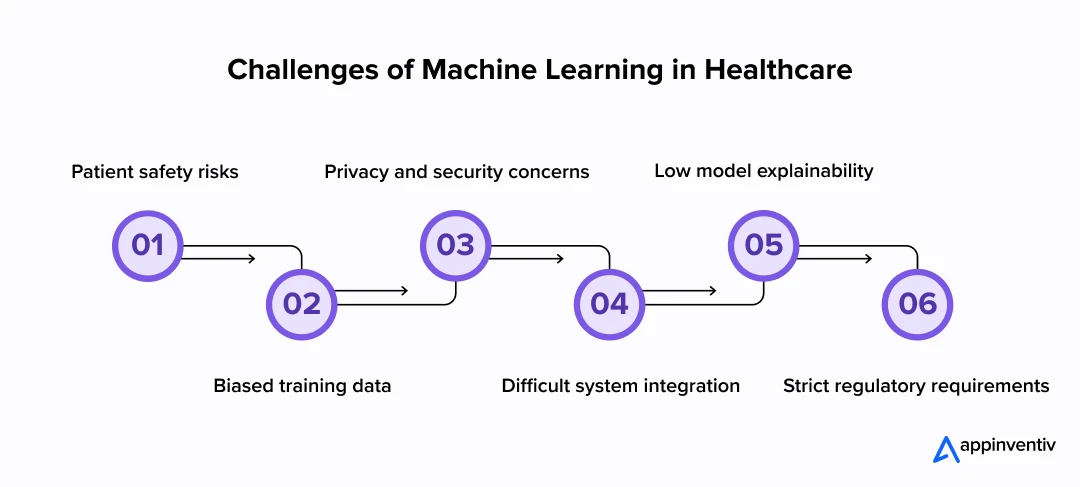
Patient Safety Concerns
Machine learning algorithms can only learn from whatever it gets fed, and hospital data isn’t always clean or complete. Sometimes a record is missing a few details, or two systems store information differently. When a model learns from this kind of patchy data, its recommendations can drift off. Doctors know this, which is why they don’t blindly follow anything a machine suggests.
The solution: A slow start helps a lot. Let the ML system run quietly in the background while doctors do their usual work. Compare its suggestions with real decisions. Fix what doesn’t line up. Over time, when doctors see the tool getting things right again and again, the fear drops and trust starts to build. It almost feels like working with a new colleague who needs a little training before you fully rely on them.
Also Read: An Easy Guide to Understand Data Analytics in Healthcare
Bias in Datasets
If the model learns mostly from one kind of patient, it may not treat others fairly. Bias doesn’t show up loudly. It creeps in quietly. One day you notice the system is making odd predictions for a certain group, and you realize the model never had enough examples of them in the first place.
The solution: You fix this by giving the model better, wider data. Bring in cases from different ages, backgrounds, conditions. Check the model every now and then to see where it slips. When you adjust it regularly, the model slowly becomes more balanced and more dependable. It’s like pruning a plant. Small cuts keep it growing in the right direction.
Privacy and Security Risks
Medical data is personal. You can’t play around with it. One small leak, and trust disappears for years. When ML systems start collecting or analyzing patient information, the pressure to protect that data gets even heavier.
The solution: Hospitals need strong walls around their data. Encryption, locked access, regular checks. Even using deidentified data during training can help. That way machine learning in healthcare grows without putting actual people at risk. When patients know their data is safe, they feel more comfortable with the technology being used behind the scenes.
Also Read: Navigating Healthcare Data Security: Common Challenges and Proven Best Practices
Complex Integration with Existing Systems
Hospitals don’t run on one neat system. They run on many. Some are old, some are new, and half of them weren’t built to talk to each other. ML needs organized data, but the reality inside many hospitals is a bit chaotic.
The solution: The simplest fix is to go one system at a time. Start with EHR integration, because that’s where most of the data lives. Once that connection is stable, move to scheduling, then imaging, then whatever comes next. Small, steady steps prevent the whole system from crashing or overwhelming the staff. You build the bridge slowly and keep checking it as you go.
The Need for Trust and Explainability
Doctors won’t trust a tool that just says “here’s the answer” without explaining how it reached it. In healthcare, blind trust is dangerous. Clinicians want to see the reasoning, the clues, the trail of evidence.
The solution: Use models that show their thinking. Even simple explanations help. When a doctor can see why the model pointed toward a certain outcome, they feel more confident using that information in their decisions. Trust grows slowly, but explainability speeds it up.
Regulatory Pressure and Compliance
Healthcare tools have to pass strict checks before they can be used. ML models often fall under the same rules as medical devices. Lots of paperwork. Lots of reviews. Lots of waiting. It slows things down, but that’s how the industry protects patients.
The solution: Transparency makes everything easier. If hospitals document how the model works, how it was trained, and how often it is monitored, regulators feel more comfortable approving it. Regular audits help too. When everything is clear and traceable, the approval process stops feeling like a battle and becomes more like a partnership.
Steps Hospitals Follow to Use ML Effectively Into Their Operations
Implementing machine learning in hospitals is not something that happens overnight. Healthcare teams already work inside tight schedules, so bringing in a new system needs to feel natural rather than disruptive. Most organizations follow a simple path that starts small, grows steadily, and leaves room to fix things along the way.
What makes the process of ML in healthcare different from other industries is the level of care involved. Decisions affect real people. So each step is taken slowly, tested often, and shaped by constant feedback from clinicians who understand the rhythm of the medical field better than any algorithm.
1. Understanding the Problem First
Teams begin by choosing one problem that feels manageable. It could be reducing readmissions, organizing patient records, or improving a diagnostic workflow. This keeps the focus narrow. It also helps everyone see how medical ML can support existing routines instead of replacing them.
When the goal is clear, the project becomes easier to plan. Doctors, nurses, and tech teams talk through what they need and how the model should behave inside a clinical setting.
2. Collecting and Cleaning the Data
Healthcare data comes from many places, and not all of it fits neatly together. A lot of time goes into cleaning records, merging formats, and removing outdated entries. It may feel slow, but this is the part that shapes how well machine learning algorithms in healthcare perform later.
Once the data is steady and reliable, teams can start building early versions of the model. These models learn from past patterns inside the hospital, not just generic datasets from outside.
3. Building the First Working Model
This is where developers create a small prototype using the chosen tech stack of ML healthcare. The model is not perfect at this stage. It simply attempts to recognize patterns doctors see all the time, such as risk factors, workflow delays, or changes in patient readings.
The idea is to test whether the tool can be trusted even a little. If it gets things wrong, the team goes back, adjusts the model, and trains it again.
4. Running the Model Quietly in the Background
Hospitals usually avoid putting a new tool directly in front of patients. Instead, the model runs silently alongside real clinical decisions. This helps everyone see where machine learning in the healthcare industry performs well and where it still needs fine tuning.
Clinicians compare their own judgment with the model’s suggestions. When they match often enough, the comfort level increases naturally.
5. Integrating the Tool Into Everyday Workflows
Once the model proves reliable, it gradually becomes part of routine care. It might help with scheduling, early warnings, diagnosis support, or documentation. This is where machine learning and health begin to work together in a way that feels practical and not overwhelming.
Hospitals usually start with one department and expand slowly. This helps maintain consistency and prevents staff from feeling overloaded.
6. Keeping an Eye on Bias, Ethics, and Fairness
Ethics of machine learning in health care remain important all through the process. Teams check regularly for bias, unusual behavior, or predictions that don’t feel fair or accurate. If a problem appears, the model is retrained or adjusted.
Ongoing monitoring is what turns ML from an experiment into a dependable healthcare machine learning solution that patients and clinicians can trust.
7. Continuous Improvement and Scaling
As the model learns from new cases, it grows more accurate. Hospitals add new data, update the system, and slowly expand it to other parts of the organization. ML becomes something that evolves with the hospital instead of a one time setup.
This long term approach is what keeps machine learning in the medical field useful and relevant. It adapts as healthcare changes.
The Future of Machine Learning for Healthcare
The future of machine learning in healthcare is shaping up quietly. Nothing flashy. Just steady changes that make work easier for doctors and patients feel more supported. As ML settles into daily routines, hospitals will rely on it the same way they rely on any other tool that simply makes things smoother.
Here is where things seem to be heading:
- Sharper and faster diagnostics
Machine learning in the medical field will help doctors catch small changes in scans or reports that are easy to miss in busy clinical settings. - Treatment plans that feel more personal
Machine learning for healthcare will use long term patterns and genetics to help shape plans that actually fit the patient instead of a general chart. - Hospital systems that talk to each other
A lot of machine learning in hospitals will focus on connecting scattered data. When everything sits in one place, care teams lose less time searching for information. - Remote care that catches problems early
Wearables and home monitors will use ML to spot small changes and send early alerts. This helps manage chronic conditions before they turn into emergencies. - Faster drug research
Healthcare ML is already helping researchers narrow down which drug candidates look promising. This kind of support cuts months of trial and error. - Fair and safe ML adoption
The ethics of machine learning in health care will stay in focus. Hospitals will check models for bias, make sure the logic is easy to understand, and protect patient data tightly.
All of this points to a future where ML supports care teams quietly in the background, giving them a little more clarity and a little more time with their patients.
Let’s turn it into a working solution that fits your goals.
How Can Appinventiv Help You Adopt ML in Healthcare?
Use cases of machine learning in healthcare are expanding by leaps and bounds, and the healthcare industry is keeping a close eye on this trend. Accordingly, organizations across the globe are leveraging AI-driven solutions and ML models to improve healthcare delivery.
Interested in empowering your medical operations with the capabilities of AI and ML? Partner with us for next-gen machine learning development solutions that speed up time-to-value.
With a team of 1200+ software developers and a proven track record of delivering 3000+ successful projects, Appinventiv can be your trusted tech partner to bring your AI/ML in healthcare vision to life.
We have worked on a multitude of healthcare projects over the past, offering our medical software development services, and integrating modern technologies including machine learning, IoT, blockchain, and more.
For instance, we developed Soniphi, the first resonant frequencies-based personal wellness system that provides a complete well-being analysis report on your personal healthcare app. Apart from Sophini, we developed Health-e-People, an integrated platform for connecting various health devices and records on one interface for comprehensive healthcare monitoring. The solution also lets users draw predictive analysis from the records and connects the users with caregivers.
So, if you are also looking to leverage the full potential of artificial intelligence and machine learning in healthcare that can cater to your needs in the most tech-friendly manner, get in touch with our experts now.
FAQs
Q. What are the benefits of machine learning in healthcare?
A. By leveraging the power of machine learning, the healthcare industry can improve overall healthcare outcomes. Here are some key advantages of using machine learning in healthcare:
- Faster data handling.
- Lower operational costs.
- Early risk detection.
- Better patient engagement.
- More personalized treatment.
- More accurate diagnoses.
- Faster drug research.
- Smoother hospital workflows.
Q. How can machine learning be used in healthcare?
A. Machine learning in the healthcare industry is used for various purposes, including disease diagnosis, drug discovery, treatment planning, effective patient care, and so on. In addition, it helps identify patterns, detect anomalies, and predict outcomes, enabling healthcare professionals to make more accurate diagnoses and prescribe more personalized treatment plans, resulting in improved patient care. Furthermore, machine learning in healthcare is used to streamline administrative tasks and enhance operational efficiency. To know more about the top examples of machine learning in healthcare, connect with our experts today!
Q. What is the future of machine learning in the healthcare industry?
A. The future of machine learning in the healthcare industry is transformative. With the ever-increasing advancements in artificial intelligence and the easy availability of healthcare data, machine learning can revolutionize how healthcare professionals conduct research, treat patients, and perform operational tasks, resulting in unprecedentedly enhanced efficiency, increased productivity, and better patient outcomes.
Q. What is machine learning in healthcare?
A. Machine learning in healthcare utilizes algorithms to analyze medical data, enhancing disease prediction, personalized treatments, and operational efficiency. Processing extensive datasets improves diagnostic accuracy, tailors treatment plans, and optimizes healthcare management, driving advancements in patient care and research.
Q. How can hospitals use machine learning to improve patient care?
A. Machine learning helps hospitals spot issues earlier by analyzing patient vitals, lab reports, and long term trends faster than manual review. It supports doctors with early alerts, risk scores, and recommendations that reduce guesswork during busy hours. ML also speeds up diagnosis by assisting with scan interpretation and identifying patterns that humans might overlook. Hospitals use it to personalize treatment plans and automate routine tasks, giving clinicians more time with patients. Overall, it helps care teams deliver safer and more proactive care.
Q. Which AI and ML platforms are best for healthcare applications?
A. Platforms like TensorFlow and PyTorch are widely used for building clinical grade ML models because they support complex imaging, prediction, and pattern recognition tasks. Cloud platforms such as Azure Healthcare AI, Google Cloud Healthcare API, and AWS Health AI provide essential features like HIPAA-ready security and FHIR based data processing. These tools make it easier to manage sensitive medical data, integrate with hospital systems, and deploy ML models at scale. They also offer strong support for explainability, which is crucial for clinical settings. The choice depends on the workflow, compliance needs, and type of ML project.
Q. Why is machine learning important for healthcare organizations?
A. Machine learning helps healthcare teams manage the huge volume of clinical data they deal with daily and turn it into insights that improve decision making. It supports faster diagnosis, early disease detection, and more precise treatment plans. ML also automates repetitive tasks like documentation, scheduling, and report sorting, reducing pressure on staff. For organizations, this leads to fewer delays, improved patient satisfaction, and more efficient operations. Over time, ML becomes a strategic tool that strengthens both clinical and administrative performance.
Q. What is the difference between AI, deep learning, and machine learning in the medical field?
A. AI is the broad field that focuses on creating intelligent systems that mimic human reasoning. Machine learning is a subset of AI that learns patterns from medical data and improves over time without being manually reprogrammed. Deep learning is a specialized branch of ML that uses neural networks to handle more complex tasks like reading MRI scans, analyzing pathology images, or predicting disease progression. In healthcare, AI offers the vision, ML provides the learning, and deep learning handles the most intricate clinical challenges. Together, they support more accurate and efficient medical decision making.

Elevate Your Healthcare Operations with Machine Learning

Fast 2-minute response, fully NDA-protected.

Top Machine Learning Trends the C-Suite Needs To Watch in 2026
Key takeaways: C-suite focus shifts from “doing AI” to providing clear P&L, risk, and efficiency impact from machine learning in 2026. Nine ML trends matter most: agentic AI, multimodal, decision intelligence, governance, edge, MLOps, responsible AI, domain models, and AI security. Executives should treat ML as a portfolio: near-term run-the-business bets, change-the-business bets, and non-negotiable…
10 Use Cases and Examples of How Machine Learning is Transforming the Logistics Industry
The widespread adoption of ML has resulted in the explosion of data from sensors, customer interactions, and digital platforms across different domains. More and more businesses are leveraging machine learning in logistics to improve their strategic decision-making expertise centered around tailoring customer experience, improving productivity, increasing engagement, and preventing fraud. According to the McKinsey Global…

Key takeaways: Machine learning in retail is reshaping the industry through smarter recommendations, dynamic pricing, and real-time personalization. AI & ML deliver measurable ROI, helping brands boost conversions by up to 40% and unlock multiple operational advantages. Successful ML implementation in retail requires high-quality data, scalable infrastructure, and continuous model optimization. With 10+ years of…