


























IoT In Education for Enterprises: Financial Impact, Risks, and Roadmap


- Why IoT in Education Has Become a Board-Level Investment Decision
- The Enterprise IoT Architecture Stack for Modern Education Ecosystems
- Total Cost of Ownership: A Five-Year Lifecycle Financial Model
- Building a Defensible Five-Year ROI Model
- High-Impact Enterprise IoT Use Cases in Education
- Benefits of IoT in Education
- Cybersecurity, Compliance, and Data Governance Strategy
- Enterprise Implementation Roadmap
- Board-Level KPIs for Measuring IoT Performance
- Challenges of Implementing IoT in Education
- The Future of IoT in Education in 2026
- How Can Appinventiv Help Maximize ROI From IoT in Education?
- FAQs

Key takeaways:
- Integrating IoT in education becomes an infrastructure investment as operational costs, compliance pressures, and visibility gaps intensify.
- Five-year ROI depends on baseline operational data, disciplined architecture, and structured financial modeling.
- Predictable TCO requires upfront planning across hardware, connectivity, cloud, maintenance, and governance costs.
- Secure IoT deployments demand zero-trust architecture, strong device identity, and continuous compliance monitoring.
- Enterprise adoption succeeds when phased implementation aligns technology decisions with measurable institutional financial outcomes.
Most CIOs and CFOs do not start thinking about the Internet of Things in education because it sounds innovative. It usually begins when operational costs creep up, facilities become harder to manage, or security expectations increase. At that point, connected infrastructure stops being a tech upgrade and starts looking more like a capital investment decision.
If your institution is exploring IoT seriously, financial clarity becomes the priority. CIOs focus on architecture, integration, and risk control. CFOs want predictable costs, measurable savings, and asset longevity. Both perspectives matter because IoT touches physical infrastructure, digital systems, and operational workflows at the same time.
This guide looks at IoT in the education industry through a five-year ROI lens. You will see how savings typically build, where hidden costs appear, and how institutions structure the total cost of ownership across hardware, connectivity, cloud platforms, maintenance, and upgrades. Security and compliance also sit at the center, especially with student data, campus surveillance systems, and regulatory oversight becoming stricter.
The core takeaway is practical. The role of IoT in education delivers lasting value when it is planned as infrastructure, financially modeled early, secured properly, and managed as a long-term operational asset rather than a short-term experiment.
EdTech usage has increased by nearly 99%.

Why IoT in Education Has Become a Board-Level Investment Decision
In many institutions, IoT does not enter the board agenda because someone wants smarter classrooms. It appears when the numbers stop adding up. Energy bills climb. Maintenance backlogs grow. Security audits get stricter. A facilities pilot might solve one problem, but it often exposes how little visibility exists across the broader infrastructure.
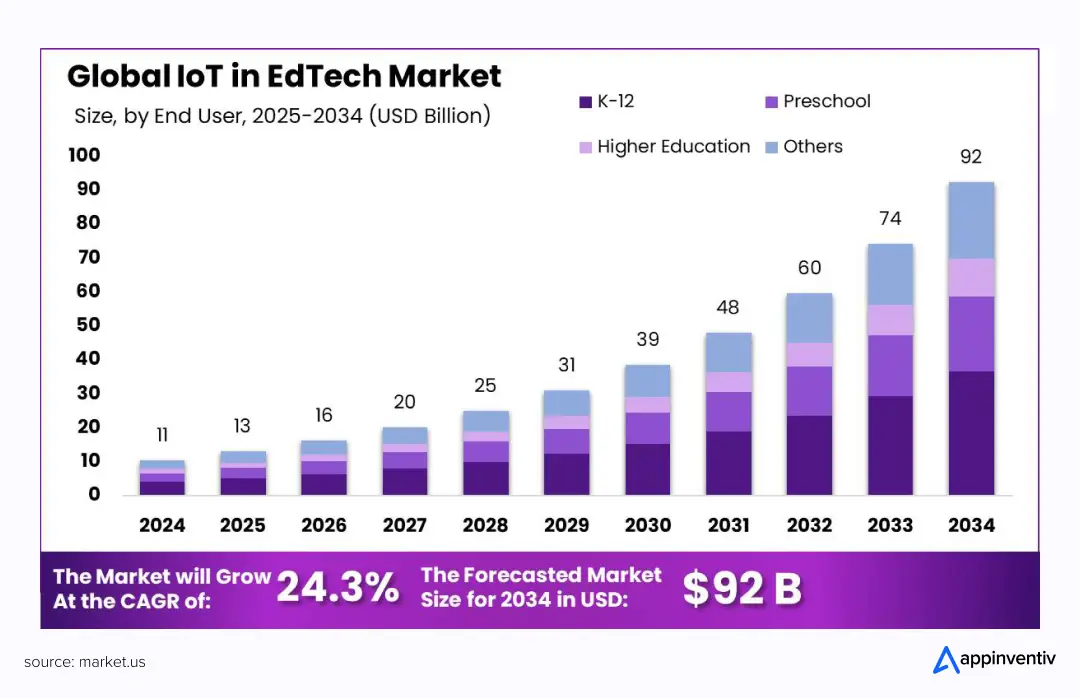
That urgency is reflected in the market direction as well, with the global IoT in education industry projected to grow to nearly $92 billion by 2034, expanding at roughly 24% annually, signaling a broader shift toward infrastructure-level investment rather than isolated pilots, a pattern that mirrors how IoT is transforming industries far beyond education.
Infrastructure Cost Pressures
Walk through a large campus, and you will see mechanical rooms running on aging building management systems, often speaking BACnet or Modbus, but operating with limited real-time insight. Adding distributed sensors tied to edge gateways changes that. Facilities teams can monitor vibration patterns in chillers, detect abnormal power draw, and trigger maintenance before equipment fails. The savings usually come from avoided downtime and fewer emergency contracts.
Smart Campus Transformation Trends
IoT in higher education is now routing telemetry into ERP systems and centralized data platforms. Some universities are modeling digital replicas of buildings to test occupancy flow or energy loads before making physical changes, applying the same infrastructure logic behind smart city deployments. It is less about dashboards and more about planning accuracy.
ESG Mandates and Energy Optimization
Continuous metering supports automated carbon accounting and sustainability reporting, where technology for sustainability is increasingly shaping how institutions meet grant and compliance expectations. That data increasingly influences grant approvals and public reporting requirements.
Security Modernization Needs
Every connected device expands the attack surface. Institutions are segmenting networks, issuing device-level identities, enforcing encrypted traffic, and monitoring anomalies centrally rather than relying on isolated controls.
Transition to Enterprise Deployment
A pilot proves technology works. Scaling forces standardization, fleet management, firmware governance, and integration discipline across campuses.
US and Global Funding Structures
Federal modernization funds and sustainability incentives are accelerating structured IoT solutions for education, especially where measurable operational gains can be demonstrated.
The Enterprise IoT Architecture Stack for Modern Education Ecosystems
When institutions scale enterprise IoT beyond a few buildings, architecture decisions start shaping everything that follows: cost, security exposure, integration complexity, and long-term flexibility. Many campuses learn this the hard way. A pilot works in isolation. Then device counts grow, vendors multiply, and data starts flowing into systems that were never designed to handle it.
A structured stack prevents that drift. That reality also shows up in IoT in education market spending patterns, with nearly 48% of investment going into hardware infrastructure and about 39.6% of adoption concentrated in K-12 institutions, reinforcing why architecture planning becomes critical early in the deployment cycle.
Below is how enterprise education environments typically think about the layers.
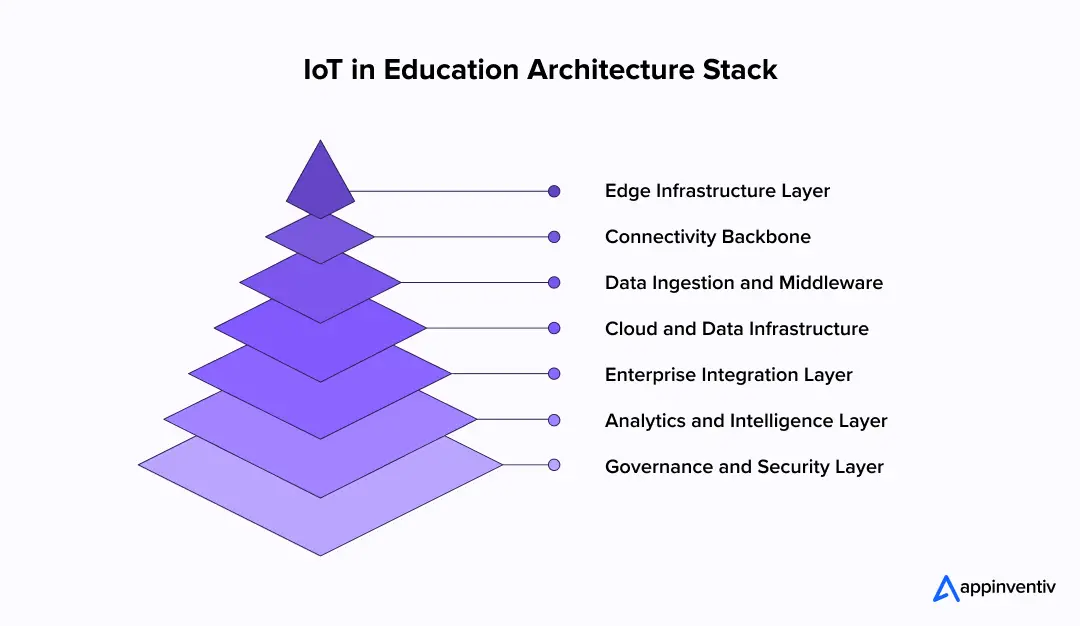
Edge Infrastructure Layer
This is the physical foundation. It includes the devices sitting in classrooms, mechanical rooms, corridors, and utility areas, generating operational signals every second.
- Environmental sensors capture temperature, humidity, occupancy, and air quality.
- Smart meters track granular energy and water consumption
- IP cameras with local processing to filter and classify footage
- RFID or BLE tags are used for tracking high-value equipment
- Edge gateways aggregate and normalize device data before forwarding it upstream
Edge gateways often handle protocol translation and basic filtering so raw noise does not overwhelm central systems.
Connectivity Backbone
Once devices are active, reliable IoT connectivity becomes the next challenge. Campuses rarely rely on a single network model.
| Connectivity Type | Where It Fits | Practical Consideration |
|---|---|---|
| Wi-Fi 6/6E | High-density academic spaces | Careful segmentation to isolate IoT traffic |
| Private 5G | Large or research-heavy campuses | Coverage planning and device compatibility |
| LPWAN | Low-power distributed sensors | Limited bandwidth but strong range |
| SD-WAN | Multi-campus orchestration | Centralized policy and traffic control |
Network segmentation is not optional. IoT traffic should be isolated from financial and academic systems from the start.
Data Ingestion and Middleware
As device volumes increase, coordination becomes more complex. This layer ensures devices can communicate reliably without custom integrations for every vendor.
- Telemetry transmission using lightweight protocols such as MQTT or AMQP
- API gateways exposing standardized interfaces
- Event streaming platforms manage continuous data flow
- Centralized device provisioning and firmware update management
- Message brokers handling asynchronous communication
Without middleware discipline, scaling becomes operationally heavy and expensive.
Cloud and Data Infrastructure
Once data leaves the edge, it must be stored, structured, and made usable. Poor design here creates long-term cost problems.
- Managed IoT cloud platforms, maintaining device registries
- Time-series databases optimized for sensor telemetry
- Data lakes are consolidating operational and academic system data
- Digital twin environments modeling building performance and occupancy behavior
- Elastic compute layers supporting analytics workloads
Cloud architecture should anticipate growth rather than react to it.
Enterprise Integration Layer
IoT data only creates value when it influences existing systems. Otherwise, it becomes another dashboard no one checks.
- ERP integration for asset lifecycle tracking and cost visibility
- CMMS integration triggering automated maintenance workflows
- LMS integration supporting occupancy-aware scheduling
- Student system connectivity enabling policy-based access control
- API based connectors minimizing custom code dependencies
This is where operational impact begins to surface.
Analytics and Intelligence Layer
After sufficient historical data accumulates, analytics begins to drive measurable change.
- Predictive maintenance models identify abnormal vibration or load behavior
- Energy optimization algorithms adjusting HVAC cycles dynamically
- Anomaly detection highlighting unusual access or device activity
- Space utilization analytics supporting consolidation decisions
Consistent telemetry and clean data pipelines are prerequisites for meaningful insight.
Also Read: What Makes Chatbots Development a Popular Next-Gen Trend?
Governance and Security Layer
As more devices connect, governance must mature. Informal controls do not scale.
- Zero-trust segmentation across networks
- Certificate-based device identity management
- End-to-end encrypted communication channels
- Continuous vulnerability scanning and patch compliance checks
- Alignment with FERPA, GDPR, and regional privacy frameworks
Security architecture should assume device compromise is possible and contain risk through isolation and monitoring.
A well-structured stack reduces surprises later. It keeps scaling manageable, protects institutional systems, and makes financial modeling more predictable. Without that structure, IoT expansion often becomes more complex and costly than originally planned.
ActiDrive demonstrates Appinventiv’s execution depth in edge-device interaction, real-time connectivity, cloud coordination, and multi-device integration. Placing it under the architecture section reinforces credibility around IoT system design, device orchestration, and scalable backend infrastructure without disrupting the ROI or CTA flow.
Total Cost of Ownership: A Five-Year Lifecycle Financial Model
This is usually where IoT conversations become practical. A pilot can look manageable on paper. Once deployment spreads across buildings or campuses, the financial picture shifts. Devices need upkeep. Data volumes grow. Integration work never fully stops.
Most enterprise education IoT programs typically cost somewhere between 50,000 and 500,000 USD over a five-year period, depending on the extent of the rollout and the condition of the existing infrastructure.
Breaking the costs into lifecycle stages makes planning more realistic.
Capital Expenditure Phase
This is the upfront investment needed to get systems running. It covers devices, connectivity readiness, and initial integration. Older campuses often spend more here because legacy infrastructure rarely aligns neatly with modern IoT devices for education.
Cost of Implementing IoT in Education
| CapEx Component | Typical Scope | Estimated Range ($) |
|---|---|---|
| Devices and Sensors | Smart meters, environmental sensors, cameras, tracking tags | $15K to $120K |
| Edge Hardware | Gateways and local controllers | $10K to $60K |
| Network Preparation | Wi-Fi upgrades, segmentation, and cabling | $20K to $150K |
| Deployment Services | Installation, calibration, system integration | $25K to $100K |
| Platform Setup | Cloud onboarding and licensing | $10K to $70K |
Good architecture choices here often prevent costly redesign later, and a closer look at IoT development costs helps institutions build more accurate early-stage budgets.
Operating Expenditure Phase
Once everything is live, spending shifts from hardware to operations. These costs build gradually and sometimes exceed initial expectations.
| OpEx Category | Cost Driver | Annual Range ($) |
|---|---|---|
| Cloud Infrastructure | Telemetry storage and compute scaling | $12K to $80K |
| Connectivity | Network coverage and device density | $5K to $40K |
| Maintenance | Hardware servicing and monitoring | $8K to $50K |
| Security Oversight | Monitoring, compliance activities | $10K to $60K |
| Platform Support | Firmware and software updates | $5K to $30K |
Operational costs stabilize once device volumes stabilize.
Hidden Costs Often Overlooked
These do not always appear in early budgeting discussions but surface later.
| Hidden Cost Area | Why It Appears | Financial Impact |
|---|---|---|
| Governance Staffing | Compliance monitoring and reporting | Around $70K to $150K yearly for large setups |
| Cyber Insurance | Expanded device exposure | Premium adjustments vary |
| Training and Adoption | Facilities and IT readiness | Temporary productivity effects |
| Integration Adjustments | Evolving enterprise systems | Additional engineering budget |
Ignoring these often distorts ROI expectations.
Asset Depreciation Strategy
IoT hardware ages differently from standard IT equipment. Sensors may sit in humid basements, outdoor areas, or mechanical rooms. Gateways face increasing data loads as deployments expand. Planning refresh cycles early keeps budgets predictable.
Common practices include:
- Replacing devices in phases rather than all at once
- Tracking battery cycles alongside hardware wear
- Budgeting upgrades tied to security or bandwidth needs
- Aligning warranties with realistic operating conditions
This avoids sudden capital shocks later.
Illustrative Five-Year TCO Snapshot
A snapshot helps anchor expectations without overpromising precision.
Mid-Size University Scenario
Usually involves energy monitoring, maintenance sensors, and integrated access or security systems across several buildings.
- Total investment often falls between 200,000 and 350,000 USD over five years.
- Integration complexity drives most cost variation
- Governance and security oversight increase gradually as systems mature
Multi-Campus District Scenario
Here, scale changes everything. Device counts rise quickly, and coordination becomes more complex.
- A five-year investment commonly approaches 400,000 to 500,000 USD
- Connectivity orchestration and centralized monitoring add operational overhead
- Standardized architecture helps control long-term operating costs
Sensitivity factors worth tracking
- Energy price volatility
- Device lifespan variability
- Growth in cloud data storage
- Changing security compliance requirements
Modeling these early usually prevents unpleasant budget surprises later.
Building a Defensible Five-Year ROI Model
Most IoT ROI decks look convincing until finance asks one simple question: where exactly do these savings come from? That is usually where assumptions get exposed. A defensible ROI model starts with operational baselines, not projections.
Before any deployment, institutions that see credible returns typically document current energy consumption, maintenance frequency, security incident cost, and space utilization inefficiencies. Without that baseline, ROI becomes guesswork.
This discipline matters even more in a landscape where EdTech usage has grown by nearly 99%, and districts now engage with more than 1,400 digital tools each month, increasing infrastructure complexity and making it harder to defend loosely modeled ROI assumptions.
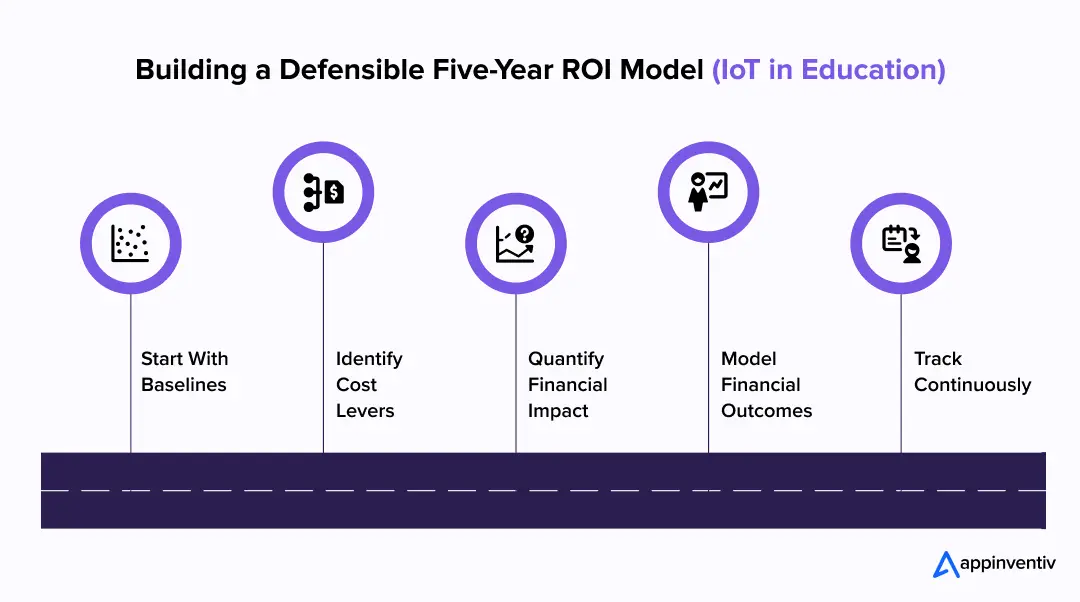
Cost Savings Levers
Savings rarely come from automation alone. They come from visibility. Once facilities teams see how buildings actually behave, inefficiencies become measurable.
- HVAC optimization using occupancy telemetry often reduces peak load rather than overall consumption, which matters because peak tariffs drive cost
- Predictive maintenance based on vibration or thermal anomalies helps avoid emergency contractor pricing and unplanned shutdowns.
- Lighting automation tied to real occupancy data typically produces faster savings than full infrastructure replacement.
- Maintenance labor shifts from routine inspection rounds to condition-based servicing, which reduces overtime and reactive work.
The key is mapping sensor telemetry directly to existing expense categories.
Revenue and Institutional Value Creation
Revenue impact in education is indirect but real. Institutions that treat IoT purely as cost reduction usually underestimate its strategic effect.
- Smart campus infrastructure influences student retention, especially where environmental comfort and safety are visible.
- Sustainability reporting backed by IoT telemetry strengthens eligibility for green funding programs and research grants.
- Space utilization analytics allow institutions to defer new construction by optimizing existing facilities.
- Enhanced safety infrastructure can influence institutional reputation, particularly for international enrollments.
These gains often show up gradually rather than immediately.
Risk Mitigation as Financial Value
Risk rarely appears in ROI spreadsheets, yet it often drives executive decisions.
- Continuous monitoring reduces the likelihood of infrastructure failures that disrupt academic operations.
- Connected environmental sensors help detect water leaks, electrical anomalies, or air quality issues before escalation.
- Automated compliance reporting reduces audit preparation overhead
- Improved security posture can influence insurance premiums and legal exposure
CFOs often view avoided losses as strongly as direct savings.
Financial Modeling Framework
A credible model connects technical telemetry with financial metrics. Institutions typically build ROI models using:
- Net Present Value calculations reflecting infrastructure lifespan and energy price forecasts
- Internal Rate of Return tied to phased rollout milestones
- Payback period estimates based on conservative savings assumptions
- Scenario simulations comparing minimal deployment versus campus-wide adoption
Models grounded in historical operational data usually face less internal resistance.
Financial baselines clarify whether IoT investments deliver sustained operational and cost efficiency.

High-Impact Enterprise IoT Use Cases in Education
Enterprise IoT in higher education rarely begins with classrooms. It usually starts in facilities, energy infrastructure, or operational efficiency programs where a measurable financial impact is possible. The real-world examples of IoT in education mentioned below show how universities are using IoT as operational infrastructure rather than experimental technology.
Smart Energy Intelligence
Arizona State University – Campus Metabolism Initiative
Arizona State University deployed a campus-wide energy intelligence system that aggregates real-time electricity, thermal, and infrastructure telemetry to support operational decision making. Facilities teams use this data to optimize building performance and sustainability reporting. Research documenting the deployment highlights the technical challenges of long-term IoT campus infrastructure and data quality management.
Financial relevance
- Reduced peak energy costs through real-time load visibility
- Data-driven sustainability reporting supporting ESG funding
- More accurate infrastructure planning based on measured consumption
This type of deployment typically shifts energy management from reactive billing analysis to proactive operational optimization.
Predictive Energy Infrastructure and Microgrid Optimization
University of California, San Diego – Campus Microgrid
UC San Diego operates one of the most advanced university microgrids, supplying a large portion of campus electricity, heating, and cooling while integrating distributed energy resources and centralized control systems. The microgrid supports operational resilience, cost optimization, and sustainability goals.
The financial implications are substantial:
- Reduced energy procurement costs through local generation and load optimization
- Greater resilience against grid instability
- Improved carbon footprint reporting tied to funding and compliance
- Ability to optimize energy consumption dynamically rather than statically
This shows IoT moving beyond monitoring into infrastructure control.
IoT-Driven Energy Sustainability Platform
Universidad Politécnica de Madrid – Smart Campus Energy Monitoring
The Telecommunications Engineering School at Universidad Politécnica de Madrid implemented an IoT-based energy sustainability platform across multiple campus buildings. The system monitors energy consumption continuously and supports operational efficiency and sustainability objectives.
Financial relevance
- Continuous energy optimization rather than periodic audits
- Better sustainability compliance reporting
- Improved infrastructure utilization planning
Here, the financial impact comes from sustained operational insight rather than one-time optimization.
What These IoT in Education Case Study Findings Tell Enterprise Decision Makers
Across these deployments, the common pattern is clear:
- Continuous telemetry enables operational decisions, not just dashboards
- Integration with facilities management and sustainability reporting strengthens ROI credibility
- IoT becomes financially defensible when tied to infrastructure performance, and institutions looking at the full picture will find that smart campus technology offers the broader strategic framework beyond individual use cases.
That alignment is typically what moves IoT from pilot status to board-level infrastructure investment.
Additional Notable IoT Deployments in Education
Some of the most practical IoT in education examples include Cisco’s Board Pro G2 for hybrid collaboration classrooms, Virrata AB’s C-PEN Reader devices supporting accessibility, smart classroom pilots at Dongguan University of Technology, and RONIN-based threat detection deployments that enhance campus security monitoring without major infrastructure overhauls.
While large-scale infrastructure use cases often drive initial investment decisions, IoT applications in education extend well beyond facilities and energy systems into daily academic and operational workflows.
Applications of IoT in Education
The application of IoT in education extends beyond large-scale energy and facilities optimization into areas that support academic operations, student experience, and administrative efficiency.
Key applications include:
- Smart attendance and access logging
Connected ID systems and entry sensors automate attendance tracking and improve access governance without manual processes, complementing conversational AI tools that further reduce administrative burden. - Learning environment monitoring
Sensors track temperature, air quality, and lighting levels to maintain comfortable, compliant classroom conditions. - Connected laboratory management
IoT-enabled lab equipment can report usage patterns, calibration needs, and safety alerts in real time. - Transportation and fleet monitoring
GPS and telematics systems track school buses or campus shuttles for route optimization and safety compliance. - Resource and device usage analytics
Monitoring shared digital devices and equipment helps reduce loss, misuse, and unnecessary procurement.
These applications extend IoT beyond infrastructure cost control into operational efficiency and governance improvement across the broader education ecosystem.
Benefits of IoT in Education
Most institutions do not adopt IoT for novelty. Understanding the benefits of IoT in education usually becomes urgent when operational friction starts affecting cost, safety, or infrastructure planning. The benefits usually show up gradually as visibility improves across campus systems.
Key advantages typically include:
- Operational cost optimization
Energy monitoring, predictive maintenance, and automation often reduce utility spend and emergency repair costs. - Improved infrastructure visibility
Real-time telemetry helps facilities teams understand how buildings actually perform, not just how they were designed to operate. - Stronger campus safety and risk control
Connected surveillance, environmental sensors, and access systems improve incident detection and response speed. - Better space utilization
Occupancy analytics help institutions optimize classrooms, labs, and shared spaces without unnecessary expansion. - Sustainability and ESG reporting support
Continuous energy and environmental data simplifies compliance reporting and strengthens funding eligibility.
In most enterprise deployments, the biggest benefit is not automation alone. It is informed decision-making based on reliable operational data, which becomes even more powerful when institutions also explore the broader role of AI in education alongside their IoT programs.
Cybersecurity, Compliance, and Data Governance Strategy
Security usually stops being theoretical once IoT expands past a single building. Early pilots feel contained. Then more sensors get added, cameras connect to central systems, HVAC controllers start streaming telemetry, and suddenly the network includes thousands of devices that were never part of traditional IT planning. That shift is where most educational institutions start revisiting security architecture.
US Regulatory Considerations
In the US, compliance is rarely a single rulebook. FERPA becomes relevant when access systems, classroom analytics, or campus safety platforms generate data tied to identifiable students. COPPA shows up more in school environments where minors interact with connected systems. State privacy laws complicate things further with breach disclosure timelines and retention expectations. Some universities now treat IoT telemetry as a separate data class, so it does not accidentally mix with regulated academic records.
Global Compliance Landscape
International campuses or collaborative research programs introduce GDPR considerations. Storage location suddenly matters. Audit trails become essential. Some institutions choose region-specific cloud zones simply to avoid cross-border data transfer complications. Governance policies increasingly cover sensor data alongside traditional enterprise data.
IoT Threat Landscape in Education
Many incidents start with something basic. Default credentials left unchanged. Firmware updates postponed. An exposed gateway nobody noticed. Cameras, environmental sensors, and building automation systems are common entry points. Once inside, attackers often try moving toward administrative systems.
Enterprise Mitigation Blueprint
Stronger deployments usually rely on device certificates instead of shared passwords, strict network segmentation, encrypted telemetry flows, routine patch cycles, and centralized monitoring tied into existing campus security operations. Security becomes ongoing operational work rather than a one-time deployment task.
Enterprise Implementation Roadmap
Most institutions do not struggle with understanding the importance of IoT in education. The friction usually shows up in planning and rollout discipline. When IoT is treated like infrastructure, not an isolated IT experiment, the outcomes tend to be far more stable.
That shift is already visible in mature markets, with North America holding over 41.8% of global IoT in education industry adoption, reinforcing the need for structured, phased implementation rather than ad hoc deployments.
Phase 1: Strategic Assessment and ROI Modeling
This stage is mostly groundwork. Teams look at existing building systems, network readiness, and current operational costs before anything new gets installed. Facilities audits and baseline energy or maintenance data often shape the financial case more than the technology discussion.
Phase 2: Architecture and Vendor Evaluation
Compatibility becomes the main question here. Platforms need to integrate cleanly with building management systems, ERP platforms, or campus networks. Many institutions also check how easily IoT devices for education can be swapped later to avoid vendor lock-in.
Phase 3: Controlled Pilot
A small, contained pilot usually works better than a broad rollout, and knowing the IoT project essentials before that phase begins reduces the risk of costly course corrections. One building or a specific facility type is enough to validate performance, security posture, and operational workflows.
Phase 4: Scaled Deployment
Expansion tends to focus on consistency. Standard device onboarding, uniform network segmentation, and centralized monitoring help prevent fragmented operations across campuses.
Phase 5: Continuous Optimization
After deployment, attention shifts to refinement. Predictive analytics, gradual AI adoption, and lifecycle tracking help improve efficiency without large disruptive upgrades.
Appinventiv partnered with a real estate client to build ILITY, a SaaS-based property management platform designed to streamline operations, tenant interactions, and asset oversight. The project focused on scalable architecture, platform usability, and enterprise-grade SaaS deployment, supporting digital transformation within property management workflows.
Board-Level KPIs for Measuring IoT Performance
Boards do not track device counts. They track impact. The right KPIs translate technical telemetry into financial and operational performance indicators. Clear metrics also prevent IoT from becoming “invisible infrastructure” with unclear returns.
Key indicators institutions typically monitor include:
- Energy cost per square foot
Measures how building-level telemetry translates into real utility savings. Useful for benchmarking performance across campuses. - Maintenance cost reduction percentage
Tracks the shift from reactive repairs to condition-based maintenance. Often tied to reduced emergency contractor spend. - Device uptime rate
Reflects the reliability of the IoT infrastructure. High uptime indicates strong device lifecycle and monitoring discipline. - Incident response time
Measures how quickly facilities or security teams respond to alerts generated by connected systems. - Space utilization improvement
Uses occupancy analytics to determine whether facilities are being overbuilt or underused. - ESG reporting accuracy and frequency
Evaluates how effectively energy and environmental telemetry support sustainability disclosures.
When these metrics are reviewed quarterly, IoT shifts from a technology expense to a measurable infrastructure performance program.
Challenges of Implementing IoT in Education
Most IoT deployments do not fail because the technology does not work. They struggle when governance, integration planning, or security discipline falls short at scale. Recognizing these patterns early helps institutions avoid costly course corrections later.
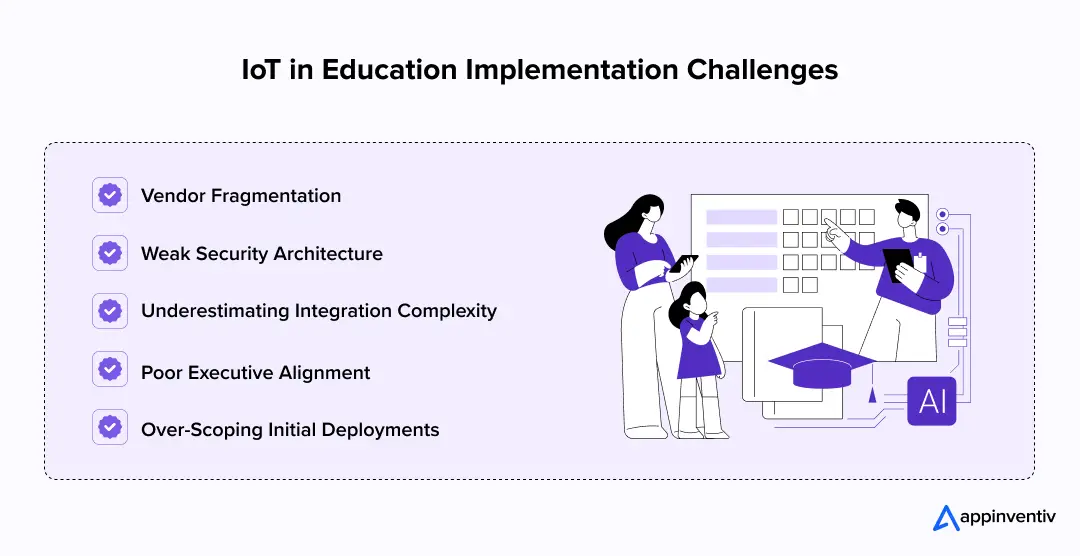
Vendor Fragmentation
Many institutions are onboarding devices and platforms incrementally. Over time, this creates incompatible protocols, siloed dashboards, and rising integration overhead. Procurement convenience often drives early decisions, not architectural fit.
What to do:
- Standardize device protocols early
- Prefer API-first platforms
- Maintain centralized device inventory
- Align procurement with the architecture roadmap
Weak Security Architecture
IoT devices in education often enter networks through facilities or operations teams, not IT. That can leave default credentials, unsegmented traffic, and inconsistent firmware patching across deployments.
Solution:
- Segment IoT networks from enterprise IT
- Use certificate-based device identity
- Enforce regular firmware updates
- Integrate monitoring with security operations
Underestimating Integration Complexity
IoT rarely operates standalone. Integration with ERP, building systems, or analytics platforms often requires more effort than device deployment itself.
How to solve it:
- Audit existing systems before rollout
- Use middleware for interoperability
- Plan integration budgets upfront
- Prioritize open standards
Poor Executive Alignment
Facilities, IT, finance, and security teams often operate separately, and this fragmentation is often compounded by how inconsistently enterprise learning tools are adopted across departments. Without shared objectives, deployments stall or lose momentum.
Mitigation:
- Establish cross-functional governance
- Align KPIs with financial outcomes
- Communicate ROI clearly to leadership
Over-Scoping Initial Deployments
Large rollouts without validation increase cost risk and operational disruption. Early assumptions may not hold at scale.
Solution:
- Start with focused pilot zones
- Validate KPIs before expansion
- Scale gradually with standardized architecture
Avoiding these pitfalls requires more than internal alignment. It calls for a partner who understands both infrastructure modernization and education app development at enterprise scale.
Executive alignment improves when the deployment strategy connects financial outcomes with operational visibility.
The Future of IoT in Education in 2026
IoT in education is moving beyond monitoring and toward coordinated infrastructure intelligence, in line with the latest IoT trends shaping enterprise deployments. By 2026, most mature campuses will not just collect telemetry. They will automate decisions based on it.
Three shifts are becoming visible.
- AI-driven building optimization
Instead of fixed HVAC schedules, AI-powered IoT models will continuously adjust airflow, lighting, and energy distribution based on occupancy patterns and weather forecasts. - Digital twins for capital planning
More institutions will simulate infrastructure changes before investing. Virtual models of buildings will help forecast energy impact, equipment strain, and space demand, converging with metaverse in education initiatives that are redefining how institutions interact with physical and digital spaces. - Integrated risk and compliance monitoring
IoT telemetry will increasingly feed centralized governance dashboards, helping institutions track sustainability metrics, safety performance, and regulatory alignment in near real time.
The direction is clear. IoT will shift from operational support to strategic infrastructure intelligence, shaping how campuses plan expansion, manage cost volatility, and strengthen resilience over the next decade.
How Can Appinventiv Help Maximize ROI From IoT in Education?
Institutions usually do not need more technology. They need clearer financial outcomes from the technology they deploy. That is where structured advisory and disciplined execution make the difference. Appinventiv supports education enterprises through ROI modeling workshops, financial simulation frameworks, and total cost optimization strategies designed specifically for the IoT in the education industry.
From an execution perspective, the focus stays on architecture maturity. Cloud-native IoT platforms, secure integration with ERP, LMS, and SIS environments, and legacy modernization ensure deployments scale without operational friction. Security is built in early through zero-trust design principles and compliance-aligned architecture.
Operational scale also matters. Appinventiv has delivered 250+ connected IoT platforms, supported 35+ industries with custom IoT solutions for education and beyond, and maintains full compliance with international IoT security standards. This experience helps institutions manage multi-campus rollout governance, lifecycle optimization, and AI-driven efficiency improvements.
Whether the requirement involves consulting, full IoT app development, managed services, or long-term performance tracking, the goal remains consistent: measurable operational value.
FAQs
Q. What is IoT in education?
A. The Internet of Things in education refers to connected devices and sensors used across campuses to improve operations, safety, and learning environments. This can include smart HVAC systems, occupancy sensors, access control, energy monitoring, and asset tracking. The real value usually shows up in operational visibility, cost optimization, and better infrastructure planning rather than classroom technology alone.
Q. How can IoT systems ensure student data privacy?
A. Privacy usually starts with data separation. Institutions often keep IoT telemetry isolated from academic records to avoid accidental exposure. Encryption, role-based access control, device authentication, and strict retention policies help reduce risk. Regular audits and compliance mapping to privacy regulations also ensure that operational data does not unintentionally become personally identifiable information.
Q. What APIs are required for IoT education app development?
A. Most IoT education app development projects rely on APIs for device telemetry ingestion, identity management, analytics integration, and enterprise system connectivity. Common integrations include ERP, LMS, student information systems, and building management platforms. Messaging protocols like MQTT and REST APIs are widely used to standardize data exchange across heterogeneous campus environments.
Q. What are the cybersecurity risks of IoT devices in schools?
A. Common risks include weak device credentials, outdated firmware, unsecured gateways, and network misconfiguration. Cameras, HVAC controllers, and environmental sensors are frequent entry points if not managed properly. Once compromised, attackers may attempt lateral movement into administrative systems. Continuous monitoring, segmentation, and strong device identity controls are essential safeguards.
Q. What compliance standards apply to IoT systems in educational institutions?
A. In the US, FERPA governs student data privacy while COPPA applies when minors are involved. Many institutions also align with SOC 2 security practices. International campuses often consider GDPR for data protection. Compliance usually depends on how IoT data intersects with identifiable information, storage location requirements, and institutional governance policies.
Q. What tech stack is used for IoT-based education platforms?
A. Typical stacks include edge sensors and gateways, cloud IoT platforms, time-series databases, analytics layers, and enterprise integrations. Connectivity may involve Wi-Fi, LPWAN, or private cellular networks. Platforms often combine cloud infrastructure, API middleware, security tooling, and analytics frameworks to manage telemetry, automate operations, and support long-term scalability.

- In just 2 mins you will get a response
- Your idea is 100% protected by our Non Disclosure Agreement.

IoT in Wearables: An Enterprise Guide to Architecture, Integration, and Scalable Deployment
Key Takeaways IoT wearables are shifting from pilot projects to enterprise infrastructure across the healthcare, industrial, and logistics sectors. Secure integration, compliance readiness, and data architecture determine wearable success more than device hardware alone. Continuous wearable data enables predictive healthcare, workforce safety optimization, and new enterprise operational intelligence capabilities. AI-driven analytics are transforming wearable data…

IoT in Mining: Modernizing Operations for Enterprise Efficiency and Safety
Key takeaways: The Internet of Things in mining turns scattered operational signals into live, decision-ready visibility across fleets, fixed plants, people, and the environment. The biggest wins usually show up first in uptime, then in safety response, and finally in energy and process stability. “More data” does not automatically mean better performance. Value comes when…

IoT in Banking Industry: Use Cases, Examples, ROI
Key takeaways: IoT in banking creates real value only when it is treated as a software and integration problem, not a hardware initiative. Security, governance, and audit readiness determine whether IoT programs scale or quietly stall in regulated environments. IoT implementation in banking typically ranges from $40,000 to $600,000+, with cost driven more by integration…