






























How to Build a Taxi Booking App in Australia: Process, Features, and Costs


- Step-by-Step Taxi Booking App Development Process in Australia
- Regulatory Requirements for Taxi Apps in Australia
- Essential Features for an Australia Ready Taxi Booking App
- Technology Stack and Architecture for the Australian Market
- Cost to Build a Taxi Booking App in Australia: MVP to Enterprise Pricing
- Revenue Models and Unit Economics for Taxi Apps in Australia
- How to Select the Right Team for Taxi App Development in Australia
- Future Trends Shaping Taxi Apps in Australia
- Why Partner with Appinventiv for Taxi Booking App Development
- FAQs

Key takeaways:
- Australia’s shift toward app-based transport is growing fast, making this the right time for businesses to build scalable taxi booking platforms.
- A successful taxi app in Australia depends on strong compliance, real-time accuracy, and a modular backend that supports multi-city operations.
- Payments, GST-ready pricing, safety workflows, and state-wise licensing must be built into the system from day one.
- Costs typically range from AUD 60,000 to AUD 600,000 ($40,000 to $400,000) depending on features, multi-city support, and infrastructure needs.
- Partnering with an experienced team improves reliability, compliance readiness, and scalability for long-term growth across Australian cities.
Recent findings from Roy Morgan highlight the shift. Around 7.4 million Australians used ride hailing apps in 2025, compared with 4.2 million who chose traditional taxis. The preference is consistent across major cities. In Sydney and Melbourne, most activity builds around airport travel and work commutes. In Brisbane, Perth, and Adelaide, demand often rises with tourism and weekend movement. For anyone exploring online taxi booking app development or planning to develop a taxi booking app in Australia, these patterns offer a solid indication of where users are already leaning.
City behaviour also shapes expectations. Taxi booking in Sydney and Melbourne taxi booking tend to move in fast, high volume cycles, while Perth taxi booking and taxi booking in Brisbane show more spread-out demand. Taxi booking in Adelaide still records a notable share of advance bookings. These differences influence how Australian taxi app development teams think about features, pricing rules, and overall service design.
With a strong demand base and clear user trends, the next step is to break down the actual development journey. The following section walks through the process of planning, building, and preparing a taxi booking app for the Australian market.
Over 7.4 million Australians now choose ride-hailing apps. If you’re building for this growing demand, our team can help you move fast and build right.

Step-by-Step Taxi Booking App Development Process in Australia
Building a taxi platform goes well beyond creating a rider and driver interface. Teams need to balance regulatory rules, real city behaviour, clean UX, data privacy, and backend systems that stay stable under traffic spikes. When businesses plan to develop a taxi booking app in Australia, the development approach has to be structured and grounded in engineering best practices. Below is a practical view of how Australia taxi app development teams usually move through the journey.
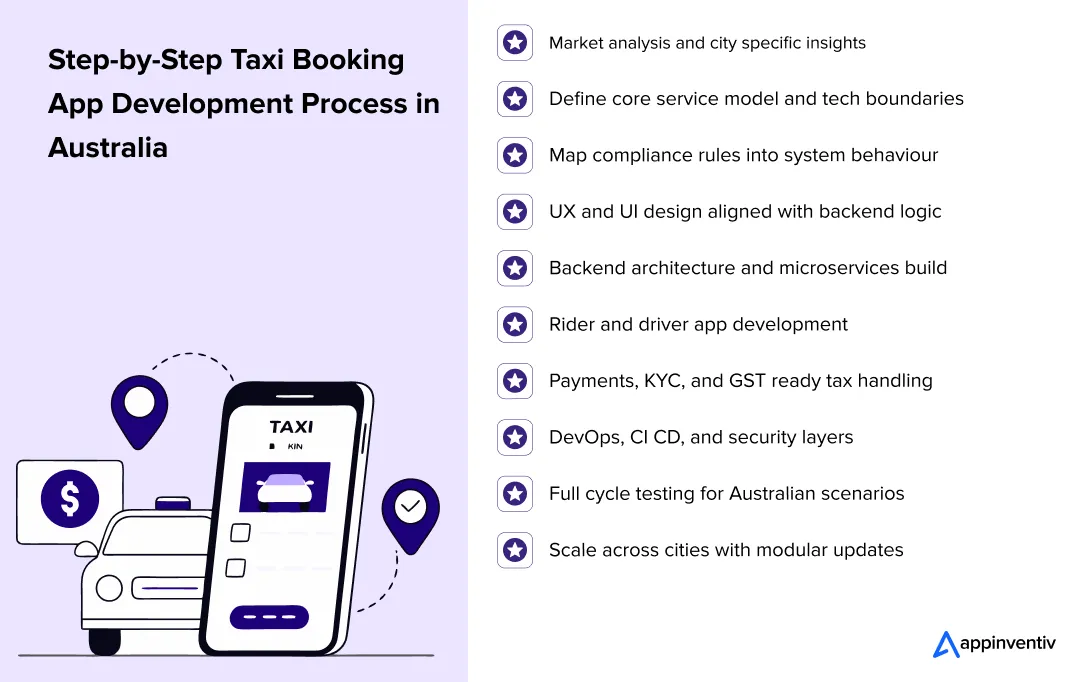
1. Start with market analysis that feeds into development
The research stage does not only influence business strategy. It shapes technical choices too. Understanding how people book rides in Sydney versus Brisbane helps developers plan for multi zone pricing, route logic, and surge handling.
Development teams often gather:
- City wise demand patterns
- API requirements for mapping and ETAs
- Expected load during peak travel
- Airport zone rules that may affect trip calculation
- Special booking use cases such as NDIS or corporate rides
These insights guide early architectural planning, especially for online taxi booking app development where user flows differ city to city.
2. Define the core service model and technical boundaries
Before writing code, teams outline what the platform must deliver at version one. This saves engineering time and reduces rework.
Teams clarify:
- Which booking types to support
- How flexible the pricing engine needs to be
- Whether live chat or call masking is required
- How many dashboards the admin ecosystem will include
- What data to store and what can be pulled from third party APIs
This step gives developers a clear direction and helps shape the tech stack for creating taxi booking app features that do not lock the product into a rigid structure later.
3. Map compliance requirements into system behaviour
Regulation in Australia is not just paperwork. It affects the technical flow. Driver verification, insurance data, nightly reporting, and safety interactions must be built into the system.
For example:
- Driver accreditation checks often require back office APIs
- Privacy Act rules influence where data sits in the database
- Some states require audit friendly logs for trip details
- Safety prompts must appear at booking and trip start
- NDB scheme requires event logging for security incidents
By handling compliance early, taxi booking app development in Australia avoids rebuilds during deployment.
4. Begin UX and UI design informed by technical constraints
Australian riders expect a simple interface, but the logic behind it can be complex. The design stage aligns the user journey with what the backend and pricing engine can support.
Design teams work closely with engineering to finalise:
- Booking flow and ETA visibility
- Fare calculation layouts
- Driver profile display
- Accessibility improvements such as large touch targets
- Location accuracy indicators for high density areas
Design files are then handed to developers with interaction notes and state diagrams.
5. Build the backend architecture and core microservices
Once the design stabilises, developers begin creating the backend. Most modern taxi systems use modular or microservice based structures rather than a single codebase. This helps scale the platform across Australia without slowdowns.
Common backend components include:
- Authentication service
- Rider service
- Driver service
- Pricing and surge engine
- Trip lifecycle engine
- Notification service
- Payment service
- Admin service
Most platforms choose cloud regions in Australia to ensure compliance and reduce latency. Development teams also set up caching layers to handle heavy read volumes during peak time.
6. Develop the rider and driver applications
Mobile teams build the two primary apps in parallel. Sprint plans usually break down each module into smaller tasks so the apps grow gradually and predictably.
Key development tasks include:
- Real-time booking and cancellation flows
- Driver matching logic
- Route calculation using mapping APIs
- Payment interaction screens
- Document upload tools for driver onboarding
- In app chat or call masking
- Trip status updates through socket or MQTT protocols
Developers also prepare the codebase for collecting performance logs from day one.
7. Integrate payments, KYC, and local tax handling
Payment integration in Australia is a detailed process. The system should support multiple payment methods and comply with local security standards.
Development teams incorporate:
- PCI aligned payment gateway integration
- Apple Pay and Google Pay integration
- PayID support for instant payments
- GST ready fare calculation
- Weekly payout modules for drivers
- KYC verification APIs for onboarding
These modules are tightly tested because financial flows affect trust.
8. Implement DevOps, CI/CD, and security layers
Taxi platforms rely heavily on stable deployments and fast issue resolution. Development teams set up DevOps pipelines early to keep updates reliable.
Most setups include:
- CI/CD pipelines for automated builds
- Environment based configuration
- Infrastructure as code for cloud setups
- Secrets management
- Automated scaling rules
- Monitoring dashboards for API health
Security teams add encryption, role based access, and protection against common attacks.
9. Run full cycle testing tied to real Australian scenarios
Testing covers functionality, performance, mobile app security, compliance, and real world trip behaviour. Teams simulate peak loads like airport travel or weekend rush to see how the pricing engine and map APIs react.
Testing usually involves:
- Functional and regression checks
- Load and stress testing
- Surge accuracy tests
- Trip flow reconfirmation across regions
- Penetration testing
- Rating and complaint workflows
- Multi device and multi network testing
Australian compliance testing is completed before launch.
10. Launch in one city and collect real usage data
Most operators release the platform first in one location, often a mid-sized city, to observe real behaviour. Development teams monitor logs and metrics to identify friction points and performance issues.
Tracking focuses on:
- Booking success rate
- Driver acceptance
- Payment completion
- Crash logs
- Server response time
- Pricing anomalies
This period shapes decisions for the next rollout.
11. Scale to more cities with modular updates
When teams plan to launch a taxi app in Australia across multiple cities, the modular backend proves valuable. Most changes are configuration based rather than structural.
Scaling includes:
- Updating city zones
- Adjusting surge logic
- Adding new driver onboarding rules
- Monitoring traffic and adjusting infrastructure
- Introducing Melbourne, Perth, or Adelaide specific workflows
This approach allows steady growth without disturbing the core system.

Regulatory Requirements for Taxi Apps in Australia
Any business planning taxi booking app development in Australia has to work within a clear regulatory frame. These rules protect passengers, ensure driver accountability, and guide how data must be collected and stored. Regulations vary across states, but the overall expectations stay consistent. If you want to operate smoothly across Sydney, Melbourne, Brisbane, Perth, or Adelaide, compliance has to be built into the product from day one, not treated as an afterthought.
National privacy and data obligations
Australia’s Privacy Act and the Australian Privacy Principles apply to all mobility platforms that handle trip history, payment data, rider details, and live location. This affects how the backend is designed, where the database is hosted, and how long user information is retained.
Developers usually pick Australian cloud regions to ensure data stays within the country. The Notifiable Data Breach scheme also requires a clear path for logging incidents and alerting affected users when a breach is confirmed. These requirements influence event logging, access controls, encryption policies, and audit trails inside the system.
State level licensing and operational rules
Each state has its own framework for commercial passenger services. NSW follows the Passenger Transport Act. Victoria requires operators to align with CPVV rules. Queensland outlines its structure through the Transport Operations for Passenger Transport Act. Western Australia uses the On Demand Booking Service authorisation. South Australia has its own accreditation system.
For developers, this means driver onboarding must support state specific document checks, vehicle inspection evidence, and insurance records. Admin dashboards often include compliance monitoring tools to help operators track the status of each driver across states.
Safety and trip handling requirements
Safety is a major policy area in Australian mobility services. Apps must offer clear emergency options, accurate pickup details, and transparent driver identity information. Some states require audit friendly trip logs that record start time, end time, route, and pricing details. These logs become part of the backend storage model.
The app’s interface must show driver information, number plate details, and a way for riders to report concerns. Developers also prepare internal workflows for reviewing complaints, investigating safety incidents, and removing non compliant drivers.
Technical alignment with Australian cybersecurity expectations
The Australian Cyber Security Centre sets broad expectations for digital platforms. While not taxi specific, these guidelines influence how teams handle secure coding, system hardening, API protection, and ongoing monitoring.
Many mobility operators follow parts of the Essential Eight maturity model. In practice, this means the system uses multi factor authentication for admin users, proper patching cycles, encrypted traffic, and monitoring dashboards that track unusual behaviour. Building these controls early reduces technical debt and keeps the platform stable as it scales.
When these regulatory layers are handled at the system design level, expansion across cities becomes far smoother. With compliance covered, the next part of the journey is shaping the actual features that make a taxi platform work well for Australian riders and drivers.
Essential Features for an Australia Ready Taxi Booking App
A strong taxi platform in Australia needs more than standard booking tools. Riders expect convenience, drivers expect clarity, and operators expect systems that stay stable even during peak hours. These expectations shape the core feature set for online taxi booking app development and guide how the rider, driver, and admin experiences come together.
| Category | Key Features (Short List) |
|---|---|
| Rider | GST included fare estimates, real time tracking, saved locations, multiple payment options, accessible vehicle choices, verified driver details |
| Driver | Instant ride alerts, navigation with traffic insights, earnings summaries, document upload, trip history |
| Admin | Live trip monitoring, driver onboarding tools, zone based pricing, complaint management, analytics dashboards |
| Safety | SOS button, verified profiles, route recording, rider feedback, deviation alerts |
Rider features
Riders want a simple, reliable way to book a trip. The experience should feel predictable from the moment they open the app to the moment they reach their destination.
Key rider features include:
- Fare estimates that already include GST
- Accurate ETAs and real-time driver tracking
- Saved locations for faster repeat bookings
- Secure payment options such as cards, Apple Pay, Google Pay, and PayID
- Support for wheelchair accessible or child seat equipped vehicles
- Clear driver identity details before the ride begins
These elements help shape the broader features of taxi booking apps in Australia and influence long-term user satisfaction.
Driver features
Drivers need tools that help them accept and complete trips with minimal friction. A clean, stable interface supports higher acceptance rates and smoother operations.
Important driver features:
- Real-time ride request notifications
- Integrated navigation with traffic insights
- Day wise and week wise earning summaries
- Easy document upload and licence renewal flows
- Trip history for dispute resolution
These features strengthen Australian taxi app development by improving driver retention and operational reliability.
Admin and operator features
Operators rely on visibility and control. An admin dashboard becomes the main hub for managing drivers, monitoring live trips, and adjusting pricing based on city behaviour.
Core admin features include:
- Real-time trip monitoring and map view
- Driver onboarding and document management
- Zone based pricing settings for each city
- Complaint handling and refund management
- Analytics dashboards for demand patterns and performance
A strong admin panel is essential for any business looking to develop a taxi booking app in Australia and operate at scale.
Safety and service quality features
Safety is a non-negotiable expectation in the Australian market. These features help build trust and keep the platform aligned with local standards.
Key safety features:
- SOS button with quick access to emergency contacts
- Verified driver profiles
- Trip route recording for audit friendly storage
- Rider feedback and reporting tools
- Automatic flags for unusual route deviations
These additions support consistent service quality and align taxi booking app development in Australia with user expectations and local guidelines.
Technology Stack and Architecture for the Australian Market
A taxi platform needs a stable backend, clean API design, and a cloud setup that performs well across Australian cities. Development teams usually choose an architecture that can handle real-time events, peak load spikes, and strict data residency needs. The stack below reflects what most Australian taxi app development teams use for long-term reliability.
Core technologies
Technologies mentioned below form the foundation of how the app delivers speed, accuracy, and smooth real-time behaviour.
- Frontend: React Native or Flutter for cross platform apps
- Backend: Node.js, Java, or Go for handling trip flows and high concurrency
- Database: PostgreSQL or MongoDB with encrypted storage
- Real-time layer: Socket.io, MQTT, or Firebase for live updates
- Cloud: AWS Sydney, Azure Australia East, or GCP Sydney for local hosting
- Maps and routing: Google Maps APIs with traffic based ETA calculations
These technologies support multi-city expansion and help maintain low latency during peak usage.
Architecture considerations
Developers often choose a modular or microservice style structure so rider, driver, trip, and pricing engines run independently.
Key architectural elements include:
- Separate services for authentication, trip lifecycle, pricing, and payments
- A dedicated surge and fare calculation engine
- Event queues for trip status changes
- API gateway for routing requests and rate limiting
- CI CD pipelines to support fast deployments
Storing data within Australia helps the platform meet local privacy standards and maintain consistent performance.
Scalability and reliability
As the platform grows from one city to many, stable infrastructure matters. Teams plan for:
- Auto scaling rules
- Load balancers
- Monitoring dashboards
- Error tracking tools
- Disaster recovery inside Australian regions
This approach ensures the platform performs consistently, even during heavy airport or weekend traffic.
Cost to Build a Taxi Booking App in Australia: MVP to Enterprise Pricing
The cost to build a taxi booking app in Australia depends on how extensive your platform needs to be. A basic MVP focuses on essential booking and trip management. A full scale product supports multi-city operations, dynamic pricing, safety workflows, and detailed admin controls. Because Australia has its own compliance and payment expectations, development teams usually plan budgets with both technical and regulatory requirements in mind.
Understanding the Australian taxi booking app development cost also helps businesses plan budgets more accurately, especially when accounting for multi-city features and local compliance.
Cost ranges
These ranges reflect what most businesses spend when working with an experienced development team:
- Basic MVP: AUD 60,000 to AUD 90,000 ($40,000 to $60,000)
- Mid range platform: AUD 120,000 to AUD 280,000 ($80,000 to $180,000)
- Enterprise grade, multi-city platform: AUD 300,000 to AUD 600,000+ ($200,000 to $400,000+)
A typical end-to-end build falls somewhere within AUD 60,000 to AUD 600,000 ($40,000 to $400,000), depending on the app’s complexity and long-term growth plans.
What drives the cost
Several elements decide how much you will spend and how long the build will take:
- The number of features in the rider, driver, and admin apps
- Real-time modules such as driver tracking, trip status, and surge pricing
- Multi-city capabilities for Sydney, Melbourne, Brisbane, Perth, and Adelaide
- Integration of Australian payments such as PayID and GST ready pricing
- Compliance work tied to state specific licences and safety rules
- The depth of the pricing engine
- Cloud usage and data residency within Australian regions
- UI design complexity and accessibility support
- Required DevOps, monitoring, and security layers
These details help operators understand why two apps with similar layouts can have very different costs.
Development timeline and effort
Most taxi booking platforms follow a phased development model that keeps the delivery predictable:
- Discovery and requirement mapping: 3 to 4 weeks
- UX UI design and architecture planning: 4 to 6 weeks
- Core development (rider, driver, admin): 12 to 16 weeks
- Testing, optimisation, and compliance checks: 4 to 6 weeks
- Pilot launch in one city: 2 to 4 weeks
This timeline helps control risk and gives teams enough room to refine their systems before scaling across states. However, if you want to know in detail, check out our guide on: how long does it take to develop an app.
How to optimise costs
Many operators reduce development spend by making early structural decisions:
- Prioritising a clear MVP with phased feature rollouts
- Using a modular backend so future updates cost less
- Choosing cross platform development to avoid two separate codebases
- Automating compliance checks inside the admin panel
- Investing in scalable infrastructure early to avoid rebuilds later
Approaching the build this way often helps keep the overall investment predictable while still supporting future expansion.
Also Read: Tricks to reduce app development cost for Startups
Revenue Models and Unit Economics for Taxi Apps in Australia
A taxi platform in Australia earns revenue through a mix of commissions, pricing rules, and partner based arrangements. The aim is to keep rides affordable for riders while ensuring steady income for drivers and operators.
When you explore monetization strategies to make ride-hailing app platforms sustainable in Australia, most models balance commissions, dynamic pricing, and partner based earnings.
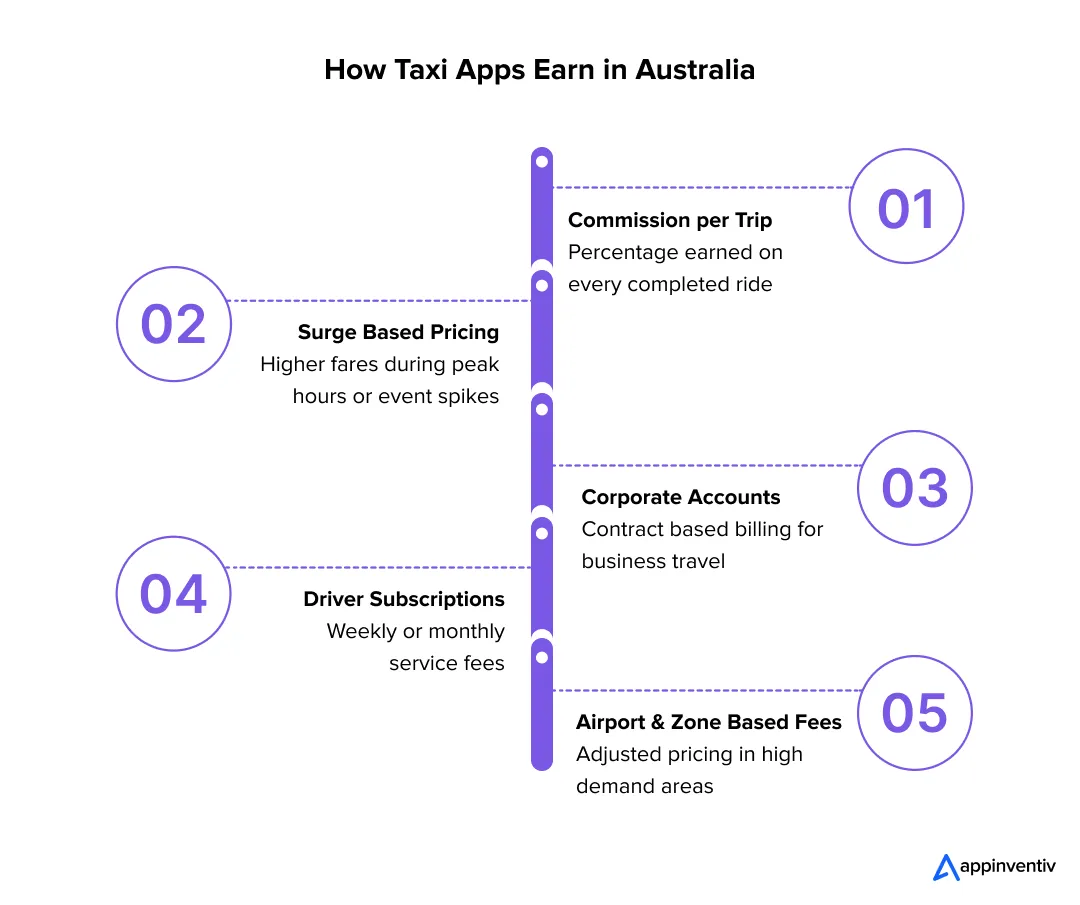
Primary revenue streams
For teams planning on-demand taxi booking app development for Australian businesses, these revenue channels form the core of the financial model.
- Commission per trip: A percentage taken from each completed ride.
- Surge based pricing: Higher fares during peak hours or event traffic.
- Corporate accounts: Fixed rate or contract based billing for business travel.
- Driver subscriptions: Weekly or monthly service fees for platform access.
- Airport and zone based fees: Adjusted pricing for high demand zones.
These models work well across cities such as Sydney, Melbourne, Brisbane, Perth, and Adelaide, where demand patterns vary through the week.
Understanding unit economics
A simple way to evaluate performance is to track contribution margin per trip. This includes the fare amount, commission collected, payment gateway fees, and any incentives paid to drivers. By measuring these values across different cities, operators can identify where pricing or operational changes are needed.
Platforms planning to launch a taxi app in Australia use these insights to refine their growth strategy and build a more sustainable model over time.
How to Select the Right Team for Taxi App Development in Australia
Selecting the right development partner is one of the most important decisions you make when building a taxi platform for the Australian market. The ecosystem here involves strict compliance rules, varied city behaviour, and technical requirements that need real experience. A capable partner helps you move through these layers with less friction and more predictability.
A good partner understands the local regulatory environment and builds your product around it. They also bring experience in developing real-time, location-based platforms that behave well under peak conditions.
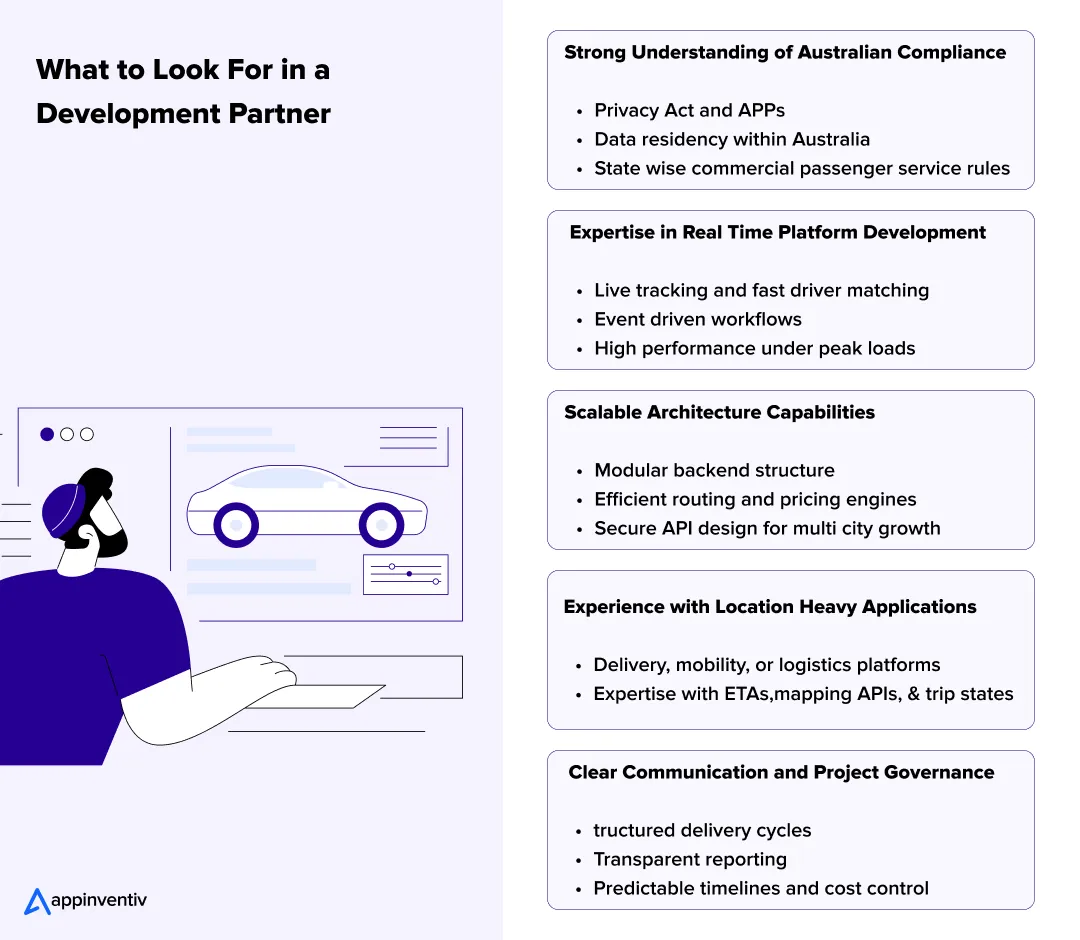
When evaluating partners for taxi booking app development in Australia, focus on the following:
- Understanding of Australian regulations: Look for teams familiar with the Privacy Act, Australian Privacy Principles, and data residency expectations. They should also understand state specific rules for commercial passenger services.
- Strength in real-time platform development: Taxi apps rely on live tracking, fast driver matching, and event driven workflows. A partner with experience in these systems reduces risk early in the project.
- Ability to build scalable architectures: Multi-city platforms need modular backends, efficient routing engines, and secure API designs. These capabilities help the product grow across Sydney, Melbourne, Brisbane, Perth, and Adelaide.
- Experience with location heavy applications: Teams that have built delivery, mobility, or logistics apps already understand how ETAs, trip states, and mapping APIs behave in real environments.
- Clear communication and project governance: Look for partners who offer structured delivery cycles, transparent milestones, and predictable reporting. This supports smoother decision-making and helps control budgets.
Evaluating partners with these points in mind makes it easier to select a team capable of delivering a stable, compliant, and scalable taxi platform for the Australian market.
Future Trends Shaping Taxi Apps in Australia
Taxi platforms in Australia are moving toward a more intelligent and energy efficient future. A lot of this shift is happening quietly in the background as systems learn from how riders travel across cities and how drivers respond to everyday demand. These small improvements gradually shape the broader direction of the market.
One clear trend is the rise of electric vehicle integration. More drivers are choosing EVs and hybrids to reduce running costs, with this eclectric fleet transition taxi apps will need features that support charging visibility, route planning, and battery aware dispatching. As the shift grows, apps will have to account for EV behaviour so trip times remain predictable.
Another direction is the steady adoption of smart dispatch systems. With the help of machine learning, platforms are learning to position drivers near airports, business districts, and major event locations without heavy manual intervention. AI based ride tracking also supports better ETAs and more accurate pricing during peak traffic. These improvements help operators reduce empty driving and improve service reliability.
Some emerging ideas are also gaining attention:
- AI integration for more accurate demand forecasting
- Driver behavior monitoring to improve safety and service quality
- Biometric verification for secure onboarding
- Blockchain for audit friendly trip records and payment transparency
- Multi service platforms that combine taxis with deliveries, rentals, or shared mobility
- Early experiments around autonomous vehicles and self driving taxis
These developments will not transform the industry overnight, but together they set the direction for cleaner fleets, smarter routing, and safer user experiences. Platforms that adapt to these innovations early will be better positioned to meet rising expectations in the Australian market.
Why Partner with Appinventiv for Taxi Booking App Development
Appinventiv brings hands-on experience in building real-time mobility platforms, making us a strong partner for businesses exploring how to build a taxi booking app in Australia. Our teams work across transport, logistics, and location-based services, giving us a clear understanding of how riders behave, how drivers operate, and what operators need to manage a reliable system. With 10+ years of APAC delivery experience and recognition among APAC’s High Growth Companies by Statista and FT for two consecutive years, we understand the scale and discipline this market demands.
Our work on TrackMyShuttle showcases the kind of engineering depth we bring to mobility projects. The platform required accurate live tracking, automated trip management, and a strong backend capable of handling high traffic. Challenges around routing, driver coordination, and real-time visibility helped us refine the same capabilities that taxi platforms depend on. This experience directly supports businesses looking for capable app developers in Australia who can deliver stable, multi-city ready systems.
Whether you are starting with one city or planning a wider rollout, we help you build a platform that is compliant, scalable, and aligned with Australian user expectations. If you are considering your next steps, our team can guide you through strategy, development, and launch to help you move forward with confidence.
FAQs
Q. How much does it cost to develop a custom taxi booking app in Australia?
A. The cost to develop a custom taxi booking app in Australia usually falls between AUD 60,000 and AUD 600,000, depending on how complex the platform is. Features like real-time tracking, multi-city support, advanced pricing rules, and safety workflows can increase the total investment. A clear plan for how to build a taxi booking app in Australia helps keep the scope predictable.
Q. How long does it take to develop a ride-hailing app for the Australian market?
A. Most ride-hailing apps take five to seven months to move from discovery to launch. This includes research, UX UI design, backend development, mobile app development, testing, and pilot releases. Timelines can vary based on feature depth and the number of cities you plan to include.
Q. What is the development process for a taxi booking app?
A. The development process usually follows a structured flow:
- Discovery and market analysis
- Feature planning and compliance mapping
- UX UI design
- Backend and mobile app development
- Integration of payments, mapping, and safety tools
- Testing, optimisation, and city-wise rollout
This process helps manage taxi app development challenges early and supports long-term scalability.
Q. Are there any legal or compliance requirements in Australia?
A. Yes. Taxi and ride-hailing platforms in Australia must follow the Privacy Act, Australian Privacy Principles, the Notifiable Data Breach scheme, and state-specific commercial passenger service regulations. Driver accreditation, insurance checks, and audit-friendly trip logs are part of the standard compliance workflow.
Q. Can I integrate multiple Australian cities into one taxi app?
A. Absolutely. Most modern platforms are built to support Sydney, Melbourne, Brisbane, Perth, Adelaide, and regional areas in a single system. This requires multi-zone pricing, separate compliance settings, and scalable cloud architecture. When planned early, multi-city expansion becomes smooth and cost-effective.
Q. What are the benefits of developing a taxi booking app for the Australian market?
A. Building a taxi app for the Australian market gives operators a stronger hold on pricing, demand, and service quality across major cities. Riders get predictable fares, real time tracking, smooth navigation and route optimization, and access to multiple payment gateways. Drivers benefit from clearer earning visibility through earnings dashboards, flexible work schedules, and priority dispatch during peak hours.
For operators, a well built platform supports automated compliance checks, trip history reports, and data analytics and insights that help refine pricing, promotions, and city wise performance. These capabilities make it easier to expand services into rural and semi urban regions while managing operations from a single system. A strong app also helps tap into airport movement, event traffic, and daily commuter demand across Australia’s busiest routes.
Q. What taxi app development challenges should I expect?
A. Common challenges include managing real-time accuracy, balancing driver supply, complying with state regulations, and handling peak-hour loads. Transparent planning and a scalable architecture help reduce most of these challenges early in the development cycle.
Q. Should I choose a white label or a custom solution for my taxi booking app?
A. White label platforms can help you launch quickly, but a custom solution gives you far more control over features, scaling, compliance, and long term costs. A custom build aligns better with Australian regulations, supports multi city expansion, and lets you tailor rider, driver, and pricing workflows to your business model. If you want a future ready platform designed around your needs, custom development is usually the stronger choice.

- In just 2 mins you will get a response
- Your idea is 100% protected by our Non Disclosure Agreement.

How to Build a Forex Currency Trading App for Multi-Currency Trading in the UAE
Key Takeaways: In the UAE, regulation comes first. Your licensing choice will shape how the entire platform is built. A forex app here needs more than charts. It needs a solid trading engine, strong liquidity connections, and reliable risk controls. AED funding, USD settlement, Islamic swap-free accounts, and Arabic support are practical requirements, not optional…

A Guide on How to Choose the Right Mobile App Development Company in Iraq
Key Takeaways Define business goals, integrations, compliance needs, and success metrics before engaging a development partner. Prioritise teams experienced in Arabic/Kurdish localisation, RTL UX, and testing on low-spec Android devices common in Iraq. Evaluate architecture maturity, security standards (SOC2/ISO), and CI/CD practices rather than focusing only on development cost. Ensure the application is designed for…

How Much Does It Cost to Build a Calorie Counting App Like Cronometer in Australia
Key takeaways: Building a calorie counting app with Cronometer-level accuracy in Australia typically costs between AUD 70,000 and AUD 700,000+, depending on data depth, compliance posture, and analytics sophistication. Underestimating compliance, data licensing, and post-launch governance is the most common cause of budget overruns for Australian nutrition platforms. The hard cost driver is not screens.…