


























Hire vs Outsource Development After Funding: What Actually Scales Faster?


- What “Scaling Faster” Really Means for Funded Startups
- Should You Build an In-House Development Team After Funding?
- Why Outsourcing Often Scales Faster After Funding
- Why AI Capabilities Scale Better With Experienced Outsourcing Teams
- Legal and Compliance Considerations When Working With a Custom Development Partner
- The Hidden Costs Founders Rarely Calculate
- Why Most Funded Emerging Businesses End Up with a Hybrid Model
- A Practical Decision Framework for Emerging Businesses After Funding
- Common Challenges After Funding and How Teams Work Through Them
- How This Decision Impacts the Next 12–24 Months
- How We Helped JobGet Raise $52 Million in Funding
- Why Emerging Businesses Partner with Appinventiv to Scale with Confidence
- FAQs

Key takeaways:
- After funding, the real challenge is execution speed without instability, not just adding engineers.
- Hiring in-house takes longer to show impact than most emerging businesses expect.
- Outsourcing accelerates delivery by adding experienced execution capacity without long hiring cycles.
- Most emerging businesses scale best with a hybrid model that balances control and speed.
- The right engineering model turns funding into predictable momentum, not chaos.
The day funding closes feels like a win. The week after feels different. Suddenly there are timelines attached to every roadmap item. Investors want updates. Hiring plans get discussed before the last sprint is even finished. This is usually when the internal debate starts to surface: hire vs outsource development after funding. Not as a strategy slide, but as a real constraint tied to time and expectations.
This urgency is not just internal. According to recent industry data, even after raising capital, roughly 35% of emerging businesses fail before they can close a subsequent funding round because they struggle to scale effectively and execute on their growth plans. That underscores just how high the stakes are once funding arrives: investors expect not just progress but velocity.
The instinctive move is to build an in-house development team. It feels stable, it feels controlled. But hiring developers after raising venture capital takes longer than most founders anticipate. Strong engineers have options. Interviews stretch. Early hires need onboarding and clarity around architecture that may not yet exist. During that ramp-up period, momentum can stall.
Meanwhile, the product itself is often still running on early decisions made under pressure. Shortcuts that were acceptable during the MVP stage begin to surface. Features become harder to extend. Performance issues show up under load. This is when conversations about working with an outsource software development company begin to feel practical rather than optional.
At this stage, the real issue is not ideology. It is an execution capacity. The decision becomes part of a broader post-funding growth strategy. Before choosing a path, founders need to define what scaling actually means for their product and how quickly it must happen.
Nearly 48.4% of new ventures fail within five years, often due to execution gaps, not capital shortages.

What “Scaling Faster” Really Means for Funded Startups
Scaling faster means improving delivery speed without increasing instability, rework, or leadership overhead.
After funding, growth pressure shifts from “can we build this?” to “can we keep building at this pace?” Speed that collapses under load is not scale. Real scale shows up when teams can ship consistently, handle complexity, and recover quickly when things break.
This is where many founders misjudge progress. Output increases, but coordination slows. Releases happen, but bugs pile up. Headcount grows, yet decision making gets harder. Scaling the engineering function after funding is about reducing friction, not just adding capacity.
The table below captures what “faster” actually looks like in practice for funded startups.
What Scaling Faster Actually Involves
| Dimension | Early-Stage Speed | Post-Funding Scale Speed |
|---|---|---|
| Delivery | Quick feature pushes | Predictable release cycles |
| Team growth | Ad-hoc hiring | Structured ramp-up |
| Architecture | MVP-driven | Scale-ready foundations |
| Decision flow | Founder-led | Distributed ownership |
| Risk | Accepted shortcuts | Controlled trade-offs |
When founders ask how to scale a tech team after Series A, this distinction matters. The next sections examine how hiring and outsourcing perform against these scale realities, not just against short-term velocity.
Should You Build an In-House Development Team After Funding?
Hiring your own engineers feels like the safest move after funding. You get people in the room, shared ownership, and the sense that the product finally has a “real” team behind it. For many founders, that control is reassuring. But control does not always translate into speed, especially at this stage.
Where In-House Teams Actually Help
When internal teams work well, they do so over time, not overnight.
- They know the product deeply: Over weeks and months, engineers build context that never shows up in tickets. They remember why certain shortcuts were taken and where the system is fragile.
- Technical decisions stay consistent: Architecture choices around data, APIs, and deployment are easier to carry forward when the same people are involved.
- Security and ownership feel clearer: Access control, IP protection, and sensitive logic stay tightly managed as expectations rise.
- The team starts thinking beyond features: Internal teams tend to invest in stability, internal tools, and cleanup once they settle in.
Also Read: Importance of Blockchain Intellectual Property Protection
Where Hiring Starts to Slow Things Down
This is where the experience of funded startups often diverges from the plan.
- Hiring takes longer than expected: Even after raising capital, good engineers are hard to land. Interviews drag on, offers get declined, and onboarding takes real time.
- New hires inherit old decisions: Most codebases still carry MVP-era shortcuts. Fresh engineers spend their first months understanding constraints instead of moving fast.
- Founders lose execution time: Managing people, aligning priorities, and reviewing work starts eating into the time once spent building.
- Coordination costs creep in: More people means more dependencies, more reviews, and slower releases if processes are not ready.
Building an in-house development team can be the right move, but only when the foundations are ready for it. Without a clear startup engineering team structure and senior technical leadership, hiring can feel like progress while quietly reducing velocity.
Quick Comparison: Hiring vs. Outsourcing (2026 Post-Funding Context)
| Decision Factor | Hiring In-House Team | Outsourcing Development |
|---|---|---|
| Time to Impact | Slow (weeks to months onboarding) | Fast (days to weeks) |
| Execution Speed | Slows initially, improves over time | Immediate acceleration |
| Control & Ownership | High | Moderate (defined by contracts) |
| Access to Expertise | Limited to hired talent | Broad, on-demand expertise |
| Cost Structure | Fixed, long-term commitment | Variable, project-based |
| Scalability | Hard to scale quickly | Easily scalable up/down |
| Technical Debt Handling | Slower without prior scale experience | Faster with experienced teams |
| Leadership Bandwidth | High involvement required | Reduced management overhead |
| Best Use Case | Stable systems, long-term ownership | Aggressive timelines, immediate scale |
Why Outsourcing Often Scales Faster After Funding
After funding, most startups are not short on ideas. They are short on execution capacity. This is where outsourcing starts to make sense, not as a fallback, but as a way to keep momentum intact while the internal team finds its footing. For many teams, working with an outsource software development company becomes the fastest way to move forward without waiting for hiring cycles to catch up.
Where Outsourcing Creates Immediate Leverage
Outsourcing delivers its biggest value when speed and depth are both required.
- Parallel work without slowing decision making: Instead of sequencing work around a small internal team, outsourced engineers can take ownership of clearly defined streams.
Backend optimization, infrastructure hardening, frontend performance fixes, and QA can move at the same time. This is often how founders realistically answer the question of how fast can you scale with outsourced developers after funding.
- Hands-on experience with scale problems: Teams that have worked with multiple growth-stage products tend to recognize patterns early.
They have dealt with traffic spikes breaking databases, CI pipelines becoming unreliable, cloud bills climbing unexpectedly, and APIs growing without clear boundaries. That exposure helps avoid mistakes that first-time scaling teams usually encounter.
- Focused work on foundations without stopping feature delivery: Many funded businesses know their core systems need work but cannot afford to pause roadmap commitments. Outsourcing allows refactoring, performance tuning, modularization, or reliability improvements to happen quietly in the background while the product continues to evolve.
- Immediate access to specialized roles: Skills like DevOps, cloud cost optimization, security hardening, or mobile performance tuning are hard to hire quickly.
Outsourcing makes it possible to bring in that expertise exactly when it is needed, without reshaping the entire team structure.
Also Read: What Makes Outsourcing a Profitable Choice for Startups
Why Outsourcing Fits the Post-Funding Phase
Outsourcing aligns well with how startups actually grow after funding.
- It expands execution capacity without locking long-term headcount
- It reduces pressure on founders to manage every technical detail
- It allows systems to mature while internal leadership develops
- It keeps delivery moving during periods of rapid change
At this stage, the real question is rarely outsource development vs hire full-time developers in isolation. It is whether the team can increase output and stability at the same time. When used deliberately, outsourcing acts as a stabilizer, not a risk. It gives emerging businesses the space to grow into their next phase without losing speed.
Our tech expertise supports high-growth journeys from early funding to large-scale expansion.

Why AI Capabilities Scale Better With Experienced Outsourcing Teams
AI sounds straightforward on paper. Add recommendations, automate decisions and make the product smarter. In practice, it is one of the fastest ways to introduce complexity into a system that is already under pressure after funding. Data quality issues surface, latency creeps in, cloud costs spike. AI Models behave differently once real users hit them.
For emerging businesses, this is where outsourcing with experienced teams changes the outcome. Teams who have implemented AI in business before tend to think beyond the model. They look at how data moves through the system, how predictions are served under load, and what happens when something goes wrong in production. That experience matters more than tooling choices.
Where experienced outsourcing teams make AI practical, not fragile:
- Data does not stay clean on its own: Real-world data is messy. Experienced teams design ingestion and processing pipelines that can tolerate gaps, delays, and inconsistencies without breaking downstream logic.
- Models need guardrails, not just accuracy: In production, fallback logic, timeouts, and confidence thresholds matter as much as prediction quality. These are often missing in first-time AI builds.
- Infrastructure decisions show up in the cloud bill: Teams with prior exposure know when to use batch inference, when real-time is necessary, and how to avoid overprovisioning compute for occasional spikes.
- Deployment needs to support change, not perfection: AI Models evolve and data shifts. Outsourcing teams usually plan for versioning, rollbacks, and gradual rollouts from the start instead of rebuilding later.
- Monitoring is about behaviour, not dashboards: Tracking drift, latency, and failure patterns helps teams intervene early, before users notice problems.
Trying to build all of this internally often stretches teams thin. Backend engineers learn data pipelines on the fly. DevOps teams adapt infra reactively. Product timelines slip while everyone catches up. Outsourcing compresses that learning curve by bringing people who have already seen these issues play out.
The advantage is not just speed. It is fewer surprises. AI features built with production experience tend to integrate more smoothly, cost less to run over time, and require fewer rewrites. Internal teams can stay focused on what differentiates the product, while experienced partners handle the complexity of making AI work reliably at scale.
Legal and Compliance Considerations When Working With a Custom Development Partner
As emerging businesses scale after funding, legal and compliance risks do not disappear when development is outsourced. They simply shift. When working with a custom development service partner, the focus moves away from employment obligations and toward governance, ownership, and risk control across delivery.
Unlike direct hiring, outsourcing removes exposure to payroll requirements, benefits regulations, and worker classification laws. That reduction in administrative burden is one reason many emerging businesses choose custom development services during high-growth phases. However, this only works when the engagement is structured correctly.
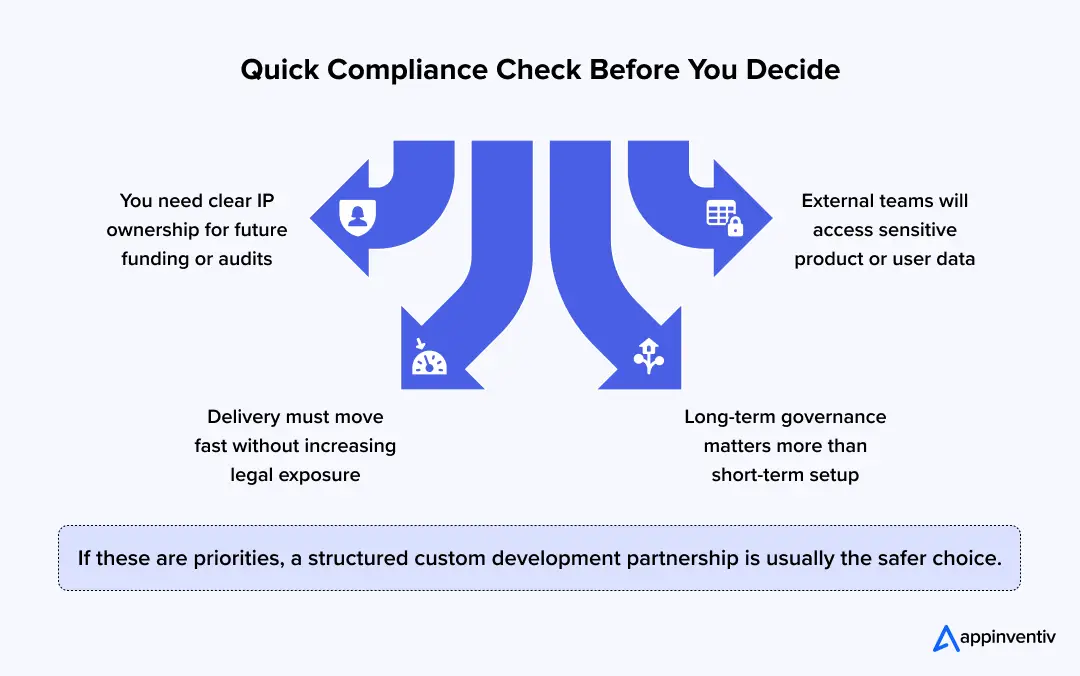
Key legal and compliance areas that matter in custom development engagements:
- Contracts and engagement structure: Clear contracts must define scope, deliverables, timelines, ownership, and exit terms. Ambiguity here often leads to delays or disputes as requirements evolve.
- Intellectual property ownership: All source code, product logic, AI models, and documentation created during the engagement should be contractually assigned to the business. This is critical for future fundraising, audits, or acquisitions.
- Data privacy and security controls: Custom development partners often access production or near-production data. Clear rules around data handling, access control, encryption, and breach response protect the business as usage grows.
- Documentation and knowledge transfer: Proper technical documentation ensures continuity and reduces dependency on individuals. This becomes especially important as internal teams expand or responsibilities shift.
- Compliance readiness at scale: As products grow, regulatory expectations increase. Working with partners that build with security and compliance in mind reduces the risk of retrofitting controls later.
Handled well, custom development partnerships can simplify compliance rather than complicate it. The right structure provides execution speed without exposing emerging businesses to long-term legal or regulatory risk.
The Hidden Costs Founders Rarely Calculate
After funding, cost decisions often look clean on spreadsheets. In practice, the most expensive issues show up in delivery friction, system instability, and repeated rework as the product grows.
Time-to-Impact Is Slower Than It Looks
Hiring developers after raising venture capital does not mean they start shipping immediately. New engineers need time to understand service boundaries, data ownership, deployment pipelines, and historical trade-offs.
If the system lacks clear documentation, environment parity, or automated testing, onboarding stretches further. Velocity often dips before it recovers, especially when senior engineers are pulled into constant support and reviews.
Technical Debt Compounds Under Load
Early architectural shortcuts usually sit around monolithic services, tightly coupled APIs, or poorly indexed databases. These choices often hold until traffic increases, background jobs pile up, or data volumes spike. Teams then respond with tactical fixes rather than structural ones.
Without experience handling these inflection points, issues around performance, reliability, and observability grow quickly. This is where the real cost of hiring developers vs outsourcing becomes visible, not in payroll, but in firefighting and downtime.
Also Read: Microservices vs Monolithic: the Best Startup Choice
Infrastructure and Cloud Costs Drift Quietly
As usage grows, infrastructure complexity increases. Poorly configured auto-scaling, inefficient queries, or unmonitored background processes can drive cloud bills up faster than revenue. Teams without prior scale exposure often discover this late.
Addressing it requires changes across mobile app architecture, caching strategies, CI/CD pipelines, and monitoring setups, not just minor optimizations.
Leadership Bandwidth Shrinks as Teams Grow
Scaling internal teams adds coordination overhead. Founders and early tech leads spend more time managing pull requests, resolving dependency conflicts, and aligning sprint priorities.
Less time is left for architectural decisions, roadmap sequencing, or long-term system design. Over time, this shift directly affects product stability and delivery predictability.
Rework Becomes the Costliest Line Item
Features built quickly without scale considerations often need to be revisited. APIs are refactored to handle new use cases. Data models are redesigned. Deployment workflows are rebuilt to support frequent releases.
When teams lack experience with growth-stage systems, these cycles repeat. Over a 12 to 24 month window, rework often outweighs initial development costs, regardless of delivery model.
Looking only at a surface-level cost comparison in-house vs outsourced development hides these realities. The next section explores why many funded startups move toward a hybrid model to manage these risks while maintaining speed.
Why Most Funded Emerging Businesses End Up with a Hybrid Model
In theory, the decision sounds binary. Build everything in-house or outsource and move faster. In reality, very few funded emerging businesses stay at either extreme for long. Once execution begins, trade-offs surface quickly, and teams adjust. This is usually how the dedicated development team vs in-house debate resolves in practice, shaped by real constraints rather than preference.
Internal Teams Anchor the System
Internal engineers tend to stay closest to the product’s long-term intent. They understand why certain architectural decisions were made and where the system is sensitive to change. In hybrid teams, this group typically owns the roadmap, core services, data models, and business-critical integrations. They set technical direction, review major changes, and protect decisions that would be costly to reverse later.
External Teams Carry Execution Weight
External teams are engaged where momentum matters more than proximity. This often includes infrastructure scaling, performance tuning, modular refactoring, test automation, and setting-up effective DevOps pipelines. These areas benefit from focused execution and prior exposure to growth-stage systems. When scoped well, this work progresses faster than it would through gradual internal expansion.
Boundaries Matter More Than Headcount
Hybrid models remain stable when technical boundaries are clear. Internal teams define interfaces, review standards, deployment rules, and quality thresholds. External teams operate within those guardrails. Well-documented APIs, shared repositories, and aligned CI/CD practices reduce friction and prevent release surprises.
Why This Fits the Growth Phase
For emerging businesses scaling product development after Series A, a hybrid model creates flexibility. Internal teams grow at a measured pace, while external capacity expands or contracts based on demand. As systems mature and leadership depth increases, ownership can shift inward without disrupting delivery.
When leaders weigh outsource development vs hire full-time developers, this outcome is common because it reflects how complex products actually scale. Speed and control are rarely found in a single model.
A Practical Decision Framework for Emerging Businesses After Funding
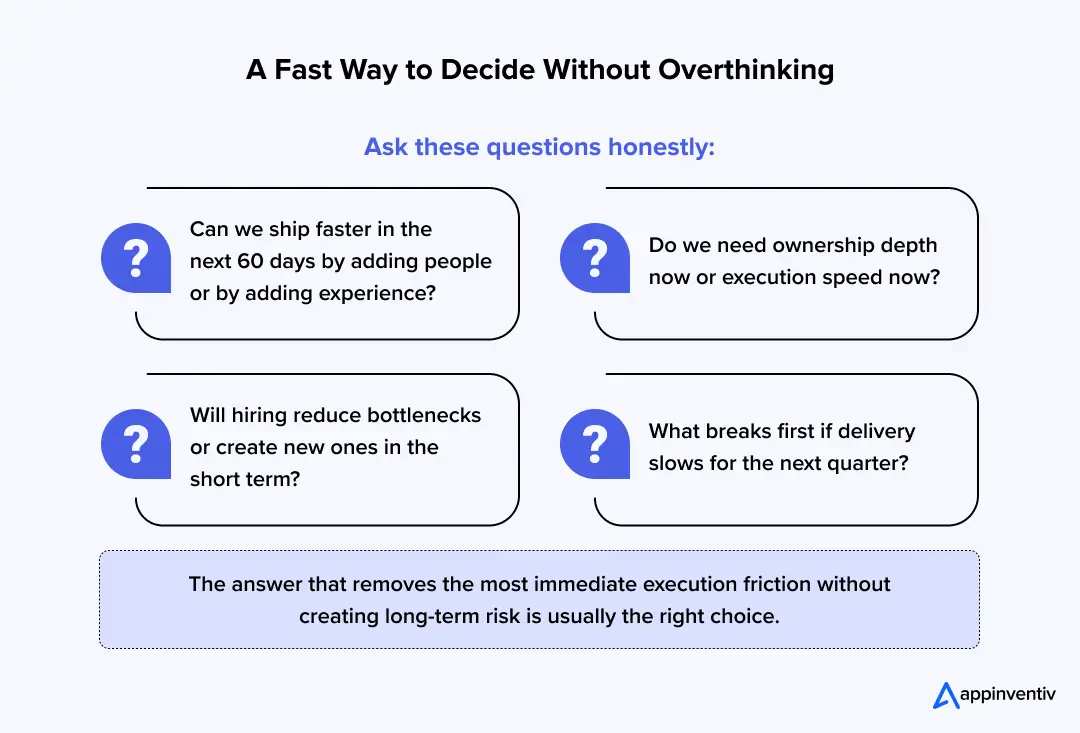
At this stage, the question is no longer theoretical. Emerging businesses need a way to decide based on execution reality, not preference. This framework helps answer should startups hire or outsource after funding by looking at signals inside the business.
When Hiring Internally Makes More Sense
Hiring is the right move when the organisation is ready to absorb people without slowing delivery.
Choose to hire when:
- Core architecture is already stable and documented
- Senior technical leadership has time to mentor and review
- The product roadmap is predictable for the next two to three quarters
- You are optimising for long-term ownership over short-term speed
In these cases, building an internal team strengthens continuity and reduces future dependency. This is often the path for emerging businesses that already have strong technical foundations and are focused on gradual expansion.
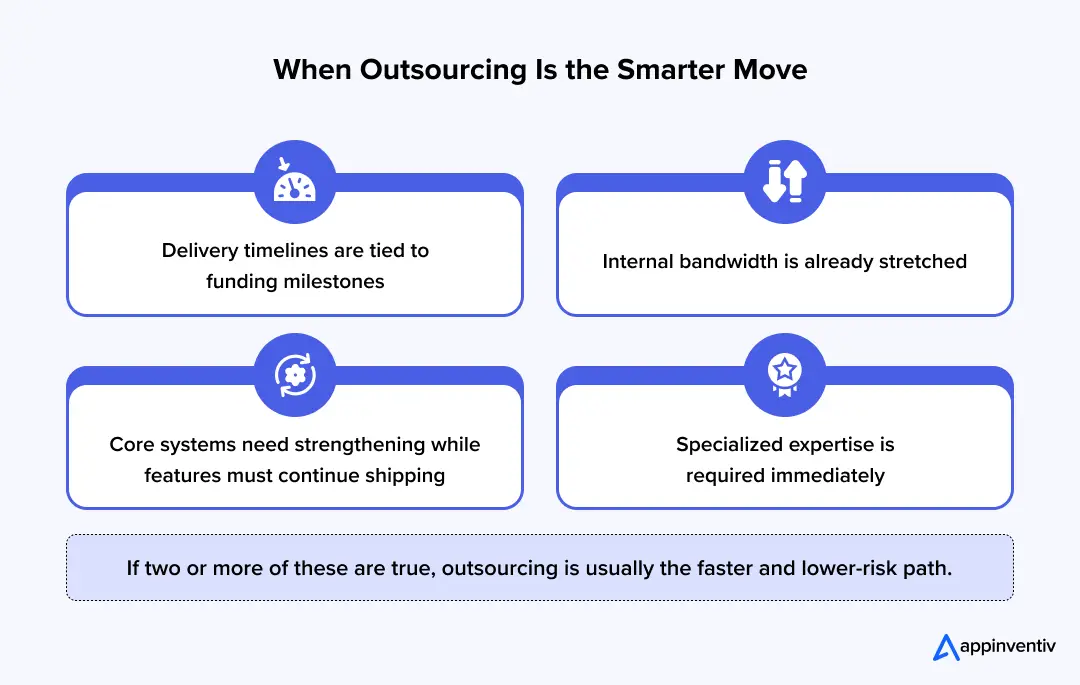
When Outsourcing Is the Faster Path
Outsourcing works best when speed and experience are the immediate constraints.
Outsourcing is the better option when:
- Delivery timelines are aggressive and tied to funding milestones
- Internal teams are stretched thin managing existing systems
- Infrastructure, performance, or reliability issues need urgent attention
- You need specialised skills that are hard to hire quickly
This is typically where leaders explore when to outsource product development, not to replace internal ownership, but to unblock execution. In these scenarios, the question shifts to how fast can you scale with outsourced developers without introducing instability.
When a Hybrid Model Is Non-Negotiable
Most emerging businesses land here, even if unintentionally.
A hybrid approach makes sense when:
- Internal teams own roadmap, architecture, and core services
- External teams execute defined workstreams in parallel
- Interfaces, review standards, and deployment rules are clearly set
- There is a plan for knowledge transfer over time
This model supports how to scale tech teams after Series A without forcing early, irreversible commitments. It allows capacity to expand while leadership and systems mature.
The Question You Should Actually Be Asking
Instead of debating outsource development vs hire full-time developers, the more useful question is this:
Where does execution slow down today, and what removes that bottleneck fastest without creating new risk?
For emerging businesses under post-funding pressure, the right answer is usually the one that preserves momentum while keeping technical control intact.
Common Challenges After Funding and How Teams Work Through Them
Most slowdowns after funding are not dramatic failures. They show up quietly, in missed deadlines, growing backlogs, and teams that feel busy but not effective. The issues are familiar. The difference is how teams respond once they notice them.
Hiring Before the System Is Ready
Emerging businesses start adding engineers while the product is still loosely structured. There is no clear picture of how services fit together, who owns what, or where changes are safe. New hires ask the same questions repeatedly and avoid touching risky parts of the system.
What works better: Before hiring aggressively, teams pause to map the system. They document key services, data flows, and deployment steps. This does not require a heavy process. Even basic clarity helps new engineers become useful faster and reduces hesitation.
Treating Outsourcing Like Task Delegation
External teams are given work without enough context. Access is limited. Standards are unclear. Progress feels slow and disconnected.
What works better: Outsourced engineers are brought closer to the product. They use the same repositories, pipelines, and monitoring tools as the internal team. Someone on the inside stays accountable for direction. Once this happens, delivery usually smooths out.
Chasing Cost Instead of Momentum
Decisions are made by comparing rates rather than outcomes. Teams choose what looks cheaper and later pay for it through delays and rework.
What works better: Leaders start measuring how quickly work turns into usable output. They pay attention to how often things need to be redone and how much time is spent unblocking delivery. Over time, this view leads to better trade-offs.
Missing Early Warning Signs
Deployments take longer. Bugs linger, and the infrastructure costs creep up. These signals are easy to ignore when growth feels urgent.
What works better: Teams treat these signs as early feedback. They invest in better monitoring, cleaner deployments, and small fixes before problems pile up. Addressing issues early usually saves far more time later.
Leaving Ownership Vague
As teams grow, responsibility spreads thin. No one is sure who decides on API changes or infrastructure updates. Releases slow down.
What works better: Clear ownership is assigned. Every critical area has someone accountable. Decisions move faster, and coordination becomes easier.
These challenges tend to surface while scaling the engineering team after funding. Teams that slow down just enough to add clarity often end up moving faster overall.
How This Decision Impacts the Next 12–24 Months
The choice you make right after funding does not just affect the next release or quarter. It quietly shapes how delivery feels, how teams operate, and how confidently the business grows over the next one to two years. The impact shows up less in speed spikes and more in consistency, stability, and optionality.
Below table shows the long-term impact of hire vs outsource decisions
| Area of Impact | What Happens When the Model Fits | What Happens When It Doesn’t |
|---|---|---|
| Delivery predictability | Releases become more consistent, timelines are easier to commit to, and surprises reduce | Output feels uneven, deadlines slip, and planning becomes reactive |
| Technical debt trajectory | Early scale work stabilises the system and slows debt growth | Shortcuts compound, making each new feature harder to ship |
| Engineering morale | Teams feel in control of their work and stay longer | Constant firefighting leads to fatigue and attrition |
| Leadership bandwidth | Founders and tech leads focus on direction and strategy | Leadership time is consumed by coordination and escalation |
| Investor confidence | Steady execution builds trust over time | Missed commitments raise questions during reviews and future rounds |
| Ability to adapt | Team structure can evolve without disruption | Course correction becomes costly and risky |
For emerging businesses scaling engineering team after funding, these outcomes matter more than early velocity. By the time the company is scaling product development after Series A, the effects of this decision are already embedded in how the organisation operates.
How We Helped JobGet Raise $52 Million in Funding
Before we move into the final perspective, here’s a real example showing how choosing the right execution model can unlock growth and investor confidence.
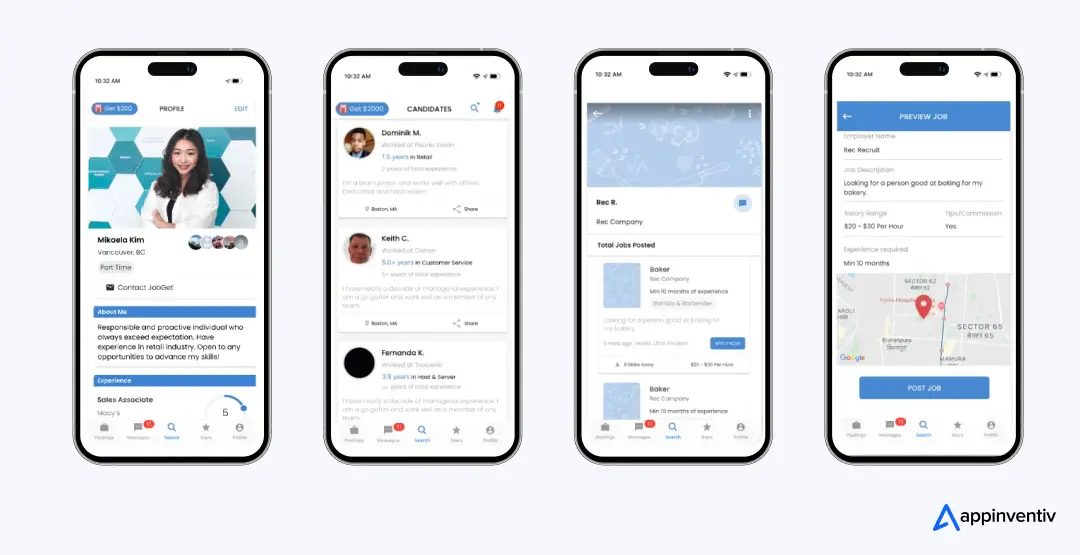
JobGet, a mobile job search platform connecting workers and employers with intelligent matching and location-based discovery, partnered with Appinventiv to build a product that truly delivered value in a crowded market. Our team worked from concept through design, development, and deployment to create a platform that reduced job search times dramatically and improved employer-worker engagement across the board.
- Appinventiv’s engineering and product delivery helped JobGet go from MVP to full-featured platform with robust search, GPS-based matching, and real-time messaging capabilities.
- As a result of that execution quality and product traction, JobGet secured $52 million in Series B funding, a clear signal of investor confidence in both the product and the team’s ability to scale.
- The app also achieved 2 million+ downloads, 50,000+ active companies on the platform, and 150,000+ jobseekers placed, all while earning notable industry recognition.
This case shows how strong execution and thoughtful technology choices can move an idea from funded concept to a growth-stage product that scales in usage and investor belief.
Get end-to-end custom app development delivered by seasoned engineers who have built and scaled products for growth-stage businesses.

Why Emerging Businesses Partner with Appinventiv to Scale with Confidence
For emerging businesses navigating hire vs outsource development after funding, the real concern is not headcount. It is execution under pressure. Once capital is deployed, delivery discipline, architectural strength, and speed of iteration determine whether growth compounds or stalls.
Appinventiv offers custom mobile app development services built to scale. With 1600+ technologists, 3000+ digital solutions delivered, and exposure across 35+ industries, our teams have supported businesses through inflection points where systems, users, and investor expectations grow at the same time. The focus is not just feature velocity, but structural stability.
Our work typically spans backend architecture modernization, modular system design, cloud infrastructure scaling, CI/CD automation, performance engineering, and security hardening. This allows emerging businesses to accelerate execution while reducing the technical risks that often surface during scaling engineering team after funding.
Instead of forcing a binary choice between internal hiring and outsourcing, we operate in flexible models. Internal teams retain product and architectural control, while our engineers expand capacity across clearly defined workstreams. This structure helps convert funding into predictable delivery momentum.
If you are evaluating how to scale your engineering function without slowing growth, get in touch, our team can make that transition far more controlled.
FAQs
Q. Is it better to hire developers or outsource after funding?
A. There is no single right answer. After funding, the decision depends on how quickly execution capacity needs to expand. Hiring works well when systems are stable and leadership bandwidth is available. Outsourcing is often more effective when timelines are tight and the product needs experienced hands immediately. For many emerging businesses, the answer to hire vs outsource development after funding ends up being a combination of both.
Q. How fast can you scale with outsourced development teams?
A. Outsourced teams can usually start contributing within days, not months. Because processes, tooling, and delivery practices are already in place, execution ramps up quickly. This is why founders asking how fast can you scale with outsourced developers often see meaningful progress far earlier than with net-new hires.
Q. What is the cost difference between hiring in-house and outsourcing?
A. On paper, salaries may look cheaper than vendor fees. In reality, the cost of hiring developers vs outsourcing includes onboarding time, management overhead, rework, and delayed delivery. When these factors are considered, outsourcing can be more cost-efficient during high-pressure growth phases.
Q. When should a startup build an in-house team?
A. An in-house team makes sense once core architecture is defined, documentation is solid, and senior technical leadership has time to mentor. This is typically when ownership and continuity matter more than raw speed. Many teams choose to build an in-house development team gradually while relying on external execution early on.
Q. Does outsourcing slow down product development?
A. Outsourcing slows things down only when context and ownership are unclear. When external teams are integrated properly, with shared tools, clear interfaces, and defined responsibilities, outsourcing often accelerates delivery instead of slowing it. The issue is not outsourcing itself, but how it is managed.
Q. How do venture-backed startups scale engineering teams?
A. Most venture-backed teams scale through a hybrid approach. Internal teams own roadmap and architecture, while external teams handle execution-heavy work. This model supports scaling engineering team after funding without forcing premature hiring or risking delivery delays as complexity increases.

- In just 2 mins you will get a response
- Your idea is 100% protected by our Non Disclosure Agreement.

Build In-House vs Hire a Development Agency: Real Cost Comparison
Key takeaways: There’s no universal winner in build in-house vs hire development agency, the right choice depends on stage, speed, and strategic priority. In-house development builds long-term capability but comes with higher fixed costs and slower ramp-up. Outsourcing offers flexibility, faster execution, and predictable project-based spend typically ranging from $40,000 to $400,000 for mid-scale initiatives.…

Digital Workspace: The New Normal for Software Development
From a time when only 5% of the employees in the USA were working remotely to now when millions across the world have been locked down in a remote working condition, the time and era of workspace is witnessing a drastic shift. While the freelancers and gig economy patrons are already extremely used to the…

How to Outsource Mobile App Development? A Comprehensive Guide
Key takeaways: Outsourcing boosts speed, innovation, and access to global talent without the delays and costs of building an in-house team from scratch. The process starts with defining your app’s goals, scope, and budget so you know exactly what to look for in an outsourcing partner. From there, choosing the right engagement model helps maintain…