
























How Generative AI is Powering Digital Product Development – 10 Use Cases, Benefits, and Real Examples

- The Role of Generative AI in Digital Product Development
- 10 Powerful Use Cases of Generative AI in Product Development
- Key Advantages of Generative AI in Product Development
- How to Successfully Integrate Generative AI into Your Product Development Project
- Challenges and Considerations in Generative AI Adoption for Digital Product Development
- Future Trends in AI-Powered Product Development
- Bringing Generative AI to Life in Your Next Product with Appinventiv
- FAQs

Key takeaways:
- Ranging from rapid prototyping through automated coding, Generative AI enables teams to speed up product delivery to market, with fewer resources and higher productivity.
- By using predictive analytics and real-time data, Generative AI helps teams make effective decisions prior to initiating the actual development based on data, which enhances the product-market fit and customer engagement.
- Generative AI releases human workforces to engage in creative innovation by taking over the continuous processes of coding, testing, and generating content.
- This ensures rapid iteration, fewer mistakes, and the development of more innovative and market-leading products.
Picture this: your product hits the market 30% faster, and you’ve cut prototyping costs nearly in half. For product teams constantly juggling deadlines, this isn’t just crucial to have—it’s a make-or-break. That’s exactly what’s unfolding today with Generative AI in digital product development.
We are now seeing how advanced machine learning models can pump out clean, production-ready code in minutes, build and tweak user interfaces using real-time data, and predict how users will actually behave with scary accuracy. This means teams can make smart design and feature calls before anyone even touches a keyboard. We’re not just talking about faster workflows; we’re looking at a complete shift in how ideas go from lightbulb moments to actual products.
Looking at McKinsey’s research, product managers are getting the most out of Generative AI—not just making their work smoother but seriously increasing productivity by handling tasks that involve lots of content creation. This works well because content-heavy work is perfect for automation, and AI is really good at finding useful patterns in fragmented data while handling product documentation on a much faster and bigger scale than people can manage.
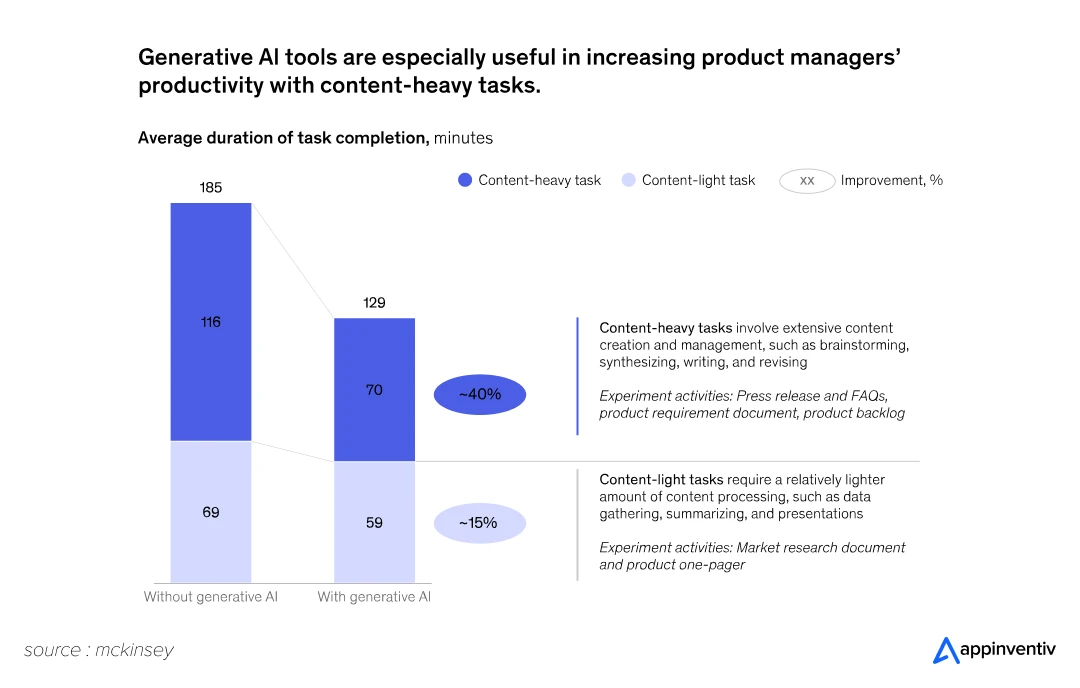
This shows how Generative AI in digital product development is making a significant impact, where it doesn’t just make things more efficient but also helps teams make better decisions and come up with new ideas throughout the entire product process.
To dive deeper, we’ll explore 10 game-changing use cases that show how Generative AI is transforming product design, development, and optimization. Before that, we’ll examine its evolving role, followed by real-world examples, key benefits, practical implementation steps, and emerging trends shaping the future of AI-driven product innovation.
Partner with our experts to design a solution that delivers measurable impact
The Role of Generative AI in Digital Product Development
Product teams are discovering something pretty remarkable: Generative AI in digital product development isn’t just another tool in the toolbox, it’s completely changing how fast you can go from brainstorm to launch. While traditional AI mostly looks at what already exists and tells you what might happen next, GenAI actually builds new products. We’re talking functional code, design mockups, user workflows, even the copy for your product pages.
Teams can now merge together prototypes, try out different approaches, and refine features at a pace that would have seemed impossible just a few years back. Generative AI for digital product design is basically like having a super technology that works across every part of your development process, helping teams stay aligned with current creative trends.
Comparing traditional product development vs AI-driven product development:
| Feature | Traditional Product Development | AI-Powered Product Development |
|---|---|---|
| Prototyping | Manual, slow | AI-assisted, rapid |
| Coding | Manual, repetitive | Automated code generation |
| Personalization | Generic | Hyper-personalized for each user |
| QA & Testing | Time-consuming | Automated & adaptive |
| Decision-making | Human intuition | Data-driven predictive insights |
In recent years, Generative AI has completely changed the way businesses approach product design and marketing, helping them stay competitive. The AI market for product design is expected to grow quickly, around 12.1% annually, rising from $15.84 billion in 2025 to nearly $25 billion by 2029. (Source: The Business Research Company)
This rapid growth underscores the need for leaders to be aware of the critical machine learning trends for 2026, driving innovation across all digital products.
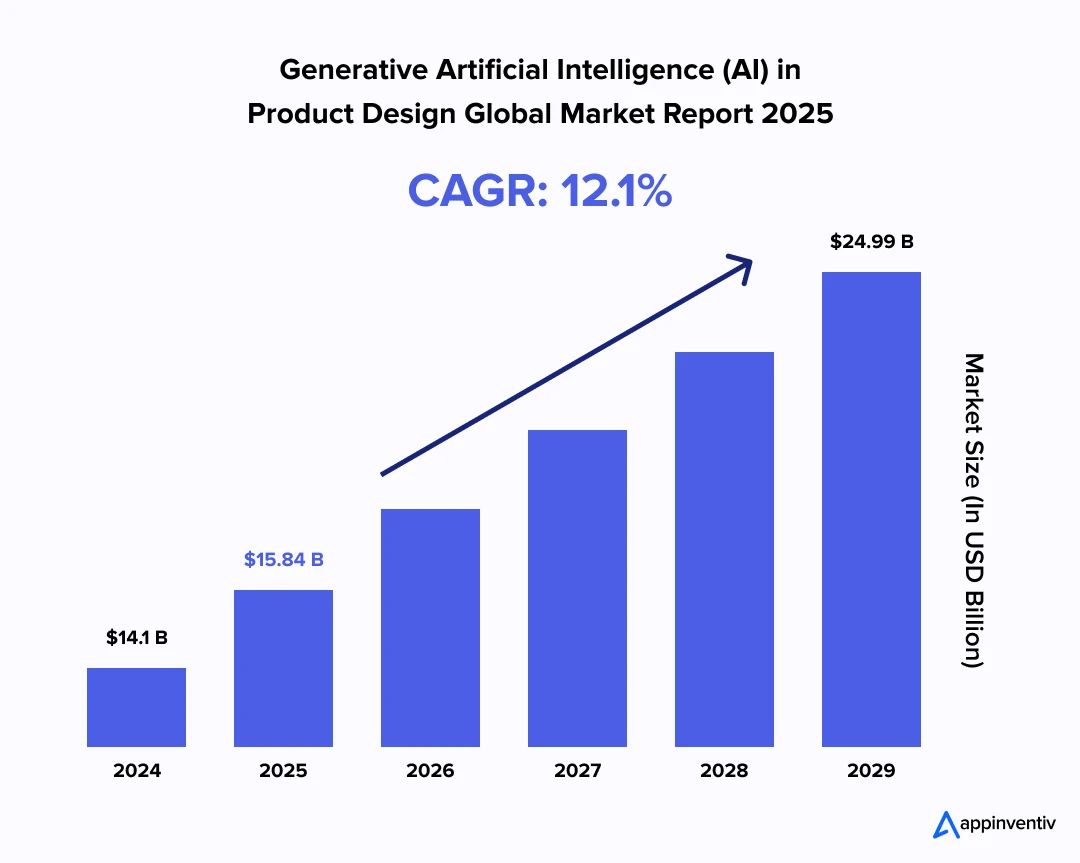
The numbers behind this shift are pretty staggering. McKinsey dropped a report that this expansion reflects strategic business leaders recognizing $60 billion in potential productivity improvements through the adoption of this emerging technology. The benefits, however, reach well beyond simple cost savings or faster development timelines.
GenAI allows companies to create tailored user experiences, enables agile product development teams to deliver enterprise-quality solutions, and facilitates ongoing product enhancement after market launch. In the current competitive digital environment, businesses that embrace these capabilities early will gain significant market advantages over those that delay implementation.
Also Read: Understanding the Role of AI in Product Development
10 Powerful Use Cases of Generative AI in Product Development
Product teams everywhere are discovering how AI changes the game when building digital solutions. It’s not just about working faster anymore; teams are cutting costs, making smarter decisions based on actual data, and creating products that users genuinely want. The latest AI breakthroughs let product teams build better, more focused solutions that hit the market quicker than ever.
Here are the 10 Generative AI use cases for products that are making waves right now, complete with practical benefits and real-world examples showing actual market impact.
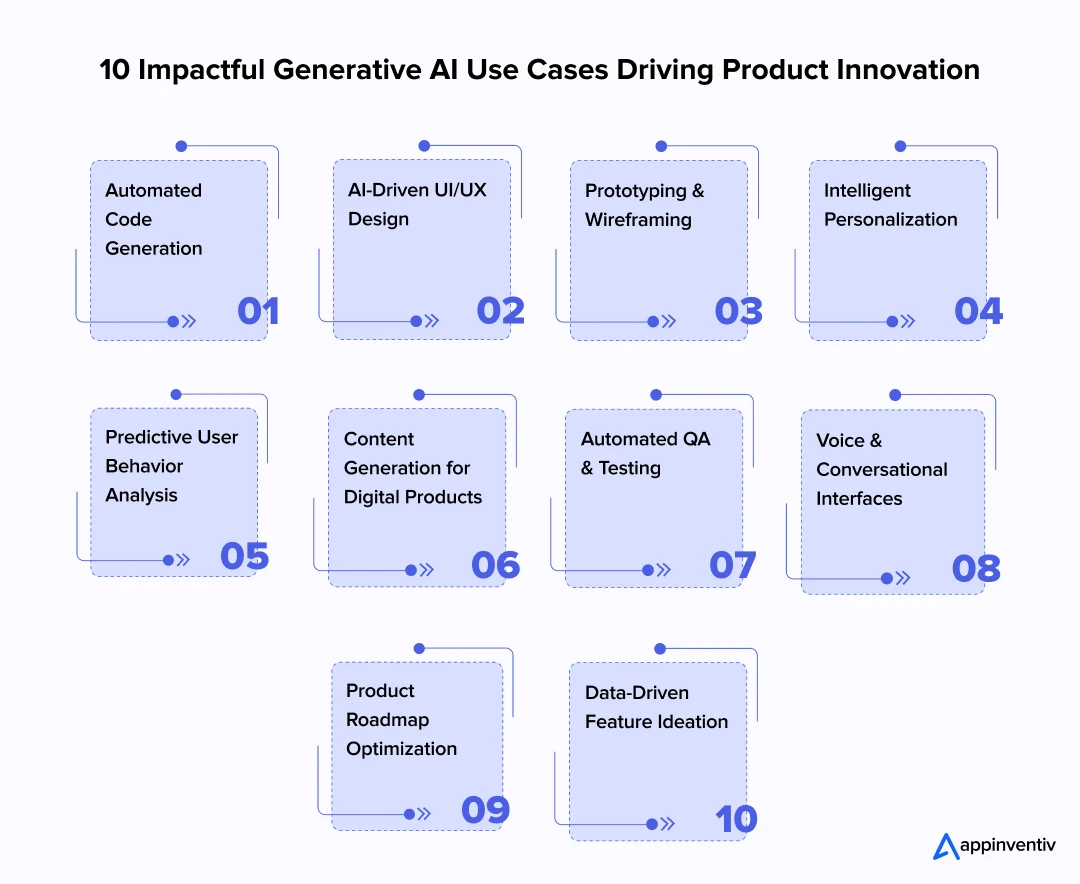
1. Automated Code Generation
AI now writes high-quality, ready-to-ship code from simple prompts or half-finished snippets, taking a huge load off product managers’ shoulders. This shift is changing Generative AI in digital product development by letting teams spend time on big-picture thinking and creative problem-solving instead of grinding through repetitive coding work.
GitHub Copilot works as an AI coding partner that recommends functions, writes complete code sections, and catches syntax mistakes as you work. By studying billions of lines of code, it learns your coding style, speeds up development cycles, and boosts overall team productivity substantially.
Business Impact:
- Reduced average sprint coding time by 25–35%
- Decreased boilerplate code effort by 40–50%
- Improved developer productivity by 20–30% per sprint
- Lowered bug density in early builds by 15–20%
CXO Signal: Faster releases with fewer engineering hours → direct cost efficiency + faster revenue realization
2. AI-Driven UI/UX Design
AI now whips up visual layouts, components, and user flows that actually match how people behave and what brands stand for. This is where Generative AI for digital product design really pays off. Teams can try out different layouts and make changes on the go based on user feedback. The end result? Interfaces that feel natural and keep people engaged.
Figma AI spits out design elements instantly, throws out layout ideas, and creates different theme options in seconds. The collaborative setup means several team members can jump in and tweak designs at the same time, cutting down project timelines while keeping everything looking consistent across all products.
Business Impact:
- UI design cycles shortened by 30–45%
- Reduced design rework iterations by 35%
- Improved design consistency across products by 25%
- Cut handoff delays between design and dev teams by 20–30%
CXO Signal: Faster product alignment and improved UX quality → higher customer engagement & retention
3. Prototyping & Wireframing
New prototyping tools can grab your rough sketches or even just written ideas and build them into wireframes that actually function. These AI-powered product development examples let companies validate concepts upfront instead of wasting budget on dead-end features. This works great with agile methods because you can test and adjust rapidly before committing to full development.
Uizard analyzes rough sketches and builds them into prototypes that users can navigate just like finished apps. Product teams test these with real users, gather their input, and refine the concept without pulling product managers away from other work. Companies report major savings in both timeline and budget using this approach.
Business Impact:
- MVP prototyping time reduced from weeks to 3–5 days
- Early-stage feature validation costs lowered by 40–60%
- Product idea rejection identified 2x faster, preventing sunk cost
- User feedback cycles accelerated by 50%
CXO Signal: Fail fast, spend less → capital efficiency & smarter product bets
4. Intelligent Personalization
AI customizes product experiences instantly by tailoring recommendations, layouts, and features to each user’s unique behaviour. This drive higher engagement, stronger customer loyalty, and increased revenue through smarter, more relevant targeting. As a result, users enjoy experiences that feel genuinely personalised and thoughtfully crafted.
Netflix utilizes Generative AI to process huge volumes of viewing data, ratings, and browsing patterns to deliver spot-on content recommendations. The platform continuously adapts to user choices, creating personalized sessions that keep subscribers engaged and reduce cancellation rates.
Business Impact:
- Increased user engagement time by 20–35%
- Improved recommendation click-through rates by 25–40%
- Reduced customer churn by 10–15%
- Revenue uplift from personalization-driven retention by 5–10%
CXO Signal: Personalization directly fuels ARR growth and customer lifetime value
5. Predictive User Behavior Analysis
AI forecasts feature adoption patterns, identifies where users typically abandon tasks, and reveals optimization opportunities. This proves vital when building digital products with Generative AI that match real user needs and market directions. Predictive analytics also prevents wasted investment in low-performing features.
Duolingo applies Generative AI models to predict learning behaviors, adjusting lesson complexity in real-time. This approach maintains optimal challenge levels without overwhelming users, significantly improving retention rates and ensuring steady progress across different user backgrounds.
Business Impact:
- Feature adoption accuracy improved by 30–40%
- Reduced drop-off points identified 2–3 releases earlier
- Retention rates increased by 15–25%
- Product roadmap misalignment reduced by 20%
CXO Signal: Data-backed roadmap decisions → lower risk of wasted product investment
6. Content Generation for Digital Products
AI now churns out massive amounts of in-app text, onboarding materials, chatbot conversations, and tutorial content that matches your brand’s voice perfectly. One of the major benefits of Generative AI for product development is how quickly and consistently it delivers polished content without the usual approval delays.
Jasper uses Generative AI to craft product copy that sounds natural and keeps users interested, whether it’s for small interface elements, welcome sequences, or support documentation. Marketing and product teams can now produce content in bulk while keeping their brand voice consistent and messaging crystal clear.
Business Impact:
- In-app and onboarding content creation time reduced by 60–70%
- Content production costs lowered by 50%
- Brand voice consistency improved across touchpoints by 30%
- Faster product localization across regions by 2–3x
CXO Signal: Scale content without scaling headcount → operational leverage
7. Automated QA & Testing
Generative AI handles those tedious, time-eating testing tasks by running through thousands of user scenarios to catch problems early. It makes quality checks way more efficient while getting products to market faster. It also keeps releases stable even when you’re pushing updates frequently.
Testim.io uses generative AI to build test cases that actually adapt when your product changes. It spots breaking points, flags security issues, and suggests concrete fixes, making deployments smoother and improving how products perform after launch.
Business Impact:
- Regression testing time reduced by 40–60%
- Production bugs decreased by 25–35%
- Release cycle frequency increased by 30%
- QA cost savings of 20–25% annually
CXO Signal: Higher release confidence → reduced downtime, legal risk, and customer complaints
8. Voice & Conversational Interfaces
AI creates natural conversations through voice assistants and chatbots, which makes products much easier for people to use. This shows Generative AI-driven product ideation at work – it basically creates brand new ways for users to interact that weren’t possible before.
Alexa Skills Kit helps product managers build engaging voice experiences across a wide range of industries. From hands-free shopping to interactive learning, it transforms traditional interfaces into natural, conversational interactions that users enjoy returning to again and again.
Business Impact:
- Customer support query resolution improved by 20–30%
- Average handling time reduced by 15–25%
- User engagement through voice channels increased by 2x
- Accessibility compliance improved across demographics
CXO Signal: Better CX at lower support cost → brand differentiation + operational savings
9. Product Roadmap Optimization
Generative AI looks at customer feedback, market signals, and how people actually use products to figure out which features should get built first. This approach to Generative AI for improving product features ensures that roadmap decisions are driven by real data rather than guesswork, allowing teams to focus their time on what will deliver the greatest impact.
Productboard utilizes Generative AI to analyze user comments and usage numbers to show teams what features really matter. It spots trends and connects them to business opportunities, helping teams focus on stuff that will actually give them an edge over the competition.
Business Impact:
- Feature prioritization accuracy improved by 35%
- Reduced investment in low-impact features by 25–30%
- Time-to-decision for roadmap planning cut by 40%
- Alignment between business goals and product delivery improved by 30%
CXO Signal: Capital goes where value is proven → stronger ROI governance
10. Data-Driven Feature Ideation
Generative AI digs through industry reports, competitor activities, and what consumers are actually saying to spark ideas for new features. This intelligent approach drives significant cost reduction in product development by preventing teams from investing in unwanted features, while accelerating innovation in areas with strong market demand.
Google AI Trends spots emerging topics, user behaviors, and market gaps that product teams can transform into competitive advantages. Companies that act on these insights quickly often end up leading market changes instead of scrambling to catch up later.
To maximize value from these use cases, product teams should develop an enterprise generative AI roadmap that sequences pilots, defines governance frameworks, and tracks ROI metrics.
Business Impact:
- New feature ideation cycles shortened by 50%
- Market-fit success rate for new features improved by 20–30%
- Reduced competitive blind spots by 35%
- Innovation pipeline velocity increased by 2x
CXO Signal: Lead markets instead of reacting → strategic differentiation
Key Advantages of Generative AI in Product Development
Generative AI combines automation with smart insights to completely change how teams plan, build, and polish digital products from start to finish. Here are some of the key benefits of leveraging advanced technologies like Generative AI for product development:
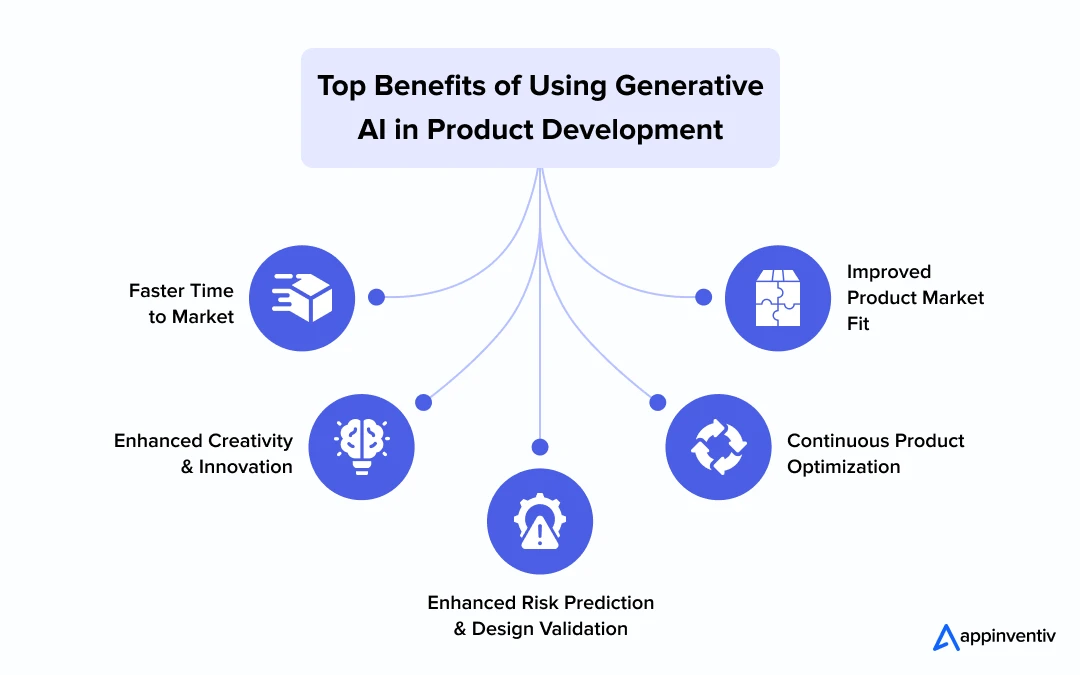
Faster Time-to-Market
AI speeds up everything – brainstorming, prototyping, coding, testing, so that businesses can beat their competitors. Automated processes eliminate roadblocks and let teams make quick changes based on user feedback. This speed defines Generative AI for digital product innovation, helping companies grab opportunities while competitors are still planning. When you cut out delays and streamline the production process, teams can keep developing products quickly, thus ensuring accelerated time to market.
Enhanced Creativity & Innovation
Generative AI brings out fresh design ideas, feature concepts, and different approaches that open up creative doors for product teams. One of the biggest benefits of Generative AI for product development is that it suggests unique, surprising directions that human teams often miss.
By delivering dozens of variations and improvements in minutes, Gen AI breaks down creative roadblocks. This means businesses can experiment freely without worrying about blown budgets or projects dragging on forever.
Improved Product-Market Fit
Generative AI digs through mountains of market research, customer feedback, and user behavior data to make sure products actually match what people want. This strengthens Generative AI in digital product development by helping teams build stuff that users genuinely need right from the beginning.
By forecasting how well features will be adopted and identifying what users value most, AI prevents teams from wasting time on features nobody wants. You end up with products that really click with target customers, boosting both initial uptake and long-term loyalty.
Continuous Product Optimization
Generative AI keeps improving products after they go live by tracking performance numbers, anticipating what users will need next, and adjusting features as situations change. This matches perfectly with Generative AI for digital product design, where products evolve constantly instead of waiting for problems to surface.
Automated improvements might include small interface changes or completely new features based on how people actually use the product. This keeps products competitive over time while ensuring customers stay interested in something that feels current and useful.
Enhanced Risk Prediction and Design Validation
AI can test how products will work in different real situations and tough conditions, helping teams catch problems and solve them before they start making anything. By checking designs on computers first, it stops expensive screwups, makes development faster, and ensures products follow safety, quality, and legal rules from day one.
These digital tests also let teams compare different design ideas quickly, choosing the one that works best and lasts longest. Down the road, this means customers are happier and companies do better against their competition.
How to Successfully Integrate Generative AI into Your Product Development Project
Adding AI to product development workflows demands careful coordination between innovation goals, strategic planning, and execution discipline. Organizations cannot simply deploy AI tools and expect immediate results – they must redesign their development frameworks to guarantee each implementation step produces tangible business outcomes. This roadmap below provides a practical framework for successful integration while controlling implementation risks.
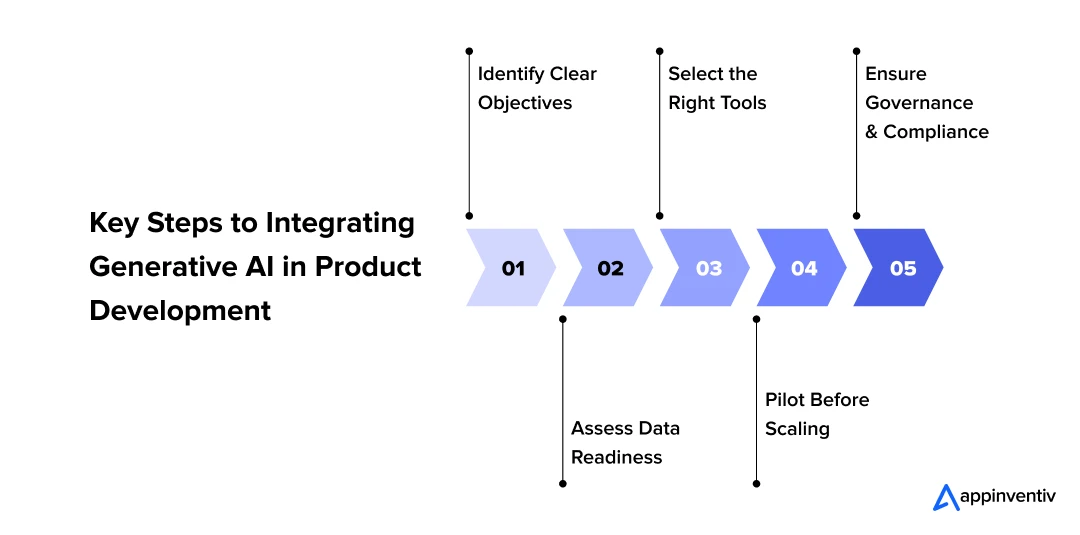
1. Identify Clear Objectives
Start by establishing concrete goals and business justification for your AI investment. Do you need faster market entry, better personalization features, or lower prototyping costs? Without well-defined targets, companies often pursue AI adoption because competitors are doing it rather than for genuine strategic value.
Organizations that effectively deploy Generative AI in digital product development tie their projects to specific, measurable results – like improving design cycle speed or eliminating manual coding tasks. This targeted approach ensures AI functions as a growth engine instead of costly technology experimentation.
2. Assess Data Readiness
AI works best when you feed it clean, relevant information. Before jumping in, take a hard look at your data – check if it’s accurate, covers different scenarios, and comes from legitimate sources. Fragmented data creates problematic results that can damage customer relationships.
Many AI-powered product development examples show that spending time upfront on data cleanup, proper labeling, and organization delivers major benefits later through better predictions, smarter personalization, and dependable automation. The better your data quality, the more value AI can provide without forcing expensive do-overs.
3. Select the Right Tools
With hundreds of AI platforms out there, picking the wrong ones can sink your entire project. Think about growth potential, how well they work with existing systems, pricing, and what specific capabilities you actually need – automated interface design, code writing, or behavior prediction.
Examining AI use cases in similar businesses helps identify platforms that have delivered real results. The goal is to build a technology setup that enhances existing processes rather than forcing a complete workflow overhaul.
4. Pilot Before Scaling
Don’t rush into company-wide deployment – that’s asking for trouble. Start with a controlled test using just a few features or one product section. This testing period lets you check performance, get team input, and spot problems without burning through your entire budget.
Think of this as your Gen AI in product development lifecycle experimentation phase, where you test, measure, and adjust your strategy. What you learn here will make your full rollout much smoother and more successful.
5. Ensure Governance & Compliance
Solid oversight is crucial for long-term AI success. You need clear rules for data privacy, bias monitoring, output validation, and decision accountability. Without these protections, even sophisticated AI can create serious reputation and legal problems.
A disciplined governance framework keeps your Gen AI in product development projects compliant with AI regulations, ethical standards, and customer expectations. When AI decisions are transparent and trackable, both your team and customers will feel more comfortable with the technology.
Also Read: The New Product Development Process
Challenges and Considerations in Generative AI Adoption for Digital Product Development
Generative AI offers exciting possibilities for product development, but rolling it out isn’t straightforward. Teams face real issues around protecting sensitive data and preventing errors that could backfire. Smart businesses tackle these problems early to avoid bigger obstacles later and keep users, business partners, and regulators satisfied. Let’s have a look at those:
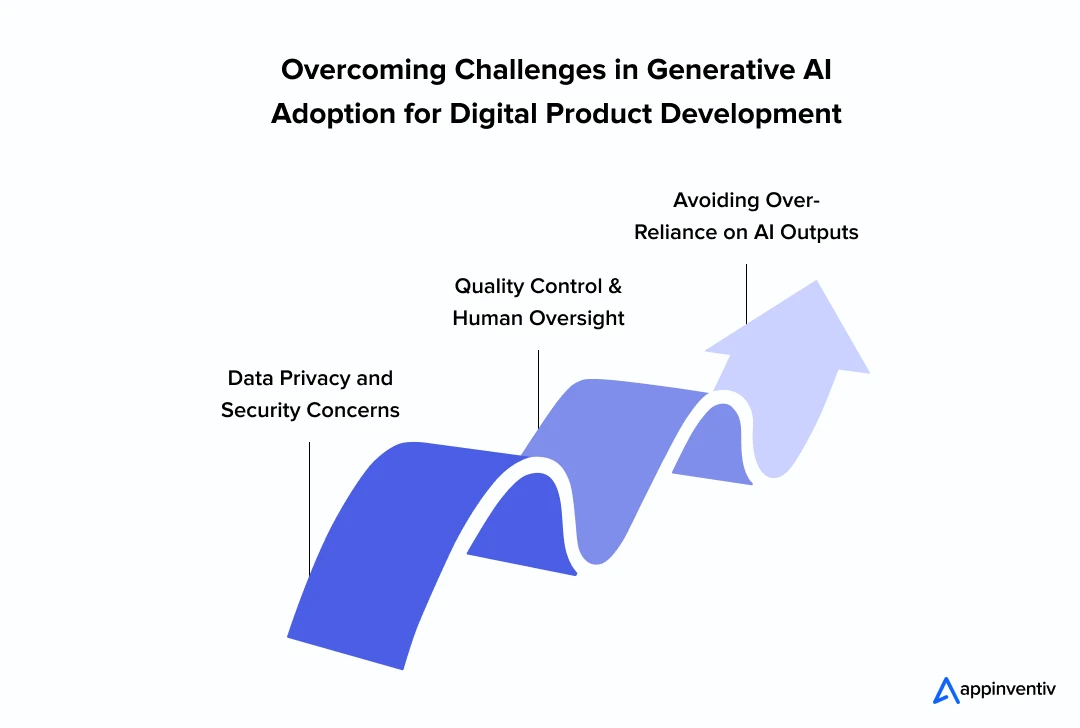
Data Privacy and Security Concerns
Generative AI systems need tons of user and company data to work properly, which creates serious privacy and security risks. When data gets stolen or misused, it damages your reputation and breaks customer trust fast.
Solution: Set up strong encryption, hide personal details in your data, and limit who can access what. Check regularly that you’re following privacy laws like GDPR or CCPA to keep your Generative AI in digital product development work secure.
Also Read: A Guide to Generative AI Security- What Every C-Suite Executive Needs to Know
Quality Control and Human Oversight
AI gets things wrong sometimes – it produces incorrect information, skips important parts, or just doesn’t understand the context. When these problems slip into your live product, users notice and get frustrated.
Solution: Have experienced people quality check the AI products before making it available for general users. Set quality standards and track how well things perform so you can keep improving, which works well in most AI-powered product development examples.
Avoiding Over-Reliance on AI Outputs
Depending too much on AI can hamper your team’s creativity and problem-solving abilities, creating generic products that don’t stand out from competitors. Teams might also accept AI suggestions without questioning whether they make business sense.
Solution: Use AI as a creative partner, not the final authority. Make teams verify AI ideas with real data and user feedback, ensuring AI-powered product development using Generative AI supports good decision-making rather than replacing human thinking.
Implement the right safeguards, oversight, and innovation frameworks to support your Generative AI journey
Future Trends in AI-Powered Product Development
AI’s job in product development is moving from helpful sidekick to the main driver of innovation. As tech gets better, several big trends are changing how teams design, build, and update digital products for what’s coming next.
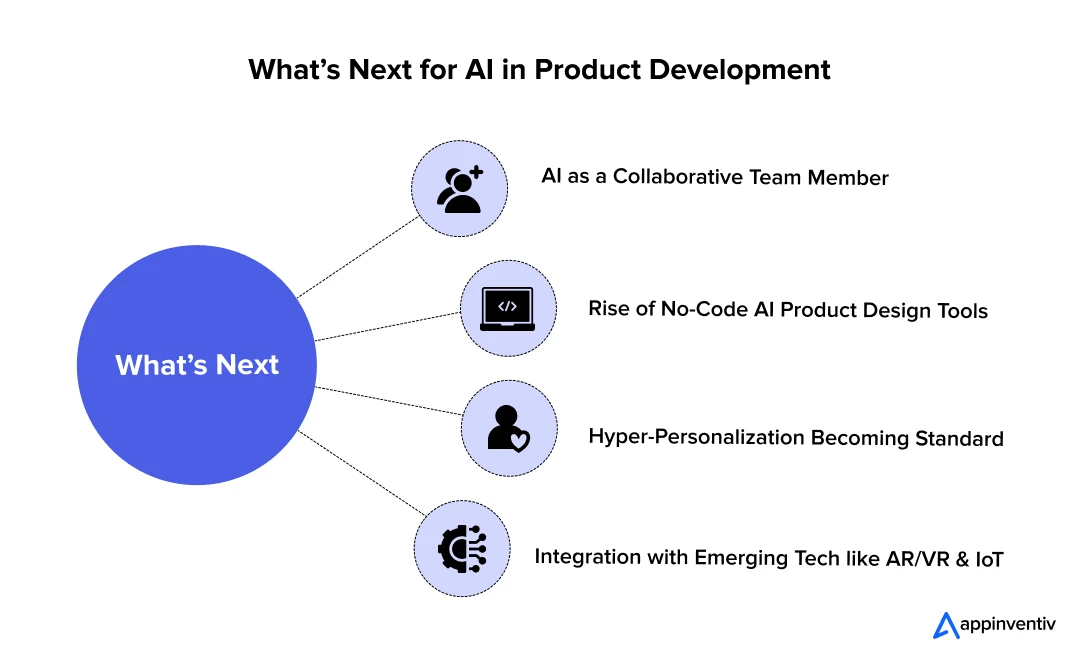
AI as a Collaborative Team Member – AI will work directly with humans during projects, throwing out suggestions, brainstorming concepts, and even making independent design or coding choices to get things done faster.
Rise of No-Code AI Product Design Tools – Simple, visual AI tools will let marketing teams and other non-programmers design and test products without needing to learn coding skills.
Hyper-Personalization Becoming Standard – AI will customize every product experience based on what each user likes, how they behave, and their current situation, turning from a luxury feature into a basic expectation.
Integration with Emerging Tech like AR/VR and IoT – AI will connect smoothly with immersive and networked technologies, creating smarter, more interactive, and highly responsive digital products.
Bringing Generative AI to Life in Your Next Product with Appinventiv
Digital products in the future will get built, developed, and improved with AI working directly with human teams—making innovation happen faster, work better, and stay within reach for companies of any size. For teams thinking about the upcoming days, the main question isn’t whether Generative AI in digital product development should be part of what they do, but how quickly they can add it to stay competitive. Businesses that start now will shape how the industry works tomorrow, turning big ideas into products that actually change markets.
As a trusted Generative AI development services partner, we, at Appinventiv, don’t just utilize technology to solve product-related challenges or build one; we figure out strategies that work for your specific business situation. Our team mixes solid AI experience with flexible development methods to get you from the first concept to launch a product much faster than old-school approaches.
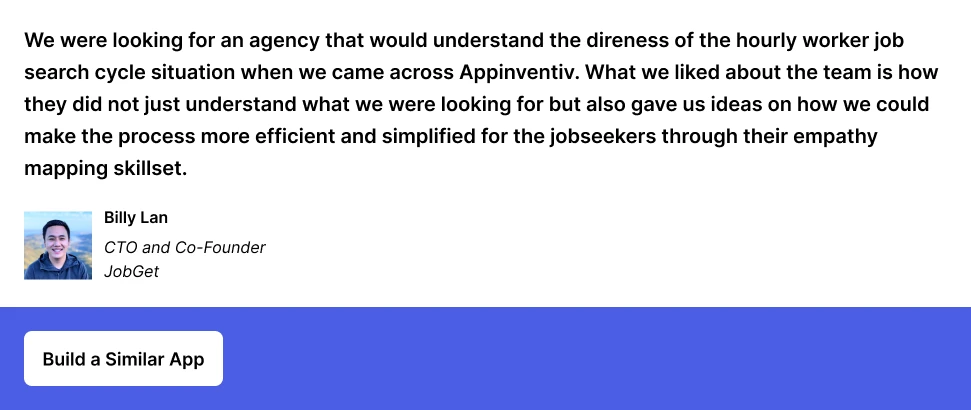
This can be validated through our strong AI-backed portfolio. We worked on various projects like Mudra, JobGet, and an AI-banking client, helping them innovate through AI and deliver enhanced business outcomes.
Whether you need AI-powered prototyping, code that writes itself, or smart user experience design, we build solutions that match exactly what you want and when you need it done.
Beyond just handling the technical stuff, we focus on creating AI solutions that can grow with your business, follow good practices, and keep working as things change. We work closely with you to figure out what success looks like, keep quality high at every step, and update your product when the market shifts.
From early prototypes to full company-wide rollouts, we make sure your AI-powered product stays fresh, follows the rules, and keeps performing well over time.
Get in touch with a leading Generative AI consulting company like ours today and start transforming your product development journey.
FAQs
Q. How does Generative AI transform product development?
A. Generative AI in digital product development streamlines workflows through automated coding, rapid prototyping, and predictive analytics. Development teams achieve faster time-to-market while reducing operational costs. The technology enables parallel testing of multiple concepts, real-time adaptation to user feedback, and data-driven feature prioritization, fundamentally changing how products move from conception to launch.
Q. How are startups using Generative AI for products?
A. Generative AI for digital product design produces multiple interface variations instantly based on brand parameters and user requirements. Design teams leverage AI-generated layouts, style systems, and interaction patterns to accelerate iteration cycles. This approach maintains creative control while enhancing productivity, resulting in user-centered designs that perform optimally from initial deployment.
Q. How does Generative AI improve digital product design?
A. Startups use Generative AI to compete against bigger companies without massive budgets. They build MVPs faster, generate UI/UX designs automatically, and create content at scale. Many embed AI features like personalized recommendations directly into their products, allowing quick market entry and flexible strategy changes without traditional development constraints.
Q. What are the best Generative AI tools for digital product builders in 2025?
A. Product teams today have access to tools that seemed impossible just a few years back. These platforms deliver real results – faster workflows, lower budgets, and creative breakthroughs that traditional methods couldn’t match. Here’s what works best for Generative AI in product design:
- ChatGPT Enterprise – tackles brainstorming, user research, and experience optimization.
- Midjourney – builds visual assets for branding, mockups, and marketing campaigns.
- GitHub Copilot – speeds up coding work and development cycles.
- Runway ML – handles video creation and multimedia production needs.
- Figma with AI plugins – streamlines design workflows and prototype building.
- Jasper – manages copywriting, content planning, and brand voice consistency.
Q. What are the key risks of using Generative AI in product development?
A. Here are some of the common pitfalls to avoid before jumping into Generative AI product development.
- Intellectual property concerns – using protected content without permission.
- Bias in AI models due to collapse – creating unfair or wrong outputs.
- Security vulnerabilities – leaking sensitive company or customer data.
- Over-reliance on automation – skipping necessary human review processes.
- Regulatory compliance issues – breaking rules in regulated industries.
- Quality control challenges – shipping poor or incorrect content.

- In just 2 mins you will get a response
- Your idea is 100% protected by our Non Disclosure Agreement.
AI Inventory Management in Australia: Benefits, Use Cases, and Implementation Strategies
Key takeaways: Traditional ERP planning reacts to history; AI predicts demand shifts, reallocates stock dynamically, and prevents costly stockouts across distributed Australian networks. AI in inventory management in Australia typically reduces inventory levels 20–40% while maintaining service targets, unlocking significant working capital across multi-state operations. Enterprise implementations usually range from AUD 70,000 to AUD 700,000+,…
How to Hire RAG Architects for Enterprise AI
Key takeaways: Define your RAG architecture scope to avoid misaligned hiring decisions Identify end-to-end architectural ownership across retrieval, governance, and scaling Evaluate deep technical capabilities beyond prompt engineering and tools Validate governance and compliance readiness at the retrieval layer Test system-level thinking through real-world failure scenarios Choose the right hiring model based on scale, risk,…
Key Takeaways: Healthcare chatbots in the UAE are moving beyond queries to support triage, patient communication, and real clinical workflows across hospitals. Effective healthcare chatbot development depends on clean data, strong system integrations, and alignment with regulations like DHA, DOH, and MOHAP. Development costs typically range from AED 147,000 to AED 1,470,000+, depending on complexity,…