






























Enterprise AI Consulting Framework: A Board-Level Guide


- Why AI Demands Board-Level Attention
- Key Components of an AI Strategy Roadmap
- Why Enterprises Struggle to Scale AI
- The Practical Benefits of an Enterprise AI Strategy
- Building an AI Strategy Framework for Board Members
- What Success Looks Like in Enterprise AI Programs
- Challenges in Measuring Enterprise AI Success and How to Overcome Them
- How Consulting Partners like Appinventiv Support Enterprise AI Decisions
- FAQs

Key takeaways:
- To succeed with enterprise AI, businesses must have a clear strategy, good governance, and alignment processes.
- Scaling AI involves rigorous structures that would connect pilots to organizational-wide influence.
- Overseeing AI at the board level is essential to transform AI experiments into business value.
- Efficient AI consulting models are accountable, risk-managing, and have measurable ROI.
- Long-term monitoring and interdisciplinary implementation are essential to the successful AI results.
You may have reached a breaking point, overwhelmed by the endless discussions about artificial intelligence. Every board agenda seems to include AI, yet clarity often feels further away than ever. Pilots multiply, vendors promise results, and internal teams stay busy. Still, few initiatives mature into systems the business truly depends on.
What is different now is the pressure. According to McKinsey, AI is becoming the central engine of future new-venture building for many companies. 56% of business leaders expect their organizations to build data- and AI-driven businesses within the next five years, making it the most cited strategic priority.
This shift signals a move away from incremental automation toward entirely new products, services, and operating models. It also means AI decisions are no longer experimental choices, but long-term commitments that shape revenue, risk, and competitive position.
The challenge is not ambition; it is about control. AI reshapes decision-making, introduces new exposure, and ties future value to data quality and governance. Without a clear structure, investment fragments and oversight weaken.
An enterprise AI consulting framework gives boards a way to step back, ask the right questions, and guide AI as an enterprise capability. This guide is written for leaders who need discipline, visibility, and decisions grounded in how large organizations actually function.
Let’s delve deeper!
While 80% of organizations target efficiency, the highest performers combine it with growth and innovation to unlock real impact.

Why AI Demands Board-Level Attention
Boards that treat AI as an IT upgrade tend to miss its real impact. Enterprise AI reshapes how decisions are made, how work flows across teams, and how risk is governed. While nearly 88% of companies use AI in at least one function, only about one-third have scaled it across the enterprise (Source: McKisney).
This gap reflects a structural issue. AI is often adopted as a set of tools rather than managed as a core business capability tied to strategy and operating models.
This misreading carries a cost. When AI remains stuck in pilots, organizations accumulate technical complexity and risk without seeing meaningful financial returns. McKinsey has found that only a small share of companies report material enterprise-level impact from AI, largely due to weak ownership, poor integration, and unclear success metrics.
Without board-level oversight, experimentation becomes the end goal. Active board involvement is what pushes AI beyond trials, forcing alignment with business outcomes and ensuring that risk, value, and accountability scale together.
Key Components of an AI Strategy Roadmap
An AI strategy roadmap assists organizations in transitioning from haphazard experimentation to action. It offers priorities, a timeline, and an accountability structure, providing a platform for an enterprise AI decision-making framework that leads to choices at the team and functional levels.
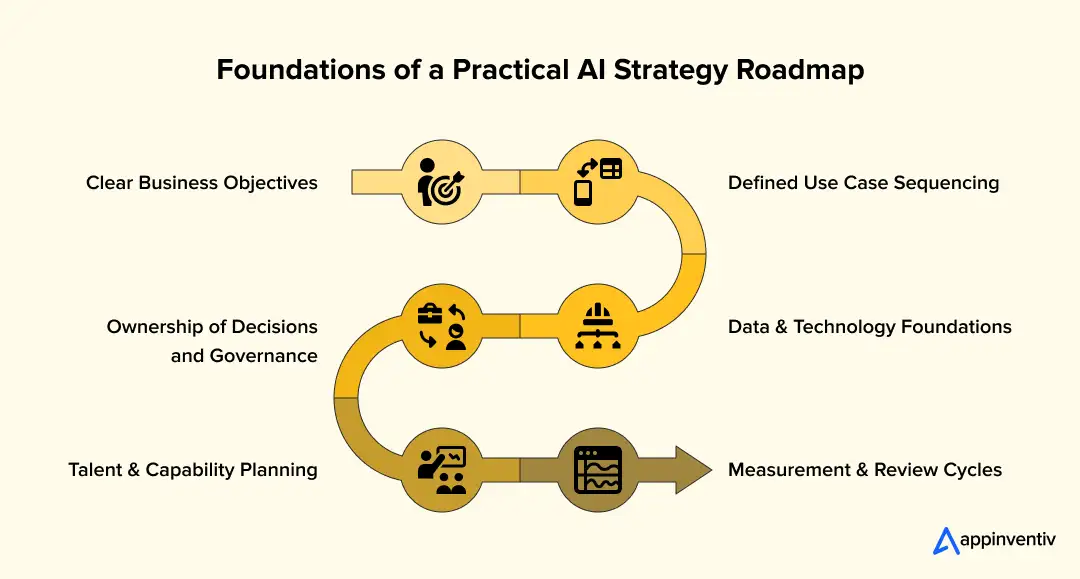
Clear Business Objectives: Begin with results that really count to the organization, be it cost efficiency, reduction of risks, or increase in revenues. By aligning initiatives to such aims, a collective sense of value is formed, which is the focus of any AI value realization framework.
Defined Use Case Sequencing: Not all the AI projects ought to roll out simultaneously. A roadmap establishes order, where the first initiatives that can be implemented offer early wins before increasing in complexity as capabilities and confidence build.
Data and Technology Foundations: Roadmaps have to consider the accessibility of data, its quality, and integration. Infrastructure and system preparation are addressed early to avoid stalling in the later stages, a major concept in enterprise AI maturity assessment.
Ownership of Decisions and Governance: Division of roles, responsibilities and decision rights has to be clarified. Formalized strategy avoids bottlenecks and makes risk and compliance handling effective, which is essentially built into AI consulting integration models.
Talent and Capability Planning: The roadmap is successful and involves the development, sharing, and deployment of skills within the organization. People’s investment combined with technology makes processes practical, scalable and sustainable.
Measurement and Review Cycles: Progress should be monitored against agreed measures with periodic review points. This will bring transparency, inform course correction and build a strong enterprise AI consulting framework that will help in long-term adoption and constant improvement.
Why Enterprises Struggle to Scale AI
Most enterprises do not stall on AI because the technology falls short. They stall when early success meets the reality of how the organization actually works. Pilots run fine. The scaling process of AI initiatives exposes gaps in ownership, data, and decision-making. Without a clear enterprise AI consulting framework, those gaps widen instead of closing.
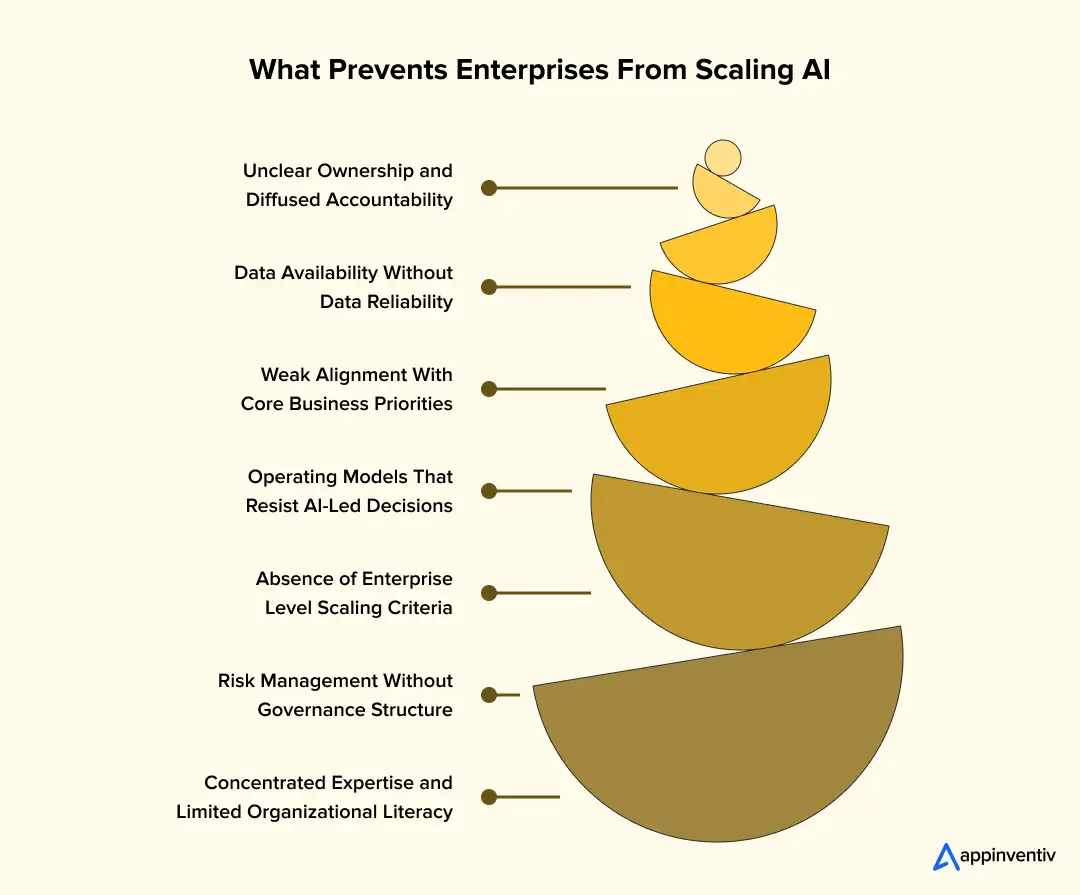
Unclear Ownership and Diffused Accountability
AI initiatives commonly originate in multiple parts of the organization at once. Innovation teams explore ideas, data teams build models, and business units pursue local gains. Responsibility becomes shared but not defined.
When outcomes disappoint or trade-offs emerge, no single group is positioned to decide what changes. Scaling slows not because leaders lack interest, but because accountability is fragmented.
Data Availability Without Data Reliability
Most enterprises appear data-rich, yet availability does not guarantee readiness. Data lives across systems built for different purposes, governed by inconsistent rules, and maintained at uneven quality.
Teams may work around these limits during pilots, but as adoption grows, those workarounds quickly fall apart. Trust in AI outputs weakens when the underlying data cannot be explained or defended.
Weak Alignment With Core Business Priorities
AI efforts are sometimes selected for their novelty or technical appeal rather than their business relevance. When market pressure rises, these initiatives struggle to justify continued investment.
Projects that are not clearly tied to revenue protection, cost discipline, or risk reduction rarely survive the transition from pilot to enterprise program.
Operating Models That Resist AI-Led Decisions
Most organizations are structured around human judgment moving through established workflows. AI changes that pattern by introducing speed and probabilistic outcomes. Existing processes are often unable to absorb this shift.
Without revisiting how decisions are made and reviewed, AI remains an add-on rather than a driver of action.
Absence of Enterprise-Level Scaling Criteria
Many teams define success only within the limits of a proof of concept. What constitutes acceptable performance, cost, or risk at enterprise scale is left open.
When the time comes to expand, leadership hesitates. The hesitation reflects uncertainty, not skepticism. Clear thresholds are missing.
Risk Management Without Governance Structure
Regulatory and reputational concerns surface quickly, especially in large and visible enterprises. In the absence of defined governance, risk aversion fills the gap.
AI expansion slows as caution replaces control. This is where enterprise AI consulting services help organizations establish boundaries that allow progress without exposing the business.
Concentrated Expertise and Limited Organizational Literacy
AI capabilities tend to be concentrated in small specialist teams, while the broader organization remains distant from the work. Collaboration becomes harder, and adoption remains uneven.
A practical AI consulting framework for enterprises addresses this imbalance by fostering cross-functional understanding, not by adding more tools.
Also Read: Exploring the Impact of AI on Business Across Sectors
The Practical Benefits of an Enterprise AI Strategy
A clear AI strategy changes what happens after the pilot stage. It brings discipline to decision-making and gives leadership a steadier view of progress, risk, and return. For many firms, this clarity is what finally makes scaling AI initiatives in large organizations possible.
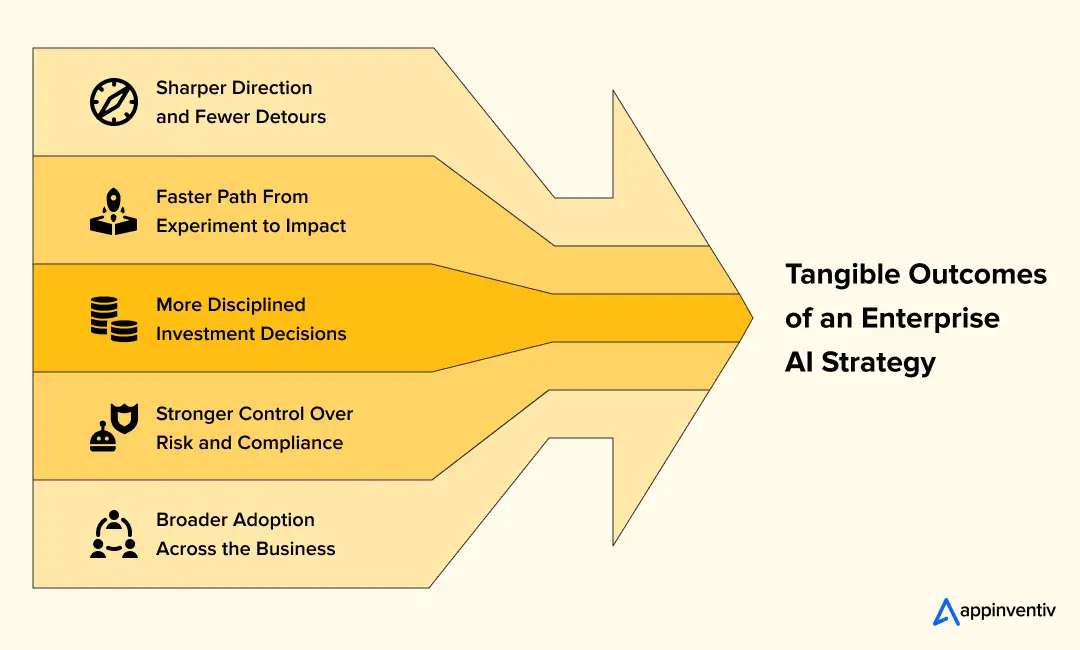
Sharper Direction and Fewer Detours
When priorities are set upfront, teams stop chasing ideas that sound promising but go nowhere. Decisions tie back to a shared plan, often captured in an AI consulting roadmap for enterprises, which keeps effort focused and reduces internal friction.
Faster Path From Experiment to Impact
Clear criteria remove much of the hesitation around moving forward. Teams know when a pilot has done its job and when it is time to expand. This is where an enterprise AI consulting framework proves its value by turning momentum into action instead of delay.
More Disciplined Investment Decisions
AI spending becomes easier to defend when outcomes are visible and tracked. Leaders can compare effort against results and adjust early. Over time, this leads to a more consistent AI investment strategy for enterprises, rather than reactive funding tied to short-term pressure.
Stronger Control Over Risk and Compliance
Defined rules around data use, oversight, and accountability reduce late-stage surprises. Risk is handled early, not after deployment. Many organizations find that progress accelerates once an AI risk and compliance framework for enterprises is in place and understood.
Broader Adoption Across the Business
AI tools gain traction when they fit how people already work. Trust builds slowly but steadily. Adoption spreads beyond early teams, supported by an AI consulting framework for enterprises that balances structure with flexibility.
Get expert-backed guidance on building a board-ready enterprise AI framework, so you can make informed decisions, manage risk, and drive measurable value.

Building an AI Strategy Framework for Board Members
An enterprise AI strategy must link AI initiatives to strategic objectives and governance. A structured AI strategy framework for board members helps turn pilots into scalable programs.
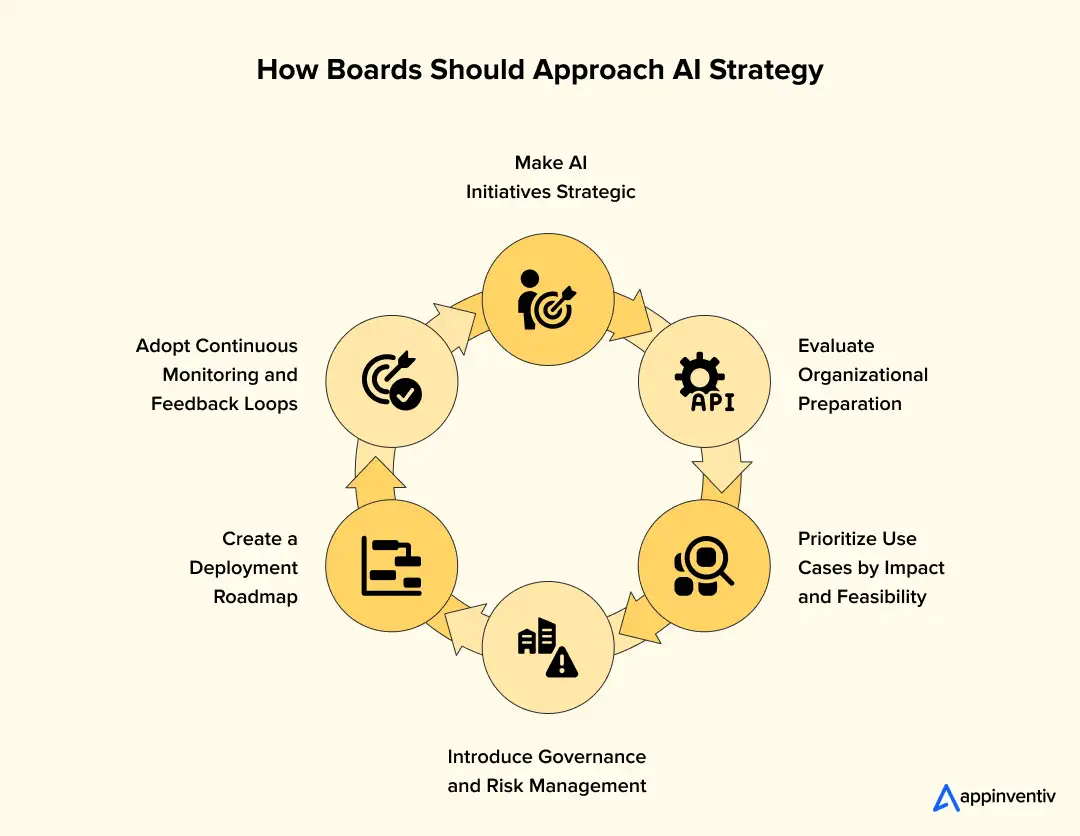
Make AI Initiatives Strategic
At first, you need to determine the area where AI can help generate tangible business value, whether it is operational efficiency, risk management, better customer experience or increased revenue. This is done to provide context for decision-making and resource allocation.
Clear alignment enables the leadership to differentiate priority projects and experiments, and thus, AI initiatives are aimed at serving the enterprise.
Evaluate Organizational Preparation
An efficient AI consulting framework for enterprises’ executive leadership evaluates the state of data infrastructure, technology integration, workforce capabilities, and governance structures.
Understanding organizational readiness helps leaders anticipate potential gaps in AI implementation, such as inconsistent data quality or process bottlenecks, and address them before scaling initiatives across the enterprise.
Prioritize Use Cases by Impact and Feasibility
AI opportunities do not provide equal returns or cannot be successfully implemented. Initial investments must be created by embarking on high-impact, viable use cases to achieve initial wins.
This incremental strategy will make sure there is movement but does not strain resources beyond capacity, the backbone of a more significant enterprise AI transformation framework.
Introduce Governance and Risk Management
Good AI governance helps to define the accountability, ownership and approval procedures. Boards and executives should set up guidelines to govern oversight, compliance, ethical AI use, and regulatory compliance.
These foundations, when entrenched at an early stage, will build trust and make AI programs able to scale without causing an operational or reputation risk.
Create a Deployment Roadmap
Strategic priorities are connected to specific actions by a roadmap that includes pilot phases, iterative improvements, and scaling plans.
This approach establishes clear responsibilities, timelines, and performance indicators, while shaping an AI operating model for enterprises that can adapt as business needs evolve.
Adopt Continuous Monitoring and Feedback Loops
The AI projects have to be assessed continuously to be efficient. Constant monitoring, performance measurement, and recalibration are useful in keeping in line with changing enterprise objectives. This practice will fill out a sustainable enterprise AI consulting framework, which will help executives transform AI initiatives into quantifiable, scalable results.
With a well-defined AI consulting framework for enterprises, organizations can shift their disjointed experimentation into an organized, board-oriented program that creates long-term strategic value.
What Success Looks Like in Enterprise AI Programs
Enterprise AI success is reflected in consistent business outcomes rather than isolated technical achievements. Here are some of the key indicators enterprises use to assess whether their AI initiatives are delivering lasting value.
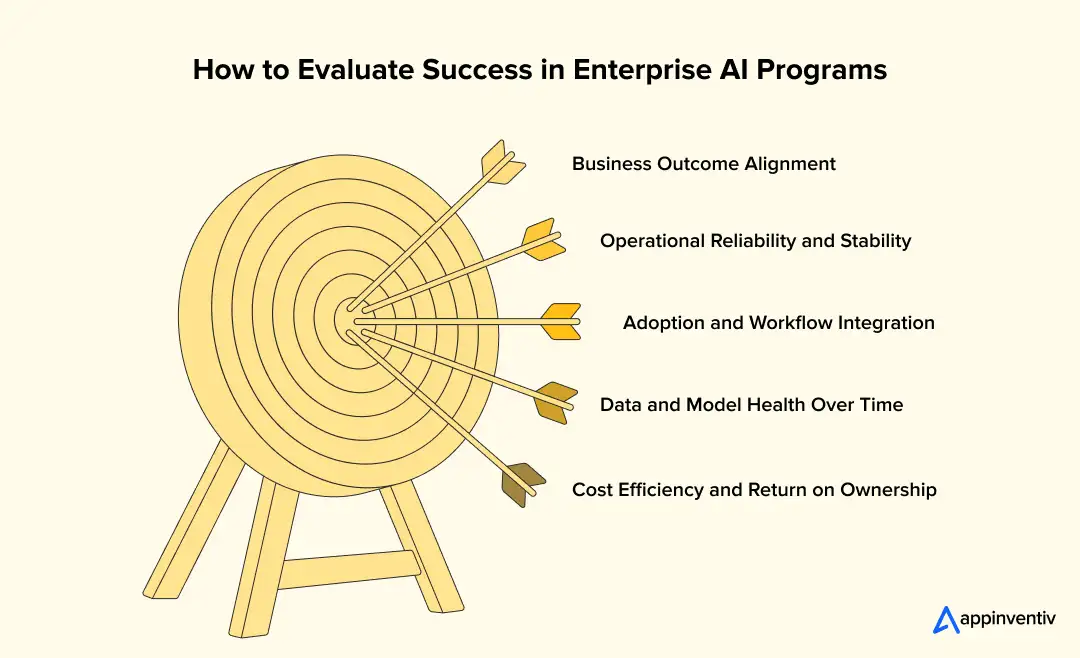
Business Outcome Alignment
Within an enterprise AI adoption framework, success starts with clear links to business results rather than abstract model scores. KPIs should reflect revenue impact, cost savings, reduced exposure, or faster execution. When outcomes stay disconnected from core goals, AI efforts stall at the pilot stage.
Operational Reliability and Stability
An AI consulting framework for large enterprises treats reliability as a primary signal of value. Measures such as system uptime, response time, error rates, and recovery speed reveal whether AI can operate under real enterprise pressure. Stability builds confidence across technical and business teams.
Adoption and Workflow Integration
The true test of an enterprise AI framework is whether employees rely on it in their daily work. Usage depth, decision dependency, and workflow penetration matter more than surface-level access metrics. Low adoption often reflects design gaps or weak alignment with how teams actually operate.
Data and Model Health Over Time
A mature enterprise AI consulting practice tracks data quality, drift patterns, retraining cycles, and performance decay. These indicators expose early warning signs before failures reach the business. Long-term usefulness depends on steady monitoring rather than reactive fixes.
Cost Efficiency and Return on Ownership
Enterprise KPIs must account for the full cost of running AI, not just initial delivery. This includes infrastructure, tooling, support, and ongoing maintenance. Metrics such as cost per decision or cost per automated process help determine whether value justifies continued investment.
Leverage the perks of enterprise AI consulting frameworks and scale your intelligent initiatives across teams

Challenges in Measuring Enterprise AI Success and How to Overcome Them
Measuring AI success at the enterprise level is rarely straightforward, as results unfold over time. This section outlines common obstacles boards and leaders face, along with practical ways to address them before they limit impact.
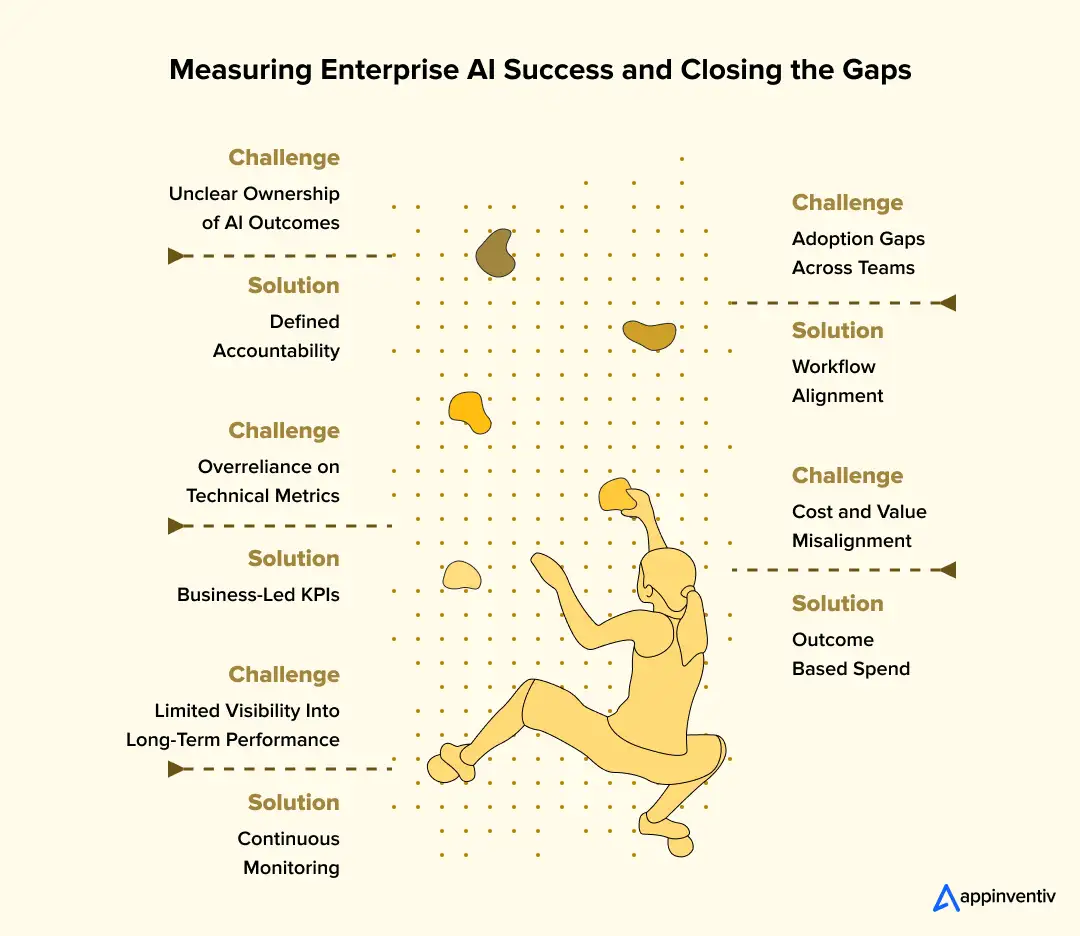
Unclear Ownership of AI Outcomes
Many enterprises struggle to define who is accountable for AI results once systems move into production. Responsibility often fragments across business units, data teams, and engineering groups, which weakens decision-making and follow-through.
Solution: An enterprise AI value strategy consultant can help establish clear ownership models that link AI outcomes to business leadership. Assigning accountability at the function level ensures KPIs lead to action rather than reports.
Overreliance on Technical Metrics
Accuracy, precision, and model scores often dominate reporting while business impact remains loosely defined. This creates progress narratives that fail to justify sustained investment.
Solution: Adopting an enterprise AI consulting business model that prioritizes outcome-based measurement helps rebalance success criteria. Business-aligned KPIs bring AI evaluation closer to how enterprises assess other core systems.
Limited Visibility Into Long-Term Performance
After deployment, many organizations reduce monitoring to surface-level checks. Over time, data drift and performance decay erode trust and reliability.
Solution: A structured enterprise AI consulting framework embeds continuous monitoring and review into normal operations. This allows teams to manage change predictably rather than respond to failures.
Adoption Gaps Across Teams
AI solutions often struggle to gain traction when they disrupt established workflows or fail to earn user confidence. Low adoption weakens return on effort regardless of technical quality.
Solution: An AI consulting framework for enterprises emphasizes early user involvement and workflow alignment. Designing AI outputs around real working patterns increases acceptance and long-term usage.
Cost and Value Misalignment
AI programs may grow in infrastructure and support costs without proportional business return. This imbalance raises concerns about sustainability.
Solution: Linking spend to delivered outcomes through disciplined cost tracking keeps investment decisions grounded. Clear visibility into value helps leaders decide when to scale, pause, or refine AI initiatives.
Also Read: 11 Key AI Adoption Challenges for Enterprises to Resolve
How Consulting Partners like Appinventiv Support Enterprise AI Decisions
At Appinventiv, we work with enterprises that recognize the potential of AI but face difficulty turning intent into outcomes. Our AI governance consulting & services are not limited to advisory support. We enable companies to make sound decisions, minimize the risk of execution and create AI systems that can withstand the actual pressure of operation.
Bridging Strategy and Execution
Businesses are frequently aware of the potential value-adds of AI, but they fail to translate that desire into reality. We have an enterprise AI consulting framework at Appinventiv that assists in mapping business priorities to structured use cases, technical roadmaps, and staged execution plans. This will minimize the disjunctures between strategic objectives and on-the-ground implementation.
Offering Experience-based, Independent Judgment
Influences on internal teams are usually influenced by the systems, tools and assumptions present. The AI consultancy model for enterprises is an outsourced idea based on actual enterprise implementations. This helps leaders be more realistic in their evaluation of options and more aware of design and scaling traps.
Facilitating the Decision Making of the Executive Level
The lack of clarity in leadership regarding trade-offs, risks, and sequencing often slows AI initiatives. As a reputed AI consulting company, we provide consulting services to top leadership and assist top management in making decisions on AI priorities and aligning them with business governance, compliance, and long-term plans. This helps executives in guiding programs with confidence.
Managing Complexity at Scale
As AI programs move beyond pilots, coordination across data, infrastructure, and teams becomes harder. Our experience in scaling AI initiatives in large organizations allows us to establish repeatable patterns, shared standards, and delivery discipline. This enables enterprises to expand AI adoption without losing control.
Enabling Long-Term Internal Capability
We believe effective consulting should reduce long-term dependency. Our teams focus on knowledge transfer through documentation, operating models, and hands-on collaboration. This prepares internal teams to manage, evolve, and govern AI systems independently over time.
Appinventiv’s approach to enterprise AI has been recognized across the industry. We have been named a winner of the Deloitte Technology Fast 50 India and recognized as a Leader in AI Product Engineering and Digital Transformation by The Economic Times. Our AI initiatives span complex, real-world programs, including projects such as JobGet, Americana ALMP, MyExec, and Vyrb, where AI systems operate at scale and support mission-critical workflows.
Connect with our experts today to discuss your enterprise AI priorities, evaluate readiness, and define a clear path from strategy to scalable execution.
FAQs
Q. How should boards evaluate enterprise AI investments?
A. The boards are expected to evaluate AI initiatives using an AI strategy framework among board members based on how it aligns with the business objectives, measures results, and risk exposure. They will need to revisit data preparedness, scalability, and operational feasibility and comprehend the necessary resources.
AI-powered regulatory compliance, ethical implications, and integration with existing enterprise systems should also be evaluated to ensure investments create real value rather than being standalone experiments.
Q. What AI consulting frameworks help enterprises scale responsibly?
A. Here are some of the top AI consulting frameworks that help enterprises scale effectively and responsibly:
Structured Deployment: An enterprise AI consulting framework allows companies to adhere to well-established milestones and implement in phases, so that AI projects go from pilot to production without losing focus on business goals.
Governance & Compliance: This issue has a powerful system that ensures ethics and compliance with regulations and the safe functioning of all AI systems, which allows for reducing the operational and reputational risks.
Repeatable Processes: Uniform methods for data pipelines, model development, and workflow integration can ensure AI solutions are consistently applied across teams and business units.
Ongoing Surveillance: Constant observation of system performance, user adoption, and business results assists businesses in identifying problems early in the process and ensures the value of AI is long-term.
Capability Building: Internal teams can be trained and knowledge shared in structured ways to be able to maintain and expand AI projects without depending on external partners.
Q. How can boards govern AI risk while accelerating adoption?
A. Risk and speed can be balanced by other boards that introduce AI governance into the decision-making mechanisms. This will entail the establishment of clear ownership, ethical and regulatory compliance and performance over time of the systems.
The board can support innovation by aligning AI projects with enterprise goals and ratifying phase-by-phase implementations to ensure innovation and reduce the operational and reputational risks of AI acceptance that boards can readily manage.
Q. What questions should board members ask about AI strategy to the tech partner?
A. Board members should ask these questions when consulting about enterprise AI strategies with their hired tech partners:
- How does our enterprise AI adoption framework align with overall business goals?
- Which AI use cases are prioritized, and what is the expected ROI?
- Are risks, compliance, and ethical considerations integrated within the AI consulting framework for large enterprises?
- How are data quality, model performance, and adoption being monitored?
- What resources and capabilities are needed for scaling AI responsibly?
Also Read: How to Hire AI Developers for Custom AI Solutions
Q. How does Appinventiv help enterprises design board-ready AI consulting frameworks?
A. Appinventiv helps companies develop organized, structured, and actionable AI strategies that boards can easily review and approve. Through strategic alignment, risk management and scalable implementations, we create board-ready frameworks balancing innovation and control.
This will enable leadership to track performance, compliance, and adoption, and deliver specific KPIs and a roadmap to long-term value. This is changing the AI efforts of pilot projects into business-scale operational capabilities.
Connect with our AI experts today to share your project idea.
Q. How can enterprises measure ROI from AI consulting initiatives?
A. Here are some of the ways through which enterprises can increase their ROI from AI consulting initiatives:
Business Impact: When implementing an enterprise AI framework, businesses can determine ROI through comparing AI results and the established business goals, thus ensuring that an investment is converted into value.
Cost & Efficiency Benefits: ROI can be measured by the cost savings achieved and the increased productivity of processes and decisions enabled by AI.
Adoption Metrics: Tracking AI adoption among employees, including how they adopt them and how much they base their decision-making on AI outputs, can give insights into applied value provision.
Operational Reliability: Stability, uptime, model reliability, and the consistency of a system’s response are assessed to determine whether AI provides reliable results over the long run.
Value vs Investment: The ratio of current operational and maintenance expenses and the business-wide long-term advantages would guide the leadership to decide whether to extend AI projects or not.

- In just 2 mins you will get a response
- Your idea is 100% protected by our Non Disclosure Agreement.

How to Hire RAG Architects for Enterprise AI
Key takeaways: Define your RAG architecture scope to avoid misaligned hiring decisions Identify end-to-end architectural ownership across retrieval, governance, and scaling Evaluate deep technical capabilities beyond prompt engineering and tools Validate governance and compliance readiness at the retrieval layer Test system-level thinking through real-world failure scenarios Choose the right hiring model based on scale, risk,…

Key Takeaways: Healthcare chatbots in the UAE are moving beyond queries to support triage, patient communication, and real clinical workflows across hospitals. Effective healthcare chatbot development depends on clean data, strong system integrations, and alignment with regulations like DHA, DOH, and MOHAP. Development costs typically range from AED 147,000 to AED 1,470,000+, depending on complexity,…

Hire Computer Vision Engineers: Reduce AI Development Costs by 45%
Key takeaways: Start with the problem first. Define the use case, data, and deployment needs before hiring. Choose the right role mix. Algorithm engineers, ML engineers, and developers handle different parts of the system. Look beyond tools. Strong engineers focus on data quality, evaluation, and real-world performance. Follow a practical hiring flow. Define → map…