



























The Strategic Roadmap to Drone Software Development: Consulting, Industry-Specific Solutions, Costs

- Drone Software Development Roadmap Quick Overview
- What Does Drone Software Development Mean for Enterprise-Scale Programs?
- How Does the End-to-End Drone Software Development Process Work from MVP to Rollout?
- Which Industrial Drone Software Solutions Deliver the Highest Enterprise Impact?
- What Are the Key Features of Drone Software for Enterprise Operations?
- What Governance and Safety Challenges Arise in Drone Software Development?
- What Are the Biggest Challenges in Drone Software Development at Enterprise Scale?
- What Is the Drone Software Development Cost for Enterprise Platforms?
- How Should Enterprises Choose a Drone Software Development Company? (Vendor Checklist)
- How Appinventiv Helps You Build a Drone Software Platform That Scales?
- Frequently Asked Questions

Key takeaways:
- Treat drone software as an enterprise stack: operations, fleet, data, integrations; avoid scope drift early.
- Run a gated rollout sequence: consulting, architecture, MVP, integrations, hardening, scale; each phase earns approval.
- Integrations decide adoption: push findings into CMMS/EAM, GIS, ticketing, BI with SSO, SCIM, and reliability pipelines.
- Governance is the product scope: audit trails, mission replay, retention, access controls, and data residency. CISOs can sign off.
- Budget drivers aren’t screens: integrations, compliance hardening, offline-first workflows, device fragmentation, and field validation inflate costs fastest.
- Data point to anchor urgency: drone software market projected to reach USD 24.39B by 2030.
You probably have a drone pilot somewhere in the organization already. A team ran a few flights, captured impressive visuals, and everyone agreed it “looks promising.” Then a familiar moment hits.
It’s a Monday ops review, someone pulls up the footage, and the questions get sharper. Who owns the approvals? Where does this data go after it lands? Can our compliance team sign off on it across regions? And the big one: what does this change in the way we run the business?
That’s the point where drone programs either mature into an operational capability or stall as an expensive side project.
If you are considering drone software development, the real decision is not about building an app. It’s about building a system that turns flights into repeatable outcomes: inspections completed faster, incidents documented cleanly, assets tracked reliably, and decisions made with better data.
This guide lays out a strategic roadmap you can actually use. We’ll start with consulting and scoping, then move through architecture, MVP build, integrations, security and governance hardening, and finally multi-site rollout. You’ll also get stage-wise cost breakdowns so procurement and leadership can fund the program in controlled phases, not blind leaps.
With 700+ drone companies globally, win through governed workflows, integrations, and scalable execution.
Drone Software Development Roadmap Quick Overview
You have probably seen this play out in a steering committee. The pilot worked. The next question is sharper: what exactly are we funding, how long will it take, and when do we say yes to scaling?
This roadmap keeps it simple. One sequence, clear deliverables, and decision gates that match how enterprises approve programs.
| Phase | Typical Duration | Typical Cost Share | Goal | Key Deliverables |
|---|---|---|---|---|
| 0. Consulting | 2 to 4 weeks | 5 to 10% | Lock scope and risks | blueprint, backlog, compliance map |
| 1. Architecture | 2 to 5 weeks | 8 to 15% | Prevent rework | reference architecture, security model |
| 2. MVP Build | 8 to 16 weeks | 30 to 45% | Prove value fast | mission, fleet, data baseline |
| 3. Integrations | 4 to 10 weeks | 15 to 25% | Fit enterprise reality | GIS, CMMS, ERP, SSO integrations |
| 4. Hardening | 3 to 8 weeks | 10 to 20% | Make it audit-ready | security controls, logs, performance, governance |
| 5. Scale Rollout | ongoing | varies | Expand across sites | rollout templates, onboarding, ops controls |
What Does Drone Software Development Mean for Enterprise-Scale Programs?
If you ask three teams what “drone software” means, you’ll get three answers: mission planning, identity and integrations, and compliance logs with retention. That mismatch is why scope drifts when this gets treated like a simple app build, even as the drone software market is projected to reach USD 24.39 billion by 2030.
As an enterprise buyer, you’re funding a layered system that turns flights into reliable outcomes. Miss one layer, and it works in a pilot, then breaks at rollout.
The Four Layers of Drone Software Development
Enterprise drone software is a stack, not a single app. These four layers ensure missions run smoothly, data stays governed, and outcomes flow into real business systems.
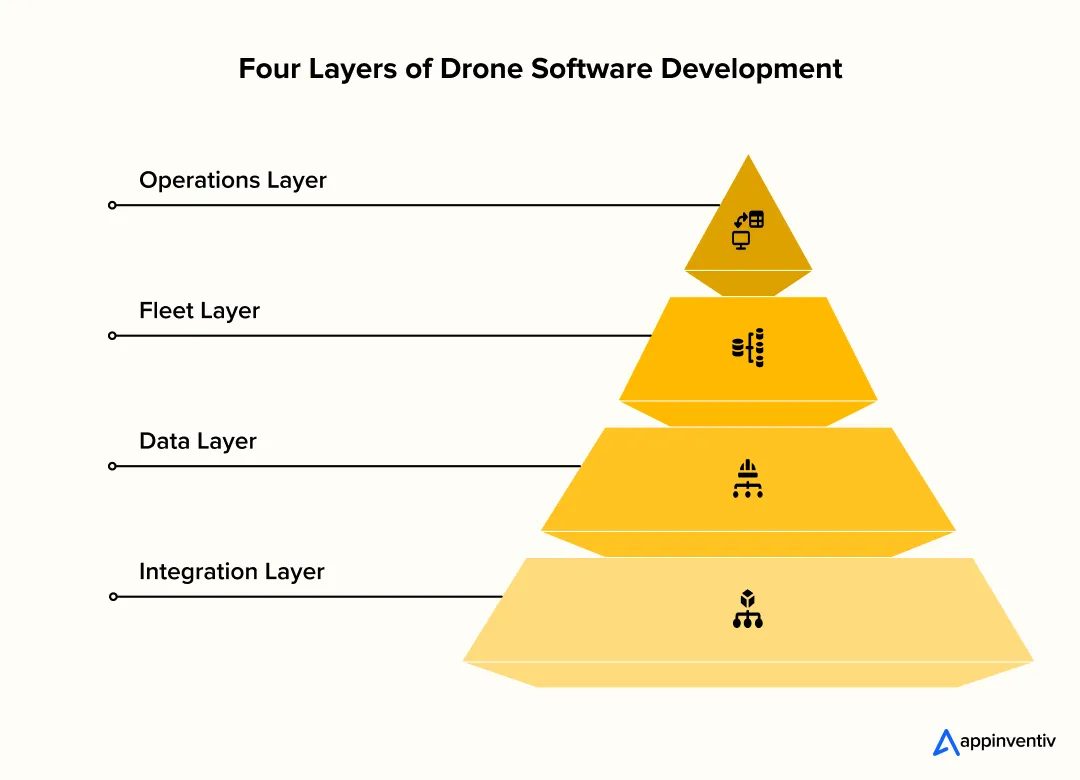
- Operations Layer: This is where work gets done. Mission planning, checklists, approvals, geofencing rules, and field workflows live here. It also includes the operational evidence your teams will need later, like who flew, why they flew, and what happened during the mission.
- Fleet Layer: Fleet is not just a list of drones. It is provisioning, device health, firmware policy, assignment controls, and role-based access at the site level. If you plan to scale across regions, this layer becomes the guardrail that keeps operations consistent.
- Data Layer: This is the part executives care about but rarely see implemented cleanly. Ingest, tagging, processing, analytics, reporting, and retention policies, plus outputs like photogrammetry and 3D mapping. It should also support telemetry synchronization and drone data log analysis software so issues can be diagnosed, not guessed.
- Integration Layer: This is where drone programs either become enterprise-ready or remain disconnected. Integrations with ERP, EAM or GIS, CMMS, ticketing tools, identity providers, and BI systems decide whether findings move into real workflows or stay trapped in dashboards.
What Are Common Drone Software Examples Used in Enterprise Operations?
Most enterprises reach a point where ad hoc drone tools stop working. To keep operations consistent, they invest in platforms that standardize how drones are used and make the data useful across teams. Below are practical drone software examples, grouped by what teams usually need first.
- Fleet and operations management platform to run missions, assign pilots, enforce policies, and keep an audit trail
- Mission planning and ground control extensions that support flight planning, real-time video, and MAVLink telemetry synchronization, with compatibility across many open-source software and ground control tools.
- Drone data platform for imagery, video, and LiDAR workflows, including photogrammetry, 3D mapping, processing, annotation, and reporting
- Industry-specific apps, such as inspection, surveillance, mapping, or delivery workflows, tailored to your operating model
If you want a quick gut check, ask this: after a flight, can your team move from captured data to a closed work order without manual chasing? If not, the gap is rarely the drone. It is the software layers and integrations you did not scope upfront.
How Does the End-to-End Drone Software Development Process Work from MVP to Rollout?
In the first real planning meeting, someone asks the question that changes the budget: “Are we building this for one site, or so ten sites can use it without reinvention?” If it’s the second, the delivery process has to look different, especially as the global drone market is projected to reach USD 163.60 billion by 2030.
Enterprise drone software is not a single build and a launch. It’s a controlled sequence where each phase produces something leadership can approve, operations can run, and risk teams can live with.
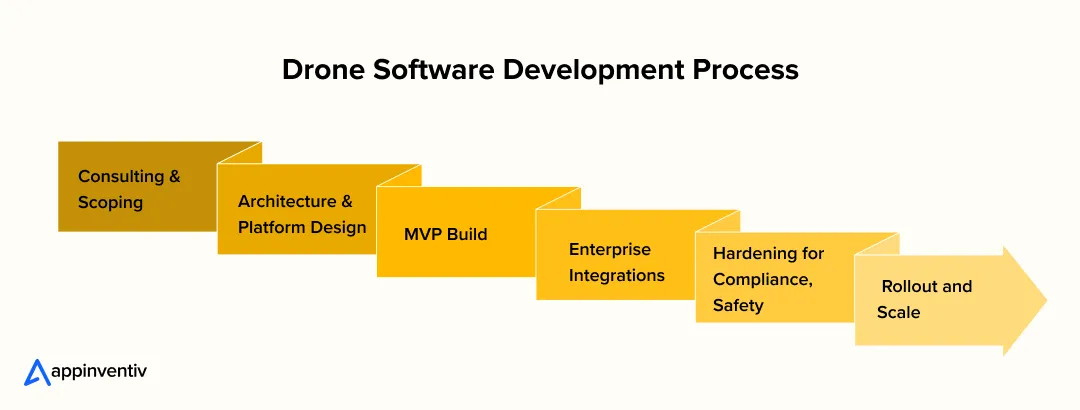
Phase 0: Drone Software Development Consulting and Scoping
This is the phase most teams try to rush into custom drone software development. It’s also the phase that prevents expensive rewrites later.
You start by getting specific about the mission. Not “inspection” as a category, but which inspection, on what assets, under what constraints, and what the final output needs to look like. If your field team currently closes a work order in Maximo or ServiceNow, you map how a drone finding should land there, step by step. No wishful thinking.
What typically gets locked in Phase 0:
- Mission and Workflow Definition: what success looks like in one repeatable workflow
- Operating Model: who approves flights, who flies, who reviews outputs, who signs off
- Compliance and Evidence Needs: what must be logged, retained, and auditable across regions
- Integration Inventory: GIS, CMMS or EAM, ERP, SSO, ticketing, BI, and data lakes
- Data Ownership and Access Rules: where data lives, who can see it, how it’s shared
- Outcome Metrics: time saved, defect detection cycle time, incident closure time, audit readiness
By the end of this phase, you should have a blueprint that clearly defines the drone software development process—one that procurement can evaluate and engineering can build without guessing. If you do not, your team will keep revisiting the scope while the build is already underway.
Phase 1: Architecture and Platform Design
This is where custom drone software development either becomes an enterprise platform or stays a pilot tool with a nicer UI. In one of the early architecture reviews, someone will ask, “What happens when a site loses connectivity mid-mission?” Your answer should already be in the design.
In this phase, we lock down how missions run end-to-end: how telemetry is captured, how media is ingested, how offline work syncs safely, and how access is governed across sites.
Architecture in practice (what gets designed and implemented)
- Field App and Ground Station Layer: mission planner, checklists, approvals, local caching, secure upload queues
- Device Identity and Access: embedded drone software development and operator identity, RBAC, policy controls, and key management
- Ingestion Gateway: API gateway, authentication, rate limits, upload integrity checks
- Telemetry Pipeline: event streaming, time-series storage, alert rules, mission event timeline
- Media Pipeline: chunked uploads, streaming support where needed, object storage, metadata tagging (site, asset, mission)
- Processing Services: imagery and LiDAR processing workflows, QA checks (blur, missing frames, GPS drift), output generation
- Geospatial Layer: geo-indexing, map layers, overlays, coordinate alignment, PostGIS-style storage pattern
- Workflow Orchestration: work order and incident flows, approval chains, SLAs, exception handling
- Integration Layer: connectors to GIS, CMMS or EAM, ERP, ticketing, BI, plus retries and failure handling
- Observability and Auditability: logs, traces, mission replay, export trails, access history, compliance reporting
By the end of Phase 1, the goal is simple: you have an architecture that can survive scale, audits, and field conditions, not just a clean diagram.
Phase 2: MVP Build
In custom drone software development, the MVP or minimum viable product is not a demo app. It’s one end-to-end workflow running in a live operating environment with controlled rollout, real users, and real constraints. The goal is to prove that a mission can move from planning to a usable output, then into a business decision, without manual workarounds.
What you typically ship in this phase:
- Mission flow with checklists, approvals, geofencing rules, and mission templates
- Fleet basics like provisioning, assignment controls, and device health signals
- Data ingest with metadata tagging (site, mission, asset) plus basic QA checks
- First “decision-ready” output, such as a defect summary, inspection report, or GIS-ready layer
- Reporting that tracks outcomes, not flights, like cycle time from finding to closure
Validation happens in the field. Connectivity drops, operators change, and edge cases show up early. That is the point. You want friction to appear now, not after rollout.
Also Read: Why and How to Build an AI MVP of Your Product?
Phase 3: Enterprise Integrations
This is where drone programs start behaving like enterprise systems. The software stops being a standalone tool and becomes part of your operating workflow. Integrations determine whether findings land where work gets executed or stay trapped in a dashboard.
Enterprise integrations that usually decide adoption:
- CMMS/EAM: create work orders with asset IDs, attach evidence, sync status back
- GIS: publish findings as map layers with accurate coordinate handling and traceability
- Ticketing: raise incidents with SLA timers, priority rules, and escalation paths
- Identity: SSO via OIDC and user provisioning via SCIM, so access stays governed
- BI: push structured events and outcomes for executive visibility and trend analysis
This phase also includes integration reliability. Retries, failure queues, and clear error states are what keep operations stable when systems go down or change.
Phase 4: Hardening for Compliance, Safety, and Auditability
Hardening is where you make the platform defensible. It’s not about adding more features. It’s about ensuring the system can survive audits, security reviews, and operational scrutiny across regions and sites.
What gets strengthened here:
- Audit trails for mission actions, evidence access, exports, and changes
- Mission replay timelines and tamper-resistant log patterns for investigations
- Role-based access, purpose-based permissions, and retention policies
- Performance and reliability under load, including media upload spikes and peak usage
- Security testing, threat modeling, and fixes driven by real risk scenarios
A practical outcome of this phase is simple: legal, risk, and security teams can sign off without “manual exceptions” that later become operational gaps.
Phase 5: Rollout and Scale
Scaling is not duplicating deployments. It’s standardizing how each new site adopts the platform without turning every rollout into a mini project. This phase is about repeatability, onboarding speed, and consistent governance.
What enterprise rollouts typically require:
- Site templates for roles, approval chains, mission libraries, and reporting formats
- Onboarding playbooks for operators, reviewers, and admin teams
- Training packs and SOP alignment so behavior stays consistent across regions
- Operational SLAs for support, issue resolution, uptime, and incident response
- Governance dashboards that track adoption, compliance, and closure metrics per site
This is also where drone software lifecycle management gets locked. Firmware changes, policy updates, and new mission types will keep coming. A scalable platform handles that through controlled releases, not emergency patches.
Which Industrial Drone Software Solutions Deliver the Highest Enterprise Impact?
If you have seen a drone program grow, this pattern is familiar. One team picks it up quickly, while another sets it aside because the software does not fit their workflow.
Industrial drone software solutions are not about piling on features. They act as workflow blueprints that connect missions directly to the tools and systems teams already rely on.
One industry estimate also suggests drones can reduce carbon emissions by 87% vs helicopter surveys.
Here are the top drone software use cases by industry:
Drone Software for Energy and Utilities
In utilities, the hard part is not getting a clear image. It’s turning findings into a governed maintenance action, fast, and with evidence.
A typical blueprint includes:
- Route libraries for repeatable inspections across towers, substations, or pipelines
- Defect tagging and severity logic tied to asset IDs
- Work order creation into CMMS or EAM, with photos and notes attached
- Compliance logs that capture who flew, where, and under what approvals
- Executive reporting that tracks cycle time from detection to closure
What success looks like: fewer truck rolls, faster triage, and maintenance workflows that do not rely on screenshots and emails.
Construction and Infrastructure
Drone software for infrastructure inspection is no longer a nice-to-have. It shortens project timelines and keeps people out of risky situations on construction sites and large infrastructure projects.
What teams really need are platforms that turn aerial data into clear, usable tasks, without hours lost to manual formatting or handoffs.
A typical blueprint includes:
- Site mapping and progress capture aligned to project milestones through drone software for construction monitoring
- Versioned timelines that show changes across weeks
- Issue marking that converts directly into tasks or tickets
- Stakeholder reports that can be shared without manual formatting
- Role controls for subcontractors, internal teams, and auditors
What success looks like: fewer disputes, clearer progress visibility, and faster issue resolution with a clean evidence trail.
Also Read: How Drone Technology in Construction is Revolutionizing the Sector
Drone Software for Logistics and Delivery, Warehousing, and Perimeter Operations
In logistics, value is tied to speed and accountability. The moment an incident happens, you need context, proof, and a workflow to close it.
A typical blueprint includes:
- Patrol missions with predefined routes and scheduling
- Incident capture workflows with time, location, and evidence logs
- Alerts that route to security operations or site leadership
- Integration into incident systems or ticketing tools
- SLA reporting for response times and resolution
What success looks like: faster incident response, fewer blind spots, and audit-ready documentation without extra manual steps.
Agriculture and Land Management
Drone software for agriculture analytics has transformed how farm operations plan interventions and optimize resource allocation during tight seasonal windows.
A typical blueprint includes:
- Field zoning and route planning are tied to farm operations
- Analytics outputs that compare health across periods
- Task creation for targeted interventions rather than blanket actions
- Reporting that supports budget planning and yield decisions
What success looks like: more targeted work, better planning decisions, and less waste in resource use.
Drone Software for Public Safety and Defense
This is where governance is the product. If evidence handling, access control, and auditability are weak, adoption will stop at the approval stage.
A typical blueprint includes:
- Strict role-based access with controlled sharing
- Chain-of-custody workflows for captured media
- Mission replay timelines and tamper-evident logs
- Incident reporting flows that reduce manual paperwork
- Readiness for multi-agency coordination without data sprawl
What success looks like: faster response with defensible records that stand up to scrutiny.
What Are the Key Features of Drone Software for Enterprise Operations?
In most product demos, everything looks great until ops asks, “Can this run through our approval chain?” IT asks about SSO and audit logs, and risk asks where the data lives. That’s when the gaps show.
Enterprise drone software isn’t judged by feature count. It’s judged by whether it survives real operations, real governance, and real scale. It also needs “hard drone” readiness: UAV compatibility, telemetry synchronization, and log-level visibility, not just workflow screens.
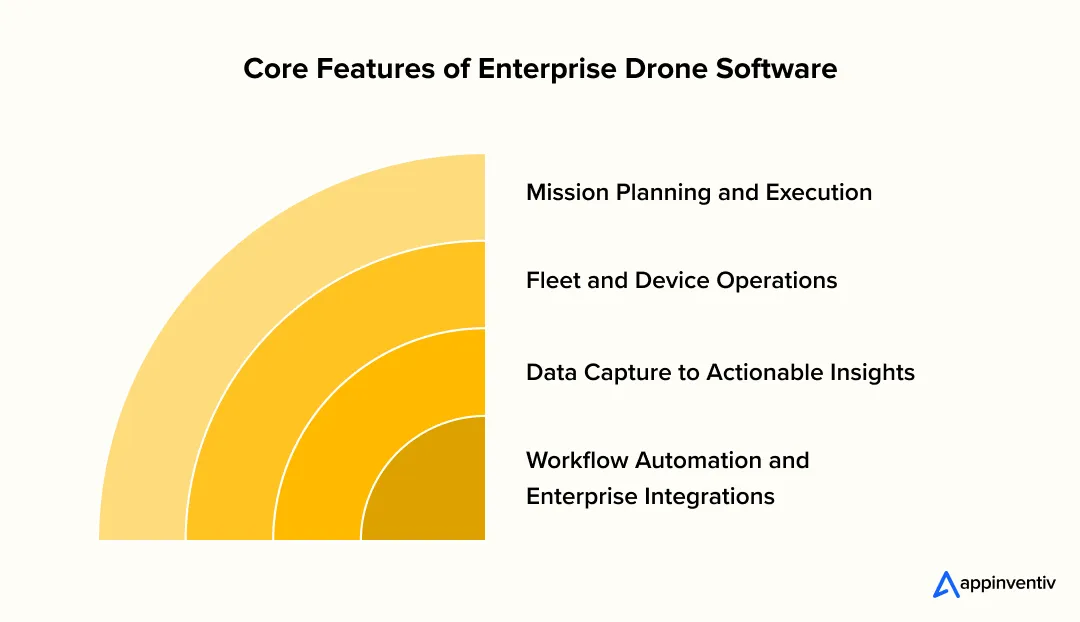
Mission Planning and Execution
This is where repeatability is built. Not just a map and a start button, but structured missions your teams can run consistently.
What this typically includes:
- Route planning with site-specific constraints and geofencing rules
- Pre-flight checklists and approval workflows that match how your org operates
- Live mission monitoring with telemetry synchronization (MAVLink), status, and event timelines, plus real-time video where needed
- Standardized mission templates so that every site does not reinvent the process
What to look for: missions that can be audited, replayed, and compared over time, and that stay consistent across software-based UAV stacks.
Fleet and Device Operations
If your fleet grows, operational control becomes a bigger challenge than flying. You need the ability to manage drones like enterprise devices.
What this typically includes:
- Provisioning and assignment controls by role, site, and team
- Device health monitoring, battery and payload status, maintenance scheduling
- Firmware policy management, plus drivers/payload profiles, so updates stay controlled, not accidental
- Access governance that prevents shared credentials and unmanaged devices
What to look for: a fleet layer that makes scaling boring, predictable, and controlled.
Data Capture, Processing, and Analytics
After a flight, the most common failure mode is simple. Someone drops a folder into a shared drive, a few screenshots get emailed around, and the “insight” never becomes action. Your platform should make that impossible.
What this typically includes:
- Secure ingest for imagery, video, and sensor data with metadata tagging (asset ID, site ID, mission ID)
- Automated quality checks to flag unusable captures early (missing frames, blur, GPS drift)
- Processing pipelines that generate usable outputs like reports, models, or dashboards
- Review and annotation workflows for defects, anomalies, or site issues
- Role-based access and retention controls so governance is enforceable
A practical drone data workflow looks like this:
- Ingest and Tag data with mission, site, and asset context
- Run QA Checks to catch capture issues before teams waste time
- Process into outputs your business can use (maps, models, defect summaries)
- Review and Annotate with severity and ownership
- Publish results into GIS and CMMS or EAM workflows where work gets executed
- Retain Evidence with access history so audits do not become a scramble
AI-powered drone software development should make inspections faster and more consistent, not become a side project only specialists understand. The focus needs to stay on everyday workflows, such as automatically spotting defects, flagging anomalies, and tagging assets, so the data flows straight into your CMMS and GIS systems.
Also Read: AI Drone Technology – Understanding the Dynamics and Business Imperatives
Workflow Automation and Enterprise Integrations
This is where drone programs either become part of the business or stay stuck as a separate tool. A simple tell is what happens after a defect is flagged. If someone has to copy details into a ticket by hand, adoption will fade once the novelty wears off.
Enterprise-ready platforms close the loop automatically, with the right objects created in the right systems.
What this typically includes:
- CMMS or EAM: create a work order with the right asset ID mapping, attach evidence, assign severity, and track closure status back into the drone platform
- GIS: publish findings as map layers, align coordinate systems, and link each marker back to the mission and asset record
- Ticketing: create incidents with priority, SLA timers, escalation rules, and evidence attached so nothing is lost in screenshots
- Identity and Access: SSO via OIDC, role templates by site, and user provisioning through SCIM, so access stays controlled as teams change
- BI and Reporting: push structured events and outcomes into dashboards so leaders see cycle time, closure rates, and recurring issues, not just flight counts
- Developer Extensibility: APIs for developers plus webhooks so internal teams can build automations without waiting on vendor roadmaps.
- Failure Handling: retries, dead-letter queues, and clear error states so integrations fail safely instead of silently.
A practical question to ask your team is: “After a flight, can we go from finding to closed work order without manual steps?” If the answer is no, the gap is usually integration design, not drone capability.
What Governance and Safety Challenges Arise in Drone Software Development?
The pilot works, then legal asks, “Can we prove who captured the footage, who accessed it, and whether it was altered?” That’s when governance becomes product scope.
To scale across sites and regions, build compliance into approvals, data handling, and audit trails from day one, and treat rules like U.S. Remote ID and EU operating categories as configurable policies, not exceptions.
Audit Trails That Hold Up Under Scrutiny
Enterprise programs need a defensible record of what happened during a mission. Not just for regulators, but for internal accountability when incidents occur.
What this typically includes:
- Mission logs with timestamps, locations, operators, and approvals
- Event timelines that can reconstruct what happened during a flight
- Evidence capture that ties outputs to asset IDs, site IDs, or incident IDs
- Tamper-resistant audit logging for access, changes, exports, and sharing
If you cannot replay the story of a mission later, you are taking on hidden risk.
Safety Controls That Match Your Operating Model
Safety goes beyond keeping a drone in the air. It includes who can launch a mission, which conditions stop it, and how edge cases are handled. Drone software regulatory compliance is not optional; it is foundational.
From U.S. Remote ID rules to EU operating categories and airspace limits, your platform needs to handle regulations as configurable policies, not last-minute fixes.
What this typically includes:
- Role-based permissions for pilots, reviewers, approvers, and admins
- Policy-driven checklists that reflect your SOPs
- Automated constraints for restricted zones, site rules, or operational thresholds
- Exception workflows for emergency missions with traceable approvals
This is what turns “we can fly” into “we can operate responsibly.”
Data Governance That Security Teams Can Sign Off/On
Drone programs often generate sensitive data. Facilities, infrastructure, public spaces, customer locations. If the storage and sharing model is unclear, adoption slows down fast.
What this typically includes:
- Clear data residency and storage strategy aligned to your regions
- Encryption in transit and at rest, with enterprise-grade key management
- Retention policies and access rules are enforced by roles and purpose
- Controlled sharing, export restrictions, and monitored downloads
If your CISO’s team has to guess how data is handled, you will feel it in delays and constraints later.
Multi-Region Readiness Without Constant Redesign
Even if you start in one geography, large enterprises rarely stay there. Rules vary, and your software needs to handle governance differences without a rebuild each time.
What this typically includes:
- Configurable policies by region, site, and mission type
- Standardized logs and reporting formats that align with audit needs
- A compliance mapping approach that connects requirements to platform controls
The practical point is simple: governance is what makes scaling safe. Without it, you are forced to choose between moving fast and staying defensible. With it, you can do both.
If policies change by region, your platform can’t be rebuilt every time. It needs configurable governance by design.
Get a multi-region policy blueprint for identity, logging, retention, and evidence trails your risk team can defend.
What Are the Biggest Challenges in Drone Software Development at Enterprise Scale?
You usually feel the friction when the program moves beyond the first site. The second location wants a different approval chain. IT asks for SSO and audit logs. Ops wants the same mission template reused without babysitting. That’s where most drone programs slow down.
Here are the challenges that actually show up in enterprise rollouts, plus the moves that keep them under control.
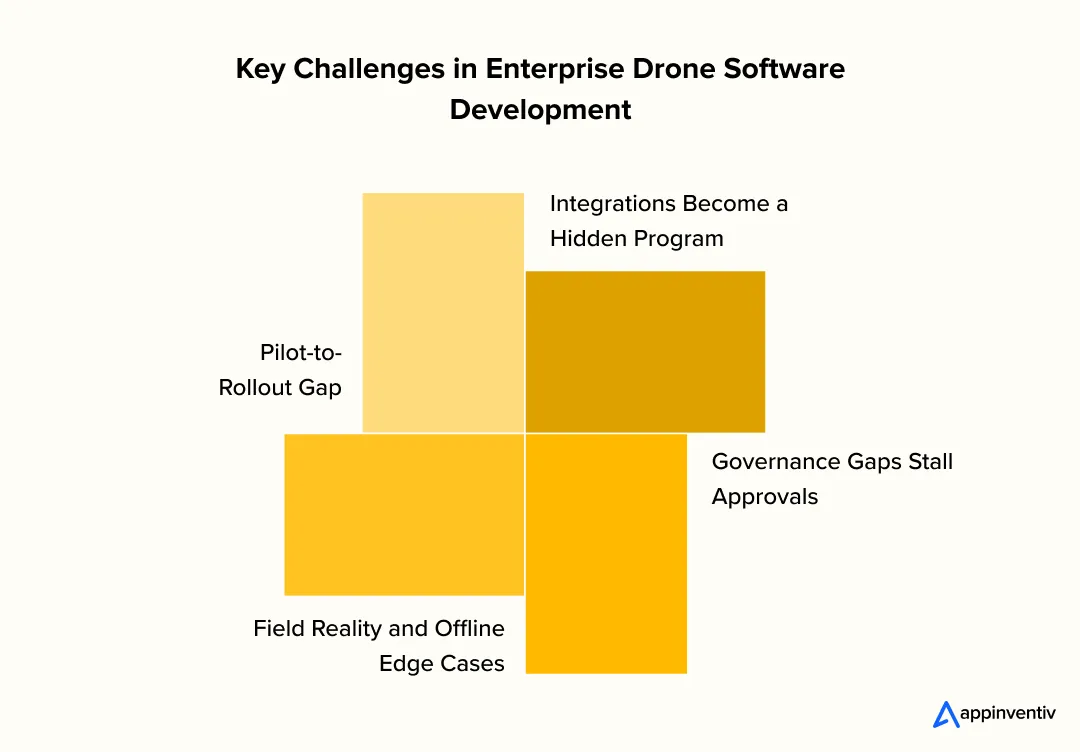
1. The Pilot-To-Rollout Gap (Scope Drift and Site-By-Site Rework)
A pilot proves the drone can fly. It does not prove your organization can run the workflow repeatedly across teams and sites.
Solution:
- Lock one workflow with clear acceptance criteria in Phase 0
- Define decision gates for “MVP complete” and “scale-ready” before the build starts
- Create site templates for roles, approvals, missions, and reporting so expansion is configuration, not rebuild
2. Integrations That Become a Hidden Program
Drone outputs do not matter if they never land in CMMS, EAM, ticketing, or GIS, where work gets executed.
Solution:
- Identify systems of record early and define what gets written back
- Build integration contracts and data models before scaling sites
- Treat integrations as a phase with its own acceptance criteria, not a single line item
3. Governance Gaps That Stall Approvals
Legal and risk teams will pause rollout if audit trails, retention, and access controls are vague.
Solution:
- Make audit logs, mission replay, and evidence capture core requirements
- Enforce RBAC and purpose-based access from day one
- Align data residency, sharing rules, and retention to where you operate
4. Field Reality (Connectivity, Offline Work, Edge Cases)
What works in a demo breaks when a site has weak connectivity or operators need to complete a mission under pressure.
Solution:
- Design offline-first flows with reliable sync and conflict handling
- Validate in real environments early, not at the end
- Instrument missions so failures are observable and fixable
What Is the Drone Software Development Cost for Enterprise Platforms?
This is where someone says, “Just give me the number.” Fair ask: CFO needs a budget band, procurement needs staged approvals, and tech leaders need clarity on what’s included.
Drone software cost is driven less by screens and more by governance, integrations, data pipelines, device variation, and real-world validation. Below is a practical cost view by complexity tier and by stage, so you fund a controlled rollout, not a one-time gamble.
A. Cost Breakdown by Complexity
| Complexity Tier | Typical Scope | Estimated Range (USD) |
|---|---|---|
| Pilot-Grade MVP | Single workflow, limited reporting, basic fleet controls | $60k to $150k |
| Business-Grade | Fleet + workflows, stronger governance, one ot two integrations | $150k to $350k |
| Enterprise Platform | Multi-site ops, deep integrations, auditability, analytics | $350k to $800k+ |
| Regulated + Autonomy-Heavy | High assurance, advanced analytics, strict governance | $800k ot $1.5M+ |
B. Cost Breakdown by Stage
| Stage | What’s Included | Budget Range (USD) |
|---|---|---|
| Consulting and Scoping | discovery workshops, blueprint, backlog, compliance map | $30k to $80k |
| UX and Architecture | workflows, reference architecture, security model | $40k to $100k |
| Core Build | mission + fleet + data foundations, APIs, admin console | $150k to $250k |
| Integrations | GIS, CMMS or EAM, ERP, SSO, event pipelines | $80k to $180k |
| QA and Field Validation | device testing, performance, test automation, field checks | $40k to $180k |
| Security and Governance Hardening | audit logs, access policies, risk fixes, compliance controls | $30k to $120k |
| Launch and Scale | deployment automation, training, rollout playbooks | $30k to $90k |
| Ongoing (annual) | support, enhancements, upgrades, monitoring | 15 to 25% of buildings per year |
Also Read: How Much Does It Cost to Develop a Software? Detailed Price Breakdown for Enterprises
What Pushes Cost Up Fastest?
Cost spikes fastest when scope expands into integrations, compliance/security hardening, and complex data workflows, because they multiply testing, approvals, and rework across teams.
Budget smarter by locking the “must-have” outcomes early, and treating anything that touches legacy systems, identity, or regulated data as a separate, planned cost line.
- Multi-site rollout with role templates, approvals, and governance controls
- Deep integrations into GIS, CMMS or EAM, ERP, ticketing, identity, and BI
- Real-time media pipelines and analytics that must work under field constraints
- Offline-first workflows with reliable sync and conflict handling
- Device fragmentation across OEMs, payloads, and firmware policies
- Audit-grade logging that legal and compliance teams can defend
- Embedded drone software development for flight controllers, firmware synchronization, and device-level security protocols
If you want a clean way to pressure-test a proposal, ask this: are we paying for a pilot experience, or are we paying for a platform that can survive scale and scrutiny? The difference shows up in integrations, validation, and governance, not in the demo.
How Should Enterprises Choose a Drone Software Development Company? (Vendor Checklist)
Vendor selection gets serious when the questions shift from “Can you build it?” to “Can we defend it?” If your risk team asks for evidence trails or IT asks how identity works across sites, you need crisp answers, not generic promises.
A quick test is to ask what happens when connectivity drops mid-mission, a firmware update breaks a workflow, or a finding must be traced back six months later.
- Consulting depth that ends in a buildable blueprint, backlog, and clear decision gates
- Acceptance criteria tied to measurable outcomes, not feature lists
- Multi-site platform design from day one, including role templates and site-level policies
- Ability to support multiple drone OEMs and payload types without brittle workarounds
- Mission logs, evidence trails, export history, and access controls are treated as core product features
- Documentation and security posture that can stand up to infosec reviews and audits
- Integrations that push findings into GIS, CMMS/EAM, ERP, ticketing, and BI workflows
- Enterprise identity readiness with SSO and provisioning patterns (OIDC, SCIM)
- Real-world field validation plan, not just QA in staging environments
- Coverage for offline workflows, sync conflicts, and operational edge cases
- Governed rollout approach with phased releases, launch readiness criteria, and rollback plans
- Onboarding playbooks and templates so each new site is configured, not a rebuild
- Support model designed for firmware shifts, policy updates, and evolving operational needs
- Engagement model that fits scale: consulting-led MVP then rollout waves, or a dedicated squad for long programs
Also Read: A Comprehensive Guide to Hiring Software Developers: Cost, Process, and Key Insights
If the checklist is clear, the next step is turning it into a decision-ready shortlist with real scoring.
Share your requirements, and we’ll map the platform scope, risks, and delivery plan into a procurement-ready evaluation pack.
How Appinventiv Helps You Build a Drone Software Platform That Scales?
If your goal is scale, you don’t need generic drone software development services. You need a team that can turn messy field workflows into a governed platform, then make it repeatable across sites without losing control. That’s how we approach drone software at Appinventiv: as an enterprise platform program, not a one-off build.
We start with consulting-led discovery to lock mission workflows, stakeholders, and success metrics. In parallel, we map compliance and evidence needs early, plan integrations with your GIS, CMMS/EAM, ERP, ticketing, and SSO systems, and define a staged delivery plan with decision gates that leadership and procurement can approve.
Our UAV software development services engineer for real conditions: repeatable mission execution, fleet governance, secure data pipelines that convert captures into usable outputs, integration layers that push results into enterprise workflows, and audit-ready security plus logging.
Our custom software development services team has delivered digital platforms for brands like IKEA, Americana, Domino’s, and 6th Street. It brings that same delivery discipline here, backed by 2000+ products supplied, 95% on-time delivery, 500+ legacy processes transformed, and 95% client satisfaction.
Frequently Asked Questions
Q. Which industries use drone software the most?
A. Drone software is widely used in energy and utilities, construction, mining, oil and gas, logistics, agriculture, telecom, smart cities, and public safety. Adoption is strongest where inspections are frequent, safety risk is high, and evidence needs to flow into maintenance, incident, or compliance workflows quickly.
Q. Can enterprise drone software use AI and real-time analytics?
A. Yes. AI can automate defect detection, asset tagging, anomaly spotting, and progress tracking from images and video. Real-time analytics helps with live mission monitoring and faster triage, while post-flight processing usually delivers the biggest enterprise value through consistent reports, evidence trails, and system-ready outputs.
Q. How is data security handled in enterprise drone software?
A. Security typically includes SSO, role-based access, encryption, secure key management, tamper-evident audit logs, and controlled retention policies. Enterprises also expect monitoring, incident response readiness, and clear rules around who can access footage, how it’s shared, and how long it’s stored for audits.
Q. How much does enterprise drone software development cost?
A. Most enterprise builds fall in the $60,000 to $300,000+ range. Costs rise fastest with multi-site governance, integrations (GIS, ERP, CMMS/EAM), security hardening, compliance logging, data pipelines, offline workflows, and field validation. A pilot MVP is cheaper, but scale and governance drive the real budget.
Q. How to choose the right drone software development company?
A. Pick a partner that can prove enterprise delivery, not just drone features. Prioritize integration depth (SSO, ERP, GIS, CMMS/EAM), security and audit readiness, rollout experience across sites, and a staged plan with clear decision gates. Ask for examples of handling approvals, permissions, and real-world connectivity issues.
Q. How do I hire drone software developers for enterprise projects?
A. Here is how you can hire drone software developers for enterprise projects:
- Look for teams with experience delivering real enterprise drone rollouts, not just pilots
- Prioritize skills in integrations like GIS, CMMS or EAM, SSO, and compliance logging
- Make sure they understand field realities such as mission planning, fleet governance, and offline workflows
- Check for IoT or embedded systems knowledge and strong cloud architecture capabilities
- Choose partners who support phased delivery with clear decision checkpoints
Q. How is drone software integrated with enterprise systems?
A. Integrations usually connect mission outputs to GIS, CMMS/EAM, ERP, and ticketing systems via APIs and event-driven pipelines. Identity is handled through SSO (SAML/OIDC) with role mapping for sites and teams. Governance requires audit logs, retention controls, and standardized data formats so outputs become work orders or reports.

- In just 2 mins you will get a response
- Your idea is 100% protected by our Non Disclosure Agreement.
Maritime Insurance Claim Software Development for UAE Ports, Insurers, and Logistics Networks
Key takeaways: Manual claims management is too slow for the UAE’s high-volume ports; digital solutions streamline processes and reduce errors. Maritime insurance claim software centralizes data, automates workflows, and ensures compliance with UAE regulations and Takaful principles. Real-time integration with port and vessel systems enables faster claim registration, validation, and settlement. Advanced analytics and risk…

How to Build a Student Management System in Australia?
Key takeaways: Australia’s tightening regulatory landscape (TEQSA, ASQA, CRICOS) makes student management system development in Australia a compliance-driven necessity, not just a digital upgrade. Monetisation models such as SaaS subscriptions, institutional licensing, white-label partnerships, and hybrid pricing offer scalable commercial opportunities in Australia’s expanding EdTech market. Addressing challenges early - data privacy, legacy migration, multilingual…

Guide to Software Risk Management: Identifying and Mitigating Key Risks in Software Development
Key takeaways: Risk management is no longer a peripheral activity; it is a core component of Enterprise Risk Governance (ERG) that ensures software ROI. Successful projects define their risk appetite—the level of risk an organization is willing to accept—before the first line of code is written. By integrating risk assessment into the early discovery phase,…









