























How Much Does It Cost to Build an eCommerce Marketplace App Like Poshmark?

- What Are the Benefits of Creating Poshmark Like Marketplace App?
- How Much Does It Cost to Build an eCommerce Marketplace App Like Poshmark?
- What Factors That Impact the Cost to Build an App Like Poshmark?
- What Features to Include While Developing App Like Poshmark?
- Hidden App Development Costs
- Ways to Optimize App Development Costs
- How to Develop an eCommerce App Like Poshmark (Step by Step)?
- Ways to Make an App Better Than Poshmark
- How Does Poshmark Clone Revenue & Business Model Work?
- Key Risks, Compliance Considerations, and Operational Challenges
- How Appinventiv Helps You Build & Launch Your C2C Marketplace App?
- Frequently Asked Questions

Key takeaways:
- Poshmark-like marketplaces enable unlocking new sources of revenue through transforming social interaction into low-capital-intensity repeat purchases.
- A marketplace app would cost between $40,000 and $400,000 to develop, depending on its features, platform and enterprise scalability needs.
- Special implementation, beginning with tests or single categories, confirms supply, demand, and monetization in 6-12 months.
- Trust, engagement, and long-term growth are guaranteed by core marketplace components, such as buyer discovery and seller analytics, as well as AI personalization.
Most teams hit a moment where the excitement of a marketplace idea meets a practical concern. How complex will the build be once real users start uploading products, making payments, and expecting a smooth experience every day?
That is why leaders exploring a C2C platform start asking about ecommerce marketplace app development long before design or coding begins. The first questions are usually simple. What is the cost to develop an app like Poshmark? How long will it take? What technical foundation will keep the platform stable once usage grows?
Building a Poshmark-style platform is rarely just about features. It is about designing scalable architecture, securing transactions, and shaping a user journey that feels effortless on both the buyer and seller sides. These decisions often influence budgets more than teams anticipate at the start.
The cost to build an ecommerce marketplace app like Poshmark generally falls between $40,000 and $400,000, depending on scope, feature depth, and customization levels. The spread in Poshmark clone app development stems from the fact that every marketplace operates differently, from workflows to moderation to payout logic.
Understanding these layers early helps avoid rework later and gives your team a clearer path from concept to launch.
Poshmark generated $4 billion GMV in 2024—discover how your marketplace can scale too.
What Are the Benefits of Creating Poshmark Like Marketplace App?
Most enterprise teams reach a point where growth slows. New revenue streams become the priority. That is exactly why many brands develop an online marketplace app for resale rather than expanding their traditional ecommerce.
The resale economy had crossed $256 billion by 2025. This shift is pushing enterprises toward online marketplace app development that blends social discovery with repeat purchasing behavior. It is also why more organizations now create an e-commerce app like Poshmark to capture C2C demand without holding inventory.
Three measurable benefits of creating poshmark like marketplace app
- Revenue diversification through commissions, promoted listings, and subscriptions. Typical take rates sit between 10% and 20%.
- Higher lifetime value driven by social feeds and community interactions.
- Lower capital intensity since sellers own inventory, not your team.
Also Read: Top 17 Mobile App Development Best Practices in 2025
Before committing to eCommerce marketplace app development or building an app like Poshmark, decision-makers align on unit economics. GMV targets, CAC, take rate, and payback period shape early planning and clarify the cost to build an app like Poshmark at scale.
Quick Poshmark Ecosystem Snapshot
| Aspect | Details |
|---|---|
| Type | eCommerce Marketplace |
| User Scale | 80 million |
| Listing Volume | 200 million |
| GMV (2024) | 4 billion |
This model shows how social discovery, frictionless listing, and secure checkout combine to create predictable marketplace growth.
For Edamama, Appinventiv helped create a specialized marketplace tailored for moms, optimizing the checkout process and product discovery, which resulted in a 20% increase in user retention and improved transaction rates.
How Much Does It Cost to Build an eCommerce Marketplace App Like Poshmark?
At some point, every leadership team asks the same question. What will this actually cost once engineering, design, compliance, and scale are factored in? That is where understanding the cost to build an app like Poshmark becomes a planning tool rather than just a budget estimate.
Pricing shifts based on scope, feature depth, platform choices, and development approach. A finance team mapping year-one investment usually starts with three clear stages.
A. Cost Schedule (MVP – Growth – Enterprise)
Here is a quick overview of a Poshmark-like marketplace development pricing.
| Product Stage | Estimated Cost | Major Focus |
|---|---|---|
| MVP | $40,000 – $80,000 | Basic functionality of buyer and seller, core administration, and necessary integrations. |
| Mid-size Growth | $80,000 – $150,000 | Improved UX/UI, social commerce functionality, analytics, and AI suggestions. |
| Full-scale Enterprise | $250,000 – $400,000+ | Advanced personalization, multi-platform support, compliance, high design, and high scalability. |
These ranges reflect typical Poshmark-like marketplace development pricing for eCommerce marketplace app development projects.
B. Cost Breakdown by Components
This component-level view helps finance teams validate the cost to build an app like Poshmark against internal investment and ROI benchmarks.
| Component | Estimated Cost | Notes |
|---|---|---|
| Mobile application development | $20,000 – $70,000 | iOS, Android, responsive web |
| Backend and Database | $15,000 – $50,000 | Scalability, security, and an administration dashboard |
| Design & UX | $10,000 – $40,000 | High-fidelity design, social functionality |
| Integrations | $5,000 – $20,000 | Payment gateways, shipping, analytics, and KYC |
| Regulatory & Security | $5,000 – $15,000 | Security, territorial legislation |
| QA + Performance | $5,000 – $15,000 | Cross-platform and cross-device testing |
| PM and DevOps | $5,000 – $20,000 | Project management, deployment, CI/CD pipelines |
Clear visibility into these layers helps enterprises align budget with strategy. It becomes easier to forecast ROI, prioritize features, and commit to building an app like Poshmark without sacrificing operational efficiency later.
This component-level view helps finance teams validate the cost to build an app like Poshmark against internal investment and ROI benchmarks.
What Factors That Impact the Cost to Build an App Like Poshmark?
Most leadership teams learn quickly that the cost to build an app like Poshmark is not just about writing code. It depends on how your marketplace is designed to perform once real buyers, sellers, and transactions come into play.
Several practical factors shape the budgets for online marketplace app development:
- Scope and complexity: Adding AI-driven personalization, social commerce features, advanced search, or integrated eCommerce analytics increases development effort and infrastructure needs.
- User roles: Buyer, seller, and admin experiences require separate workflows, permissions, and security layers. Each role adds logic to the platform.
- Role of UI/UX in App Development: A refined interface, smooth listing flows, and clear discovery journeys reduce drop-offs. Achieving this level of UI/UX requires additional design cycles, testing, and systemized design frameworks.
- Technology stack choices: Decisions between native builds and cross-platform development influence performance, scalability, and maintenance costs. Backend architecture, cloud hosting, and database design further affect the budget.
- Integrations and compliance: Payment systems, logistics APIs, and regional data regulations introduce extra implementation and verification work.
- Team structure: Experienced architects, QA teams, and DevOps support are essential for stable marketplace operations.
Understanding these drivers helps enterprises estimate the cost to build an app like Poshmark realistically and plan an ecommerce marketplace app development roadmap that supports long-term growth.
With Adidas, Appinventiv’s solution for integrating multi-platform support and payment gateways increased global user acquisition by 25%. This highlights how technology stack choices can influence costs and deliver significant ROI.
What Features to Include While Developing App Like Poshmark?
When you build an ecommerce marketplace app like Poshmark, features decide whether users return after their first sale or disappear. A Poshmark-style ecosystem works only when buyers trust the flow and sellers feel supported at every step. This is where ecommerce marketplace app development moves from basic listings to real marketplace momentum.
Core feature layers for Poshmark clone app development
Buyer Experience
- Quick onboarding with social or OTP login to reduce early drop-offs
- AI search with image-to-product discovery and natural language queries like “black summer dress under $50.”
- Personalized feeds driven by browsing and purchase behavior
- Secure checkout with encrypted multi-payment options
- Offer and negotiation tools that drive social commerce engagement
Seller Experience
- KYC-based verification to protect marketplace integrity
- GenAI seller tools that auto-remove image backgrounds and generate product descriptions
- Smart listing suggestions with category and price recommendations
- Inventory and order dashboards with real-time performance insights
Admin and Platform Infrastructure
- Commission and fee automation
- AI-driven fraud and counterfeit detection
- Escrow-as-a-Service payment logic that holds buyer funds in a secure wallet, releases payouts only after delivery confirmation, and triggers refunds automatically if disputes arise.
- PCI DSS-compliant multi-seller payout systems
- Real-time notifications and logistics tracking
These capabilities form the foundation of Poshmark clone app development, scaling beyond early traction and building lasting marketplace trust.
Hidden App Development Costs
Most teams budget for ecommerce marketplace app development. Fewer plan for what happens after launch. A Poshmark-like marketplace keeps evolving once real sellers, buyers, and transactions start flowing. These post-launch costs shape the true cost to build an app like Poshmark over time.
Ignoring them early often leads to rushed fixes, scaling pressure, and unplanned spend.
Key back-office cost drivers
- App Maintenance: Continuous updates, security patches, API version upgrades, and performance tuning
- App Hosting: Cloud infrastructure for media storage, real-time feeds, databases, and CDN delivery
- App Promotion and Marketing: Paid acquisition, referral programs, influencer campaigns, and liquidity building
- Legal and Licensing Fees: KYC verification, payment compliance, regional data protection, and intellectual property safeguards
Estimated Cost Range
| Cost Component | Ballpark Estimate (Annual) |
|---|---|
| App Maintenance | $15,000 – $80,000 |
| Hosting & Infrastructure | $8,000 – $50,000 |
| Promotion & Marketing | $10,000 – $200,000+ |
| Legal & Licensing | $5,000 – $30,000 |
For enterprises planning Poshmark-like marketplace development pricing, these operational layers directly impact long-term ROI and platform stability.
Ways to Optimize App Development Costs
By adopting a more cost-effective development strategy and resource-efficient practices, you can reduce development costs without compromising product quality.
- Develop an MVP to validate the marketplace’s fundamental mechanics, then expand.
- Only features that directly influence user acquisition, liquidity, and conversions should be prioritized.
- Develop for iOS and Android with a single codebase using cross-platform development.
- Offshore to skilled groups in cost-effective areas to gain access to talent at a minimal budget.
These optimization steps help control the cost to build an app like Poshmark without compromising scalability or compliance readiness.
How to Develop an eCommerce App Like Poshmark (Step by Step)?
Learning how to build an ecommerce marketplace app (step by step) reveals that it cannot be done by simply coding — it requires a platform that can be scaled, generate revenue, and build trust.
The competitive nature of the market, with more than 28 million stores in eCommerce worldwide, necessitates a structured approach towards ecommerce marketplace app development.
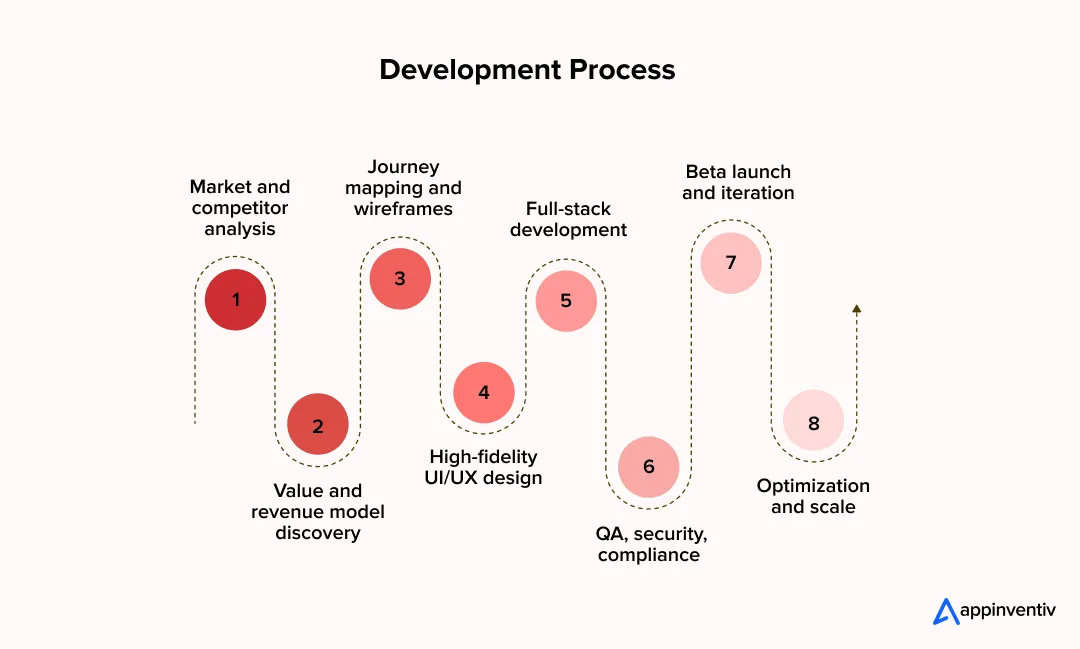
Step 1: Competitive Analysis and Market
Begin your online marketplace app development with competitor analysis, market analysis, and market gaps analysis. The information here is used to guide feature prioritization and the monetization strategy.
Step 2: Product Discovery
Establish your app’s value, revenue model, and differentiators. A clear vision would ensure that resources are directed towards what drives business results.
Step 3: User Journeys and Low-Fidelity Wireframes
Map buyer and seller flows. The wireframes enable early usability testing and help identify friction points without incurring significant development costs.
Step 4: High-Fidelity Design
Pay attention to intuitive, visually appealing interfaces that align with your brand. All the design decisions must amplify interactions and conversions.
Step 5: Frontend and Backend Development
Create a scalable backend and a user-friendly front end to facilitate effective buyer-seller interactions. Incorporate safe payment gateways, KYC, shipping, and analytics.
Step 6: Quality Assurance, Security and Compliance Testing
Performance, security and regulatory compliance Test thoroughly. Enterprise adoption relies on trust and reliability.
Step 7: Beta Testing & Launch
Conduct a pilot with a controlled audience to gather feedback. Test experience and work with insights to narrow the gaps and then roll it out to a broader audience.
Step 8: Scale & Optimization
After launch, focus on AI customization, retention efforts, and efficiency to increase the marketplace’s liquidity.
The roadmap will ensure your business is set to develop an online marketplace app that is scalable, revenue-generating, and long-term successful.
Also Read: Mobile App Development Explained: The Ultimate Step-by-Step Guide
Partner with experts to deliver enterprise-grade eCommerce app development services tailored to your business.
Ways to Make an App Better Than Poshmark
A marketplace can do better than Poshmark by being easier to use, more aesthetically refined, and smarter in how it helps people find, purchase, and sell merchandise.
The three key strengths are UI/UX, features, and technology. The following is a short form of what actually drives the needle.
UI/UX
It ought to have a more personal interface that is quick to use and aesthetically pleasing.
- AI-Driven Personalization: A personalized home feed that adjusts to every user and their taste and navigation habits.
- Interactive Product Pages: 360-degree view or plain AR demos that allow consumers to learn about things within a short time.
- Theme-Based Browsing: It is collections organized around style, mood, or events that facilitate discovery more naturally.
- Social and Community Layers: in-app aesthetics, suggestions by creators, and user portraits which foster trust and inspiration.
- Frictionless Checkout: One-button navigation, with visible BNPL and smart cart recommendations.
Features
The features must help users find the appropriate products more quickly, make purchases with confidence, and rely on what they see.
- Smart Search: Intent understanding, voice, image search, and filter-heavy search.
- Virtual Try-Ons: AR previews of clothes, beauty and accessories.
- Live Shopping and Shoppable Videos: Instantly converting in-app streams or branded content.
- Advanced Reviews: Photos generated by users and sheer clarity in ratings through attributes.
- Seamless Returns & Tracking: Definite policies, immediate credit facilities, and real-time order notification.
Technologies
The tech stack is expected to deliver high individualization, speed, and scalability, while remaining adaptable as new features are introduced.
- Modern Frontend: React Native or Flutter to support easy cross-platforms.
- Microservices Backend: Scale search, feeds, notifications, and seller tools without any slowing of the platform.
- Search and Recommendation Engines: Elastic search or Algolia to do quick searching, supported by an ML model to get personalized feeds.
- AI & Computer Vision: Visual search models, AR try-on models and dynamic recommendation models.
- Cloud & DevOps: AWS or GCP pipelines to update continuously and on-demand uptime.
- Headless Commerce Architecture: The frontend and backend run independently. This allows faster interface updates, smoother performance under traffic spikes, and easier integration of new features without rebuilding core systems.
This blend produces a marketplace that is aesthetically polished, profoundly personalized, and fast in every interaction, providing a more compelling experience than Poshmark.
How Does Poshmark Clone Revenue & Business Model Work?
For enterprises, it is important to understand how a Poshmark clone’s revenue & business model work before spending on the development of ecommerce marketable apps. An effective model incorporates sellers’ incentives and the platform’s profitability in a well-designed manner.
A clear monetization structure is essential to recover the cost to build an app like Poshmark and sustain long-term marketplace margins.
A. Key Revenue Streams
A Poshmark market-type business makes money in several supplementary ways. A combination of them can also help enterprises to optimize their user activity, as well as profitability:
- Commission/Take Rate: This is a percentage of every transaction, yielding predictable revenue. In Poshmark-type markets, the commission is usually 10-20%.
- Seller Service Fees: Advanced inventory management, analytics, or promotional boosts can generate additional revenue.
- Promoted Listings and Ads: Sellers can pay to gain more visibility for their products, which encourages engagement and makes the platform profitable.
- Tiers of Subscription: Subscription levels can include optional premium tiers (such as early listing access or discounts).
- Shipping Support Fees: Efficient logistics operations can be achieved, and buyer satisfaction can be enhanced.
- Brand Partnerships and Collaborations: Businesses can partner with larger companies to secure exclusive launches, sponsorships, or affiliate revenue.
This multi-stream structure is what offsets the cost to build buying and selling app platforms operating at sustained transaction volume.
Also Read: How Do Apps Make Money: Strategies to Boost Your Revenue Potential
B. Strategic Advantages
- Supply-side Liquidity: When more sellers are encouraged, more product varieties are created, attracting buyers and increasing transaction volume.
- Retention & Engagement: Social commerce interactions, such as following sellers, sharing listings, and engaging with offers, promote repeat visits.
- Scalable Monetization: Multiple revenue streams reduce dependence on any one channel and offer opportunities to increase margins.
By aligning the platform’s features with monetization approaches, businesses can create an eCommerce app like Poshmark that is not only operationally efficient but also financially viable and poised for growth.
Key Risks, Compliance Considerations, and Operational Challenges
There are challenges involved in launching a similar marketplace like Poshmark, and this is what the enterprise needs to overcome initially. Knowledge of these dangers will make implementation easier and improve the platform’s long-term reliability.
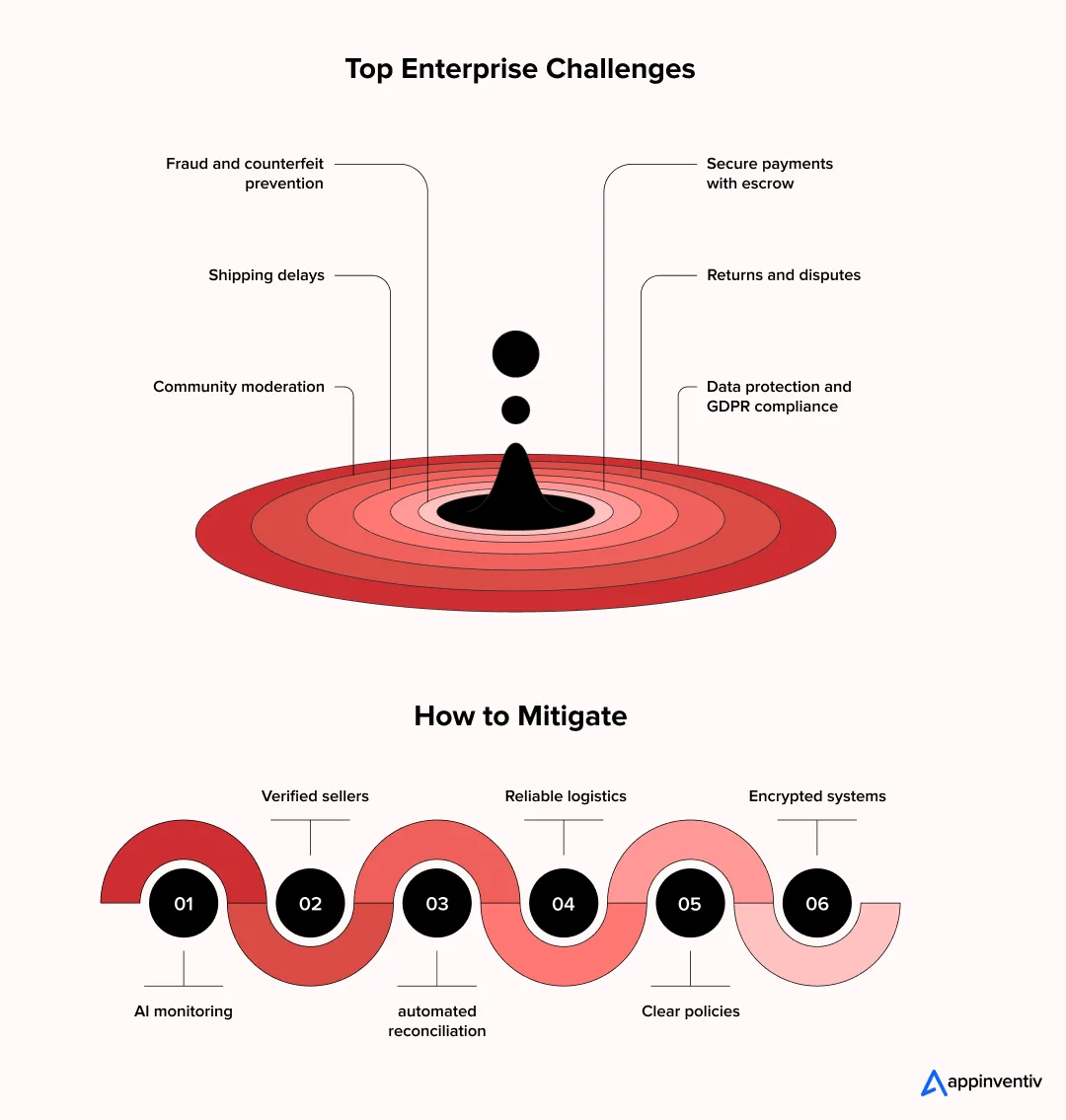
- Fraud and Counterfeit Prevention
C2C platforms attract bad actors as soon as transaction volume rises. Seller verification, AI-based listing scans, and performance scoring systems reduce counterfeit exposure. Real-time anomaly dashboards help teams spot unusual activity before revenue or reputation takes a hit.
Also Read: How Much Does It Cost to Build a Fraud Detection Software?
- Payments & Escrow
Secure payment flow keeps buyers and sellers confident. Escrow-based settlement ensures funds are released only after successful delivery. Automated reconciliation and multi-gateway integrations keep cross-region transactions reliable and auditable.
- Shipping Coordination
Delayed deliveries weaken marketplace trust quickly. Integrating logistics partners, live shipment tracking, and predictive delay alerts helps maintain consistent delivery experiences across regions.
- Returns & Disputes
Returns are unavoidable in C2C commerce. AI-assisted fraud detection and automated dispute workflows reduce manual overhead while ensuring fair, fast resolution.
Compliance and Security
Once real money and personal data move through the platform, compliance becomes non-negotiable.
Enterprise-grade marketplace app development typically requires:
- PCI-DSS Level 1 compliance for secure multi-seller payment processing
- SOC 2 Type II certification to ensure data security and operational integrity
- GDPR and CCPA adherence for user privacy and regional data protection
- End-to-end encryption for user communication and transaction records
- KYC verification to prevent fraudulent seller onboarding
Teams that build compliance into architecture from day one avoid expensive retrofits later.
A proactive approach to risk, compliance, and operations allows enterprises to develop an online marketplace app that remains secure, trusted, and ready for long-term scale.
Also Read: 11 Biggest Challenges in Mobile App Development
Ensure your app design, revenue model, and user experience align with enterprise goals.
How Appinventiv Helps You Build & Launch Your C2C Marketplace App?
You must have a partner that provides quantifiable business value when you launch your C2C marketplace app. Appinventiv has already built 400+ eCommerce portals over 9+ years, supported 30+ retailers and brands with a 96% client satisfaction rate, and integrated 25+ payment gateways to enable seamless transactions.
Our architecture-first approach ensures enterprises accurately forecast the cost to build buying and selling app ecosystems before development begins.
We start with discovery, which means understanding your market, users, and revenue objectives. It is based on that that we construct enterprise-grade architecture, scalable back-end systems, secure payments, KYC and logistics integration.
The outcome of our eCommerce app development services speaks volumes. Adidas’s eCommerce app enhanced physical discovery and increased interactions in the regions. Edamama optimized buyer-seller relationships and the checkout process, which increased retention.
The 66th Street app has expanded to only average order value and multi-brand inventory management. The two apps demonstrate how a smart marketplace architecture can drive growth, engagement, and revenue.
Through Appinventiv, businesses can launch their C2C marketplace app with conviction, scaled to handle both revenue and user retention. Let’s connect to learn how a Poshmark-like site can produce concrete business results for your brand.
Frequently Asked Questions
Q. Why develop an app like Poshmark?
A. The resale and C2C eCommerce market is growing, with enterprises having the potential to access it via a Poshmark-like marketplace. It generates new sources of revenue, attracts buyers and sellers and creates long-term brand loyalty. In cases where companies want to develop an e-commerce application, such as Poshmark, it is a social commerce model with scalability.
Q. How can I monetize an app like Poshmark?
A. The commissions of the transactions, fees of the seller services, the promoted listing, subscriptions, and shipping support fees may generate the revenues. Businesses can leverage various streams to ensure reliable, replicable revenue that aligns with the Poshmark clone’s revenue model and business model.
Q. How long does it take to make a Poshmark clone?
A. Poshmark clone app development is determined by scope and complexity. MVPs can be completed in 3-5 months, and full-scale enterprise marketplaces with advanced features can be completed in 8-12 months. Using a systematic roadmap ensures predictable schedules for developing online marketplace apps.
Q. What affects the cost of building an ecommerce marketplace app?
A. Some of them are the complexity of features, the user count, their more sophisticated features such as AI, the depth and complexity of the UI/UR, the technology stack, third-party integrations, platform counts, and compliance requirements. These are useful for predicting the cost to develop an app like Poshmark, an ecommerce marketplace application.
Q. How much does it cost to build an ecommerce marketplace app like Poshmark?
A. Depending on their size, the cost to build an ecommerce marketplace app like Poshmark is between $40,000 and $80,000, mid-size growth apps $80,000 and $150,000, and full-scale enterprise development $250,000 and above. Prices are based on features, platforms, integrations, and compliance requirements.
Q. Which tech stack is best for developing an ecommerce marketplace app like Poshmark?
A. For Poshmark clone app development, common stacks include React Native or Flutter for cross-platform applications, Node.js or Django to make a backend application, and AWS or Azure to create a cloud infrastructure that can scale. The option affects the performance, scalability, and development costs of Poshmark clone apps.
Q. What are the ongoing maintenance costs after the launch?
A. The maintenance is usually 15 to 20 percent of the original development cost per year. It includes updates, server expenses, bug fixing, and the addition of new features to guarantee a smooth process and user satisfaction.

- In just 2 mins you will get a response
- Your idea is 100% protected by our Non Disclosure Agreement.
How Much Does It Cost to Build a Fashion Marketplace App Like Depop in the UK?
Key takeaways: A Depop-style fashion marketplace in the UK usually costs £32,000 to £320,000, depending on how simple or advanced you want the app to be. The UK’s resale-fashion scene is growing quickly, so demand for social, pre-loved fashion apps is only going up. Costs increase when you add things like AI recommendations, logistics integrations,…
How Much Does It Cost to Develop an eCommerce Platform like The Iconic in Australia?
Key takeaways: Building an eCommerce platform like The Iconic in Australia can cost anywhere from AUD $46,500 to AUD $775,000+ depending on scale and sophistication. The real eCommerce cost drivers are backend architecture, integrations, compliance, and system reliability, not just design screens. Platforms like The Iconic succeed because they combine shopping experience, logistics, and payments…
Key takeaways: Global eCommerce fraud losses are expected to exceed $107 billion by 2029. Digital growth, Buy Now Pay Later features, and rising automation are all opening up new avenues for fraudsters to exploit. First-party abuse and refund abuse have ended up being the greatest source of pain globally, affecting nearly half of all online…