

























ERP Software Development Cost in 2026: A Comprehensive Guide

- How Much Does an ERP System Cost in 2026?
- Critical Factors Affecting ERP Software Development Cost in 2026
- Various Pricing Models of ERP Software Development
- ERP Software Implementation Process: Steps, Costs & Timeline
- ERP Cost Optimization Strategies: Making the Most of Your Investment
- How to Calculate ERP ROI
- How Can Appinventiv Help You With ERP Software Development?
- FAQs

Key takeaways:
- ERP systems are essential for modern businesses to integrate information, automate tasks, and streamline operations, ultimately boosting efficiency and profitability.
- The estimated cost for ERP software development ranges from $40,000 to $400,000, but can vary widely based on requirements.
- The total cost depends on specific features, the development team’s location, and the required total development hours.
- Adding technologies like AI and blockchain to an ERP system can also significantly increase the overall cost.
Businesses today face constant pressure to improve efficiency and stay competitive. Yet many companies still rely on outdated, fragmented systems that slow down operations and increase costs.
So, what is the solution? The answer lies in the development of ERP/Enterprise Resource Planning. Many businesses across diverse domains, such as healthcare, finance, and construction, have already adopted these integrated solutions to connect all aspects of their operations, from finance and HR to supply chain and customer management.
What’s even more compelling is that the global ERP software market is expected to grow to around $101 billion by 2026. This indicates a steady pattern and high demand for ERP software development. Therefore, if you are thinking of optimizing your business resources, now is the time to develop and implement an ERP system for your business.
Here’s also a graph exhibiting the primary goals of implementing ERP software systems:
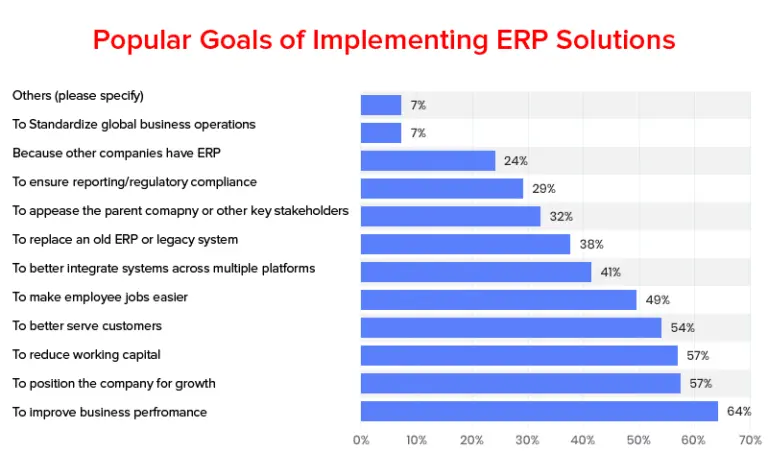
However, despite all the compelling benefits and reasons, ERP implementation can be a huge investment. According to industry estimates, on average, ERP software development cost ranges from $40,000 to $400,000 or more, depending on the size and complexity of your project.
This raises the critical question: How do you plan and budget for ERP development in 2026?
In this blog, we’ll explore the key factors that affect custom ERP software development costs, helping you understand where your money will go and how you can optimize your budget.
Discuss your project idea with us and get a detailed quotation tailored to your needs.
How Much Does an ERP System Cost in 2026?
The average cost to develop ERP software might range from $40,000 to $400,000. In some cases, it may even cost more. However, this is just a rough estimate. There are various factors such as implementation costs, complexity of projects, number of features etc. can increase or lower the final price.
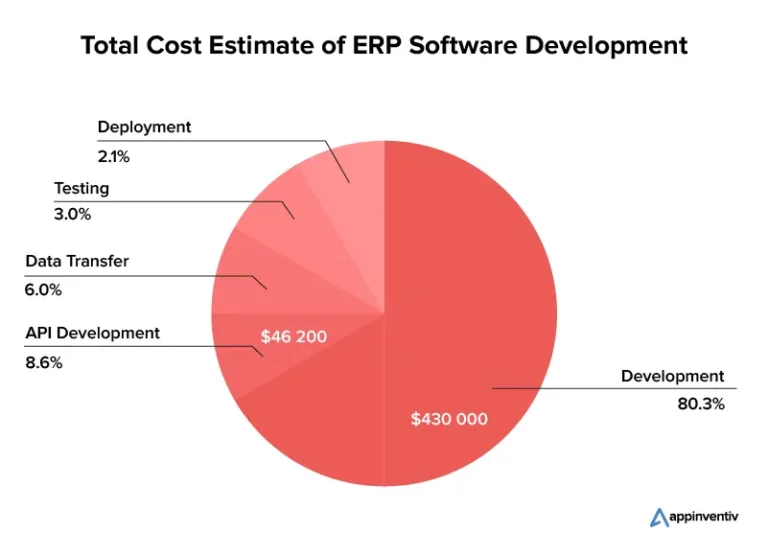
To give you an idea of cost factor significance, here’s a graph depicting the share of some factors and costs involved. However, keep in mind that the final cost to develop ERP software may vary depending on several other components (details later) and your unique project requirements.
Estimating Custom ERP Software Costs: A Simple Formula for Budgeting
When developing ERP software, understanding how to estimate costs can help you prepare for the investment required. A simple formula for ERP system cost estimation is:
Cost = (Hourly Rate of Developers) x (Total Development Hours)
For instance, if your ERP project spans 4-6 months and the hourly rate for developers is between $50 and $150, the total enterprise resource planning development costs will fall somewhere between $32,000 and $144,000.
The final amount depends on factors such as the hourly rate, the complexity of your ERP system, and how long the development process will take.
However, calculating the total development hours is not so easy. But worry not. Typically, you can also carry out a timeline by understanding how many professionals are involved, calculating the time they spend and multiplying these numbers by their hourly rates.
For instance, here’s an ERP software development timeline estimate (in %) depicting how much time professionals spend on each phase of development (details later).
| Development Phase | Development Phase | Back-end Developer | Quality Control |
|---|---|---|---|
| Concept/design | 4% | 6% | 2% |
| Development | 12% | 20% | 14% |
| Testing | 2% | 5% | 4% |
| Support services | 2% | 4% | 5% |
| Total | 20% | 35% | 25% |
This timeline again varies according to the complexity of software and level of research and development.
ERP software development pricing is not easy to understand; therefore, you must have a thorough understanding of your cost elements so you don’t overrun your budget. It is also essential to consult a leading ERP software development company like Appinventiv from the very initial phase to get an accurate ERP development cost analysis.
(Also Read: ERP Accounting Software Development – All You Need To Know)
Critical Factors Affecting ERP Software Development Cost in 2026
There are a number of different factors that have a direct impact on the cost of developing an ERP system. These include implementation and training costs, expertise of developers, maintenance costs, and more. It is impossible to give a one-size-fits-all ERP development cost estimate. Therefore, here’s an ERP implementation cost breakdown based on all factors.
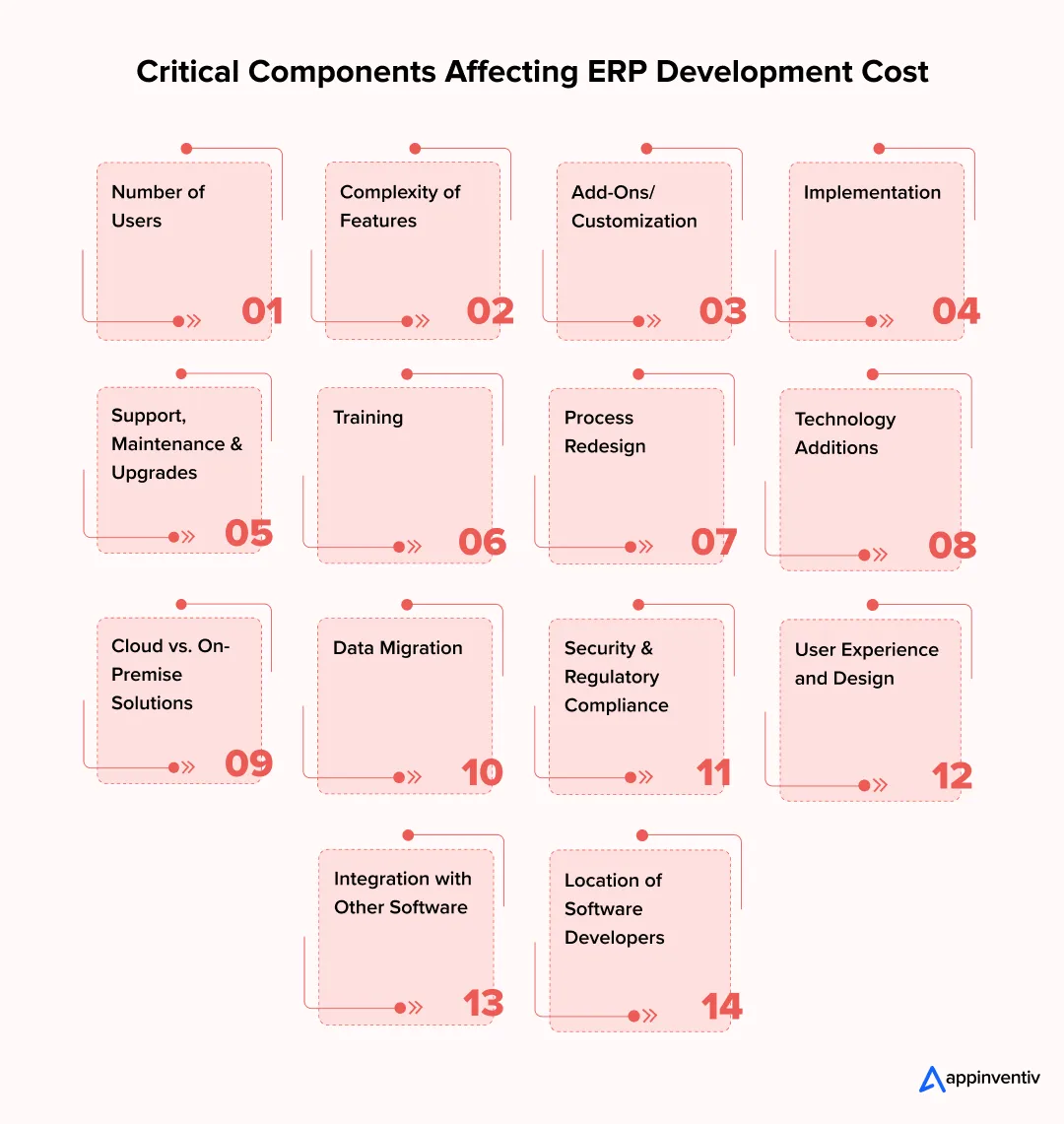
Let’s discuss each of these factors in detail below.
Number of Users
When deciding whether an ERP system is affordable for your organization, you need to consider the number of users who will initially have access to the system. Many ERP vendors charge on a per-user basis. This means that with the increase in the number of users, the cost of ERP also increases. You also need to consider the cost of including new users and how that expense could increase in the future as you scale your business.
Complexity of Features
Apart from the number of users, you also need to determine the features that you need to include in your ERP system. There are a few significant features that make ERP software stand out from other types of software. These include common databases, automation, interaction, data analysis, and more. The more features you add, the higher would be the overall ERP system development cost.
So, it is important to first gauge your exact requirements and then invest in a solution that matches those requirements. The right estimation can be one of the main strategies to improve the ROI of your system.
Usually, this is what the ERP implementation cost breakdown and timeframe look like based on different project complexities:
| Business Size | Estimated Cost | ERP Development Timeline | Key Considerations |
|---|---|---|---|
| Small Businesses | $40K – $100K | 3 to 6 months | Simpler ERP systems, fewer users, minimal customization |
| Medium Businesses | $100K – $250K | 6 to 9 months | Moderate complexity, more users, some customization needed |
| Large Businesses | $250K – $400K | 9 to 12 months | Complex systems, large user base, high customization, integrations with multiple tools |
Add Ons/Customization
In order to offer a comprehensive range of services and functionalities to your employees, you can integrate several third-party add-ons like Enterprise IMs tool or social media logins. You can also include specific modules, such as supply chain management, for increased functionality in your system. The cost of these additional capabilities will differ depending on what you decide to include and which ERP development partner you choose.
Implementation
ERP systems are complex software applications, so you will likely need to change operating systems, hardware, and software in order for the ERP system to run properly. If you are implementing ERP for the first time, it’s advisable to have professionals to install and configure your ERP system.
This will make the process of implementing ERP software smoother, secure and easy. But you will need to include these implementation costs in the total ERP price. Additionally, some vendors offer more consultative assistance, but this costs extra as well.
Support, Maintenance & Upgrades
The moment a new version of your ERP solution is announced, you will have to start planning for the maintenance and upgrade. The last thing you would want is your system becoming obsolete and inviting issues and bugs. You’ll need to ask your vendor how often updates are made, and if the cost of these upgrades is included in the base price of the ERP system development.
Frequent and timely maintenance ensures that if the system is up and running as expected, at all times. Maintenance costs of an ERP typically run between 15–20% of the initial implementation price.
Training
It might not be easy for your employees to start using a newly adopted ERP system right away. That’s the reason why they might require additional training on how to use such a system. Often, the ERP vendor provides training upon request at a standardized hourly rate. In such a case, you will need to factor these additional costs into your analysis when reviewing ERP systems for purchase or opting for a custom ERP system.
Process Redesign
When a business moves from a legacy system to an ERP system for organizational growth, it calls for a number of process redesigns. And the same applies when you move from one ERP system to another. You will still have to bring some redesign to match your company’s business processes with the software’s processes. This, in turn, requires additional costs and affects the final ERP system cost.
Technology Additions
Modern ERP systems use the latest technologies such as AI analytics, IoT, blockchain, machine learning, etc. to provide visibility and intelligence efficiency across every business unit. Thus, the cost of your ERP system will automatically increase with the inclusion of these technologies. The more technologies you add into the system, the greater would be your ERP system costs.
Cloud vs. On-Premise Solutions
Cloud-based ERP systems generally offer lower upfront costs and allow for scalability as your business grows. However, they often come with higher ongoing subscription fees.
On-premise systems require significant initial investments in hardware and infrastructure but have lower recurring costs since you won’t be paying for subscriptions.
Data Migration
Migrating data from legacy systems can be a time-consuming and costly process, especially when dealing with large volumes of data. It requires careful data mapping, cleaning, and ensuring compatibility with the new ERP system, which can extend the timeline and increase costs.
Security & Regulatory Compliance
Many industries require ERP systems to follow robust security measures and comply with strict regulations, such as GDPR, HIPAA, or SOX. Adding features that ensure compliance can significantly increase development costs as the system needs to be customized to meet legal standards.
User Experience and Design
We all know that an intuitive UI/UX is the life and soul of a successful software, and an ERP system is no exception. Thus, crafting engaging UI/UX is crucial for system adoption and productivity. However, creating a visually appealing design with intriguing elements can increase the overall ERP software development costs.
Integration with Other Software
ERP systems often need to integrate with other existing tools. This includes but is not limited to CRM, accounting, or supply chain systems. The complexity of these integrations, especially if you need custom solutions, can increase development costs and extend the project timeline.
Location of Software Developers
Location is another factor that plays a vital role in deciding the cost of ERP software. For e.g., the cost of ERP software development in North America is different from custom software development services in Perth, Ukraine, or India. This is due to the fact that services around the world vary significantly in terms of cost as well as quality.
Here is a table outlining an average rate comparison of ERP software developers in different regions:
| Region | iOS (Avg. $/Hr.) | Android (Avg. $/Hr.) | Cross-platform (Avg. $/Hr.) |
|---|---|---|---|
| India | 22–90 | 15–25 | 20–30 |
| Southeast Asia | 23–55 | 30–45 | 30–45 |
| Asia | 25–35 | 20–30 | 25–35 |
| Middle East | 30–70 | 35–60 | 30–70 |
| Europe | 35–55 | 35–55 | 30–50 |
| Ukraine | 40–78 | 38–60 | 40–78 |
| South Africa | 45–80 | 40–80 | 40–80 |
| Latin America | 28–90 | 28–90 | 40–160 |
| USA | 60–120 | 60–120 | 60–130 |
| UK | 60–75 | 60–75 | 55–75 |
| Canada | 90–120 | 80–140 | 90–120 |
| Australia | 90–120 | 100–120 | 90–120 |
Besides the factors that are mentioned above, the pricing model is another thing that helps in deciding the final ERP price. So, let’s see what are the different pricing models available in the market.
Various Pricing Models of ERP Software Development
Commonly, ERP software vendors utilize different types of pricing models. In this section, we’ll delve deeper into 4 key types of ERP development pricing models to understand their mechanics and functionalities.
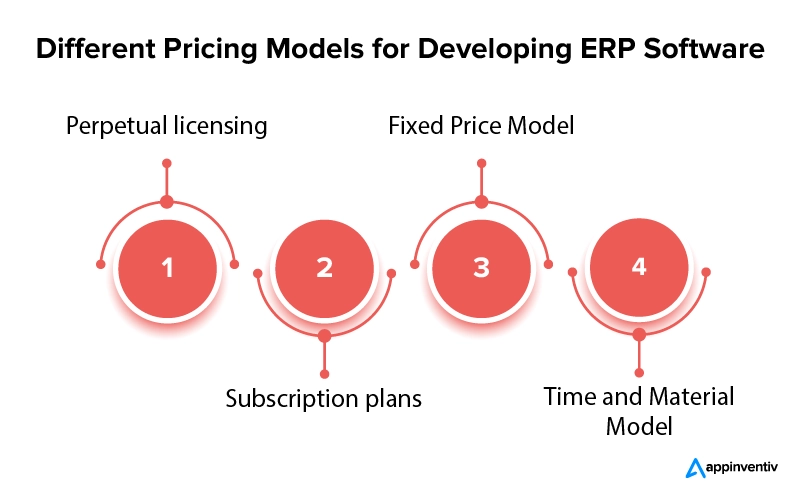
Perpetual Licensing
Perpetual licensing is applicable for organizations that want to host ERP software on-premise. In such a setting, companies are required to pay the one-time up-front cost of the ERP software. The costs of a perpetual license depend on the level of customization and the number of users. One key benefit of perpetual licenses is that companies are not required to pay recurring costs for support, maintenance, and upgrades.
Subscription Plans
Companies looking to leverage cloud servers for ERP software implementation can opt for subscription plans. In this pricing model, the vendor hosts and maintains the ERP system at a third-party server. Companies opting for subscriptions need to pay monthly/annual charges against the required software solution. Subscription plans are often offered to companies with a minimum contract length.
Fixed Price Model
Opting for a fixed price model for ERP software development gives businesses cost predictability and budget certainty. With a predetermined price agreed upon with the development team, companies can accurately allocate funds and plan resources without unexpected cost overruns. However, ensuring that all project requirements are well-defined upfront is essential to avoid additional charges for scope changes.
Time and Material Model
Choosing the time and material model allows businesses to adapt and refine project requirements as they progress. Businesses pay for the time and resources invested in development, allowing them to prioritize features and adjust based on evolving needs. While this model may entail more active project management to monitor costs, it ensures that businesses only pay for what is delivered, promoting efficiency and transparency in the development process.
Now that you have got a fair idea of different pricing models and the average cost of ERP implementation, let us come to one of the significant parts: ERP development and deployment process, along with cost and timeline.
ERP Software Implementation Process: Steps, Costs & Timeline
The implementation of an ERP system in a business is the one factor on which both success and failure of the ERP system ride. When done right, it can take your business to great heights but when implemented wrong, it can make your processes complex. With that said, let us look at what the ERP implementation process entails.
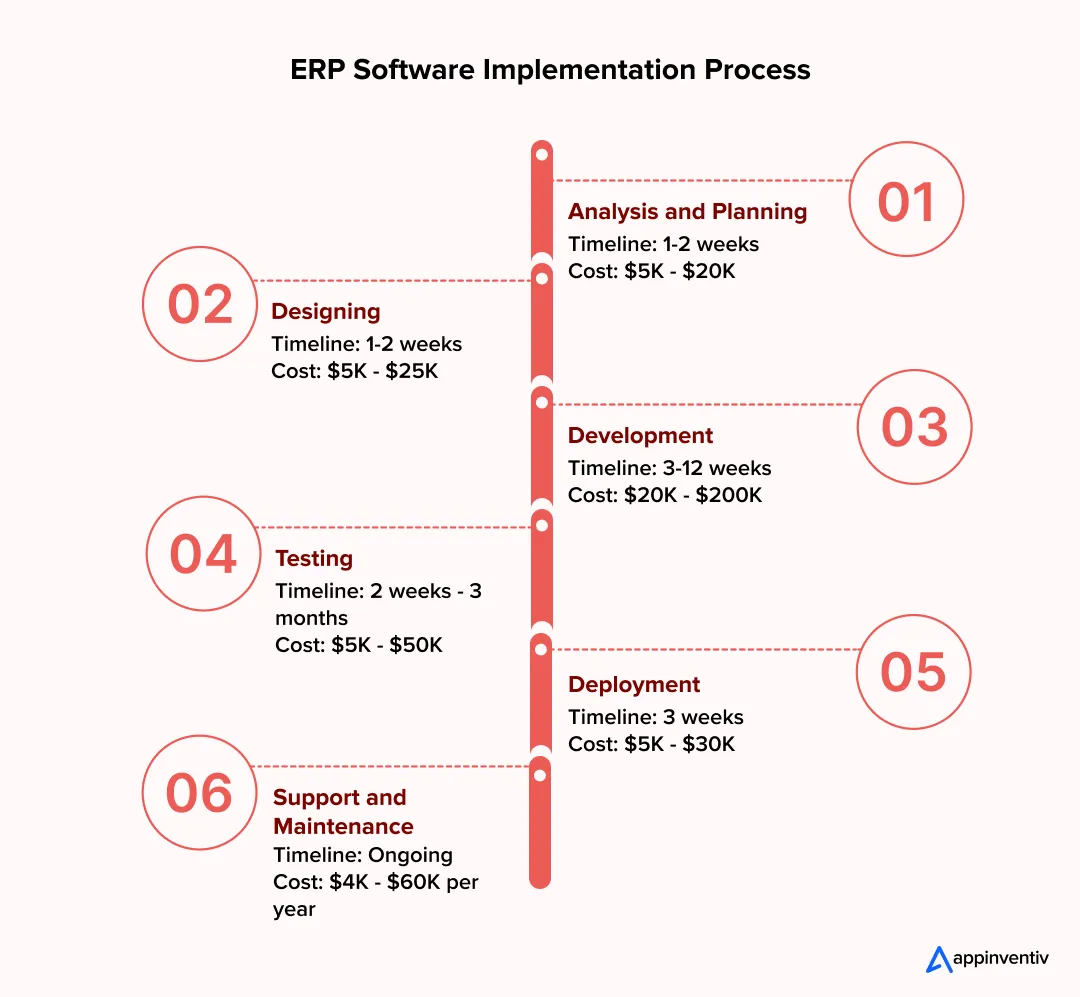
Analysis and Planning (1-2 weeks)
Cost: $5K – $20K
At this stage, key stakeholders are identified who are most acquainted with the company or department where the project will be implemented. They will gather and formulate the goals and objectives of the project.
Given that they have a thorough knowledge of the business process, they will help specify the ERP system to be built and provide up-to-date information. They can identify processes that are less automated and thus need to be improved. At this stage, it is essential to understand how business processes are related to one another.
Designing (1-2 weeks)
Cost: $5K – $25K
At this stage, the UI/UX of the ERP system is designed by the project team. The enterprise architecture is selected, the hardware requirements are specified, the wireframes are developed and the organizational measures necessary for the implementation of the system are determined.
Development (3-12 weeks)
Cost: $20K – $200K
This is the most integral phase, where your development team builds the ERP system. IT architects analyze the connections between each tool and design an appropriate architecture.
Old data (from the current ERP or company documentation) is converted to the format required by the new ERP. The information and data needed in the new ERP are defined as well.
Testing (2 weeks-3 months)
Cost: $5K – $50K
Following ERP development, it is essential to test the system before it goes live. The created software is checked for bugs, errors, and glitches. The performance of tools and functions and the convenience of the interface are also being tested. If the tests are conclusive, users are trained in the system.
Deployment (3 weeks)
Cost: $5K – $30K
After the system is tested and staff learns to use the new system, the ERP is introduced into the work environment. First, it is done on a small scale. If everything is fine, the ERP system is integrated into all business processes of the company.
Support and Maintenance (Ongoing)
Cost: $4K – $60K per year
Once the ERP system is made live, the whole process of support and maintenance starts. This ongoing phase is crucial for ensuring that the system continues to perform as expected. Support includes troubleshooting issues, resolving bugs, and addressing system downtime, while maintenance ensures regular updates, feature enhancements, and adaptation to evolving business needs.
This whole implementation process of ERP takes different times and costs differently, according to the different business sizes it is going to be deployed in.
ERP Cost Optimization Strategies: Making the Most of Your Investment
While implementing an ERP system is a big investment, but worry not, there are some proven ways you can count on to reduce ERP software development costs. To help you keep the costs in check, here are some smart strategies:
1. Focus on Core Features
Instead of developing a full scale ERP, stick with the core features only that your business needs. For instance, you can use pre-built modules for things like HR, finance, and supply chain. This keeps costs lower and lets you scale the system as your business grows.
2. Opt for Cloud-Based ERP
Cloud ERP systems usually have lower setup costs and save on ongoing expenses. Why? Because with cloud based ERP, you need not buy servers or hire in-house IT staff. Also, you only pay for what you need, so the system can grow with your business without eating into your budget.
3. Roll Out the System in Phases
Rolling out in phases is another smart strategy to optimize ERP software development costs. You can start with the most important areas, like accounting or inventory management. This helps control costs and reduces risk while ensuring the system is fully adopted over time.
4. Outsource to Cost-Effective Regions
Outsourcing your ERP development to regions like India, Eastern Europe, or Southeast Asia can save you a lot of money. These areas offer talented developers at a typically lower cost. It’s a cost-effective way to get top-quality work while staying within budget.
Now that we know the estimated budget and cost optimization strategies to build ERP software, let’s look at ways to calculate the ROI from your ERP system. Understanding the ROI will help you evaluate the long-term value and justify your investment in the system.”
How to Calculate ERP ROI
To determine the ROI for your ERP system, you’ll need to assess both the tangible and intangible benefits it will bring to your business.
Identify Tangible Benefits
- Reduced manual labor and administrative costs
- Improved inventory and supply chain management, leading to cost savings
- Fewer errors and less rework, resulting in lower operational expenses
- Faster reporting and analytics, saving employee time
Estimate Intangible Benefits
- Better decision-making through real-time data visibility
- Enhanced customer satisfaction due to streamlined processes
- Improved compliance and reduced risk of regulatory penalties
Calculate Total Cost of Ownership (TCO)
- Include the initial development or purchase cost
- Add implementation, training, and integration expenses
- Factor in ongoing maintenance, support, and upgrade costs
Project Payback Period and ROI
- Subtract the total cost from the estimated annual savings and benefits
- Divide the net benefit by the total cost to get your ROI percentage
- Determine how many months or years it will take to recoup your investment
| Example: If your ERP system costs $120,000 to implement and saves your company $40,000 per year in labor and process improvements, your payback period is three years. Any savings beyond that period represent pure ROI. |
Expert Tip: Engage key stakeholders from different departments to identify all potential benefits and get a holistic view of the ERP’s impact on your business.
How Can Appinventiv Help You With ERP Software Development?
The benefits of implementing an ERP system far outweigh the initial ERP software development cost. When used correctly, modern ERP systems give you a competitive edge with a higher level of operational intelligence that allows you to be more agile and deliver superior customer experiences.
Therefore, if you are planning to invest in ERP systems, opting for our ERP Software Development Services can be your best bet. Our skilled team of 1600+ tech experts can guide you through the entire process and help increase your operational efficiency. Our services include
- Custom enterprise software development
- Enterprise mobility development
- ERM Software integration services
- Legacy application modernization
- Enterprise data management and more
What Makes Us Different from Other ERP Service Providers
With 10+ years of industry experience and over 1000+ enterprise-grade solutions delivered, we are a proven leader in enterprise software development. We’ve successfully digitized 500+ enterprise processes and achieved the following impressive metrics:
- 15+ global recognitions and awards
- Featured in Deloitte Fast 50 India for two consecutive years
- Ranked among APAC’s High-Growth Companies by Statista and the Financial Times for two consecutive years
- 95% SLA compliance rate, ensuring timely and high-quality delivery
- 95% client satisfaction rate, with 90% repeat clientele
- 5+ strategic partnerships with Google Cloud, Microsoft Azure, AWS, etc.
Our Real Life Business Impact:
- 10x increase in data throughput for clients leveraging our ERP solutions
- 30% operational cost savings achieved through process optimization and ERP integration
Consult our industry experts to start your ERP journey today.
FAQs
Q. What is the typical development timeline for ERP software?
A. The development timeline for ERP software ranges from 3 months to 1 year or more. The timeline can vary based on factors such as project scope, complexity, and customization requirements.
Q. How much does it cost to develop an ERP software?
A. On average, ERP software development costs range from $40,000 to $400,000 or more. However, this is just a rough estimate. The actual price of ERP software implementation varies depending on various factors.
For instance, the cost of an ERP system for a small business ranges between $40,000 and $100,000, while an advanced ERP for a big business can scale the figure to even $400,000.
To get an in-depth understanding of the factors affecting ERP development costs, please refer to the above blog.
Q. What are the benefits of investing in ERP software development in 2026?
A. Investing in ERP software development can yield numerous benefits for businesses. These include:
- Improved efficiency and productivity through streamlined processes
- Enhanced data visibility and analytics capabilities for informed decision-making
- Better resource allocation and cost management
- Increased scalability to support business growth
- Improved customer satisfaction through enhanced service delivery.
Q. How do I estimate the ROI on a new ERP system before building it?
A. To estimate ROI for your ERP system price, think about what you want it to do. Will it save time? Cut costs? Make operations more efficient?
Start by comparing the benefits with the costs of development. Track things like less time spent on manual tasks or faster decision-making to see how the system improves your business.
You can also talk to different teams to find out how the ERP can help them, giving you a better idea of the overall impact.
Q. What is a more cost-effective option: build or buy ERP software?
A. It depends on your needs:
- Buying an ERP is usually cheaper and faster. Off-the-shelf systems come with built-in features and are quicker to set up, making them a good choice for businesses with standard needs.
- Building an ERP system is more expensive and takes longer, but it’s customizable. If your business has unique needs or plans to scale in a specific way, building a system might be a better investment long-term.
For most businesses, buying is cheaper and quicker. But if you have special requirements, building may be worth the extra cost.
Q. What’s the most cost-effective ERP tech stack?
A. A cost-effective ERP stack depends on your needs, but here are some solid options:
- Frontend: React or Angular (easy for users to interact with)
- Backend: Node.js or Python (good performance at a low cost)
- Database: PostgreSQL or MySQL (both are free and open-source)
- Cloud: AWS, Azure, or Google Cloud (affordable cloud services)
- ERP Software: Odoo or ERPNext (open-source and customizable)
Q. How do modern AI and automation features affect ERP development cost?
A. AI and automation can add to the initial cost of an ERP system, but they offer great long-term value.
- AI can help analyze data and predict trends, which improves decision-making. It costs more upfront, but it saves time and reduces errors in the long run.
- Automation helps with repetitive tasks like data entry. This cuts labor costs and reduces mistakes, so while it costs more initially, it boosts efficiency over time.
Adding AI and automation in ERP increases upfront costs, but they pay off by saving money and improving business processes in the future.

- In just 2 mins you will get a response
- Your idea is 100% protected by our Non Disclosure Agreement.
Key takeaways: State regulations shape your cloud choices, security configurations, and system layouts long before code is written. Saudi laws demand built-in protections across mobile applications, cloud software, machine learning platforms, and corporate tools. Early design planning cuts code rewrites, network threats, buyer procurement delays, and long-term engineering budgets. Separate business sectors require distinct technical…
Enterprise Regulatory Risk Management in Australia: Challenges, Strategies, and Solutions
Key takeaways: Policy documents no longer protect you. Regulators now demand hard technical proof that your operational controls actually work. Manual spreadsheets and yearly audits create dangerous blind spots. Legacy setups simply break under intense CPS 230 and FAR pressure. High-performing enterprise risk management frameworks in Australia hardwire boardroom strategy directly into the technical architecture…
Digital Maturity Assessment for Australian Enterprises: Where You Are, Where You Need to Be
Key takeaways: Digital maturity has evolved from a transformation metric into a core indicator of operational resilience, governance readiness, and long-term enterprise scalability across Australia. AI adoption is exposing weaknesses in data quality, governance, and operational agility that digitisation spending alone cannot fix. CPS 230, CPS 234, the SOCI Act, and Privacy Act reforms are…