


























How Cloud Services Accelerate Product Development for Businesses


- How Cloud Services Change the Speed Equation
- Business Benefits: What Faster Product Development Actually Delivers
- High-Value Use Cases of Cloud Product Development for Business
- A Practical Lifecycle for Cloud-Enabled Product Development
- Challenges in Cloud-Accelerated Delivery and How to Address Them
- Measuring Cost and ROI: KPIs for Cloud-Accelerated Products
- The Future of Cloud Product Development: What’s Coming Next?
- How Appinventiv Supports Cloud-Driven Product Organizations
- FAQs

Key takeaways:
- Cloud product development changes the speed, cost, and risk profile of modern software delivery.
The cost of cloud product development ranges between $40,000 and $400,000 or more. - Cloud platforms give you instant access to AI/ML, edge computing, and advanced analytics without dropping tons of money upfront.
- Appinventiv supports enterprise cloud product development through cloud consulting, assessment, architecture design, data engineering and product development.
For most enterprises, product cycles used to follow annual budgeting rhythms. Today, customers expect meaningful updates every quarter, security fixes in days, and new digital experiences on par with the best in their category. Traditional, IT-heavy release models simply cannot keep up with that pace.
As that pressure has mounted, organizations have tried to squeeze more out of their existing data centers, only to hit hard limits around capacity, coordination, and speed. That is why cloud adoption has quietly shifted from an experimental option to the default foundation for modern digital delivery.
As McKinsey summarizes the value side succinctly: the key benefits of cloud are “faster time to market, simplified innovation and scalability, and reduced risk.” At the same time, Gartner’s distinguished vice president, Milind Govekar, said, “There is no business strategy without a cloud strategy.” Together, those two perspectives underline a simple reality: if your products are not built on cloud, they will struggle to compete with those that are.
For CIOs and product leaders, this is not an abstract technology story; it is a direct comment on how quickly you can respond to customers and competitors. This is exactly where Cloud-Based Product Development changes the picture. Instead of building everything on top of brittle, on-premise stacks, teams use cloud tools for product development, such as managed databases, CI/CD platforms, serverless runtimes, and observability services. These building blocks reduce undifferentiated work and free up scarce engineering time for features customers actually notice.
In this blog, we will explore how cloud native product development changes the mechanics of delivery, the business outcomes that matter to boards and product owners, and a practical lifecycle for the implementation of cloud in product development that turns strategy into measurable execution.
Releases are getting faster across the industry. Don’t let legacy bottlenecks hold you back.

How Cloud Services Change the Speed Equation
Speed is usually the first promise you hear about cloud, but it is also the most misunderstood. Cloud does not magically make teams faster; it removes the friction that slows them down at every stage of delivery. When you look closely at modern cloud product development, the real advantage comes from how cloud services for product development change the way environments, code, and teams move through the lifecycle. Let’s talk in detail to understand how cloud services change the speed equation:
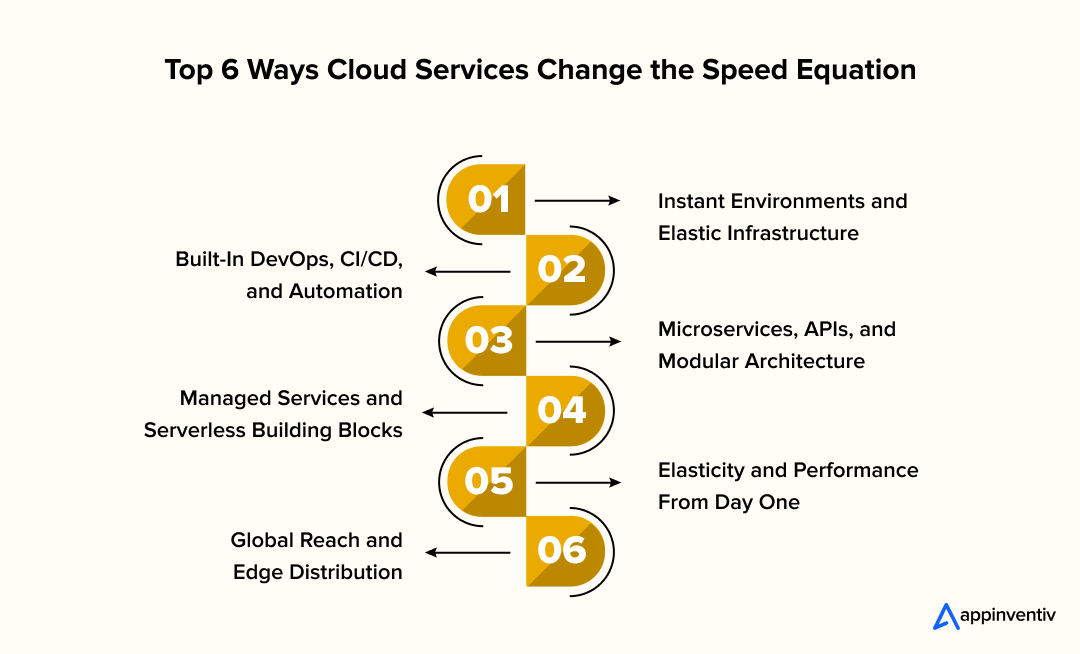
Instant Environments and Elastic Infrastructure
In a traditional setup, spinning up a new test environment might involve procurement tickets, firewall requests, and manual configuration. With cloud product development, environments become software artifacts. Teams define infrastructure as code and provision production-like stacks in minutes rather than days.
Hyperscale platforms give you on-demand compute, storage, and networking that grow with usage instead of forcing you into early capacity guesses.
This is the first major accelerator of cloud transformation product development: product teams can parallelize work streams, run more experiments, and avoid waiting for infrastructure to catch up.
Built-In DevOps, CI/CD, and Automation
Modern cloud services for app development include managed CI/CD pipelines, artifact repositories, test runners, and deployment engines. Instead of assembling toolchains from scratch, teams plug into these services and automate repetitive tasks such as builds, smoke tests, security scans, and rollouts.
When these capabilities sit close to your runtime, you get a natural form of cloud enabled product development. With this configuration changes, application updates, and infrastructure adjustments travel together through the same automated pipeline.
This is where frequent deployments stop being risky events and turn into a healthy routine that supports faster learning cycles.
Microservices, APIs, and Modular Architecture
Monolithic systems slow product teams’ capabilities down because every change touches a large, tightly coupled codebase. In contrast, cloud native product development favors microservices, modular APIs, and event-driven designs.
Each service owns a narrow functional slice, which allows independent teams to ship at their own cadence. Cloud-native platforms provide service discovery, API gateways, and messaging backbones that make this modularity manageable.
For product heads, this translates into a portfolio of capabilities that can be recombined rapidly to test new user journeys or business models. The impact of cloud on product development here is architectural as much as operational.
Managed Services and Serverless Building Blocks
Databases, caches, search engines, observability stacks, ML pipelines, authentication layers, and even entire integration platforms now arrive as managed services. You still own the design decisions, but you do not need to run the underlying infrastructure.
Serverless runtimes take this further. You deploy functions or containers and the platform handles scaling, patching, and capacity. This pattern is a cornerstone of cloud-based product development because it shifts investment from plumbing to differentiated logic.
You can use managed AI APIs, event buses, or streaming services as cloud tools for product development, plugging them into your product without months of platform engineering work.
Cloud adoption accelerates value only when it is part of a broader enterprise digital product engineering strategy that aligns architecture, team structure, and funding with continuous outcome delivery.
Elasticity and Performance From Day One
Elastic scaling is more than a technical convenience. It changes product strategy. With scalable cloud solutions for product development, you can launch an MVP, validate adoption, and handle sudden spikes without re-platforming.
For enterprises, this elasticity matters when launching into new regions, running high-visibility campaigns, or embedding AI experiences that are compute-intensive.
Instead of over-provisioning hardware, you align spend with real demand. That reduces financial risk and supports an incremental approach to cloud product development for businesses that are still calibrating their digital ambitions.
Global Reach and Edge Distribution
Users expect consistently quick responses whether they sit in London, New York, or Singapore. Cloud platforms provide global regions, CDNs, and edge runtimes. That allows you to push application logic and content closer to users, improving latency-sensitive journeys such as payments, trading, or live collaboration.
When combined with strong observability, this creates a powerful form of cloud business development: brands can test new markets with localized variants of the same product, measure adoption, and scale only where traction appears.
Also Read: The New Product Development Process – A Guide
Business Benefits: What Faster Product Development Actually Delivers
Speed on its own is just an engineering metric; what really matters is what that speed unlocks for the business. When cloud product development is done right, faster delivery shows up in hard numbers: earlier revenue, lower risk, better customer retention, and more room to experiment. This is where the benefits of blood-based product development become visible to boards, investors, and product owners alike. The below section explains some of the key advantages of cloud product development:
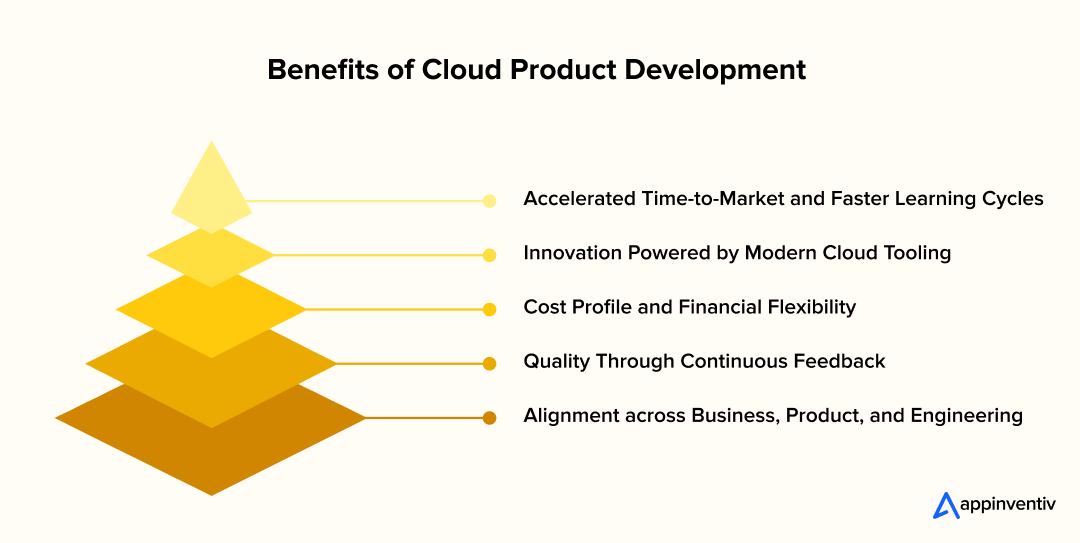
Accelerated Time-to-Market and Faster Learning Cycles
Companies that adopt modern cloud platforms report that they can bring new capabilities to market 20 to 40% faster. That delta compounds over multiple releases. If your teams deliver features months ahead of competitors, you capture feedback earlier, refine your roadmap faster, and strengthen your position in key segments.
It is not just about deploying code more frequently; it is about de-risking product bets by learning earlier in the lifecycle.
Innovation Powered by Modern Cloud Tooling
Modern cloud platforms aren’t just infrastructure; they’re comprehensive development ecosystems. Cloud tools for product development include integrated CI/CD pipelines, AI-driven analytics, and collaborative development environments that simply didn’t exist in traditional settings. Take AI integration as an example. The same cloud platforms that host your applications provide sophisticated AI and machine learning capabilities that can be integrated directly into your products.
According to Statista, AI-specific cloud services grew 140 to 180% in Q2 2025, demonstrating how rapidly these capabilities are being adopted. When your development platform includes these advanced tools natively, innovation becomes a matter of integration rather than ground up development through scalable cloud solutions for product development.
Cost Profile and Financial Flexibility
Cloud does not automatically reduce cost. However, when governance is sound and architecture is right-sized, enterprise cloud product development shifts much of your spend from fixed capital to variable operating expense.
That matters when product demand is uncertain. You avoid heavy upfront investments on hardware and licenses, and instead scale spending with adoption. Cloud providers also offer granular cost analytics, which can be tied to features, teams, or business units. This makes it easier to calculate the overall benefits and impact of cloud on product development in financial terms and to align investment with value.
Quality Through Continuous Feedback
Frequent deployments, automated tests, feature flags, and blue-green or canary releases allow teams to ship safely while monitoring real-world impact. Issues are spotted early and rolled back or patched before they become incidents.
For product leaders, continuous delivery is both a quality and a reputation play. Users experience steady, incremental improvement instead of infrequent, disruptive changes. This is one of the less visible but powerful benefits of cloud-based product development. Here, product quality is not just a QA function; it becomes a property of the whole delivery system.
Alignment across Business, Product, and Engineering
When the platform standardizes how code moves from laptop to production, conversations with business stakeholders shift. Instead of debating whether deployments are possible, you talk about which experiments are worth running.
Modern cloud product development encourages this shared language. Metrics such as lead time, deployment frequency, error rate, and customer outcomes become widely understood. In that environment, roadmaps are easier to prioritize, and trade-offs between features, technical debt, and compliance become more transparent.
High-Value Use Cases of Cloud Product Development for Business
Cloud only proves its value when it shows up in real, everyday work. That’s why leaders increasingly ask, “Where exactly does this change my product roadmap?” High-value use cases of cloud product development answer that question with concrete scenarios where speed, scalability, and resilience translate into new revenue, stronger customer journeys, and more flexible operating models. Let’s uncover some of the most transformative use cases of cloud product development:
Launching a New Digital Platform
A common use case is seen in building a new digital channel, such as a direct-to-consumer portal, a partner marketplace, or a data-as-a-service product for large enterprises. Starting that journey with cloud product development for business means teams can assemble a modern stack quickly, integrate where needed, and avoid carrying old constraints into a new initiative.
Managed APIs, identity platforms, and serverless functions allow you to stand up a working prototype in weeks. Cloud-native foundations make it easier to roll out multi-app ecosystems with shared services and modular releases.
A strong example here is our work with ReelMedia, where we built a cloud native multi-app ecosystem designed for smooth content hosting, management, and distribution. The platform architecture supports high media throughput, quick feature rollouts, and unified session handling, all enabled by a cloud-backed backend.
Modernizing a Legacy Product into a Cloud-Native Platform
Many enterprises run mission-critical systems that are reliable but rigid. Replacing them in one step is risky. A more pragmatic pattern is to carve out specific domains and rebuild them using cloud native product development.
Strangler-fig architectures, domain-driven microservices, and event hubs make it possible to gradually move functionality into the cloud while the core system still runs. For leadership, this creates incremental examples of cloud product development where every migrated domain becomes proof that modernization can deliver performance, reliability, and agility without jeopardizing existing revenue streams.
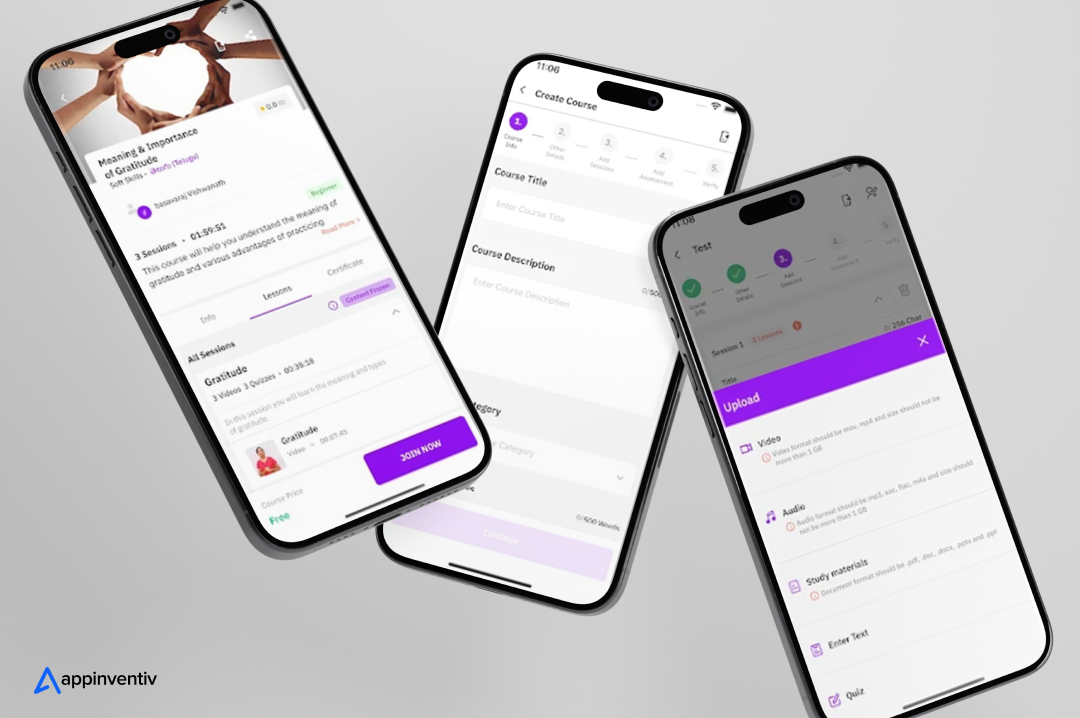
A practical demonstration of this model is the Dr. Reddy’s eLearning Platform, which Appinventiv built on Microsoft Azure using agile development methodologies. The platform supports features like Picture-in-Picture video learning, role-based access management, and in-app content creation, all backed by a flexible cloud backend that ensures scalability across user groups. The system saw 5,000+ app downloads in the first two months, demonstrating how modernization combined with cloud can quickly expand reach.
Scaling a Successful Prototype into an Enterprise-Grade Product
Innovation labs and venture units often build prototypes that gain traction and then struggle to scale. The architecture that was acceptable for a pilot cannot handle enterprise security, compliance, or multi-region traffic.
A structured move into enterprise cloud product development solves this. Teams re-platform onto managed runtimes, formalize CI/CD, introduce observability, and strengthen data protection. This is a classic scenario where cloud transformation product development turns a promising concept into a robust product with the right operational backbone.
Cloud scaling is particularly powerful for platforms expected to grow in user volume or feature complexity. Our project, Avatus, an avatar-driven social networking platform, is one such example. The product required a cloud-ready design to deliver a consistent, real-time social experience while supporting dynamic user growth. The cloud-first setup ensures the system can scale smoothly as community engagement increases.

Data-Intensive and AI-Driven Products
AI-driven experiences, recommendation engines, and advanced analytics put serious pressure on infrastructure. Training models, serving predictions, and streaming real-time data are difficult to support on traditional stacks.
Cloud platforms provide specialized services for data lakes, streaming pipelines, vector search, and managed ML. Combined, these form high-value cloud services for product lifecycle management, especially for data-rich products that evolve through experimentation.
Data-heavy product categories, including transport and mobility, also benefit from cloud-native pipelines. For example, TrackMyShuttle, a transportation solution developed by Appinventiv, uses a cloud-based backend to process location data, optimize shuttle routes, and support real-time tracking. This design enables reliable service delivery even during peak usage periods.
As AI workloads grow, the future of cloud product development will be tightly tied to how well enterprises can orchestrate these capabilities rather than build them from scratch.
A Practical Lifecycle for Cloud-Enabled Product Development
Understanding modern transformation approaches is valuable, but taking action is essential. The transition from traditional development to cloud product development requires careful planning, strategic execution, and ongoing commitment to optimization. Here is a step by step process to help you secure your place on cloud successfully without disrupting your current flow:
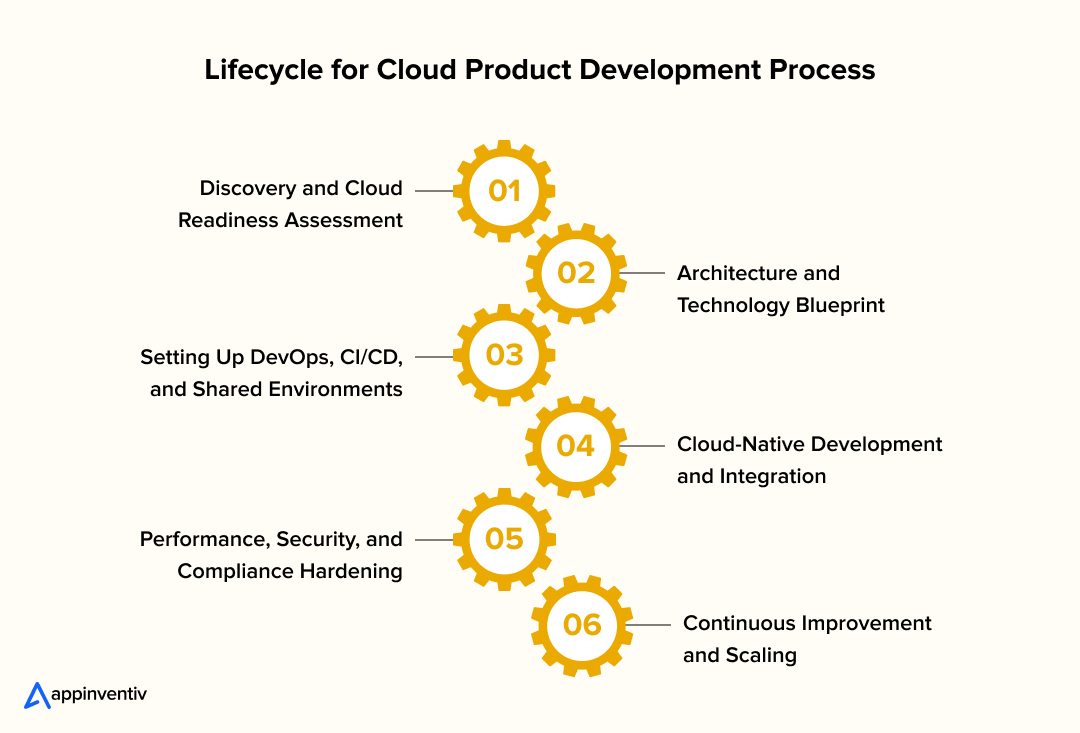
Discovery and Cloud Readiness Assessment
Good outcomes start with brutal honesty about where you are. In this stage, you map current architecture, environments, deployment practices, and constraints. You also assess business priorities, regulatory requirements, and skills.
This is where cloud consulting services can help provide an objective roadmap for the successful implementation of cloud in product development, highlighting which products or domains are ready for a move and which need pre-work, such as data cleanup or process changes.
Architecture and Technology Blueprint
Next, you define the target picture. Which workloads go to public cloud, which stay on-prem, and where hybrid patterns make sense. You also set standards for networking, identity, observability, and platform services.
This blueprint frames your cloud product development for businesses over the next two to three years. It clarifies where you will use PaaS, serverless, or containers, and how cloud services for product lifecycle management will plug into existing toolchains.
Setting Up DevOps, CI/CD, and Shared Environments
Before you ask your cloud development team to re-architect applications, it is wise to set up the basic plumbing: CI/CD pipelines, artifact management, environment strategies, and automated testing.
Done well, these shared capabilities give you a baseline of cloud solutions and agile product development. Every product team benefits from the same release machinery, security checks, and policy enforcement instead of re-inventing them.
Cloud-Native Development and Integration
With the groundwork in place, teams can start building or refactoring services. They gradually move from monoliths to modular architectures, introduce event-driven flows, and integrate SaaS or third-party APIs where appropriate.
This is the most valuable phase of cloud product development for business, but it rests on the previous steps. Design decisions here should consider data residency, resilience, and how easily services can be maintained as the portfolio grows.
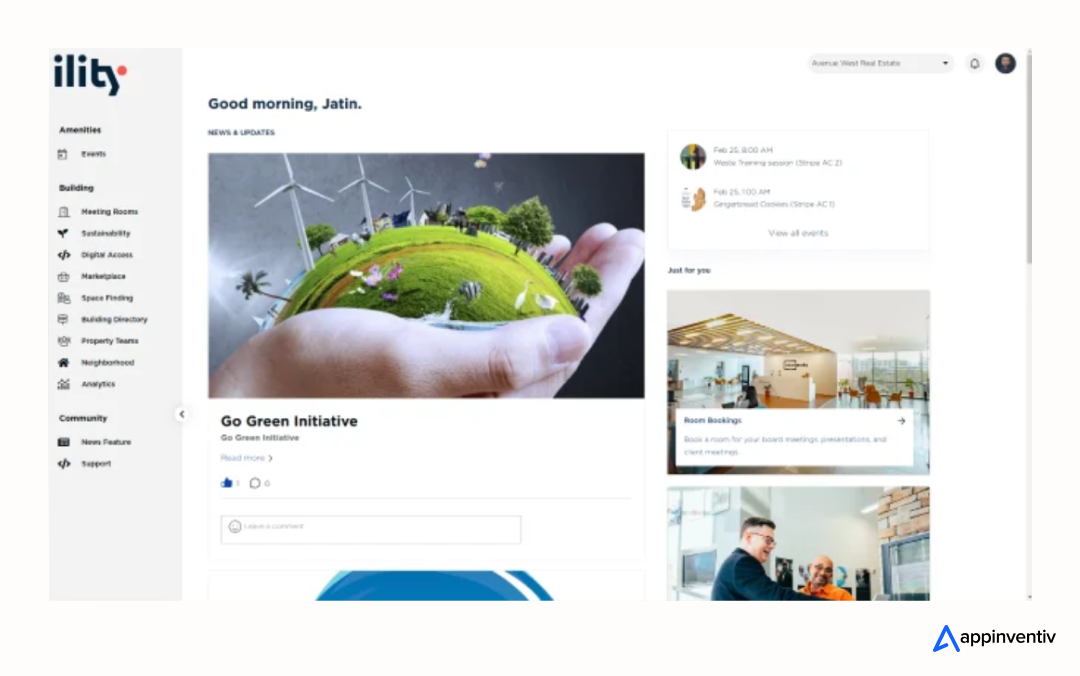
A strong illustration of this is Ility, a white-label real estate SaaS platform we engineered with modular tenancy management, automated billing workflows, and enterprise-grade access control. Its cloud-native architecture allows property managers to scale across portfolios without restructuring the system, while also ensuring consistent performance and data reliability.
The Results?
40% Occupancy Increased
20% Landlord Rol Increased
Performance, Security, and Compliance Hardening
As adoption grows, the risk surface increases. You need systematic approaches to identity management, secret management, encryption, monitoring, and incident response. For regulated industries, this stage also involves aligning with frameworks and compliances such as HIPAA, GDPR, SOC 2, PCI DSS, or regional privacy laws.
Here, your cloud service provider can help by providing native controls, audit trails, and policy engines. Combined with central governance, they reduce the operational burden on individual teams while still allowing rapid releases.
Continuous Improvement and Scaling
Cloud work is never “done”. Usage patterns change, new services appear, and teams learn from incidents. Mature organizations treat this as an ongoing optimization loop.
Cost optimization, performance tuning, and platform simplification are part of everyday cloud business development rather than periodic “big bang” programs. Over time, this continuous refinement shapes the future of cloud product development in your organization, making it more predictable and sustainable.
Challenges in Cloud-Accelerated Delivery and How to Address Them
Cloud has proven its strategic value, but the execution remains uneven. Typically, only a small fraction of organizations can captured the full value of their cloud programs, while others report no significant value. The root causes are rarely technical alone. They usually involve operating models, skills, and governance. These challenges are common and solvable, provided they are addressed explicitly within your cloud product development roadmap.
Cost Sprawl and Uncontrolled Usage
Without discipline, cloud bills creep up through orphaned resources, underused environments, and inefficient designs. This can overshadow the advantages of cloud in digital transformation.
Proven approaches to overcome this barrier:
- Introduce clear tagging standards tied to products, teams, and environments.
- Set budgets and alerts on key services and projects.
- Use FinOps practices to treat cost as a shared responsibility, not just a finance concern.
In practical terms, you need scalable cloud solutions for product development that can grow with demand but are still guided by sensible guardrails.
Security, Compliance, and Data Residency
The shared responsibility model puts immense pressure on businesses to actively manage their security posture. Compliance requirements for GDPR, HIPAA, or industry-specific regulations add complexity, particularly for organizations operating across multiple jurisdictions.
Proven approaches to overcome this barrier:
- Implement zero-trust security frameworks from the outset
- Leverage cloud-native security tools and automated compliance monitoring
- Engage compliance experts familiar with your industry’s specific requirements
- Establish clear data governance policies and enterprise data strategy aligned with regulatory mandates
Governance, Standards, and Architecture Drift
If every team selects its own tech stack, deployment pattern, or security approach, complexity grows rapidly. This creates fragmented tooling, duplicated engineering effort, and hidden vulnerabilities.
Proven approaches to overcome this barrier:
- Establish clear “paved roads” for cloud product development including approved runtimes, databases, CI/CD templates, and observability standards.
- Maintain a centralized platform team responsible for shared tooling and reusable components.
- Document patterns and enforce them through automated policies, not manual reminders.
Cost Management
The pay-as-you-go model brings flexibility, but without structure, it leads to sprawl. More than 20% of organizations report limited visibility into their cloud spend, resulting in unpredictable overruns and unnecessary waste.
Proven approaches to overcome this barrier:
- Implement real-time cost monitoring and alerting systems
- Establish FinOps practices with cross-functional accountability
- Use reserved instances and savings plans for predictable workloads
- Regularly audit and optimize resource utilization with automated tools
In all four areas, seasoned cloud product development companies (like Appinventiv) that understand both technology and product development services can shorten the learning curve and help internal teams avoid predictable mistakes.
Measuring Cost and ROI: KPIs for Cloud-Accelerated Products
Cost and ROI conversations are inevitable once cloud services for product development scale across a portfolio. Companies want to know how much they need to invest and what they are getting for the investment to justify further initiatives.
Cost of Cloud Product Development
While there is no fixed price tag to quote the exact cost of cloud product development, on average end-to-end cloud product development initiatives range from $40,000 to $400,000 per product. However, the exact figure for your organization will vary based on:
- Size and complexity of the product or platform.
- Degree of modernization vs net-new build.
- Regulatory and security requirements.
- Need for advanced data and AI capabilities.
A simplified indicative cost breakdown for mid-sized projects can look like this:
| Cost Component | Typical Range (USD) | What It Covers |
|---|---|---|
| Discovery, strategy & cloud readiness | $5,000 – $50,000 | Workshops, assessments, roadmap, initial cloud business development planning |
| Architecture & cloud foundation setup | $10,000 – $50,000 | Target architecture, landing zone, core platform services |
| Cloud-native engineering & integration | $10,000 – $250,000 | Feature development, integrations, cloud product development builds |
| QA, automation & performance testing | $5,000 – $20,000 | Test suites, pipelines, non-functional testing |
| Observability & incident management setup | $5,000 – $30,000 | Monitoring, logging, alerting, runbooks |
| Continuous optimization & managed improvements | $5,000 – $55,000+ | Cost tuning, performance refinements, minor enhancements |
Remember, these cost ranges are indicative and will vary by industry, regulatory environment, and product complexity.
Also Read: Cloud Migration Costs: A 2026 Financial Guide
ROI of Cloud Product Development
To understand ROI, you should track a concise set of KPIs that connect Cloud-Based Product Development activities to outcomes:
- Speed – Lead time from commit to production; release frequency per product.
- Stability – Change failure rate, mean time to recovery.
- Cost – Cloud spend per active user, transaction, or unit of revenue.
- Adoption – Active users, feature adoption, customer journey completion rates.
- Innovation – Number of experiments or new features shipped per quarter.
When these indicators are monitored consistently, the ROI of cloud on product development becomes visible in both financial and product terms, helping you refine investment decisions over time.
Also Read: How to evaluate the ROI and cost-benefit of cloud migration
The Future of Cloud Product Development: What’s Coming Next?
The cloud you work with today won’t look the same in a couple of years. New capabilities are quietly moving in, reshaping how teams plan, build, and maintain products. Some shifts are already visible; others are coming in steadily, almost unnoticed, until they suddenly feel unavoidable. Here is what the future of cloud product development is heading to:
AI-Native Development Environments
Artificial intelligence in cloud infrastructure is rapidly becoming embedded in every layer. From AI assisted coding tools to intelligent resource optimization, the next generation of cloud platforms will be fundamentally AI native. AI companies are reaching $100 million in annual recurring revenue in just 5.7 years, a full year faster than previous benchmarks.
This acceleration in AI capabilities means that products built on cloud platforms will increasingly incorporate AI features as default functionality rather than add ons.
Edge Computing Integration
The future of cloud product development includes increasingly sophisticated edge computing integration. While cloud platforms provide centralized processing power, edge computing brings computation closer to where data is generated.
This distributed computing model opens new product possibilities, particularly for IoT applications, real-time analytics, and latency-sensitive services. Products that seamlessly blend cloud and edge computing will deliver user experiences that purely cloud-based solutions cannot match.
A Shift Toward Lean and Sustainable Usage
Another trend: teams are getting serious about efficiency. They’re trimming unused services, tightening scaling rules, and being more deliberate with how workloads run. This isn’t just cost-driven. Cleaner, lighter architectures tend to be easier to operate and maintain, which matters just as much as the monthly bill.
Your competitors made their cloud decision years ago. They’re already achieving nearly 20-40% faster launches and 20-30% cost savings. Close the gap with expert-led transformation that delivers results from day one.

How Appinventiv Supports Cloud-Driven Product Organizations
For many enterprises, the question is no longer whether to adopt cloud, but how to structure cloud product development so that it reliably produces better products, not just higher bills. This is where we come in. Our role in highly valuable in three core areas.
Strategy, Architecture, and Operating Model
We work with technology and business leaders to define a clear vision for cloud transformation product development: which products to move first, how to phase migrations, and how to balance risk against speed.
Our teams design cloud reference architectures, shared platforms, and governance models that allow cloud-based product development to scale across multiple business units without devolving into chaos. This often involves helping internal platform teams define opinionated but flexible “paved roads” for development.
End-to-End Engineering and Product Delivery
From discovery and UX research through development, test, and launch, our team of 1600+ tech experts executes every aspect of cloud product development for businesses with utmost efficiency. Our tech squad combines backend, frontend, DevOps, data, and QA specialists familiar with multiple hyperscalers.
Because we build products for different sectors, we bring tested patterns for security, compliance, and observability.
Optimization, Evolution, and Future Roadmaps
After launch, our focus shifts to continuous optimization and maintenance. We help businesses tune performance, refine autoscaling, streamline services, and improve observability. Over time, this builds a sustainable foundation for the future of cloud product development inside your organization.
We also help you figure out where to introduce new AI services, when to expand into edge computing, and how to balance core modernization against new digital bets.
To make this more concrete, here is what our cloud footprint looks like today:
- 500+ cloud migrations executed.
- 20+ hybrid-cloud setups delivered.
- 2000+ cloud deployments executed.
- 35+ industries mastered.
- 5+ strategic cloud partnerships.
- 24/7 cloud operations monitoring.
Ready to transform your product development with cloud services? Partner with our proven expertise today.
FAQs
Q. What cloud tools are best for accelerating product development?
A. The right cloud tools for product development depend on your domain and regulatory environment, but most successful setups share common elements:
- Managed compute options such as containers or serverless runtimes.
- Native CI/CD platforms, secrets management, and observability
- Managed databases, caches, and messaging services aligned with your architecture.
Q. How can cloud services enhance product development for my business?
A. Cloud platforms give your teams rapid access to environments, modern runtimes, and managed capabilities that would be difficult to replicate on-prem. When combined with strong governance, cloud services for product development help you:
- Shorten release cycles and increase deployment frequency.
- Improve resilience and monitoring across your digital products.
- Scale offerings as demand grows
Q. What are the benefits of cloud computing for product development?
A. The main advantages of cloud product development include:
- Faster experimentation, because environments and pipelines are ready when needed.
- Access to advanced capabilities, such as AI services and global edge distribution, without building them internally.
- Tighter collaboration between business, product, and engineering, supported by shared metrics and automated workflows.

- In just 2 mins you will get a response
- Your idea is 100% protected by our Non Disclosure Agreement.
Green Cloud - How Cloud Adoption Helps Improve Sustainability/ESG Goals of Enterprises
Key takeaways: Adopting green cloud solutions lowers energy consumption, cuts emissions, and reduces operational costs. Companies like UEM Edgenta and Bharti Airtel have seen measurable improvements in sustainability and efficiency. AI Enhances Green Cloud Efficiency. AI optimizes energy use, predicts demand, and minimizes waste in cloud infrastructure. Your Green Cloud Roadmap. Start with an infrastructure…
Cloud Migration Strategy for Enterprises in Australia: Benefits, Implementation Process and Tools
Key takeaways: Cloud migration in Australia is accelerating as enterprises modernize aging systems and prepare for AI-driven workloads. Local cloud regions in Sydney, Melbourne and Brisbane make compliance and performance far easier for large-scale migrations. A strong cloud migration strategy for enterprises in Australia depends on clear assessment, the right tools and ongoing optimization. Industry…
How to Ensure Data Integrity and Security During Cloud Migration?
Key takeaways: Learn how to assess risks during migration, ensuring data integrity and compliance with global standards like GDPR and HIPAA. Secure your cloud transition by implementing encryption, checksum verification, and real-time validation to maintain data accuracy. Address issues like legacy data models, schema mismatches, downtime, and third-party toolchain risks that could threaten data integrity.…