























Cloud Data Migration – Adopting the Right Strategy and Best Practices

 Share -


- 01Why Enterprises Are Adopting Enterprise Cloud Migration Across Edge, Private, And Public Clouds?
- 02How Does Edge Computing Fit Into Cloud Migration Strategies In 2026?
- 03What Is The Best Strategy For Managing Workloads Across Edge, Private, and Public Clouds?
- 04How Do Enterprises Plan A Cloud Migration Strategy In 2026?
- 05What Are The Key Components Of A Modern Cloud Migration Strategy?
- 06How Do Cloud Migration Strategies For Enterprises 2026 Apply The 7 Rs Of Cloud Migration?
- 07How Do You Manage Workloads Across Hybrid and Multi-Cloud Environments?
- 08Cloud Migration Tools And Technologies Enterprises Rely On In 2026
- 09Hybrid Cloud Vs Multi Cloud: Which Is Better For Enterprises?
- 10How Do Enterprises Ensure Data Compliance Across Multiple Clouds?
- 11How Do Companies Avoid Cloud Vendor Lock-In In 2026?
- 12What Are The Top Strategies For Minimizing Downtime During Cloud Migration?
- 13Cloud Migration Challenges And Solutions In 2026
- 14How Does AI-Driven Cloud Workload Optimization Transform Cloud-Native Workload Management?
- 15What Role Does Automation Play In Modern Cloud Migration Strategies?
- 16What KPIs Measure Enterprise Cloud Migration Success?
- 17Cloud Migration Roadmap: Step-By-Step Enterprise Execution Model
- 18Future Trends Shaping Cloud Migration Beyond 2026
- 19Why Appinventiv For Enterprise Cloud Migration Strategy?
- 20Frequently Asked Questions

- Workload-first cloud strategy improves performance, compliance, and long-term cost control.
- Edge, private, and public clouds now operate as a single enterprise fabric.
- Automation and AI-driven optimization reduce downtime and the risk of continuous cloud spend.
- Governance-first architectures keep multi-cloud environments secure, auditable, and resilient.
- Structured migration roadmaps turn enterprise cloud transformation into predictable execution.
Most cloud conversations inside large enterprises sound confident at first. Then reality shows up. A fraud detection service needs responses in under 50 milliseconds. A legal team insists customer records stay inside specific US jurisdictions. An AI team spins up a new training cluster, and suddenly, East Coast data starts drifting to West Coast regions. Someone notices after the bill arrives.
By 2026, this is normal. Infrastructure is no longer a single destination. It is a mesh of edge locations, private environments, and hyperscaler platforms operating as one distributed cloud environment, in a market projected to reach $1.56 trillion by 2030. Your team is not debating if migration should happen. You are deciding where each workload should execute, where data is allowed to rest, and how quickly systems must react when conditions change.
This is why enterprise cloud migration now starts with the workload, not the platform. A practical cloud migration strategy today is designed for movement. Data gravity, sovereignty requirements, and AI compute demands force architecture decisions that did not exist a few years ago.
Multi-cloud workload orchestration and hybrid cloud workload management sit at the center of this shift. Without them, latency rises, governance weakens, and cost control turns into guesswork.
This guide breaks down how US enterprises are handling Cloud migration in 2026, with real architecture patterns and execution models built for complex operating environments.
94% of companies now use cloud services in some form.
Why Enterprises Are Adopting Enterprise Cloud Migration Across Edge, Private, And Public Clouds?
Most enterprise cloud conversations start with a simple observation. The old model of picking one cloud and moving everything there no longer fits how systems behave in production. Your team feels this when an application performs well in testing but struggles once real users and real data enter the picture.
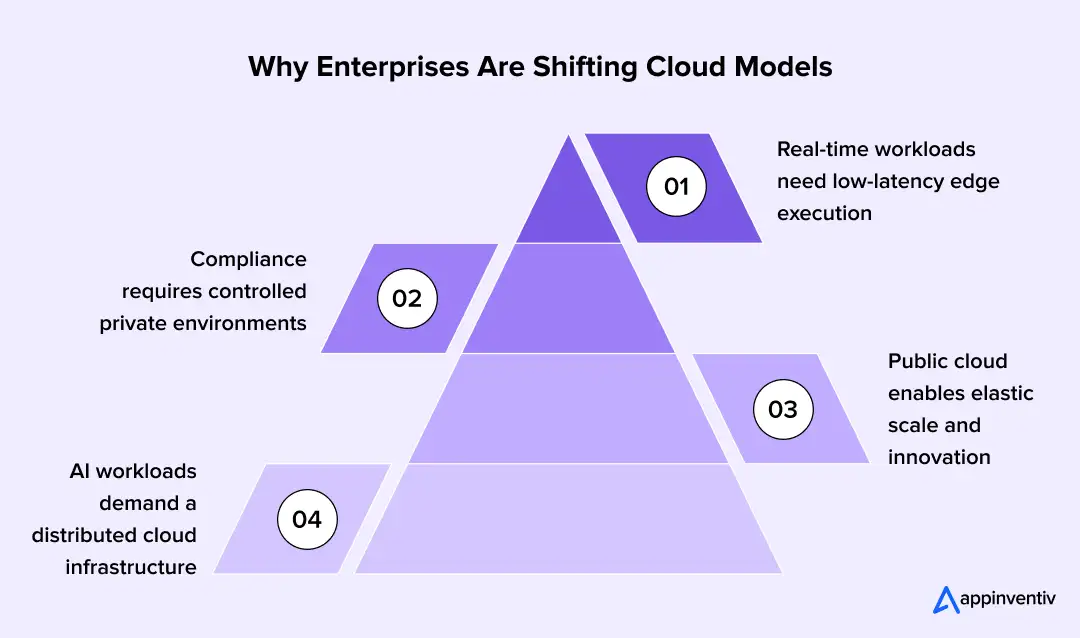
Several forces are driving enterprise cloud migration across edge, private, and public cloud layers, as 94% of companies now use cloud services in some form.
Latency-Sensitive Operations Are Moving Closer
A manufacturing control system cannot wait for a round-trip to a distant region. Retail checkout systems running computer vision need immediate responses. Edge computing expansion makes this possible by placing computers near devices, sensors, and users.
Regulatory and Data Residency Requirements
Healthcare platforms must keep patient records within approved US jurisdictions. Financial services must retain audit logs inside controlled environments. These conditions often require private cloud segments alongside public cloud services.
Resilience Now Includes Vendor Risk
Many enterprises learned hard lessons from hyperscaler outages and sudden pricing changes in a market where AWS holds 31% share, Azure 25%, and Google Cloud 10%. A cloud modernization strategy that spans more than one provider lowers exposure. It also gives negotiation leverage when contracts renew.
AI and ML Workloads Demand Flexible Infrastructure
Training pipelines consume massive compute for short periods. Inference services require consistent low latency. Distributed cloud environments allow both patterns to coexist without overbuilding capacity.
You can already see these models in finance, healthcare, and manufacturing. Core systems run on a private cloud for control. Customer platforms scale on the public cloud. Edge locations handle real-time processing near operations.
This is why enterprise cloud migration now focuses on building connected cloud layers rather than choosing a single destination.
How Does Edge Computing Fit Into Cloud Migration Strategies In 2026?
Nowadays, enterprise teams meet the edge requirement in production, not in planning. A vision system on a warehouse floor starts lagging. A remote diagnostics app struggles when connectivity fluctuates. Your team realizes that the computer must sit closer to where data is created.
In 2026, edge is a core layer in any serious edge computing cloud strategy. Real-time workloads cannot wait for a round-trip to centralized regions. IoT platforms, operational control systems, and AI inference services all demand immediate processing. Sending every event upstream increases latency and bandwidth costs.
Edge As The Real Time Execution Tier
This keeps latency within defined thresholds and reduces upstream data volume. Edge environments now handle:
- Device and sensor data preprocessing
- Real-time AI inference
- Local event filtering
- Immediate operational responses
A Practical Enterprise Architecture Pattern
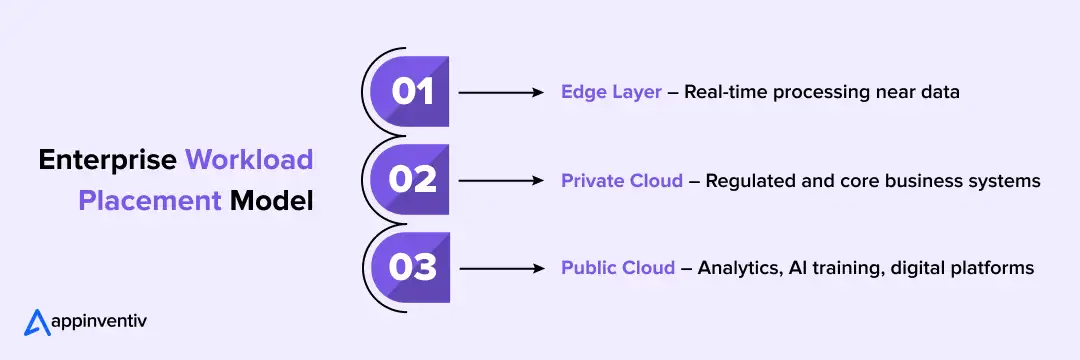
Most enterprises now follow a connected three-layer model. This pattern supports cloud-native workload management while maintaining control over sensitive operations.
- Edge for real-time execution
- Private cloud for regulated data and core systems
- Hyperscaler core for analytics and AI training
Data Gravity And Kubernetes At The Core
Large datasets are costly to move. Latency budgets determine where processing must live. Training pipelines stay centralized, while containerized inference services run on lightweight Kubernetes clusters at edge sites. Central clusters handle orchestration, policy, and updates.
The result is simple. Edge computing is no longer separate from cloud migration. It is embedded into modern cloud migration solutions in 2026.
What Is The Best Strategy For Managing Workloads Across Edge, Private, and Public Clouds?
Top enterprise cloud discussions reach a familiar moment. Someone pulls up an application map. Another opens a compliance matrix. Then the real question lands. Where should each workload actually run, and how do we keep it portable when requirements change?
In 2026, the answer is no longer tied to one platform. The most effective enterprise cloud architecture is built around edge, private, and public cloud integration. The goal is not just deployment. It is a controlled movement. Workload portability across clouds has become a design principle, not a contingency plan.
The Enterprise Reference Architecture
Leading enterprises now follow a consistent structural model.
- Edge layer handles real-time execution close to users, devices, and operations.
- Private cloud layer hosts regulated data, core business systems, and sensitive workloads
- The public cloud layer provides elastic compute for analytics, AI training, and digital channels.
The value lies in how these layers connect. Secure networking, consistent identity controls, and shared observability create a single operating fabric rather than three isolated environments.
The Unified Control Plane
Managing distributed environments manually does not scale. A unified control plane has become essential.
- Central policy enforcement across all clouds
- Standardized identity and access management
- Shared monitoring and telemetry
- Automated workload scheduling and placement
This control plane allows teams to deploy once and run anywhere without rewriting operational logic.
Workload Classification Comes First
Effective placement starts with clear workload classification. Most enterprises evaluate four practical dimensions.
- Latency requirements that define proximity to users or machines
- Compliance boundaries driven by industry regulations
- Data residency rules that restrict storage and processing locations
- Cost-performance ratios that balance efficiency and scale
A fraud detection service may run inference at the edge. A billing platform may stay in a private cloud. A customer analytics engine may scale in the public cloud. Each choice is intentional.
Centralized Management Platforms Tie It Together
Centralized cloud management platforms now orchestrate provisioning, governance, security, and cost controls across environments. They prevent tool sprawl and give leadership clear visibility into performance and spend.
For your team, the strategy is straightforward. Design for integration first. Portability and control follow naturally when architecture leads the migration plan.
Appinventiv partnered with a real estate SaaS provider to build Ility, a cloud-based software designed for multi-portfolio property operations. The team delivered a modular cloud architecture supporting automated billing, centralized portfolio management, and stable scaling as user demand increased. The platform helped improve occupancy outcomes and landlord ROI while maintaining consistent system availability.
Results Snapshot
- Cloud-based multi-portfolio property platform delivered
- Automated billing and portfolio management enabled
- Improved occupancy outcomes and landlord ROI supported
How Do Enterprises Plan A Cloud Migration Strategy In 2026?
Planning a large migration rarely starts with technology. It usually starts with a spreadsheet that keeps growing. Someone lists applications. Someone else adds owners. A third team starts drawing dependency lines. At some point, it becomes clear that moving fast without a plan will break something important.
In Cloud migration in 2026, effective cloud migration planning is structured, repeatable, and driven by data rather than assumptions. Enterprises no longer treat migration as a one-time project. They treat it as an operating model.
Portfolio Discovery And Dependency Mapping
The first step is gaining visibility. This step often exposes legacy integrations that were never documented but still run critical processes.
- Application inventory across business units
- Technical dependency mapping between systems
- Identification of shared services and hidden coupling
- Baseline performance and availability metrics
Data Classification And Regulatory Mapping
Next comes data understanding. This ensures compliance is designed in rather than added later.
- Categorizing data by sensitivity and criticality
- Mapping workloads to industry and US regulatory requirements
- Defining data residency and retention policies
- Identifying workloads that require private or sovereign environments
FinOps Baselining Before Migration
Cost surprises derail migrations. FinOps baselining creates financial guardrails before workloads move. Enterprises are now established:
- Current infrastructure spend benchmarks
- Unit cost per workload or transaction
- Forecasted cloud consumption models
- Chargeback and showback structures
Also Read: How FinOps helps in cloud cost optimization
Landing Zone Design
A landing zone provides the foundation for scale. This avoids rebuilding security and governance for every workload.
- Network segmentation and security boundaries
- Identity and access control frameworks
- Logging, monitoring, and policy enforcement
- Standardized infrastructure templates
The Migration Factory Operating Model
Large enterprises now run migration like production. The migration factory model allows dozens or hundreds of applications to move with consistent quality and predictable outcomes.
- Standardized migration pipelines
- Automated testing and rollback procedures
- Reusable patterns for common workload types
- Central reporting on progress and risk
For your team, the takeaway is practical. A cloud migration strategy in 2026 succeeds when planning becomes an operational discipline, not a preliminary phase.
What Are The Key Components Of A Modern Cloud Migration Strategy?
Cloud migrations often fail in quiet ways. Not because workloads do not move, but because governance, security, and cost controls never scale with them. Many enterprise teams realize this only after the first wave goes live and operational complexity starts to climb.
A modern cloud migration strategy in 2026 is built on control systems as much as infrastructure. Cloud governance and compliance, cloud security and data sovereignty, and cloud cost optimization strategy now sit at the core of migration design, not at the end of it.
Here are some cloud data migration best practices:
Governance Built Into The Platform
Enterprises are moving away from manual oversight. This keeps control without slowing delivery teams.
- Policy-as-code frameworks define security, network, and compliance rules
- Automated enforcement prevents drift across environments
- Standardized templates keep configurations consistent
- Central governance teams maintain shared policies
Identity And Zero-Trust Security
Access models have evolved. This reduces risk as workloads move between clouds.
- Unified identity across edge, private, and public environments
- Least-privilege access policies
- Continuous verification instead of perimeter trust
- Centralized key and secrets management
Data Sovereignty And Compliance Enforcement
Data location now drives architecture decisions, especially as over 60% of organizations cite improved data security during cloud migration and regulatory compliance as primary benefits of cloud adoption.
- Residency policies embedded into workload placement
- Encryption in transit and at rest by default
- Controlled data sharing across environments
- Continuous compliance checks mapped to US regulations
Observability And Audit Readiness
Visibility is no longer optional. Teams see issues before they affect customers.
- Unified logging and telemetry across all environments
- Real-time security and performance monitoring
- Immutable audit trails for regulatory reporting
- Automated incident detection and response
FinOps And Cost Accountability
Cloud spend without structure becomes waste. A cloud cost optimization strategy keeps financial control aligned with technical growth.
- Chargeback and showback models per team or product
- Budget thresholds and automated alerts
- Cost optimization tied to workload performance
- Executive visibility into consumption trends
The message for enterprise teams is clear. Cloud migration solutions in 2026 depend less on moving workloads and more on building the governance, security, and financial systems that keep them under control.
Also Read: Why Cloud-Managed Services Are a Strategic Necessity for Modern Enterprises
How Do Cloud Migration Strategies For Enterprises 2026 Apply The 7 Rs Of Cloud Migration?
Most enterprise teams already know the 7 Rs of cloud migration on paper. The challenge appears when real applications enter the discussion. A legacy billing system has undocumented dependencies. A customer portal cannot afford downtime. A cloud data warehouse is too expensive to refactor this year. That is when cloud migration strategies rehost, refactor, replatform, and replace, stop being theory and start becoming business decisions.
In 2026, the 7 Rs are used as a workload mapping model, not a checklist. Each R represents a tradeoff between speed, cost, risk, and long-term value. A successful cloud migration strategy, a lift and shift approach for one system, may be the wrong answer for another.
Expanded 7 Rs Mapping To Workload Types
Companies usually apply Rs as mentioned below. This mapping keeps migration decisions consistent across large portfolios.
- Rehost for a stable legacy system cloud migration where speed matters more than optimization
- Replatform for applications that need minor changes to gain cloud efficiency
- Refactor for systems that must scale, modernize, or support AI-driven features
- Repurchasing when replacing on-premises software with SaaS is cheaper long-term.
- Relocate for moving virtualized environments with minimal redesign
- Retire for systems that no longer deliver business value
- Retain for workloads that must remain on premises for regulatory or technical reasons
In 2026, repurchase decisions increasingly include SaaS portfolio rationalization, in which enterprises consolidate overlapping software subscriptions to control costs, reduce integration complexity, and simplify governance.
ROI And Risk Drive Each Decision
Rehosting delivers fast wins and reduces data center pressure. It also carries forward technical debt. Refactoring unlocks cloud native performance and automation. It demands time, skills, and investment. Replatforming sits in the middle. It improves efficiency without a full redesign.
Repurchase decisions often come from finance teams. If a SaaS platform delivers the same capability with lower operational cost, rebuilding rarely makes sense. Relocation is often chosen when virtualization stacks must move quickly without architectural change.
Knowing When Refactoring Is Unavoidable
Some systems cannot meet future requirements without redesign. In these cases, refactoring becomes a strategic modernization move rather than a migration step.
- AI integration needs event-driven architectures.
- Real-time services require horizontal scaling.
- Security models need zero-trust alignment.
These principles in 2026 help enterprises balance urgency and modernization. The goal is not to modernize everything at once. It is to apply the right R to each workload with clear cloud migration ROI and controlled risk.
How Do You Manage Workloads Across Hybrid and Multi-Cloud Environments?
Competent enterprise teams reach a point where cloud environments work individually but feel disjointed together. That is when hybrid cloud workload management becomes an operational priority. In 2026, multi-cloud workload orchestration is less about infrastructure choice and more about coordinated execution.
Multi-Cluster Kubernetes As The Runtime Layer
Teams need a consistent way to run workloads everywhere. Kubernetes has become that layer.
- Edge and private cloud run lightweight clusters
- Public cloud uses managed Kubernetes services
- Central control planes enforce policies
- Workloads shift across clusters without redesign
This keeps application delivery consistent across environments.
Service Mesh And Cross-Cloud Networking
Distributed systems fail when connectivity is fragile. Service mesh frameworks now handle this complexity.
- Secure service-to-service communication
- Intelligent traffic routing and failover
- Encrypted cross-cloud data paths
- End-to-end request tracing
Applications behave like one system even when the infrastructure is spread out.
Unified CI/CD Pipelines
Delivery pipelines cannot fragment across clouds.
- Single deployment pipelines for all environments
- Automated cross-cloud testing
- Canary releases and controlled rollbacks
This prevents release delays caused by cloud-specific processes.
Identity Federation And Access Control
Access policies must follow workloads.
- Federated identity across providers
- Centralized role management
- Continuous verification for privileged actions
Security remains consistent as workloads move.
Cross-Cloud Data Synchronization
Data placement must stay deliberate.
- Event streaming syncs distributed databases
- Controlled replication across regions
- Edge caching for faster local access
For your team, the practical outcome is clear. Hybrid and multi-cloud environments become manageable when runtime, networking, identity, delivery, and data layers operate as one coordinated fabric.
Appinventiv In Practice
In recent enterprise cloud engagements, Appinventiv has supported organizations in operationalizing multi-cloud governance and workload orchestration at scale. These programs focused on standardizing deployment pipelines, automating compliance controls, and improving cross-environment visibility to stabilize distributed cloud operations under production load.
Cloud Migration Tools And Technologies Enterprises Rely On In 2026
Enterprise cloud migration in 2026 is executed through carefully selected toolchains, not isolated utilities. The focus is on planning accuracy, controlled data movement, unified operations, and continuous visibility across distributed environments. Cloud-native tools and cloud management platforms now form the backbone of large-scale migration programs.
Planning And Cost Modeling
Forecasting prevents budget and capacity surprises.
- AWS Pricing Calculator and Azure Pricing Calculator for cost modeling
- Cloudockit for architecture mapping and documentation
Data Migration And Synchronization
Reliable data movement reduces cutover risk.
- Azure Migrate for workload discovery and readiness
- Cloud Sync pipelines for continuous replication
- SnapMirror for block-level data mirroring
Data And Storage Platforms
Modern data layers support scalable cloud operations.
- Object-based storage repository for unstructured data
- Cloud Volumes ONTAP for enterprise storage control
- Databricks and ETL/ELT frameworks for cloud analytics pipelines
Cloud-Native Operations And Monitoring
Unified visibility keeps environments stable.
- Cloud-native tools for automation and orchestration
- Monitoring tools for performance and security tracking
- Cloud management platforms for governance enforcement
These technologies enable enterprises to execute cloud migration with predictable cost, controlled risk, and operational consistency at scale.
Hybrid Cloud Vs Multi Cloud: Which Is Better For Enterprises?
Most enterprise teams arrive at this question once architecture planning becomes real. The right answer depends on what your enterprise cloud architecture needs to prioritize. Control, resilience, performance, or cost.
By 2026, hybrid and multi-cloud will no longer be competing choices. They are tools used for different outcomes. The decision comes down to compliance, resilience, latency, and operational complexity.
Enterprise Decision Matrix Table
| Primary Driver | Preferred Model | Why It Fits |
|---|---|---|
| Compliance-driven environments | Hybrid Cloud | Keeps regulated systems in private cloud while using public cloud for scale |
| Resilience and vendor risk reduction | Multi Cloud | Distributes workloads across hyperscalers |
| Latency-sensitive operations | Edge-Hybrid | Runs real-time workloads close to users and devices |
| Cost and scale optimization | Multi Cloud | Enables provider flexibility and pricing leverage |
| Strict data residency control | Hybrid Cloud | Maintains jurisdictional control over data placement |
TCO And Operational Complexity
Hybrid cloud strengthens governance and compliance control. Multi-cloud improves flexibility and resilience but increases orchestration effort. Edge-hybrid improves performance while adding distributed management overhead.
Most enterprises adopt a blended model that balances all three.
Also Read: Which Is the Best Cloud Solution for Your Business – Public, Private, Hybrid, or Multi-Cloud?
How Do Enterprises Ensure Data Compliance Across Multiple Clouds?
As cloud environments expand, governance must scale with them. In 2026, regulations such as the EU Data Act, DORA, and NIS2 are influencing global workload residency, encryption standards, and cross-border data transfer policies for multinational enterprises.
US Regulatory Alignment
Enterprises begin by mapping cloud workloads directly to regulatory obligations.
- HIPAA for healthcare data protection
- PCI-DSS for payment and transaction systems
- SOC2 for security and availability controls
- FedRAMP for government and public sector workloads
These frameworks define workload placement, access controls, and audit requirements.
Residency Enforcement
Data location is enforced at the infrastructure and policy layers.
- Region-locked storage and database services
- Policies preventing unauthorized cross-region replication
- Continuous monitoring of data movement
This keeps sensitive data inside approved US jurisdictions.
Encryption And Key Management
Security controls follow data across every environment.
- Encryption in transit and at rest by default
- Centralized key management platforms
- Customer-managed keys for high-sensitivity workloads
Data remains protected even when workloads move across clouds.
Continuous Compliance Automation
Manual audits are replaced by continuous enforcement.
- Policy-as-code for configuration control
- Automated compliance scanning
- Real-time governance dashboards
- Automated audit evidence collection
Enterprises maintain compliance through constant visibility and enforcement rather than periodic review cycles.
Appinventiv worked with a digital challenger bank serving over two million users to optimize its multi-cloud environment. The engagement focused on automated infrastructure governance, unified deployment workflows, and continuous monitoring. This helped lower operating costs and sustain high platform uptime, supporting secure and reliable banking services at scale.
Results Snapshot
- Multi-cloud governance and deployment workflows are automated
- Continuous monitoring is embedded across environments
- Lower cloud operating costs and sustained high uptime achieved
How Do Companies Avoid Cloud Vendor Lock-In In 2026?
Vendor lock-in rarely appears in early migration plans. It shows up later, when switching providers feels too expensive, too risky, or too operationally disruptive. By 2026, enterprises treat lock-in prevention as a design requirement, not a negotiation tactic. Workload portability across clouds and cloud management platforms makes that possible.
Open Standards As The Portability Foundation
Enterprises rely on open technologies to keep workloads movable.
- Kubernetes is the common runtime layer
- Terraform for infrastructure provisioning across providers
- OpenTelemetry for unified observability and tracing
These standards prevent workloads from being tied to proprietary execution or monitoring models.
API Abstraction Strategy
Direct dependency on provider-specific services increases switching friction.
- Abstraction layers for storage, messaging, and identity services
- Internal APIs shielding applications from cloud-native service lock-in
- Shared service catalogs across environments
This allows teams to replace underlying providers without rewriting core applications.
Centralized Cloud Management Platforms
Visibility and control must stay independent of any vendor.
- Unified provisioning and policy enforcement
- Cross-cloud cost and performance monitoring
- Standardized governance and security controls
Cloud management platforms give enterprises consistent operations even when workloads span multiple providers.
Exit Planning As An Architecture Principle
Exit strategies are now built before migration begins.
- Data export and replication plans are defined early
- Contractual clarity on data ownership and extraction
- Regular portability testing of critical workloads
This ensures that moving away from a provider remains a controlled option, not a crisis response.
For enterprise teams, avoiding lock-in in 2026 is no longer about resisting hyperscalers. It is about designing architectures where changing providers is feasible by design, not by exception.
What Are The Top Strategies For Minimizing Downtime During Cloud Migration?
Downtime rarely comes from the migration itself. It usually comes from surprises during cutovers. A service dependency that was missed. A database that takes longer to sync than expected. A rollback plan that was never tested. This is why top strategies for minimizing downtime during cloud migration focus on controlled transitions rather than big-bang moves.
By 2026, cloud migration and minimizing downtime strategies will be built into execution pipelines, not handled manually on release nights.
Blue-Green Cutovers
Teams run old and new environments side by side before switching traffic. This reduces risk for customer-facing platforms.
- Production workloads remain live during migration.
- Traffic shifts only after validation checks pass
- Instant rollback is available if issues appear
Canary Migrations
Enterprises introduce change in small increments. This prevents widespread impact from hidden defects.
- A subset of users or transactions moves first
- Performance and error rates are monitored
- Gradual expansion follows successful validation
Parallel Run And Rollback
Critical systems demand extra caution. This approach is common in finance and healthcare platforms.
- Legacy and cloud systems run simultaneously
- Data consistency checks run in real time
- Rollback paths are tested before go-live
Continuous Data Replication
Data readiness defines migration speed.
- Real-time replication keeps the source and target in sync
- Minimal cutover windows for databases
- Reduced risk of data loss or corruption
For your team, the lesson is practical. Downtime reduction in 2026 depends less on migration tools and more on disciplined execution patterns that treat cutover as a controlled process, not a single event.
Cloud Migration Challenges And Solutions In 2026
Most enterprise cloud programs do not fail. They slow down. A migration wave that was meant to take three months stretched to six. Costs drift upward. Teams lose confidence in the roadmap. By 2026, leading organizations handle this differently. They expect friction. They plan for it. Cloud Migration Challenges and Solutions in 2026 are treated as known operating conditions, not surprise events.
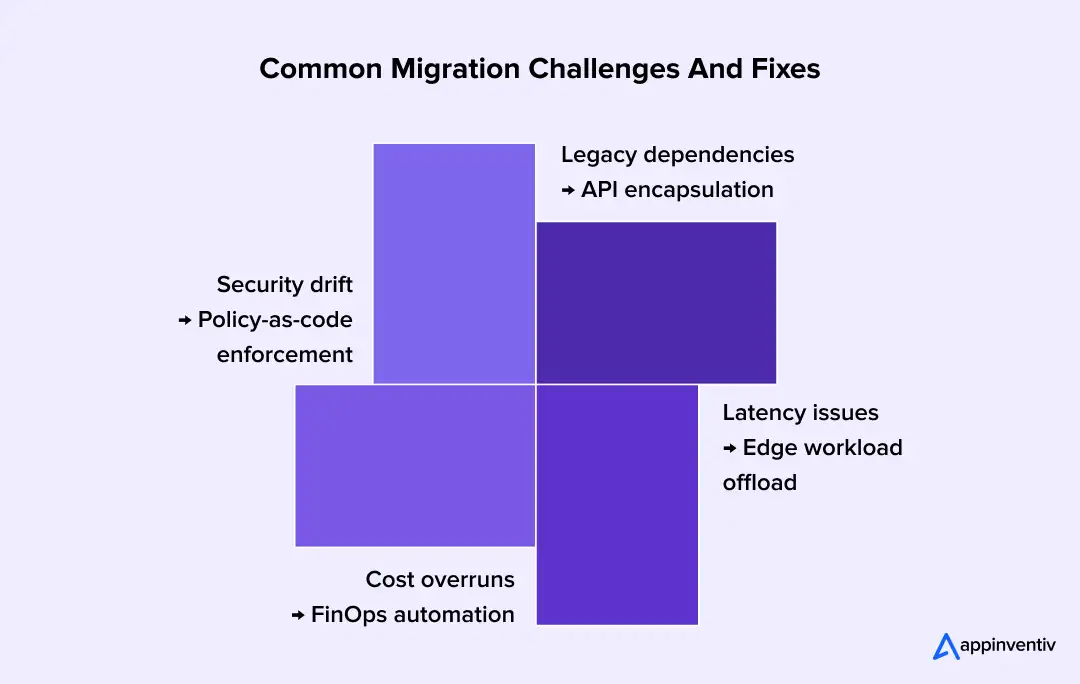
Legacy Dependencies
Many core enterprise systems were never built to move. They rely on hidden integrations, shared databases, or outdated protocols that only surface once migration begins. Rewriting everything is rarely realistic, so teams need controlled modernization paths.
Solutions
- Encapsulate legacy systems behind stable APIs
- Refactor only components that block scale or security
- Isolate fragile dependencies before migration waves
Latency Bottlenecks
Performance issues often appear after go-live. A customer transaction takes longer. A production line dashboard refreshes too slowly. When workloads move farther from users or machines, latency becomes visible quickly.
Solutions
- Shift real-time processing to edge environments
- Place workloads in regional cloud zones
- Apply latency-aware routing controls
Cost Overruns
Cloud environments grow quickly. New services launch. Test environments stay running. Without financial baselines, teams lose track of what each workload actually costs.
Solutions
- Introduce FinOps automation early
- Define cost targets per application group
- Monitor consumption continuously
Security Drift
Security policies often start consistently, then diverge as new environments appear. Over time, access rules, network policies, and encryption settings fall out of alignment.
Solutions
- Apply policy-as-code enforcement
- Automate compliance and configuration scans
- Centralize identity and access governance
Tool Sprawl
Different teams adopt different cloud tools. Observability splits. Governance becomes inconsistent. Incident response slows because no single view exists.
Solutions
- Implement centralized cloud management platforms
- Standardize monitoring and governance stacks
- Retire overlapping toolchains
Skills Gaps
Cloud platforms evolve faster than traditional operating models. Teams struggle with automation, orchestration, and multi-cloud coordination.
Solutions
- Align teams to cloud-first operating practices
- Introduce SRE and platform engineering roles
- Invest in continuous cloud training
Enterprises that plan for these patterns move faster, stay compliant, and keep migration programs steady under real production pressure.
Identify legacy, latency, cost, and security gaps before scaling efforts.
How Does AI-Driven Cloud Workload Optimization Transform Cloud-Native Workload Management?
Most cloud environments run well until demand shifts without warning. A product launch drives unexpected traffic. An AI training job consumes more compute than planned. Costs rise while performance still fluctuates.
In 2026, FinOps 2.0 practices, such as predictive cost modeling, automated egress routing, and workload-level budget enforcement, have become critical for controlling multi-cloud spend at scale.
Predictive Autoscaling
Scaling is no longer reactive. AI models forecast workload demand before it hits infrastructure limits.
In practice
- Usage patterns are learned over time
- Capacity scales ahead of peak periods
- Overprovisioning is reduced without risking availability
Intelligent Workload Placement
Applications are no longer tied to fixed environments. Placement decisions adapt to real-time conditions.
In practice
- Latency, cost, and compliance guide scheduling
- Workloads shift across edge, private, and public clouds
- Performance remains consistent during demand changes
Autonomous Remediation
Distributed environments generate too many signals for manual response. AI systems now handle first-line operations.
In practice
- Anomalies are detected early
- Root causes are identified automatically
- Corrective actions are executed without waiting for human intervention
Continuous Cost-Performance Tuning
Optimization happens continuously instead of in review cycles.
In practice
- Resource usage is analyzed in real time
- Inefficient workloads are automatically resized
- Budget thresholds trigger immediate adjustments
AI-based cloud workload optimization transforms cloud-native workload into a self-adjusting system that keeps performance, resilience, and cost aligned as enterprise environments grow more complex.
What Role Does Automation Play In Modern Cloud Migration Strategies?
Enterprise migrations slow when manual steps pile up. Environment setup, security configuration, testing, and provisioning quickly become bottlenecks. In 2026, automation is the engine that keeps cloud migration planning consistent, scalable, and controlled across large enterprise cloud migration programs.
Infrastructure-As-Code
Manual configuration does not scale across distributed cloud environments. Infrastructure-As-Code brings repeatability and traceability to environment creation.
- Version-controlled infrastructure templates
- Consistent network and security configuration
- Auditable change history
Migration Pipelines
Large application portfolios require standardized execution rather than custom migration scripts for every workload.
- Automated deployment and data transfer flows
- Pre-cutover validation testing
- Built-in rollback procedures
Continuous Compliance
Governance cannot rely on periodic reviews once workloads are spread across clouds. Automation keeps compliance active at all times.
- Policy-as-code enforcement
- Continuous configuration scanning
- Automated remediation for violations
Zero-Touch Provisioning
Cloud environments must be ready when teams need them, not after ticket queues clear.
- Pre-approved templates trigger instant provisioning
- Identity and access policies are applied automatically
- Monitoring and logging are enabled by default
For enterprise teams, automation is no longer an efficiency tool. It is the foundation that allows cloud migration strategies to scale without losing governance, security, or operational control.
What KPIs Measure Enterprise Cloud Migration Success?
When cloud migration reaches the executive table, one question always comes up. Did this transformation actually make the business stronger, or did we just move infrastructure? In 2026, enterprise teams rely on outcome-driven KPIs to prove that cloud programs improved stability, performance, financial control, and governance.
These measurements transform cloud migration from a technical initiative into a business performance story.
Availability And SLA Improvement
Reliability is often the first visible signal of success. If uptime does not improve, the migration value is hard to defend.
- Uptime across migrated platforms
- SLA adherence for critical services
- Reduction in unplanned outages
Latency Reduction
Cloud and edge strategies must show tangible performance gains. Latency metrics reveal whether workload placement decisions were right.
- Response time before and after migration
- Regional performance consistency
- Stability during traffic spikes
Cost Per Workload
Consumption-based pricing demands financial clarity. Cost-per-workload tracking shows whether cloud cost optimization is working in practice.
- Cost per application or transaction
- Comparison with legacy run costs
- Savings from automation and rightsizing
Deployment Frequency
Modern cloud environments should speed up delivery, not slow it.
- Release frequency per application
- Time from code commit to production
- Reduction in manual deployment effort
MTTR And Incident Automation
Faster recovery reflects operational maturity.
- Mean time to recovery
- Percentage of incidents auto-resolved
- Drop in manual escalations
Compliance Audit Cycle Time
Continuous compliance must simplify audits.
- Time to produce audit evidence
- Number of policy violations detected
- Share of automated control checks
Together, these KPIs give enterprise leaders clear proof that cloud migration is delivering measurable business value.
Cloud Migration Roadmap: Step-By-Step Enterprise Execution Model
Most enterprise cloud programs struggle when migration is treated as a one-time initiative. In 2026, successful organizations approach enterprise cloud migration as a repeatable execution model. A cloud migration strategy now needs defined phases, shared ownership, and delivery patterns that scale across portfolios without losing control.
This roadmap reflects how large enterprises execute migration programs in practice.
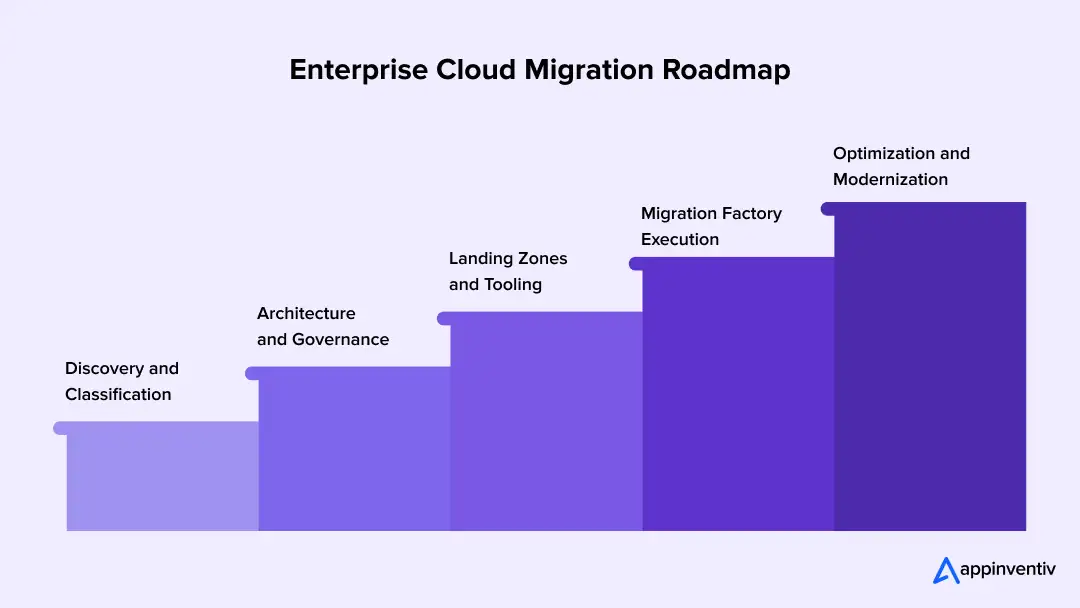
Step 1: How Do Enterprises Discover And Classify Cloud Workloads?
Migration starts with understanding the current landscape. Teams build a clear picture of applications, data, and dependencies before making placement decisions.
- Application and infrastructure inventory
- Dependency and data flow mapping
- Workload classification by latency, compliance, and criticality
This phase exposes risks early and prevents surprises during migration waves.
Step 2: How Are Architecture And Governance Defined Before Migration?
Once workloads are understood, architecture decisions establish long-term control. Governance frameworks are defined before environments are built.
- Enterprise cloud architecture design
- Security, identity, and compliance frameworks
- Operating model and policy definition
This ensures consistency as environments scale.
Step 3: Why Do Enterprises Build Landing Zones Before Moving Workloads?
Before workloads move, foundations must be ready. Landing zones provide standardized environments that inherit governance automatically.
- Network and security boundary setup
- Observability and logging frameworks
- Standardized infrastructure templates
This avoids rebuilding controls for every migration.
Step 4: How Does The Migration Factory Model Scale Enterprise Execution?
Large portfolios require industrialized delivery. A migration factory model keeps execution predictable across teams and business units.
- Standard migration pipelines
- Automated testing and cutover processes
- Central progress and risk reporting
This maintains velocity without sacrificing reliability.
Step 5: Why Is Continuous Modernization Required After Migration?
Migration creates a starting point, not a finish line. Continuous improvement delivers sustained business value.
- Performance and cost optimization
- Targeted refactoring of key systems
- Continuous compliance and security hardening
For enterprise teams, this roadmap turns migration into a controlled rhythm where modernization continues long after the first workloads move.
Map workloads, governance, and modernization steps for the enterprise roadmap.
Future Trends Shaping Cloud Migration Beyond 2026
A decent number of enterprises will finish their current migration waves just as new infrastructure expectations emerge. Architecture decisions will be shaped by sovereignty demands, AI acceleration, sustainability mandates, and next-generation security requirements. The question is no longer where workloads run, but how adaptable your cloud foundation is to what comes next.
- Sovereign and Industry Clouds: Regulated sectors and governments are driving jurisdiction-controlled cloud environments. Expect national and industry-specific platforms where data residency, compliance certification, and infrastructure control are built in by default.
- AI-Native Infrastructure: Cloud platforms are being redesigned around AI workloads. Training, inference, data pipelines, and GPU scheduling are becoming first-class infrastructure capabilities rather than specialized add-ons.
- Edge AI Acceleration: Inference is shifting closer to data sources. Real-time decision systems in factories, hospitals, retail stores, and logistics networks will rely on localized AI execution integrated into broader cloud fabrics.
- Carbon-Aware Workload Scheduling: Sustainability goals are influencing workload placement. Cloud systems will increasingly shift computing to regions with lower carbon intensity and track emissions as an operational metric.
- Quantum-Ready Security: Security architectures are preparing for post-quantum threats. Cryptographic agility, post-quantum encryption, and long-term data protection planning are becoming standard in cloud security roadmaps.
Enterprises that account for these trends early will avoid future rework and ensure their distributed cloud environments remain resilient, compliant, and future-ready.
Why Appinventiv For Enterprise Cloud Migration Strategy?
Choosing a partner for enterprise cloud migration is rarely about tools. It is about trust. You need a team that understands enterprise cloud architecture, can orchestrate hybrid and multi-cloud environments, and builds governance into every layer instead of bolting it on later.
At Appinventiv, cloud migration solutions are delivered with a governance-first mindset. Security, compliance, and FinOps controls are designed alongside architecture, so your workloads stay performant, compliant, and cost-efficient as they scale. Automation, observability, and continuous optimization are treated as standard operating requirements, not optional upgrades.
Our delivery experience reflects real enterprise execution, not pilot projects.
Cloud Delivery At A Glance
- 500+ cloud migrations executed
- 20+ hybrid-cloud setups delivered
- 2000+ cloud deployments executed
- 24/7 cloud operations monitoring
- 35+ industries supported
- 50+ cloud experts onboard
- 5+ strategic cloud partnerships
Business Impact
- 30% cost reduction via cloud
- 99.90% availability SLA
- 2x infrastructure efficiency gains
For US enterprises, this translates into predictable execution, audit-ready governance, and modernization that continues beyond migration.
If your team is planning the next phase of cloud transformation, connect with our cloud architects to design a migration strategy built for scale, compliance, and long-term control.
Frequently Asked Questions
Q. Is A Single-Cloud Strategy Still Viable For Enterprises In 2026?
A. A single-cloud strategy can still work for enterprises with limited regulatory complexity and predictable workloads. Still, most large organizations now require hybrid or multi-cloud flexibility to manage data residency, resilience, and latency demands. Single-cloud models often struggle with vendor risk, compliance segmentation, and workload portability as the distributed cloud becomes standard.
Q. How Do Enterprises Decide Which Workloads Belong At The Edge Versus The Cloud Core?
A. Teams evaluate latency sensitivity, data gravity, compliance boundaries, and connectivity reliability. Real-time operational systems and AI inference often belong at the edge. Data analytics, AI training, and customer platforms typically stay in cloud core environments. Clear workload classification during cloud migration planning prevents costly re-architecture later.
Q. Can Legacy Applications Be Migrated Without Refactoring In 2026?
A. Yes, many legacy systems can be rehosted or relocated without full refactoring. This approach supports faster enterprise cloud migration when modernization budgets or timelines are tight. Still, applications with scalability, security, or integration limitations often require partial refactoring to meet cloud-native workload and governance requirements.
Q. Does Kubernetes Eliminate Multi-Cloud Complexity, Or Add To It?
A. Kubernetes reduces deployment inconsistency by providing a common runtime layer across environments. At the same time, it introduces new operational responsibilities such as cluster management, networking, and policy control. Enterprises succeed when Kubernetes is paired with cloud management platforms and mature SRE operating practices.
Q. How Are Workloads Monitored Across Edge, Private, And Public Clouds?
A. Enterprises use unified observability stacks that aggregate logs, metrics, and traces across all environments. Central dashboards provide performance visibility, security alerts, and compliance reporting. Service mesh tracing and OpenTelemetry standards help track requests end-to-end, even when workloads span edge, private, and public cloud layers.
Q. How Will AI-Driven Workload Optimization Change Cloud Migration Strategies?
A. AI-driven cloud workload optimization enables predictive scaling, intelligent workload placement, and autonomous remediation. Migration strategies now account for continuous optimization rather than static infrastructure design. This shifts cloud migration in 2026 from one-time execution toward adaptive environments that improve performance, resilience, and cost efficiency over time.


Fast 2-minute response, fully NDA-protected.
How to Build a DESC-Compliant Azure Architecture in the UAE Without Data Residency Risks
Key takeaways: Azure UAE data residency compliance is not just about choosing UAE North or Central; logs, backups, APIs, identity flows, and monitoring paths also need control. DESC-aligned Azure architecture should be planned before deployment or migration to avoid audit issues, delayed approvals, and expensive rework. Enterprises must map the full data journey across storage,…
How Cloud Services Accelerate Product Development for Businesses
Key takeaways: Cloud product development changes the speed, cost, and risk profile of modern software delivery. The cost of cloud product development ranges between $40,000 and $400,000 or more. Cloud platforms give you instant access to AI/ML, edge computing, and advanced analytics without dropping tons of money upfront. Appinventiv supports enterprise cloud product development through…
Green Cloud - How Cloud Adoption Helps Improve Sustainability/ESG Goals of Enterprises
Key takeaways: Adopting green cloud solutions lowers energy consumption, cuts emissions, and reduces operational costs. Companies like UEM Edgenta and Bharti Airtel have seen measurable improvements in sustainability and efficiency. AI Enhances Green Cloud Efficiency. AI optimizes energy use, predicts demand, and minimizes waste in cloud infrastructure. Your Green Cloud Roadmap. Start with an infrastructure…