






























AI Implementation in Australia: Enterprise Use Cases, Costs, Strategy, & Governance (2026)

 Share -


- 01AI’s Economic Impact and Market Size
- 02Australia AI Strategy, Regulation and Governance
- 03How to Implement AI in Australian Businesses in 2026: A Step by Step Process
- 04Industry-Wise AI Implementation Use Cases in Australia
- 05Key Challenges Australian Businesses Face When Implementing AI & How to Overcome Them
- 06Build vs Buy vs Integrate: Which AI Approach Fits?
- 07Cost of Implementing AI in Australian Enterprises
- 08How Appinventiv Supports Enterprise-Grade AI Implementation in Australia?
- 09FAQs

Key takeaways:
- More than one-third of Australian SMEs have adopted AI, according to the National AI Plan.
- AI transforms Australian sectors like mining, fintech, retail etc., improving processes and productivity.
- The cost of AI implementation in Australia ranges from AUD 70,000 to AUD 700,000 or more.
- The NAIC’s six essential practices now provide practical guidance for responsible AI adoption.
In 2026, AI in Australia has evolved from a “disruptive innovation” into a core component of national productivity. Driven by persistent labor shortages and a 30% CAGR in the local AI market, Australian enterprises are no longer asking if they should implement AI, but how to do so without compromising data sovereignty or regulatory standing.
According to the Australian Government, over one-third of Australian businesses are already using or trialling AI, with adoption highest among large enterprises where productivity pressure, labour constraints, and compliance complexity intersect. And over half of organisations that harness AI technologies have cited positive business outcomes in several operational areas.
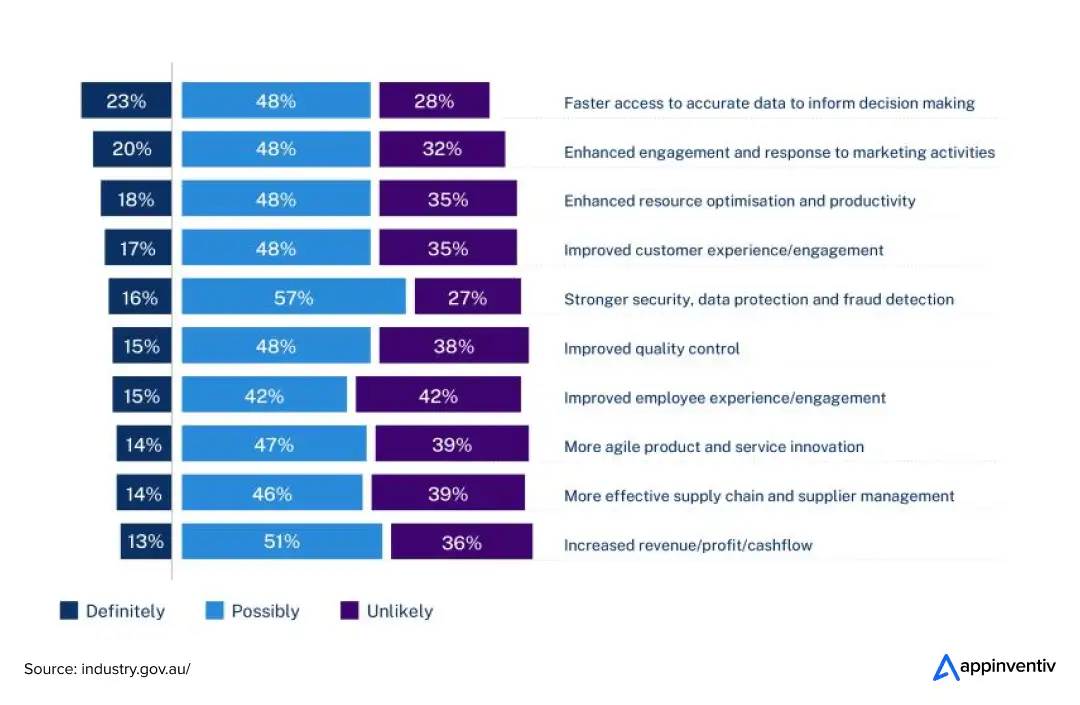
So, with nearly half of Australian businesses now utilising advanced AI and machine learning models, the focus has shifted toward operational resilience. This AI implementation guide for Australian businesses outlines the strategic roadmap for deploying AI that integrates seamlessly with existing ERP and CRM systems while remaining defensible under the scrutiny of the National AI Centre (NAIC) and local privacy mandates.
We can help you turn opportunities into outcomes!

AI’s Economic Impact and Market Size
Market signals and economic modelling now align on one point. AI has moved from experimental spend to a material driver of enterprise value in Australia. The Australian AI market is projected to exceed $80 billion in annual value by 2033, growing at a CAGR of 30%. This market growth is underpinned by broader economic impact.
According to CSIRO’s Data61 report, digital technologies, including artificial intelligence, could contribute around $315 billion to Australia’s GDP by 2030, reflecting broad economic impact from productivity, efficiency, and digital transformation.
Key Economic Benchmarks & Ecosystem Analysis
The transition from experimental “AI pilots” to “AI-first operations” is creating a tiered economic impact across the Australian landscape:
- The Productivity Dividend: According to the Deloitte/Amazon “The AI Edge” Report, accelerating AI adoption among Australian small businesses alone is set to add $44 billion to the economy. Businesses moving from “basic” to “intermediate” AI maturity report an average 61% gain in operational efficiency.
- Sector-Specific Value: Data from the OpenAI Australia Opportunity Report 2025 indicates that the greatest economic gains are currently concentrated in Professional Services (79% adoption) and Financial Services, where generative AI is reducing document processing cycles by up to 75%.
- Investment & R&D Incentives: To fuel this $142 billion opportunity, the Federal Government continues to offer the 43.5% R&D Tax Incentive. This allows Australian firms to offset nearly half of their development costs when solving technical uncertainties in AI model fine-tuning or custom integration.
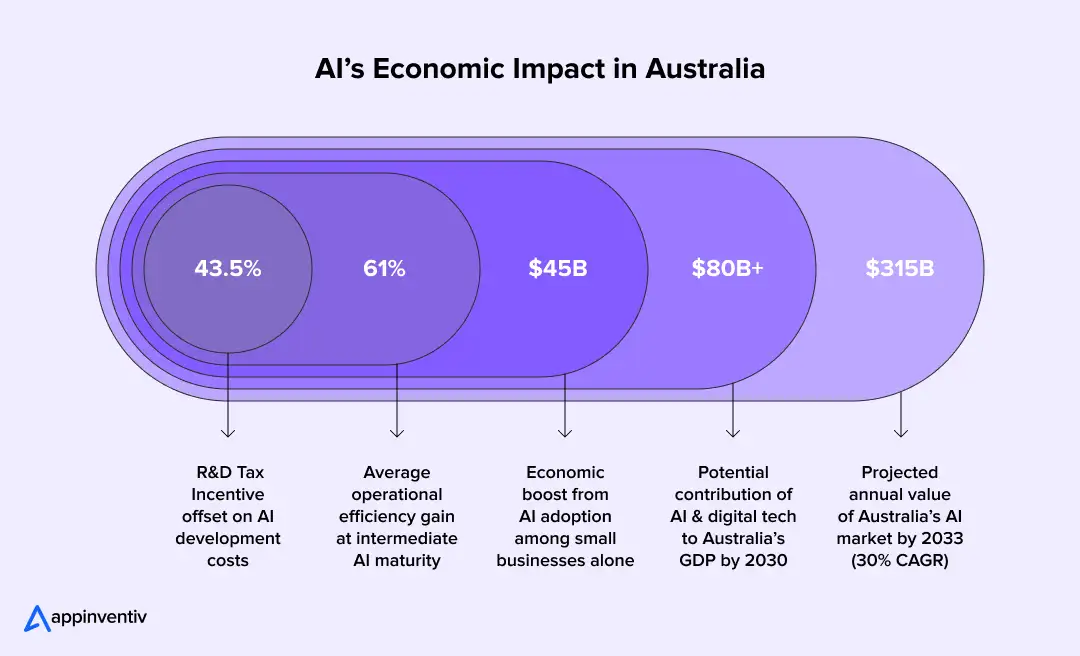
For enterprise leaders, this impact translates into a clear “why now” moment. Organisations that delay risk embedding face higher operating costs and slower decision cycles as AI becomes standard infrastructure across their industries.
Australia AI Strategy, Regulation and Governance
The government is taking a proactive approach toward shaping a safe and trustworthy future of artificial intelligence in Australian businesses. The government has laid a strong foundation for regulating artificial intelligence through a mix of ethical guidelines, consultations, and existing legislation for businesses across sectors like mining, government, retail, logistics, and eCommerce.
To further support ethical and responsible use of AI in the government and other sectors, several new initiatives have been launched, including:
- National AI Centre (NAIC): Coordinates practical guidance for industry on responsible AI use and capability building.
- National AI Plan (2025): Sets long-term direction for safe adoption, skills development, and national AI capability.
- Australian Public Service AI Plan: Introduces mandatory governance and secure tooling for Australian Government agencies, shaping responsible AI use across the APS.
- AI Safety Institute: Established in 2026, it analyses emerging AI capabilities, risks and harms and supports regulators and agencies with technical insights and AI safety expertise.
- AI Adoption Program: Provides funding support to move AI from pilots into production.
- Responsible AI Network: Brings industry, researchers, and government together on ethical use.
- High-Risk AI Consultations: The government has considered stronger controls for high-risk AI applications, but these should not be presented as current mandatory high-risk AI regulations.
- Sovereign Infrastructure Investment: Expands local data centre capacity for compliant AI workloads.
- Ethical and Data Governance Frameworks: Updates privacy and Indigenous data guidance for AI use.
- Guidance for AI Adoption: The NAIC’s current guidance outlines six essential AI practices: accountability, impact assessment, risk management, information sharing, testing and monitoring, and human control.
- Practical AI Governance: The NAIC also supports practical measures such as AI screening and risk assessment, maintaining an AI register, defining internal AI policies, assigning accountability across third-party suppliers, and maintaining meaningful human oversight and intervention.
- AS ISO/IEC 42001:2023: Organisations can also use AS ISO/IEC 42001:2023, the Australian adoption of the international AI management system standard, to structure AI governance, risk management and ongoing improvement.
The 10 December 2026 Deadline
Under the updated Privacy Act 1988, Australian businesses must now provide transparency on Automated Decision-Making (ADM). If your AI influences hiring, credit scoring, or customer service, you must disclose the data used and the logic behind the output.
By aligning with these principles, frameworks and AI compliances in Australia, organisations across industries can ensure they are leading with ethical, responsible AI solutions.
For enterprises, the impact of AI adoption is practical. Adoption risk is lower. Data residency assumptions are clearer. Governance expectations are becoming consistent across the public and private sectors.
Most importantly, AI programs can now be designed for longevity. This policy stability allows Australian enterprises to move beyond contained trials and embed AI into core operating models with confidence.
How to Implement AI in Australian Businesses in 2026: A Step by Step Process
The standard AI roadmap in Australia follows a six-step progression: problem identification, data readiness assessment, model selection, system integration, governance establishment, and continuous scaling. This structured approach ensures that AI deployments move beyond “Proof of Concept” (PoC) into production environments that meet local security benchmarks (ACSC) and operational resilience standards (CPG 234/CPS 230). Here are the key steps to implement artificial intelligence in Australian businesses:
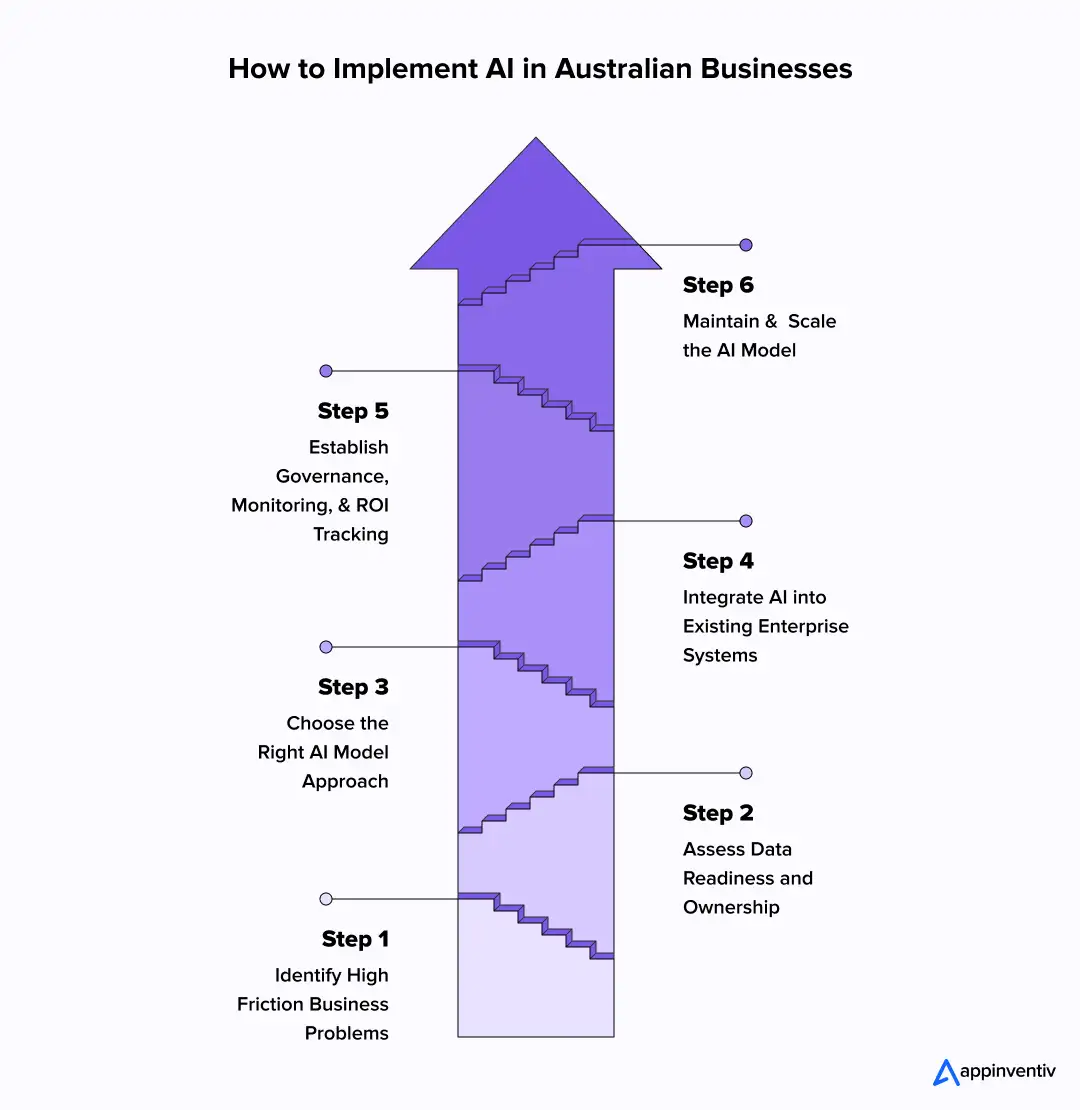
Step 1: Identify High-Friction Business Problems
AI delivers value when applied to persistent operational friction. Cost leakage, manual bottlenecks, compliance exposure, and scalability limits provide the strongest foundation. Thus, your first step is to figure out a practical use case and anchor that to measurable outcomes.
Step 2: Assess Data Readiness and Ownership
Data quality, lineage, and ownership determine feasibility. Australian enterprises must also evaluate where data resides, who controls it, and how it can be accessed without breaching internal or external obligations. This step often determines the timeline and cost more than model complexity.
Step 3: Choose the Right Model Approach
The next vital step is to choose the right AI model as per your defined use case. For instance, predictive models suit forecasting and risk scoring. Generative AI models in Australia support knowledge work and customer interaction. Optimisation models improve scheduling and asset utilisation. Computer vision enhances inspection and safety. The wrong choice creates cost without value.
Step 4: Integrate AI into Core Systems
AI that sits outside ERP, CRM, EHR, or asset management platforms rarely scales. Thus, you must integrate AI into existing legacy systems to ensure smooth adoption. Enterprises that embed AI outputs directly into existing workflows see faster value realisation.
Step 5: Establish Governance, Monitoring, and ROI Tracking
As AI systems move into production, governance becomes an operational requirement. Thus, enterprises must ensure models remain explainable, auditable, and aligned with security and AI compliance in Australia. Continuous performance monitoring and ROI tracking help leadership confirm that AI outcomes remain tied to cost control, risk reduction, and decision quality over time.
Step 6: Maintain and Scale
Models degrade. Regulations evolve. Business conditions shift and consumer demands evolve. Therefore, ongoing monitoring, retraining, and upgrading are essential to protect long-term returns.
Also Read: How to Build an AI App in Australia: A Complete Guide
Industry-Wise AI Implementation Use Cases in Australia
AI adoption in Australian industries is categorised by “High-Friction” use cases where automation solves labor shortages, safety risks, and regulatory reporting burdens. While fintech and retail lead in consumer-facing AI, the mining and energy sectors utilise AI primarily for predictive maintenance and digital twin simulation to optimise geographically dispersed assets. Let’s delve deeper to comprehend industry-wide AI use cases for Australian businesses:
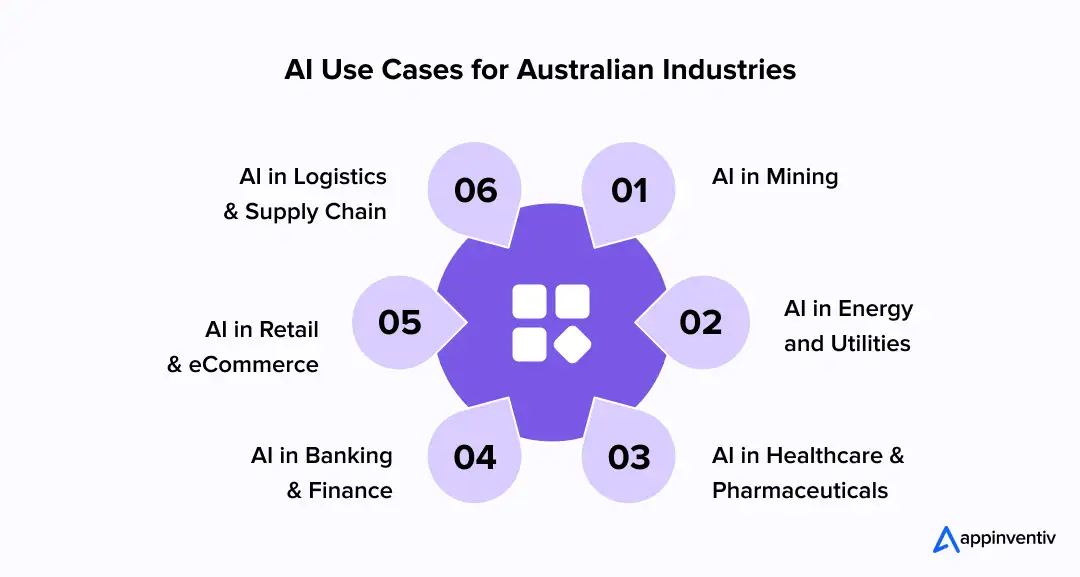
AI in Mining
In the Australian resources sector, AI is primarily used for predictive maintenance, autonomous haulage, and load forecasting to reduce operational downtime. Mining operators deploy AI and machine learning models to analyse sensor data from geographically dispersed fleet assets, identifying equipment degradation days before failure. Without AI, operational strain typically appears as:
- Limited early warning of equipment degradation
- Safety risks identified only after near-miss events
- Production inefficiencies driven by static optimisation models
AI implementation delivers forward-looking operational control. Predictive models assess equipment health across fleets. Optimisation systems balance throughput, energy use, and maintenance windows. Safety analytics identify emerging risk patterns across sites. These capabilities are embedded into operational control environments rather than isolated dashboards.
Practical AI Use Case: Mining operators apply AI to fleet health monitoring, production optimisation, and safety compliance analytics within tightly governed operational systems.
Real World Example: Australian mining enterprises now predict critical equipment failures days in advance, improving uptime and workforce safety without disrupting production schedules.
AI in Energy and Utilities
Energy and utility providers operate under growing regulatory scrutiny while managing ageing infrastructure. Without AI, challenges commonly include:
- Inaccurate load forecasting during demand volatility
- Reactive asset maintenance increasing outage risk
- Limited predictive insight across network performance
AI implementation strengthens predictability and regulatory assurance. Load forecasting models improve demand accuracy. Asset optimisation systems extend infrastructure lifespan. Outage prediction supports faster response while maintaining compliance transparency.
Practical AI Use Case: Utilities and energy sectors deploy AI for demand forecasting, predictive maintenance of network assets, and regulatory performance monitoring aligned with Australian oversight expectations.
Real World Example: AGL Energy uses AI to manage electricity demand and supply, which is crucial for efficiently integrating renewable energy sources and minimising waste. This helps in supporting Australia’s sustainability goals.
Also Read: How AI in Manufacturing in Australia is Transforming Factory Operations and Improving Productivity
AI in Healthcare and Pharmaceuticals
Healthcare systems and pharmaceutical operations in Australia experience persistent structural strain without AI. In day-to-day operations, this typically surfaces as:
- Capacity planning that reacts after bottlenecks form
- Clinicians working across fragmented patient and diagnostic systems
- Drug discovery and trial cycles slowed by regulatory review and cost escalation
AI implementation addresses these constraints by inserting predictive visibility and decision support at points where delay and risk accumulate. In hospital environments, forecasting models anticipate patient flow, staffing pressure, and bed utilisation. Within pharmaceutical, AI compresses early research timelines by narrowing viable compound pools while remaining aligned with Australian therapeutic governance standards.
Practical AI Use Case: Australian healthcare providers deploy AI-enabled imaging analysis, claims processing, and medical supply forecasting within tightly governed clinical data environments. Pharmaceutical firms apply machine learning to detect adverse drug events earlier and optimise national distribution networks without compromising compliance rigor.
Real World Example: The Royal Melbourne Hospital uses AI-assisted imaging analysis to accelerate diagnostic review, reducing turnaround time while preserving clinician oversight and auditability.

AI in Banking and Finance
Without AI, Australian banks and insurers operate under compounding operational pressure, typically driven by:
- Growing transaction volumes that overwhelm manual review processes
- Increasing fraud sophistication that outpaces static rule engines
- Expanding regulatory reporting obligations across multiple jurisdictions
AI implementation introduces adaptive risk intelligence across core financial operations. Transaction monitoring models learn evolving behavioural patterns rather than relying on fixed thresholds. Regulatory reporting automation lowers reconciliation effort while maintaining the explainability required by Australian supervisory bodies.
Practical AI Use Case: Financial institutions apply AI to real-time fraud detection, automated compliance reporting, and dynamic customer risk scoring, embedding outputs directly into core banking and case management platforms.
Real World Example: Commonwealth Bank, one of Australia’s largest banks, utilises artificial intelligence to monitor transaction patterns for signs of frauds and deploys AI chatbots to deliver 24/7 customer support and automate customer experience.
AI in Retail and eCommerce
Retail operations face persistent instability without AI-driven decision support. Common pressure points include:
- Demand volatility that renders historical forecasting unreliable
- Margin compression driven by overstocking and markdown dependency
- Inventory misalignment across channels and regions
AI implementation improves commercial precision rather than surface-level automation. Forecasting models continuously recalibrate to live demand signals. Pricing engines respond to elasticity changes. Personalisation systems align offers with intent rather than broad segments.
Practical AI Use Case: Australian retailers use AI for demand forecasting, assortment planning, pricing optimisation, and automated replenishment, tightly integrated with procurement and distribution systems.
Real World Example: Woolworths, a leading retail app in Australia, uses AI to optimise stock levels and create custom marketing strategies as per consumer behaviour. This has helped them significantly enhance both sales and customer satisfaction.
AI in Logistics and Supply Chain
Supply chains without AI remain exposed to disruption and inefficiency. This mainly happens due to:
- Manual routing and planning that cannot adapt in real time
- Inventory imbalances across warehouses and regions
- Supplier risk visibility limited to historical performance
AI implementation introduces adaptive control across logistics networks. Routing models optimise delivery paths under live conditions. Inventory placement adjusts dynamically. Integration into transport and warehouse systems accelerates execution without expanding headcount.
Practical AI Use Case: Logistics providers apply AI to routing optimisation, warehouse automation, and supplier risk analytics embedded within transport management systems.
Real World Example: Toll Group, a leading logistics provider in Australia, uses AI-powered software to refine delivery routes and manage fleet operations.
Also Read: How Australian Businesses Can Build a Scalable eCommerce Logistics Strategy for Global Growth
Key Challenges Australian Businesses Face When Implementing AI & How to Overcome Them
The three primary barriers to AI implementation in Australia are fragmented legacy data estates, a critical specialised skills gap, and regulatory uncertainty regarding data sovereignty. Enterprises often struggle to scale AI beyond pilot stages due to “Data Silos” that prevent models from accessing high-quality, real-time information. These barriers are operational and structural, not technical, and tend to compound if not addressed early.
| Primary Barrier | Enterprise Impact | Strategic Solution & “The Appinventiv Approach” |
|---|---|---|
| Fragmented Legacy Data Estates | Model hallucinations and poor accuracy due to “Data Silos.” | Implement a Data Fabric Architecture to unify disparate ERP/CRM streams without full migration. |
| Regulatory & Data Sovereignty Risks | Non-compliance with the Privacy Act 1988 and GDPR-aligned AU laws. | Deploy Sovereign Cloud hosting (AU-only) and localised PII masking to ensure data never leaves the jurisdiction. |
| Board-Level Risk Sensitivity | Delayed approvals and lack of ownership for AI-driven “black box” decisions. | Integrate Explainable AI (XAI) frameworks and “Human-in-the-loop” (HITL) workflows to ensure auditability. |
| Critical AI Skills Gap | Inability to maintain models, leading to “Model Decay” post-launch. | Adopt Managed MLOps (Machine Learning Operations) to automate retraining and performance monitoring. |
| Integration Complexity | AI remains a “siloed pilot” that fails to deliver actual ROI to the business. | Use Agentic API Orchestration to embed AI outputs directly into existing legacy workflows (SAP, Salesforce, etc.). |
Also Read: Melbourne’s Al Reality Check: 13 Industries That Chose Evolution
Build vs Buy vs Integrate: Which AI Approach Fits?
Australian enterprises typically have three implementation paths when considering AI adoption
| Approach | Best suited to | Key consideration |
|---|---|---|
| Build | Differentiated use cases requiring proprietary models, workflows or IP | Higher development and maintenance requirements |
| Buy | Standardised functions such as copilots, document processing or customer support | Faster deployment, but less control over customisation and data architecture |
| Integrate | Enterprises with existing AI tools, ERP, CRM or data platforms | Connects AI capabilities to existing workflows without rebuilding the entire technology stack |
For many organisations, the practical answer is integrate first, then build selectively. Existing foundation models and enterprise AI platforms can handle generic capabilities, while custom development can be reserved for proprietary workflows, domain-specific data and differentiated business logic.
Cost of Implementing AI in Australian Enterprises
The cost of implementing AI in Australia varies widely, driven less by model complexity and more by enterprise readiness and governance expectations. On average, the cost to implement AI in businesses ranges from AUD 70,000 and AUD 700,000 or more. For most organisations, the primary cost drivers are not algorithms but the surrounding infrastructure and controls.
Typical cost components include:
| Cost Components | What It Covers in Practice | Indicative Cost Range (AUD) |
|---|---|---|
| Data Readiness & Governance | Data cleansing, lineage mapping, access controls, sovereignty alignment | $60,000 – $250,000 |
| AI Model Development | Model selection, training, validation, explainability design | $70,000 – $300,000 |
| System Integration | Embedding AI into ERP, CRM, operational and analytics platforms | $120,000 – $350,000 |
| Security & Compliance Controls | Audit logging, risk monitoring, regulatory alignment, approvals | $50,000 – $150,000 |
| Infrastructure & Ongoing Operations | Model retraining, performance monitoring, and infrastructure optimisation over time | $40,000 – $120,000 annually |
These ranges reflect typical AI implementation costs in Australia for mid-to-large enterprises. Final investment depends on integration depth, regulatory exposure, and long-term operating model decisions.
Also Read: How Australian Enterprises Are Using Intelligent Automation to Reduce Operational Cost
How Appinventiv Supports Enterprise-Grade AI Implementation in Australia?
AI success is no longer about proving technical feasibility. That phase has passed. The real challenge in 2026 is executing AI programs that withstand regulatory scrutiny, integrate cleanly with legacy systems, and continue delivering value long after the first model goes live. This is where many initiatives stall. And that is the problem we help Australian organisations solve.
Appinventiv, as an experienced artificial intelligence development company in Australia, works with organisations to move AI from use-case definition and architecture through integration, deployment and continuous improvement.
Our AI consulting solutions for Australia reflect this execution-first approach. With 5+ agile delivery centres nationwide, we support AI systems beyond initial deployment, including model retraining, governance updates, and performance optimisation as regulatory and operational conditions evolve.
For instance, we have deployed over 3000+ digital assets locally, many of them deeply integrated into ERP, asset management, clinical, and financial platforms. This level of integration is a key reason our client relationships with Australian brands like Lite N’ Easy, Multinail, Tribees and Rapid Teachers tend to persist, reflected in a 90% retention rate across long-term engagements.
Our AI work underpins platforms such as Vyrb, YouCOMM, Mudra, JobGet, and Chat & More, each requiring different balances of scale, security, user trust, and regulatory sensitivity.
In our 11+ years of APAC delivery experience, we have:
- 300+ AI-powered solutions delivered across enterprise use cases
- 150+ custom AI models trained and deployed in live environments
- 75+ enterprise AI integrations completed, often across legacy-heavy ecosystems
- 200+ data scientists and AI engineers supporting sustained delivery and scale
These capabilities translate into measurable business outcomes when applied correctly. Across Australian enterprise programs, AI deployments have contributed to efficiency improvements of around 35%, decision-making cycles accelerating by up to 75%, and average operating cost reductions approaching 40%, while maintaining a 99.5% compliance SLA across ISO and SOC2-aligned environments.
Share your AI vision with us and witness your idea taking shape.
FAQs
Q. How much does AI implementation cost in Australia?
A. The cost of AI implementation in Australia ranges from AUD 70,000 to AUD 700,000 or more, depending on data readiness, model complexity, integrations, security requirements and ongoing operations.
Q. How is Artificial Intelligence being used in Australia?
A. Across Australia, AI is being applied where operational pressure is highest. Enterprises use it to improve forecasting, detect risk earlier, optimise assets, automate reporting, and support faster decisions. Most deployments sit inside existing systems such as ERP, clinical platforms, banking cores, and asset management tools rather than as standalone products.
Q. How long does it take to implement an AI pilot?
A. The time it takes to implement an AI pilot ranges from 3 to 12 months or more. Timelines vary depending on data quality, integration scope, and governance approvals. Programs that move faster usually already have clean data and clear ownership.
Q. Is government support available for AI implementation in Australia?
A. Yes. Federal and state initiatives provide grants, research partnerships, and policy guidance to support responsible AI adoption. These programs reduce uncertainty, but enterprises remain fully accountable for security, compliance, and outcomes.
Q. Should a business build, buy or integrate AI?
A. The choice depends on the use case. Buying suits standard capabilities, building suits differentiated AI requirements, while integration works well when AI needs to connect with existing enterprise systems and workflows.
Q. Which Australian industries benefit most from AI implementation?
A. The benefits of AI adoption in Australia are visible across industries with complex operations and regulatory oversight. This includes but is not limited to:
- Banking and Finance
- Retail and eCommerce
- Manufacturing
- Mining
- Agriculture
- Energy and Utilities
- Logistics and Supply Chain
Q. How does AI implementation help Australian businesses?
A. AI improves efficiency by reducing manual work, increasing accuracy in forecasting and risk detection, and shortening decision cycles. When implemented correctly, it strengthens resilience and cost control rather than acting as a one-off productivity tool.
Q. Does my AI data stay in Australia? (Data Sovereignty)
A. Yes, we utilise Sovereign Cloud architectures (such as AUCloud or local AWS/Azure regions) to ensure data residency remains within Australian jurisdiction. This ensures compliance with the Privacy Act 1988 and meet the security requirements of the Australian Cyber Security Centre (ACSC).
Q. How do the new 2026 Australian AI regulations affect my business?
A. Current regulations mandate transparency for Automated Decision-Making (ADM). If your AI influences critical outcomes (e.g., credit, hiring, or healthcare), you must ensure the system is explainable and auditable. Aligning with the Australian AI Ethics Framework is now a prerequisite for enterprise-scale deployment to mitigate legal and brand risk.
Q. How should Australian businesses govern AI?
A. The NAIC recommends six essential practices covering accountability, impact assessment, risk management, information sharing, testing and monitoring, and human control. Organisations can also maintain AI registers, risk assessments, policies and supply-chain accountability.
Q. What are Australia’s 2026 automated decision-making requirements?
A. From 10 December 2026, relevant APP entities must include specified information in their privacy policies where personal information is used by computer programs for decisions that could reasonably be expected to significantly affect an individual’s rights or interests.


Fast 2-minute response, fully NDA-protected.

AI Data Integration: How to Connect, Clean and Prepare Data for AI
Key takeaways: AI initiatives fail when fragmented, poor-quality data reaches models without sufficient context, controls or ownership. AI-ready pipelines must connect, clean, enrich, govern and continuously monitor data across its lifecycle. Real-time processing matters when AI decisions depend on current transactions, events, inventory or operational conditions. Data architecture should follow the AI use case, balancing…

AI-Native SDLC: Foundational 90-Day, 5R AI SDLC Adoption Playbook
Key takeaways: Why AI coding tools accelerate coding and software delivery How AI-native SDLC shifts engineering from code to intent, context, and outcomes The role of specifications, AI agents, and continuous verification in enterprise delivery How to redesign engineering teams for human–agent collaboration The platform, governance, and guardrails required to scale AI-native development A practical…

AI Agent Governance: How to Govern Autonomous AI Across Business Systems
Key takeaways: AI agents require controls at the action, identity, data, tool, and workflow levels. Every enterprise agent should have a registered owner, an approved purpose, and a defined risk tier. Access must be based on the agent’s task rather than inherited from a human user or shared service account. High-impact actions need real-time policy…