






























How AI Chatbots for eCommerce are Driving 3x More Sales in 2026


- What Drives Sales Impact from AI Chatbots in eCommerce
- How AI Chatbots for eCommerce Drive 3× More Sales
- Enterprise Tech Architecture and Stack: What Enables Real Sales Impact
- Measuring Impact and ROI: What Leaders Should Track
- Governance, Risks & Compliance: What Business Leaders Must Get Right
- eCommerce AI Chatbots in Action: Use Cases Backed by Credibly Documented Deployments
- Implementation Playbook: Deploying AI Chatbots for eCommerce
- How Does Appinventiv Build eCommerce Chatbots That Drive Revenue
- Frequently Asked Questions

Key takeaways:
- AI chatbots for eCommerce have a direct impact on revenue. When aligned with buying intent, they lift conversions, increase order value, and drive repeat purchases.
- The strongest impact comes from personalization and guided selling, helping shoppers decide faster and buy with greater confidence.
- Abandoned cart recovery is a major revenue driver in 2026. AI chatbots re-engage users at the right moment with relevant prompts.
- Results depend on strong system integration. Product data, inventory, CRM, and analytics must work together for consistent outcomes.
- Success should be measured through business KPIs. Conversion uplift, recovered revenue, and reduced support load matter more than chat volume.
- Governance and data control remain critical. Reliable chatbot performance requires careful design and experienced development oversight.
Digital commerce does not fail because customers lack intent. It fails because they hesitate, wait, or leave when something feels unclear. A shipping question remains unanswered, a product comparison takes too long, or a return policy is buried three clicks deep.
In 2026, those moments decide revenue. This is why AI chatbots in eCommerce are no longer treated as support utilities. The most effective implementations operate closer to a sales layer, shaping how buyers move through product discovery, checkout, and post-purchase decisions.
In high-traffic enterprise stores, even a 1–2% conversion lift can translate into millions in incremental revenue. When AI chatbots are engineered around buying friction rather than generic engagement, conversion increases of 10–25% during pilot phases are common, with full-funnel impact compounding over time.
The difference is not automation for its own sake. It is timing, relevance, and access to the right data at the exact point where uncertainty appears.
For business leaders, the conversation has moved past whether chatbots “work.” The real question is where they intervene in the buying journey, and whether those interventions measurably change conversion rates, order value, and repeat purchases.
This post breaks down how that shift is happening, where the real gains come from, and what it takes to build an eCommerce AI chatbot that influences revenue rather than just conversations.
Appinventiv builds revenue-focused eCommerce chatbots that turn real-time shopper intent into measurable growth.

What Drives Sales Impact from AI Chatbots in eCommerce
Rather than focusing on features, the real question for leaders is where chatbots move revenue in measurable ways and where they fail when ignored.
Many commerce teams already have sufficient traffic; their challenge is hesitation. Shoppers hesitate when answers are slow or comparisons feel confusing. Smart chat interventions reduce that hesitation.
Research on enterprise AI adoption shows that organisations are increasingly treating AI as a way to improve outcomes like customer experience and eventually revenue growth, even though many are still early in scaling these systems across functions.
Where impact appears in practice
- Conversion lift: Buyers who interact with chat assistance move forward more quickly because uncertainty is resolved in context, not after the fact.
- Cart recovery: Real-time conversational prompts during checkout reclaim sales that follow-up emails usually miss.
- Relevance through personalization: Retailers tailoring recommendations based on behaviour and context typically see revenue increases of 20-35% than static experiences.
- Support acceleration: When a large share of routine queries are handled instantly, decision momentum is preserved rather than paused or dropped.
All of these effects tie back to a simple insight: buyers convert when friction disappears faster than it emerges. In practice, successful teams see improvements in assisted sessions before support metrics — because buyers stay in the funnel rather than exiting it.
Also Read: Chatbots vs. Conversational AI: Which Suits Your Business?
As more digital retailers embed chat into core commerce flows, the experience is shifting from static browsing to guided decisions, not because chat is trendy, but because it makes measurable differences in real buyer behaviour.
How AI Chatbots for eCommerce Drive 3× More Sales
eCommerce AI chatbots do not drive sales because they “engage users.” They drive sales when they are engineered to intervene at specific friction points in the buying journey. In practice, the difference between a chatbot that converts and one that merely exists comes down to timing, data access, and restraint.
In enterprise eCommerce builds we have worked on, the strongest revenue impact consistently appears when chatbots are treated as part of the sales flow, not as an overlay on top of it. Below is how that impact is actually achieved.
1. Product Discovery Is Designed Around Elimination, Not Choice
Large catalogs rarely fail because they lack options; they fail because they present too many paths. Effective chatbots reverse this dynamic by quickly and intelligently narrowing choices.
At the interaction level, the chatbot applies constraint-based logic to reduce cognitive load, filtering options in real time using session intent, availability, and contextual signals.
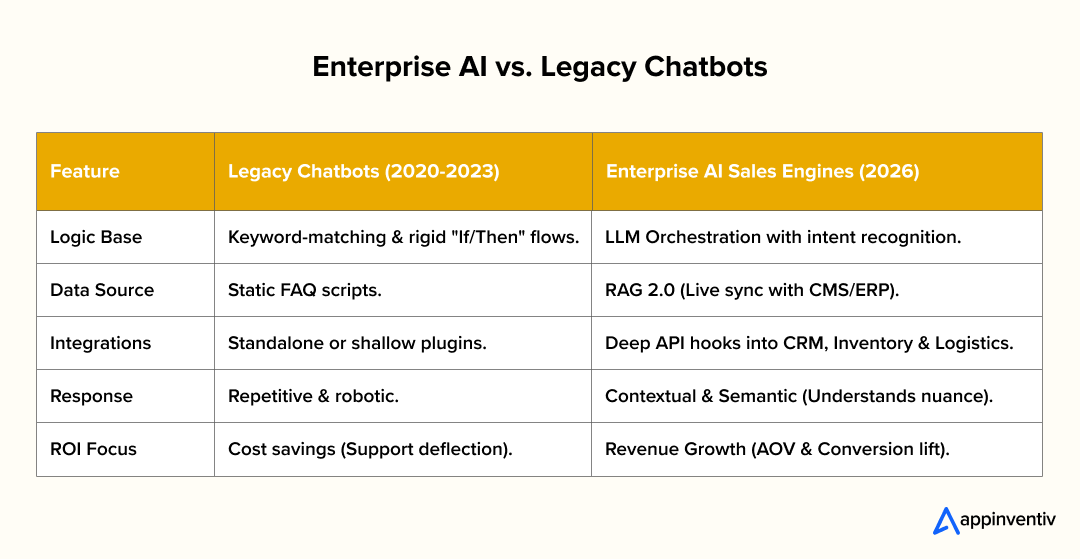
At the engineering level, modern implementations go beyond keyword matching. Instead of relying on traditional search rules, advanced systems use vector embeddings and semantic search to understand what the buyer actually means.
For example, if a shopper asks for “attire for a rainy wedding in Tuscany,” the system does not search only for “wedding.” It queries a vector database to identify items associated with water resistance, breathable fabrics, formal styling, and climate suitability. The result set reflects intent, not just keywords.
This semantic understanding allows the chatbot to:
- Ask fewer, high-signal questions to clarify constraints
- Apply budget, context, and preference filters early
- Surface only relevant, in-stock, comparable options
The conversation remains short, direct, and focused on narrowing rather than browsing.
When implemented this way, product discovery accelerates and decision fatigue drops sharply. In production commerce environments, this approach consistently improves add-to-cart rates compared to static navigation or keyword search, particularly on mobile, where decision friction is highest.
2. Personalization Is Contextual, Not Just Historical
Personalization that relies only on past purchases underperforms. What converts is session-level context.
High-performing eCommerce personalization with AI chatbots adapts responses based on how the user arrived, what they have already viewed, and where they pause. A customer entering from a paid campaign requires a different conversation than a returning buyer comparing options.
This is where many chatbot pilots fall short. Without tight integration into analytics, CRM, and catalog data, conversations feel generic, and buyers disengage. When context is wired correctly, conversion uplift follows because information arrives at the exact point of hesitation.
3. Cart Recovery Happens Before the Cart Is Abandoned
The most effective cart-recovery systems do not wait for abandonment. They intervene when friction appears.
Checkout hesitation is rarely random. Delivery timelines, return policies, payment uncertainty, or stock concerns tend to surface at predictable points. High-performing chat systems monitor these signals in real time and step in before intent cools.
In modern implementations, this intervention is increasingly powered by agentic workflows rather than simple prompts. Instead of asking the shopper to verify details, an AI agent performs autonomous pre-checks behind the scenes.
Before the user confirms purchase, the system can:
- Validate real-time inventory availability
- Confirm delivery windows via logistics APIs
- Surface return eligibility and warranty terms
- Detect payment or shipping constraints
The agent can then respond proactively: “I’ve confirmed this can reach you by Friday,” or “This item is eligible for hassle-free returns.” By resolving uncertainty before it is voiced, the system removes the final friction point.
This shift from reactive messaging to autonomous verification is why conversational intervention during checkout consistently outperforms post-session email recovery. Industry benchmarks show recovery rates improving by 20–25% when assistance is triggered while purchase intent is still active.
In practice, the value is not the reminder itself. It is the removal of last-mile uncertainty at the exact moment a buyer decides whether to proceed.
Also Read: How can M-Commerce Apps Lower their Cart Abandonment Rate?
4. Upselling Is Embedded, Not Pushed
Upselling through chat works only when it feels operationally helpful.
Instead of promotional prompts, high-converting chatbots introduce add-ons and upgrades as part of the decision logic. Accessories are suggested when compatibility matters. Upgrades appear when they remove trade-offs the buyer has already surfaced.
This approach increases average order value without slowing checkout, which is why it performs particularly well in category-heavy and subscription-based commerce environments.
5. Support Automation Is Positioned as a Sales Function
In real eCommerce systems, support questions often block purchases rather than follow up on them.
Chatbots that resolve delivery, return, and compatibility queries early prevent buyers from exiting the session to search for answers elsewhere. When nearly all pre-sale questions are resolved instantly, purchase momentum is preserved.
This is why support automation, when implemented correctly, shows up in revenue metrics before it shows up in cost savings.
6. Performance Improves Because the System Learns Where Sales Stall
Static flows plateau quickly. Conversational AI for eCommerce does not.
Over time, well-designed eCommerce chatbot benefits by identifying recurring objections, missing information, and decision points that correlate with drop-offs. These signals feed back into product content, pricing clarity, and conversation design.
In mature deployments, this feedback loop is one of the biggest long-term advantages. Conversion gains compound not because the chatbot “gets smarter,” but because the buying journey itself becomes tighter.
7. Engineering “Revenue Safety” with Deterministic Guardrails
In an enterprise environment, a chatbot that “hallucinates” a discount or misquotes a return policy is a liability. The 3x sales growth seen in 2026 is underpinned by Deterministic Guardrails.
While the interface is fluid and conversational, the transaction logic remains rigid. By decoupling the “Creative Layer” (the LLM) from the “Transaction Layer” (the ERP/Pricing Engine), the architecture ensures generative outputs cannot alter pricing logic, discount rules, inventory thresholds, or compliance constraints enforced at the system-of-record level.
The LLM can interpret intent, generate responses, and guide the user journey, but final validation always passes through the ERP and pricing engine. This separation preserves AI-driven agility while maintaining deterministic control over margins, approvals, and brand governance.
What This Looks Like in Practice
At Appinventiv, the strongest results come when chatbots are embedded within the broader commerce architecture, not deployed as isolated tools. When tightly integrated with catalog data, inventory systems, and analytics, enterprise teams typically see measurable gains in conversion and revenue within the first few months.
The pattern is clear. Chatbots generate revenue when they’re built around real buying behavior, powered by accurate data, and aligned with defined business rules.
That is why, in 2026, AI chatbots are no longer evaluated as engagement tools. They are evaluated as revenue infrastructure.
Why 3× Becomes Possible
Sales growth compounds when conversion lift, AOV increase, and cart recovery improvements occur simultaneously. Chatbots influence all three layers of the funnel at once.
Enterprise Tech Architecture and Stack: What Enables Real Sales Impact
Sales performance from AI chatbots is rarely limited by conversation design but by architecture. In practice, teams discover that chatbot results plateau when the underlying stack cannot support accurate answers, real-time context, or scale under traffic spikes.
For business leaders, understanding this architecture is less about technology preference and more about risk. The wrong foundation leads to inconsistent responses, broken personalization, and systems that cannot evolve with the business.
Below is how revenue-grade eCommerce AI chatbots are typically structured in production environments.
1. LLM Orchestration and Vector Embeddings
Beyond a base model (like GPT-4 or Gemini 1.5 Pro), enterprise-grade bots utilize an Orchestration Layer (such as LangChain or Semantic Kernel). Convert the full product catalog into vector embeddings and store them in a high-performance vector database such as Pinecone or Milvus for fast, similarity-based retrieval.
This enables true “Semantic Search,” allowing the bot to infer that a query like “something for a summer wedding” points to breathable fabrics and appropriate silhouettes, even if those exact terms don’t appear in the product title.
Also read: How to develop an LLM model? A comprehensive guide for enterprises
2. RAG (Retrieval-Augmented Generation) 2.0
To eliminate hallucinations, implement the Agentic RAG in your eCommerce architecture. When a user asks a question, the system retrieves the “ground truth” from your live CMS or Knowledge Base before generating a response.
This ensures that in 2026, your chatbot isn’t just “chatting”—it is performing a real-time lookup of verified data, making it a reliable source for technical specs and shipping SLAs.
3. Data Integration That Reflects Live Commerce Reality
Chatbots influence sales only when they reflect the same reality as the storefront.
This requires direct integration with CRM systems, order management platforms, inventory management, and pricing engines. Static data or delayed syncs undermine personalization and lead to contradictory answers.
In real deployments, most chatbot failures trace back to shallow integrations rather than model quality. When data flows are designed correctly, chatbots can answer availability questions, confirm delivery timelines, and adjust recommendations without human intervention.
4. Knowledge Management That Scales With the Catalog
As product catalogs expand, unstructured content becomes a bottleneck.
High-performing systems rely on structured product taxonomies and knowledge relationships that map variants, bundles, alternatives, and compatibility rules. This structure allows chatbots to guide decisions rather than simply repeat descriptions.
Teams often underestimate this layer at first. Over time, it becomes one of the strongest contributors to accurate recommendations and reduced support escalation.
5. Platform and Channel Compatibility Without Lock-In
Enterprise eCommerce environments are rarely uniform. Chatbots must operate across platforms, regions, and channels without fragmenting logic.
Most production deployments support major commerce platforms such as Shopify, Magento, Salesforce Commerce, or SAP Commerce Cloud, often within headless or composable architectures. The same conversational logic must work across web, mobile apps, and marketplace interfaces.
Choosing API-driven integration over rigid plugins is usually what allows teams to scale without rework later.
6. Analytics and Monitoring Tied to Revenue Outcomes
Visibility is not optional; teams need to see where chat contributes and where it fails.
Revenue-grade stacks include analytics that track conversion paths influenced by chat, escalation rates, response accuracy, and drop-offs at key decision points. These signals inform both conversation design and broader commerce improvements.
In mature setups, chatbot analytics often surface issues in pricing clarity, product content, or checkout flow long before they appear in traditional dashboards.
Why Architecture Determines Long-Term Impact
A chatbot can be deployed quickly, but one that scales revenue cannot.
In practice, teams that invest early in architecture avoid rework, reduce risk, and see steadier performance gains over time. The stack determines whether the chatbot becomes a growth asset or an operational constraint.
This is why enterprise buyers increasingly evaluate chatbot initiatives through an architectural lens before measuring ROI.
The 2026 Data Goldmine: Capturing Zero-Party Insights
With the total phase-out of third-party cookies, AI chatbots have emerged as the primary vehicle for collecting Zero-Party Data. Unlike passive tracking, chatbots capture intent in the customer’s own words.
- Intent Mapping: Identifying “why” a customer is buying (e.g., “gift for a minimalist friend”).
- Feedback Loops: Instantly surfacing catalog gaps (e.g., “Users are asking for this dress in linen, but we only have silk”).
For enterprise leaders, this isn’t just a sales tool; it’s a real-time R&D engine that informs inventory planning and marketing strategy.
Measuring Impact and ROI: What Leaders Should Track
Adoption alone does not justify investment. The value of AI chatbots for eCommerce becomes clear only when their impact is measured against revenue, efficiency, and customer experience outcomes.
This section outlines how business leaders should evaluate performance and tie chatbot activity to commercial results.
Core KPIs That Reflect Business Impact
The most reliable indicators focus on sales movement and operational efficiency, not chat volume.
Conversion lift
Measure the percentage increase in completed purchases after chatbot interaction versus sessions without chat support. This directly reflects how well the eCommerce AI chatbot supports decision-making for buying.
Abandoned cart recovery rate
Track how many stalled checkouts are recovered through proactive chat prompts. An effective AI chatbot for abandoned cart recovery can reclaim revenue that traditional email reminders often miss.
Average order value (AOV)
Monitor changes in basket size influenced by recommendations and add-ons. This helps assess the impact of the eCommerce chatbot for upselling and cross-selling.
Support deflection and cost savings
Measure how many pre-sale queries are resolved without human intervention. Strong eCommerce customer support automation reduces support costs while keeping buyers on the purchase path.
Appinventiv provides tailored AI chatbot development that aligns with commerce systems.

Revenue Attribution Across Channels
Chatbots often influence decisions across multiple sessions and touchpoints. Attribution should reflect this reality.
Key practices include:
- Tracking chatbot-assisted sessions that lead to purchases later
- Mapping chat interactions to CRM records and order histories
- Separating informational chats from sales-influencing conversations
This approach gives a clearer picture of how eCommerce sales automation contributes to revenue, especially in longer buying cycles.
Measuring Long-Term Customer Value
Short-term sales matter, but long-term impact often carries more weight.
Leaders should track:
- Repeat purchase rates among chatbot-assisted customers
- Changes in customer lifetime value after chat adoption
- Reduction in churn due to faster issue resolution and guidance
Over time, these signals indicate whether the chatbot is improving the overall digital commerce customer experience, not just closing single transactions.
Many teams add analytics after deployment. This often leads to gaps in insight. Defining KPIs and attribution rules upfront makes results clearer and decisions faster. This is also where structured consultation during planning and development can prevent rework later.
Governance, Risks & Compliance: What Business Leaders Must Get Right
As AI chatbots become embedded across eCommerce operations, governance moves from a technical concern to a board-level responsibility. Decision-makers are no longer asking whether chatbots work; they are asking how. They are asking whether these systems are safe, compliant, auditable, and reliable at scale.
This section outlines the core AI-powered data governance areas leaders should address before and after deployment.
Data Privacy, Security, and Regulatory Compliance
Customer conversations often contain personal, transactional, and sometimes sensitive data. That makes chatbots part of the company’s regulated data environment.
Key compliance considerations include:
Data protection regulations
Chatbot systems must align with GDPR compliance, CCPA, and other regional privacy laws, particularly around consent, data minimization, and the right to erasure. For global eCommerce platforms, cross-border data transfer controls are equally important.
Data storage and residency
Leaders should clearly define where chat data is stored, how long it is retained, and who can access it. This is often dictated by cloud configuration choices and regional hosting requirements.
Security controls
Encryption in transit and at rest, role-based access controls, audit logs, and regular security reviews are essential. Chatbots integrated with payment systems or customer accounts must follow the same security standards as core commerce platforms.
From a technical standpoint, this often involves a stack built on secure cloud platforms such as AWS or Azure, paired with encrypted databases, API gateways, and identity and access management (IAM) layers.
Many organizations engage experienced development partners at this stage to ensure regulatory compliance is designed into the architecture rather than added later.
Transparency, Consent, and User Trust
Trust is fragile in conversational interfaces. Customers need clarity on what the chatbot is, what it can do, and how their data is used.
Best practices include:
Clear disclosure
Users should know when they are interacting with an automated system and when a human agent may take over.
Consent-driven data usage
Any use of conversation data for analytics, personalization, or training should be tied to explicit consent and documented policies.
Explainable behavior
Responses that influence purchasing decisions should be grounded in product data, pricing rules, and availability, not vague or speculative answers.
These controls are usually implemented through conversation design rules, policy engines, and content moderation layers sitting on top of the language model. A well-structured governance framework ensures that customer-facing conversations remain accurate and compliant, even as the chatbot scales across regions and brands.
Accuracy, Risk Management, and Response Guardrails
One of the most discussed risks with AI chatbots is incorrect or misleading responses. In commerce, even small inaccuracies can affect revenue, compliance, or brand trust.
Effective mitigation strategies include:
Model grounding
Connecting the chatbot strictly to verified sources such as product catalogs, pricing systems, order databases, and FAQs. This limits responses to approved data.
Validation and confidence checks
Implementing logic that verifies answers before they are shown, especially for returns, refunds, warranties, and shipping commitments.
Safe fallback mechanisms
When confidence is low, the chatbot should escalate to a human agent or provide a neutral response rather than guessing.
From a technology perspective, this typically involves a layered setup: LLMs integrated via APIs, retrieval systems for structured data, rule-based validation, and human-in-the-loop escalation workflows. Choosing and configuring this stack correctly often requires both technical depth and domain understanding, which is why many organizations seek advisory or development support during rollout.
Why Governance Cannot Be an Afterthought
Governance decisions made early affect scalability, risk exposure, and long-term operating costs. Retrofitting compliance or guardrails after launch is far more expensive than designing them upfront. For leaders evaluating chatbot initiatives, governance should be treated as a core workstream alongside product design and integration.
eCommerce AI Chatbots in Action: Use Cases Backed by Credibly Documented Deployments
Enterprise adoption of conversational AI in retail is no longer experimental. What matters now is where these systems measurably improve decision-making, reduce friction, and increase purchase confidence.
Below are use cases grounded in documented implementations and industry case studies.
1. Customer Support Automation & CX Efficiency
Use case: Always-on conversational support for order queries, product guidance, and routine service requests.
Retail conversational AI performs best when connected to operational systems such as order databases, CRM profiles, and policy repositories. This enables the system to return verified answers rather than generic responses.
Sephora’s conversational assistants and virtual beauty advisors illustrate this model. AI-powered tools provide real-time product guidance and support, helping customers resolve queries quickly while improving engagement and satisfaction.
When routine queries are resolved instantly, and complex cases escalate automatically, organizations reduce service load while maintaining response accuracy and consistency.
Technical enabler:
- Real-time order & policy retrieval
- Escalation workflows for low-confidence responses
- CRM-linked customer context
Also read: AI in Customer Experience: Revolutionizing Business Growth
2. Guided Product Discovery & AI-Assisted Recommendations
Use case: Helping shoppers choose the right product through conversational guidance and AI-driven recommendations.
Sephora’s AI ecosystem demonstrates how conversational assistance combined with AI analysis improves product discovery and purchase confidence. Tools such as Virtual Artist and AI-driven recommendations enable customers to explore products interactively and receive personalized suggestions.
These systems reduce uncertainty, improve engagement, and encourage purchase completion by turning browsing into guided decision-making.
Observed impact patterns:
- Improved engagement and confidence
- Higher likelihood of purchase
- Reduced return rates due to better selection
Technical enabler:
- AI recommendation engines
- Computer vision & preference analysis
- Contextual product data retrieval
3. Conversational Commerce & Purchase Confidence
Use case: Assisting customers during decision moments to increase purchase confidence.
Conversational assistants integrated into the buying journey act as digital advisors, answering questions, clarifying product attributes, and guiding choices in real time. Research on conversational AI in retail highlights how virtual assistants enhance engagement and accelerate sales by delivering real-time interaction and personalized guidance.
The value lies in reducing uncertainty at the exact moment purchase decisions are made.
Technical enabler:
- Natural language understanding tuned for product queries
- Retrieval-grounded responses
- Real-time inventory & product attribute lookup
4. Personalization & Loyalty-Driven Engagement
Use case: Using behavioral data to personalize recommendations and encourage repeat purchases.
AI-powered retail systems collect interaction and preference data to deliver tailored recommendations and experiences. Sephora’s personalization engine uses customer behavior and preference insights to recommend relevant products and improve satisfaction.
Personalization shifts engagement from transactional to relationship-driven.
Technical enabler:
- Behavioral data modeling
- Preference learning
- Consent-based personalization frameworks
5. Omnichannel Conversational Experience
Use case: Maintaining consistent assistance across mobile apps, web, and in-store digital touchpoints.
Retail conversational AI increasingly operates across channels to support a unified customer journey. Sephora’s digital ecosystem integrates AI-powered experiences across mobile and in-store touchpoints, enabling customers to explore products and receive guidance seamlessly.
This continuity ensures customers do not restart interactions when switching channels.
Technical enabler:
- Centralized customer profiles
- API-driven omnichannel architecture
- Session continuity across platforms
Why These Use Cases Matter
The value of conversational AI in commerce does not come from automation alone. It comes from removing friction at decision points.
When implemented with verified data access, personalization logic, and omnichannel continuity, AI chatbots evolve from support tools into guided buying systems that improve confidence, engagement, and revenue performance.
For leadership teams evaluating adoption, the key consideration is not whether chatbots exist but whether they are engineered to influence real buying decisions.
Implementation Playbook: Deploying AI Chatbots for eCommerce
Most eCommerce chatbots do not fail because the model is weak or the platform is wrong. They fail because teams treat deployment as a feature launch rather than a system rollout. In real commerce environments, chatbots sit inside sales funnels, data pipelines, and compliance boundaries. Getting them to perform requires discipline more than speed.
What follows is not a generic rollout sequence. It reflects how chatbot deployments actually succeed when revenue, not experimentation, is the goal.
1. Start With a Commercial Outcome, Not a Capability List
The first mistake teams make is starting with what the chatbot can do instead of what it must change. Conversion, cart recovery, and support deflection are not equal priorities, and trying to solve all of them at once usually leads to diluted results.
High-performing teams pick one primary outcome to optimise first. That might be reducing checkout hesitation, increasing add-to-cart rates in complex categories, or clearing pre-purchase support bottlenecks. Everything else is secondary until that outcome moves.
This clarity shapes every downstream decision, from conversation design to integration depth.
2. Design Conversations Around Where Buyers Hesitate
Effective chatbots are not placed everywhere. They appear where friction is predictable.
In practice, this usually means product comparison stages, checkout transitions, and moments where users pause or loop back. Mapping the customer journey is less about documenting flows and more about identifying where people stop progressing.
Chatbots that intervene too early feel intrusive. Chatbots that intervene too late recover little. Timing, not coverage, determines impact.
3. Treat Conversation Design as a Constraint System
The best conversational flows are not chatty, but focused.
In production deployments, successful chatbots use short, directive responses, avoid open-ended questions, and escalate quickly when confidence drops. Fallbacks are not an edge case; they are part of the design.
Teams that over-optimise for friendliness often sacrifice clarity. In commerce, clarity closes deals faster than tone.
4. Integrations Decide Whether the Chatbot Is Trusted
No chatbot influences sales if it operates on partial or outdated data.
Inventory accuracy, delivery timelines, pricing logic, and customer context must match what the storefront shows. When answers diverge, trust collapses immediately. Most underperforming pilots trace back to shallow integrations rather than poor AI.
This is why mature teams invest early in clean connections with CRM, order management, inventory, and analytics systems. Without that foundation, optimization becomes guesswork.
5. Governance Is Built In, Not Added Later
Compliance and AI guardrails cannot be layered on after launch without disruption.
In real deployments, consent handling, data retention rules, escalation logic, and response constraints are designed alongside conversation flows. This avoids rework and reduces risk as usage scales.
Teams that delay governance decisions often end up freezing rollout just as traction appears.
6. Pilot Narrowly, Then Watch the Right Signals
Pilots fail when success metrics are vague.
High-performing teams track a small set of indicators from day one: conversion lift in chatbot-assisted sessions, cart recovery influenced by chat, and the volume of support questions resolved before checkout.
Chat volume alone is meaningless. What matters is whether the chatbot changes buying behaviour.
7. Scale Only After the System Stabilises
Scaling too early magnifies flaws.
Once a chatbot performs reliably in one high-impact area, expansion across channels becomes far simpler. Web, mobile apps, marketplaces, and messaging platforms can share the same logic if the underlying architecture is sound.
At this stage, consistency matters more than novelty. Buyers expect the same answers regardless of where the conversation starts.
What This Looks Like in Practice
In enterprise eCommerce implementations, teams that follow this approach typically see measurable impact within the first few months, not because the chatbot is advanced, but because it is tightly scoped, well integrated, and governed from the outset.
Deployment success is less about the tool and more about execution discipline. When chatbots are treated as part of the commerce system rather than an add-on, revenue impact follows naturally.
Connect with our team for a tailored roadmap and execution plan.

How Does Appinventiv Build eCommerce Chatbots That Drive Revenue
Appinventiv has extensive experience in AI chatbot development services, driving measurable sales and enhancing AI chatbots for customer engagement. Our approach combines deep technical expertise with a clear understanding of business goals.
Precision Engineering: The Appinventiv Commerce AI Framework
We don’t just “deploy” bots; we engineer Commerce Intelligence Layers that integrate deeply with your existing ecosystem. Our approach is defined by three pillars:
- System Interoperability: Engineered for sub-50ms latency between the chat interface and core systems such as SAP, Salesforce, or Oracle to support real-time pricing, inventory, and order validation.
- Compliance-First Design: Native PII masking, role-based access controls, and SOC 2/GDPR-aligned data handling frameworks built in from the architecture layer to enable secure global deployment.
- Revenue Attribution: Each conversation maps to a defined GTM (Google Tag Manager) event, enabling end-to-end tracking from first interaction through checkout for precise 1:1 ROI measurement.
Our work with innovators like Mudra and MyExec demonstrates our ability to turn complex AI logic into intuitive, high-converting user experiences.
Every AI chatbot for eCommerce sales we build is designed around engagement, personalization, and tight commerce integration. From intelligent virtual shopping assistants to conversational flows that recover abandoned carts, our AI consulting services focus on connecting technology directly to measurable revenue outcomes.
Start an enterprise chatbot pilot with Appinventiv to evaluate how intelligent, integrated chatbots can enhance conversions, streamline support, and drive measurable business outcomes.
Frequently Asked Questions
Q. How do AI chatbots increase eCommerce sales?
A. AI chatbots for eCommerce guide buyers through product discovery, provide real-time support, and recover abandoned carts. By addressing hesitation points instantly, they help convert interest into completed transactions. (See the Impact Measurement and ROI section for more details.)
Q. Can eCommerce chatbots improve conversion rates?
A. Yes. Effective eCommerce chatbot use cases often show conversion lifts of 10–25% during pilot deployments. Key performance indicators include reduced cart abandonment, higher add-to-cart rates, and increased average order value.
Q. What ROI do AI chatbots deliver for eCommerce businesses?
A. Pilot projects typically show measurable revenue gains within 3–6 months. When scaled across channels, an AI chatbot for abandoned cart recovery and upselling can contribute to a 2–3× increase in sales over a 12-month period, depending on traffic and product mix.
Q. How are eCommerce brands using chatbots in 2026?
A. Brands are employing AI chatbots for product recommendations, 24/7 support, upselling, loyalty program engagement, and multi-channel conversations. Advanced use cases include predictive cross-selling and integration with inventory systems for real-time guidance.

- In just 2 mins you will get a response
- Your idea is 100% protected by our Non Disclosure Agreement.

How Much Does It Cost to Build a Conversational AI Chatbot in the UAE?
Key Takeaways AI chatbot development in the UAE typically costs AED 150,000–1,470,000 ($40K–$400K), based on complexity. Backend integration and compliance drive cost more than the chatbot interface itself. Arabic NLP, UAE hosting, and PDPL requirements increase budget and engineering effort. LLM + RAG enterprise chatbots sit at the higher end due to integration and infrastructure…

AI Inventory Management in Australia: Benefits, Use Cases, and Implementation Strategies
Key takeaways: Traditional ERP planning reacts to history; AI predicts demand shifts, reallocates stock dynamically, and prevents costly stockouts across distributed Australian networks. AI in inventory management in Australia typically reduces inventory levels 20–40% while maintaining service targets, unlocking significant working capital across multi-state operations. Enterprise implementations usually range from AUD 70,000 to AUD 700,000+,…

How to Hire RAG Architects for Enterprise AI
Key takeaways: Define your RAG architecture scope to avoid misaligned hiring decisions Identify end-to-end architectural ownership across retrieval, governance, and scaling Evaluate deep technical capabilities beyond prompt engineering and tools Validate governance and compliance readiness at the retrieval layer Test system-level thinking through real-world failure scenarios Choose the right hiring model based on scale, risk,…









