


























Top Enterprise Use Cases for Agentic RAG in eCommerce Transformation


- Technical Overview of Agentic RAG
- Difference Between Standard RAG and Agentic RAG
- Agentic AI Use Cases for Retail & eCommerce
- Benefits of Agentic RAG in eCommerce
- Enterprise Roadmap for Implementing Agentic RAG in eCommerce
- Future Trends in Agentic RAG of eCommerce
- Challenges of Agentic RAG in eCommerce and Practical Solutions
- Deploy Agentic RAG in Your eCommerce Ecosystem with Appinventiv
- FAQs

Key takeaways:
- Agentic RAG in eCommerce combines retrieval, generation, and autonomous decision-making, enabling AI systems to plan, reason, and act on real-time data for smarter automation and personalization.
- This approach powers advanced use cases like dynamic merchandising, personalized recommendations, automated customer care, and intelligent pricing, improving efficiency and customer experience.
- Enterprises benefit from enhanced operational resilience, data-driven decisions, and scalable support, while maintaining consistent omnichannel interactions.
- Implementing agentic RAG requires robust data integration, governance, and continuous monitoring to address challenges like fragmented data and model drift.
- As agentic RAG evolves, it will drive fully autonomous, context-aware commerce systems that adapt to business needs and market changes in real time.
When Walmart rolled out its AI‑led shopping assistant across its digital channels, the aim was not just to answer routine queries but to act on customer intent by suggesting products, updating cart contents, adjusting recommendations based on behaviour and handling service tasks with minimal human input.
The autonomous responsiveness there is based on Agentic Retrieval-Augmented Generation (Agentic RAG). It is a system that does not just report the appropriate data to inventory feeds, pricing systems, and customer histories but also reasons over it and decides on actions to accomplish objectives.
This is important in the context of eCommerce, since fixed knowledge and rule-based bots cannot match the scale and variations in shoppers’ needs, but agentic RAG integrates retrieval and decision logic based on the circumstances of real-time commerce.
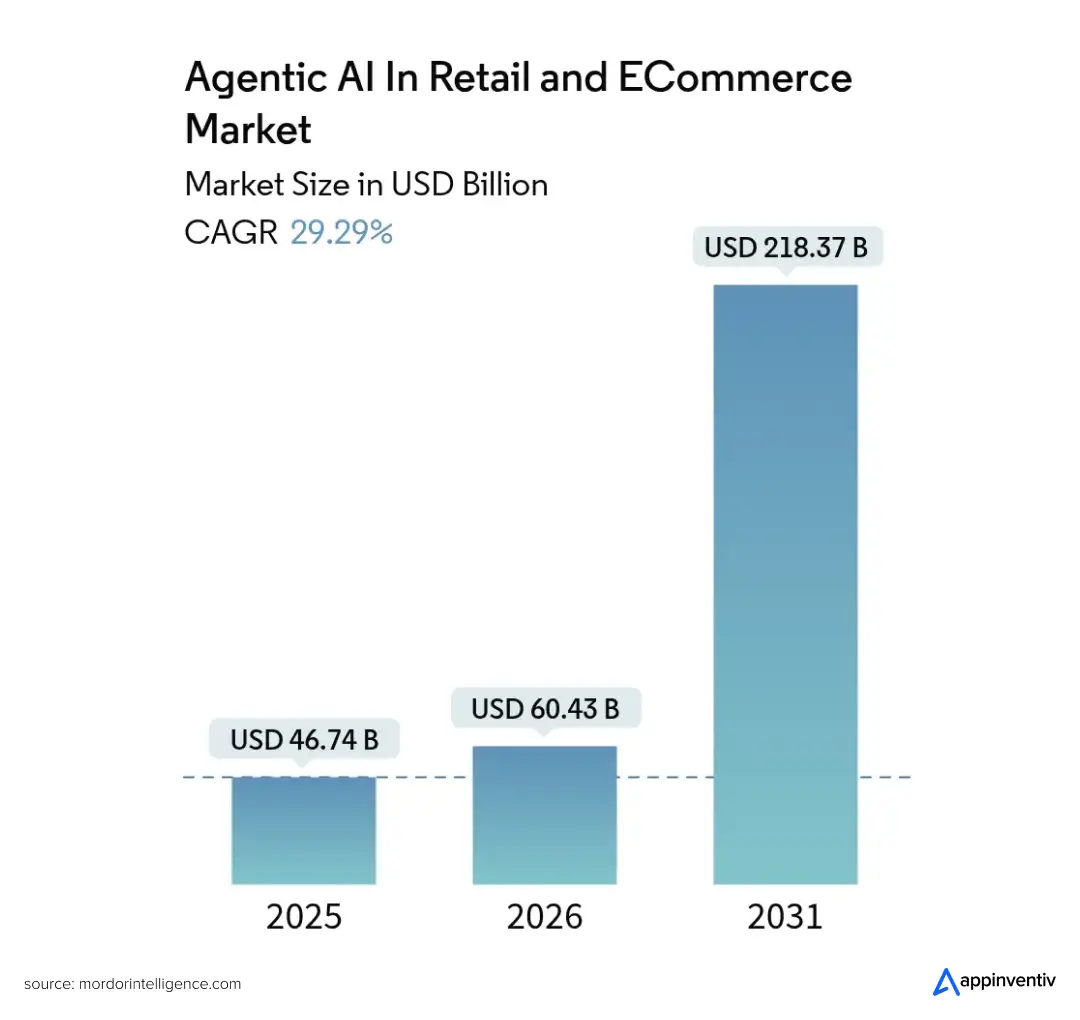
The market behind this is already massive: the agentic AI in the retail and eCommerce industry will have a $60 billion plus size in 2026 and is projected to skyrocket soon to $218.37 billion by 2031, as retailers use autonomous pricing, fulfillment and engagement agents capable of running at scale. (Source: Mordor Intelligence)
Looking ahead, eCommerce enterprises are expected to expand agentic RAG adoption across omnichannel operations, leveraging these systems for predictive inventory allocation, automated promotions, and advanced personalization.
Integration with emerging technologies such as real-time analytics, voice commerce, and IoT-enabled store operations will further increase the impact, making agentic RAG a foundational element of next-generation retail strategy. The result is not just faster operations, but more intelligent, context-aware commerce that scales with the complexity of modern consumer behavior.
Take the first step toward smarter retail operations

Technical Overview of Agentic RAG
Fundamentally, Agentic Retrieval-Augmented Generation (RAG) is a composite of three layers united together, such as retrieval, generation, and agentic decision-making. It forms an AI mechanism capable of autonomously planning, reasoning, and acting based on real-time data, making it a key part of RAG applications in AI development.
It is on this technical basis that agentic RAG in eCommerce can be described as transformative for businesses that seek to leverage it for scalable automation and personalization.
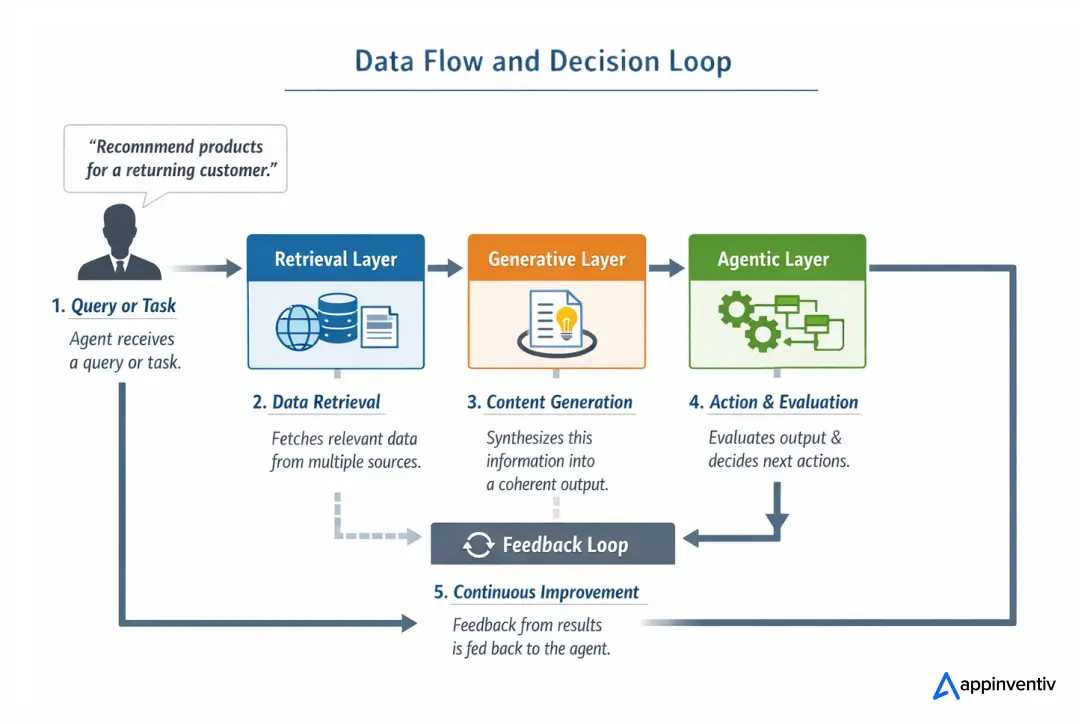
Retrieval Layer
This is the knowledge backbone of this system. It connects to various structured and unstructured data feeds, such as product catalogs, pricing feeds, customer history, support tickets, inventory systems and external market data.
The retrieval layer focuses on relevance and context, unlike traditional search, which the generative layer uses accurate and current information. This is one of the fundamental enablers of Agentic RAG for eCommerce because it enables AI to provide accurate suggestions and responses.
Generative Layer
When the appropriate data is brought, the generative layer produces smooth and contextually appropriate outputs. In the case of eCommerce, this may include customized product offers, real-time pricing offers, or automatic replies.
The generative layer is based on advanced large language models (LLMs) but grounded in retrieved information, avoiding hallucinations and enhancing factual accuracy. This is what Agentic AI in eCommerce can bring to bear to provide actionable insights at scale.
Also Read: RAG Models in Generative AI
Agentic Decision-Making Layer
The difference between agentic AI and agentic RAG is the agentic layer. In this case, AI agents are independent coordinators: they decide what to retrieve, the way to process it, and what to do next.
Agents are permitted to combine several queries, update workflows, activate system actions (such as inventory management or discounts), and even learn through feedback loops to improve performance over time.
Difference Between Standard RAG and Agentic RAG
To understand why enterprises are adopting more advanced AI, it helps to compare traditional approaches with RAG for eCommerce. The table below highlights key differences in decision-making, data handling, and real-world application, showing
| Feature / Aspect | Standard RAG | Agentic RAG |
|---|---|---|
| Core Role | Pulls relevant information and generates an answer. | Pulls information, makes decisions, and can act on them automatically. |
| Decision Approach | Follows instructions or prompts without thinking beyond them. | Chooses what to do next, plans steps, and evaluates results as it goes. |
| Data Handling | Works on the immediate query; one round of retrieval. | Pulls from many sources, may loop through data multiple times to get context. |
| Context Awareness | Limited; can miss nuances or current changes. | Understands context and real-time updates before generating output. |
| Action Capability | Does not act on outputs; requires user intervention. | Can perform tasks on its own, like updating dashboards or adjusting offers. |
| Learning Over Time | Static; mostly learns only when the model is retrained. | Uses feedback from results to refine decisions continuously. |
| Best Use Cases | Simple Q&A, basic content generation. | Enterprise scenarios like eCommerce personalization, dynamic pricing, or supply chain decisions. |
| Complexity | Straightforward setup; minimal integration. | Multi-layered setup combining retrieval, generation, and agentic reasoning; needs system integration. |
Also Read: RAG vs Fine Tuning: Choosing the Right AI Strategy
Agentic AI Use Cases for Retail & eCommerce
By integrating data retrieval, reasoning, and autonomous action, AI agents are transforming retail and eCommerce activities. The following explores Agentic AI use cases for retail & e‑commerce, highlighting practical applications that large enterprises are already implementing.
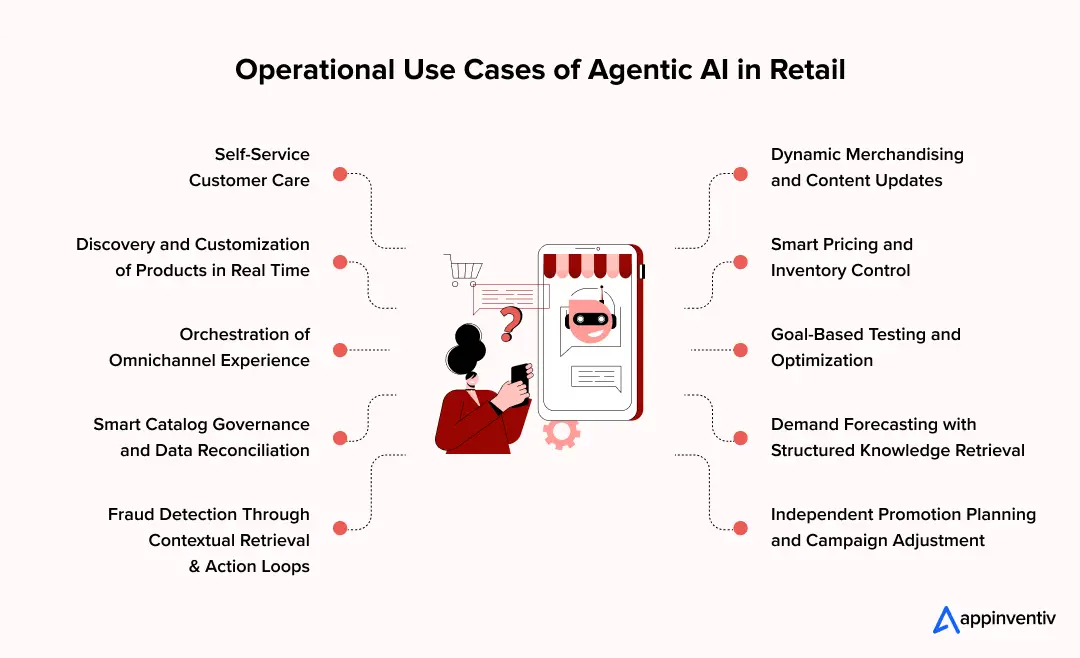
Self-Service Customer Care
Using AI agents, questions can be answered by accessing the order histories, shipping information and support policies, and proper answers can be produced automatically.
For instance, Amazon has AI agents that perform automated support activities like shipment tracking or returns. Such systems enhance response times and give human agents time to prioritize complex cases, which is an effective agentic RAG use case in eCommerce.
Dynamic Merchandising and Content Updates
The agentic systems dynamically change product displays, banners, and offers based on shopper behavior, stock, and campaign priorities.
Target uses AI agents to optimize home page layouts and point out trending products at peak times of the year. Autonomously managed by the system, the cross-sell and upsell recommendations are updated and presented in a practical RAG for eCommerce applications that increase visibility and sales.
Discovery and Customization of Products in Real Time
Personalization demands systems that respond to customers’ behavior in real time. The agentic AI bots in eCommerce interpret browsing history, purchase history, and inventory information to provide personalized recommendations.
One of the top real-world examples of Agentic RAG in eCommerce is Walmart, which uses agentic RAG to dynamically suggest products on its website and app, taking into account live inventory, trending products, and user preferences to show relevant suggestions that update as the consumer browses, improving engagement and conversions. This reflects one of the best agentic RAG applications in eCommerce.
At Appinventiv, we helped Edamama transform its basic eCommerce app into an AI-driven platform, delivering personalized shopping experiences and significantly improving customer service.

Smart Pricing and Inventory Control
The AI agents track demand change, rival pricing, and inventory position, and will automatically revise pricing tactics or change channel stock allocations.
Best Buy applies Agentic RAG dynamically to online pricing and the distribution of stock, which helps to reduce stockouts and keep popular products on hand continuously. This makes Best Buy one of the top use cases for agentic RAG in eCommerce.
Orchestration of Omnichannel Experience
The consistency of agentic AI ensures that web, mobile, email, and in-store channels are consistent through unifying the preferences and history of interaction between customers.
Nike uses artificial intelligence agents to coordinate the shopping experience across sites. Whenever customers are browsing mobile applications, email campaigns, or even in stores, they get similar product recommendations. This is a clear example of agentic RAG use cases in eCommerce in practice.
Goal-Based Testing and Optimization
Algorithms may be applied to layouts, workflows, and offers by AI to continuously test and apply the most successful configurations to optimize conversions.
Home Depot uses agentic AI to test variations in checkout flows, product placement, and promotions in real time. The agents learn from outcomes and deploy optimized configurations automatically, illustrating practical applications of RAG for eCommerce in enterprise testing.
Fraud Detection Through Contextual Retrieval and Action Loops
The use of fixed rule engines is not sufficient to detect fraud in high-volume commerce settings. Before generating a contextual risk summary, agentic architectures look up transaction histories, behavioral signals, device fingerprints, and previous risk evaluations.
PayPal uses retrieval-based AI models that assess the context of transaction data relative to past behavioural patterns in real time. This is how the retrieval-grounded reasoning enhances the transaction governance beyond the traditional filters.
Demand Forecasting with Structured Knowledge Retrieval
Before making forecasts, agentic systems access historical sales data, supplier scheduling data, logistics data, and external demand data. The output of AI-based demand forecasting is not simply predictive; it dictates operational changes, such as a replenishment schedule or area distribution priorities.
Procter & Gamble uses AI-assisted planning systems that couple prior retail demand with distribution intelligence to optimize production and allocation decisions. Using the operations data retrieved as the basis of the forecasts allows the system to match manufacturing cycles to downstream retail performance, preventing excess inventory and eliminating shortages.
Smart Catalog Governance and Data Reconciliation
Large stores maintain large product inventories that are constantly updated on price, availability, specifications, and compliance labels. The agentic systems access structured product records, supplier feeds, and merchandising rules, and then produce reconciled updates.
Wayfair uses AI-based inventory and catalog management systems that compare supplier changes to available product metadata. When inconsistencies are detected, the system cross-references previous listings and structured attributes, then implements updates. This retrieval-grounded procedure eliminates duplicates in the catalog, pricing errors, and incomplete descriptions, ensuring catalog accuracy at scale.
Independent Promotion Planning and Campaign Adjustment
Promotion patterns involve aligning price regulations, inventory quantities, marketing schedules, and performance indicators. The agentic systems access campaign history, conversion data, and inventory levels, then generate promotional changes. The agent determines whether to extend, pause, intensify, or localize offers based on real-time results.
Macy uses AI-based campaign analytics to track the performance of promotions on online platforms. The system is based on the retrieved sales data and regional demand trends to make decisions that can be adjusted mid-campaign without waiting for a predetermined reporting period. This will reduce response time and promotional effectiveness without compromising operational control.
Benefits of Agentic RAG in eCommerce
The emergence of AI agents has reinvented the nature of business in eCommerce. In addition to mere automation, agentic RAG systems can reason with data, act on it, and dynamically modify processes. The advantages are extensive, including enhanced customer experience, operational resilience, and increased revenues.
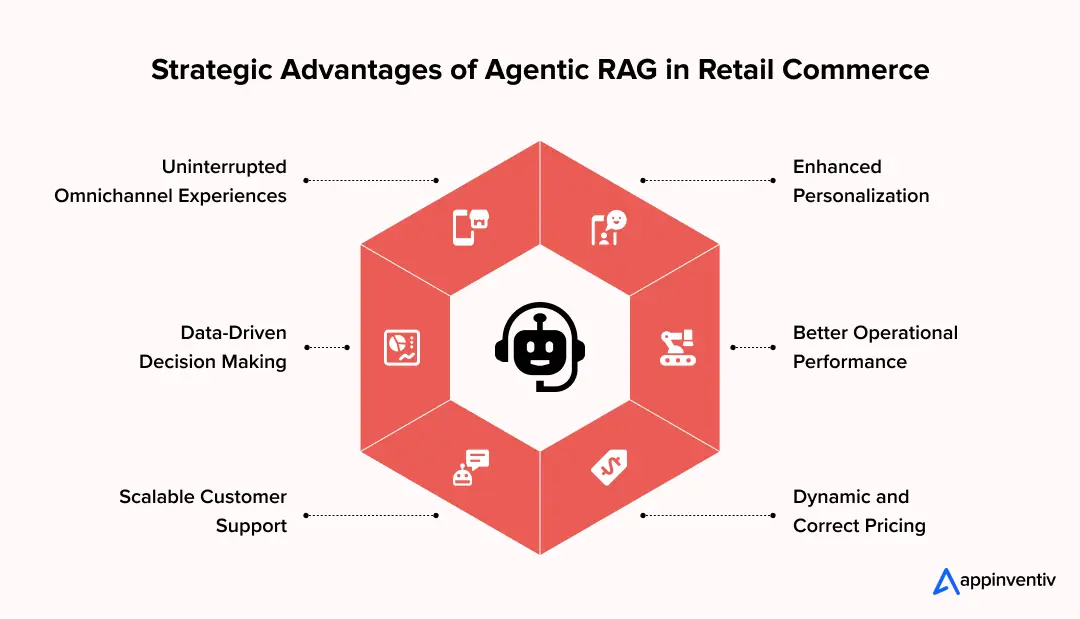
Enhanced Personalization
Using real-time browsing patterns, purchase history, and even contextual clues such as place or device, agentic RAG can be used to provide individual shoppers with product recommendations. This is not just a matter of static suggestions but makes every interaction relevant.
These abilities are among the top use cases for agentic RAG in eCommerce, enabling retailers to achieve higher interaction and conversion rates without losing the personal touch.
Better Operational Performance
Monotonous and time-intensive processes, including updating the database with product information, answering customer inquiries about orders, and inventory reconciliation, can be performed independently by AI agents. The teams will take less time on routine functions and be able to concentrate on strategic functions.
This is one practical application of Agentic RAG in eCommerce, illustrating how companies ought to be able to balance resources without reducing the quality of their outputs.
Dynamic and Correct Pricing
The market situation and consumer demands vary. The AI agentic agents have the capability of tracking real-time inventory, competitor prices, and demand signals to increase or decrease prices and promotions dynamically. RAG for eCommerce enables retailers to reap the best margins, avoid stock imbalances and react to changing trends, which would have been unachievable in a manual process.
Scalable Customer Support
The AI agents can answer a broad scope of customer queries on different channels, such as web chat, email, and mobile apps, and can only pass complex matters to human agents. The system gets the information needed about orders, shipping, and return policies in real time, hence responding quickly and correctly.
This demonstrates the operational benefits of agentic AI in eCommerce, reducing wait times and enhancing customer satisfaction.
Data-Driven Decision Making
The data used by agentic RAG is consolidated and interpreted to include the sales trends, inventory levels, and user behavior, among others. This enables the marketing, merchandising and operations teams to make evidence-based decisions faster than intuition-based ones.
The tangible impact of Agentic AI in eCommerce is observed in better planning and optimization of campaigns and reduced stockouts or poorly aligned promotional activities.
Uninterrupted Omnichannel Experiences
The modern shopper engages with the brand on the web, mobile, email, and the in-store platform. The agentic AI bots may be able to sustain a context in these touchpoints, making recommendations, promotions and responding to services to be consistent and pertinent.
This consistency boosts loyalty and interaction, and it is one of the best applications of agentic RAG in eCommerce, as well as the brand consistency in every channel.
Enterprise Roadmap for Implementing Agentic RAG in eCommerce
Adopting agentic RAG requires more than deploying a model. It is the process of harmonizing data systems, workflows, and business objectives in such a way that agents can retrieve information with proper accuracy and act responsibly. The subsequent steps provide a way for implementing RAG in eCommerce in a realistic and systematic way.
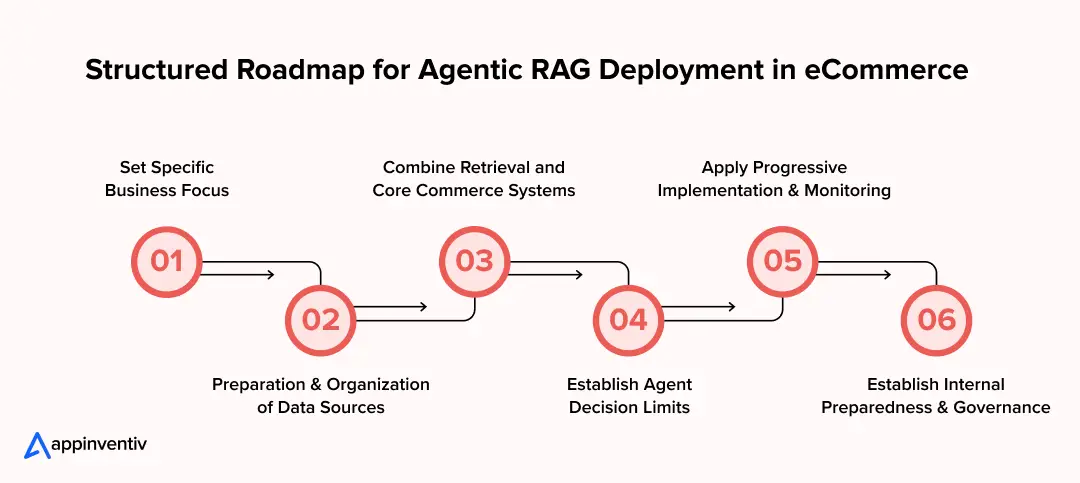
Set Specific Business Focus
Organizations must set quantifiable objectives before implementing autonomous agents. It could be the personalization point, the price point, or customer service, but either way, it has to be clear at this point, or it will be a failure in the future.
The initial focus of many enterprises is the most promising and top use cases for agentic RAG in eCommerce, including in recommendation engines or automated customer support, where it is feasible to see returns early.
Preparation and Organization of Data Sources
Reliable data is needed in agentic systems. The product catalogs, pricing systems, CRM systems, and inventory databases must be accurate and available. Even a well-planned Agentic RAG of eCommerce solutions without clean inputs will deliver irregular results. Before deployment, AI-powered data governance, validation checks and system integration should be considered.
Combine Retrieval and Core Commerce Systems
To operate successfully, agentic workflows require retrieval layers directly linked to ERP, OMS, and customer platforms. This makes RAG in eCommerce run on live data rather than static data. The work of integration might entail developing an API, aligning middleware, and conducting thorough environment testing.
Establish Agent Decision Limits
Autonomous systems ought to be under specifications. Enterprises have to decide what agents can do on their own and when human control is needed. These structured guardrails are especially important in Agentic AI for eCommerce, where revenue and brand trust rely on pricing, promotions, and customer communications, making careful planning essential in RAG application development.
Apply Progressive Implementation and Monitoring
The complete implementation of it cannot occur in a single night. Controlled environments of pilot programs enable teams to test accuracy, quality of response, and operational impact. When implementing Agentic RAG in eCommerce, ongoing monitoring and feedback loops are essential to refine performance and prevent unintended outcomes.
Establish Internal Preparedness and Governance
Organizational readiness is also needed in technology adoption. Teams need to understand the functionality of agentic systems, how to interpret their outputs, and how to connect when required. Clear accountability structures ensure that as the system scales across new business functions, governance remains stable, transparent, and sustainable.
Future Trends in Agentic RAG of eCommerce
Enterprise commerce is moving beyond isolated AI pilots. Retrieval and generation now operate within decision-aware systems embedded across merchandising, logistics, and customer operations. Here are some of the key trends shaping this transition.
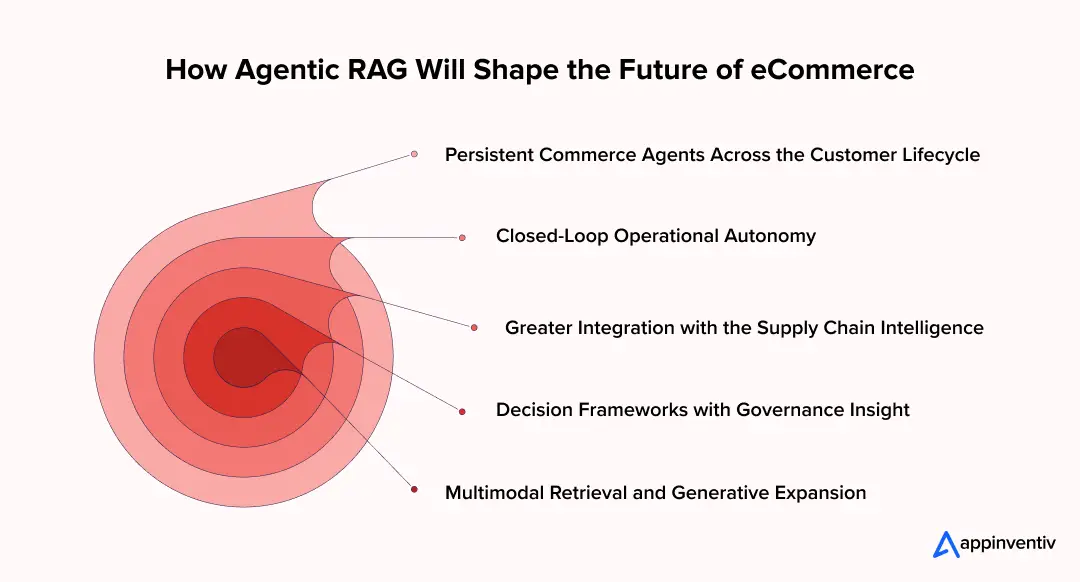
Persistent Commerce Agents Across the Customer Lifecycle
In the present day, the majority of implementations are activated at the search or checkout point. The future of RAG for eCommerce is in the continuum of agents that will go through the entire customer lifecycle. Such systems will store contextual memory between sessions, channels and campaigns.
The agent will also access the previous browsing history, loyalty history, fulfilments and service interactions and then generate a response rather than responding to one query. In the long run, this forms a continuous intelligence coverage as opposed to discrete personalization instances. The retailers will use the agent as a long-term digital operator and not a one-time response engine.
Closed-Loop Operational Autonomy
The future of Agentic RAG in eCommerce will be determined by systems that not only provide insights but also take action within specific guardrails. Demand signals, marketing performance, and supply chain constraints will first be retrieved by the agents, and then corrective steps will be decided.
For example, when the conversion drops in a particular area, the agent can review the history of pricing, inventory levels, and promotion timing, and then advise a change in discount strategy. The system will make pre-authorised changes in the mature deployment without any human involvement and record the justification for review. This change of advisory to conditional autonomy will characterize the next stage of enterprise AI adoption challenges.
Greater Integration with the Supply Chain Intelligence
As the use of agentic AI in the retail industry evolves, retrieval layers will have more and more links to upstream information sources, including supplier lead times, manufacturing schedules, and logistics performance.
Rather than generating demand forecasts independently, the agent will access supply constraints and then generate output in terms of merchandising or pricing. Visibility and bundling logic can be adjusted if there is excess inventory. This coordination between online storefront operations and the physical supply chain will reduce operational disparities that currently exist between trade and fulfillment networks.
Decision Frameworks with Governance Insight
Scrutiny of regulations and internal audit standards is becoming stricter in large retail businesses. The second stage of Agentic AI in retail will involve embedded governance gateways within the decision loop.
The system will access compliance policies and previous decision histories to confirm conformity before releasing catalog amendments, pricing changes, or offers to specific customers. Instead of governance being regarded as a post-action review, it is integrated with the retrieval step. This minimizes risk and does not slow the operation.
Multimodal Retrieval and Generative Expansion
The systems of the future will go beyond the tabular and structured text. The retrieval pipelines will be fed with image libraries, product videos, voice interactions, and even in-store sensor data.
Efforts by an agent to retrieve visual similarity patterns can be followed by submitting alternative product recommendations. It can refer to store-level foot traffic indicators prior to changing the home page banners. This multimodal retrieval method extends context and narrows the reasoning depth without augmenting manual control.
Equip your business with intelligent, decision-aware systems that adapt and scale

Challenges of Agentic RAG in eCommerce and Practical Solutions
RAG integration within an enterprise retail setting presents technical, operational, and governance complexity. It is a real value, and the restrictions are real. The main challenges and solutions are listed below.
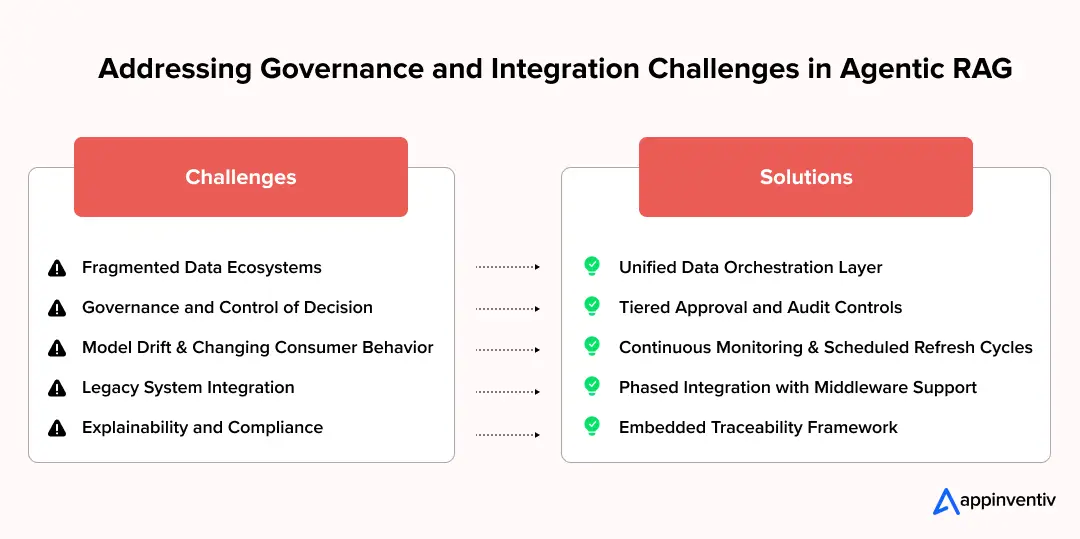
Fragmented Data Ecosystems
Retail information is spread across ERP, CRM, OMS, PIM, and marketing systems. When there is an inconsistency or latency in the dataset retrieved by the retrieval layers, the outputs will not be reliable.
Solution: Create a centralized data orchestration layer and standardized APIs and validation points. High-impact domains like inventory, pricing, and the status of orders should be prioritized as real-time synchronization is essential.
Governance and Control of Decision
The more systems shift from creating insights to taking action, the greater the likelihood of unintentional changes in pricing or promotion.
Solution: Establish approval levels for the approval system. Low-risk automatically executed actions can run within predefined limits, and high-impact decisions are sent through a human process. Record a complete log of accessed information and the performance of operations.
Model Drift and Changing Consumer Behavior
Customer preferences, demand patterns, and competitive pricing shift quickly. Static retrieval logic can become outdated.
Solution: Implement continuous monitoring with performance benchmarks tied to conversion, return rates, and margin impact. Refresh retrieval sources and retrain decision logic at defined intervals rather than reacting only after performance drops.
Legacy System Integration
Many enterprise retailers operate on older infrastructure not designed for autonomous decision layers.
Solution: Adopt phased deployment. Begin with advisory outputs before enabling execution. Use middleware to modernize legacy systems through AI and modern retrieval engines without requiring full platform replacement.
Explainability and Compliance
Leadership teams and regulators require transparency in how pricing, recommendations, or approvals are generated.
Solution: Embed traceability into the architecture. Each decision should log retrieved sources, applied rules, and final action paths. Structured documentation builds internal trust and simplifies audits.
Deploy Agentic RAG in Your eCommerce Ecosystem with Appinventiv
The future of agentic RAG in eCommerce is in systems that do not just retrieve and act. These architectures assess context, trade off operational limitations and take systematic action in pricing, merchandising, customer service and inventory control.
Due to the increasing complexity of retailing environments, decision-aware systems will be integrated into the core infrastructure, rather than optional additions. The impact is measurable. Even shorter response times, more accurate inventory matching and standardized personalization are no longer a thing of experiment but a mandatory operation.
For enterprises preparing for this shift, partnering with a capable RAG development company like Appinventiv is critical. The operation requires a rigorous data architecture, governance controls and integration with the available commerce stacks. Developed models have difficulties with providing stable results without that background.
Appinventiv helps organizations by providing them with coordinated deployment roadmaps, system integration, and customized retail ecosystem for various eCommerce and retail clients like IKEA, YKA, Adidas, 6th Street and others.
As a trusted custom AI agent development company, we stay aligned with your domain and scale solutions to support enterprise growth objectives, which can be well-identified in our vast portfolio.
Connect with our experts to get started with your agentic RAG journey for your eCommerce business.
FAQs
Q. What is agentic AI in eCommerce?
A. Agentic AI can be applied to eCommerce, where systems access business data and make guided decisions based on that data in retail procedures. These systems do not just produce responses, but analyze context, including inventory, price, and customer history and then take action.
As we come to larger Agentic AI use cases for retail and eCommerce, we are no longer talking about a simple automation but a more systematic decision-making directly in relation to business results.
Q. How does agentic RAG improve traditional eCommerce automation?
A. Here’s how agentic RAG improvises conventional eCommerce automation:
- Gets live operational information and then produces outputs, as opposed to constant rules.
- Analyzes the environment like inventory, prices and customer behavior and then initiates measures.
- Eliminates manual control through routing, approving or varying workflows.
- Takes lessons based on the consequences and perfects the future reaction based on the feedback.
- Supports the practical application of Agentic RAG in eCommerce across merchandising, service, and pricing operations.
Q. What is the difference between RAG and agentic AI in eCommerce?
A. RAG, in the case of eCommerce obtains the relevant information and creates responses based on it. It enhances precision in searching, supporting and recommending, but usually ends at content generation.
This is further extended to agentic AI, which brings with it decision logic and controlled execution. In Agentic RAG in retail, the system not only retrieves and generates, but also decides next steps like updating prices, workflow or escalating issues respectively on established governance rules.
Q. How does RAG improve customer experience in online retail?
A. RAG enhances customer experience by basing responses on real-time retail data, which is accurate. It retrieves order history, product details, shipment schedules, and policy details before producing answers or suggestions.
This minimizes misinformation and minimizes the response time. Such organized retrieval in an online retail setting builds trust, enhances the effectiveness of personalization, and ensures that shoppers receive context-sensitive responses rather than generic ones.
Q. How Agentic RAG transforms retail?
A. Here’s how Agentic RAG transforms retail:
- Integrates customer information, inventory, and price engines into a single decision process.
- Makes automated changes in routine, like promotions or stock assignments within pre-set guardrails.
- Enhances the accuracy of merchandising by providing context-based suggestions.
- Increases transparency of operations through recording of decisions and outcomes.
- Aligns front-office behavior with back-office supply and demand indicators.
Q. What are Advanced RAG techniques, and why do they matter for enterprise AI systems?
A. Advanced RAG techniques extend basic retrieval by improving how systems search, rank, and reason over information. Approaches such as hybrid multi-stage retrieval combine keyword filtering with semantic vector search and re-ranking to increase contextual accuracy.
HyDE improves recall by generating a provisional answer before retrieval, helping bridge vocabulary gaps. Graph RAG structures data as entities and relationships, enabling deeper reasoning across connected information. Together, these methods strengthen precision, traceability, and decision quality in enterprise AI environments.

- In just 2 mins you will get a response
- Your idea is 100% protected by our Non Disclosure Agreement.

AI Inventory Management in Australia: Benefits, Use Cases, and Implementation Strategies
Key takeaways: Traditional ERP planning reacts to history; AI predicts demand shifts, reallocates stock dynamically, and prevents costly stockouts across distributed Australian networks. AI in inventory management in Australia typically reduces inventory levels 20–40% while maintaining service targets, unlocking significant working capital across multi-state operations. Enterprise implementations usually range from AUD 70,000 to AUD 700,000+,…

How to Hire RAG Architects for Enterprise AI
Key takeaways: Define your RAG architecture scope to avoid misaligned hiring decisions Identify end-to-end architectural ownership across retrieval, governance, and scaling Evaluate deep technical capabilities beyond prompt engineering and tools Validate governance and compliance readiness at the retrieval layer Test system-level thinking through real-world failure scenarios Choose the right hiring model based on scale, risk,…

Key Takeaways: Healthcare chatbots in the UAE are moving beyond queries to support triage, patient communication, and real clinical workflows across hospitals. Effective healthcare chatbot development depends on clean data, strong system integrations, and alignment with regulations like DHA, DOH, and MOHAP. Development costs typically range from AED 147,000 to AED 1,470,000+, depending on complexity,…