



































The pandemic settled the question of whether virtual care belongs in modern medicine. This report reads the current telemedicine trends through hard data, so you can decide where to build, not whether to.
Virtual care stopped being an experiment somewhere around the time it stopped making headlines.
The trends in telehealth that defined the last few years, explosive growth, emergency adoption, and a regulatory scramble, have given way to something steadier and, for anyone building a product, far more useful. This report reads the current telehealth industry trends through hard data: market size, where utilization actually landed, how AI is reshaping the day-to-day work, and what the trends in telemedicine mean for the platforms you put into the world.
The view is built for decision-makers in the United States first, with one eye on the global market that tends to follow the same playbook a beat behind. We will keep the focus where it belongs, on what to build and why, and leave the hype to someone else.

Why have telehealth trends shifted from growth to consolidation?
The headline numbers still read like a growth market, and they are. Grand View Research puts the global telehealth market above $87.7 billion in 2026, on track to reach $187.5 billion by 2033 at a compound rate near 11.5%.
Look one layer down, though, and the telemedicine market trends tell a more grown-up story. The frantic, pandemic-era spike is over. What replaced it is durable infrastructure.
The clearest read comes from Medicare.
A University of Michigan analysis of 539 million outpatient visits found that telehealth made up barely 0.1% of evaluation and management visits before 2020, spiked to 41% in April 2020, then settled into a steady band of 5.7% to 7.0% through 2023 and 2024.
That is the shape of a technology that has found its level. Commercial data agrees.
FAIR Health’s Monthly Telehealth Regional Tracker shows telehealth utilization holding near 15% of commercially insured patients in early 2025, with month-to-month changes measured in fractions of a percentage point.
Provider behavior has changed for good. Roughly 94% of consumers now show the will to come back for future virtual healthcare appointments, compared to the 80% of 2020.
So the question facing health systems is no longer whether virtual care belongs in the mix. It is which workloads it should carry, and how to build for them.
The forecasts keep the stakes high: Telemedicine trends, according to Fortune Business Insights, are set to push the telemedicine segment above $123 billion this year and reach $441 billion by 2034.
band by 2023 and 2024. Intermediate points shown for shape.
For builders, consolidation is good news. It means the patterns are known, the integration points are stable, and the winners are decided on execution rather than novelty. The trends in telehealth that matter now are operational, not promotional.
Which telemedicine technology trends are defining the category?
If you strip away the noise, telemedicine trends come down to six core shifts. Here’s the data we have gathered through
- First, ambient documentation. AI scribes are moving from pilots to production quickly. In Appinventiv healthcare projects, these tools have been associated with a 30–50% reduction in time spent on clinical notes.
- Second, interoperability. FHIR and HL7 are now baseline requirements. Roughly 70%+ of healthcare clients prioritize EHR integration early in discovery, as standalone systems rarely survive procurement.
- Third, cloud-native architecture. It enables scale without rework. Cloud-first telemedicine platforms typically reduce infrastructure overhead by 40% while supporting rapid growth.
- Fourth, remote patient monitoring and wearables are increasingly central to chronic care delivery.
- Fifth, asynchronous care. Store-and-forward workflows reduce dependency on live visits and can improve the efficiency of routine interactions by 20–30%.
- Sixth, security-by-design. Compliance is no longer an add-on. Security and regulatory requirements account for 15–25% of total development effort across healthcare builds.
Usage data reinforces this direction. Mental health accounts for roughly 52.1% of telehealth claim lines, showing where demand is concentrated.
Overall, the category is shifting away from feature-heavy platforms toward interoperable, workflow-driven systems. Demand is strongest in behavioral health, chronic care, and follow-up management.
of every other category. Source: FAIR Health Telehealth Regional Tracker
How is AI changing the economics of virtual care?
The strongest near-term case for AI in virtual care is not diagnosis. It is time.
Clinicians burn two to three hours on administrative work for every hour of patient care, and documentation is the heaviest part of that load. Ambient AI tools attack it head-on.
By early 2026, roughly one in three physicians reported using AI at least daily, and voice-based documentation had climbed to 29% of physicians, up from 20% a year earlier, according to Doximity’s State of AI in Medicine report.
Institutional adoption is further along than many realize. A study in the American Journal of Managed Care found that nearly two-thirds of US hospitals on the Epic EHR were using ambient AI documentation in 2025.
The trials back the enthusiasm with numbers. In a randomized study at Atrium Health, clinicians using an ambient scribe were far more likely to report less after-hours charting, 47% versus 14% in the control group, and they reported markedly less documentation frustration. Close to 90% wanted to keep using the tool. That is the rare technology that clinicians ask to keep.
The catch is governance. IBM’s 2025 breach research found that organizations using AI and automation in security resolved incidents 80 days faster and saved close to $1.9 million on average, yet the same report flagged ungoverned, shadow AI as a fast-growing source of exposure.
In healthcare, where the average breach already runs $7.42 million, that is not a footnote. The AI-powered telemedicine trends that pay off are the ones shipped with access controls, audit trails, and model oversight baked in. The rest are liabilities wearing a demo.
For telemedicine trends in healthcare, the lesson stays consistent: AI earns its keep when it hands clinicians time back and keeps data safe.
Where is remote patient monitoring headed?
If telehealth’s first act was the video visit, its second is the data stream.
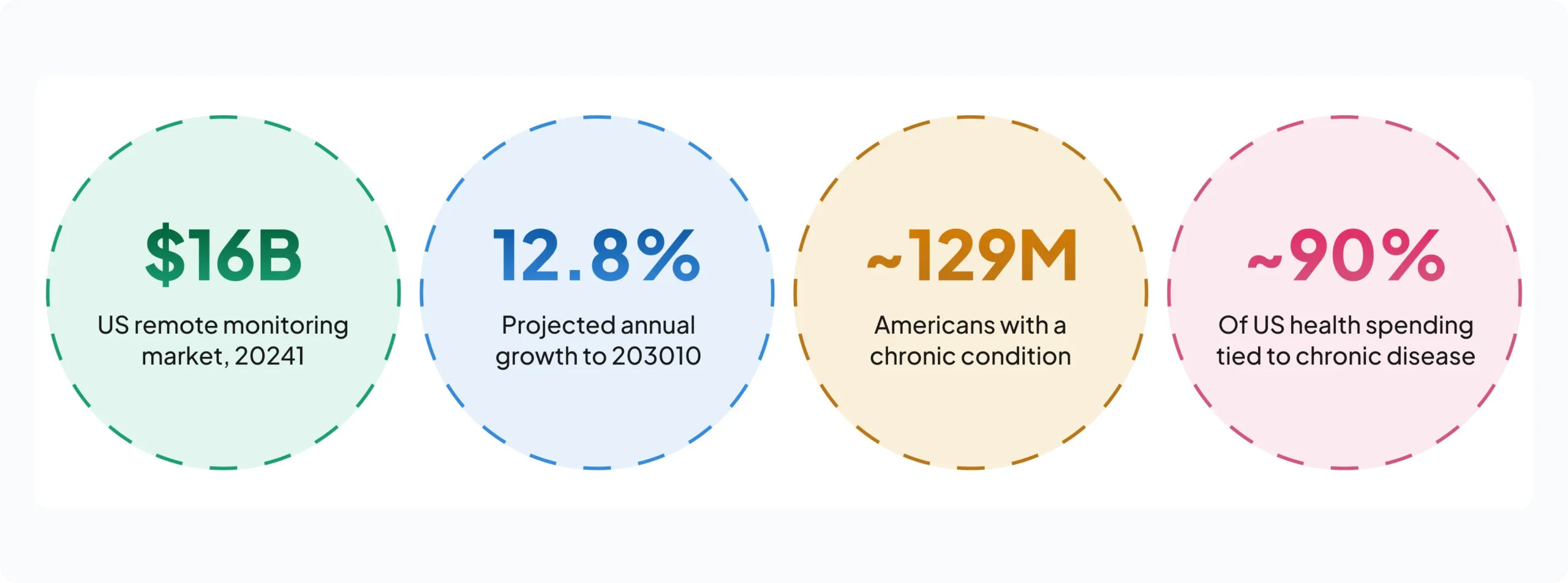
Remote patient monitoring is where virtual care stops being an episode and becomes continuous. The US remote monitoring market sat near $16 billion in 2025 and is projected to roughly double to $29 billion by 2030.
The driver is not gadgetry. It is the brutal math of chronic disease. Chronic conditions account for about 90% of US healthcare spending, and roughly 129 million Americans live with at least one.
Move even a slice of that care into the home, and the savings compound. Studies of Veterans Affairs programs have reported up to a 25% drop in hospital admissions from structured monitoring.
Here is the part that teams underestimate. Collecting readings is easy. Turning a firehose of blood-pressure cuffs, glucose monitors, and pulse oximeters into something a clinician can act on, without drowning them in noise, is the real engineering.
That work, ingesting connected-device data, normalizing it, and surfacing the few signals that actually matter, is the heart of modern medical device software development.
It is also where telemedicine platform adoption trends are heading: away from standalone apps and toward platforms that fold monitoring, messaging, and visits into one record.
Whether you are validating a basic app or scaling across a hospital network, the fundamentals of healthcare mobile app development hold steady: secure by default, interoperable by design, and built to ingest device data without breaking compliance.
The trends in telemedicine and virtual care all point the same way, which is continuous, data-rich, and quietly always-on.
Which specialties are driving telemedicine adoption trends?
Not every specialty took to virtual care the same way, and the spread is wider than most dashboards suggest.
The University of Michigan data sorts cleanly into three tiers. High-use specialties, led by behavioral health, deliver close to 44% of their visits virtually.
Medium-use fields like primary care sit around 8%. Low-use, procedure-heavy specialties such as orthopedic surgery barely register, at roughly 1%. Medicare mirrors this almost exactly, with virtual care covering about 44% of behavioral health visits and 9% of primary care visits.
The telehealth adoption trends here are less about technology and more about clinical fit. Care that lives in conversation and follow-up travels well over video. Care that needs hands does not.
Clinician confidence tracks the same line. CDC data shows that about 76% of primary care physicians and 73% of medical specialists felt they could deliver similar-quality care virtually, against roughly 51% of surgical specialists.
What do telemedicine trends in allergy and immunology look like?
Allergy and immunology is a useful test case, because it sits right on the line between talk and touch. The specialty adopted synchronous video quickly, but it has been slower to use the fuller toolkit of asynchronous and at-home options.
The visit mix is instructive. Among new tele-allergy referrals studied during the pandemic, food-related reactions made up about 50%, hives and swelling around 23%, and rhinitis about 18%.
Telehealth continues to achieve strong approval ratings in allergy and immunology clinics, with a recent study showing that approximately 87% of patients are satisfied with virtual allergy management, and roughly 49% to 57% of patients strongly prefer or use a hybrid model of care for its convenience and time savings.
The telemedicine trends in allergy and immunology point toward hybrid care: video for history and follow-up, in-person for testing, and asynchronous tools to close the gap in between. That same hybrid logic is quietly reshaping telemedicine industry trends across most specialties.
What does the US telehealth map look like by region?
Telehealth adoption is national, but it is not uniform. Utilization, the mix of conditions, and even the cost of a virtual visit shift by region.
FAIR Health’s commercial data through early 2025 showed virtual use easing across most of the country, with the steepest month-over-month dips in the West and Northeast and a smaller pullback in the South, before the West ticked back up in March.
West
-4.3% then +1.8%
Utilization fell from January to February 2025, then the West was the only region to rise in March.
Mental health is the top telehealth diagnosis. Adults aged 19 to 40 make up the largest share of users, in line with the national pattern.
One pattern held everywhere: mental health was the single largest reason for a telehealth visit in every US region, and patients aged 19 to 40 made up the biggest share of users.
Select a census region to see what changed.
The takeaway for builders is less about any single month and more about the steadiness underneath. Demand is broad-based, behavioral health leads everywhere, and the most active users are younger adults who expect a clean digital experience. Design for that audience, and regional swings become noise rather than signal.
How are reimbursement and compliance reshaping telemedicine trends?
Two forces will shape telemedicine trends more than any feature: who pays, and who is liable.
On payment, the ground keeps shifting. Pandemic-era waivers let Medicare cover video and phone visits without the old geographic limits, and lawmakers have extended those flexibilities in a series of short windows rather than making them permanent.
The cost of that uncertainty is real. When a budget lapse briefly interrupted Medicare telehealth coverage, some patients were told they might owe the full cost of visits before payment was restored retroactively.
More than 350 organizations we know have pushed for a permanent fix. For anyone building in this space, the planning assumption should be simple: design for a world where coverage rules tighten and loosen, and never bet a business model on a single waiver.
On liability, the numbers are blunt. Healthcare has been the costliest sector for data breaches for 14 straight years, with an average incident reaching $7.42 million and taking 279 days to contain.
Across all US industries, the average breach hit $10.22 million. Virtual care widens the attack surface every time it adds a device, an integration, or a model.
The operational backbone, scheduling, records, billing, and the audit trails regulators expect, is where mature healthcare IT services either earn their keep or quietly leak risk.
The telehealth future trends worth planning around are not exotic. They are disciplined reimbursement strategy and security that holds up under audit. The telemedicine industry trends reward teams that treat compliance as architecture, not paperwork.
What do these telehealth trends mean for your build decisions?
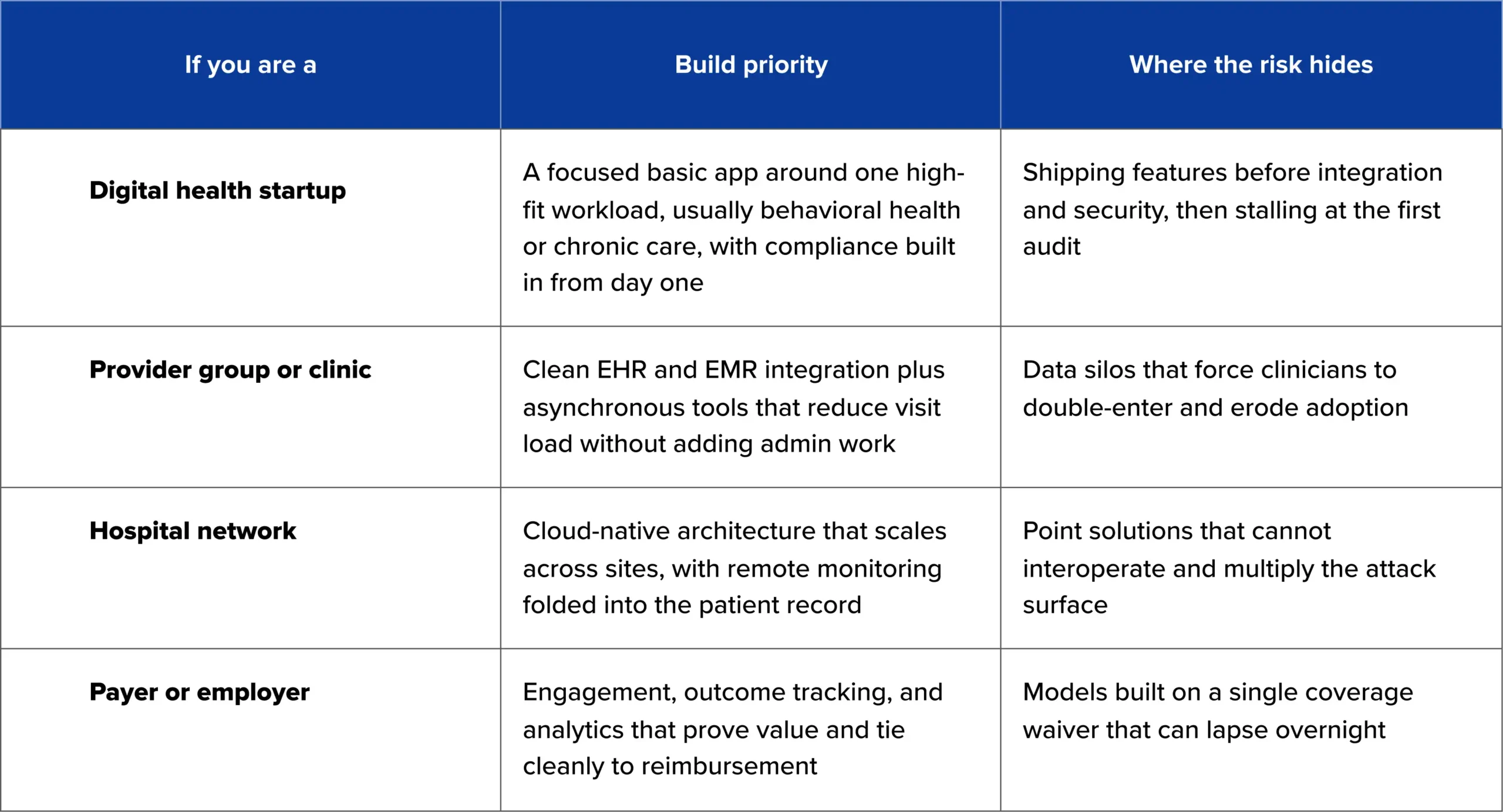
Pull the threads together, and a clear build agenda falls out of these telehealth trends.
Lead with care model and compliance, not features. A working telemedicine app development roadmap starts with the workloads you intend to move virtually, the regulations that govern them, and the systems you have to integrate, then earns its feature list from there.
Prioritize interoperability early, because retrofitting FHIR and EHR connectivity later is the most expensive mistake teams make. Build security in from the first commit. And treat AI as an efficiency layer with governance attached, not a bolt-on.
Budgets follow scope. A realistic read on telemedicine app development cost separates teams that ship from teams that stall, and it usually tracks the depth of integration and compliance work more than the visible interface.
The gap between a slick demo and a deployable product is mostly the unglamorous middle: integration, security, reliability, and audit-readiness. That is precisely what mature telemedicine app solutions are built to absorb.
None of this requires chasing the newest acronym. The telemedicine trends in healthcare that compound are boring on purpose: stable integrations, defensible security, measurable time savings, and a platform that scales without a rebuild. Build for those, and the rest tends to follow.
How can Appinventiv Help You Out?
We have spent more than a decade building healthcare software that has to pass audits, protect patient data, and stay standing under real clinical load. Across that time, our teams have shipped secure, compliance-heavy systems where AI sits under controlled clinical logic rather than running loose, and where HIPAA, SOC 2, FHIR, and HL7 are engineering requirements, not afterthoughts.
That experience shapes how we approach virtual care. We embed regulatory rules directly into data models and access layers, so platforms hold up during compliance reviews and adapt when policy shifts.
We design EHR and EMR integration that gives clinicians a single source of patient truth. We build remote monitoring that turns connected-device data into usable signal. And we deliver low-latency video, e-prescriptions, and care coordination on architectures that scale from a basic app to a hospital network.
If you are weighing a build, our telemedicine app development solutions cover the full path: consulting on care model and compliance, secure architecture, and delivery that survives both audit and scale.
Let us build virtual care that is secure by default, interoperable by design, and ready for whatever the next set of rules brings.

FAQs
Q. What are the technology trends in the telehealth industry?
A. The current technology trends in the telehealth industry cluster around six areas: ambient AI documentation that drafts clinical notes from a visit, FHIR and HL7-based interoperability with the EHR, cloud-native architecture that scales across sites, remote patient monitoring through connected devices and wearables, asynchronous or store-and-forward care, and security-by-design. The unifying theme is reliability and integration rather than novelty.
Q. Can telehealth trends help healthcare providers overcome technology challenges?
A. Yes, when applied with discipline. Interoperability standards cut the integration pain that creates data silos, ambient AI reduces the documentation burden that drives burnout, and cloud-native design lowers the infrastructure load of scaling.
The benefits only hold, though, if security and compliance are built in from the start rather than added later. The providers who win treat these trends as architecture decisions, not quick fixes.
Q. How do physicians adopt telehealth tech?
A. Most physicians start with synchronous video for existing patients, then layer in asynchronous tools, remote monitoring, and AI assistance as confidence grows. Adoption tends to stick when the technology fits the clinical workflow, integrates with the EHR, and aligns with reimbursement.
Tools that hand time back, such as ambient documentation, see the fastest uptake, while procedure-heavy specialties adopt more slowly because the care needs a hands-on patient.
Q. How can medical practices benefit from new telemedicine trends?
A. Practices gain on several fronts: wider patient reach beyond their immediate geography, lower overhead from fewer in-person visits, stronger chronic-care continuity through remote monitoring, less clinician burnout thanks to AI scribes, and new revenue lines from virtual and hybrid care.
The largest gains come from matching virtual care to the right workloads, which usually means behavioral health, follow-ups, and chronic disease management.
Q. What are some key benefits of telemedicine trends?
A. The core benefits are access, convenience, cost-efficiency, continuity, and capacity. Patients reach care without travel, providers extend their reach and reduce overhead, chronic conditions get monitored continuously rather than episodically, and clinician time is freed by automation. Taken together, these trends let healthcare organizations deliver more care to more people, with the same or fewer resources.