
































How is Technology Changing the Future of Consumer Lending?

 Share -



- 01Strategic Forces Reshaping Consumer Lending
- 02How Digital Lending Technology Works: Architecture and Integration
- 03Technologies Accelerating Innovation in Consumer Lending
- 04Enterprise Benefits of Digital Lending Technology
- 05Cost To Build A Digital Lending Platform
- 06Compliance, Risk and Regulatory Considerations in Digital Lending
- 07Enterprise Implementation Roadmap for Digital Lending Technology
- 08Enterprise Challenges in Digital Lending Adoption
- 09Digital Lending Technology Trends in 2026 and Beyond
- 10Why Enterprises Partner With Appinventiv for Digital Lending
- 11Frequently Asked Questions

Key takeaways:
- Digital lending technology platforms accelerate approvals while strengthening compliance, risk visibility, and operational efficiency.
- API-first architectures enable embedded credit distribution across digital ecosystems and partner platforms.
- AI underwriting improves credit accuracy, fraud detection, and portfolio performance at enterprise scale.
- Regulatory alignment and explainable AI governance are now essential for scalable digital lending.
- Early technology adoption helps enterprises capture market share and sustain a competitive lending advantage.
Consumer lending did not change overnight, but the shift is hard to ignore now. Spend a little time with a lending operations team and the pattern becomes clear. Applications that once took days are now expected to move in minutes. Digital lending technology is playing a central role in this shift, helping lenders process applications faster, analyze richer data signals, and deliver credit decisions that better match real financial activity.
Fintech players and embedded finance platforms have accelerated these expectations by placing credit directly inside the customer journey, whether at checkout or inside apps. At the same time, regulatory scrutiny has increased. Transparency, explainability, and stronger data controls are no longer optional conversations in boardrooms, pushing many institutions to rethink how their lending technology stack is built.
In this blog, we explore how digital lending technology is reshaping consumer lending, what these changes mean for enterprise leaders globally and in the US, and how organizations can turn this shift into a competitive advantage rather than treating it as a compliance exercise.
BNPL already accounts for 2.3% of global eCommerce payments.

Strategic Forces Reshaping Consumer Lending
If you look inside most lending teams today, the pressure is obvious. Customer expectations moved faster than most legacy systems did. That gap is now pushing a real reset, with traditional lenders competing directly against agile players powered by advanced fintech lending technology.
- Embedded finance is spreading quickly
Buy now, pay later, in-app loans, checkout financing. These are becoming normal. Some market estimates suggest embedded finance could cross $1.7 trillion globally by 2034. Credit is moving closer to where decisions actually happen. - Open finance is changing how lenders compete
APIs now pull transaction data, income signals, and even behavioral patterns. Your team gets richer inputs without having to build everything internally. - Data intelligence is becoming the edge
Static credit scores alone no longer cut it. AI models help refine approvals, reduce defaults, and expand the pool of eligible borrowers. Lenders using advanced lending analytics often report stronger approval accuracy. - Speed is now expected
Customers who get instant approvals elsewhere expect the same from lending. Waiting days feels outdated, prompting many institutions to accelerate the adoption of scalable online lending technology that enables real-time credit decisions.
Simply put, lending technology is no longer back-office infrastructure. It is shaping customer experience, risk strategy, and revenue growth all at once.
For many institutions, this shift is accelerating capital allocation toward digital lending investment technology that supports faster credit decisions and deeper data integration.
How Digital Lending Technology Works: Architecture and Integration
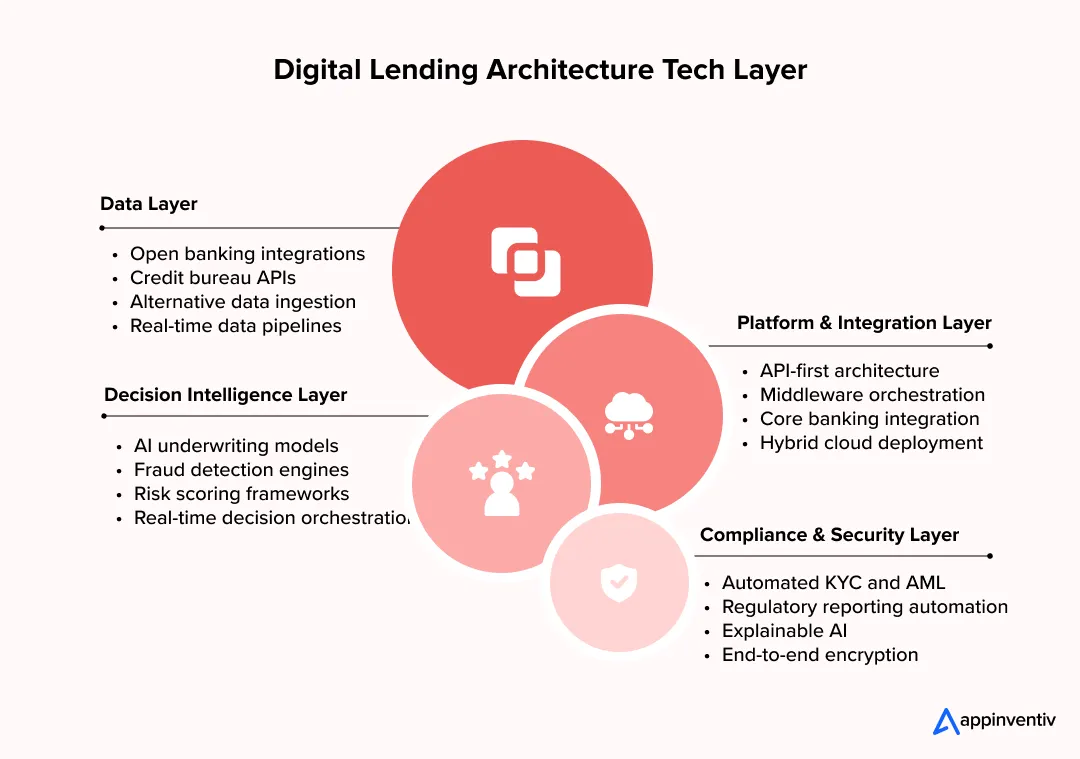
If you walk through how a loan actually gets approved today, it rarely travels through one clean, linear system. A modern digital lending system is like a network. Data keeps arriving from different directions. Risk models evaluate signals in the background. Decision engines respond quickly, sometimes in seconds. Compliance checks happen alongside the transaction, not after it. And all of this still has to be reconciled with core banking ledgers that were built years ago.
Open banking has accelerated this reality. Estimates suggest open banking facilitated payments could expand by nearly 2,800% to exceed $116 billion globally, with Europe representing roughly 75% of users. When that much financial activity moves through APIs, lenders are pushed toward architectures that can ingest, validate, and respond to data continuously.
For your team, this is not just technical theory. It is how digital lending technology works in practice at enterprise scale. Choices made at this layer influence scalability, compliance, resilience, and long-term portfolio outcomes. That is why digital lending investment technology increasingly centers on durable APIs, governed data pipelines, and systems designed with regulatory scrutiny in mind.
Data Infrastructure and Alternative Data Pipelines
Many lending transformation efforts eventually stall for one reason. The data underneath is inconsistent. Models can only work with what they receive.
In most enterprise environments, the data layer includes:
- Open banking integrations that retrieve transaction history, income indicators, and spending behavior through secure APIs
- Credit bureau APIs delivering traditional scores and repayment records in real time
- Alternative data ingestion, such as utility payments, device metadata, e-commerce behavior, and digital interaction patterns
- Streaming pipelines are built on event-driven architectures,so updates happen as activity occurs.
- Centralized data lakes or lakehouse environments that consolidate structured and unstructured datasets
- Governance frameworks that track lineage, enforce role-based access, apply encryption standards, and manage retention polici.es
When this foundation is stable, credit evaluation shifts from periodic review to ongoing assessment. That change alone can alter how risk is managed.
AI Decision Intelligence Layer
Once data is structured and validated, intelligence starts to layer in. This is where underwriting becomes adaptive instead of static.
Typical components include:
- Ensemble AI credit scoring approaches combine traditional FICO-type logic with alternative credit signals.
- Fraud detection engines using anomaly detection, device fingerprinting, and network pattern analysis
- Real-time decision orchestration engines evaluating eligibility, pricing, and exposure thresholds in milliseconds
- Monitoring systems tracking model drift, bias indicators, and performance variance over time
- A particular event in machine learning, where, with the help of mortgage lending AI, models are trained on historical loan performance and macroeconomic context.
In mature enterprise setups, explainability tooling is embedded here. Your compliance team can review how a decision was reached without reconstructing the entire model chain afterward.
Platform Architecture and Core Banking Integration
Even strong models face friction if integration is weak. In many institutions, this is where projects slow.
A practical platform layer often includes:
- API-first lending platforms exposing origination, servicing, and decision endpoints securely
- Effective fintech software integration relies on middleware orchestration layers that translate data between front-end applications and legacy core banking systems.
- Event-driven microservices architectures that allow underwriting, pricing, and servicing modules to scale independently
- Wrapper APIs around mainframe systems as a modernization step, instead of immediate full replacement
- Hybrid cloud deployments that keep sensitive workloads on controlled infrastructure while scaling analytics workloads in public cloud environments
When these components are aligned, origination, disbursement, servicing, and collections stay synchronized with core ledgers. That alignment protects operational stability.
Compliance, Security and Automation Layers
Compliance in digital lending is rarely something added later. In well-designed systems, it is built into the transaction flow itself.
Enterprise-grade stacks commonly include:
- Automated KYC and AML workflows integrating identity verification providers with sanctions screening APIs
- Regulatory reporting automation supporting fair lending reviews and consumer protection oversight
- End-to-end encryption and tokenization secure sensitive financial information
- Role-based access controls combined with zero-trust security models to limit exposure
- Explainable AI frameworks that document reasoning behind approvals and denials
When these layers operate together, lending operations become easier to audit and more resilient under scrutiny. That distinction often separates experimental builds from enterprise-ready digital lending platforms.
Technologies Accelerating Innovation in Consumer Lending
If you spend time with lending product teams, you notice the change is rarely dramatic. It builds gradually. One new integration here, a data upgrade there, then suddenly the lending experience feels very different. What is driving that shift is not a single technology.
It is the combination of data pipelines, AI underwriting, automation layers, and compliance tooling, all working together behind the scenes. For enterprise lenders, this mix affects underwriting precision, operational efficiency, regulatory posture, and how customers perceive the lending journey.
Seeing how these technologies behave in live environments usually tells you far more than vendor presentations. That is why many institutions are now looking at integrated digital lending solutions that combine underwriting intelligence, automation, and compliance infrastructure into a unified operational stack.
Generative AI in Lending Operations
Generative AI has moved beyond experimental chat interfaces. In many lending environments, it now sits quietly inside operational workflows.
Common use cases include:
- Large language models are helping underwriters scan borrower summaries and supporting documentation faster
- NLP pipelines converting bank statements, payslips, and tax records into structured data fields
- Conversational copilots supporting servicing teams, collections interactions, and onboarding tasks
- Retrieval augmented generation setups, grounding model responses in internal credit data for better control
When implemented thoughtfully, these tools help teams work faster without losing audit visibility.
Embedded Lending Ecosystems
Embedded lending tends to work best when integration friction is low. That usually comes down to APIs and how well systems share data.
Typical implementations involve:
- Real-time credit decision APIs are placed directly inside e-commerce, mobility, or SaaS environments
- SDK modules offering contextual loan options inside third-party apps
- Event-driven triggers generating credit offers based on transaction behavior
- Secure partner data exchange through OAuth frameworks, tokenization, and consent management layers
This often shortens acquisition cycles and improves conversion because credit appears exactly when customers need it.
Cloud Native Lending Platforms
Cloud adoption has reshaped how lending infrastructure scales. Instead of periodic hardware upgrades, teams can scale workloads as demand fluctuates.
Most environments include:
- Containerized microservices supporting origination, underwriting, and servicing workflows
- Distributed data processing frameworks managing large credit datasets
- Infrastructure-as-code configurations allow faster environment setup
- Hybrid cloud patterns where sensitive financial data stays controlled while analytics workloads scale externally
These setups typically improve resilience while reducing deployment delays.
Intelligent Automation Workflows
Automation has evolved quite a bit over the past few years. Static scripts handled repetitive tasks before. Now, many systems adjust dynamically.
You often see:
- AI-assisted robotic process automation handling document verification
- Workflow engines coordinating underwriting, compliance reviews, and servicing actions
- Real-time portfolio monitoring powered by streaming analytics
- Automated escalation paths when exceptions or anomalies appear
This helps reduce operational friction while maintaining governance oversight.
Blockchain Experimentation in Lending
Blockchain adoption in lending remains selective, though interest continues. Most institutions approach it cautiously.
Current enterprise pilots usually focus on:
- Smart contracts automating repayment scheduling and servicing logic
- Distributed identity frameworks supporting borrower verification
- Immutable audit trails are useful for compliance reporting
These use cases are still evolving, but they continue to attract experimentation where auditability and transparency matter most.
Technology-led lending platforms improve approvals, risk visibility, and operational speed.

Enterprise Benefits of Digital Lending Technology
When leadership teams review lending transformation budgets, the discussion rarely centers on dashboards or interface upgrades. The question usually sounds different. Is this going to move the needle? The measurable benefits of digital lending technology tend to show up in approval velocity, risk control, and margin stability rather than visual modernization.
In many institutions, performance gaps become visible first. Underwriting takes longer than expected. Manual reviews pile up. Risk visibility feels reactive. Once the stack is rebuilt with stronger data flows and automation, those friction points start easing.
Faster Approvals, Better Conversion
Approval speed often becomes the earliest signal of change. Automation, real-time data processing, and alternative credit scoring shorten underwriting loops that previously required back-and-forth verification. With digital onboarding and instant fund disbursement connected through open banking integrations, the time between approval and funding narrows. Fewer delays usually mean fewer abandoned applications.
Lower Operational Overhead and Cost Efficiency
Operations teams feel the impact next. Verification checks, compliance monitoring, and servicing workflows that once depended on manual coordination move into automated pipelines. Cloud computing infrastructure reduces the burden of maintaining hardware-heavy environments. The result is not just theoretical efficiency, but reduced workload pressure and measurable cost control over time.
Sharper Risk Visibility and Fraud Prevention
Risk management improves differently. Continuous data ingestion and fraud detection engines surface anomalies earlier. Advanced analytics add behavioral context that traditional scoring alone cannot provide. Instead of waiting for portfolio stress indicators, teams can respond sooner while still maintaining regulatory discipline.
Improved Borrower Experience
Borrowers notice the difference in simpler ways. Interfaces feel clearer. Offers appear more aligned with financial behavior. Digital onboarding removes repeated documentation loops. Faster responses and predictable communication tend to strengthen trust, especially when credit decisions are explained clearly.
Expanded Accessibility and New Revenue Potential
Alternative credit scoring and open banking data expand visibility into customers who previously lacked strong credit files. Embedded lending partnerships place credit options closer to transaction moments. For many lenders, that broader reach supports incremental revenue without automatically increasing exposure.
Viewed through this lens, digital lending investment technology becomes less about appearing modern and more about sustaining portfolio performance in a market that moves faster each year.
Also Read: Digital Transformation in Fintech
Cost To Build A Digital Lending Platform
When teams start exploring digital lending, the cost question usually comes up early. There is no single number. The investment depends on how complex the platform needs to be, how deeply it integrates with existing banking systems, and how much compliance and automation you plan to build in from day one.
| Platform Level | Typical Cost Range (USD) | What This Usually Covers |
|---|---|---|
| MVP / Pilot Platform | $50K–$100K | Basic loan origination, digital onboarding, simple underwriting flows, limited integrations mainly for testing market fit |
| Growth-Stage Platform | $100K–$250K | Automation, alternative credit scoring, API integrations, cloud deployment, and stronger compliance workflows |
| Enterprise Lending Platform | $250K–$500K | AI underwriting, real-time decision engines, deep core banking integration, fraud detection, regulatory automation, scalable infrastructure |
In most cases, this is not just a software build. It is the infrastructure for how your lending business will operate going forward. Teams that plan for scale, compliance, and future integrations early usually avoid expensive rework later.
Also Read: Loan Lending App Development Cost
Compliance, Risk and Regulatory Considerations in Digital Lending
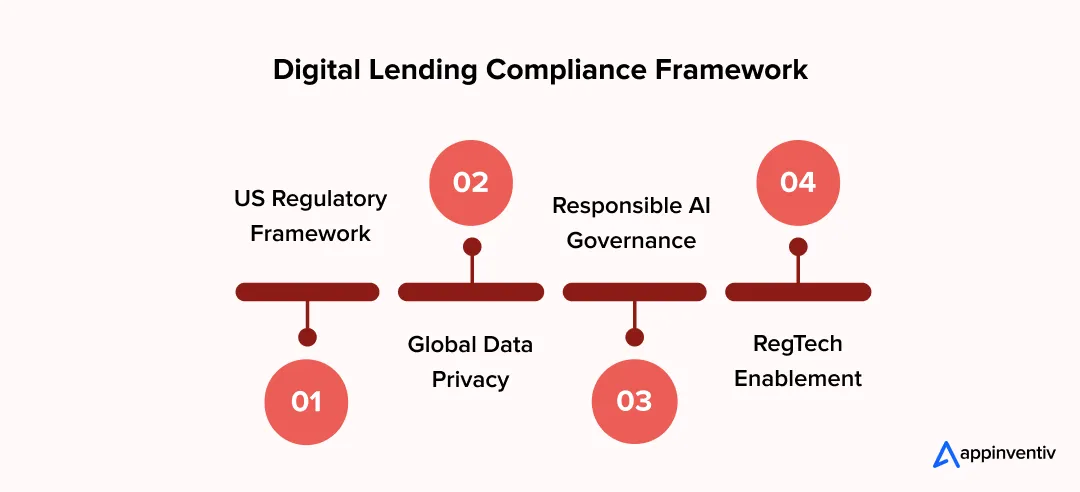
In enterprise lending, compliance decisions shape system design as much as product strategy. Once underwriting becomes automated and data-driven, regulators expect traceability, fairness, and strong controls across jurisdictions.
The rise of embedded credit models adds another dimension. Buy Now, Pay Later, and similar products are projected to reach about $576 billion globally by the end of 2026, roughly 380% growth in a few years, and they already account for around 2.3% of global eCommerce payments.
As these models scale, regulatory scrutiny around transparency, affordability checks, and consumer protection continues to increase.
Fair Lending Regulations in the United States
US lenders operate under a tightly supervised framework.
- Compliance with the Equal Credit Opportunity Act and Regulation B
- Fair Housing Act considerations where applicable
- Oversight from the Consumer Financial Protection Bureau for consumer lending practices
- Model risk management aligned with supervisory guidance from the Federal Reserve and OCC
- Adverse action notice requirements for automated denials
- Statistical testing for disparate impact and bias
Automated decision engines must produce explainable outputs, not black box results.
Data Privacy Frameworks Across Regions
Data governance varies significantly across markets.
- United States: Gramm-Leach-Bliley Act, California Consumer Privacy Act
- European Union: General Data Protection Regulation with strict consent and data transfer controls
- India: Digital Personal Data Protection Act with localization and consent obligations
- Singapore and broader Asia Pacific: PDPA frameworks governing financial data handling
Common requirements include:
- Explicit consent management
- Data minimization and purpose limitation
- Encryption at rest and in transit
- Cross-border data transfer safeguards
Responsible AI Governance
As AI underwriting expands, applying responsible AI principles has become central to meeting regulatory expectations around algorithmic accountability
- Bias testing and fairness monitoring
- Model documentation and validation frameworks
- Human oversight for high-risk credit decisions
- Continuous model performance monitoring and drift detection
Cross-Border Lending and RegTech Enablement
Global lenders face additional complexity. They must handle:
- Jurisdiction-specific reporting standards
- Local credit bureau integration requirements
- AML and sanctions screening obligations across regions
RegTech platforms now automate KYC, transaction monitoring, regulatory reporting, and audit trail generation. For enterprise lenders, strong compliance architecture reduces regulatory exposure while strengthening institutional trust.
Also Read: Enterprise AI Governance, Risk, and Compliance: An Executive Guide
Enterprise Implementation Roadmap for Digital Lending Technology
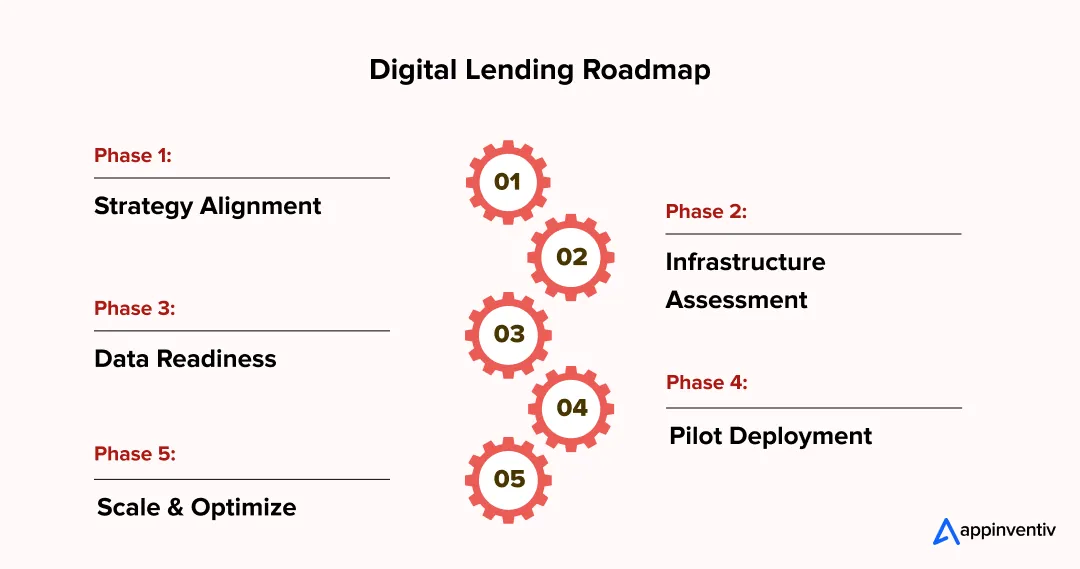
When digital lending programs slow down, the problem is rarely the core technology itself. More often, it comes down to rollout sequencing, integration surprises, or priorities that were never fully aligned. A structured roadmap does not remove complexity, but it helps your team move through it without constant course correction.
You can already see borrower behavior changing. Some industry reports suggest roughly 36% of people aged 18 to 29 now use pay by bank weekly. That level of comfort with instant financial interactions raises expectations around credit access as well. Lenders who align technology, data readiness, and compliance early tend to adapt faster as those expectations evolve.
Step 1: Align the Business Case First
Before vendor evaluations begin, leadership alignment usually saves time later. Be specific about what success means for your organization. Faster approvals, lower underwriting costs, or entry into new borrower segments are common priorities. When those outcomes are clear upfront, technology decisions stay tied to measurable impact instead of drifting into experimentation.
Step 2: Assess Your Existing Technology Landscape
Most lending environments are layered over time. Legacy core systems, middleware bridges, and newer API layers often coexist. Some components scale without issue, others create latency or integration friction. A realistic assessment of system readiness, security posture, and integration constraints helps avoid expensive adjustments once implementation starts.
Step 3: Strengthen Data Foundations Early
Data challenges rarely stay hidden once automation increases. Fragmented credit datasets, unclear ownership boundaries, or inconsistent access controls tend to surface quickly. Cleaning data pipelines and tightening governance early usually stabilizes later model performance and reduces operational disruption.
Step 4: Choose Implementation Partners Carefully
Regulated environments add another layer of complexity. Partners who understand compliance audits, legacy integration realities, and scalable platform delivery typically reduce execution risk. Experience here often shortens timelines more than aggressive delivery promises.
Step 5: Pilot Before Scaling
A focused rollout in a single lending segment often produces the clearest operational insight. Track approval accuracy, operational efficiency, and reporting stability first. Once performance steadies, expansion becomes far more predictable. At this stage, leadership also gains a clearer view of the cost of building a digital lending platform at enterprise scale.
Enterprise Challenges in Digital Lending Adoption
Digital lending adoption rarely stalls because the technology is unavailable. The friction usually comes from integration realities, regulatory expectations, and internal readiness. Addressing these areas early keeps transformation practical and reduces downstream disruption.
Legacy Infrastructure Constraints
Legacy banking modernization becomes critical here, as many enterprise lenders still run core systems designed for batch processing rather than real-time APIs or AI-driven underwriting. Integration complexity, latency issues, and upgrade risks often slow modernization.
Solutions
- Introduce API gateways or middleware to bridge legacy cores with modern platforms.
- A phased application modernization strategy is often more effective than attempting a full system replacement at once.
- Use hybrid cloud deployments to scale analytics without disrupting core systems
Data Silos and Interoperability Issues
Credit data often lives across multiple internal systems, bureaus, and partner platforms. Inconsistent formats and governance gaps affect underwriting accuracy and operational efficiency.
Solutions
- Establish centralized data platforms or lakehouse architectures
- Standardize governance, lineage tracking, and access controls
- Enable real-time data synchronization across lending workflows
Regulatory Complexity
Consumer lending is subject to strict regulatory oversight globally. Requirements differ across jurisdictions, especially around fair lending, privacy, and reporting.
Solutions
- Embed compliance automation directly into decision workflows
- Deploy RegTech tools for monitoring, reporting, and audit readiness
- Maintain jurisdiction-specific compliance frameworks
AI Explainability Concerns
Automated underwriting raises questions around transparency, bias, and accountability. Regulators expect explainable decision logic.
Solutions
- Implement explainable AI frameworks and model documentation
- Conduct regular bias testing and performance validation
- Maintain human oversight for sensitive credit decisions
Organizational Change Management
Technology adoption affects underwriting workflows, decision authority, and operational processes. Without internal alignment, adoption slows.
Solutions
- Invest in targeted training and change enablement programs
- Align leadership messaging around measurable outcomes
- Roll out the transformation incrementally to build confidence
Lenders adopting automation early are already strengthening customer acquisition and efficiency.

Digital Lending Technology Trends in 2026 and Beyond
If you are planning investments today, the next two to three years matter. The shift is not just toward faster systems. It is toward smarter, more autonomous credit ecosystems.
- Agentic AI underwriting assistants
Agentic AI in finance is moving beyond models that only score risk — new systems directly assist underwriters by summarizing applicant data and recommending pricing bands. They summarize applicant data, highlight risk anomalies, and recommend pricing bands. Your analysts stay in control, but decisions move faster. - Autonomous credit decision systems
Real-time orchestration engines are evolving to handle approvals, pricing, and compliance checks in a single flow. Human review becomes an exception rather than the default. - Hyper-personalized lending products
Dynamic pricing models adjust rates and terms based on behavioral and transactional signals. Credit offers become context-aware rather than static products. - Embedded credit ecosystems
Alongside peer-to-peer lending platforms, Lending will continue integrating into marketplaces, SaaS tools, and consumer apps. APIs and consent-based data sharing make credit part of everyday transactions. - ESG-linked lending models
Some institutions are tying credit incentives to sustainability metrics, particularly in green financing segments. - Continuous risk monitoring platforms
Instead of assessing risk solely at origination, lenders are deploying ongoing portfolio-monitoring systems that detect stress signals early and trigger proactive action.
Why Enterprises Partner With Appinventiv for Digital Lending
When lending transformation moves from strategy to execution, the partner you choose matters more than the platform itself. Integration complexity, compliance exposure, and speed to market all sit on that decision.
Appinventiv brings over 10 years of focused FinTech expertise and has delivered 200+ FinTech products across global markets. That experience shows up in practical ways, particularly in enterprise lending software development, where faster integrations, fewer compliance surprises, and more predictable delivery cycles become critical.
Security and risk control remain central. Our lending platforms are built to support 98% fraud detection accuracy with transaction reliability backed by a 99.50% security SLA. For enterprise lenders handling sensitive financial data, that stability is critical.
Operational efficiency is another driver. Many clients see up to 30% reduction in operational costs after automation. AI-driven decisioning is introduced into underwriting and servicing workflows.
You also get architecture designed for scale. AI-led underwriting, compliance-first design, and proven core banking integration experience ensure the platform grows with your lending portfolio.
For enterprises moving toward digital lending, timing matters. Early movers are already capturing market share. The question usually becomes how fast you want to close that gap.
Frequently Asked Questions
Q. What is digital lending technology?
A. Digital lending technology refers to the use of digital platforms, web-based platforms, and digital lending sites to manage the complete loan lifecycle online. Borrowers submit a digital loan application via a mobile phone, tablet, or desktop, eliminating the need for traditional branch visits and paperwork.
Unlike traditional lending, which relies heavily on manual processing, digital lending leverages fintech solutions, online technology, automation, and digital transformation to streamline underwriting, approval, disbursement, and servicing. This enables faster access to digital bank loans while improving operational efficiency, accessibility, and overall borrower experience.
Q. What role does automation play in digital lending technology?
A. Automation helps lenders process applications faster while maintaining consistency. It handles document verification, underwriting workflows, compliance checks, and servicing tasks. This reduces manual intervention, lowers operational costs, and shortens approval timelines. Your team can focus more on portfolio strategy, risk management, and customer experience rather than on repetitive administrative work.
Q. How do APIs enable embedded lending solutions?
A. APIs allow lending capabilities to integrate directly into third-party platforms such as eCommerce apps, SaaS products, or marketplaces. They enable real-time data exchange, credit decisioning, and loan servicing without redirecting customers to other sites. This keeps lending contextual, improves conversion rates, and helps enterprises reach customers at the point of need.
Q. What are the compliance requirements for digital lenders?
A. Digital lenders must meet fair lending regulations, consumer protection laws, data privacy mandates, and anti-money laundering requirements. In the US, this often involves CFPB oversight, ECOA compliance, and clear adverse action notices. Globally, requirements vary by region but generally include data security controls, auditability, transparency, and responsible AI governance.
Q. How do fintech lenders manage data privacy regulations?
A. Most fintech lenders implement strong consent management, encryption, and access control frameworks. Data minimization practices ensure only necessary information is collected. Many also use tokenization, anonymization techniques, and continuous monitoring to protect borrower data. Compliance teams regularly review evolving regulations to ensure ongoing alignment with regional privacy laws.
Q. How to integrate digital lending software with core banking systems?
A. Integration typically involves API gateways, middleware orchestration layers, and event-driven data pipelines. Many lenders use wrapper APIs around legacy cores rather than a full replacement. Hybrid cloud setups often support analytics workloads while core transaction data remains controlled. Proper testing, data mapping, and compliance validation are essential before full deployment.
Q. How long does it take to develop a digital lending app?
A. Timelines vary based on platform complexity, compliance requirements, and the scope of integration. A basic digital lending application may take four to six months. Enterprise-grade platforms with AI underwriting, regulatory automation, and core banking integration often take 9 to 18 months, including testing, pilot rollout, and phased scaling.
Q. How are financial institutions adopting digital lending technology?
A. Financial institutions are adopting digital lending through digital banking platforms, loan origination systems, and fintech integration to improve credit risk assessment. Many use AI-powered underwriting and alternative data, while mobile money lenders, online wallets, seamless payment tools, invoice financing, and supply chain finance expand offerings. Some deploy no-code lending automation to accelerate rollout and operational efficiency.
Q. What are digital lending platforms, and how are they changing lending?
A. Digital lending platforms use automation, alternative data, and advanced credit scoring models to streamline lending across channels like mobile lending, loan marketplaces, peer-to-peer lending, and crowdfunding platforms. These platforms support digital banks and neobanks, enable balance sheet lending, and power newer models such as resale marketplace lending, making borrowing faster, more accessible, and increasingly data-driven.
Q. What business models do digital lending platforms typically use?
A. Digital lenders operate across models such as balance-sheet lending, lending-based crowdfunding, resale marketplace lending, and revenue-based financing. Many earn through origination fees, service fees, and digital lending analytics platforms that refine risk models. Some also support invoice and supply chain financing and operate within regulatory sandbox frameworks while ensuring ongoing regulatory compliance.


Fast 2-minute response, fully NDA-protected.

Cost of Developing a Payment Gateway: A Complete Breakdown
Key takeaways: Custom gateway development requires $50,000 to $500,000 in upfront capital, and enterprise platforms cost more at scale. Core infrastructure, security compliance, and settlement logic consume far more budget than basic checkout screens. High transaction volumes require concurrency controls, failover systems, monitoring tools, and automated reconciliation engines. Platform ownership creates recurring costs for security…

How Much Does RegTech Software Development Cost in the UK in 2026?
Key takeaways: RegTech software development cost in the UK spans £40,000 to £400,000+, with regulatory scope and legacy integration depth driving the cost. High-performance systems deliver a 30% to 50% reduction in manual workloads, protecting enterprises from severe FCA penalties. Advanced AI features generally represent around 25–40% of the total project investment due to the…

Building Next-Generation Digital Payment Systems for Australia's NPP Economy
Key takeaways: Australia's NPP is approaching 1.82 billion real-time transactions annually; BECS decommissioning by 2030 creates a hard migration deadline that cannot be managed through incremental patches. The July 2026 Payday Super mandate makes real-time payment infrastructure a legal compliance requirement. Enterprises without NPP-capable payroll systems are already operating against a regulatory clock. NPP platform…