



























How to Implement a RAG System for Retail: Architecture, Integration, and Best Practices

- Why Retail Needs a Structured RAG Implementation
- Retail RAG Architecture for Retail: A Practical System Design
- Step-by-Step Framework for a Successful RAG System Implementation for Retail
- RAG Integration with Retail Systems: Connecting AI to Your Core Stack
- Retail-Specific Best Practices for RAG Accuracy and Reliability
- How to Evaluate the ROI of a RAG System for Retail
- Common Failure Modes in Retail RAG Deployments
- Future of RAG in Retail: Where Retail AI Is Headed Next
- How Appinventiv Can Help You Build a Retail-Ready RAG System

Key takeaways:
- A successful RAG system implementation for retail depends more on architecture and integration than on model selection.
- RAG integration with retail systems like PIM, ERP, OMS, and POS is critical to ensure accuracy and prevent misinformation.
- Hybrid retrieval, structured metadata, and freshness controls are essential for reliable RAG-powered systems in retail.
- Measuring operational, commercial, and accuracy metrics is key to proving the real impact of RAG in retail.
- Retailers that treat RAG architecture for retail as foundational infrastructure will scale faster and avoid common deployment failures.
Retail doesn’t have a data problem. It has a reliability problem. Product catalogs update daily. Promotions change by region. Inventory shifts by the hour. Yet many AI deployments still generate answers that sound right but aren’t grounded in live retail systems. That disconnect is why Retrieval augmented generation in retail is moving from experimentation to serious investment. A properly designed RAG system for retail pulls answers directly from approved enterprise data instead of relying on static model knowledge.
But a chatbot alone is not a strategy. A successful RAG system implementation for retail requires structured ingestion pipelines, hybrid retrieval logic, and tight RAG integration with retail systems like PIM, ERP, OMS, and POS. When done right, RAG in retail supports real workflows, reduces misinformation, and delivers measurable operational impact.
In this blog, you will learn how to architect, integrate, and optimize a production-ready RAG framework built specifically for modern retail environments.
Stop experimenting with disconnected AI tools. Build a structured RAG system for retail that connects directly to your enterprise data and reduces operational risk.
Why Retail Needs a Structured RAG Implementation
Retail leaders are not investing in AI for novelty. They are investing to reduce friction across operations, support, merchandising, and store execution. But without structure, AI layers create more confusion than clarity. A reliable RAG system implementation for retail solves this by grounding responses in real enterprise data rather than guesswork.
Here’s why a structured approach matters:
- Retail data changes constantly. Prices, promotions, inventory, and policies shift daily. A loosely connected AI software cannot keep up. A properly engineered RAG system for retail connects directly to trusted systems to maintain accuracy.
- Customer trust is fragile. A single incorrect return policy or stock response can cost a sale. Structured RAG in retail reduces hallucinations by retrieving answers from verified sources before generating a response.
- Omnichannel complexity increases risk. Store, web, app, and contact center systems don’t always sync perfectly. A defined RAG architecture for retail helps unify knowledge across channels without replacing existing infrastructure.
- Operational efficiency depends on reliable access to knowledge. Associates, support teams, and merchandising managers spend time searching across dashboards. A well-built RAG-powered system in retail reduces lookup time and improves response consistency.
- AI adoption is accelerating in retail, but execution remains uneven: AI platform-driven retail ecommerce sales are forecast to grow by 278.1 % in 2026 to reach $20.57 billion, highlighting both the opportunity and growing investment retailers are making in advanced AI capabilities.
Retail RAG Architecture for Retail: A Practical System Design
When retailers explore RAG for Retail, the focus often starts with the model. In reality, long-term success depends far more on architecture than on model choice. A strong RAG system implementation for retail is built on clearly defined layers that reflect how retail systems actually function.
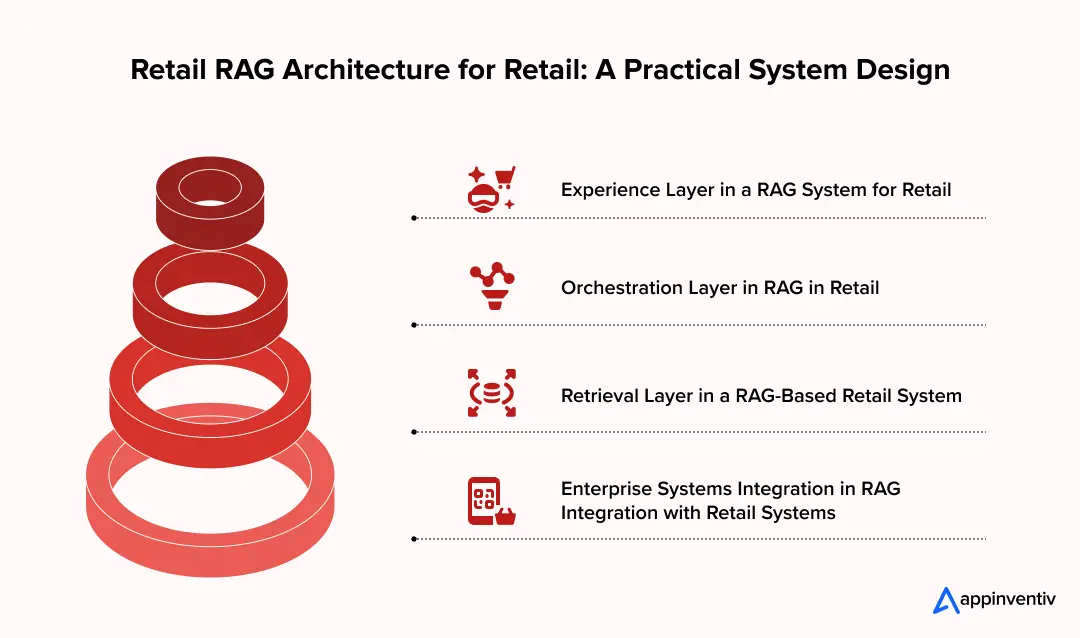
Below is how a production-ready RAG architecture for retail should be structured.
1. Experience Layer in a RAG System for Retail
This is where the query originates. It may be:
- An eCommerce assistant helping customers find products
- A support dashboard answering return-policy questions
- An in-store tablet assisting associates
- A mobile app chatbot
Many retailers begin with RAG-driven chatbots, but the architecture must support multiple touchpoints. A scalable RAG-powered system in retail should work across online, in-store, and contact center environments without duplicating logic.
2. Orchestration Layer in RAG in Retail
This layer acts as the traffic controller. It determines:
- What type of query is being asked
- Which data sources should be retrieved
- What filters apply (region, store, channel)
- Whether escalation or fallback is required
Without orchestration, RAG in retail risks pulling loosely related content. A structured RAG framework for retail ensures that every response is routed correctly before it is generated.
3. Retrieval Layer in a RAG-Based Retail System
This is where Retrieval augmented generation in retail becomes operational. A mature RAG system for retail uses:
- Vector search for semantic relevance
- Keyword search for precision
- Metadata filtering for structured constraints
- Reranking for contextual accuracy
Retail catalogs are structured. Pricing logic is conditional. Policies vary by geography. Pure semantic search is rarely sufficient. Hybrid retrieval ensures that RAG-powered systems in retail remain accurate and grounded.
4. Enterprise Systems Integration in RAG Integration with Retail Systems
The retrieval layer must connect to real systems of record. This is where the integration of RAG systems in Retail becomes critical. Typical integrations include:
- PIM for product attributes
- ERP integration for pricing and cost logic
- OMS for order status
- WMS for inventory levels
- POS for store-level data
- CRM/CDP for personalization
- CMS for policies and FAQs
A reliable RAG-based retail system does not rely on outdated static documents. It retrieves directly from enterprise sources. This is the foundation of effective RAG integration with retail systems.
Why Structured Architecture Determines RAG Impact on Retail Operations
Retail environments are layered and fast-moving. Without structure, AI tools create inconsistencies instead of efficiency. A well-defined RAG architecture for retail:
- Reduces misinformation risk
- Aligns responses with live enterprise data
- Supports omnichannel execution
- Strengthens trust across teams
This is where the real RAG impact on retail operations begins. When architecture is designed intentionally, Applications of RAG in retail move beyond pilots and start delivering measurable operational outcomes.
Step-by-Step Framework for a Successful RAG System Implementation for Retail
A strong retail RAG system implementation is rarely about flashy demos. It’s about solving one real retail problem, grounding it in trusted data, and scaling only after accuracy is proven. Below is a clearer breakdown of how experienced teams approach building a production-ready RAG system for retail.
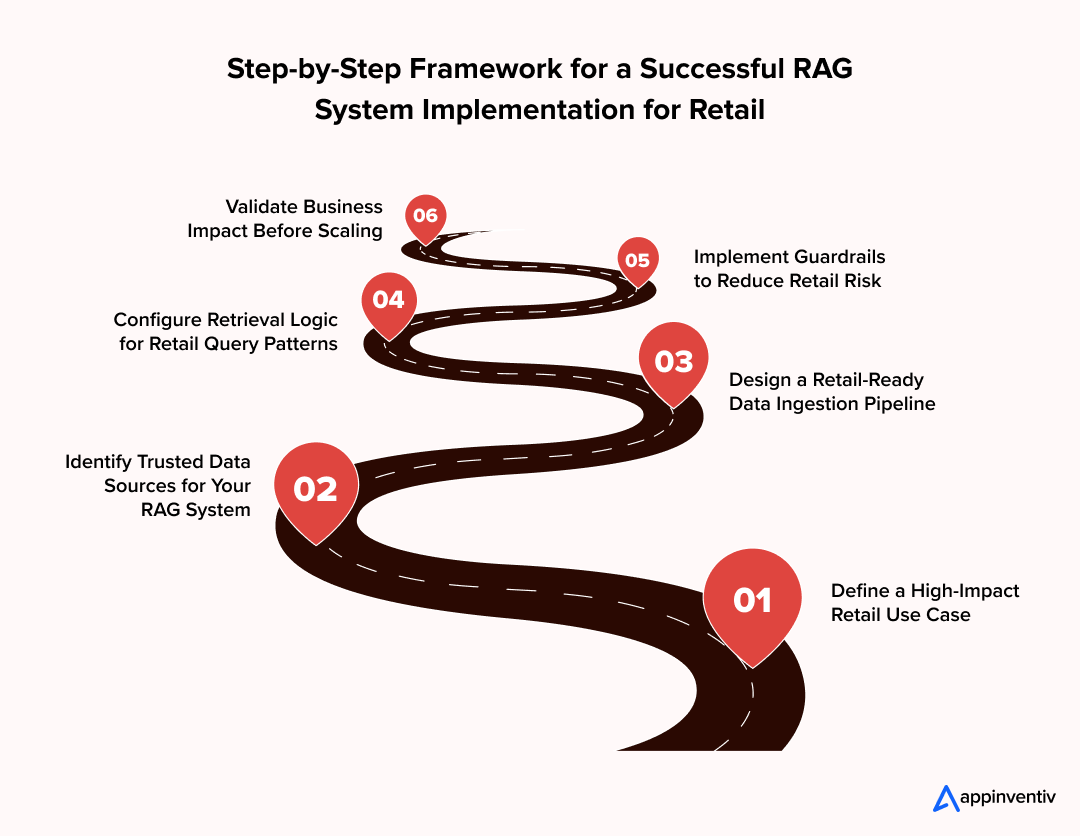
Step 1: Define a High-Impact Retail Use Case
Before touching architecture, decide what problem your RAG for the Retail business is solving. Start with one focused RAG Retail Use Case, such as:
- Automating return and refund policy queries
- Supporting store associates with SOP guidance
- Enhancing product discovery for complex catalogs
- Reducing order-status escalations via OMS-backed answers
Keeping scope tight lets you demonstrate the benefits of RAG in the retail industry in measurable terms rather than broad promises.
Step 2: Identify Trusted Data Sources for Your RAG System
Not every document should be indexed on day one. For implementing RAG in Retail Businesses, clearly define which systems serve as sources of truth:
- PIM for structured product data
- ERP for pricing and commercial logic
- OMS for order lifecycle details
- POS/WMS for store and warehouse inventory
- CMS for approved policy documentation
A reliable RAG system for retail retrieves from systems that are current and governed. Indexing inconsistent or outdated data is one of the most common challenges of RAG in retail.
Step 3: Design a Retail-Ready Data Ingestion Pipeline
This is where your RAG architecture for retail moves from concept to system. Key implementation actions include:
- Cleaning and normalizing the catalog and policy data
- Removing outdated document versions
- Structuring chunks differently for product specs vs policies
- Applying metadata tags such as store, region, channel, and season
- Setting refresh cycles based on data volatility
A poorly structured ingestion pipeline weakens even the best RAG-based retail system.
Step 4: Configure Retrieval Logic for Retail Query Patterns
Retail queries are structured and conditional. Your retrieval logic should reflect that. An effective RAG system for retail typically uses:
- Hybrid search combining semantic and keyword retrieval
- Metadata filtering for location and channel constraints
- Reranking layers to improve relevance
- Structured lookups for pricing and availability data
This is where RAG integration with retail systems becomes critical. Real-time information must be pulled accurately to avoid operational errors.
Step 5: Implement Guardrails to Reduce Retail Risk
Retail AI errors can directly impact revenue and trust. Strong RAG-powered systems in retail include:
- Source citations in responses
- Confidence scoring thresholds
- Escalation logic for uncertain cases
- Policy conflict detection across regions
These guardrails make RAG in retail usable for frontline teams and customer-facing workflows.
Step 6: Validate Business Impact Before Scaling
Before expanding deployment, evaluate performance in real retail conditions. For RAG-powered assistants for retail, validation should include:
- Accuracy testing against real historical queries
- Inventory mismatch simulations
- Expired promotion checks
- Latency testing during peak traffic
This stage determines whether your integration of RAG systems in retail will scale safely or introduce friction.
A disciplined framework like this turns a technical experiment into a dependable RAG-based retail system that delivers real operational value.
Also read: 20 Best Profitable AI Business Ideas in 2026
A disciplined rag system implementation for retail requires secure integration, hybrid retrieval, and governance built for scale. Let’s design it right from day one.
RAG Integration with Retail Systems: Connecting AI to Your Core Stack
This is where most RAG for retail initiatives either mature or quietly stall. It’s easy to build a prototype that answers questions from a curated knowledge base. It’s much harder to execute real RAG integration with retail systems where data lives across ERP, OMS, PIM, POS, WMS, and CRM platforms, often owned by different teams with different priorities.
If your retail rag system implementation does not connect cleanly to core systems, it becomes another layer of abstraction. And retail does not reward abstraction. It rewards precision.
1. Integrating RAG with Product Information Systems (PIM)
Your PIM holds structured product attributes. Sizes, materials, variants, compatibility rules. For RAG-powered systems in retail, this integration enables:
- Accurate product comparisons
- Attribute-specific queries (“Is this jacket waterproof?”)
- Variant clarification (color, size, bundle versions)
Without proper PIM integration, even a strong RAG system for retail will default to generic answers. That erodes trust quickly.
2. Integrating RAG with ERP and Pricing Engines
Pricing in retail is rarely static and discounts vary by channel. Promotions stack conditionally and regional rules apply. A production-ready RAG-based retail system must:
- Retrieve current pricing logic from ERP
- Validate active promotions
- Respect region-based price overrides
- Handle tax or currency differences
This is one of the major challenges of RAG in retail. If pricing responses are even slightly outdated, the operational impact can be immediate.
3. Integrating RAG with OMS and Order Systems
Customers don’t just ask, “Where is my order?” They ask, “Why is my order delayed?” or “Why was my return rejected?” Effective Integration of RAG systems in retail with OMS enables:
- Context-aware order explanations
- Policy-grounded return responses
- Status-based guidance without manual lookup
This is where RAG impact on retail operations becomes visible. Support teams reduce escalation. Customers receive consistent answers and operational friction drops.
4. Integrating RAG with Inventory and POS Systems
Inventory mismatches are common in omnichannel environments. For implementing RAG in retail businesses, the retrieval logic must:
- Distinguish between warehouse and store inventory
- Reflect near-real-time stock updates
- Avoid answering from stale cached data
- Handle “low stock” edge cases carefully
When integrated correctly, RAG in retail supports in-store associates with confidence. When poorly integrated, it amplifies confusion.
5. Integration Patterns That Reduce Risk
In real-world retail environments, clean integration usually involves:
- API gateway layers to centralize data access
- Event-driven sync using change data capture
- Read replicas for high-query systems
- Caching with strict expiration rules
- Clear ownership boundaries between systems
Strong RAG architecture for retail does not replace core systems. It orchestrates them intelligently.
Retail-Specific Best Practices for RAG Accuracy and Reliability
Once the integration layer is in place, the real test begins. A RAG system implementation for retail does not fail because the model is weak. It fails when retrieval is careless, metadata is inconsistent, or freshness is ignored.
Retail environments are unforgiving. A single wrong promotion detail or outdated return policy can undo customer trust. That is why RAG in retail must be built with discipline from the start.
Below are practical best practices that strengthen performance without overcomplicating the system.
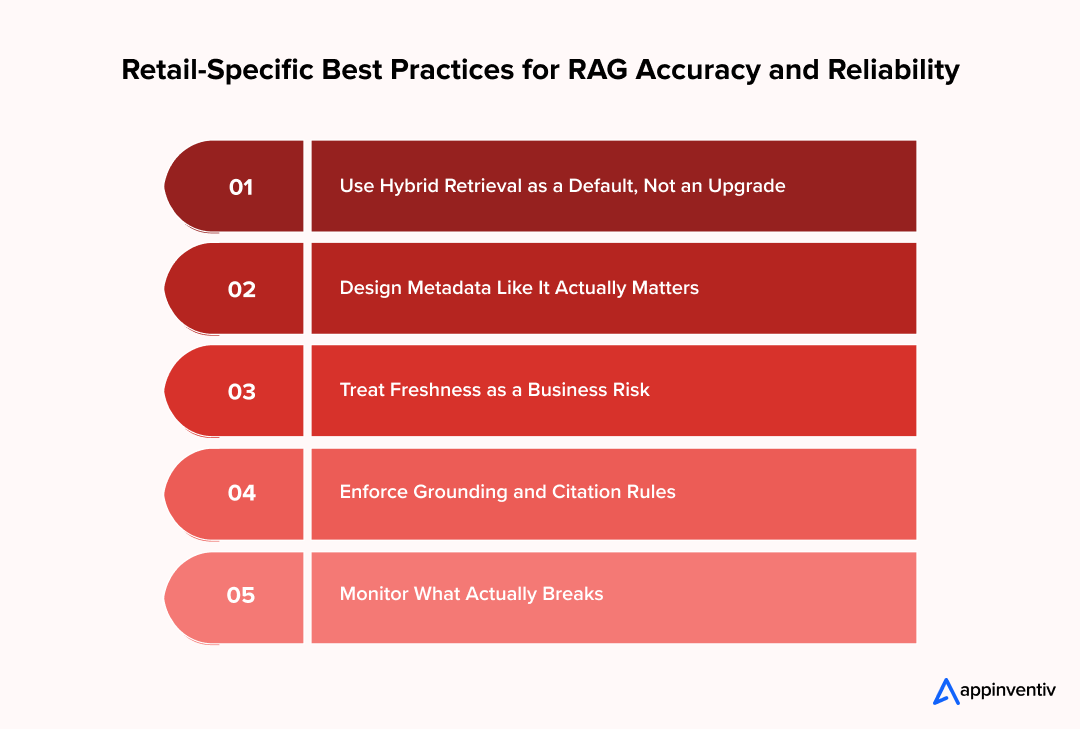
1. Use Hybrid Retrieval as a Default, Not an Upgrade
Retail queries are structured. Customers ask about size availability, delivery timelines, compatibility, price differences, and policy conditions. A reliable RAG system for retail should combine:
- Semantic search for intent understanding
- Keyword search for precision
- Metadata filtering for region and channel constraints
Vector search alone is rarely enough. Hybrid logic makes RAG-powered systems in retail more predictable and less prone to subtle errors.
2. Design Metadata Like It Actually Matters
Metadata is not decorative. It is operational control. For a strong RAG architecture for retail, tag content with:
- Region
- Store location
- Channel (online vs in-store)
- Season or campaign
- Policy version
Many challenges of RAG in retail stem from missing metadata. Without it, the system may retrieve the correct policy for the wrong region.
3. Treat Freshness as a Business Risk
Retail data changes rapidly as promotions expire, inventory levels fluctuate, and pricing rules evolve, so a production-ready RAG-based retail system must be designed to manage freshness with precision rather than treat data updates as an afterthought.
- Separate static content from dynamic data
- Set refresh intervals based on volatility
- Log retrieval timestamps
- Prioritize the most recent valid version
Freshness management is central to protecting the RAG’s impact on retail operations.
4. Enforce Grounding and Citation Rules
Trust grows when answers show their source. Effective RAG-driven chatbots in retail should:
- Cite the document or system used
- Indicate confidence level when appropriate
- Escalate ambiguous cases to human agents
Grounding reduces hallucination risk and strengthens adoption among frontline teams.
5. Monitor What Actually Breaks
Even a well-designed RAG system implementation for retail needs continuous review.
- Retrieval accuracy
- Policy conflicts
- Inventory mismatches
- Latency under peak load
- Repeated user corrections
The goal is not perfection on day one. The goal is steady improvement. Over time, these practices turn experimental applications of RAG in retail into dependable operational infrastructure.
In the next section, we will examine how to measure the business value and operational returns of a well-executed RAG system for retail, beyond technical metrics alone.
How to Evaluate the ROI of a RAG System for Retail
Technology teams often measure latency and retrieval accuracy. Retail leaders measure revenue, cost reduction, and operational efficiency. A successful RAG system implementation for retail must satisfy both.
If the value cannot be clearly demonstrated, even the most technically sound RAG system for retail risks is seen as experimental rather than essential. Measuring impact early ensures that
RAG in retail moves beyond innovation budgets and into operational strategy.
Below is how retailers typically evaluate real performance.
1. Operational Efficiency Metrics
Start with workflow improvements. This is where the immediate impact shows up. For RAG-powered systems in retail, track:
- Reduction in average handle time for support queries
- Decrease in internal knowledge lookup time for store associates
- Fewer escalations for policy or order clarification
- Consistency of answers across channels
When Integration of RAG systems in retail is done properly, teams spend less time searching and more time serving.
2. Commercial Performance Indicators
Retail investment decisions ultimately tie back to revenue. For a well-executed RAG-based retail system, monitor:
- Conversion rate improvement from AI-assisted product discovery
- Cart recovery is influenced by policy clarification
- Increase in average order value through accurate recommendations
- Reduction in returns caused by misinformation
These indicators demonstrate the benefits of RAG in the retail industry in a language executives understand.
3. Accuracy and Trust Signals
Operational adoption depends on confidence. Track:
- Citation coverage percentage
- Retrieval hit rate
- Frequency of policy conflicts
- Inventory mismatch errors
- Escalation rates due to uncertainty
These measures reflect the real RAG impact on retail operations, especially in customer-facing workflows.
4. Cost Efficiency Metrics
AI must also make financial sense. Evaluate:
- Cost per query
- Infrastructure spend relative to usage
- Savings from reduced manual handling
- Productivity gains across teams
Over time, consistent measurement transforms applications of RAG in retail from isolated pilots into strategic infrastructure.
When performance is tracked holistically, leadership can see how a disciplined RAG system implementation for retail contributes not just to better answers but to stronger operational outcomes and commercial resilience.
In the final section, we will explore how to future-proof your RAG architecture for retail so it continues to evolve alongside changing customer expectations and retail technologies.
Also read: Agentic RAG Implementation in Enterprises – Use Cases, Challenges, ROI
Common Failure Modes in Retail RAG Deployments
Most RAG system implementations for retail efforts do not fail because the technology is immature. They struggle because retail environments are complex, fast-moving, and deeply interconnected. When structure is weak or governance is overlooked, even a well-designed RAG system for retail can start producing inconsistent outcomes.
Understanding these common failure points helps retailers avoid costly mistakes.
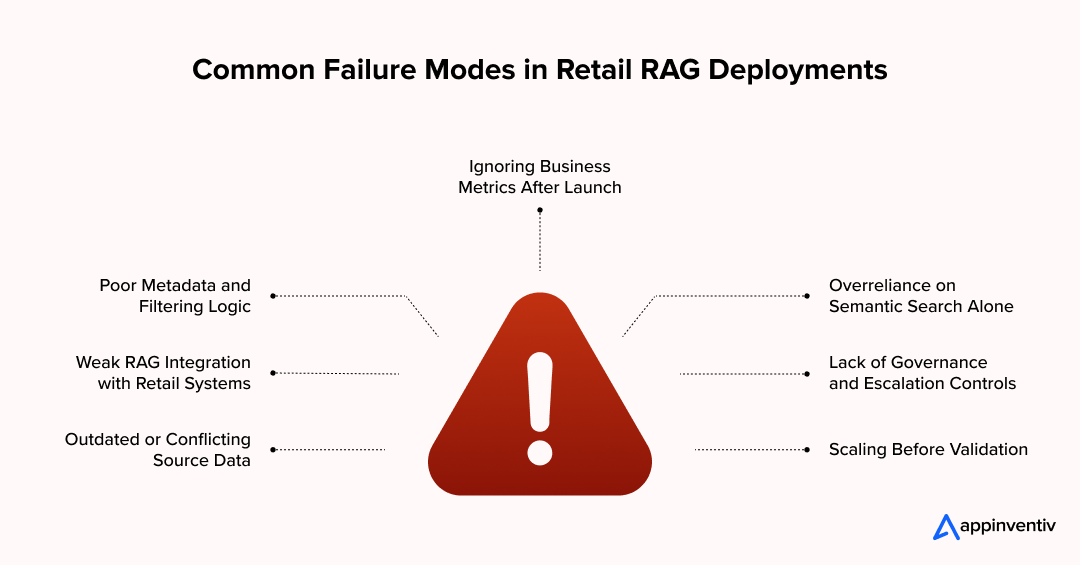
- Outdated or Conflicting Source Data: One of the biggest challenges of RAG in retail appears when promotions expire, policies are updated in one system but not another, or pricing logic changes without synchronized indexing. A poorly maintained RAG-based retail system may retrieve technically correct information that is no longer commercially valid, which can quickly erode customer trust.
- Weak RAG Integration with Retail Systems: When RAG integration with retail systems is shallow, the AI layer ends up retrieving data from static documents rather than live enterprise data. Without strong Integration of RAG systems in retail across PIM, ERP, OMS, and inventory platforms, responses become detached from operational reality.
- Poor Metadata and Filtering Logic: Retail is location-sensitive and channel-dependent. If the RAG architecture for retail does not include structured metadata for region, store, channel, and campaign, the system may surface the right policy for the wrong geography. This subtle mismatch is one of the most overlooked weaknesses in early RAG in retail deployments.
- Overreliance on Semantic Search Alone: Many initial applications of RAG in retail depend heavily on vector similarity without hybrid filtering. Product catalogs and pricing rules require precision, not approximation. A strong RAG system for retail must combine semantic retrieval with structured keyword and rule-based constraints.
- Lack of Governance and Escalation Controls: Retail operations carry financial and reputational risks. Without citation requirements, confidence thresholds, and escalation paths, RAG-powered systems in retail may deliver answers that sound confident but lack grounding. This is where operational confidence begins to decline.
- Scaling Before Validation: Some retailers expand use cases before thoroughly validating one controlled RAG Retail use case. Scaling prematurely often exposes gaps in freshness controls, performance stability, and system interoperability. A disciplined RAG system implementation for retail requires structured testing before broader deployment.
- Ignoring Business Metrics After Launch: Even technically stable deployments can lose executive support if the RAG impact on retail operations is not clearly measured. Without tracking conversion influence, resolution accuracy, or productivity improvements, leadership may question the ongoing investment in RAG for retail business initiatives.
Retail environments reward systems that are precise, governed, and aligned with operational workflows. By recognizing these failure modes early, organizations can strengthen their RAG architecture for retail, reduce risk, and ensure their RAG-powered systems in retail remain dependable as scale increases.
Also Read: RAG vs Fine Tuning: Choosing the Right AI Strategy
Future of RAG in Retail: Where Retail AI Is Headed Next
Retail AI is not standing still. What feels advanced today will feel standard in a few years. The Future of RAG in Retail is less about chat interfaces and more about embedded intelligence inside everyday workflows. Here’s where things are moving.
- From Chatbots to Embedded Assistants: The next phase of AI-powered agents or assistants for retail will live inside POS dashboards, merchandising tools, and supply chain systems, not just customer-facing chat windows.
- Multimodal Product Understanding: Retailers are moving toward systems that combine text and image retrieval. A strong RAG-based retail system will soon handle “Find me something like this” using product images and catalog data together.
- Deeper Personalization through CDP Integration: As RAG integration with retail systems expands, responses will factor in customer history, loyalty tier, and buying patterns, making hyper personalization more contextual and less generic.
- Agentic Workflows, Not Just Answers: The evolution of RAG in retail will include systems that not only retrieve information but initiate workflows such as processing returns or checking stock transfers.
- Operational Intelligence Beyond Support: More applications of RAG in retail will emerge in merchandising, pricing analysis, and inventory forecasting, where contextual retrieval improves decision-making speed.
- Stronger Governance and Explainability: As adoption grows, retailers will demand clearer traceability. The RAG impact on retail operations will increasingly depend on transparency, audit logs, and measurable accountability.
Retailers that treat the implementation of the retail RAG system as foundational infrastructure rather than an isolated experiment will be better positioned to adapt as these trends mature.
Stay ahead with a scalable RAG architecture for retail that adapts to evolving workflows, personalization demands, and operational complexity.
How Appinventiv Can Help You Build a Retail-Ready RAG System
A successful RAG system for retail is not built in isolation. It must integrate cleanly with enterprise systems, respect retail workflows, and deliver measurable impact. As an experienced AI software development company, Appinventiv designs scalable architectures that support secure data pipelines, hybrid retrieval logic, and strong RAG integration with retail systems across PIM, ERP, OMS, and inventory platforms.
Through our Retrieval augmented generation services, we help retailers move beyond prototypes and build dependable, production-ready solutions aligned with real business goals. Our experience delivering large-scale eCommerce platforms such as Edamama and 6thStreet reflects our understanding of complex retail ecosystems, performance requirements, and omnichannel execution.
If you are planning a structured RAG system implementation for retail that seamlessly integrates with your existing stack while maintaining accuracy and governance, our team can help you architect it from the ground up.
Let’s build a RAG-driven retail system that your operations team can trust and your leadership team can measure.
FAQs
Q. How can retailers successfully implement RAG systems at scale?
A. Retailers can scale a RAG system implementation for retail by starting with a clearly defined use case, validating data quality, and ensuring strong Integration of RAG systems in Retail across core platforms like PIM, ERP, and OMS. Scaling should only happen after accuracy, latency, and governance controls are tested in a controlled environment. A structured RAG framework for retail prevents pilot fatigue and ensures long-term operational stability.
Q. How does Appinventiv build enterprise-grade RAG systems for retail?
A. Appinventiv approaches the RAG system for retail development as a systems architecture initiative rather than a chatbot layer. Our teams design secure pipelines, hybrid retrieval logic, and structured RAG integration with retail systems that connect directly to enterprise data sources. As an AI software development company, we ensure governance, observability, and measurable impact remain central to every RAG for Retail business deployment.
Q. What RAG architecture is ideal for retail use cases?
The ideal RAG architecture for retail includes four key layers: experience interfaces, orchestration logic, hybrid retrieval, and enterprise system integration. A reliable RAG-based retail system combines semantic and keyword search with strict metadata filtering. This ensures Retrieval augmented generation in retail aligns with pricing logic, regional policies, and inventory constraints while maintaining performance across channels.
Q. How can retailers integrate RAG-powered chatbots into existing customer support systems?
A. Retailers can embed RAG-driven chatbots in retail support environments by integrating them directly with CRM, OMS, and knowledge base systems. Instead of replacing workflows, the chatbot becomes a retrieval layer that grounds responses in approved data. Strong RAG integration with retail systems ensures that policy clarifications, order explanations, and returns guidance are consistent across web, mobile, and contact center channels.
Q. What are the common challenges in RAG system development for retail?
A. Some of the most frequent Challenges of RAG in Retail include outdated promotions, inconsistent metadata, shallow system connectivity, and overreliance on semantic search. A poorly structured RAG system implementation for retail may retrieve correct but irrelevant content if governance and filtering are weak. Addressing these risks early protects operational accuracy and strengthens the overall RAG impact on retail operations.
Q. How can agentic RAG improve retail automation and decision-making?
A. Agentic capabilities expand the role of RAG-powered systems in retail beyond answering questions. Instead of simply retrieving information, agentic workflows can initiate actions such as processing returns, checking stock transfers, or flagging pricing inconsistencies. This represents the Future of RAG in Retail, where intelligent automation enhances both operational efficiency and decision support across merchandising, supply chain, and customer service functions.

- In just 2 mins you will get a response
- Your idea is 100% protected by our Non Disclosure Agreement.

How Much Does It Cost to Build a Conversational AI Chatbot in the UAE?
Key Takeaways AI chatbot development in the UAE typically costs AED 150,000–1,470,000 ($40K–$400K), based on complexity. Backend integration and compliance drive cost more than the chatbot interface itself. Arabic NLP, UAE hosting, and PDPL requirements increase budget and engineering effort. LLM + RAG enterprise chatbots sit at the higher end due to integration and infrastructure…

AI Inventory Management in Australia: Benefits, Use Cases, and Implementation Strategies
Key takeaways: Traditional ERP planning reacts to history; AI predicts demand shifts, reallocates stock dynamically, and prevents costly stockouts across distributed Australian networks. AI in inventory management in Australia typically reduces inventory levels 20–40% while maintaining service targets, unlocking significant working capital across multi-state operations. Enterprise implementations usually range from AUD 70,000 to AUD 700,000+,…
How to Hire RAG Architects for Enterprise AI
Key takeaways: Define your RAG architecture scope to avoid misaligned hiring decisions Identify end-to-end architectural ownership across retrieval, governance, and scaling Evaluate deep technical capabilities beyond prompt engineering and tools Validate governance and compliance readiness at the retrieval layer Test system-level thinking through real-world failure scenarios Choose the right hiring model based on scale, risk,…









