

































POS (point-of-sale) System Development for Australian Businesses – Step-to-step Execution & Integration Plan


- Why Australian Businesses Need a Custom POS System?
- Understanding the Types of POS Software in Australia
- Step-by-Step Guide to POS System Development for Australian Businesses
- Challenges in Building a POS System in Australia and How to Overcome Them
- How to Choose the Best POS System in Australia?
- Cost of POS System Development for Australian Businesses
- Future Trends and Outlook for POS Systems in Australia
- How Appinventiv Can Help with POS System Development for Australian Businesses?
- Frequently Asked Questions

Key takeaways:
- The Australian POS market is expected to reach $1.2 billion by 2030, driven by demand.
- POS system development for Australian businesses offers scalability, growth with your business, and support for multi-location operations, while improving day-to-day efficiency.
- A bespoke POS helps you meet Australia’s PCI-DSS v4.0 and privacy laws, lowering audit risk and protecting business data.
- Custom POS systems help build stronger customer relationships through loyalty tools, offers, and faster checkout experiences.
- Cleaner inventory control, sales tracking, and real-time reporting simplify operations and lower everyday operational costs.
- A custom POS connects with CRM, ERP, and accounting systems, giving real-time insights that support faster decisions.
Australian businesses are starting to realise that the Point-of-Sale does a lot more than handle payments. It quietly keeps the whole operation moving. It shapes the moment a customer steps up to the counter, it affects how smoothly staff get through a busy day, and it influences the decisions leaders make when they’re looking at the bigger picture.
Even so, plenty of organisations are still working with older systems that slow things down in ways that aren’t always obvious: longer waits, patchy visibility into stock, and missed cues that could point to new revenue.
For enterprise leaders, investing in POS system development in Australia isn’t about chasing shiny technology. It’s a call about how the business runs. A modern system cuts everyday friction, tightens security, and brings forward the kind of customer and operational insights that actually help a company grow.
But it only works if it’s planned properly — fitting into the systems you already use, meeting your compliance requirements, and rolling out in a way that doesn’t introduce needless risk.
This blog walks through a practical way to build and launch a POS that fits the realities of large Australian enterprises. Whether the goal is a smoother customer experience, more reliable operations, or staying aligned with local regulations, the focus here is on clear decisions rather than jargon.
The aim is simple: a POS that grows with your business instead of holding it back.
Businesses using modern POS reduce billing errors by 30% and speed up checkout by 40%, as outlined above.

Why Australian Businesses Need a Custom POS System?
The Australian point-of-sale environment is rapidly changing. With increasing digital transformations by enterprises, POS system development in Australia has become essential as the demand for more intelligent and agile point-of-sale solutions has also increased.
Today, the country represents 4.8% of the global point-of-sale terminal market, wherein fixed terminals still have the largest market share.
But the real drive lies with mobile point-of-sale systems that will see an 12.48% CAGR till 2030. That growth tells a clear story: modern Australian enterprises want point-of-sale systems that can shift, scale, and integrate as their operations evolve.
POS system development for Australian businesses isn’t just a nice-to-have; for several enterprises, it is part of their digital transformation strategy and a pragmatic solution to various problems that keep cropping up as they grow and evolve.
Benefits of Australian POS System: Why Custom Solutions Matter?
POS system development for Australian businesses delivers positive implications that go far beyond the checkout counter by affecting how the business is run, how customers feel, and how leaders make decisions.
- Scalability: A tailored POS scales up or down with growth, whether that is a growing number of outlets, franchise partners, or a range of products on offer. It keeps everything stable while the business evolves.
- Improved Customer Experience: The loyalty programmes, personalised offers, and faster checkout will help foster stronger, more consistent customer relationships. They help differentiate the brand in a very crowded marketplace.
- Operational Efficiency: A customised POS automates inventory management, sales tracking, and reporting, which removes the tedium of manual work. It reduces errors, cuts operational costs, and frees teams to focus on higher-value tasks.
- Compliance and Security: Custom systems are easier to align with Australian regulations and security standards for customer data protection against potential risk exposure, and help businesses comply as the rules change.
- Integration with Existing Systems: An integrated point-of-sale system in Australia that seamlessly connects with ERP, CRM, and accounting tools gives leaders a single, real-time view of their performance. Decisions become faster and more informed, each based on a common truth.
Understanding the Types of POS Software in Australia
Businesses can choose from several different types of POS systems in Australia, each designed for different operational needs. Traditional on-premise systems run on local servers, cloud-based solutions operate entirely online, hybrid systems combine both approaches, and mobile POS apps enable transactions on smartphones and tablets.
Understanding these options helps you select the right fit for your business model.
| Type of POS Systems Australia | Deployment | Best For | Key Advantage | Consideration |
|---|---|---|---|---|
| Traditional/On-Premise | Local servers | Large enterprises with stable locations | Full data control | High upfront costs |
| Cloud-Based | Remote servers | Growing businesses, multi-location | Accessibility anywhere | Requires internet |
| Hybrid | Local + Cloud | Businesses needing offline capability | Works without internet | More complex setup |
| Mobile POS | Smartphones/Tablets | Retail, hospitality, events | Ultimate flexibility | Limited to basic features |
A. Key Features of a POS Software in Australia
With powerful hardware combined with a feature-rich point of sale software in Australia, modern systems create seamless retail experiences. Knowing what’s available helps you create a system that better matches your operational requirements.
1. Hardware Considerations for POS Systems Australia
Physical components are foundational to your POS infrastructure, enabling both transaction and customer interaction at every touchpoint.
- Touch-screen terminals for intuitive order entry and checkout
- Barcode scanners for fast product identification
- Receipt printers: thermal or impact, for transaction records
- Cash drawers with secure locking mechanisms
- Card readers for chip, swipe, and contactless transactions
- Customer displays – showing transaction details
- Kitchen Display Systems in hospitality operations
- Scale integrations for weighted products
2. Software Considerations for POS Systems Australia
The software layer powers your business logic by connecting all hardware components and managing critical business functions.
- Inventory management tracking stock levels and movements
- Building detailed profiles for Customer Relationship Management (CRM)
- Multi-location support for centralised oversight
- Managing employees – permissions and time tracking
- Loyalty programmes that reward repeat customers
- Actionable insights generated through reporting and analytics
- Payment processing handling multiple methods of payment
- Real-time synchronisation across all touchpoints
B. Tech Stack for POS Software Development in Australia
Building a robust POS requires the selection of the appropriate technology stack that will balance performance, security, and scalability for the Australian market conditions.
1. Essential Technologies for POS System Development
Your technical foundation determines system reliability, speed, and future growth potential across all components.
- Frontend frameworks: React or Angular for responsive interfaces
- Backend languages: Node.js, Python, or Java for server logic
- SQL databases: MySQL or PostgreSQL for transactional data
- NoSQL databases: MongoDB for flexible, real-time operations
- Cloud platforms: AWS, Azure, or Google Cloud for infrastructure
2. Security and Compliance Considerations
Australian organisations must implement tight security protocols that not only secure customers’ data but also assist in maintaining compliance with regulations during business operations. Here are the security and compliance requirements for pos systems in Australia:
Key requirements include:
- PCI-DSS v4.0 compliance, including Multi-Factor Authentication (MFA) for all administrative and remote system access
- End-to-end encryption (E2EE) to protect transaction and cardholder data
- Australian Privacy Act and Notifiable Data Breach (NDB) Scheme compliance for lawful data handling and breach reporting
- Peppol e-Invoicing integration to automate B2B invoicing, GST reporting, and enterprise procurement workflows
- Australian Consumer Law (ACL) compliance for GST, refunds, and receipt processing
- Secure, audited APIs for safe ERP, CRM, and accounting integrations
- Australian data residency controls for regulated and enterprise-grade deployments
3. Mobile Technology Stacks
Mobile capabilities extend your POS beyond fixed terminals, enabling the flexibility to deliver service anywhere your customers require it.
- Cross-platform frameworks: React Native or Flutter
- NFC technology for contactless payments
- Offline-first architecture using Service Workers and PouchDB/CouchDB sync for zero-downtime operations and automatic data synchronisation.
Step-by-Step Guide to POS System Development for Australian Businesses
Building a custom POS system might seem daunting, but breaking it down into clear steps makes the process manageable. With the POS market in Australia expected to reach $1.2 billion by 2030, now is the ideal time for businesses to invest in tailored solutions that align with their unique needs.
As the demand for advanced, integrated POS systems grows, here are the steps to develop and launch a POS system in Australia that actually works for your business.
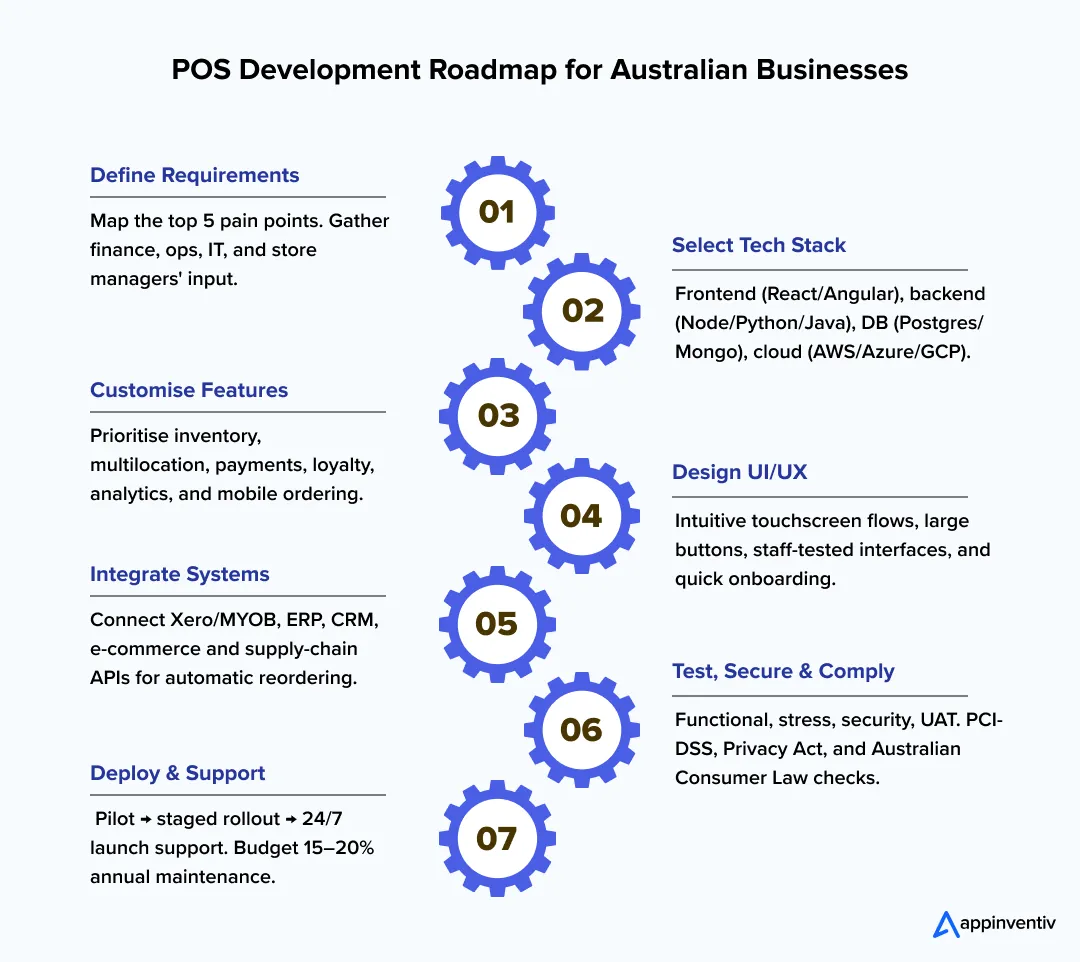
Step 1: Define Your Business Requirements
When considering how to build a POS system in Australia, start with the problems, not the features.
Before diving into development, sit down with your team and identify what’s actually broken. Are customers waiting too long at checkout? Is inventory tracking a nightmare? Do you lose sales data when systems go offline?
Gather input from the people who’ll use the system daily:
- Finance team: What reporting do they need?
- Operations: What slows them down currently?
- IT: What integrations are essential
- Store managers: What really irritates staff and customers?
Write down your top 5 pain points. These become your development priorities.
Step 2: Selecting the Right POS System Tech Stack
Your technology choices in point-of-sale system development for Australian businesses determine your flexibility tomorrow.
Don’t just pick what’s popular—choose what fits your needs:
- For the frontend: React or Angular if you want modern, responsive interfaces
- For the backend: Node.js for speed, Python for data processing, Java for enterprise stability
- For databases: PostgreSQL for transactions, MongoDB for flexibility
- For hosting: AWS, Azure, or Google Cloud for Australian data centres
The golden rule? Pick technologies your team can actually maintain. A cutting-edge stack is useless if nobody knows how to fix it when something breaks.
Pro tip: Choose platforms with strong Australian developer communities. You’ll need local support when issues arise.
Leveraging Edge Computing for Low-Latency Transactions
During peak Australian retail events like Click Frenzy and Boxing Day, POS volumes surge, and even minor latency can slow checkouts. Edge computing solves this by processing critical POS operations closer to the device, rather than relying entirely on centralised cloud servers.
- Local processing for transaction validation and payment handling
- Real-time inventory updates at the store level
- Cloud synchronisation for reporting and analytics
- Faster checkouts with minimal network dependency
- Zero-downtime performance during peak trading hours
Step 3: Customisation and Feature Set
Build what you need, not everything you could possibly want.
Begin by listing your must-haves:
Essential features for most businesses include:
- Inventory tracking in real time
- Multilocation support if you have many stores
- Basic reporting of sales, products, and staff performance.
- Web processing of card, mobile wallet and contactless transactions
Add these if they solve specific problems:
- Customer loyalty programmes for repeat business
- Advanced analytics to drive data-driven decisions
- Mobile ordering for hospitality businesses
- Franchise management for multi-owner operations
Match features to your industry. A restaurant needs table management; a retail store needs size/colour variants. Don’t pay for features you won’t use.
Appinventiv’s Kudu: A quick-service restaurant project that demonstrates how a tailored ordering flow and kitchen integration streamline QSR operations and reduce order-to-serve times.
Step 4: Design of POS Software and Development of UI/UX
In the case of POS software development in Australia, if your staff needs training to use it, you’ve designed it wrong.
Your POS interface should be obvious. New employees should figure out basic transactions within minutes, not days.
Design Priorities:
- For staff: Large buttons, clear labels, logical flow from product selection to payment
- For customers: Easy-to-read displays of what they are purchasing
- For mobile: Touch-friendly interfaces that work on tablets in any lighting
Test your design with actual staff members—not just managers. The person working Saturday rush hour will tell you what’s really practical.
Step 5: Integration with Existing Business Systems
In point of sale system development for Australian businesses, your POS shouldn’t be an island.
Modern businesses run on connected systems. Your point of sale needs to talk to:
- Accounting software (Xero/MYOB) to automatically capture all financial records
- ERP systems for enterprise resource planning
- CRM systems to manage customer relations
- E-commerce sites for unified inventory
- Supply chain systems for automatic reordering
Plan these integrations from day one. Adding them later costs more and causes headaches. Use standard APIs wherever possible—they’re easier to maintain and update.
Reality check: Integration usually takes longer than expected. Budget extra time here.
Appinventiv’ developed YK Almoayyed, a retail & distribution platform that demonstrates inventory-to-distribution integration and automated replenishment workflows that mirror the supply-chain integrations.
Step 6: Test, Secure, Comply
This isn’t an optional step in Australian POS system development, no matter how anxious you are to launch
Testing phases you can’t skip:
- Functional testing: Does everything work as designed?
- Stress testing: Can it handle Black Friday traffic?
- Security testing: Could anyone break in or steal data?
- User-acceptance testing: is it practical for real users?
Australian Compliance Essentials:
- PCI-DSS certification for payment security
- Customer’s data is in compliance with the Australian Privacy Act
- Customer’s Return and Warranty Policy in compliance with Australian Consumer Law
- Data residency requirements, if storing sensitive information
Don’t cut corners on security. One data breach will cost far more than proper security testing.
Step 7: Deployment and Post-Deployment Support
Launch day is just the beginning.
Here is your rollout strategy:
- Phase 1: Pilot at one location with your most adaptable team
- Phase 2: Feedback retrieval and emergency debugging
- Phase 3: Roll out in stages to the remaining locations
- Phase 4: Close monitoring in the first month
Staff training matters more than one might think:
- Hands-on practice with dummy transactions
- Quick reference cards at each terminal
- 24/7 support line during the first two weeks
- Regular check-ins with store managers
Post-launch support shall involve:
- Immediate bug fixes
- Performance monitoring
- Regular system updates
- Continuous staff education for new features
Budget reality: Plan for 15-20% of development costs annually for maintenance and support. Systems that aren’t maintained become problems fast.
The bottom line: Take your time in planning and testing. Rushing development leads to expensive fixes later. A well-built POS system should serve your business for years, adapting as you grow.
Also Read: Software Product Development – Steps and Methodologies
Challenges in Building a POS System in Australia and How to Overcome Them
Most point of sale system development for Australian business projects feels manageable at the start. Then real constraints show up. A payment edge case during a weekend rush, a report that does not match GST totals, or a legacy system that refuses to sync. That is usually when teams realise how demanding a custom POS build in Australia can be.
Below are the main challenges you are likely to run into, and how to deal with them without slowing your business down.
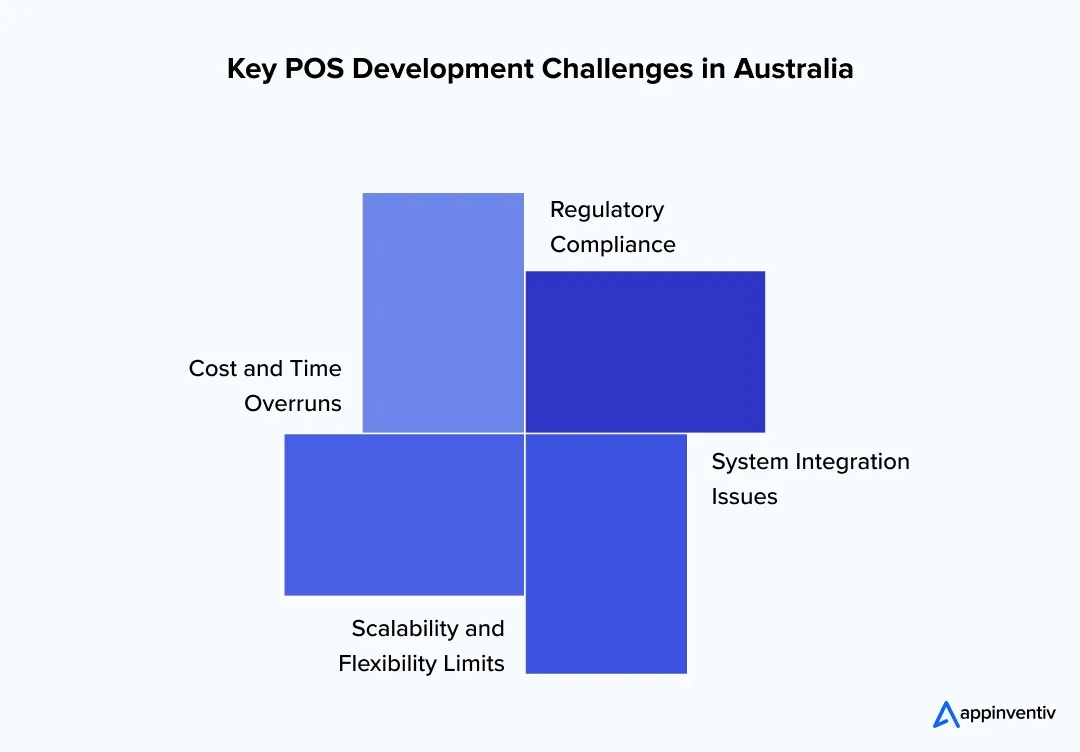
1. Regulatory Compliance Challenges
If you are building for Australia, compliance shapes almost every decision. Your POS has to align with PCI-DSS, Privacy Act requirements, GST calculations, and state-specific consumer rules. Missing one detail can mean fines or awkward conversations with auditors.
The smartest move is to plan compliance early. Bring in specialists during design, not once development ends. Add audit logs from day one so transactions and access are easy to track.
Choose certified payment gateways so security standards are handled outside your core system. Keep reviews ongoing and documentation current. When compliance is part of the product, it stays manageable.
2. Integration Issues
Australian POS system development requires your point-of-sale system to integrate with tools that already run your business. That often includes older ERP systems, CRMs, or inventory platforms that were never designed to talk to modern software. These gaps tend to surface when reports do not line up at the month’s end.
Start with a clear integration audit. List every system and map how data should move between them. Middleware or API tools can help bridge older tech with newer services. Build error handling so failed syncs are visible right away. Focus first on the integrations that affect daily operations.
3. Cost and Time Overruns
POS projects grow faster than expected. New feature requests appear, edge cases multiply, and timelines slip. Budgets often stretch before anyone notices.
Break the work into phases with fixed milestones. Release a minimum viable system that handles core transactions, then expand based on actual usage. Keep a contingency buffer in the budget. Review progress weekly so small issues do not turn into expensive fixes.
4. Scalability and Flexibility
What fits today may struggle tomorrow. More stores, higher volumes, or new sales channels can expose rigid design choices.
Plan for growth early. Use cloud infrastructure that scales naturally. Keep the architecture modular so parts can change without full rebuilds. Design for higher volumes than you need today. Configurable rules give your team room to adapt as the business evolves.
Before anyone sits down to talk numbers, this usually starts with frustration. A manager is asking why yesterday’s sales do not match the report. Someone is staying back late to fix inventory counts. Over time, those moments add up, and the question becomes whether a custom POS system is worth the cost.
From compliance to integrations, we design POS-ready systems built for local business realities.

How to Choose the Best POS System in Australia?
Choosing a POS system usually starts when something is no longer working. Reports lag. Checkout slows during peak hours. Support takes too long to respond. At that point, the decision is less about features and more about finding the right partner to build or deliver the system.
That choice matters. The gap between a POS that genuinely supports your business and one that becomes costly overhead often comes down to who builds it and how well they understand Australia’s operating environment.
1. Verify Australian Market Experience
Start with local knowledge. Your POS partner should clearly understand PCI-DSS requirements and the Australian Privacy Act. Ask where they have already delivered systems and in which industries. Retail experience does not automatically carry over to hospitality or services, and those gaps tend to surface later.
2. Demand Measurable Proof
Look beyond polished decks. Ask for case studies that show real outcomes, such as faster checkouts or reduced manual work. If possible, speak with Australian clients directly. A short conversation often reveals more than a testimonial ever will.
3. Assess Technical Capabilities
Your POS needs to support cloud deployment, mobile use, and system integrations without friction. Make sure the team has done this before. Certifications like ISO or SOC2 are not guarantees, but they set a baseline for how security and processes are handled.
4. Prioritise Local Presence
Issues rarely appear at convenient times. Local delivery teams can respond during Australian business hours and understand compliance nuances. That support matters when something breaks mid-shift.
5. Evaluate Development Approach
Clear milestones and agile delivery help protect your budget. Ask how testing is handled and how scope changes are managed once development is underway.
In the end, the best POS system in Australia pairs solid technology with a partner who knows the market and stays involved after launch.
Cost of POS System Development for Australian Businesses
For businesses investing in point of sale software in Australia, that cost is not small. Most custom POS builds land somewhere between AUD 70,000 and AUD 700,000 or higher. The range is wide because no two systems are built for the same reality.
Knowing how the budget breaks down and what actually influences it helps you make decisions without guesswork.
Here is a quick overview of POS software development cost in Australia:
| Component | Basic System | Mid-Range System | Enterprise System |
|---|---|---|---|
| Requirements & Planning | AUD 6K – 12K | AUD 12K – 22K | AUD 22K – 40K |
| UI/UX Design | AUD 8K – 15K | AUD 15K – 28K | AUD 28K – 50K |
| Frontend Development | AUD 12K – 22K | AUD 25K – 45K | AUD 45K – 85K |
| Backend Development | AUD 15K – 28K | AUD 30K – 55K | AUD 55K – 100K |
| Database Architecture | AUD 6K – 12K | AUD 12K – 22K | AUD 22K – 40K |
| Payment Gateway Integration | AUD 8K – 15K | AUD 15K – 25K | AUD 25K – 45K |
| Third-Party Integrations | AUD 6K – 12K | AUD 15K – 30K | AUD 35K – 70K |
| Security & Compliance | AUD 5K – 10K | AUD 12K – 22K | AUD 25K – 50K |
| Testing & QA | AUD 6K – 14K | AUD 15K – 30K | AUD 35K – 70K |
| Deployment & Training | AUD 4K – 8K | AUD 10K – 18K | AUD 20K – 40K |
| Annual Maintenance (Year 1) | AUD 10K – 18K | AUD 18K – 35K | AUD 40K – 70K |
| TOTAL INVESTMENT | AUD 70K – 140K | AUD 150K – 350K | UD 380K – 700K |
Note: Costs are in AUD and represent typical ranges for custom development in Australia.
Factors Influencing Development Costs
What you end up spending is shaped very early. A few decisions in the planning stage tend to matter more than anything that comes later.
- Custom vs. Pre-built Solutions
Off-the-shelf POS systems often cost $50 to $200 per month and look appealing at first. They work until your team needs something slightly different. Custom systems cost more upfront, often three to five times more, but they are built around how your business actually runs. If your workflows are unique, that difference shows up fast in daily operations.
- Feature Complexity
Basic selling, inventory tracking, and reports sit at the lower end of the cost range. Adding mobile payments, advanced analytics, multiple locations, loyalty features, or AI recommendations pushes costs up by 40 to 60 percent. It helps to ask which features remove friction today, not which ones look impressive on a roadmap.
- Development Timeline
Simple systems can be delivered in three to four months. Larger enterprise builds often take nine to eighteen months. Trying to compress that timeline usually increases costs due to overtime and rework. A steady pace almost always delivers better outcomes.
- Integration Requirements
Most businesses already rely on ERP, CRM, e-commerce, or accounting tools. Each integration needs custom development, testing, and ongoing support. Budget around $8,000 to $15,000 per major system you need connected.
Total Cost of Ownership (TCO)
A custom POS isn’t just an expense; it’s a revenue protection strategy that reduces shrinkage through AI-driven vision and eliminates ghost inventory via real-time ERP synchronisation.
- Operational Efficiency: Automated inventory frees up 10 to 15 hours a week that staff usually spend fixing counts.
- Revenue Growth: Better stock visibility reduces lost sales by 30% to 40%, while more relevant campaigns convert far better.
- Data-Driven Decisions: Clear reporting often leads to margin gains of 15% to 20%.
- Reduced Errors: Manual mistakes cost retailers significant money each year. Automation removes most of that risk.
- Scalability: Custom systems expand with your business, adding locations without starting over.
Also Read: Build vs Buy Software: How to Make the Right Choice for Your Business
Future Trends and Outlook for POS Systems in Australia
Walk into any busy store today, and you can feel the shift driven by modern POS system development for Australian businesses. Staff move faster, customers expect fewer delays, and systems are expected to just work. That pressure is shaping how POS platforms are evolving across Australia, and the next few years will change how businesses run their front lines.
Here is what is driving that change.
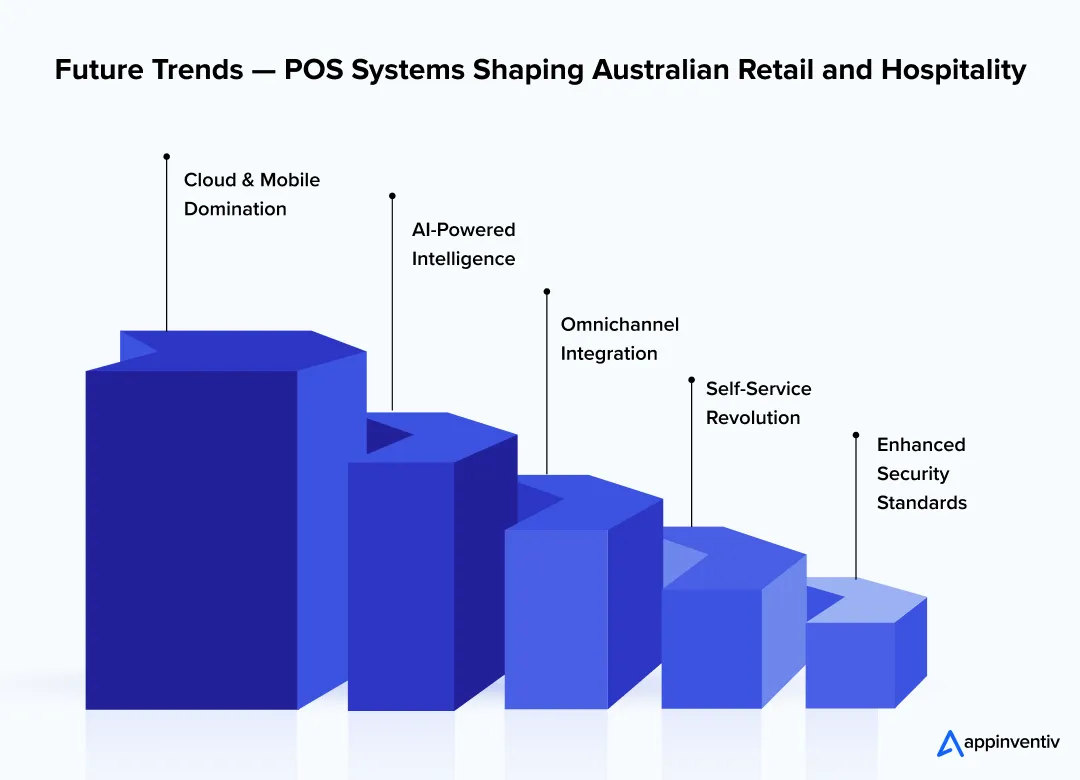
1. Cloud and Mobile Domination
On-premise POS setups are slowly fading out. Many Australian businesses are moving to cloud and mobile systems because they fit modern operations better. When you can check sales numbers from a tablet after hours or add a new location without installing servers, the appeal is obvious.
Cloud platforms also remove much of the hardware upkeep, which frees teams to focus on day-to-day operations instead of system maintenance.
2. AI-Powered Intelligence
POS systems are doing more than processing transactions now. AI is pushing them into a supporting role for decision-making. Some systems can forecast inventory needs before shelves run low, flag unusual transactions as they happen, or recommend products based on buying patterns.
Over time, machine learning helps refine stock levels so teams spend less time reacting and more time planning.
Also Read: 14 Use Cases on How Australian Retailers Are Adopting AI to Stay Competitive
3. Omnichannel Integration
Customers no longer think in terms of channels. They just expect consistency from an integrated point of sale system in Australia. A modern POS brings together in-store purchases, online orders, mobile apps, and even social sales into one view.
Someone can buy online, return in-store, or check stock from their phone without friction. When systems are unified, teams see the full picture instead of fragmented data.
4. Enhanced Security Standards
Data protection expectations in Australia continue to rise. POS platforms are adjusting with stronger encryption, biometric sign-ins, and automated checks that support compliance. The goal is not just security today, but systems that can adapt as regulations change, without needing a full rebuild every few years.
5. Self-Service Revolution
Self-service checkouts and kiosks are becoming more common across retail and hospitality. Many customers prefer quick, independent transactions, especially during peak hours. When these tools connect directly to the core POS, reporting stays clean, and inventory stays accurate. That balance helps businesses lower wait times without sacrificing oversight.
Together, these shifts point to POS systems that are more flexible, more intelligent, and easier to scale. For Australian businesses, the focus is moving from running transactions to supporting smarter operations.
Let’s map features, integrations, and rollout based on how your business actually operates.

How Appinventiv Can Help with POS System Development for Australian Businesses?
Most teams only look for a POS partner when pressure is already on. A rollout date is close, systems need to scale, and downtime is not an option. In that moment, experience and local understanding matter.
Appinventiv brings over a decade of APAC delivery experience, including Australia. With 250+ digital assets deployed in the region and five agile delivery centres nationwide, the team operates close to where businesses run. Our 96% client retention rate reflects long-term partnerships, not one-off projects.
As a leading software development company in Melbourne, Appinventiv has worked across 35+ industries, including retail, hospitality, healthcare, and large enterprises. We understand sector-specific POS challenges. That experience reduces risk and shortens decision cycles.
Security is built in, not added later. We deliver a 99.50% security compliance SLA aligned with ISO and SOC2 standards. Payment and customer data protections are contractually guaranteed.
Australian enterprises working with us report an average 35% efficiency gain, driven by streamlined operations and stronger system reliability. We have also been ranked among APAC’s high-growth firms by Statista and the Financial Times for two consecutive years.
From planning through ongoing optimisation, Appinventiv stays involved, offering local support, regulatory awareness, and the technical depth needed for POS system development in Australia that works in real Australian conditions. Talk to our team to map your POS requirements before development begins.
Frequently Asked Questions
Q. What is POS software?
A. Most businesses hit a point where sales, stock, and payments can no longer live in separate tools. POS software brings all of that together. It processes transactions, tracks inventory, manages payments, and captures sales data in one system.
You might be running it on a tablet at the counter or a phone during a rush, but behind the scenes, it connects payment hardware with reporting and business tools so retail and hospitality teams can work from a single view.
Q. How much does it cost to build a POS system in Australia?
A. In Australia, a custom POS system typically costs AUD 70,000 to AUD 700,000, depending on complexity and integration needs. Small-to-mid businesses usually invest AUD 70,000 to AUD 150,000 for core functionality. Growing enterprises spend AUD 150,000 to AUD 350,000 for multi-location systems and integrations.
Large enterprises with advanced compliance and ERP connectivity invest AUD 350,000 to AUD 700,000+. These estimates include development, integrations, compliance, training, and first-year maintenance. Off-the-shelf tools cost less upfront but offer limited scalability.
Q. How to develop a POS system in Australia?
A. POS system development in Australia starts with clarity. Define where your current setup causes friction and what your team needs daily. From there, choose the tech stack, design practical interfaces, and plan integrations with CRM, ERP, or accounting systems. Compliance with PCI-DSS and the Australian Privacy Act is critical. After thorough testing, deploy in stages and train staff so adoption does not slow operations.
Q. How long does it take to build a POS software in Australia?
A. Timelines depend on scope. A basic POS can take three to four months. Systems with custom integrations usually need six to nine months. Enterprise platforms often run for nine to eighteen months. Trying to rush the process tends to push costs up by 20 to 30 percent without improving outcomes.
Q. How do you integrate a POS with payment gateways in Australia?
A. Integration typically involves connecting to providers like Stripe, Square, or Westpac through secure APIs. The system must follow PCI-DSS standards, use tokenisation, and support cards, mobile wallets, and contactless payments. Teams usually test everything in sandbox environments before going live to catch issues early.
Q. How do restaurant POS systems in Australia handle operations?
A. Restaurant POS platforms manage table layouts, ordering, kitchen routing, and modifiers. Many support QR ordering, tableside payments, and delivery apps. Behind the counter, they track ingredients, integrate with accounting software, and ensure GST reporting stays accurate.
Q. What makes hospitality POS systems in Australia different?
A. Hospitality environments move fast. POS systems here support table management, split bills, kitchen displays, and different service modes like dine-in or takeaway. They also handle tips, staff rosters, and peak-time volumes while staying aligned with local licensing and reporting rules.
Q. What features should retail POS software in Australia include?
A. Retail POS systems need real-time inventory tracking, barcode scanning, multi-location support, and loyalty programmes. Payment integration, GST handling, sales analytics, staff permissions, and e-commerce connections are essential. Cloud access allows teams to manage stores even when off-site.

- In just 2 mins you will get a response
- Your idea is 100% protected by our Non Disclosure Agreement.

Maritime Insurance Claim Software Development for UAE Ports, Insurers, and Logistics Networks
Key takeaways: Manual claims management is too slow for the UAE’s high-volume ports; digital solutions streamline processes and reduce errors. Maritime insurance claim software centralizes data, automates workflows, and ensures compliance with UAE regulations and Takaful principles. Real-time integration with port and vessel systems enables faster claim registration, validation, and settlement. Advanced analytics and risk…

How to Build a Student Management System in Australia?
Key takeaways: Australia’s tightening regulatory landscape (TEQSA, ASQA, CRICOS) makes student management system development in Australia a compliance-driven necessity, not just a digital upgrade. Monetisation models such as SaaS subscriptions, institutional licensing, white-label partnerships, and hybrid pricing offer scalable commercial opportunities in Australia’s expanding EdTech market. Addressing challenges early - data privacy, legacy migration, multilingual…

Guide to Software Risk Management: Identifying and Mitigating Key Risks in Software Development
Key takeaways: Risk management is no longer a peripheral activity; it is a core component of Enterprise Risk Governance (ERG) that ensures software ROI. Successful projects define their risk appetite—the level of risk an organization is willing to accept—before the first line of code is written. By integrating risk assessment into the early discovery phase,…