


























Odoo Implementation Cost in 2026: Complete ERP Budget Breakdown


- How Much Does Odoo Implementation Cost in 2026?
- What Key Factors Influence Odoo Implementation Costs?
- Odoo Deployment Cost Comparison (Cloud vs On-Prem vs Managed)
- Hidden Odoo Implementation Costs Enterprises Often Miss
- ERP Implementation Lifecycle and Methodology
- Odoo Implementation Cost by Industry (2026)
- Odoo Implementation Cost by Business Function
- Ongoing Odoo Maintenance Cost (Annual Ownership)
- Realistic Odoo Implementation Budget Scenarios (2026)
- What Are Some Tips to Reduce Odoo Implementation Costs?
- Odoo Licensing and Subscription Cost Structure (2026)
- Total Cost of Ownership (TCO) for Odoo ERP Implementation
- What Are the Enterprise Benefits of Odoo Implementation?
- Odoo Implementation Partner Pricing and Expected ROI
- Sample Odoo Implementation Budget (US Example)
- Why Choose Appinventiv as Your Odoo Implementation Partner
- Frequently Asked Questions

Key Takeaways
- Enterprise Odoo implementation typically ranges from $50K to $500K+, depending on scope.
- Integration and customization typically account for 45%–70% of the total implementation budget.
- Licensing scales per user, while complexity drives configuration and integration costs.
- Annual ownership averages 15%–25% of the initial implementation investment.
- Phased rollout and disciplined governance significantly reduce budget overruns.
Most enterprise teams reach a point where their existing systems start slowing things down. It usually shows up quietly at first. Reporting takes longer, data sits in separate tools, and your operations team ends up stitching spreadsheets together before leadership reviews. That is often when ERP modernization discussions begin.
Platforms like Odoo have gained traction globally because they offer a modular approach. You can roll out finance, CRM, inventory, or operations in phases instead of forcing a full transformation overnight. Still, before any roadmap gets approved, one question always comes up. What will the Odoo implementation cost actually look like over time?
That question goes beyond license fees. Your ERP budget usually includes deployment setup, integration with existing systems, employee training, ongoing support, and lifecycle considerations. Many enterprises also factor in change management because adoption determines whether the system delivers value or just adds another layer of complexity.
Industry data shows that 95% of organizations report improved processes after ERP adoption, with an average post-implementation ROI of 52%, which explains why planning conversations are taken seriously at the executive level.
Clear cost visibility helps your team avoid rushed decisions. It also makes vendor conversations more productive since you already understand the moving parts behind Odoo ERP cost planning and Odoo pricing structures. The goal of this guide is simple. Provide a grounded view of implementation, deployment, integration, training, and long-term operational costs so your organization can plan with confidence.
95% of organizations improve processes, and ERP ROI averages 52% post-implementation.

How Much Does Odoo Implementation Cost in 2026?
If you have ever sat in an ERP budget discussion, you know how it usually begins. Someone asks for a rough number first. Not perfection, just something realistic enough to start planning. With Odoo implementation in 2026, that number can shift quite a bit depending on how complex your operations are, where your teams are located, and how deeply the system connects with existing tools.
For enterprises operating across the US or multiple regions, implementation budgets generally fall into these broad ranges:
Odoo Implementation Cost Breakdown (2026)
| Business Scope | Estimated Implementation Cost (2026) |
|---|---|
| MVP / Limited Rollout | $50,000 – $120,000 |
| Mid-Size Organization | $120,000 – $300,000 |
| Enterprise / Multi-Region | $300,000 – $500,000+ |
These figures reflect implementation work only. Licensing and Odoo pricing usually sit in a separate budget line and scale with users or edition choices. What drives higher enterprise costs is rarely one thing.
It is usually a mix of broader module coverage, deeper integrations, reporting alignment, and regional compliance requirements. If you are coordinating teams across time zones or dealing with multiple currencies, timelines can stretch faster than expected.
Odoo Customization Cost (2026 Benchmarks – US Market)
Customization is usually the largest variable in an Odoo enterprise implementation cost breakdown.
Odoo covers common workflows out of the box. The moment you start aligning it with your actual finance approvals, warehouse logic, or executive reporting standards, costs begin to move. The more you try to replicate legacy processes exactly, the higher your spend.
Odoo Customization Cost Benchmarks (US – 2026)
| Customization Type | Typical Cost Range | Budget Impact |
|---|---|---|
| UI / Dashboard Adjustments | $500 – $2,500 | Low |
| Workflow Automation (Approvals, Routing) | $1,500 – $7,000 | Moderate |
| Advanced Reporting / CFO Dashboards | $1,200 – $5,000 | Moderate |
| Industry Logic (Manufacturing, Traceability) | $5,000 – $25,000 | High |
| New Module Configuration or Extensions | $4,000 – $20,000+ | High |
Consulting Rates (US 2026):
- Standard configuration: $75 – $110/hour
- Advanced enterprise logic: $110 – $150/hour
Customization Cost Impact by Approach
| Approach | Cost Impact |
|---|---|
| Adopt standard Odoo workflows | Baseline |
| Moderate configuration alignment | +15–30% |
| Heavy legacy replication | +30–70% |
The key cost driver is not the platform. It is how much process redesign your organization is willing to accept.
Odoo Integration Cost (Connecting Your Tech Stack)
Implementation sets up Odoo. ERP integration connects it to the rest of your business. For most US mid-market and enterprise companies, integration accounts for 20%–35% of total implementation cost. The more real-time data exchange required, the higher the integration complexity.
Odoo Integration Cost Benchmarks (US – 2026)
| Integration Type | Cost Range | Example Systems |
|---|---|---|
| Pre-built Connector | $1,000 – $3,000 | Shopify, WooCommerce |
| Standard API Integration | $3,500 – $8,000 | Stripe, ShipStation |
| Multi-System Integration | $10,000 – $30,000 | CRM + WMS + Finance stack |
| Legacy ERP Integration | $15,000 – $40,000+ | AS400, custom ERP |
Integration Complexity Impact
| Complexity Level | Timeline Impact | Budget Impact |
|---|---|---|
| Simple connector | Baseline | No change |
| Multi-app real-time sync | +20–35% time | +20–40% cost |
| Legacy or poorly documented system | +40–60% time | +30–70% cost |
Integration cost usually increases when:
- APIs are undocumented
- Data models do not align
- Real-time sync is required
- Security rules are complex
Most overruns happen here, not in basic configuration.
Odoo Data Migration Cost (Often Underestimated)
Data migration looks simple until teams open legacy databases. QuickBooks exports, spreadsheet-based inventory, and fragmented CRM data. Cleaning and validating this information often becomes the silent cost driver inside ERP projects.
Odoo Data Migration Cost Benchmarks (US – 2026)
| Migration Scope | Cost Range |
|---|---|
| Basic Contacts / SKU Import | $1,000 – $3,000 |
| 2–3 Years Financial Data | $5,000 – $15,000 |
| Multi-Year Historical Data | $8,000 – $25,000 |
| Complex Manufacturing Data | $10,000 – $30,000+ |
Impact of Data Quality on Budget
| Data Quality | Timeline Impact | Cost Impact |
|---|---|---|
| Clean & Structured | Baseline | No change |
| Moderately Inconsistent | +25% time | +15–30% cost |
| Dirty / Fragmented | +40–70% time | +25–60% cost |
Poor data quality is one of the biggest reasons implementation budgets expand late in the project.
Combined Cost Impact Summary
When you layer these together:
| Component | Typical Share of Total Implementation |
|---|---|
| Customization | 25–45% |
| Integration | 20–35% |
| Data Migration | 10–25% |
| Core Configuration & PM | 15–25% |
For a $250,000 enterprise rollout:
- Customization: ~$75K – $110K
- Integration: ~$50K – $85K
- Migration: ~$25K – $60K
That is where the real budget movement happens.
What Key Factors Influence Odoo Implementation Costs?
If you compare two companies implementing the same ERP platform, the budgets rarely match. One may complete rollout smoothly within expectations, while another sees costs stretch because operational realities are different. The cost of Odoo implementation usually reflects business complexity more than the platform itself.
Understanding what actually drives these variations helps your team plan more realistically and avoid surprises during deployment.
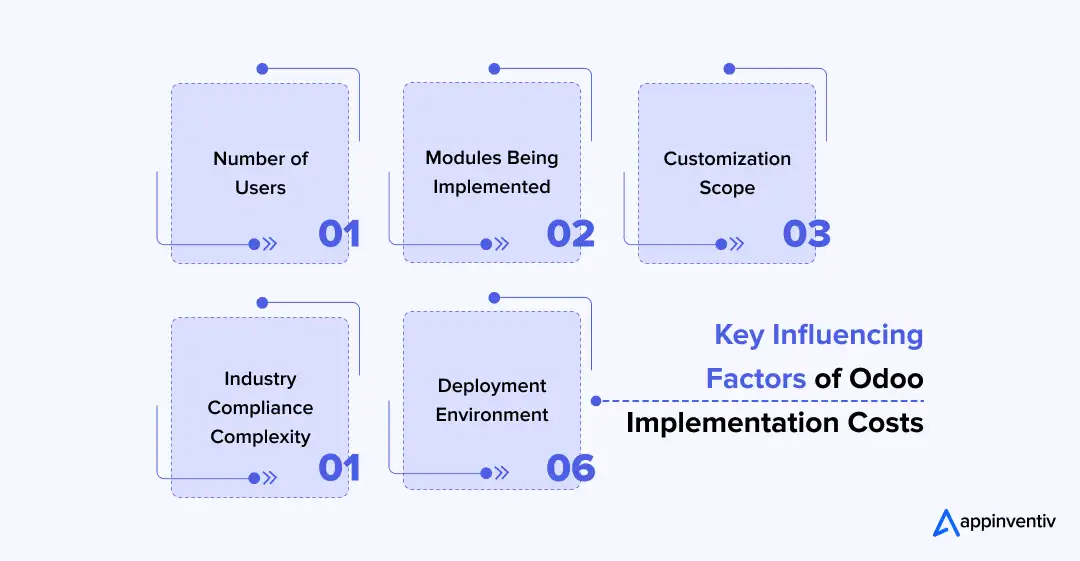
Number of Users
User count affects more than licensing. It shapes access control setup, training scope, reporting workflows, and support requirements. A rollout across a single department looks very different from organization-wide adoption.
Even small details matter here. For example, aligning user roles across finance, operations, and regional teams often takes longer than expected.
Modules Being Implemented
Most organizations do not activate every module at once. They usually prioritize based on immediate operational needs.
Common starting points include:
- CRM for customer lifecycle visibility
- Accounting for financial consolidation
- Inventory management for operational tracking
- Manufacturing modules for production workflows
The broader the module coverage, the greater the implementation coordination required.
Customization Scope
Every organization has established workflows. Implementation often involves adapting ERP configurations to match those processes rather than forcing teams to change everything overnight.
This might include:
- Workflow adjustments
- Reporting formats
- Approval hierarchies
- Dashboard personalization
Keeping customization focused usually helps control both cost and timeline.
Industry Compliance Complexity
Regulatory requirements influence implementation more than many teams expect. Industries like healthcare, manufacturing, fintech ERP, or distribution often require specific reporting structures, audit trails, or data governance standards.
Compliance alignment can add additional planning, validation, and documentation steps.
Deployment Environment
Infrastructure decisions also shape Odoo deployment cost over time.
Typical options include:
- Odoo.sh managed environment, often preferred for structured deployment and simplified maintenance
- Cloud-hosted ERP setups, offering scalability and predictable infrastructure management
- On-premise infrastructure, sometimes chosen for strict compliance or data sovereignty needs
Each approach affects performance expectations, maintenance responsibilities, and long-term operational planning.
When you look at all these drivers together, one thing becomes clear. Odoo ERP implementation cost rarely depends on a single factor. It reflects how extensively the ERP platform integrates into daily operations and how carefully deployment decisions are made early on.
Odoo Deployment Cost Comparison (Cloud vs On-Prem vs Managed)
Deployment choice affects more than hosting cost. It influences long-term Odoo ERP cost, compliance flexibility, scalability, and operational control. Most enterprises evaluate three options: managed Odoo environments, cloud-hosted ERP, and on-premise infrastructure. Each comes with different cost patterns and operational trade-offs.
Also Read: Cloud Manufacturing Software Development: Benefits, Types & Cost
Deployment Cost Comparison (US 2026 Estimates)
| Deployment Model | Typical Monthly Cost | Best For | Key Consideration |
|---|---|---|---|
| Odoo Online (SaaS) | Included in subscription | Standardized operations | Limited customization |
| Odoo.sh Managed Cloud | $100–$400/month | Growing SMBs & mid-market | Balanced flexibility |
| Cloud IaaS (AWS/Azure/GCP) | $300–$1,000/month | Enterprise scale | Full scalability |
| On-Premise | $500–$1,500+/month equivalent | Strict compliance needs | Higher IT overhead |
Choosing the right deployment model early helps control long-term ERP costs and prevents expensive infrastructure changes later.
Hidden Odoo Implementation Costs Enterprises Often Miss
ERP budgets often look complete during planning, but several smaller cost elements usually appear after deployment begins. These are normal operating costs, but are often underestimated.
Factoring them early helps keep the overall cost of Odoo implementation predictable. Typically, these additional costs range between $10,000 and $60,000+ annually, depending on scale.
Employee Training ($3K–$15K)
User onboarding, workshops, and documentation ensure adoption and reduce operational errors.
Change Management ($5K–$20K)
Process alignment, communication planning, and stakeholder coordination support a smoother transition.
Post-Go-Live Support ($3K–$10K)
Stabilization support covers workflow adjustments, reporting refinements, and user queries.
Also Read: ERP AI Chatbot Development: Features, Use Cases & Benefits
Annual Maintenance ($5K–$25K+)
Performance tuning, configuration updates, and system monitoring maintain efficiency.
Upgrade Management ($2K–$10K per cycle)
Version updates, security improvements, and feature enhancements require periodic planning.
Accounting for these hidden costs early helps avoid budget surprises and supports stable long-term ERP adoption.
ERP Implementation Lifecycle and Methodology
ERP rollouts rarely fail because of technology. Most issues come from an unclear structure. A defined ERP implementation lifecycle keeps budgets predictable, aligns stakeholders, and reduces last-minute surprises.
For enterprise Odoo implementations, total project costs typically range between $50,000 and $500,000+, depending on scope and complexity.
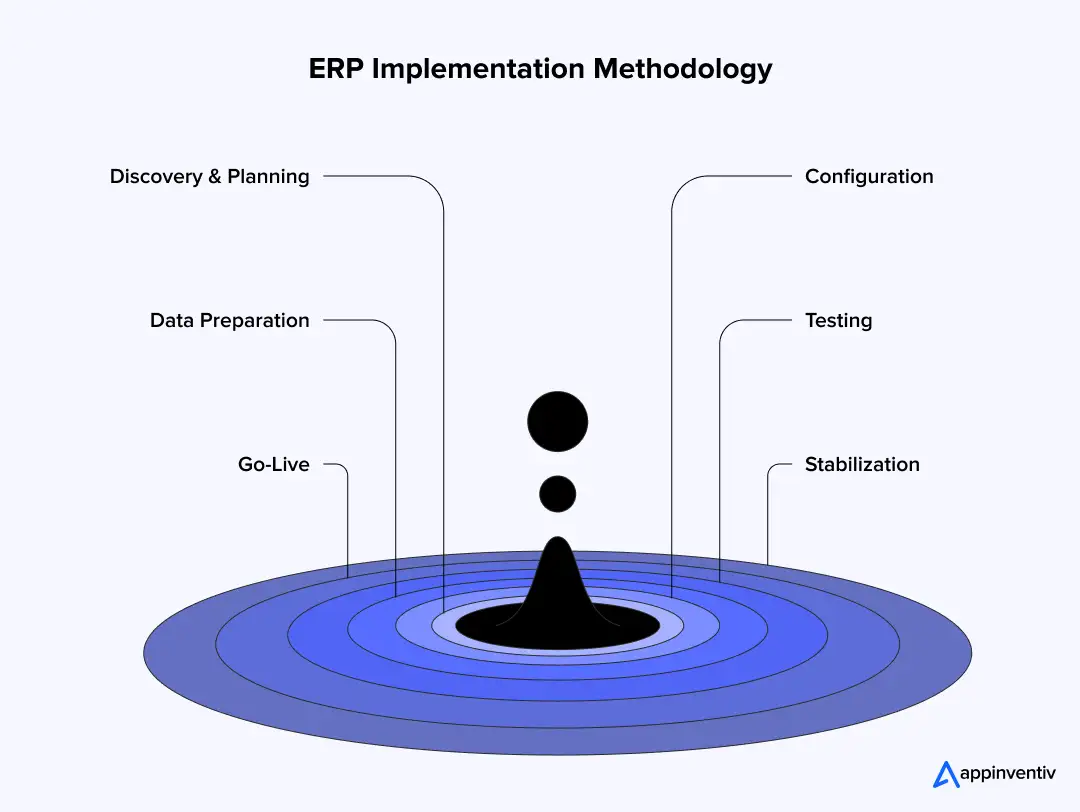
A typical ERP implementation methodology rollout follows these stages:
Discovery and Planning (~$5K–$40K)
Processes, integrations, compliance needs, and scope boundaries are defined. Strong discovery prevents costly scope changes later.
Configuration (~$15K–$150K)
Modules, workflows, access roles, and reporting structures are aligned with business operations.
Data Readiness (~$5K–$40K)
Data cleansing, mapping, and validation ensure accurate reporting post-launch.
Testing (~$5K–$25K)
Functional checks and user acceptance testing confirm stability before deployment.
Go Live (~$3K–$15K)
Controlled rollout, monitoring, and immediate support.
Stabilization (~$5K–$30K)
Post-launch adjustments ensure adoption, performance, and reporting accuracy.
A structured lifecycle helps enterprises manage risk while keeping ERP investment aligned with operational goals.
Odoo Implementation Cost by Industry (2026)
The cost of Odoo implementation varies significantly by industry because operational complexity, compliance needs, and integration requirements differ. Even with similar modules, sector-specific workflows often drive different budget ranges.
| Industry | Typical Implementation Cost Range (US 2026) | Key Cost Drivers |
|---|---|---|
| Manufacturing | $150K – $500K+ | Production workflows, inventory traceability, supply chain integration |
| Retail & E-commerce | $80K – $300K | Omnichannel integration, payments, and real-time inventory sync |
| Healthcare | $120K – $400K | Compliance, data security, system validation |
| Distribution & Logistics | $100K – $350K | Warehouse integration, vendor coordination, logistics tracking |
| SaaS & Digital Businesses | $70K – $250K | Billing workflows, CRM integration, analytics reporting |
Industry requirements largely determine how deeply ERP integrates into operations, which ultimately shapes implementation cost.
Odoo Implementation Cost by Business Function
ERP implementation costs often vary by business function because each department has different workflows, reporting needs, and integration requirements. Understanding this helps prioritize rollout phases and budget allocation more realistically.
| Business Function | Typical Implementation Cost Range (US 2026) | Key Cost Drivers |
|---|---|---|
| Finance | $40K – $150K | Reporting setup, compliance, and accounting integrations |
| CRM / Sales | $25K – $120K | Data sync, customer lifecycle workflows, marketing integrations |
| Supply Chain | $50K – $200K | Inventory tracking, vendor workflows, logistics integration |
| HR | $20K – $90K | Payroll alignment, employee data migration, and compliance reporting |
| Operations | $70K – $250K+ | Production workflows, traceability, operational reporting |
Functional priorities often determine implementation sequencing, which directly influences overall Odoo ERP implementation cost.
Ongoing Odoo Maintenance Cost (Annual Ownership)
Once Odoo goes live, spending shifts from implementation to ongoing ownership. Maintenance keeps the system secure, optimized, and aligned with evolving workflows. Most organizations typically budget 15–25% of the initial implementation cost annually for maintenance and operational continuity.
Annual Odoo Maintenance Cost Breakdown (US 2026 Estimates)
| Category | Typical Yearly Cost | What It Covers |
|---|---|---|
| Support & Monitoring | $12K – $40K | Issue resolution, user support, system monitoring |
| Version Upgrades | $3K – $15K | Annual upgrades, compatibility adjustments |
| Enhancements | $6K – $30K | Workflow improvements, minor feature additions |
| Hosting & Infrastructure | $700 – $8K | Cloud, managed hosting, or on-prem upkeep |
Consistent maintenance helps maintain system stability, supports compliance needs, and ensures the ERP continues delivering operational value as business requirements evolve.
Realistic Odoo Implementation Budget Scenarios (2026)
Ranges help, but leadership usually wants context. What does an Odoo ERP implementation cost look like for companies at different growth stages? These scenarios give a practical view.
| Scenario | Typical Budget | Common Scope |
|---|---|---|
| SMB / Focused MVP | $50K–$120K | Finance, CRM, limited integrations, basic data migration |
| Mid-Market Rollout | $120K–$300K | Multiple modules, ERP integrations, structured reporting |
| Enterprise Multi-Region | $300K–$500K+ | Multi-entity finance, compliance, and advanced integrations |
SMB rollouts focus on core modules and a controlled scope. Mid-market deployments involve broader integrations and governance. Enterprise projects require cross-region coordination, compliance alignment, and deeper system integration.
These examples show how scope, integrations, and operational complexity shape Odoo ERP implementation costs more than the platform itself.
Deployment choices shape scalability, compliance readiness, and long-term operational cost stability.

What Are Some Tips to Reduce Odoo Implementation Costs?
When ERP budgets are defined, the real focus shifts to control. Reducing the cost of Odoo implementation is not about cutting features. It is about avoiding rework and managing scope with discipline.
1. Use a Phased Rollout
Start with high-impact areas like finance or CRM Implementation. Expanding gradually reduces risk and stabilizes adoption.
2. Prioritize Core Modules
Most organizations get most of their value from focused modules. Additional functionality can follow once operations settle.
3. Limit Excess Customization
Avoid replicating every legacy workflow. Controlled configuration keeps both implementation and maintenance costs predictable.
4. Select an Experienced Partner
Experienced teams anticipate integration and data risks early, reducing expensive corrections later.
5. Establish Governance Early
Clear scope boundaries and change control processes prevent budget creep.
Cost optimization in enterprise ERP is about sequencing decisions strategically, not minimizing investment.
Odoo Licensing and Subscription Cost Structure (2026)
Before you finalize the implementation scope, you need clarity on licensing. Not just the headline price, but how Odoo pricing actually scales as your team grows.
Odoo follows a SaaS-style subscription model. You pay primarily per active user under the Enterprise edition. Community remains open source and free, but it shifts infrastructure, upgrades, and support responsibility to your internal team.
For most US mid-market and enterprise organizations, Enterprise is the realistic choice.
Community vs Enterprise: What Changes Financially?
Community Edition
- License cost: $0
- No official vendor support
- No managed hosting (Odoo.sh)
- Limited advanced apps
- Higher internal maintenance responsibility
Community works when you have strong internal technical ownership and limited compliance exposure.
Enterprise Edition
- User-based subscription model
- Full app suite access
- Vendor support and bug fixes
- Upgrade services included
- Option for managed cloud hosting
Enterprise shifts risk away from internal teams and supports structured growth.
What Is the Odoo ERP Pricing Breakdown? (Subscription Plans 2026)
Odoo Enterprise generally offers three subscription tiers.
Odoo Software Price Breakdown
| Plan | Typical US Pricing (Per User / Month) | Best For |
|---|---|---|
| One App | $0 (single app limit) | Small teams testing Odoo |
| Standard | ~$25–$31 | SMB unified ERP rollout |
| Custom | ~$37–$47 | Mid-market & enterprise deployments |
Standard Plan
- Access to core apps
- SaaS hosting
- No custom modules
- Limited API flexibility
Custom Plan
- Full app access
- API access for integrations
- Multi-company support
- Odoo.sh hosting option
- Custom workflow flexibility
For enterprises planning multi-entity operations, integration-heavy workflows, or compliance-driven reporting, the Custom plan is typically required.
How Per-User Licensing Scales
This is where the budgeting of Odoo software price becomes concrete.
Example:
50 users on Custom plan
≈ $40 × 50 × 12 months
≈ $24,000 annually in subscription cost
At 200 users, licensing alone approaches $96,000 per year.
That is still materially lower than many legacy ERP platforms. However, user growth projections should be built into a three to five-year TCO model, not treated as static.
Important detail: not every employee needs a paid license. Operational staff can sometimes interact via portals or structured workflows without full user access, which helps control Odoo ERP cost.
App Selection and Cost Reality
Odoo’s model is user-based, not app-based. Adding more apps does not increase subscription cost directly.
What increases instead:
- Implementation hours
- Training effort
- Configuration complexity
- Integration scope
Licensing remains predictable. Implementation cost grows with operational depth.
Third-Party Module Costs
The Odoo ecosystem includes thousands of add-ons. Many are free. Others range from $50 to several hundred dollars annually per module.
Common enterprise purchases include:
- Shipping connectors
- Advanced reporting packages
- Payroll extensions
- Warehouse management enhancements
- Industry compliance modules
Individually minor. Collectively meaningful.
What Enterprise Leaders Should Evaluate
When structuring licensing budgets, most CFOs focus on:
- Realistic user adoption growth
- Plan tier alignment with integration needs
- Hosting strategy implications
- Multi-company requirements
- Upgrade cycle stability
Licensing will not dominate your Odoo ERP implementation cost. Still, it defines your recurring ERP cost baseline. Getting this right early prevents friction during expansion phases.
Total Cost of Ownership (TCO) for Odoo ERP Implementation
Implementation cost usually gets the first spotlight. Still, most enterprise teams quickly look beyond launch because ongoing ERP expenses often shape the real financial picture. Understanding Odoo ERP cost through a total cost of ownership lens helps avoid underestimating long-term investment.
Implementation vs Lifecycle Cost
Before diving into specifics, it helps to separate one-time implementation expenses from recurring operational costs.
| Cost Category | Typical Cost Range (US) | What It Includes |
|---|---|---|
| Implementation | $50,000 – $500,000+ | Configuration, integrations, data migration, training |
| Lifecycle Costs (Annual) | $20,000 – $120,000+ | Licensing, hosting, maintenance, support |
Implementation gets the system operational, while lifecycle costs ensure continued performance and scalability.
Subscription Renewals
Licensing is usually the most predictable recurring expense, and user growth directly affects it.
| Plan Type | Typical Cost Per User (Monthly US) | Example Annual Cost |
|---|---|---|
| Standard | ~$25–$31 | 100 users ≈ $30K/year |
| Custom | ~$37–$47 | 100 users ≈ $45K/year |
As adoption expands across departments, subscription costs typically scale gradually.
Maintenance Costs
Maintenance spending often depends on how actively the ERP environment evolves after deployment.
| Maintenance Type | Typical Annual Cost | What It Covers |
|---|---|---|
| Basic Support | $8,000 – $25,000 | Minor updates, monitoring |
| Advanced Support | $25,000 – $60,000+ | Optimization, adjustments, ongoing improvements |
Consistent maintenance helps prevent operational disruptions over time.
Hosting Lifecycle Costs
Deployment choices influence infrastructure spending, so comparing options early helps budgeting.
| Deployment Model | Typical Cost Range | Notes |
|---|---|---|
| Odoo Online (SaaS) | Included in subscription | Predictable recurring cost |
| Odoo.sh Managed Cloud | ~$200 – $1,500/month | Depends on usage |
| On-Premise Hosting | $5,000 – $25,000/year | Infrastructure + IT resources |
Infrastructure planning plays a significant role in long-term ERP cost stability.
Support Contracts
Support models vary depending on internal expertise and operational risk tolerance.
| Support Model | Typical Cost | Best Fit |
|---|---|---|
| Internal ERP Team | Variable payroll cost | Large enterprises |
| Vendor Support Partner | $15,000 – $50,000/year | Mid-market to enterprise |
Reliable support ensures smoother operations after go-live.
Looking at Odoo implementation through a TCO perspective helps leadership move from short-term budgeting toward sustained operational value.
What Are the Enterprise Benefits of Odoo Implementation?
ERP investments are rarely about cost reduction alone. Most enterprises adopt Odoo to improve operational visibility, streamline workflows, and support long-term growth. When implemented effectively, the benefits go beyond system consolidation.
Unified Data Visibility
Finance, operations, and sales teams work from a single data source, improving reporting accuracy and decision speed.
Process Efficiency Gains
Standardized workflows reduce manual handoffs, improve inventory tracking, and align billing cycles, which lowers operational friction.
Compliance Readiness
Centralized data and structured audit trails help meet regulatory requirements and simplify audit preparation.
Scalability Advantages
ERP creates a stable foundation for expansion across regions, departments, or higher transaction volumes without constant system changes.
Operational Cost Optimization
Savings typically come from reduced manual work, fewer reporting inconsistencies, and better procurement tracking rather than direct cost cuts.
Overall, Odoo implementation helps enterprises build connected operations where data, workflows, and decision-making stay aligned as the business grows.
Odoo Implementation Partner Pricing and Expected ROI
Implementation partner pricing usually follows hourly or packaged models. In the US market, consulting rates typically range from $120 to $180/hour for US experts, $60–$110/hour for nearshore teams, and $25–$60/hour for offshore specialists. Many enterprises use a hybrid approach, combining local strategic oversight with offshore execution to balance cost and expertise.
ROI often becomes visible within 12–20 months after deployment, mainly through efficiency gains and automation.
| Impact Area | Typical Improvement |
|---|---|
| Manual work reduction | 30–55% |
| Order processing speed | 20–40% faster |
| Inventory cost reduction | 10–25% |
| Administrative productivity | 15–35% |
When implemented well, Odoo helps unify operations, reduce errors, and improve decision-making through better data visibility.
Compare realistic scenarios before finalizing scope, integrations, timelines, and budget commitments.

Sample Odoo Implementation Budget (US Example)
To make budgeting more tangible, here is a simple example of how the cost of Odoo implementation may look for a mid-sized US business. Actual numbers vary based on scope, integrations, and customization level, but this provides a practical planning reference.
| Category | Estimated Cost |
|---|---|
| Licensing (30 users) | ~$8,500–$9,000/year |
| Core Implementation | ~$50,000–$60,000 |
| Integrations | ~$10,000–$15,000 |
| Data Migration | ~$6,000–$10,000 |
| Training | ~$5,000–$8,000 |
| Hosting | ~$2,000–$3,000/year |
| Maintenance (Year 2+) | ~$15,000–$20,000/year |
Estimated Year 1 Total: ~$90,000–$105,000
This example highlights how implementation, integrations, and training typically form the highest upfront costs, while licensing, hosting, and maintenance shape ongoing ERP ownership expenses.
Why Choose Appinventiv as Your Odoo Implementation Partner
Choosing the right implementation partner often determines how smoothly ERP adoption progresses. Appinventiv focuses on structured ERP services that prioritize implementation clarity, integration stability, and long-term operational value rather than platform development.
With 10+ years of experience, the team supports enterprises through deployment planning, system integration, and operational alignment. Strong enterprise integration capability helps ensure Odoo connects effectively with finance systems, CRM platforms, supply chain tools, and existing business applications.
A governance-first approach helps control scope, manage risk, and maintain predictable budgets throughout implementation. Security and compliance considerations are built into delivery processes, supporting organizations operating in regulated or multi-region environments.
Key indicators of delivery reliability include:
- 10+ industry certifications supporting enterprise ERP implementation
- 95% client satisfaction rate reflecting consistent delivery quality
- 90% repeat clientele, indicating long-term partnership value
Appinventiv’s global delivery experience allows enterprises to scale ERP implementations across regions while maintaining operational continuity. The focus remains on stable implementation, integration, and adoption support so organizations can extract measurable value from their ERP investment.
Frequently Asked Questions
Q. How long does an Odoo implementation take?
A. Timelines depend on scope and business size. Small or focused rollouts typically take 2–4 months. Mid-market implementations usually run 4–8 months, while enterprise multi-region deployments may extend to 9–15 months. Factors like integrations, data migration complexity, and internal readiness often influence timelines more than the ERP platform itself.
Q. How long to see ROI?
A. Most organizations begin seeing measurable ROI within 12–20 months. Gains typically come from automation, reduced manual work, improved reporting accuracy, and faster operational workflows. ROI speed depends on adoption levels, process alignment, and how effectively integrations and training are managed after go-live.
Q. How should ERP implementation budgets be structured?
A. Budgets should follow a total cost of ownership (TCO) approach. This includes implementation, licensing, hosting, integrations, training, and ongoing maintenance. Planning across a 3–5 year horizon helps finance teams anticipate recurring costs and avoid underestimating long-term ERP investment requirements.
Q. Is Odoo cheaper than SAP?
A. Generally, yes, especially for mid-market companies. Odoo typically uses subscription-based pricing with lower implementation costs, while SAP often involves higher licensing, infrastructure, and customization expenses. Still, the right choice depends on complexity, scalability needs, industry requirements, and long-term business objectives rather than cost alone.
Q. Why do ERP implementation budgets exceed initial estimates?
A. Budgets typically expand due to scope changes, data quality issues, integration complexity, and user adoption challenges. As workflows are mapped in detail, new requirements often emerge. Data migration may uncover inconsistencies that require cleanup. Integrations can demand more effort than expected. Additional training and post-go-live refinements also add cost. Most overruns stem from underestimated complexity, not the ERP platform itself.
Q. Why is planning and analysis important before ERP implementation?
A. Planning and analysis help align implementation with business needs, workflows, and company’s structure. A clear business needs assessment supports proper budget allocation, plan selection such as standard plan or custom plan, and preparation for testing, employee training, and challenges. This ensures business processes remain stable while development and implementation move forward efficiently.
Q. Why are training and change management critical for ERP adoption?
A. Effective training and change management improve employee readiness and system utilization during ERP implementation. Ongoing training, clear project communication, and technical assistance help teams adapt to legacy systems transitions, module updates, and external API integrations. Structured training methods, preventive maintenance, and version control practices support smoother adoption and long-term operational stability.

- In just 2 mins you will get a response
- Your idea is 100% protected by our Non Disclosure Agreement.
Oil and Gas ERP Software Development: Features, Benefits, Process, Integration and more
The oil and gas industry operates in a complex and volatile environment. It involves oil and gas exploration, extraction, drilling, production, and transportation. Consequently, the industry faces several challenges, such as fluctuating market demands, stringent regulatory requirements, and the constant pressure to reduce greenhouse gas emissions. Notably, oil and gas production, transport, and processing contribute…

How ERP AI Chatbots Are Reshaping Enterprise Workflows
Key takeaways: ERP AI chatbots turn slow, manual ERP tasks into instant, automated actions. Real-time data, voice commands, and multi-system access make ERP chatbots a game changer. Leading brands like H&M, Unilever, and PepsiCo are already leveraging ERP AI chatbots. AI chatbots improve user adoption by simplifying complex ERP navigation. Challenges like integration, scalability, and…

How ERP eCommerce Integration Can Help Scale Your Business to New Heights
Operating an eCommerce business is a complex process that requires effective management of multiple interconnected components. This includes various activities such as planning and allocation of resources, inventory management, internal communications, etc. What makes eCommerce operations even more challenging is that each area often operates within separate systems, having its unique set of processes. Thus,…









