
































How AI in Media and Entertainment Industry is Revolutionizing the Sector

 Share -


- 01Why AI Has Become a Business Priority for Media and Entertainment Companies
- 0210 AI Use Cases in Media and Entertainment With Real-World Examples
- 03Business Benefits of AI in Media and Entertainment
- 04Business Challenges of Adopting AI in Media and Entertainment
- 05How to Implement AI in Media and Entertainment Workflows
- 06Future of AI in Entertainment and Media
- 07How Appinventiv Helps Media and Entertainment Businesses Build AI That Works at Scale
- 08FAQs

Key takeaways:
- AI now supports the complete media lifecycle, from content planning and production to distribution and monetization.
- Media companies can use AI to reduce repetitive production work without handing over creative control.
- Recommendation, localization, archive search, and advertising offer clear opportunities for measurable business returns.
- Copyright, performer consent, training data, and content provenance require controls before enterprise-wide adoption.
- Businesses should begin with one costly or slow workflow and measure its current performance before introducing AI.
- The future will favour connected, human-reviewed AI systems built around licensed data and existing media operations.
Consider a media company preparing to release a new series across several markets. Its teams must evaluate audience demand, control production costs, prepare regional campaigns, create subtitles and dubbing, manage thousands of digital assets, and improve content discovery after launch. AI can now support each of these activities within the same content lifecycle.
This wider role explains why AI in media and entertainment has become a business priority in 2026. Studios use it to shorten post-production. Streaming companies apply it to discovery and retention. Publishers use it to manage content at scale, while advertisers produce and test campaign variations for different audience segments. As mobile apps reshape the entertainment industry, AI adds another layer of personalization to how audiences discover and engage with content.
For decision-makers, the opportunity goes beyond creating content faster. AI in entertainment can improve asset utilization, support international distribution, reduce manual workloads, and help teams make better programming and investment decisions. It gives media businesses a practical way to respond to rising content demand without increasing costs at the same rate.
Adoption still requires firm controls around copyright, data rights, performer consent, brand safety, and creative ownership. The following ten use cases show where AI is producing business value today and what companies should consider before integrating it into their operations.
Build an AI roadmap that improves production, discovery, localization, and content monetization.

Why AI Has Become a Business Priority for Media and Entertainment Companies
The interest in AI is not coming from technology teams alone. Production heads, editors, marketing teams, and platform owners are all dealing with workloads that have become difficult to manage through conventional processes.
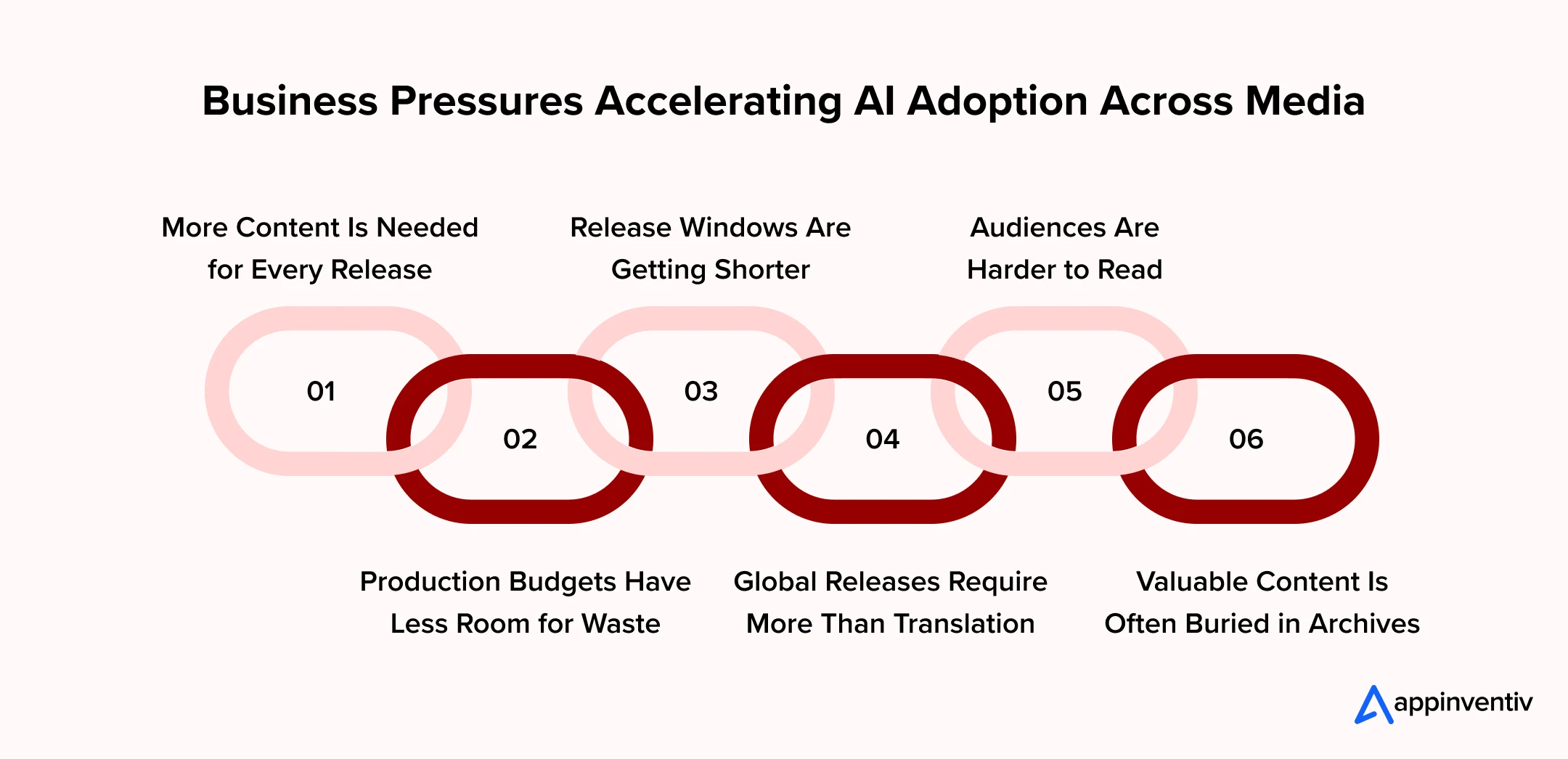
More Content Is Needed for Every Release
Releasing a film, show, game, or album is only part of the work. The same release also needs trailers, short clips, thumbnails, social posts, interviews, and platform-specific artwork. These assets must often be prepared for several audience groups. Artificial intelligence for media & entertainment gives teams a practical way to handle this additional work without expanding every department.
Production Budgets Have Less Room for Waste
Media projects have always involved uncertainty. Teams shoot extra footage, develop ideas that never reach production, and spend hours searching for the right asset. AI is helping them spot some of this waste earlier. It can compare script versions, locate footage, prepare rough edits, and flag technical issues before they become expensive to correct.
Release Windows Are Getting Shorter
A campaign may need to react to latest media trends, audience response, or competitor release within hours. Waiting several days for every new creative version is no longer practical. With AI in media applications, teams can prepare alternatives quickly and decide which ones deserve further work. Editors and marketers still make the final call, but they begin with more options.
Global Releases Require More Than Translation
Content prepared for another country needs accurate dialogue, subtitles, artwork, metadata, and cultural references. A direct translation often misses the original emotion or context. AI can complete the first round of localization and highlight areas that need review. Language specialists then refine the material before it reaches viewers.
Audiences Are Harder to Read
Two people paying for the same streaming service may have little in common beyond their subscription. Their preferred genres, viewing times, devices, and tolerance for ads may be completely different. AI in entertainment helps companies study these differences and make better decisions about recommendations, promotions, advertising, and release schedules.
Valuable Content Is Often Buried in Archives
Broadcasters, studios, labels, and publishers may own decades of material that teams cannot easily search. Files may have weak descriptions, missing tags, or inconsistent rights information. AI can identify people, objects, dialogue, themes, and scenes within these archives. That makes older content easier to reuse, license, package, or promote.
These business pressures are driving AI adoption in media and entertainment. The market is projected to rise from $43.1 billion in 2026 to $159.3 billion by 2033 as companies increase investment across production, streaming, gaming, publishing, and advertising.
Furthermore, the impact of AI in the media and entertainment industry can be seen in how companies are turning once-static archives into searchable commercial assets. With clearer metadata and rights information, teams can uncover licensing opportunities, create new content packages, and earn more from material they already own.
10 AI Use Cases in Media and Entertainment With Real-World Examples
The strongest AI use cases in media and entertainment are not limited to content generation. They cover planning, production, editing, distribution, audience engagement, advertising, and rights protection. Here is how businesses are applying them in practice.
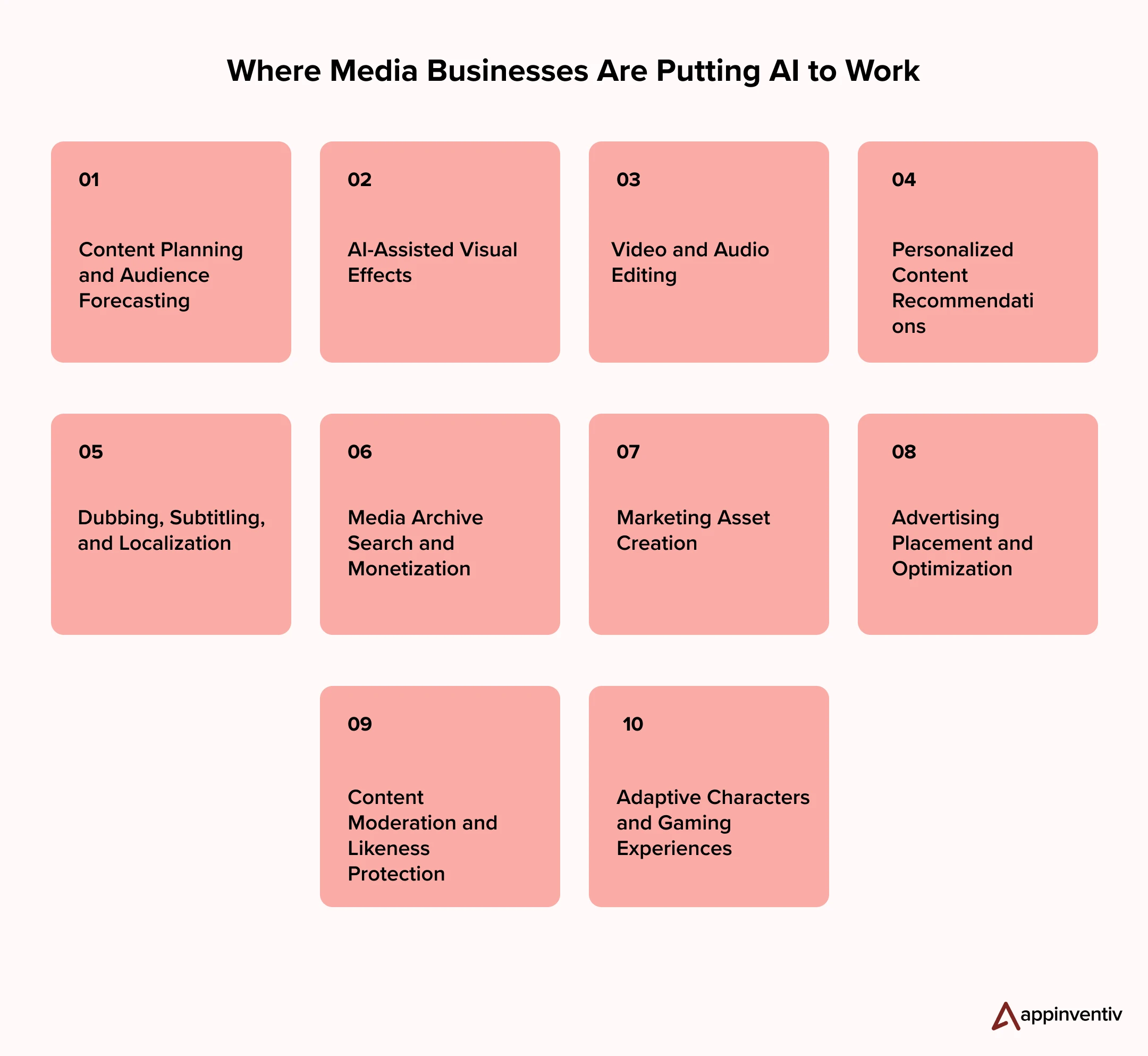
1. Content Planning and Audience Forecasting
Producing a film or series involves substantial financial risk. AI helps studios compare scripts, genres, casting options, audience segments, and past box-office results. These findings give decision-makers another layer of evidence before approving budgets or planning distribution. The final decision remains with producers and studio executives.
Real-world example: Warner Bros. partnered with Cinelytic to use its AI-supported project management system. The platform helps evaluate elements such as talent value, production costs, release strategies, and potential market performance.
2. AI-Assisted Visual Effects
Complex effects often require large teams and months of detailed work. AI can help create background elements, extend environments, increase crowd sizes, remove unwanted objects, and refine difficult sequences. Artists still direct the visual outcome, but they can complete selected tasks faster.
Real-world example: Netflix used generative AI in the Argentine series El Eternauta to create a building-collapse sequence. The company said the sequence was completed ten times faster than it could have been through conventional visual-effects methods. Netflix has since expanded AI use across post-production workflows.
3. Video and Audio Editing
Editors spend considerable time locating clips, cutting footage, correcting colour, cleaning audio, adding captions, and preparing versions for different platforms. AI can handle the first round of this work and leave editorial teams to focus on accuracy, pacing, and the final story.
Real-world example: Reuters partnered with CuttingRoom in 2026 to support AI-assisted newsroom editing. Editors can search verified Reuters footage using plain-language instructions and complete tasks such as cutting, audio mixing, colour correction, captioning, and platform formatting.
4. Personalized Content Recommendations
Large catalogues are useful only when viewers can find something relevant. AI studies viewing history, listening behaviour, skipped content, search activity, and engagement patterns. Platforms use these signals to organize homepages, recommend titles, and bring older content back into circulation.
Real-world example: Spotify’s AI DJ combines its recommendation technology with generative AI and voice commentary. It selects music around a listener’s habits while explaining why particular tracks have been included. The experience gives Spotify another way to improve discovery and maintain listener engagement.
[Also Read: How to Build an AI Voice Agent? Process, Costs & Features]
5. Dubbing, Subtitling, and Localization
Global releases need more than direct translation. Dialogue must preserve meaning, timing, tone, and cultural context. AI can generate transcripts, prepare subtitles, translate speech, and produce an initial dubbed version. Language experts then review pronunciation, emotion, and regional accuracy before release.
Real-world example: Spotify introduced AI Voice Translation for podcasts. The system translates an episode while producing speech that resembles the podcaster’s original voice. This allows creators to reach listeners in other languages without recording the full episode again.
6. Media Archive Search and Monetization
Broadcasters and studios often own thousands of hours of footage with limited or inconsistent metadata. AI can identify speakers, locations, objects, scenes, and key moments within these archives. Teams can then find useful material without reviewing every file manually. Better search also creates more opportunities to reuse or license existing content.
Real-world example: Reuters Imagen integrated Magnifi’s AI technology to tag video, identify key moments, and produce highlights from live and archived footage. Media companies can use the resulting assets across broadcast, social media, OTT platforms, and other digital channels.
7. Marketing Asset Creation
One release may need several trailers, posters, thumbnails, social clips, banners, and regional campaign versions. AI helps marketing teams resize assets, remove or replace backgrounds, generate variations, and adapt creative material for different audiences. Designers retain control over the final output and brand presentation.
The use of AI in social media also helps marketing teams track audience sentiment and refine campaigns around how people respond to each release.
Real-world example: Netflix uses personalized artwork to present different title images to different viewers. Its recommendation systems select artwork based on what may be most relevant to each member, allowing the same film or series to be marketed through several visual angles.
8. Advertising Placement and Optimization
Advertisers want to reach suitable viewers without placing a message beside inappropriate content. AI can assess audience behaviour, scene context, campaign performance, and viewing conditions. Media companies use this information to improve targeting, choose suitable placements, and adjust campaigns while they are still active.
Real-world example: Disney developed an advertising tool called Disney’s Magic Words. It uses AI to examine scenes and identify their mood, content, brands, and imagery. Advertisers can then place campaigns alongside scenes that match a desired emotion or message.
9. Content Moderation and Likeness Protection
Platforms receive more uploads than human review teams can examine individually. AI in media and entertainment apps can flag violent material, harmful speech, copyright concerns, manipulated media, and policy violations. Human reviewers remain necessary for ambiguous cases where meaning depends on satire, reporting, culture, or context.
For businesses planning to create a social media app, moderation tools, reporting options, and review workflows should be part of the initial product scope.
Real-world example: YouTube has expanded AI-based likeness detection to help creators find unauthorized videos that imitate their faces. Eligible creators can review detected content and submit removal requests when their image has been misused.
10. Adaptive Characters and Gaming Experiences
Traditional game characters follow dialogue trees and predetermined behaviours. Newer AI applications in entertainment allow characters to respond more naturally to player questions and actions. Developers can also use AI to test environments, generate early assets, balance gameplay, and explore alternative story paths.
Real-world example: Ubisoft presented NEO NPC, an experimental project involving generative characters that can hold unscripted conversations with players. Writers define each character’s personality, background, and narrative role, while the AI generates responses within those boundaries. The project shows how studios are exploring more responsive game worlds without removing writers from character development.
Build the digital foundation that makes it possible.
Business Benefits of AI in Media and Entertainment
Media companies do not need another tool that only looks impressive in a demonstration. The investment must save time, improve margins, or help content earn more throughout its commercial life.
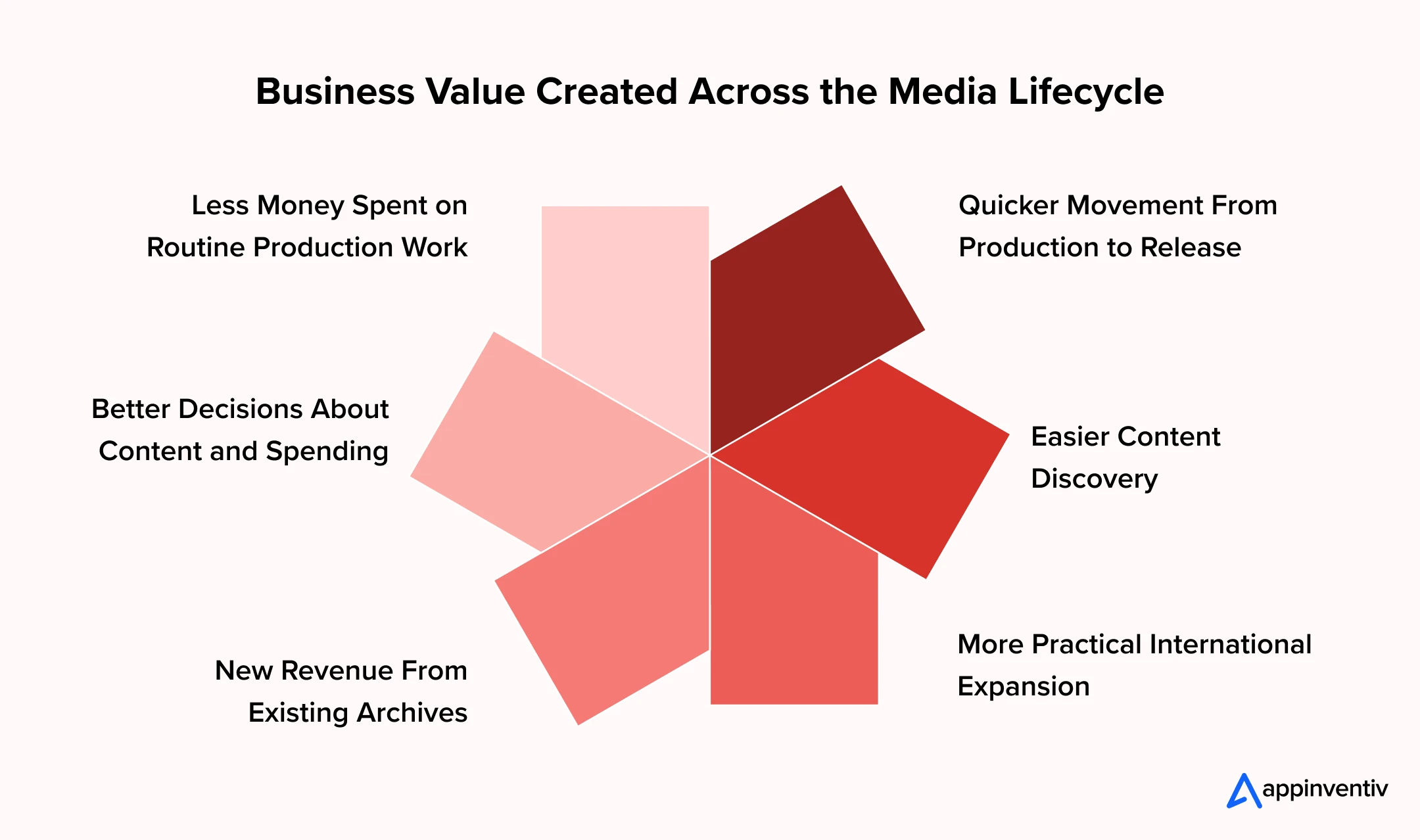
Less Money Spent on Routine Production Work
Transcribing interviews, tagging footage, preparing rough cuts, and resizing campaign assets take hours. Much of this work follows repeatable steps. Automating those steps leaves producers, editors, and designers free to concentrate on decisions that shape the final content.
Quicker Movement From Production to Release
A finished programme can still get delayed by editing, subtitles, artwork, approvals, and platform formatting. AI speeds up parts of this work and reduces handovers between teams. That matters when a campaign depends on a short-lived trend, live event, or fixed release window.
Easier Content Discovery
Viewers rarely browse an entire catalogue. They usually choose from the titles placed in front of them. Better recommendations help audiences find something worth watching or listening to sooner. They also give older titles another chance to attract attention instead of disappearing inside a large library. This builds on the growing role of movie streaming apps in the media industry, where catalogue navigation and viewing convenience shape the audience experience.
More Practical International Expansion
Dubbing and subtitling every release for every market can be expensive. AI-assisted localization lowers the effort required to prepare an initial version. Local specialists can then correct the language, cultural references, pronunciation, and tone before publication.
New Revenue From Existing Archives
Studios, broadcasters, publishers, and sports organizations often hold years of valuable material. Poor tagging makes much of it difficult to find. Once footage becomes searchable by speaker, location, subject, or event, teams can reuse it in new programmes, license it, or turn it into short-form content.
Better Decisions About Content and Spending
Audience behaviour gives businesses useful clues about demand, timing, and format. Teams can use those signals when setting budgets, selecting promotion channels, or deciding whether a title deserves another season. The benefits of AI in media and entertainment become meaningful when they improve such commercial decisions, not when they simply add more software to the workflow.
Business Challenges of Adopting AI in Media and Entertainment
The main difficulties now appear when companies move from small experiments to everyday production. The table below covers the operational challenges businesses face when introducing artificial intelligence in the media industry.
| Challenge | How It Affects the Business | Practical Response |
|---|---|---|
| Unclear Rights Over Training Data | AI vendors may not fully disclose the material used to train their models. This creates uncertainty over whether generated music, images, scripts, or footage can be used commercially. | Select vendors with clear data policies, indemnity terms, licensing records, and enterprise usage rights. |
| Performer Consent and Digital Likeness | Voice cloning, facial recreation, and digital doubles may exceed the consent originally given by actors or presenters. Disputes can delay releases and damage talent relationships. | Define permitted uses, markets, duration, compensation, and reuse conditions in talent agreements. |
| AI Tools Outside Approved Workflows | Creative teams may upload scripts, rough cuts, customer data, or unreleased campaigns to public tools without security approval. | Provide approved tools, restrict sensitive uploads, maintain access logs, and train teams on confidential content handling. |
| Poor Integration With Production Systems | Standalone AI tools often do not connect properly with editing suites, media asset management platforms, rights databases, or approval workflows. | Begin with integration requirements and test the complete workflow before expanding the system. |
| Inconsistent Creative Output | Characters, colours, voices, and visual styles may change between generated assets. These variations create extra correction work and weaken brand consistency. | Use approved reference assets, style controls, review checkpoints, and version histories for every production. |
| Unpredictable Processing Costs | Generating high-resolution video, running models repeatedly, and storing multiple asset versions can increase cloud and computing costs quickly. | Track cost per asset, set usage limits, remove unnecessary versions, and reserve expensive models for high-value work. |
| Difficulty Measuring Commercial Value | A team may produce assets faster without improving revenue, engagement, or production margins. Faster output alone does not prove that the investment worked. | Measure production hours saved, cost per approved asset, localization time, engagement, reuse, and revenue contribution. |
| Limited Control Over Vendor Models | A provider may change its model, pricing, output rules, or data policy. Media companies can then lose consistency or face unexpected migration work. | Avoid placing the entire workflow with one provider. Keep source assets, prompts, metadata, and approval records portable. |
| Weak Content Provenance | Teams may struggle to prove which material was filmed, licensed, edited, or generated. This becomes critical during rights reviews and misinformation disputes. | Record the source, model, edits, approvals, consent, and licensing status of every AI-assisted asset. |
| Skills and Responsibility Gaps | Creative, legal, data, and technology teams may each assume another department has reviewed the output. Important issues are then found close to release. | Assign named owners for creative review, rights clearance, security, accuracy, and final publication. |
How to Implement AI in Media and Entertainment Workflows
Successful adoption starts with a defined business problem, not a collection of AI tools. Businesses need to decide the role of AI in media and entertainment, what data it may access, and who remains responsible for the final output.
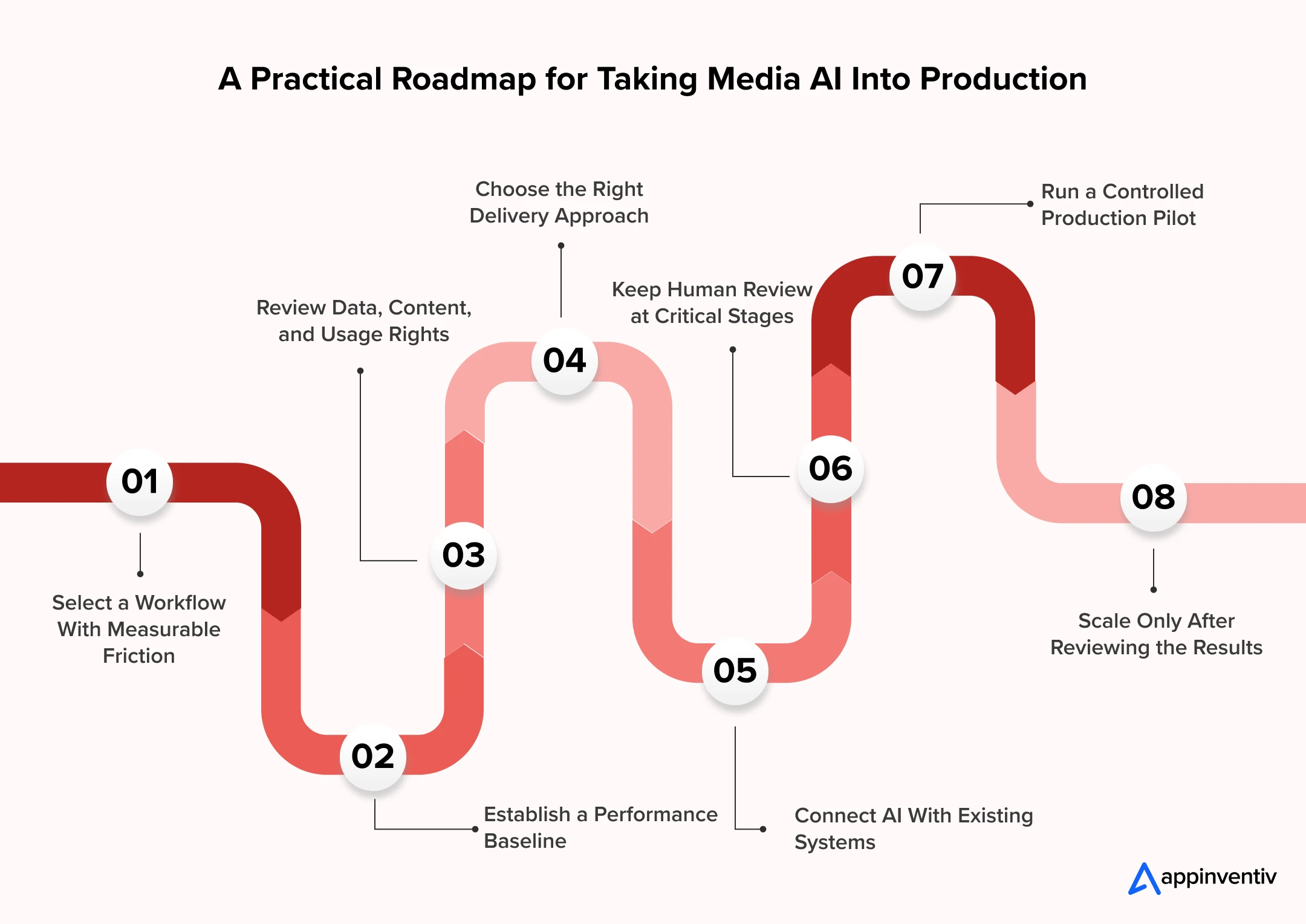
1. Select a Workflow With Measurable Friction
Start with a process that already causes delays or unnecessary expense. Suitable starting points include archive search, transcription, subtitle preparation, rough editing, content tagging, or campaign adaptation.
2. Establish a Performance Baseline
Record the current cost, turnaround time, error rate, and approval effort. Without this baseline, the business cannot determine whether the AI system has delivered a genuine improvement.
3. Review Data, Content, and Usage Rights
Identify which scripts, videos, audio files, viewer records, and licensed assets the system will access. Confirm that existing agreements permit the intended use before sharing material with a model or vendor.
4. Choose the Right Delivery Approach
An off-the-shelf tool may work for standard tasks such as transcription. A custom system is more suitable when the workflow depends on proprietary archives, internal rights data, unique brand rules, or integration with existing production software.
5. Connect AI With Existing Systems
The solution may need to work with editing platforms, media asset management systems, content management tools, analytics platforms, or rights databases. Plan integrations of AI with these apps or systems early to prevent teams from copying files between disconnected systems.
6. Keep Human Review at Critical Stages
Editors should approve final cuts. Language specialists should review localized content. Legal teams should clear rights, while brand teams check public-facing assets. AI should reduce routine work without removing professional accountability.
7. Run a Controlled Production Pilot
Test the system with real content, deadlines, and users. A demonstration using sample files will not reveal integration issues, approval delays, inconsistent output, or unexpected processing costs.
8. Scale Only After Reviewing the Results
Compare the pilot with the original baseline. Review time saved, cost per approved asset, correction rates, audience response, and user feedback. Expand the system only when the results justify wider AI adoption in media and entertainment.
Let our AI specialists help you find it, build it, and take it into production.
Future of AI in Entertainment and Media
The next phase will not revolve around producing more synthetic content. It will focus on placing AI inside everyday workflows while giving creators, rights holders, and audiences greater control over how it is used.
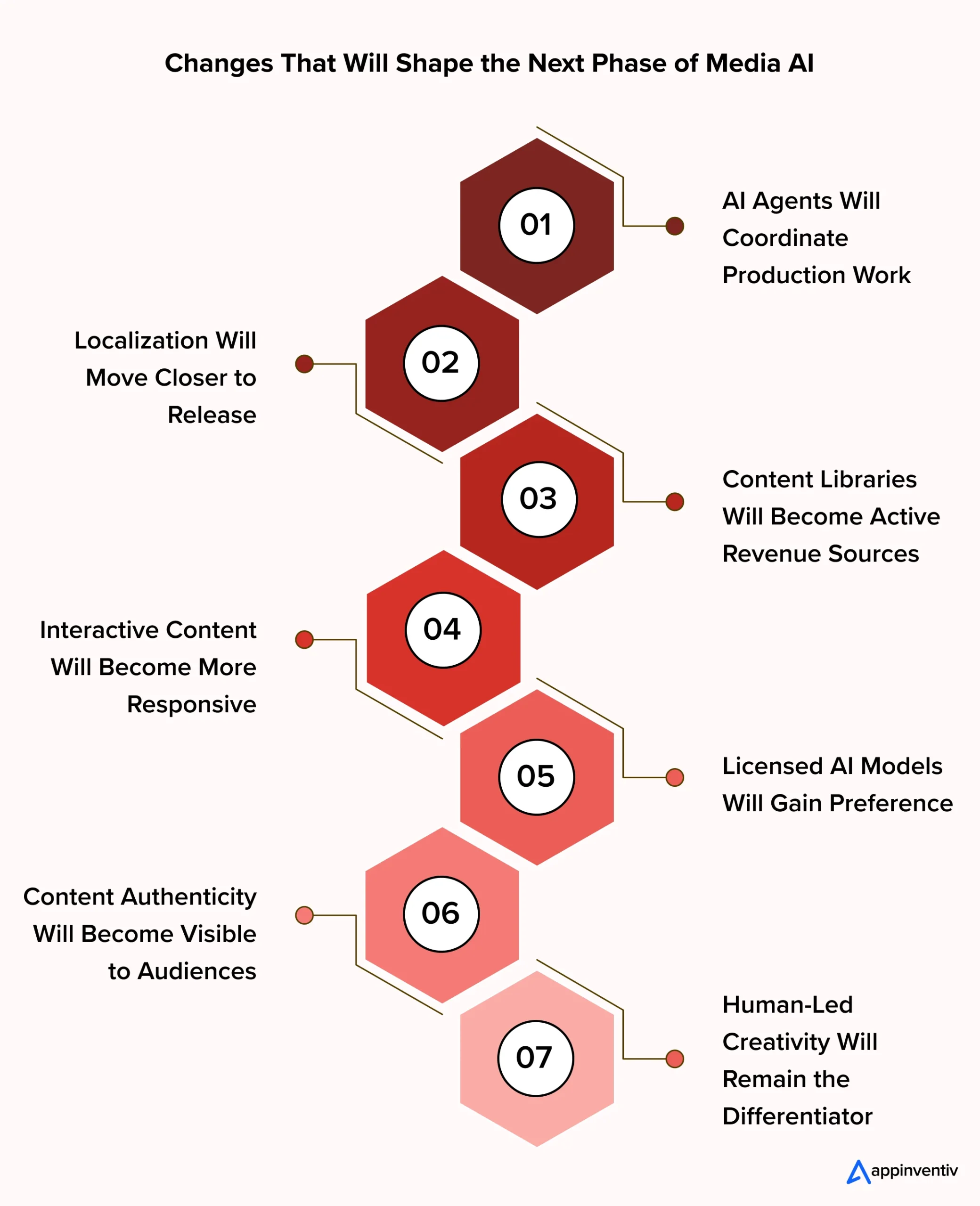
AI Agents Will Coordinate Production Work
AI agents will begin handling connected tasks rather than completing one instruction at a time. An agent could locate footage, prepare a rough cut, generate captions, format versions, and send them for approval. Teams will still set the rules and approve the final material.
Localization Will Move Closer to Release
Dubbing and subtitling will become part of the main production workflow instead of a separate process completed weeks later. This will allow studios to prepare more language versions at launch while retaining closer control over voice, timing, and cultural accuracy.
Content Libraries Will Become Active Revenue Sources
Older footage will no longer sit untouched because it lacks detailed tags. Multimodal AI will make archives searchable by dialogue, person, object, location, event, and mood. Rights holders can then identify clips suitable for licensing, advertising, documentaries, or short-form reuse.
Interactive Content Will Become More Responsive
Games and immersive experiences will respond more closely to player choices. Characters may remember earlier conversations, adjust their behaviour, and react to changing situations. Writers will define the story boundaries, while AI manages variations within them.
Licensed AI Models Will Gain Preference
Media companies will become more careful about the models used in commercial production. Tools trained on licensed footage, music, voices, and artwork will be easier to defend than models with unclear training sources. Rights records and creator compensation will increasingly influence vendor selection.
Content Authenticity Will Become Visible to Audiences
Platforms will introduce stronger labels, provenance records, and detection systems for synthetic media. These controls will help audiences distinguish recorded content from generated or altered material. They will also give businesses a clearer record of how each asset was produced.
Human-Led Creativity Will Remain the Differentiator
AI will make competent content easier to produce. That will also make distinctive ideas, performances, and creative direction more valuable. The future of AI in entertainment will depend less on whether companies can generate content and more on whether they can create something audiences remember.
Together, these future trends of AI in media & entertainment point toward a more connected production environment. The technology will handle a larger share of repetitive execution, while people retain responsibility for taste, context, rights, and final creative judgment.
How Appinventiv Helps Media and Entertainment Businesses Build AI That Works at Scale
A media AI system must do more than generate content. It needs to work with production software, content libraries, audience data, rights records, approval processes, and distribution platforms. A tool that sits outside this environment usually creates more manual work than it removes.
Appinventiv helps media and entertainment businesses identify suitable AI use cases and connect them with measurable commercial goals. Depending on the requirement, this may involve content recommendation, archive intelligence, automated metadata, moderation, localization, audience analytics, or AI-assisted production workflows.
As an entertainment app development company, our teams also build the supporting technology around the model. This includes data pipelines, cloud infrastructure, APIs, user interfaces, access controls, monitoring systems, and integrations with existing media asset management or content management platforms. Each system is designed around the way the business already creates, reviews, and publishes content.
Governance remains part of the development process. We help businesses define how content enters the system, who may access it, where human approval is required, and how generated outputs are recorded. This allows companies to expand AI in entertainment and media without losing control over their content, data, or intellectual property.
Whether the goal is to test one high-value workflow or build a larger AI platform, we can take the project from discovery and prototyping through development, integration, and production deployment.
FAQs
Q. What is AI in media and entertainment?
A. AI in media and entertainment refers to the use of machine learning, generative AI, computer vision, natural language processing, and recommendation systems across media workflows. Companies use these technologies to plan content, edit footage, personalize recommendations, localize releases, manage archives, optimize advertising, and monitor content rights.
Q. How will AI change entertainment and media in the future?
A. The future of AI in entertainment will involve closer coordination between technology and creative teams. AI will handle more of the repetitive work surrounding production, while people continue to control the story, performance, and final release.
Likely changes include:
- Faster dubbing and localization for global releases
- More responsive characters in games and virtual worlds
- AI agents coordinating multistep production tasks
- Better search and monetization of older content
- Stronger tracking of consent, ownership, and content origin
- Greater use of licensed models for commercial production
Q. What are some examples of AI in the entertainment industry?
A. Current AI in media and entertainment examples include Netflix using generative AI for selected visual-effects work, Spotify providing personalized music through its AI DJ, and Reuters using AI to tag footage and create highlights from video archives. Other examples include automated subtitling, voice translation, personalized artwork, content moderation, and responsive game characters.
Q. How does AI help with media content creation?
A. AI supports the work around content creation rather than replacing the entire creative process. A typical workflow may look like this:
- Audience and market research
- Concept comparison and script analysis
- Storyboarding and previsualization
- Rough editing and audio cleanup
- Subtitles, dubbing, and localization
- Campaign asset creation
- Human review and publication
Writers, directors, editors, designers, and legal teams remain responsible for the creative and commercial decisions made at each stage.
Q. How do AI agents work in media and entertainment workflows?
A. AI agents can complete a sequence of connected tasks based on defined instructions and approval rules. For example, an agent may search a media archive, identify suitable footage, prepare a rough clip, create captions, and format versions for different platforms.
The workflow usually follows this order:
- The user sets the task and operating rules.
- The agent searches approved content and data sources.
- It completes permitted production or administrative actions.
- The system records the sources and changes made.
- A designated team member reviews the result.
- Approved content moves to the next production stage.
Q. How is AI transforming media and entertainment?
A. AI is changing how media businesses plan investments, produce content, reach international audiences, and earn revenue from existing assets. Production teams can complete repetitive work faster. Streaming platforms can improve discovery, while rights holders can make large archives easier to search and license.
The larger change is operational. AI in the media and entertainment industry is moving from separate experiments into connected workflows that support production, marketing, distribution, advertising, and audience engagement.
Q. How can businesses measure the ROI of implementing AI in media and entertainment?
A. Businesses should compare results against the cost and performance of the original workflow. The measurement should cover financial returns, operating improvements, and content performance.
Useful ROI measures include:
- Production hours saved per approved asset
- Reduction in editing or localization costs
- Time taken from production to publication
- Percentage of AI output requiring rework
- Increase in archive licensing or content reuse
- Improvement in viewing time or subscriber retention
- Advertising revenue or campaign conversion
- Infrastructure, model, and vendor costs
- Legal, review, and governance expenses
A project has delivered value only when the measurable gain exceeds the full cost of building, running, reviewing, and governing the system.


Fast 2-minute response, fully NDA-protected.

The AI ROI Crisis: Why Enterprises Are Struggling to Prove Value and How to Fix It
Key takeaways: AI ROI is a capital-allocation question. Boards want payback periods and P&L impact. AI ROI challenges rarely have a single cause. Data, legacy systems, use-case choice, ownership and stalled pilots compound each other. Choose two or three outcome metrics per use case, set the baseline first, and report in dollars. Make every further…

Retrieval Augmented Generation in Australia: Architecture, Implementation and Cost
Key takeaways: RAG grounds LLM answers in approved content, improving reliability without retraining a model. Data quality and access permissions decide production outcomes more than the model. Indicative build costs run from AUD 70,000 to 700,000, driven by data and integrations. Measure value against a pre-deployment baseline, separating realised benefits from projected savings. A general-purpose…

The Multiplier Effect of AI Agents: The Rise of AI Swarms
Key takeaways: AI agent swarms coordinate specialized agents to solve complex problems that may be difficult for a single agent to handle effectively. More agents do not automatically mean better outcomes. Swarms deliver value when work can be divided, executed in parallel, and coordinated toward a shared objective. Enterprise readiness depends on governance. Clear accountability,…