































MVP to Market: Realistic Cost, Timelines & Tech Stack for MVP App Development in Australia


- What Defines a True MVP and What Doesn’t
- When to Execute an App MVP: Strategic Use Cases
- How Much Does It Cost to Build an MVP App in Australia?
- How to Optimise MVP App Development Cost?
- How Long Does It Take to Build an MVP App?
- Best Tech Stack for MVP App Development in Australia
- What Are Some Critical Compliance & Security Considerations in Australia?
- Avoiding Common Pitfalls in MVP App Development
- From MVP to Scalable Product: Planning the Future of MVP Mobile App Development
- How to Build an MVP for a Mobile App?
- How Appinventiv Helps Turn MVPs into Market-Ready Products
- FAQs

Key takeaways:
- MVP development costs in Australia typically land between AUD 50,000 and AUD 200,000+, driven by integration depth, security, and delivery shape.
- Time-to-market can vary from 8 to 20 weeks, influenced by integrations, compliance, and feature scope.
- Choosing the architecture and best tech stack for building mvp app early reduces rebuild risk when traction arrives.
- In regulated sectors, privacy, supplier risk, and audit readiness are not “later problems”. They are design inputs.
- Done properly, MVPs reduce commercial risk by proving demand before you fund a full operating model.
The current economic climate in Australia has fundamentally shifted the conversation from “feature parity” to “value validation.” This transition marks a departure from the era of sprawling, multi-year digital transformation budgets toward a more disciplined, evidence-based investment model.
Consequently, MVP app development in Australia has evolved from a startup-centric concept into a sophisticated risk-mitigation tool leveraged by ASX 200 companies and government agencies to ensure capital efficiency.
Consider the trajectory of Canva and Airwallex. These Australian unicorns did not launch with the sprawling feature sets they possess today. They identified a high-friction pain point such as complex graphic design and global payments, respectively and built the leanest possible production-grade solution to solve it. This approach allowed them to capture early adopter data, iterate based on actual Australian user behavior, and secure successive funding rounds backed by hard metrics.
For instance, Canva’s MVP approach enabled it to attract over 300,000 users within its first 12 months of launch in 2013 in Sydney, focusing purely on simplified design tools before scaling to a $42 billion valuation with 260 million monthly active users by early 2026.
Similarly, Airwallex began in 2015 as a targeted solution for cross-border payment inefficiencies for small businesses; by 2025, it achieved $720 million in annualised revenue and processed over $130 billion in annual transaction volume.
Inspired from the structured success of these business giants? Then thai blgo is for you. This e examines how to structure MVP delivery in Australia with realistic cost expectations, governance considerations, and architecture choices that support long-term viability and success in the Australian soil.
MVP delivery should not rely on assumptions. Get a transparent cost range, compliance-aligned architecture, and a realistic timeline roadmap before you commit capital.

What Defines a True MVP and What Doesn’t
The most common point of failure in Australian digital projects is “Scope Creep disguised as an MVP.” To ensure your investment is protected, it is vital to distinguish between different stages of technical validation.
The term “MVP” is frequently misused. For Aussie startups, that confusion causes friction between product, technology, finance, and risk teams.
A prototype is not an MVP. A pilot is not an MVP. A reduced feature build without commercial intent is not an MVP. Below is a practical comparison used in executive workshops.
| Stage | Purpose | Users | Production-Ready | Commercial Intent |
|---|---|---|---|---|
| Prototype | Concept demonstration | Internal | No | No |
| Pilot | Controlled environment testing | Limited | Partially | Limited |
| App MVP | Market validation with real users | External | Yes | Yes |
| Full Product | Scale & optimisation | Broad market | Yes | Yes |
A genuine app MVP is deployable, secure, and usable by paying or target users. It operates in real conditions. It generates measurable data. From a governance perspective, it must meet minimum compliance and cybersecurity thresholds. Anything less introduces board-level risk.
In short, an MVP is not “incomplete” software; it is “focused” software. It must be robust enough to handle real customer data and secure enough to pass a standard vendor risk assessment.
This distinction becomes critical during MVP application development, particularly when external funding or regulated industries are involved.
When to Execute an App MVP: Strategic Use Cases
For Australian leaders, the decision to execute an MVP usually stems from one of four strategic tensions: capital allocation, speed to market, regulatory complexity, or legacy modernisation.
- Market Validation: If you are launching a new consumer-facing service, an app MVP allows you to measure actual user behavior rather than relying on sentiment analysis or focus groups.
- Securing Investment: For founders, a functional MVP with a growing user base is a prerequisite for Series A or B rounds in the current Australian VC climate, where “growth at all costs” has been replaced by “sustainable unit economics.”
- Legacy Transformation: Large organisations often use MVPs to test new digital workflows in specific departments before a national rollout, reducing the risk of widespread operational disruption.
- Regulated Entry: In sectors like Fintech or Healthtech, MVP app development for startups allows for the testing of compliance frameworks such as Consumer Data Right (CDR) integrations on a smaller scale.
How Much Does It Cost to Build an MVP App in Australia?
App development cost estimation in early-stage product discussions often lacks operational realism. Under-scoping is common. So is ignoring compliance overhead.
The typical MVP app development cost in Australia ranges between AUD 50,000 and AUD 200,000+. In regulated or integration-heavy environments, it can exceed that band. Here are some critical cost drivers that materially influence budgets.
Key Factors Affecting the Cost of MVP App Development
- Scope of core features: Number, complexity, and interdependency of core functionalities
- Number of user roles: Distinct access levels, permissions, and workflow variations
- Third-party integrations: External APIs, platforms, and system connectivity requirements
- Payment gateways and financial workflows: Transaction logic, reconciliation, compliance, and settlement processes
- Cloud infrastructure design: Scalability planning, redundancy, regional hosting, resilience
- Data security architecture: Data encryption layers, access controls, monitoring, threat protection
- Compliance mapping and documentation: Regulatory alignment, audit trails, and governance documentation
When organisations build MVP app in Australia, compliance efforts can account for 10–20% of the total budget in regulated industries. That proportion surprises many Aussie startups. So, these are not optional layers. They determine resilience.
If you want a simple sanity check on why security and governance belong in MVP planning, look at the current threat environment. The Australian Cyber Security Centre reports over 42,500 calls to the Australian Cyber Security Hotline in FY2024–25 and over 1,200 incidents responded to.
This is not abstract. It shapes what “reasonable controls” look like, even for early product releases.
MVP App Development Cost Breakdown by the Project Complexity
| Complexity | Estimated Cost (AUD) | Typical Use Case |
|---|---|---|
| Basic MVP | 50,000 – 70,000 | Simple validation app with minimal integrations |
| Moderate MVP | 70,000 – 120,000 | Customer-facing app with APIs, dashboards, payments |
| Advanced MVP | 120,000 – 200,000+ | AI based app features, workflow automation, multi-user environments |
Hidden Cost Drivers and Overlooked Expenses
Many businesses underestimate the “Run” phase of the MVP. To build MVP app in Australia successfully and keep the cost in budget, you must account for:
- Cloud Infrastructure: Monthly AWS or Azure burns can scale quickly if the architecture isn’t optimised for the initial low-traffic phase.
- Security Audits: For any app handling PII (Personally Identifiable Information), a penetration test and security audit are non-negotiable for board-level risk management.
- App Store Compliance: Regular updates to meet evolving iOS and Android privacy guidelines can consume 10% of the initial build cost annually.
- Data Residency: Ensuring data stays on Australian soil often incurs a premium in managed service configurations.
- MVP Maintenance: During MVP application development, you must allocate a post-launch enhancement buffer of at least 15–25% of the initial build cost. Real user feedback always surfaces refinements.
How to Optimise MVP App Development Cost?
To keep your MVP app development cost in Australia manageable, you must account for three core areas:
- Feature Pruning: Using the MoSCoW (Must-have, Should-have, Could-have, Won’t-have) method to aggressively cut non-core features of MVP app in Australia.
- Cross-Platform Frameworks: Using React Native or Flutter to build for iOS and Android simultaneously, typically saving 30% in development cost and time.
- BFF (Backend for Frontend) Patterns: Streamlining API interactions to reduce complex backend logic during the initial phase.
How Long Does It Take to Build an MVP App?
There is often pressure to “move fast” when building an MVP. In practice, Australian projects that skip early validation or compliance checks usually slow down later. Architecture decisions, security controls, and integration planning need to be addressed upfront. Otherwise, teams spend months correcting avoidable gaps.
For most organisations, a realistic MVP timeline falls between 3 and 9 months. The exact duration depends on feature depth, integration exposure, and regulatory obligations.
Why Some MVPs Sit at Three Months and Others at Nine
A focused product with limited integrations and straightforward workflows can reach market closer to the three to four month mark.
Where integrations involve banking systems or sensitive customer data, the timeline naturally extends. Additional security layers, audit preparation, and performance validation take time.
Experience shows that compressing testing or governance rarely shortens the overall journey. It simply shifts effort to post-launch correction, which is almost always more expensive, time taking and disruptive.
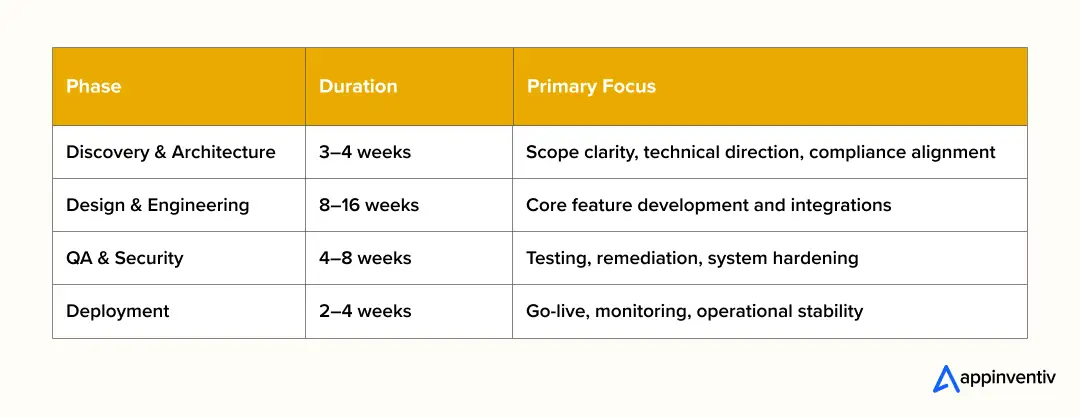
Let’s have a quick breakdown of practical delivery phases along with the key actions executed at each stage:
Discovery and Architecture (3–4 weeks)
Workshops with founders and stakeholders. Clear problem definition. Technical approach agreed. Early compliance mapping and infrastructure planning are completed before engineering begins.
Design and Core Engineering (8–16 weeks)
User experience design, backend and frontend build, API integrations, and cloud configuration. Features are delivered in working increments so feedback can be incorporated without disrupting momentum.
Quality Assurance and Security Validation (4–8 weeks)
Functional testing, performance checks, security review, and remediation cycles. In regulated environments, this stage may include documentation and audit preparation.
Deployment and Release Stabilisation (2–4 weeks)
Production setup, monitoring configuration, staged rollout, and close observation of real-world usage. Early fixes are handled quickly to avoid technical debt accumulation.
Best Tech Stack for MVP App Development in Australia
In the Australian sectors, selecting the app tech stack is a decision regarding long-term Total Cost of Ownership (TCO). You should prioritise frameworks that offer a high density of local talent and a robust security posture.
Frontend Technologies
For most Australian MVPs, the debate centers on cross-platform efficiency versus native specialised performance.
- React Native: Remains the “safe bet” for Australian startups. In 2026, the adoption of the New Architecture (Fabric) has eliminated legacy bridge bottlenecks. It is ideal for teams looking to leverage existing web (React) talent and ensure a fast MVP app development in Australia.
- Flutter: Increasingly popular for design-led brands in Sydney and Melbourne. Flutter’s Impeller rendering engine provides 120 FPS performance, making it the choice for visually ambitious products.
- Swift / Kotlin: Reserved for high-compliance fintech or biotech applications that require deep, low-level integration with iOS and Android hardware (e.g., advanced biometrics or background mesh networking).
Backend & APIs
- Node.js (NestJS/TypeScript): The standard for rapid MVP application development. Its non-blocking I/O is perfect for the high-concurrency needs of consumer-facing apps.
- Python (FastAPI): This is recommended for any MVP featuring ML and AI integration in Australia. Its native support for asynchronous tasks makes it incredibly performant for real-time data processing.
- Go (Golang): Used increasingly in Australian infrastructure-heavy projects (mining/logistics) for its superior performance in microservices.
Cloud & Infrastructure (The Sovereignty Lens)
Cloud and infrastructure choices are where many Australian projects fail their first audit.
- AWS (Sydney/Melbourne): The default for scalability. Features like AWS Nitro provide the high-level isolation required for enterprise-grade security.
- Microsoft Azure: The backbone for the Australian government and healthcare sectors due to its integrated Identity and Access Management (IAM) and native compliance templates for the Information Security Manual (ISM).
- Google Cloud (GCP): Frequently chosen by data-intensive startups for its superior BigQuery and AI Vertex integrations.
Also Read: AWS Vs Azure Vs Google Cloud – Which Cloud Platform to Choose
Data Layer: Balancing flexibility with auditability
The database decision affects reporting, compliance, and performance.
- PostgreSQL: Strong default for transactional reliability, reporting, and structured data integrity.
- MongoDB: Useful when the data model is evolving rapidly and flexibility is required.
- Managed Database Services: Reduce operational overhead while improving backup, scaling, and reliability.
- Governance Consideration: Data classification and retention decisions should inform schema design and storage policies early.
Critical Considerations:
- Data Residency: All PII (Personally Identifiable Information) must stay within Australian borders to satisfy major business procurement rules.
- DevSecOps: Treat infrastructure as code (Terraform/Pulumi), ensuring that security guardrails are baked into the MVP development process in Australia.
What Are Some Critical Compliance & Security Considerations in Australia?
For an Australian technology leader, compliance is not a checkbox; it is a foundational architectural requirement. This includes:
Privacy Act 1988 & 2024–2026 Reforms
Recent updates to the Privacy Act 1988 have heightened the accountability of Australian businesses. By December 2026, new transparency obligations regarding Automated Decision-Making (ADM) will be mandatory. If your MVP uses an algorithm to approve a loan or triage a patient, your architecture must be “explainable” by design to meet the OAIC’s updated standards.
ASD Essential Eight Maturity
The Australian Signals Directorate (ASD) recommends the Essential Eight as the baseline for cyber resilience. For an MVP, it means targeting Maturity Level 1 or 2, focusing on:
- Application Control: Preventing unauthorised code execution.
- Multi-factor Authentication (MFA): Enforced on all administrative and high-risk user access points.
- Regular Backups: Automated and stored in a physically separate Australian region.
Industry-Specific Frameworks
- Fintech: Alignment with the Consumer Data Right (CDR) and PCI-DSS for payment integrity.
- Healthtech: Adherence to My Health Record integration standards and HIPAA-aligned (adapted for AU) encryption.
- Govtech: Ensuring the stack meets the IRAP (Information Registered Assessors Program) assessment requirements for secure government data.
The Australian Cyber Security Centre emphasises that organisations must be prepared to detect and respond to cyber incidents quickly. This reinforces the importance of logging, monitoring, and recovery planning even for early-stage systems.
Avoiding Common Pitfalls in MVP App Development
Most MVP failures are not engineering failures. They are decision failures. So, before you go for MVP app development for startups, you should steer clear of some common mistakes that businesses often make:
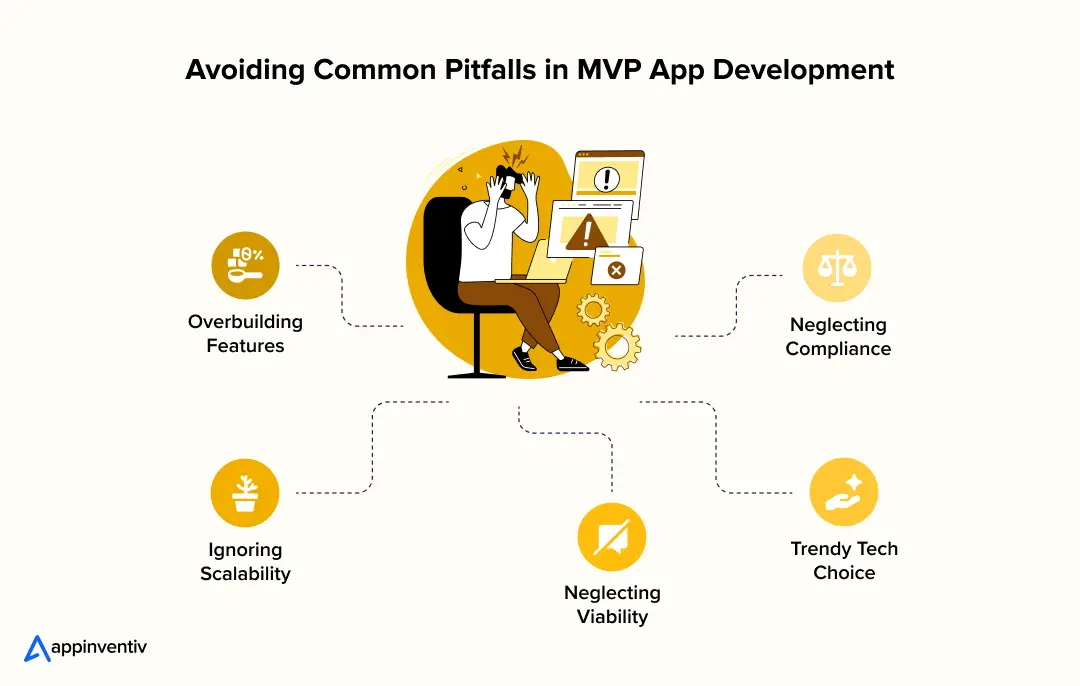
1) Overbuilding Features: The “Minimum” in MVP is often ignored. Every extra feature at launch increases your MVP app development cost in Australia and dilutes the data you collect.
2) Neglecting the “V” (Viability): A product that is buggy or non-compliant isn’t an MVP; it’s a liability.
3) Ignoring Scalability Planning: You do not need full scalability for an MVP, but you do need an architecture that can scale without rewrite. We choose patterns that allow controlled evolution.
4) Choosing Tech Because It Is Fashionable: “Modern” is not a strategy. The right tech stack decision is something that can support, and govern.
5) Skimping on Onboarding and UX: Even a strong MVP may fail if users cannot complete the core journey. Adoption friction kills learning.
6) Treating Compliance as a Post-launch Activity: This is where Australian teams get burned. Privacy, access, logging, and vendor controls are cheaper when designed early.
Translate your product vision into a technically sound, scalable MVP designed for Australian regulatory and integration realities.

From MVP to Scalable Product: Planning the Future of MVP Mobile App Development
The launch of an app MVP is not the finish line; it is the point where the actual work of product-market fit begins. In the Australian market, where user acquisition costs are high, the transition from validation to growth must be data-driven and architecturally sound. Here is how you can do it:
Using MVP Analytics to Guide Roadmap Decisions
User behaviour data, retention metrics, and usage frequency should inform prioritisation. Assumptions should not drive scale investment.
Refactoring vs Scaling Architecture
If early build choices were pragmatic but limited, refactoring may be necessary before aggressive scaling. This is not failure. It is disciplined progression.
Investor Readiness & Funding Rounds
Structured documentation, security posture clarity, and measurable traction strengthen funding discussions.
Also Read: App Funding in Australia (2026): Grants, R&D Tax & More
How to Build an MVP for a Mobile App?
The right approach to create a minimum viable product balances speed, governance, and measurable learning. Each stage of MVP app development process in Australia reduces uncertainty while ensuring the product remains secure, scalable, and operationally viable.
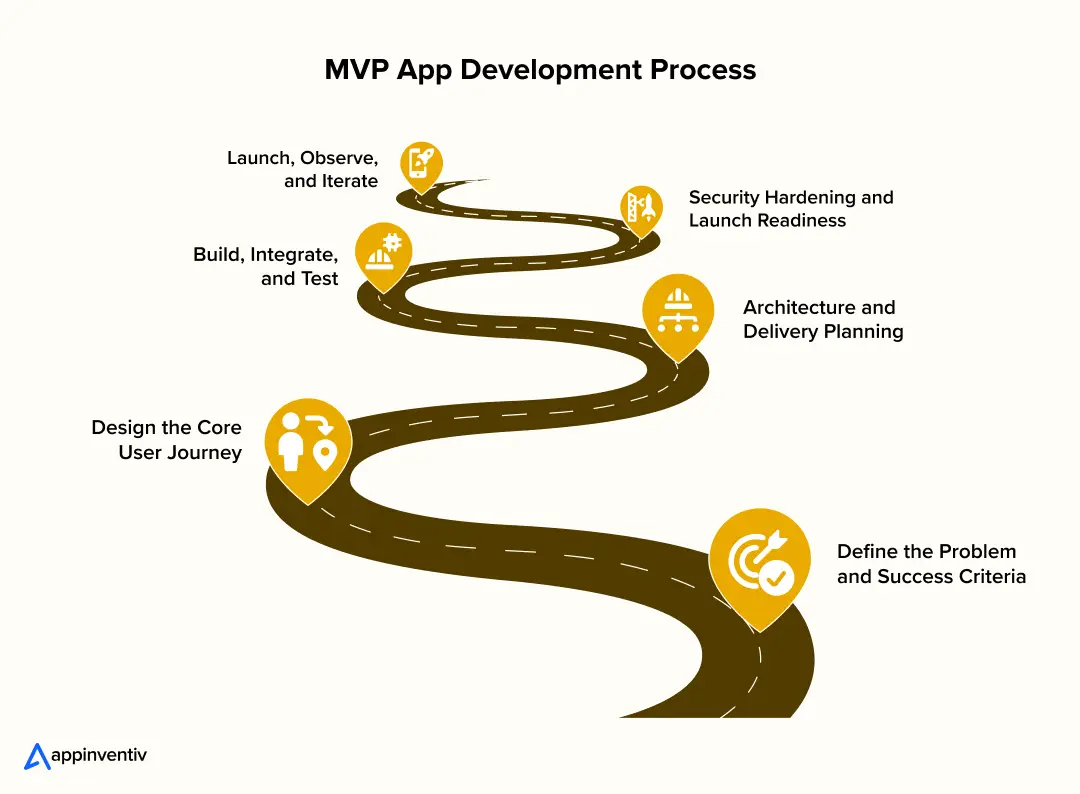
Step 1: Define the Problem and Success Criteria
Estimated cost: AUD 6,000 – 15,000
Before writing code, leadership alignment is essential. This stage converts assumptions into testable hypotheses and ensures success is measured using business outcomes rather than feature completion. It also establishes governance clarity early, avoiding misalignment later.
- clarify the business hypothesis
- define measurable success indicators
- identify regulatory and data considerations
- align decision-makers on delivery cadence
Clear success criteria prevent scope drift and protect investment focus.
Step 2: Design the Core User Journey
Estimated cost: AUD 8,000 – 20,000
An MVP succeeds when users can complete the primary task quickly and without friction. Designing the core journey ensures the product validates real behaviour rather than theoretical workflows. It also prevents rework caused by usability failures.
- map primary workflows and edge cases
- design onboarding and accessibility flows
- define analytics events for measurement
A well-designed journey improves adoption and produces meaningful usage insights.
Step 3: Architecture and delivery planning
Estimated cost: AUD 10,000 – 25,000
This stage determines whether the MVP becomes a scalable platform or a short-lived prototype. Architectural decisions must support security, integration, and future growth while keeping delivery lean. Governance and infrastructure choices made here influence long-term cost and risk.
- select technology stack and infrastructure approach
- define environments and DevSecOps pipelines
- plan integration and security controls
This planning prevents costly rebuilds when adoption increases.
Step 4: Build, Integrate, and Test
Estimated cost: AUD 20,000 – 95,000
Execution discipline becomes critical at this stage. The goal is not rapid coding alone, but reliable implementation that supports real usage conditions. Integration accuracy, monitoring readiness, and testing quality determine launch stability.
- implement frontend and backend components
- integrate identity, APIs, and required services
- establish monitoring and automated testing
Delivery discipline here determines reliability and operational confidence at launch.
Step 5: Security Hardening and Launch Readiness
Estimated cost: AUD 6,000 – 25,000
Before release, the MVP must be safe to operate in a live environment. This stage ensures privacy disclosures, vulnerability remediation, and operational readiness align with Australian governance expectations. It protects both users and organisational trust.
- vulnerability checks and remediation
- privacy disclosures and store compliance
- operational monitoring and support readiness
This phase ensures the MVP can be launched responsibly and supported effectively.
Step 6: Launch, Observe, and Iterate
Ongoing investment required
Launch is the beginning of learning, not the finish line. Real user behaviour reveals friction points, adoption drivers, and operational constraints. Continuous observation enables informed decisions about scaling, refining, or pivoting.
- monitor adoption and performance
- gather behavioural insights
- refine features based on usage data
Real learning begins after launch, not before.
Also Read: Guide to Build an AI MVP for Your Product
Whether preparing for funding or enterprise onboarding, ensure your MVP stands up to due diligence, audit scrutiny, and scale expectations.

How Appinventiv Helps Turn MVPs into Market-Ready Products
In a market where execution risk is high, Appinventiv, as an experienced mobile application development company in Australia, serves as a strategic delivery partner for organisations that demand more than just code. We provide the governance-first approach necessary for the MVP app development in Australia.
Why Partner with Appinventiv?
- Australia-Centric Expertise: Our 10+ years of APAC delivery experience have made us understand the nuances of the local market, from Sydney’s fintech standards to the operational needs of Perth’s resources sector.
- Compliance-First Culture: We don’t just “add security” at the end; it is baked into our MVP app development cost in Australia from day one.
- Proven Delivery with Australian Business: Our experience working with Aussie businesses like Lite N’ Easy, Multinail and Rapid Teachers has strengthened our ability to delivery project with different complexities from MVP to enterprise grade applications.
- Scale-Ready Delivery: Our team of 1600+ tech experts is trained in delivering digital strategy consulting services in Australia for private, public and regulated industries, ensuring your MVP can handle 10,000 users as easily as it handles 10.
Our Proven Track Record in APAC
- 3000+ Digital Assets Deployed in Australia
- 78% Client Retention Rate
- 35+ Industries Digitally Transformed
- 5+ Agile Delivery Centers Across Australia
- 35% Efficiency Gains in Australian Enterprises
Are you ready to move your concept to the Australian market with a high-performance MVP?
Get a Custom MVP Cost Estimation Today
FAQs
Q. What is MVP in app development?
A. MVP app development in Australia is the most basic version of a new application that allows a team to collect the maximum amount of validated learning about customers with the least effort.
- Core Purpose: To test a fundamental business hypothesis before committing to full-scale development.
- Viability: It must solve a real problem for a specific user group (the “Painkiller” test).
- Minimum: It includes only the non-negotiable features required to facilitate the user’s primary journey.
Q. What an app MVP launch should look like?
A. An MVP launch in Australia should feel polished and secure, even if the feature set is narrow. It should look like:
- A Frictionless Core Loop: The primary action (e.g., booking a service or viewing a report) must be flawless.
- Governance-Ready Infrastructure: Data must reside in Australian cloud regions (Sydney/Melbourne) with transparent privacy disclosures.
- Integrated Feedback Loops: Users should have a direct channel within the app to report issues or suggest improvements.
- High Performance: Even at low volume, the app must be fast and responsive on modern Australian mobile networks (5G).
Q. How MVP Development in Australia Transforms Ideas?
A. In the Australian market, an MVP acts as a functional learning engine that converts unvalidated assumptions into proprietary data.
- Evidence over Intuition: It provides the hard data (e.g., 30-day retention rates) needed to justify internal CAPEX or secure Series A/B funding from local VCs.
- Regulatory Sandbox: It allows businesses to test compliance with Consumer Data Right (CDR) or My Health Record on a controlled user group.
- Market Alignment: It adapts global ideas to local nuances, such as Australia’s unique logistics challenges or specific payment preferences.
Q. Why MVP Development Matters for Australian Businesses?
A. For Australian firms navigating high labor costs and strict regulatory oversight, the MVP model is a critical risk-management tool.
- Resource Optimisation: It prevents the 64% feature waste typical in “Big Bang” releases where features are built but never used.
- Speed to Market: Launching in weeks rather than months allows you to capture early adopters and establish a brand presence before competitors.
- Capital Preservation: It reduces initial development spend by 40–60% compared to full-product builds, protecting the balance sheet.
- Risk Mitigation: 42% of failed Australian startups cite a “lack of market demand” as their primary reason for failure, a risk the MVP directly addresses.
Q. What are the benefits of building an MVP app?
A. There are several benefits of MVP app development. Some of the most common ones are:
- Validates real market demand before full-scale investment
- Reduces upfront development cost and financial exposure
- Accelerates time-to-market with focused core features
- Generates early user feedback for data-driven improvements
- Attracts investors with a working proof of concept
- Minimises technical risk through staged development
- Enables controlled scalability planning from the start
- Improves product–market fit through iterative refinement
- Prevents overbuilding unnecessary or low-value features
- Establishes measurable success metrics early in the journey

- In just 2 mins you will get a response
- Your idea is 100% protected by our Non Disclosure Agreement.

How to Build a Forex Currency Trading App for Multi-Currency Trading in the UAE
Key Takeaways: In the UAE, regulation comes first. Your licensing choice will shape how the entire platform is built. A forex app here needs more than charts. It needs a solid trading engine, strong liquidity connections, and reliable risk controls. AED funding, USD settlement, Islamic swap-free accounts, and Arabic support are practical requirements, not optional…

A Guide on How to Choose the Right Mobile App Development Company in Iraq
Key Takeaways Define business goals, integrations, compliance needs, and success metrics before engaging a development partner. Prioritise teams experienced in Arabic/Kurdish localisation, RTL UX, and testing on low-spec Android devices common in Iraq. Evaluate architecture maturity, security standards (SOC2/ISO), and CI/CD practices rather than focusing only on development cost. Ensure the application is designed for…

How Much Does It Cost to Build a Calorie Counting App Like Cronometer in Australia
Key takeaways: Building a calorie counting app with Cronometer-level accuracy in Australia typically costs between AUD 70,000 and AUD 700,000+, depending on data depth, compliance posture, and analytics sophistication. Underestimating compliance, data licensing, and post-launch governance is the most common cause of budget overruns for Australian nutrition platforms. The hard cost driver is not screens.…