






























A Guide on How to Choose the Right Mobile App Development Company in Iraq


- Why Choosing the Right Mobile App Partner Matters
- Start With Internal Clarity: Outcomes, Scope and Constraints
- How to Evaluate a Mobile App Development Partner
- Technical Evaluation: Architecture, Stack and Scalability
- Security, Privacy and Compliance
- Localisation and UX for Arabic and Kurdish Users
- Integrations with Local Services: Payments, Telecom and Government APIs
- Team Composition, Process and Governance
- Typical Cost to Hire a Mobile App Development Company in Iraq
- Post-Launch Runbook, Analytics and Growth Engineering
- Local Dynamics and Enterprise Challenges in 2026
- Common Mistakes to Avoid
- Technical & Procurement Readiness Checklist
- How Appinventiv Supports Your Mobile Transformation
- FAQ'S

- Define business goals, integrations, compliance needs, and success metrics before engaging a development partner.
- Prioritise teams experienced in Arabic/Kurdish localisation, RTL UX, and testing on low-spec Android devices common in Iraq.
- Evaluate architecture maturity, security standards (SOC2/ISO), and CI/CD practices rather than focusing only on development cost.
- Ensure the application is designed for Iraq’s connectivity realities with offline-first workflows and broad device testing.
- Assess experience integrating with enterprise systems, payment infrastructure, and local telecom services.
- Plan delivery and procurement carefully using milestone-based contracts, architecture reviews, and post-launch support models.
Launching a mobile product in Iraq is not a simple development exercise. By the end of 2025, the country had around 50.8 million cellular mobile connections, making smartphones the primary gateway to digital services across sectors.
At the same time, the technology environment is far from uniform. Device capabilities range from premium smartphones in major cities like Baghdad to lower-spec Android devices across wider regions, while connectivity and infrastructure conditions can vary significantly.
In this environment, the success of a mobile product often depends less on the idea itself and more on how well the underlying architecture, localisation strategy, and system integrations are planned from the start.
Organisations that choose the wrong development partner frequently face delayed launches, integration failures with enterprise systems, poor performance on low-end devices, and expensive redesigns after deployment.
This is why selecting the right mobile app development company becomes a strategic decision rather than a procurement task. This guide will help decision-makers approach that decision with clarity.
At Appinventiv, performance is engineered at the architecture level optimised for low-end devices, real networks, and scale.

Why Choosing the Right Mobile App Partner Matters
If your users are in Baghdad, Sulaymaniyah, Kirkuk or other cities of Iraq, the custom mobile app development partner you hire affects operations, scalability and user trust, not just the codebase.
Here are the main reasons you should treat partner selection as strategic:
Business continuity depends on it
An app is often a primary customer touchpoint. A company that struggles with integrations can disrupt workflows, delay services, or create inconsistent data across systems.
Security cannot be a checkbox
In finance, healthcare, logistics or public services, weak security becomes a regulatory and reputational problem. The right partner embeds secure coding, threat modelling and compliance planning from day one.
Short-sighted scaling increases cost
A solution that holds for 1,000 users but fails at 10,000 is expensive to replace. An experienced team of iOS and Android app developers in Iraq designs for growth and new business lines without requiring total rewrites.
Localisation drives adoption
Apps that mishandle Arabic and Kurdish layout, copy or UX usually underperform, especially in bilingual regions like Sulaymaniyah and Kirkuk.
Also Read: How to do Mobile App Localisation to Increase its Conversion Rate by 200%
Maintenance and support matter most after launch
Poor SLAs, slow incident response or no post-release playbook stall adoption. A mature mobile application development partner in Iraq will have documented runbooks for production support.
Data ownership and compliance are non-negotiable
Don’t waive IP clauses or source-code rights. An app development company must disclose how they manage and store user data before you sign.
TCO is more than the build price
Hosting, updates, security audits and monitoring all feed into real ROI. A credible partner presents a long-term operating cost view, not only development estimates.
Selecting a custom mobile app development firm in Iraq isn’t about hiring coders; it’s about partnering with a team that builds secure, scalable, multilingual systems and can support them for years. With high stakes, technical due diligence should be mandatory.
| Quick Decision Summary: Mobile App Development in Iraq (2026) | |
|---|---|
| Decision Area | Quick Guidance |
| Company type | Prefer Strategic Managed Services partners with local delivery and governance. |
| Localisation | Native Arabic & Kurdish reviewers + RTL and font testing. |
| Performance | Optimise for low-end Android; aim <3s cold load for key flows. |
| Security & Compliance | SOC 2 or ISO 27001 readiness; third-party pentest required. |
| Integrations | Middleware for SAP/Oracle; staged contract and API sandboxing. |
| Post-launch | SLA-backed support, monitoring, retention/escrow for handover. |
Start With Internal Clarity: Outcomes, Scope and Constraints
Before contacting mobile app development partner in Iraq, align internally on fundamentals.
Business Outcomes and Target Users
Be explicit: do you aim to grow digital revenue, cut operational costs, improve satisfaction, or comply with regulation?
Identify core user groups: field operators needing offline sync, shoppers in Baghdad, or government staff using secure e-signatures.
Must-Have versus Nice-to-Have Features
List essential features (authentication, payments, core workflows) separately from optional items (personalisation, advanced analytics). This helps the development partner prepare realistic proposals and keeps the scope under control.
Integration Scope
Specify required integrations: ERP, CRM, payment gateways, telco APIs, mapping services and identity providers. Integration effort often accounts for the largest share of the project cost.
Compliance and Security Constraints
If you’re in finance, health or the public sector, capture applicable compliance rules. State whether data must remain in-country and note any contractual privacy requirements.
Budget and Delivery Window
Give a range rather than a fixed figure. As a guideline, scoped MVP development often takes 6–10 weeks; enterprise apps with integrations and governance typically run 4–9 months. Use these ranges to screen development partner’s capacity and pace.
Success Metrics
Pick KPIs now, for example, 30-day retention, crash rate <1%, or average backend response time under 300 ms. They become acceptance criteria for testing.
How to Evaluate a Mobile App Development Partner
A disciplined shortlist reduces procurement noise and focuses on partners who can actually deliver outcomes.
Run an RFI/RFP
Standardise requests and score responses on: team make-up, portfolio evidence, security practices, proposed architecture and ongoing support model.
Portfolio, Client Evidence and Production Experience
Review the company’s portfolio, client testimonials, and independent reviews to understand the type of products they have delivered and the industries they serve. Ask for links to live apps on App Store and Google Play, and check ratings, user feedback, and release frequency. A track record of enterprise applications, payment integrations, and multilingual products is usually a strong indicator of real delivery experience.
Local Presence and Language Capability
A development company with local engagement or experience with bilingual mobile app development in Iraq understand telco limitations and localisation needs. Confirm whether they have Arabic and Kurdish-capable UX writers and testers.
References and Case Studies
Request references on similar projects. If possible, interview a previous client about delivery timeliness, code quality and support responsiveness.
Delivery Maturity
Choose development companies that can explain their SDLC: sprint cadence, QA, security testing and release management. Ask, for example, sprint plans and CI/CD documentation.
Warning Signs
Be wary of companies that have no published apps, avoid IP discussions, cannot show security artefacts, or give vague schedules and budgets.
Practical Scoring Matrix for Choosing an Implementation Partner
When you score proposals, use a weighted matrix.
| Criteria | Weight | What to look for |
|---|---|---|
| Technical competence | 30% | Architecture diagrams, CI/CD pipeline docs, autoscaling plan |
| Security & compliance | 25% | SOC 2 / ISO 27001 evidence, SAST/DAST outputs, pentest summaries |
| Localisation & UX | 15% | RTL examples, Kurdish script support, low-end device screenshots |
| Delivery maturity & team stability | 15% | Staff assignment, turnover rates, sample sprint plans |
| Commercial & support | 10% | TCO clarity, milestone payments, SLA terms |
| References | 5% | Client contact, similar-domain case study, live app links |
Use short, observable evidence for each cell, not impressions. This creates objective comparisons between companies and surfaces hidden trade-offs in proposals.
Appinventiv helps enterprises in Iraq turn validated plans into dependable mobile products.

Technical Evaluation: Architecture, Stack and Scalability
Technical skill separates competent teams from risky ones. The following areas are essential for enterprise mobile app solutions.
Platform Approach: Native vs Cross-Platform
- Native (Swift/Kotlin) fits use cases needing deep hardware access or peak performance (camera, AR, low-level tuning).
- Cross-platform (Flutter, React Native) shortens time-to-market and reduces duplicate work for iOS and Android app developers in Iraq. Flutter often offers a pragmatic balance for many business apps, but requires a justification that covers performance and long-term maintenance.
Ask firms not just which framework they choose, but why. Require a decision matrix that weighs maintenance, developer availability and platform trade-offs.
Backend Architecture and Scalability
Prefer modular backends, microservices or well-structured modular monoliths, fronted by API gateways. For resilience and scale, a provider should propose cloud-managed services, autoscaling and managed databases. Request architecture diagrams showing data flow, caches, load balancing and failover strategies.
Mobile App Technology Stack & Backend Development in Iraq
Ask for a proposed stack and the reasoning behind it. A common enterprise stack might include:
- Frontend: Flutter or native frameworks.
- Backend: Node.js / Java / .NET microservices, PostgreSQL or managed NoSQL.
- Infrastructure: AWS / Azure / GCP managed services, container orchestration or serverless components.
- Observability: centralized logs, APM, crash reporting and product analytics.
A clear CI/CD pipeline description is a sign of operational maturity.
AI and Advanced Capabilities
In 2026, AI-powered mobile app development features such as conversational assistants, recommendations, and on-device ML are in high demand. Development firms must explain mobile app development trends in Iraq, such as model hosting, inference costs and privacy trade-offs. For LLM features, ask about model versioning, prompt governance and content moderation.
On-Device AI & Small Language Models (SLMs) in 2026
In 2026, enterprise mobile applications will increasingly adopt on-device Small Language Models (SLMs) to reduce dependence on constant high-bandwidth connectivity. Instead of sending every request to cloud-hosted AI models, SLMs allow conversational assistance, lightweight personalization, and intelligent classification directly on the device.
For deployments in Iraq, this approach reduces latency in low-connectivity zones, lowers inference costs, and improves privacy since sensitive inputs may not leave the device. Development partners should clarify model size and quantization strategy, device memory and CPU requirements, fallback mechanisms to server inference, and procedures for updating models securely in production.
Testing and Device Coverage
Because many Iraqi users run older Android devices, testing is required on:
- A matrix of device models and OS versions, including low-memory phones such as entry-level Redmi and older Samsung Galaxy A devices.
- Network simulations for 2G/3G/4G and flaky connections.
- Automated regression suites (unit, integration, UI) and manual exploratory testing for localisation.
Device And Testing Matrix Example
Create a device test matrix for acceptance testing. Include a minimum of 20 device models across Android API levels and manufacturers, with categories for memory (512MB, 1GB, 2GB+), CPU tiers, and screen resolutions. Define network profiles for tests: 2G (edge), 3G (variable), 4G stable, and a high-latency intermittent profile.
For acceptance, require automated smoke tests and a manual exploratory session per major locale (Baghdad, Sulaymaniyah).
Connectivity Realism, and Offline-First Engineering
Connectivity conditions vary widely across Iraq, especially for logistics, field operations, and rural deployments. Beyond testing only network speeds, development firms should demonstrate offline-first architecture strategies using local encrypted storage, background synchronization queues, and deterministic conflict resolution when connections are restored.
Modern delivery patterns increasingly use service workers, Progressive Web App fallbacks, and edge caching to ensure critical workflows continue even with unstable connectivity. Partners should include offline and reconnection scenarios within their device testing matrices to ensure consistent behaviour across regions.
DevOps and Release Automation
Ask for a CI/CD walkthrough: how builds are produced, signed and released, how rollbacks happen and how staged releases (canary or phased) are managed.
Deeper CI/CD and Observability Requirements
Ask mobile application development firms in Iraq to show how feature branches flow to environments: dev → QA → staging → production. Confirm automated checks at each gate: linting, SAST, unit tests, integration tests, UI smoke.
For observability, require APM traces for key flows, structured logs with correlation IDs, and dashboards for business KPIs as well as technical metrics. Also, request retention policies for logs and traces to support audits.
Security, Privacy and Compliance
Security must be integrated into delivery, not bolted on later. Enterprise buyers frequently require partner evidence of SOC 2 Type II or ISO 27001 certification. Include these checks in your RFI: certification scope, latest audit date, and a remediation plan for any open controls.
Secure Development Practices
Demand secure coding standards, mitigation for OWASP Mobile Top 10 risks, and encryption for sensitive data at rest and in transit.
Penetration Testing and Audits
Require third-party penetration tests before production and a remediation plan tied to acceptance criteria.
Identity and Access Controls
Use OAuth2 / OpenID Connect, SSO where relevant, MFA for high-risk flows and short-lived tokens.
Data Residency and Privacy Controls
Decide whether personal data must stay on local servers. If so, the partner must present a compliant hosting and backup plan with clear retention and deletion policies.
Operational Security
Ask how secrets are managed (no hardcoded keys), how rotation is enforced and where logs are stored. Ensure logging avoids exposing sensitive fields.
Security Questions
- Do you run SAST and DAST as part of your pipeline?
- Can you share recent pentest summaries?
- What is your incident response and breach notification process?
Extra Interview Questions
- Walk me through a recent incident: how was it detected, communicated and resolved?
- How does your team keep up with OS updates and third-party library vulnerabilities?
- Can you show example sprint reports, including velocity and defect trends?
- How do you estimate integration work with on-premise ERPs, and what contingencies do you include?
- What is your approach to license management for third-party SDKs and attribution requirements?
Sample Technical Due-Diligence Checklist
- Review the architecture diagram for single points of failure.
- Confirm disaster recovery RTO/RPO targets and test cadence.
- Validate DB backup and restore procedures in a staging run.
- Inspect secret management and key rotation policies.
- Ensure deployment rollbacks are tested and documented.
Localisation and UX for Arabic and Kurdish Users
Localisation extends past translation. For mobile app development in Iraq, cultural nuance and script handling are crucial.
Right-to-Left (RTL) and Font Rendering
Arabic requires mirrored layouts; confirm the company’s experience with RTL, fonts and line wrapping. Kurdish (Sorani) may need different script handling, verify support for script variants and typography.
Dialect and Copy Nuance
Arabic in Iraq uses local idioms; pure Modern Standard Arabic sometimes misses the mark. Kurdish copy should reflect local norms. Ideally, have native reviewers from the target region check content.
Visual Language and Imagery
Choose icons and imagery that align with cultural expectations. Avoid generic stock photos that feel out of place.
Simplicity and Accessibility
Many users are new to advanced mobile experiences. Design straightforward onboarding, clear in-app help and accessible UI in local languages.
Local Testing
Run user tests with real participants in Baghdad and Sulaymaniyah. Observe flows on live devices and in actual network conditions.
Integrations with Local Services: Payments, Telecom and Government APIs
Local mobile app development integrations typically define project effort and risk.
Payments
Support for local payment rails and popular mobile wallets raises conversion. Confirm the development company’s experience in integrating local payment APIs and handling reconciliations.
In Iraq, validate local payment acceptance paths and regulatory rules (for example, integration and settlement windows for Zain Cash and any Central Bank of Iraq electronic payment requirements). The development partner should provide sample reconciliation flows, settlement timings and sandbox/test credentials for local acquirers.
Also Read: How to Build a Payment App Like Zain Cash?
Telecom Integrations
OTP and SMS delivery depend on telco quality. The company should propose reliable SMS gateways and fallbacks (voice OTP, email) for critical flows.
Telecom and SMS Strategies
The partner should provide a fallback stack for OTPs: primary SMS gateway, a secondary international gateway, and voice fallback. Insist on delivery reporting and monitoring for OTP flows, and a retry/backoff strategy to reduce false negatives. Where required, plan local aggregator contracts to improve delivery in specific governorates.
Mapping and Geolocation
Where mapping data is incomplete, insist on fallback strategies and, where relevant, integration with local map providers.
Mapping Fallbacks and Geodata
Where commercial map coverage is incomplete, require offline tile caches, address fuzzy-matching, and a manual address capture flow in the UI. For logistics apps, insist on configurable geofence tolerances, an ability for users to correct GPS pins, and server-side enrichment pipelines that can reconcile GPS to local address registries.
ERP and Legacy Systems
Connecting to SAP, Oracle, Dynamics, or bespoke on-premise systems requires middleware and careful staging. Expect extra time for API contracts, test environments and data mapping.
Offline-First Patterns
For field operations, local storage and robust sync are essential: handle conflict resolution, encrypt local data and queue syncs.
Payments and Reconciliation Specifics
Ask development partners how they handle settlement windows, chargebacks and reconciliation with local banks. Request a short diagram showing the end-to-end payment flow from the customer device, the payment gateway, the acquirer, and your accounting system. Confirm testing approaches for sandbox and production payment integrations, and request dispute-handling processes.
Team Composition, Process and Governance
Large initiatives require more than hiring mobile app developers in Iraq. Establish governance early.
Core Roles
Ensure the firm supplies product and design leads, senior engineers, QA, DevOps, a dedicated PM and business analysts. Be cautious if critical roles are subcontracted without clear accountability.
Engagement Model
Confirm whether a stable core team is committed to the engagement. High turnover is a delivery risk.
Delivery Methodology
Prefer iterative delivery with tangible sprint demos. A shared backlog, sprint reviews and an issue tracker maintain visibility and predictability.
Reporting and Communications
Set meeting cadence, escalation paths and meeting languages (English, Arabic). Weekly demos and monthly steering are common.
Intellectual Property and Contracting
Clarify IP: the transfer of source code, design assets, and architecture documents should be included in the contract.
Legal and IP Nuance to Watch For
Ensure the contract specifies not just source code delivery but also build artifacts, CI/CD scripts, and environment configuration templates. Clarify which third-party libraries are permitted and how their licenses affect redistribution.
Define who pays for remediation if a third-party license issue arises after delivery. Also include a clause for bug bounty or security remediation costs within a defined window after launch.
Governance Example: Escalation and Decision Rights
Define an escalation ladder: day-to-day issues to the PM, technical blockers to a senior architect, and contractual disputes to an executive sponsor. Document decision rights for scope changes, retention of code, and third-party procurement so you avoid slow approvals during critical windows.
Typical Cost to Hire a Mobile App Development Company in Iraq
The cost of mobile app development in Iraq varies depending on project scope, integration complexity, security requirements, and long-term support expectations. Teams with strong enterprise delivery experience, localisation expertise, and compliance capabilities often operate at higher rates but typically reduce operational and technical risks over time.
Understanding these factors helps decision-makers compare proposals more effectively. The table below outlines typical cost ranges for different types of mobile application projects.
| Project Type | Estimated Cost (USD) | Estimated Cost (IQD) |
|---|---|---|
| Basic MVP Mobile App (limited features, minimal integrations) | $35,000 – $70,000+ | IQD 45,500,000 – IQD 91,000,000+ |
| Cross-Platform Business App (API integrations, analytics, moderate scale) | $70,000 – $180,000+ | IQD 91,000,000 – IQD 234,000,000+ |
| Enterprise Mobile Platform (ERP integrations, security compliance, analytics, large user base) | $180,000 – $400,000+ | IQD 234,000,000 – IQD 520,000,000+ |
These estimates depend heavily on backend architecture, payment integrations, AI capabilities, localisation, and ongoing maintenance requirements. When evaluating proposals, decision makers should consider not only the development budget but also infrastructure costs, security audits, post-launch support, and future feature expansion.
Pricing Models
Fixed-price fits well-defined scopes. Time-and-materials suits evolving scopes and longer partnerships. Hybrid models work too for an MVP fixed price, then T&M for growth.
Major Cost Drivers
- Integration complexity (ERP, payments).
- Security and compliance (pentests, audits).
- Localisation and testing across cities and languages.
- AI or analytics features that require model hosting.
- Post-launch SLAs and support.
Budget Benchmarks
As a rule of thumb:
- Simple, single-platform MVP: a few weeks and modest budgets.
- Cross-platform MVP with basic integrations: 2–3 months.
- Full enterprise app with integrations and compliance: 4–9 months, higher budgets.
(Use ranges rather than precise numbers; ask the development partner for itemised cost breakdowns.)
Procurement Tips
Tie payments to milestones. Require a staging environment and acceptance tests. For large upfront sums, consider escrow arrangements.
Procurement Terms And Milestone Guidance
For complex programmes, break deliverables into 6–12 week milestones that produce tangible outcomes (prototype, MVP, integration milestone, compliance go-live). Link 70–80% of payments to delivered and accepted milestones, hold 10–15% as a final retention or escrow for successful handover, and keep the remainder for support and warranty. Include a contract clause for knowledge transfer and transition support in case you change providers later.
We validate scalability, CI/CD, security posture, and integration risk

Post-Launch Runbook, Analytics and Growth Engineering
Launch is the start of product work, not the end.
Maintenance and SLA
Define response times for critical issues, schedule monthly health checks and list supported OS versions. Confirm policy for patching third-party libraries and security fixes.
Monitoring and Analytics
Enable crash reporting, performance monitoring and user analytics from day one. Build dashboards for latency, error rates and retention metrics.
User Acquisition and Store Optimisation
Create localized App Store and Google Play listings in Arabic and Kurdish with localized screenshots and descriptions. Plan segmented pushes and lifecycle messages.
Iteration and Roadmap
Use the first 90 days of traffic to validate product-market fit and prioritise improvements. Continuous delivery helps release incremental value quickly.
More on Post-Launch Growth Engineering
Post-launch is where product teams learn and prioritise. Use feature flags to roll out risky features to small cohorts. Run short experiments (two-week A/B tests) to validate UX changes. Implement event-driven analytics so product managers can query sessions and funnels. Plan a 90-day roadmap with a focus on stabilization, performance fixes and the top three user-requested features.
Local Dynamics and Enterprise Challenges in 2026
In 2026, development partners should acknowledge and address specific challenges of mobile app development in Iraq present in the market.
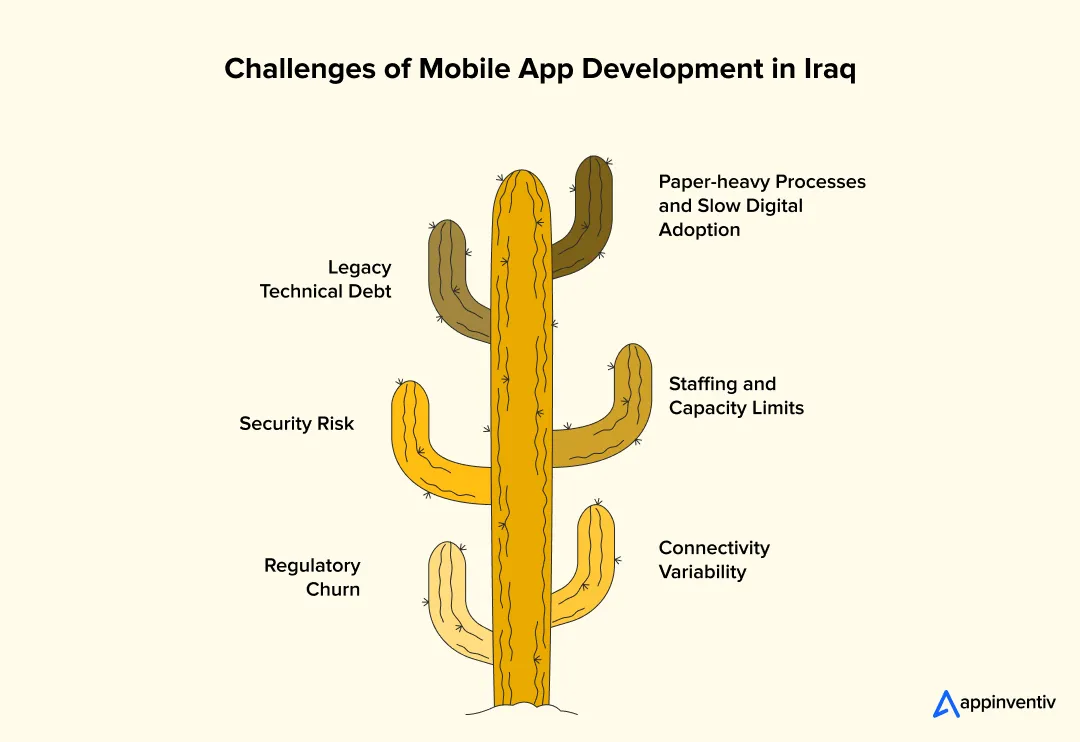
Paper-heavy processes and slow digital adoption
Digital maturity varies; specialize in digitizing legacy manual workflows through phased modernization. A partner should suggest pragmatic pilots: deliver one module, validate, then scale.
Legacy technical debt
Many organisations need parallel modernization. A firm must offer migration patterns that limit disruption and preserve essential workflows.
Staffing and capacity limits
Experienced mobile and backend engineers are in short supply. Verify partner’s capacity and hiring plans and seek guarantees for continuity.
Security risk
Cyber threats remain a top concern. Firms should show operational security and incident response readiness.
Connectivity variability
Network quality varies; prefer offline-first design and efficient delta sync mechanisms.
Regulatory churn
Rules affecting data residency and digital services change. Ask partners how contracts will handle future regulatory shifts.
Common Mistakes to Avoid
Even experienced teams make missteps. Avoid these common mobile app development errors to reduce delays, unexpected cost and technical debt.
Basing selection only on price
The cheapest quote often leads to poor code, bad UX and security gaps that surface later and require rework.
Undefined scope and acceptance criteria
Vague requirements make delivery unreliable. Document features, user journeys and integration contracts. Link payments to acceptance tests.
Underestimating Arabic and Kurdish Localisation
Hire mobile app developers in Iraq who understand RTL, font issues, and dialect nuance. Poor localisation testing kills adoption in cities like Sulaymaniyah and Kirkuk.
Skipping security checks
If you do not verify encryption, secure APIs and proper authentication, you risk data exposure and non-compliance in regulated sectors.
No post-launch support plan
Without a maintenance roadmap, updates and OS changes break experiences. Ensure SLA terms cover bug fixes, security patches and upgrades.
Ignoring long-term operating costs
Don’t budget solely for a single build. Plan for hosting, monitoring, updates and third-party subscriptions.
Missing stakeholder alignment
Failing to involve business, compliance and IT teams causes problems during integrations and audits. Run a short internal scoping sprint before issuing an RFP.
Signing without technical and legal review
Ensure contracts cover IP, code transfer, payment milestones, exit terms and data protection. Legal and technical review prevents future disputes.
Each of these mistakes can be avoided through disciplined planning and by working with a partner who proactively flags risks rather than waiting for them to surface. A mature mobile app development process anticipates challenges upfront and embeds resilience, not just features, into every release cycle.
Technical & Procurement Readiness Checklist
Selecting the right partner is a high-stakes decision. Use this checklist to streamline decisions from internal planning to contract sign-off.
Before Partner Outreach
Ensure internal clarity before you initiate any discussions. A short discovery sprint within your team can align priorities and prevent miscommunication later.
- Run a scoping sprint that defines goals, KPIs and constraints.
- List required integrations (SAP, Oracle, CRM, local payment rails, telecom APIs).
- Document device and connectivity constraints (Android Go, offline needs).
- Specify localisation needs (Arabic RTL, Kurdish Sorani, dialect copy, app-store languages).
- Record compliance and data protection requirements (local rules in addition to GDPR).
During Partner Evaluation
At this stage, focus on verifying the depth of enterprise mobile app solutions and the firm’s capabilities, not just breadth.
- Request architecture diagrams that show API gateways, mobile backend and storage.
- Ask for links to live apps and audit artefacts (pentest summaries, SAST/DAST outputs).
- Verify the team structure and whether key staff are assigned in-house.
- Confirm release practices: staged rollouts, rollback plans and device/network testing.
- Check localisation examples: bilingual screenshots and regional UX reviews.
Before Signing the Contract
Make sure the legal and delivery structure is watertight; this will reduce downstream risks.
- Write clear IP transfer clauses for source, designs and architecture assets.
- Define milestone deliverables and link payments to acceptance tests.
- Lock post-launch SLAs: uptime, response times and support steps.
- Clarify currency, payment terms and tax liabilities for cross-border deals.
- Add termination and transition clauses to ease partner changes if required.
Consider commissioning a short partner readiness or architecture review. It’s a targeted, low-cost exercise (often a few days) that surfaces hidden risks and clarifies next actions, a small spend that pays off by lowering the total cost of ownership.
Here’s how Appinventiv supports long-term mobile initiatives in regulated and emerging markets.

How Appinventiv Supports Your Mobile Transformation
Appinventiv is an experienced mobile app development company serving across the Middle East region, combining delivery process maturity with practical outcomes. We have delivered mobile programmes across 35+ industries, supported 1,600+ tech specialists, and deployed 150+ AI models for enterprise customers in regulated markets.
How we support teams in markets like Iraq:
Scoping & Partner Readiness
Focused workshops that produce an RFP, acceptance criteria and an architecture checklist you can use in procurement.
Bespoke Mobile Application Development
Native and cross-platform development emphasising modular design, automated tests and staged releases. We document CI/CD and release gates so you can follow builds through environments.
Localisation and UX (Arabic & Kurdish)
Design and copy reviewed by native speakers. RTL, fonts and dialect testing are standard. We run device sessions in Baghdad, Sulaymaniyah and Kirkuk to validate flows under real network conditions.
Legacy Modernization & Integrations
Secure middleware to connect mobile apps to SAP, Oracle, Microsoft Dynamics or bespoke systems. We map data flows, define contracts, and stage integration testing to protect live operations.
AI-Enabled Features and Analytics
Practical AI-powered mobile app development—chat assistants, recommendations and lightweight on-device models—delivered with governance for privacy and model management. We focus on cost-effective patterns that add user value without operational surprise.
Security & Compliance
End-to-end security: secure coding, SAST/DAST, third-party pen tests and incident response plans. For regulated sectors, we offer data-residency options and audit artefacts.
Post-Launch Operations & Growth Engineering
SLA-backed maintenance, monitoring dashboards, crash reporting and regular health checks. We run experiments (A/B tests) and refine store listings for better adoption.
If you want a low-effort way to validate firms, commission a short architecture review or partner-readiness audit. It’s a focused exercise (typically a few days) that surfaces hidden risks and clarifies next steps, and it’s the most cost-effective way to reduce long-term TCO.
FAQ’S
Q. Why is choosing the right mobile app development company in Iraq important?
A. The right development partner helps ensure your application aligns with local user expectations, device capabilities, and regulatory requirements. Iraq’s mobile landscape includes varied network conditions, bilingual user interfaces, and integrations with regional payment systems or enterprise software.
A capable partner understands these factors and can design scalable, secure solutions that reduce rework, minimise operational risk, and accelerate adoption once the app is launched.
Q. What should I expect from the mobile app technology stack and backend development in Iraq?
A. A well-structured mobile application stack typically includes native or cross-platform frameworks on the front end, combined with scalable backend services, RESTful or GraphQL APIs, and cloud infrastructure for reliability and growth.
Development teams should also implement CI/CD pipelines, monitoring tools, and automated testing frameworks. Each architectural decision should be based on long-term maintainability, expected user load, and integration requirements.
Q. How long does it take to develop a mobile app in Iraq?
A. Development timelines depend on the scope and complexity of the application. A basic MVP with limited features may take around 6–10 weeks, while a cross-platform business application with integrations can take 2–4 months.
Large enterprise platforms involving ERP integrations, localisation, compliance checks, and advanced analytics often require 4–9 months or more for full implementation.
Q. What factors influence the cost of mobile app development in Iraq?
A. Several elements affect the final development cost. These include the complexity of integrations with existing enterprise systems, localisation for Arabic and Kurdish users, security and compliance requirements, and the need for advanced features such as AI-driven capabilities or analytics.
Infrastructure setup, ongoing maintenance, and post-launch updates also contribute to the overall long-term cost.
Q. How does a development partner ensure app security and data protection?
A. Security is typically addressed through a combination of practices and tools. These include secure coding standards, encryption of sensitive data in transit and at rest, regular vulnerability testing through SAST and DAST tools, and independent penetration testing before release.
Mature teams also establish incident response procedures, access control policies, and compliance checks to ensure applications remain secure after deployment.
Q. What post-launch support and maintenance services are typical?
A. Post-launch support usually includes performance monitoring, bug fixes, security updates, and compatibility updates for new OS versions. Teams also track usage analytics to identify issues and opportunities for improvement.
Many organisations establish SLA-based maintenance agreements that define response times, update schedules, and continuous improvements to keep the application stable and relevant.
Q. Why do businesses in Iraq need industry-specific mobile app development solutions?
A. Different industries have unique regulatory and operational requirements. Financial services applications may require strict encryption, identity verification, and compliance with payment regulations.
Logistics platforms often require offline-first capabilities, route optimisation, and mapping integrations. Healthcare or government applications may require strong privacy safeguards and audit-ready data management processes.
Q. What platforms should businesses prioritise when launching mobile apps in Iraq?
A. Android typically dominates smartphone usage in many emerging markets, including Iraq, due to the availability of affordable devices. However, organisations targeting enterprise users or premium consumer segments may still require both Android and iOS versions. Many businesses choose cross-platform development to support both ecosystems while maintaining a single codebase.

- In just 2 mins you will get a response
- Your idea is 100% protected by our Non Disclosure Agreement.

How to Build a Forex Currency Trading App for Multi-Currency Trading in the UAE
Key Takeaways: In the UAE, regulation comes first. Your licensing choice will shape how the entire platform is built. A forex app here needs more than charts. It needs a solid trading engine, strong liquidity connections, and reliable risk controls. AED funding, USD settlement, Islamic swap-free accounts, and Arabic support are practical requirements, not optional…

How Much Does It Cost to Build a Calorie Counting App Like Cronometer in Australia
Key takeaways: Building a calorie counting app with Cronometer-level accuracy in Australia typically costs between AUD 70,000 and AUD 700,000+, depending on data depth, compliance posture, and analytics sophistication. Underestimating compliance, data licensing, and post-launch governance is the most common cause of budget overruns for Australian nutrition platforms. The hard cost driver is not screens.…

MVP to Market: Realistic Cost, Timelines & Tech Stack for MVP App Development in Australia
Key takeaways: MVP development costs in Australia typically land between AUD 50,000 and AUD 200,000+, driven by integration depth, security, and delivery shape. Time-to-market can vary from 8 to 20 weeks, influenced by integrations, compliance, and feature scope. Choosing the architecture and best tech stack for building mvp app early reduces rebuild risk when traction…









