

























Most Popular Cross-Platform App Development Frameworks in 2026 and Beyond

 Share -


- 01Understanding Cross-Platform App Development Frameworks
- 02Features of Cross-Platform Development Framework
- 03What are the Best Frameworks For Developing Cross-Platform Mobile Apps?
- 04Cross-Platform Mobile App Development Frameworks – A Quick Comparison
- 05Frameworks on the Decline: What to Avoid in the Future
- 06What are the Benefits of Cross Platform Development Frameworks?
- 07Key Decision Factors for Framework Selection
- 08Common Mistakes to Avoid in Framework Selection
- 09Cross-Platform App Development Future Trends
- 10Start Building High-Impact Cross-Platform Apps with Appinventiv
- 11FAQs

Key takeaways:
- Cross-platform application development frameworks will also save you time and costs since the same code can be used to run on different platforms.
- Each of the popular frameworks, such as Flutter, React Native, and Ionic, has its advantages and disadvantages; thus, knowing the difference between them is the key to making the correct decision.
- The choice that you make ought to be informed by your project needs, team experience, and the degree of performance or UI customization that you require.
- The correct framework can guarantee an appropriate user experience and easy maintenance that will make your app a success on all devices.
Building an app today no longer means choosing between Android and iOS. You want to reach users on both, and on the web too, without paying for two separate builds. Cross-platform app development frameworks make that possible.
The hard part is choosing one. There are dozens of frameworks, and they work in different ways. Flutter uses Dart. React Native runs on JavaScript and TypeScript. Kotlin Multiplatform lets teams share Kotlin code while keeping native UI. .NET MAUI brings C# to mobile and desktop. Each one makes different trade-offs on performance, native access and UI consistency. A choice that’s right for one product can slow another one down.
This guide compares the top cross-platform frameworks: what each does well, where it falls short, and which kinds of projects it suits best. First, let’s cover what cross-platform app development actually means.

Understanding Cross-Platform App Development Frameworks
To be concise, cross-platform is a type of software that has the ability to run on multiple computing platforms, i.e., Android, iOS, Windows, Blackberry, etc. The apps built on this framework do not require separate coding for each platform; rather, coding once will create the foundation for the app to run as efficiently on all platforms. It is one of the most popular methods in the app development domain today, which almost all the top mobile app development services companies swear by.
To further elaborate, cross-platform app development companies specialize in creating versatile and efficient applications that work seamlessly across different operating systems. By utilizing advanced mobile frameworks and tools, these IT consulting firms can reduce development time and costs while ensuring a consistent user experience across all platforms.
Features of Cross-Platform Development Framework
Cross-platform app development frameworks come equipped with various advantages that enable the construction of apps across several platforms, making them more economical and uniform. Key features include:

Single Codebase
An app framework enables a developer to create one codebase that can be executed on various platforms. This saves on development time, makes it easier to maintain, and ensures the devices maintain the same functionality and design.
Native-Like Performance
Modern cross platform mobile application development frameworks are developed in a manner that provides performance that is similar to native applications. They maximize the performance of rendering, memory utilization, and the activities that are specific to the device to deliver seamless user experiences to cross-platform applications.
Pre-Built UI Components
The majority of them include pre-built UI components and templates, which allow developers to build polished and responsive interfaces in a short time. These parts can be modified to suit brand requirements and app needs.
Fast Iteration Hot Reload
Flutter and React Native frameworks also have the hot reload feature, which can make changes visible to a developer as they develop. This speeds up the development, testing, and debugging.
Plugin and API Support
Cross-platform app development frameworks generally have wide libraries, plugins, and APIs. These assist in integrating with third-party services, device hardware, and cloud platforms, without the need to develop the functionality.
Community and Documentation
It boasts a strong developer community and comprehensive documentation, making it easier to troubleshoot issues, follow best practices, and stay updated on new features.
Scalability and Maintenance
Cross platform web app development is useful in simplifying the development of web apps that will be cross-platform because they can be improved on all platforms at once. This maintains consistency, lowers technical debt, and contributes to the app’s growth in the long term.
Appinventiv’s Insights
When selecting a cross-platform framework, prioritize features that align with your project goals and team expertise. Focus on performance, scalability, and the availability of pre-built components to speed up development while maintaining a native-like user experience.
What are the Best Frameworks For Developing Cross-Platform Mobile Apps?
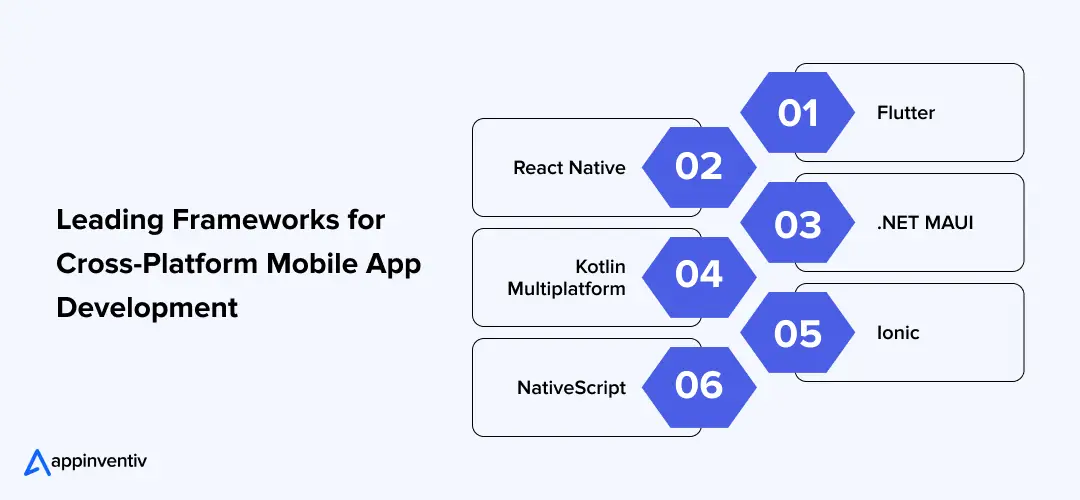
Your framework choice affects how fast you ship, how the app performs, and how much it costs to maintain years later. The six frameworks below are the ones most enterprise teams evaluate today. Each takes a different approach to sharing code across platforms.
Flutter
Google released Flutter in 2017. It’s an open-source UI toolkit that builds apps for Android, iOS, web and desktop from a single codebase written in Dart. Flutter doesn’t wrap native components. It draws every pixel with its own rendering engine, Impeller, so the UI looks the same on every device.
That control over rendering is why many teams treat Flutter as an ideal cross-platform framework for products where brand consistency and smooth animation matter.
Features
- Dart compiles ahead of time to native ARM code, so apps start fast and run smoothly.
- Stateful hot reload shows code changes in under a second without losing app state, which shortens design and QA cycles.
- A large widget library, with Material and Cupertino components, gives teams a consistent UI across platforms without separate design work.
- It’s a strong choice for building a Minimum Viable Product (MVP) because one team can ship to both stores quickly.
- Platform channels and a growing package ecosystem on pub.dev give access to native device features when you need them.
React Native
Meta built React Native, and it’s still one of the most widely used cross-platform frameworks. Developers write apps in JavaScript or TypeScript using React, and the framework renders real native UI components on Android and iOS. That’s why many businesses consider React Native the right platform for their apps.
The New Architecture is now the default. It replaces the old bridge with the JavaScript Interface (JSI), which lets JavaScript call native code directly. The result is faster rendering and smoother interactions.
Features
- Web teams that already know React can move into mobile with a short learning curve, which keeps hiring simpler.
- Developers can write native modules in Swift, Kotlin, Objective-C or Java for heavy work like video processing or custom hardware access.
- A huge open-source community and npm ecosystem cover most common needs, from maps to payments to analytics.
- Fast Refresh and the Hermes JavaScript engine improve developer speed and app startup time.
- Sharing one codebase across platforms helps keep React Native app development cost in check.
.NET MAUI
.NET Multi-platform App UI (.NET MAUI) is Microsoft’s successor to Xamarin. Microsoft released it in 2022 and ended Xamarin support in May 2024. With MAUI, teams build apps for Android, iOS, macOS and Windows from a single project using C# and XAML.
It’s a natural fit for organizations already invested in Microsoft’s stack, including Azure, Visual Studio and existing .NET backends.
Features
- A single project structure handles every target platform, with platform-specific code only where it’s needed.
- MAUI renders native controls on each platform, so apps feel at home on Android, iOS and Windows.
- It has full access to native device APIs, and Blazor Hybrid lets teams reuse web UI components inside native apps.
- Shared C# code across the backend and the client cuts duplication and simplifies long-term maintenance.
- Teams with existing Xamarin apps have a supported migration path instead of a full rewrite.
Kotlin Multiplatform
JetBrains built Kotlin Multiplatform (KMP), and it became stable in late 2023. KMP takes a different route from the other frameworks. Instead of sharing everything, teams share the business logic, such as networking, data and validation, and keep native UI on each platform. Teams that want a shared UI too can use Compose Multiplatform, which is now stable for iOS.
Google officially supports KMP for sharing logic between Android and iOS, which gives enterprise teams confidence in its future.
Features
- Sharing business logic removes duplicate code while keeping a fully native look and feel.
- It fits into existing Android and iOS projects, so teams can adopt it one module at a time without rewriting the whole app.
- Shared code compiles to native binaries on iOS, so performance stays close to fully native apps.
- Android teams already writing Kotlin can start with almost no learning curve.
- Netflix, McDonald’s and Cash App use KMP in production.
Ionic
Ionic is an open-source UI toolkit for building cross-platform apps with web technologies: HTML, CSS and JavaScript or TypeScript. It originally depended on AngularJS. Today it works with Angular, React and Vue, so teams can use whichever web framework they already know.
Ionic runs on Capacitor, its native runtime, which gives web code access to device features. It also builds web apps, which makes Ionic a strong candidate for PWA development.
Features
- Ionic includes a large library of prebuilt UI components that adapt to iOS and Android design conventions automatically.
- Capacitor plugins give apps access to the camera, GPS, file system, push notifications and other native features.
- One codebase can ship as an iOS app, an Android app and a progressive web app.
- Web developers can build mobile apps with skills they already have, which lowers the cost of hiring and training.
- It works best for content-driven and business apps. Graphics-heavy apps may hit performance limits.
NativeScript
NativeScript is an open-source framework for building truly native mobile apps with JavaScript or TypeScript. It works with Angular, Vue, React and Svelte. Unlike web-based tools, it renders native UI components directly, without WebViews.
NativeScript is now part of the OpenJS Foundation. It’s a niche option, but a capable one for teams that want direct native API access without leaving JavaScript.
Features
- It gives direct access to every native Android and iOS API from JavaScript, with no wrappers or plugins required.
- It renders platform-native UI, so apps look and behave like apps built with native tools.
- Developers can use npm packages, CocoaPods and Gradle libraries in their projects.
- It’s a good fit for Angular or Vue teams that need deep native control.
- The community is smaller than Flutter’s or React Native’s, so it’s worth checking plugin coverage before committing.
Now, let’s move ahead and give you a crisp comparison of all the best cross-platform mobile app development frameworks available, each tailored to meet different project requirements and goals.
Cross-Platform Mobile App Development Frameworks – A Quick Comparison
This comparison of cross-platform mobile development frameworks covers what each framework does best, where it falls short and who uses it, so you can shortlist the right one for your project.
| Framework | Language | Pros | Cons | Examples |
|---|---|---|---|---|
| Flutter | Dart | High performance, consistent UI on every platform, fast hot reload | Larger app size, Dart talent pool smaller than JavaScript’s | Google Pay, BMW, Alibaba |
| React Native | JavaScript / TypeScript | Huge community, native UI components, easy move for React web teams | Complex animations and heavy native work may need custom modules | Facebook, Instagram, Shopify |
| .NET MAUI | C# / XAML | Single project for mobile and desktop, strong Microsoft ecosystem | Smaller community, fewer third-party libraries | Enterprise line-of-business apps |
| Kotlin Multiplatform | Kotlin | Shares logic while keeping fully native UI, gradual adoption | iOS teams need Kotlin familiarity, younger library ecosystem | Netflix, McDonald’s, Cash App |
| Ionic | HTML, CSS, JS/TS | Uses web skills, ships to mobile and web from one codebase | Performance limits for graphics-heavy apps | MarketWatch, Sworkit |
| NativeScript | JavaScript / TypeScript | Direct native API access, true native UI | Smaller community, fewer ready-made plugins | RegelNeef |
Frameworks on the Decline: What to Avoid in the Future
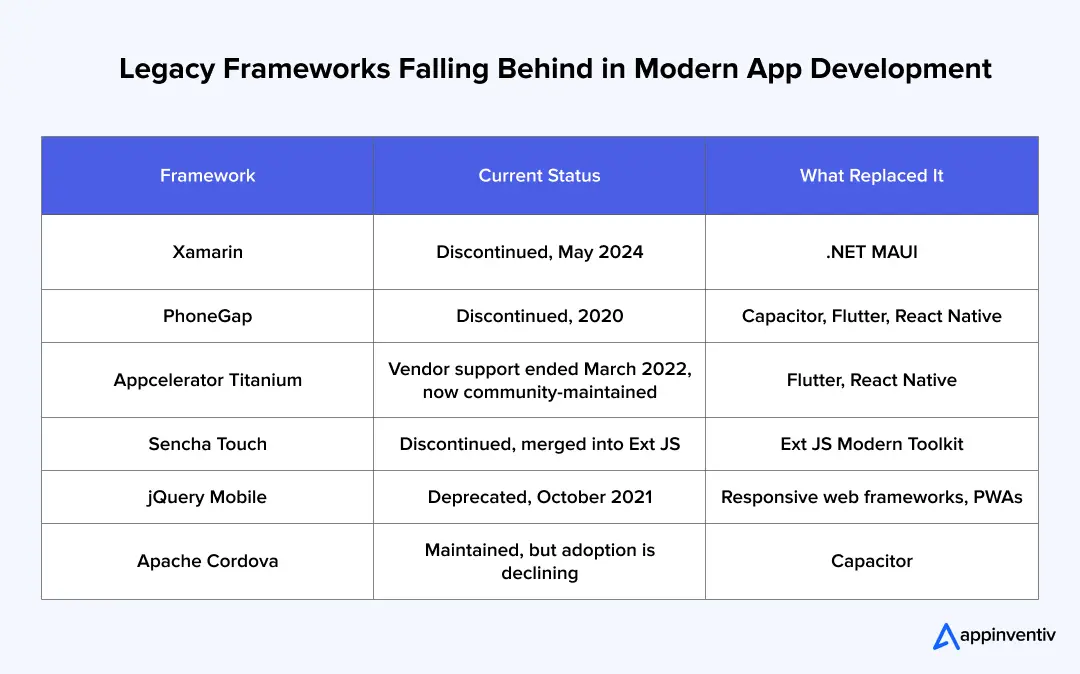
Several frameworks that once led cross-platform development are now discontinued, deprecated or kept alive only by small volunteer communities. Building a new app on any of them means your team takes on security patches, OS compatibility fixes and an expensive migration later. Here’s where each one stands today.
| Framework | Current status | What replaced it |
|---|---|---|
| Xamarin | Discontinued, May 2024 | .NET MAUI |
| PhoneGap | Discontinued, 2020 | Capacitor, Flutter, React Native |
| Appcelerator Titanium | Vendor support ended March 2022, now community-maintained | Flutter, React Native |
| Sencha Touch | Discontinued, merged into Ext JS | Ext JS Modern Toolkit |
| jQuery Mobile | Deprecated, October 2021 | Responsive web frameworks, PWAs |
| Apache Cordova | Maintained, but adoption is declining | Capacitor |
Already Discontinued
Xamarin
Microsoft ended support for Xamarin and Xamarin.Forms on May 1, 2024. Xamarin apps no longer get updates for new iOS and Android versions, so publishing to the app stores gets harder with every OS release. Microsoft’s official migration path is .NET MAUI, which keeps C# and much of the existing code.
PhoneGap
Adobe stopped developing PhoneGap in August 2020 and shut down PhoneGap Build on October 1, 2020. Teams that used it either moved to plain Apache Cordova or switched to Capacitor, Flutter or React Native.
Appcelerator Titanium
Axway announced the end of its Appcelerator products in February 2021 and ended Titanium SDK support on March 1, 2022. The SDK was open-sourced and handed to TiDev, a community group that still maintains it. With no commercial vendor behind it and a shrinking talent pool, Titanium is a risky base for an enterprise app.
Sencha Touch
Sencha merged Sencha Touch into Ext JS, and the standalone product is no longer developed. Existing apps need to move to the Ext JS Modern Toolkit or be rebuilt on a current framework.
jQuery Mobile
The jQuery team officially deprecated jQuery Mobile in October 2021, and it no longer gets updates. Modern responsive web frameworks and PWAs have fully taken its place.
Still Maintained, But Losing Ground
Apache Cordova
Cordova is still an active Apache project, but new development has largely moved to Capacitor. Capacitor was built by the Ionic team as Cordova’s modern successor and supports most Cordova plugins. Existing Cordova apps can keep running, but new projects are better started on Capacitor, Flutter or React Native.
Appinventiv’s Insights
Sticking with declining technologies increases maintenance costs and limits scalability. Teams investing in cross platform mobile app development should migrate to supported frameworks that evolve with current OS and hardware updates.
What are the Benefits of Cross Platform Development Frameworks?
Cross-platform app development frameworks streamline the entire mobile development process by enabling faster deployment and wider reach with minimal effort. They help businesses maintain feature parity and design consistency across different platforms while optimizing resource use. Here are some of the top benefits of cross platform mobile app development frameworks for modern app projects.

Maximum Exposure to the Target Audience
Utilizing a cross-platform mobile development approach empowers you to construct an application and send it to different platforms, including the web. This implies that by building a single application, one can target both iOS and Android platforms, hence expanding their range.
Reduced Development Cost
The cross-platform application development depends on the idea ‘compose once, run all over the place’. Reusable code and agile application development through tools can reduce the expense of development. In this manner, to improve your business on numerous platforms and tools in a practical manner, there is no other choice but to use cross-platform applications.
Easier Maintenance & Deployment
Since there’s just one developed application that runs on all platforms, it is simpler to keep up and also send code or changes made. Updates can be synced over all platforms and gadgets, consequently saving time and money. Besides, if a bug is found in the regular codebase, it ought to be fixed once. Along these lines, developers can save a great deal on time and money.
Quicker Development Process
The speedy development process is another mutually advantageous situation with regard to creating cross-platform applications. Single source code for multiple platforms can help diminish the development efforts by 50% to 80%. It assists you in getting a feature-rich business application in less time. The group of developers can fulfill the expected deadlines in cross-platform application development.
Reusable Code
Another beneficial thing about this platform is that the code can be utilized over and over. Rather than developers creating new code for each platform, a single code can be reused. This saves time and resources by eliminating repetition in the code-making process.
Easy Integration with Cloud
Cross-platform mobile applications are absolutely compatible and can exploit different plugins incorporated with the cloud settings. In other words, the single source code is composed of different plugins and extensions to improve the application’s scalability and usefulness.
Key Decision Factors for Framework Selection
Choosing the right cross-platform mobile app development framework is crucial for the success of your project. It can define the efficiency, performance, and user experience of your app, influencing both short-term development goals and long-term maintenance. Here are the factors that can impact your choice of the best cross-platform application development framework:

Project Requirements
Know the peculiarities of your project. Think about what kind of app you are creating, what functionality you require, and what degree of UI complexity would be required. Applications that have complex animations, hardware-intensive functions, or follow complex multimedia functionality may correspond better to some cross-platform app development frameworks as compared to others.
Performance Needs
Determine the importance of performance to your application. When your application needs close-to-native responsiveness and a native experience, select frameworks with reputations for close-to-native performance, e.g., Flutter or React Native. Cross-platform mobile app development frameworks differ in how they handle rendering, memory, and device-specific tasks.
Community and Support
Examine the magnitude and vitality of the framework’s community. A vibrant community of developers will offer more support, be easy to access, and be updated regularly, which is beneficial in the development and troubleshooting. Powerful community support will guarantee quicker resolution of the issue and availability of common best practices.
Cost Efficiency
Evaluate the cost-effectiveness of the framework. Some of the best cross-platform mobile app development frameworks save both time and money spent on development because they are write once, run anywhere. Others might be in need of special skills or extended development periods, which adds up to higher project costs.
Development Team’s Speed and Expertise
Evaluate how quickly your team can adapt to the chosen framework. The pace of cross-platform mobile app development often depends on familiarity and prior experience. Partnering with an experienced outsourcing team can accelerate delivery, reduce training time, and ensure smoother execution. However, adopting unfamiliar frameworks may increase development time, introduce errors, and raise overall project risk.
Integration Capabilities
Test the ease of integration with other third-party tools, APIs, and existing backend systems through the framework. A seamless integration facilitates making your app take full advantage of the key services and functionality, which improve the overall performance and user experience of the end product.
Security Features
Test the security settings of the framework. The presence of cross-platform mobile app development frameworks with the ability to encrypt, provide secure authentication, and secure data protection mechanisms aids in protecting the user data and allows adherence to the regulations.
Long-Term Maintenance and Updates
Look at the history of the framework updating and its compatibility with new OS versions. Using a properly maintained structure benefits in the long run, minimizes technical debt, and your app is always able to perform.
UI/UX Capabilities
Look at the tools that the framework uses to create responsive and interactive interfaces. An architecture that embraces platform-friendly UI components and platform-specific animation will enhance user experience, which is essential to adoption and retention.
The choice of the appropriate framework is not merely a matter of technique but a strategic decision that can influence the efficiency, performance, cost, and success of your services in creating cross-platform mobile applications in the long run.
Common Mistakes to Avoid in Framework Selection
The choice of the framework to use is a major determinant of the success of any application. It is possible to be aware of these mistakes and make the right decisions in the team, preventing the expensive traps. Making a wrong choice may lead to delays, high costs, and performance issues that could cause user experience problems. Here are some of the top mistakes to address.

Choosing Based on Popularity Alone
Depending on the most fashionable paradigm may be counterproductive. One framework can be popular but may not fit your project requirements, performance needs, or supported platforms. A cross-platform mobile development framework comparison should help you determine which tools are most appropriate for your project’s aims, rather than just following the hype.
Ignoring Community Support and Documentation
Frameworks that have limited tutorials, have little documentation, or are experiencing a declining community can hamper development and end up making troubleshooting hard. The ideal choice of the best cross platform app development framework is one with an active community and extensive guidance that will help resolve the problems quickly and provide access to good practices.
Neglecting Long-Term Maintenance
Certain frameworks might be effective at first, but they do not keep up with the OS changes, security patches, or new devices. The lack of focus on maintainability increases the cost and the technical debt. This is because a framework with good longevity and periodic updates will be picked to ensure sustainable cross-platform mobile app development.
Failing to Consider Platform-Specific Needs
Android and iOS are not treated equally in all frameworks. The quality of the app can be affected by the disregard for platform-specific considerations of the UI and UX. When analyzing cross-platform app development frameworks, it is critical to evaluate the flexibility of the framework so that an app appears and functions as it should on all platforms.
Underestimating Learning Curve and Developer Skillset
Implementing a system that is not within your team could add more time to development and decrease productivity. Evaluate the expertise and training needs of developers and commit to a new tool. The appropriate framework is to be matched with team competencies and allow scalability and performance.
Failure to Assess Third-Party Integrations
The number of apps that are dependent on plugins or other libraries is high. A framework that has few third-party adherents can limit functionality or require elaborate workarounds. The ability to be compatible with necessary integrations is an important factor that can guarantee the process of development.
Concentrating on Development Speed Alone
The desire to build things quickly is intoxicating, yet focusing on short-term speed at the expense of maintainability and performance can lead to technical debt. An architectural design ought to have an equilibrium between the efficiency of development and long-term reliability, bwith less problematic refactoring and scalability in the future.
Let our team guide you to the right solution for faster, smoother development

Cross-Platform App Development Future Trends
As we approach the end of 2025, we can see how quickly the cross-platform app development landscape is changing. It is important that companies keep pace with these trends in order to maintain a competitive advantage. The following are the major developments to follow:

AI-Powered App Features
AI is improving the capabilities of apps by providing on-device processing, self-centric user experiences, and predictive analytics. Applications will be smarter and will learn their users, based on their behavior and anticipating their needs, which can be particularly handy when it comes to industries such as logistics, to optimize their operations in real-time.
Improved Native-Like Performance
Cross-platform systems such as Flutter and React Native are closing the performance gap to native applications, providing a high-performance system with GPU-accelerated rendering, effective memory management, and native integration between modules to provide a smooth and responsive user experience.
Integration with the Emerging Technologies
IoT, AR, and Blockchain are becoming more involved in cross-platform applications. This will provide an easy communication with smart devices, interactive experiences, and higher data protection, which such industries as logistics, healthcare, and finance will need to simplify operations and establish transparency.
Low-Code and No-Code Development
No-code/low-code platforms are the new democratic approach to app development ,allowing business leaders to prototype swiftly, save money, and empower non-coders to help in the creation of apps. This tendency gains momentum, innovation, and speed to market, specifically in startups and SME.
Focus on Security and Compliance
With the increased importance of data security, cross-platform frameworks are being integrated with end-to-end encryption, biometric authentication, and regulations like GDPR and others. Such solutions keep user information secure, and apps are of a high standard, which is essential in the industry where sensitive data is involved.
Start Building High-Impact Cross-Platform Apps with Appinventiv
Having considered the best frameworks, it is evident that the cross-platform development environment is not only vibrant but also competitive. All frameworks have their own advantages, and their adaptability will decide which instruments will prevail on the market, and the newcomers will constantly challenge the limits. Selecting the appropriate framework is not only about popularity today but also the ability to be scaled in the long run, perform, and meet the business objectives.
As a reputed mobile app development services company, we have more than 10 years of experience in developing high-impact cross-platform enterprise solutions for our global clients, including KFC, Domino’s, Pizza Hut, Adidas, HIPP, Kudu, and IKEA, to name a few.

These case studies highlight our ability to navigate complex requirements across industries, ensuring apps that are not only functional but also intuitive, visually engaging, and consistent across devices.
We are a reputable cross-platform mobile application development firm with a blend of technical expertise and insights into user behavior to increase the effectiveness and coverage of mobile solutions. By designing experiences custom to the specific goals of each business, our developers are able to guarantee compatibility with all platforms.
With Appinventiv, businesses can not only have an app but also gain a strategic partner who provides world-class, scalable, and future-ready mobile solutions that stand out in a competitive digital environment. Connect with our experts today to share your next project idea!
FAQs
Q. Which is better, native or cross-platform development?
A. The best cross-platform framework depends on your specific project needs, developer skills, and desired app features. React Native is often known for its robust community support and ability to allow developers to write apps with a native feel using JavaScript. On the other hand, Flutter is also highly regarded for its fast performance and beautiful UI capabilities.
To ensure successful implementation, partnering with a cross-platform mobile app development services provider can be your best bet, as they can help you tailor solutions that leverage the strengths of these frameworks.
Q. How do you make a mobile app cross-platform?
A. Well, the answer is as easy as cutting a pie. You can choose from a wide variety of cross-platform app frameworks available in the market. These frameworks ensure that your app is smooth functioning and is able to run just as efficiently on all platforms as a native app.
Moreover, the easiest way out of this would be to choose an impeccable cross platform mobile app development company with the experience and proper tech stack needed for effective app development.
Q. What are some of the top challenges in cross-platform app development?
A. Here are some of the challenges in cross-platform development and solutions to overcome those:
Performance Issues
Challenge: Cross-platform applications may perform more slowly than native applications because of additional layers of frameworks.
Solution: Implement performance-optimized structures, such as Flutter or React Native, and reduce heavy animations or libraries not necessary.
Limited Native Access
Challenge: There are frameworks that not only do not have access to the device-specific features entirely.
Solution: Use plugins or write custom native modules for Android and iOS to extend functionality.
UI/UX Inconsistency
Challenge: It is a challenge to bring a native appearance and feel across platforms.
Solution: Adhere to the design guidelines of individual platforms and apply adaptive UI elements of contemporary frameworks.
Obsolete Plugins and Dependencies
Challenge: Third-party extensions can cause a failure or loss of updates.
Solution: Use libraries that are well-maintained and keep them updated.
Q. Which language is best for cross-platform app development?
A. The best language for cross-platform app development depends on the framework and project needs. Dart (used in Flutter) is popular for its performance and native-like UI. JavaScript and TypeScript dominate with frameworks like React Native and Ionic. Kotlin and C# are preferred for Kotlin Multiplatform and .NET MAUI, respectively. Each balances flexibility, speed, and community support across leading cross-platform app development frameworks.


Fast 2-minute response, fully NDA-protected.

How Much Does It Cost to Develop a Remote Patient Monitoring App in the UAE?
Key takeaways: Feature scope and system integrations, not the app itself, determine your final development cost. DHA, DOH, and MOHAP compliance must be built into your architecture from day one. Wearables, EHRs, and health information exchanges are the biggest technical cost drivers. A successful RPM platform combines continuous monitoring, clinical workflows, and secure interoperability. Early…

How Much Does It Cost to Develop an App Like Herfy in 2026?
Key takeaways: Herfy-like app development costs SAR 150,000 to SAR 1,500,000 ($40,000 to $400,000). Costs rise with rider tracking, POS sync, kitchen displays, loyalty, and branch controls. Saudi apps need Arabic UX, Mada, STC Pay, VAT, and ZATCA-ready invoice flows. Peak loads during Ramadan, Eid, and weekends need strong backend and load testing. A phased…

Key takeaways: The operating model determines survival. The code does not. Compliance under PDPL in the UAE and SDAIA in Saudi Arabia must be engineered into architecture, not added before launch. A serious build costs between AED 147,000 and AED 1,470,000 (USD 40,000 to USD 400,000), depending on scope. The single largest cost most operators…