




























How Australian Enterprises Are Using Intelligent Automation to Reduce Operational Cost


- The Core Reasons Pushing IA Adoption in Australia
- Benefits of Intelligent Automation Strategy for Australian Enterprises
- Intelligent Automation Use Cases: Where Australian Enterprises Are Applying IA
- Challenges of Intelligent Automation and How to Overcome Them
- Governance, Compliance, and Risk Management in Automation Programs
- Implementation Strategies of AI Automation for Australian Businesses: A Practical Roadmap
- Core Technology Layers Fueling Intelligent Automation for Australian Enterprises
- How Appinventiv Can Help Australian Enterprises Scale Intelligent Automation
- FAQs

Key takeaways:
- Australian enterprises are using intelligent automation to automate core processes such as reconciliations, approvals, exception handling, and compliance reporting.
- Intelligent automation initiatives typically range from AUD 70,000 to AUD 700,000, depending on scope, integration depth, and governance needs.
- When implemented with control, intelligent automation delivers lower operating cost, faster decision cycles, and improved audit readiness.
Across Australian boardrooms, cost conversations have changed tone. What was once treated as a short-term cycle driven by inflation or market volatility is now recognised as structural. Labour costs continue to rise, regulatory workloads expand, and enterprise operations grow more complex with every system added over the past decade.
According to the Australian Bureau of Statistics, labour costs across multiple sectors increased again through 2024, while productivity growth remained flat. At the same time, federal and state digital transformation programs are encouraging modernisation, but not without adding governance, security, and reporting obligations.
According to the Australian Government’s AI Action Plan, AI-led productivity improvements are expected to contribute up to AUD 315 billion to the economy by 2030, with automation playing a central role. For enterprise leaders, the pressure is not simply to automate faster. It is to reduce operational cost without increasing risk exposure.
Traditional automation approaches, built around scripts and isolated task automation, are no longer delivering sustainable savings. They often reduce effort in one area while shifting cost and risk elsewhere. This is where intelligent automation for Australian enterprises is reshaping expectations. Instead of automating steps, organisations are redesigning how decisions, exceptions, and controls flow across operations.
This blog focuses on how enterprises are applying intelligent automation (IA) in Australia to deliver measurable cost reduction while maintaining audit readiness, data sovereignty, and long-term ownership.
Australian enterprises work with Appinventiv to design automation that remains compliant, secure, and cost-effective as complexity grows.
The Core Reasons Pushing IA Adoption in Australia
Australian enterprises are not adopting automation because it is the talk of the town. They are adopting it because existing operating models are becoming financially unsustainable. Three pressures consistently push IA adoption across industries.
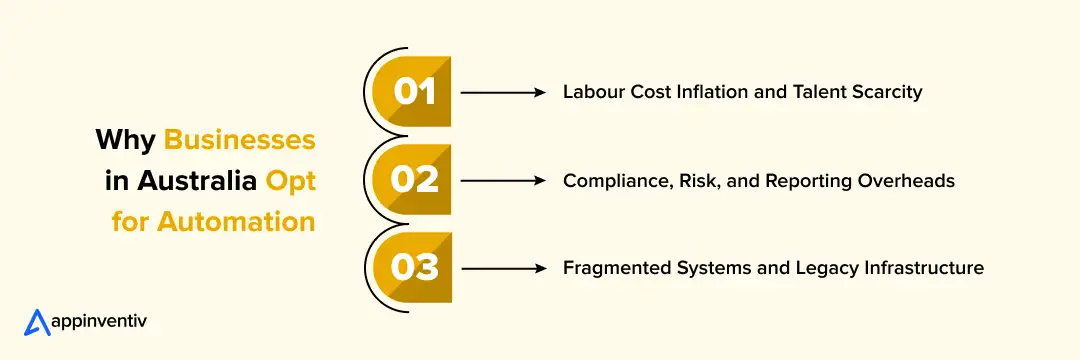
- Labor Inflation: With the Fair Work Commission’s recent wage increases, manual “swivel-chair” activity is now a significant balance sheet liability.
- The Compliance Tax: Navigating the Privacy Act 1988 and industry-specific regulations (like RG 271 in finance) adds a layer of manual reporting that scales poorly.
- Technical Debt: Legacy “spaghetti” architecture in Australian banks, mining firms and other industries creates “data silos” that leak revenue through manual reconciliation.
Benefits of Intelligent Automation Strategy for Australian Enterprises
For Australian enterprises, intelligent automation is a cost and control strategy, not a productivity experiment. It delivers value by reducing rework, stabilising decision-making, and embedding compliance directly into operations. The benefits outlined below reflect these enterprise-level outcomes:
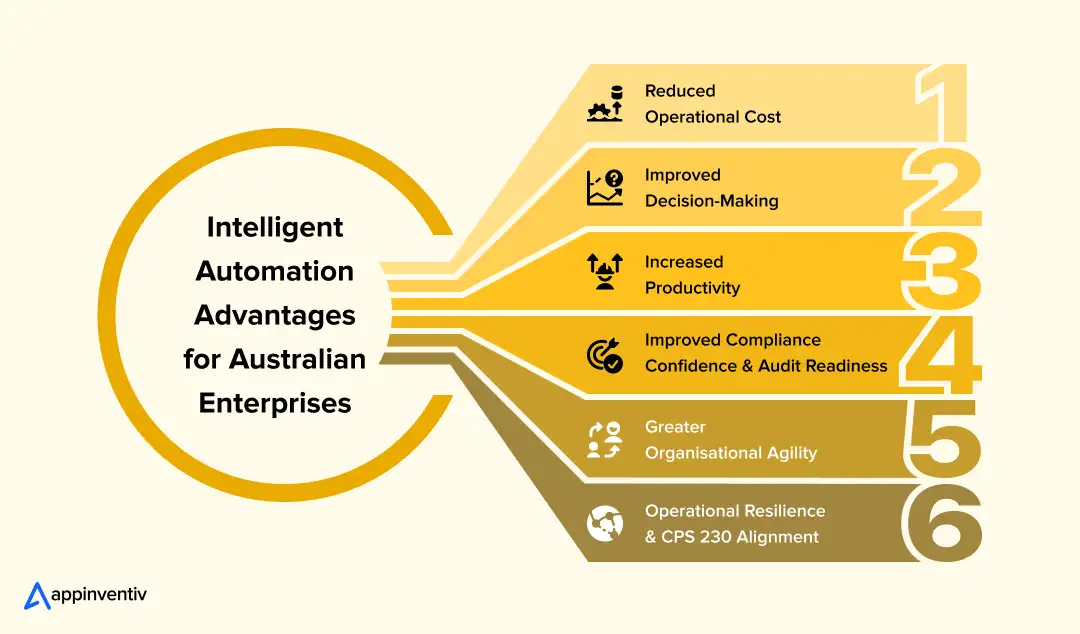
Reduced Operational Cost at the Source
Intelligent automation initiatives for cost reduction focus on removing rework, exception backlogs, and redundant controls. Instead of saving minutes per task, enterprises eliminate entire process loops that consume time and budget without adding value.
Improved Decision-Making Under Operational Load
Automation augmented with AI and analytics supports consistent decision-making at scale. This is especially valuable in high-volume environments where manual judgement becomes a bottleneck and increases error rates. Better decisions reduce downstream correction costs.
Increased Productivity Without Linear Cost Growth
As transaction volumes rise, manual processes scale poorly. Intelligent automation absorbs demand without pulling more people into coordination and review roles. Over time, growth stops translating directly into higher operating costs, which changes how enterprises plan capacity.
Improved Compliance Confidence and Audit Readiness
When validation, logging, and exception handling are automated, compliance activities become repeatable and transparent. Audit preparation effort drops, and risk exposure becomes easier to manage.
Greater Organisational Agility
Automation platforms allow enterprises to adapt workflows quickly in response to regulatory change, market shifts, or operational disruption. This flexibility reduces the cost of change, which is often overlooked in traditional ROI calculations.
Operational Resilience & CPS 230 Alignment
For financial entities, automation is now a resilience tool. Under CPS 230, intelligent automation helps maintain critical business services through real-time control and self-healing.
Intelligent Automation Use Cases: Where Australian Enterprises Are Applying IA
Australian enterprises are no longer experimenting with isolated automation. They are moving away from “Bot-only” RPA toward Intelligent Automation – the fusion of AI, OCR, and workflow orchestration. Deployment is now concentrated in functions where cost exposure, compliance risk, and operational volume intersect. The use cases below reflect where intelligent automation consistently delivers measurable cost reduction without increasing governance burden.
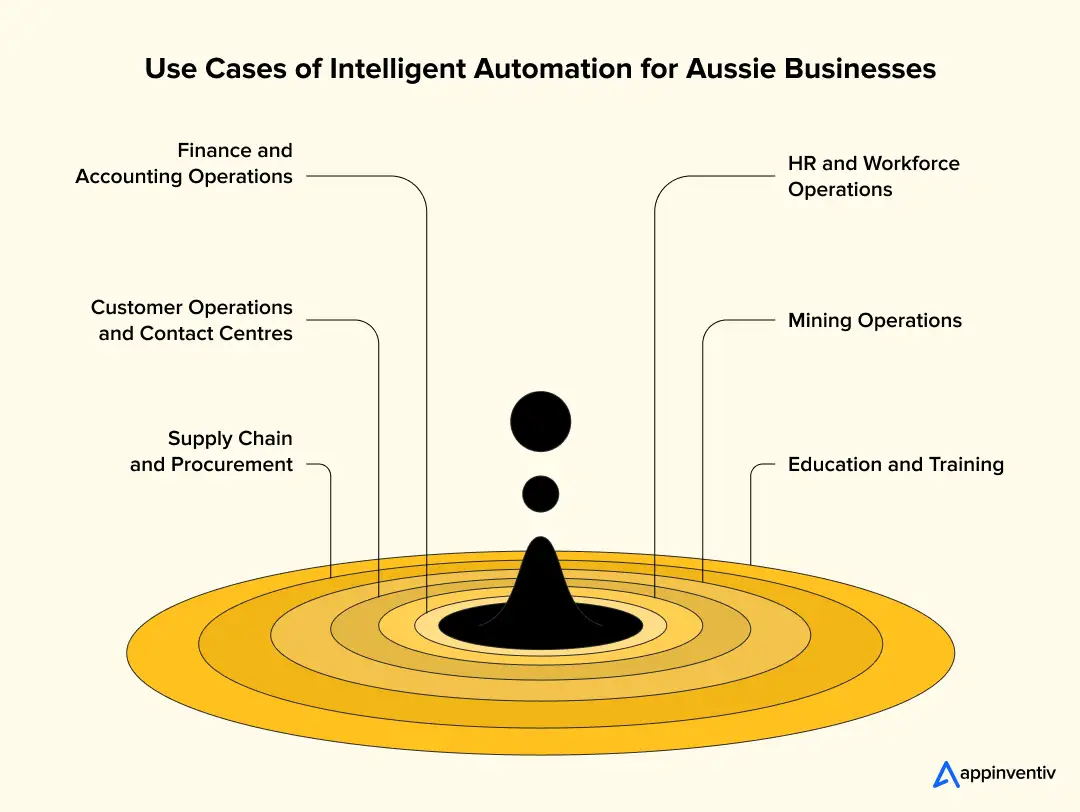
Finance and Accounting Operations
Finance teams in Australia carry an unusually heavy control burden. Reconciliations, validation checks, statutory reporting, and audit preparation consume time that does not directly contribute to business performance, yet cannot be eliminated.
Fintech companies in Australia are applying AI and IA to reconcile multi-entity ledgers, validate invoices against contracts, and flag anomalies before they reach reporting cycles. AI-driven exception handling narrows human intervention to cases that genuinely require judgement. Over time, this reduces close-cycle effort and lowers the hidden cost of error remediation that often goes unmeasured.
Customer Operations and Contact Centres
Customer operations become expensive long before headcount numbers suggest a problem. The real cost sits in volatility. Demand surges, regulatory complaints, and service penalties introduce pressure that traditional staffing models struggle to absorb.
AI automation in Australian enterprises is now focused on decision load rather than raw call volume. Requests are routed based on context, not availability alone. Agents receive guidance during live interactions, reducing cognitive strain. Post-interaction work that once spilled into back-office queues is handled automatically. The outcome is steadier cost per interaction, even as service complexity increases.
Supply Chain and Procurement
Procurement and supply chain functions often hide cost leakage behind manual approvals and fragmented supplier data. During disruption, these weaknesses become visible through expedited shipping, emergency sourcing, and contract non-compliance.
Intelligent automation is applied to demand forecasting, supplier onboarding, compliance validation, and contract monitoring. Decisions that once relied on spreadsheets and email chains are now governed by consistent logic. This reduces inventory holding costs and prevents reactive decisions that inflate spend during volatility.
HR and Workforce Operations
HR costs tend to rise quietly. As organisations grow or contract, administrative effort follows headcount rather than operational need. Validation checks, payroll exceptions, and compliance reporting consume time that leadership expects to be spent on workforce planning.
Enterprises are using intelligent automation to stabilise this load. Onboarding follows standard paths. Payroll is validated before issues escalate. Leave and entitlement rules are enforced inside workflows rather than after submission. Over time, operating cost becomes less sensitive to workforce fluctuation.
Mining Operations
Mining introduces cost drivers that office-based industries never face. Safety obligations, asset reliability, and environmental reporting carry direct financial and regulatory consequences. Distance magnifies every delay.
Intelligent and AI automation in Australian enterprises for mining operations supports condition monitoring, safety workflows, and regulatory reporting across dispersed sites. Alerts are routed automatically. Decisions reach the right teams without manual coordination. Downtime reduces, and inspection effort becomes more predictable, particularly where human access is slow or costly.
Education and Training
Education institutions operate with constrained budgets and complex reporting obligations. Manual administration across enrolment, funding validation, and compliance reporting creates recurring cost pressure.
Here, intelligent automation supports student administration, reporting cycles, and learning analytics. Manual handling drops. Governance remains intact. Institutions gain cost stability without compromising obligations to regulators or funding bodies.
Also Read: AI in Education in Australia: Benefits & Use Cases (2026)
Challenges of Intelligent Automation and How to Overcome Them
When intelligent automation moves out of pilots and into live operations, the friction points are rarely technical surprises. They surface gradually, often during audits, cost reviews, or delivery slippage discussions. Most Australian enterprises encounter the same pressure areas, even when their industries differ.
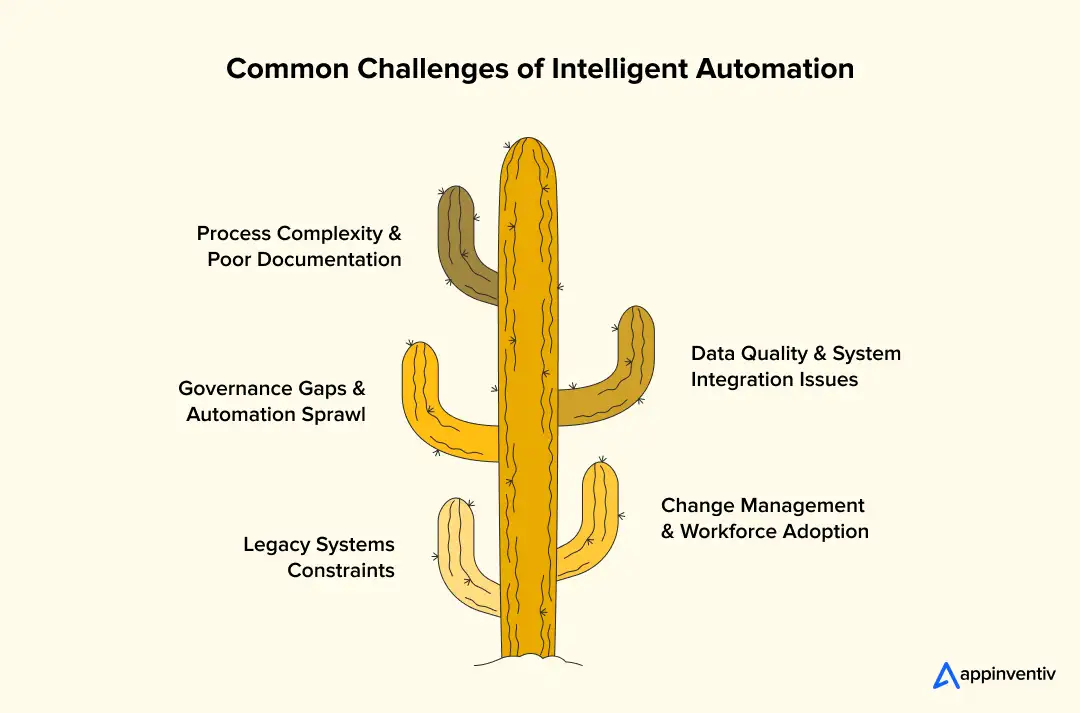
Process Complexity and Poor Documentation
Automation struggles first where processes depend on informal judgement rather than clear rules. Variations that feel manageable to people become brittle once encoded. Over time, maintenance effort starts to outweigh the original efficiency gain.
Data Quality and System Integration Issues
Automation does not tolerate ambiguity in data. Gaps between finance systems, operational platforms, and reporting layers surface quickly. What initially looks like a logic issue usually traces back to inconsistent data ownership.
Change Management and Workforce Adoption
Teams hesitate when automation changes how decisions are made but not who carries responsibility. Confidence drops when outputs cannot be explained easily. Adoption slows long before anyone labels it resistance.
Governance Gaps and Automation Sprawl
As different teams automate independently, visibility weakens. Bots and workflows multiply quietly across functions. The risk shows up later, often during audit or incident response, when no single owner can explain the full execution path.
Legacy System Constraints
Older platforms limit where automation can safely operate. Workarounds accumulate. Over time, small manual dependencies re-enter processes that were meant to be automated, reintroducing cost and risk.
How Can Australian Enterprises Overcome These Challenges?
Australian enterprises that move past these challenges rarely solve them in isolation. Instead, they reset the foundations. Processes are simplified before automation expands. Data ownership is clarified so automation works with stable inputs. Leaders make accountability explicit when decisions shift from people to systems. Governance is introduced early, not as a control layer but as a visibility mechanism. Legacy platforms are integrated gradually through orchestration rather than replaced under pressure. This approach keeps automation aligned with cost control, rather than allowing hidden complexity to return through the back door.
Governance, Compliance, and Risk Management in Automation Programs
For Australian enterprises, governance determines whether automation reduces cost or quietly increases long-term exposure. When controls are weak, automation shifts effort from operations into audit, remediation, and risk management. That trade-off rarely shows up early, but it compounds over time.
Enterprises that scale automation successfully treat governance as part of system design. Controls are embedded into workflows, not applied after deployment. This ensures automation decisions remain explainable, auditable, and compliant as volume and complexity increase.
Core Governance and Compliance Considerations in Intelligent Automation
| Governance Area | Enterprise Risk Addressed | How Automation Is Applied |
|---|---|---|
| Auditability | Inability to trace automated decisions | Every action and decision path is logged with time, source, and outcome |
| Data privacy & sovereignty | Exposure of sensitive or regulated data | Data access restricted by role and geography within automation workflows |
| Role-based access control | Unauthorised execution or overrides | Permissions embedded into orchestration layers, not left to users |
| Exception handling | Silent failures or unmanaged edge cases | Defined escalation paths trigger human review only when required |
| Change control | Automation drift over time | Versioned workflows with approval gates for updates |
When these controls operate by default, compliance effort moves out of manual review cycles and into continuous assurance. Audit preparation becomes lighter, operational risk is reduced, and automation remains economically viable as it scales.
In this model, intelligent automation functions as a compliance enabler rather than an additional risk surface.
Also Read: Intelligent App Development Cost Estimation Guide
Implementation Strategies of AI Automation for Australian Businesses: A Practical Roadmap
Sustainable cost reduction does not come from deploying more bots or adding isolated AI tools. Australian enterprises that see durable results approach intelligent automation as a long-term operating capability, not a delivery project. The roadmap matters as much as the technology.
The sections below reflect how enterprises sequence automation decisions to balance cost impact, risk exposure, and execution discipline.
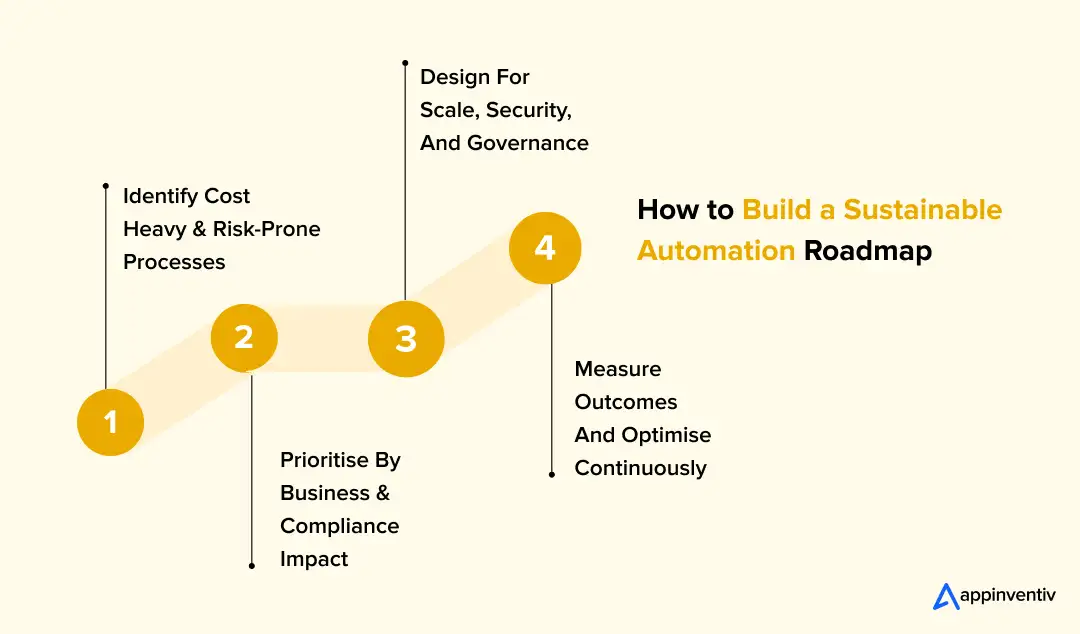
Identify Cost-Heavy and Risk-Prone Processes
Automation programs start where cost and risk intersect. These are not always the loudest or most visible processes, but the ones that quietly accumulate effort, rework, and oversight.
In this phase, enterprises focus on:
- Mapping end-to-end workflows, including exceptions and approvals
- Quantifying manual effort, error rates, and downstream correction cost
- Identifying compliance touchpoints that amplify operational drag
The objective is clarity. Automation applied without this grounding often shifts cost rather than removing it.
Prioritise by Business and Compliance Impact
Not every process deserves automation at the same time. Mature programs rank opportunities based on measurable impact, not internal preference.
Here, teams typically:
- Score processes by cost leakage and volume
- Assess regulatory sensitivity and audit exposure
- Align automation candidates with enterprise priorities
This prevents low-value automation that consumes budget while delivering limited savings.
Design for Scale, Security, and Governance
Automation designed for a single function rarely scales cleanly. Australian enterprises increasingly design automation architectures with enterprise-wide governance in mind from day one.
Key focus areas include:
- Standardised orchestration and integration layers
- Centralised logging, monitoring, and access controls
- Clear ownership models for automation assets
This design discipline avoids the hidden cost of retrofitting controls later.
Measure Outcomes and Optimise Continuously
Cost reduction compounds only when outcomes are measured and adjusted. Enterprises that treat automation as “done” rarely sustain value.
Ongoing focus includes:
- Tracking operational cost reduction, not just effort saved
- Monitoring exception trends and failure points
- Refining decision logic as data and regulations evolve
Automation becomes a living system rather than a static deployment.
Also Read: How to Build an AI App in Australia: A Complete Guide
Unmanaged automation often shifts cost into audit, remediation, and operational risk. Governed automation prevents that trade-off.
Core Technology Layers Fueling Intelligent Automation for Australian Enterprises
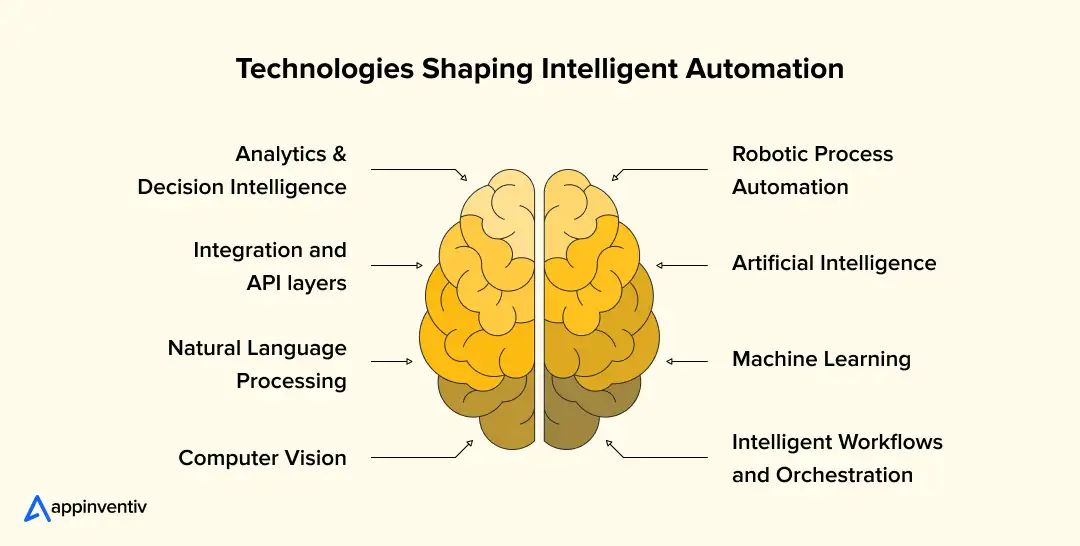
Intelligent automation in Australian enterprises is built from a coordinated set of technologies. Each component supports a different aspect of cost control, from execution stability to decision accuracy. Value comes from how these components work together under enterprise constraints.
Robotic Process Automation (RPA)
RPA handles structured, high-volume tasks that consume operational capacity. It provides consistency and speed where manual execution previously drove cost.
Artificial Intelligence
AI initiatives in Australia supports judgement-based decisions such as classification, prioritisation, and anomaly detection. It reduces escalation and review effort without removing accountability.
Machine Learning
Machine learning models adapt automation behaviour over time based on historical outcomes. This helps reduce recurring exceptions that inflate long-term operational costs.
Intelligent Workflows and Orchestration
Workflow orchestration coordinates actions across systems and teams. It prevents automation from fragmenting and reintroducing manual coordination effort while maintaining a strict human-in-the-loop (HITL) governance boundary.
Analytics and Decision Intelligence
Analytics provide visibility into performance, risk, and cost impact. Enterprises use these insights to intervene early, before inefficiencies compound.
Integration and API Layers
Integration layers connect legacy and modern platforms without forcing replacement. This limits transformation cost while enabling automation to scale across systems.
Natural Language Processing (NLP)
NLP supports document-heavy and communication-driven processes. It reduces manual handling while preserving traceability and compliance context.
Computer Vision
Computer vision is applied selectively in inspection, verification, and monitoring scenarios. It replaces repetitive visual checks that are costly and inconsistent at scale.
Together, these tech components form the technical foundation for enterprise intelligent automation Australia programs that prioritise durability over short-term gains.
How Appinventiv Can Help Australian Enterprises Scale Intelligent Automation
At Appinventiv, we approach intelligent automation for Australian enterprises as a structural cost-control capability, not a tooling exercise. Our work focuses on execution depth, governance alignment, and long-term ownership.
In our 10+ years of APAC delivery experience, we have deployed over 3000 digital assets in Australia, supporting enterprises across 35 industries, with a 78% client retention rate. Our team of 1700+ tech experts operates through five agile delivery centres across Australia.
From a security and compliance perspective, our automation programs operate under a 99.50 percent SLA across ISO and SOC-aligned controls. Enterprises working with us have achieved efficiency gains of up to 35%, driven by reduced rework, lower compliance overhead, and improved operational throughput.
How We Execute Artificial Intelligence Development Services in Australia: 4 Pillars of Sustainable Scale
- Process Discovery (Mining): We don’t guess. We use data-driven process mining to find where your “invisible” costs live.
- Architectural Integrity: We build “API-first” architecture so your automation survives your next legacy system upgrade.
- The Human-in-the-Loop (HITL) Model: We design systems where AI handles 90%, and humans handle the 10% high-risk exceptions.
- Continuous Value Tracking: We measure success in AUD saved and Risk mitigated, not just “hours back to the business.
As an Australian AI consulting company, we design custom intelligent automation solutions that scale responsibly. The emphasis is always on cost predictability, audit readiness, and resilience, not short-term acceleration.
FAQs
Q. What is AI automation in an enterprise context?
A. AI automation for businesses in Australia refers to systems that execute operational tasks while applying decision logic under defined controls. It moves beyond simple task automation by allowing systems to classify, prioritise, and respond to situations that would otherwise require human judgement, without removing accountability from teams.
Q. How does intelligent automation differ from standard RPA?
A. Think of RPA as the “arms” (doing) and AI as the “brain” (thinking). Intelligent Automation is the entire body. While RPA follows a strict script, IA uses Machine Learning to handle unstructured data (like handwritten invoices) and changing variables.
Q. How does intelligent automation work across complex enterprise systems?
A. Intelligent automation works by coordinating how existing systems interact, rather than replacing them. It sits across ERP, CRM, operational platforms, and data layers, guiding execution and decisions end to end.
In practice, this means:
- processes move without manual handoffs
- exceptions are routed only when needed
- decisions follow consistent, auditable rules
Q. How are Australian enterprises using intelligent automation to reduce costs?
A. Australian enterprises reduce costs by embedding automation where effort scales faster than transaction volume. Instead of focusing on speed alone, they use automation to remove repeat validation, reduce rework, and stabilise operations.
The cost impact typically appears through:
- lower manual oversight
- fewer escalations and corrections
- improved predictability in service delivery
Q. Which industries in Australia benefit most from intelligent automation?
A. Adoption is strongest in industries with recurring volume and regulatory pressure. Financial services, mining, healthcare, education, logistics, and energy see faster returns because automation directly reduces administrative and compliance overhead.
These sectors benefit not because they automate more, but because they automate where cost and risk intersect.
Q. What industries use intelligent automation?
A. Industries using intelligent automation include:
- BFSI Sector
- Healthcare and Life Sciences
- Mining and Resources
- Manufacturing
- Retail and eCommerce
- Logistics and Supply Chain
- Energy and Utilities
- Education and Training
- Telecommunications
- Government and Public Sector
Q. How can enterprises implement intelligent automation successfully?
A. Successful programs avoid rushing into tools. Enterprises start by identifying cost-heavy processes, then design automation with governance and security embedded from the outset.
They focus on:
- clear ownership of automated decisions
- stable integration with core systems
- ongoing visibility into performance and exceptions
Q. Is intelligent automation suitable for regulated Australian environments?
A. Yes. Regulated environments often gain the most value when automation is designed correctly. Automated controls operate continuously, not periodically, which reduces audit preparation effort and improves compliance consistency across operations.
Q. What is the future of intelligent automation for Australian enterprises?
A. The future of intelligent automation lies in systems that act with greater autonomy while remaining explainable and controlled. For Australian enterprises, this means automation that supports long-term cost reduction without increasing regulatory, security, or operational risk.

- In just 2 mins you will get a response
- Your idea is 100% protected by our Non Disclosure Agreement.

AI Inventory Management in Australia: Benefits, Use Cases, and Implementation Strategies
Key takeaways: Traditional ERP planning reacts to history; AI predicts demand shifts, reallocates stock dynamically, and prevents costly stockouts across distributed Australian networks. AI in inventory management in Australia typically reduces inventory levels 20–40% while maintaining service targets, unlocking significant working capital across multi-state operations. Enterprise implementations usually range from AUD 70,000 to AUD 700,000+,…

How to Hire RAG Architects for Enterprise AI
Key takeaways: Define your RAG architecture scope to avoid misaligned hiring decisions Identify end-to-end architectural ownership across retrieval, governance, and scaling Evaluate deep technical capabilities beyond prompt engineering and tools Validate governance and compliance readiness at the retrieval layer Test system-level thinking through real-world failure scenarios Choose the right hiring model based on scale, risk,…

Key Takeaways: Healthcare chatbots in the UAE are moving beyond queries to support triage, patient communication, and real clinical workflows across hospitals. Effective healthcare chatbot development depends on clean data, strong system integrations, and alignment with regulations like DHA, DOH, and MOHAP. Development costs typically range from AED 147,000 to AED 1,470,000+, depending on complexity,…