


































20 Best Profitable AI Business Ideas in 2026

 Share -


- 01Why AI Businesses Are More Profitable in 2026
- 0220 Profitable AI Business Ideas for 2026
- 03How to Choose the Right AI Business Ideas
- 04Monetization Models That Work for AI Businesses
- 05Challenges You May Face When Starting an AI Business and How to Overcome
- 06Future Trends Shaping AI Businesses Beyond 2026
- 07How Appinventiv Helps Turn AI Ideas Into Real Business Impact
- 08FAQs

- AI business opportunities in 2026 are driven by real operational needs, not hype or experimentation.
- The most profitable AI business ideas solve workflow friction, reduce costs, or improve decision speed.
- Automation, predictive intelligence, and compliance-focused solutions offer strong ROI and long-term demand.
- Success depends on solving real problems, integrating into existing workflows, and choosing sustainable pricing models.
- Future growth will favor industry-specific AI, agent-driven automation, and solutions built on trust and data security.
Artificial intelligence isn’t a side experiment anymore. It has slipped into everyday work, helping teams handle routine queries, spot equipment issues early, and make sense of growing data. This growing reliance on AI for business is creating real demand for practical AI business ideas that solve everyday operational headaches.
In 2026, the focus has clearly shifted from testing to outcomes. Companies are investing in solutions that improve efficiency, reduce risk, and support growth. That shift is opening doors for founders exploring AI startup ideas, AI automation business ideas, and scalable AI-based business ideas built around real workflows rather than one-off features.
At the same time, generative AI and machine learning tools have made building faster and more accessible. Launching AI SaaS tools or automation platforms no longer requires massive infrastructure. Whether you’re evaluating AI small business ideas, exploring machine learning business ideas, or searching for AI business ideas, the opportunity lies in removing friction from daily work and creating lasting value.
These shifts are also creating new AI ideas for business across industries, from automation to decision intelligence. For founders exploring best AI business ideas, the focus is no longer experimentation but solving real operational challenges.
Identify high-value use cases and build AI solutions aligned with your operational goals.

Why AI Businesses Are More Profitable in 2026
AI is no longer a side experiment. It has become a core lever for cutting costs, improving productivity, and accelerating growth. Companies are actively investing in AI for business solutions that remove manual work and improve decision speed. This shift is pushing demand for practical AI business ideas that solve real operational problems.
What’s different now is the expectation of action. Businesses want systems that execute tasks, not just generate insights. This is fueling AI automation business ideas and scalable AI businesses that integrate directly into everyday workflows.
The momentum is clear. The global AI market is expected to surpass $1.8 trillion by 2030, reflecting rapid adoption across industries.
Why Profitability is Improving
- Intelligent Automation replaces repetitive labor, increasing demand for automated business ideas
- AI budgets are operational, enabling scalable AI business model innovation
- Recurring revenue supports sustainable AI businesses to start
- Data and integrations create defensibility for AI-powered business ideas
- Generative AI lowers barriers to building AI business ideas
AI adoption today is driven by economics. The most successful Artificial Intelligence Business Ideas are those that reduce friction and become part of daily operations.
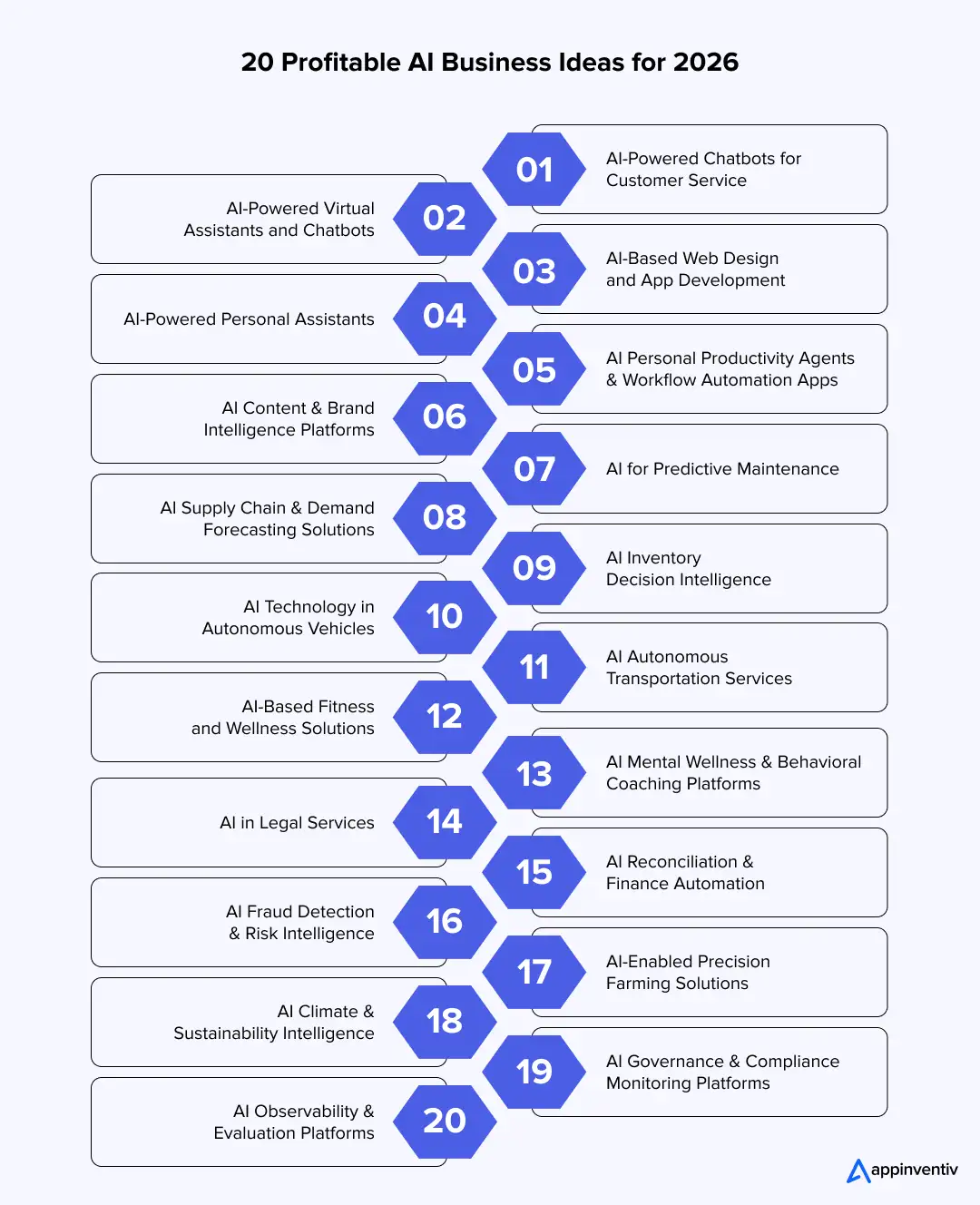
20 Profitable AI Business Ideas for 2026
The most promising AI business ideas today are not built around hype. They succeed by removing friction from daily work, reducing costs, or helping organizations make better decisions faster. Whether you are exploring AI startup ideas, testing machine learning trending business ideas, or building scalable AI businesses, the opportunities below reflect real market demand and long-term value.
The ideas below represent some of the best AI business ideas available today, especially for builders searching for scalable opportunities and AI-related startup ideas aligned with real market demand.
1. AI-Powered Chatbots for Customer Service
Customer service teams still spend a large portion of their day answering the same questions. Modern AI chatbots go beyond scripted replies. They can process refunds, track orders, update accounts, and escalate complex issues when needed.
Where the value comes from
- Lower support costs without reducing service quality
- Faster resolution times and 24/7 availability
- Integration with CRM, billing, and order systems
Why it’s profitable: Businesses pay for outcomes. Automation that reduces support workload makes this one of the most reliable AI automation business ideas.
2. AI-Powered Virtual Assistants and Chatbots
Internal virtual assistants are becoming the “front door” to company knowledge. Employees can ask questions, generate reports, retrieve documents, or trigger workflows without switching systems.
Business impact
- Reduces time spent searching across tools
- Improves knowledge access and decision speed
- Enables workflow automation across departments
Organizations adopting artificial intelligence for business operations see immediate productivity gains.
3. AI-Based Web Design and App Development
Small businesses and startups need a professional digital presence quickly, but traditional development can be expensive and slow. AI-assisted design and development tools now generate layouts, code structures, and UX suggestions in minutes.
Where opportunity exists
- Vertical templates for healthcare, retail, and finance
- Rapid MVP development platforms
- AI-driven UX and conversion optimization
This is a strong entry point for builders exploring AI app ideas and scalable AI saas business ideas. Solutions like these are among the most practical AI tools for business ideas, helping companies launch faster while reducing development overhead.
4. AI-Powered Personal Assistants
Professionals and executives are overloaded with information and meetings. AI personal assistants summarize conversations, prioritize tasks, and surface insights before decisions are made.
Why is demand rising
- Information overload at leadership levels
- Hybrid work complexity
- Need for better time allocation
Premium productivity tools fall into high-value AI powered business ideas with a strong willingness to pay.
5. AI Personal Productivity Agents & Workflow Automation Apps
Instead of juggling multiple tools, users can rely on AI agents to draft emails, prepare reports, schedule follow-ups, and track action items.
Real-world benefits
- Saves hours of repetitive work each week
- Improves consistency and follow-through
- Connects with workplace apps for automation
This category continues to grow as companies seek automated business ideas that improve daily efficiency. Automation platforms are becoming a core part of using AI in business, helping teams eliminate repetitive work and focus on higher-value tasks.
6. AI Content & Brand Intelligence Platforms
Content creation is no longer the bottleneck. Knowing what performs and why is where value lies. AI platforms now analyze performance, maintain brand consistency, and suggest improvements.
Differentiators
- Cross-channel performance insights
- Tone and brand compliance monitoring
- SEO and engagement optimization
A practical path for entrepreneurs exploring AI in business opportunities.
7. AI for Predictive Maintenance
Unexpected equipment failures can halt operations and cause costly downtime. AI models detect patterns in sensor data to identify issues before they cause breakdowns.
Industries seeing strong ROI
- Manufacturing
- Logistics fleets
- Energy and utilities
A high-impact AI-based business idea where cost savings justify rapid adoption.
8. AI Supply Chain & Demand Forecasting Solutions
Supply chain disruptions and poor demand planning create waste and lost revenue. AI systems improve forecasting accuracy and optimize logistics.
Business value
- Better demand planning
- Reduced inventory waste
- Improved delivery efficiency
This is a strong opportunity within machine learning startup ideas focused on operational efficiency.
9. AI Inventory Decision Intelligence
Retailers often struggle with overstocking or stockouts. AI tools analyze sales patterns and external factors to guide replenishment decisions.
Why it matters
- Protects margins through smarter stocking
- Improves customer satisfaction
- Supports real-time demand response
A practical AI small business idea with strong retail adoption potential. Retailers and small enterprises are increasingly exploring artificial intelligence small business opportunities to improve margins and respond faster to demand shifts.
Also Read: How AI in Retail Improves Shopping Experiences
10. AI Technology in Autonomous Vehicles
AI is enabling safer navigation, real-time decision making, and fleet intelligence in semi-autonomous environments.
Opportunity areas
- Safety monitoring systems
- Industrial vehicle automation
- Fleet performance analytics
This represents one of the more advanced new AI business ideas emerging in mobility.
11. AI Autonomous Transportation Services
Logistics and delivery operations are moving toward automation to improve efficiency and reduce costs.
Where value is created
- Warehouse transport automation
- Delivery route intelligence
- Fleet utilization optimization
Service-based deployment creates a sustainable AI business model.
Also Read: AI in Logistics Industry: Key Benefits and Use Cases
12. AI-Based Fitness and Wellness Solutions
Consumers increasingly expect personalized wellness guidance. AI platforms in fitness analyze activity, recovery, and lifestyle patterns to provide tailored recommendations.
Growth drivers
- Wearable device integration
- Preventive health awareness
- Personalized coaching experiences
This consumer-focused category is gaining traction among ai powered business ideas. This category continues to attract founders searching for AI business ideas for entrepreneurs looking to build consumer-focused platforms.
13. AI Mental Wellness & Behavioral Coaching Platforms
Mental wellness is becoming a workplace priority. AI in the mental wellness industry provide guided support, mood tracking, and behavioral coaching.
Why adoption is growing
- Workplace stress and burnout concerns
- Remote work isolation
- Corporate wellness investments
An emerging opportunity within artificial intelligence for small businesses.
14. AI in Legal Services
Legal professionals spend significant time reviewing contracts and compliance documents. AI tools accelerate review while flagging risks.
Key use cases
- Contract analysis and risk detection
- Compliance monitoring
- Legal research automation
High efficiency gains make this one of the most profitable AI business ideas. Legal automation is gaining traction among professionals exploring AI business ideas for beginners, thanks to clear use cases and strong demand.
Also Read: Top 10 Use Cases of AI in the Legal Industry
15. AI Reconciliation & Finance Automation
Manual reconciliation slows finance teams and increases error risk. AI systems continuously match transactions and flag discrepancies.
Business value
- Faster financial closing cycles
- Improved accuracy and compliance
- Reduced manual workload
A strong AI business idea for enterprises with clear ROI.
16. AI Fraud Detection & Risk Intelligence
As digital transactions grow, fraud risks increase. AI systems detect unusual behavior in real time.
Adoption drivers
- Payment security improvements
- Regulatory compliance requirements
- Real-time risk detection
One of the most resilient AI businesses to start in financial services.
Also Read: AI-Powered Fraud Detection Software Development Services
17. AI-Enabled Precision Farming Solutions
Farmers are adopting AI in agriculture to improve yield and reduce resource waste.
Applications
- Crop health monitoring
- Smart irrigation optimization
- Yield prediction analytics
A sustainability-focused AI startup idea with strong future demand. Agritech innovation is opening the door to AI-related startup ideas, particularly in regions focused on sustainability and food security.
18. AI Climate & Sustainability Intelligence
Organizations face increasing pressure to track emissions and sustainability metrics.
Opportunity areas
- Carbon tracking automation
- ESG reporting tools
- Climate risk modeling
Regulatory and investor pressure are driving AI adoption in sustainability.
19. AI Governance & Compliance Monitoring Platforms
As AI adoption grows, organizations need visibility and control over how systems operate.
Critical capabilities
- Audit trails and decision logs
- Policy enforcement
- Data lineage tracking
A trust-focused AI saas business idea with strong enterprise demand.
Also Read: AI in Data Governance: Reshaping Enterprise Data Strategy
20. AI Observability & Evaluation Platforms
Companies deploying AI need to ensure reliability and safety. Observability tools monitor performance and detect risks.
Key value
- Detect drift and accuracy issues
- Monitor reliability and safety
- Support responsible AI deployment
This emerging category will support the next wave of scalable AI businesses.
These top AI business ideas reflect where real demand and long-term value exist. Whether you are exploring AI ideas for business, launching AI-based startup ideas, or building enterprise solutions, the strongest opportunities lie in solving real problems and embedding intelligence into everyday workflows.
Organizations adopting and using AI in business operations are seeing measurable efficiency gains and faster decision cycles. This growing demand is encouraging founders to explore AI-generated business models that deliver outcomes rather than just insights.
Design, build, and deploy AI systems that integrate seamlessly and deliver real ROI.

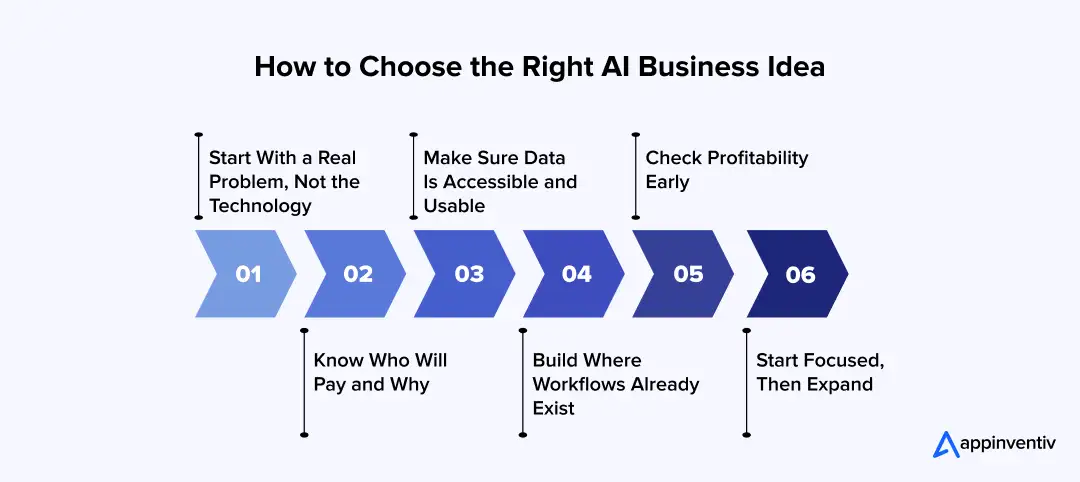
How to Choose the Right AI Business Ideas
There’s no shortage of AI business ideas right now. The real challenge is picking one that people will actually pay for. Many founders build impressive tools, only to realize later that the problem wasn’t urgent enough to justify adoption. The ideas that succeed usually solve something businesses deal with every single day.
Instead of chasing trends, focus on practicality and value.
1. Start With a Real Problem, Not the Technology
AI delivers the most value when it removes friction from existing work.
Ask yourself:
- Does this problem waste time, money, or resources?
- Are teams handling it manually or through messy workarounds?
- Would automation make a noticeable difference?
Solutions rooted in everyday operational pain tend to outperform generic AI-based business ideas.
2. Know Who Will Pay and Why
A great product still fails if there isn’t a clear buyer.
Look for:
- Teams with defined budgets, like operations, finance, or support
- Problems tied to cost savings or revenue protection
- Improvements that boost productivity or reduce risk
Clarity here strengthens your AI business model and speeds up adoption.
3. Make Sure Data is Accessible and Usable
AI systems depend on data to produce reliable outcomes.
Consider:
- What data is needed for the solution to work?
- Will companies be willing and able to share it securely?
- Will outcomes improve as more data is used?
Access to usable data also strengthens long-term defensibility.
4. Build Where Workflows Already Exist
Tools that sit outside daily workflows often get ignored. Adoption improves when AI fits into the tools teams already use.
High-value integrations include:
- CRM and ERP systems
- Finance and payment tools
- Supply chain software
- Collaboration platforms
Deep integration improves retention and makes AI businesses more valuable over time.
5. Check Profitability Early
Not every AI solution scales profitably. Infrastructure and model usage costs can add up quickly.
Test early:
- What customers are willing to pay
- Estimated operating costs at scale
- Ways to control costs using smaller models or optimization
This helps ensure your AI powered business ideas remain sustainable.
6. Start Focused, then Expand
Many successful products begin by solving one specific problem extremely well.
A practical path:
- Target a narrow, high-value use case
- Gain traction in one industry or workflow
- Expand features and integrations over time
The strongest artificial intelligence business ideas don’t try to do everything at once. They become valuable by fitting into daily work and proving their worth quickly.
Monetization Models That Work for AI Businesses
Having a strong idea is only part of the equation. How you charge for it often determines whether the business becomes sustainable or struggles to scale. Many founders focus heavily on building the product, then realize later that infrastructure costs, customer expectations, or support needs make their pricing difficult to sustain.
In 2026, successful AI businesses will not charge for access to technology. They charge for time saved, costs reduced, and outcomes improved. Choosing the right pricing structure early helps protect margins and makes growth more predictable.
1. Subscription (SaaS) Pricing
This model works well when your solution delivers ongoing value rather than one-time results.
Works best for:
- Workflow automation platforms
- AI assistants and productivity tools
- Compliance and monitoring solutions
Predictable revenue makes this ideal for scalable ai saas business ideas.
2. Usage-based Pricing
Some AI solutions create value based on how much they are used. Charging per interaction or transaction keeps pricing aligned with value.
Common examples:
- Customer support automation
- Document and data processing
- Fraud monitoring systems
This approach fits naturally with expanding AI automation business ideas.
3. Outcome-based Pricing
Businesses increasingly prefer paying for results rather than for software access.
Examples include:
- Percentage of cost savings achieved
- Revenue improvements from optimization tools
- Reduction in manual workload
This model builds trust and strengthens your AI business model.
4. API & Platform Licensing
If your AI capabilities power other products, licensing access can create a scalable revenue stream.
Ideal for:
- Document intelligence engines
- Detection or recognition systems
- Industry-specific AI modules
This approach supports high-scale AI product ideas.
5. Enterprise Customization & Integration Fees
Large organizations often need deeper integration, security controls, and customization.
Revenue opportunities:
- Implementation and onboarding
- Workflow customization
- Compliance and security setup
Common among AI business ideas for enterprises, where integration depth adds value.
6. Data & Insights Monetization
As your platform grows, aggregated insights can become valuable in their own right.
Potential offerings:
- Industry benchmarks
- Predictive trend dashboards
- Operational performance insights
This creates a long-term advantage for AI in business platforms.
The most successful Artificial Intelligence Business Ideas rarely rely on a single pricing model. Subscription revenue builds stability, usage pricing scales with growth, and outcome-based pricing reinforces value.
When pricing reflects real impact, customers stay longer, and profitability becomes easier to sustain.
Challenges You May Face When Starting an AI Business and How to Overcome
At the idea stage, building an AI venture can feel straightforward. The demo works, the concept sounds promising, and the opportunity looks clear. But once real users enter the picture, practical challenges start to surface. Most founders run into similar roadblocks. Knowing what’s ahead helps you move forward without unnecessary setbacks.
Here are some common hurdles teams face when building AI business ideas, along with practical ways to address them.
- Keeping Operating Costs Under Control
- Addressing Data Privacy and Compliance Concerns
- Building Trust and Encouraging Adoption
- Handling Integration Complexity
- Avoiding Overbuilding Too Early
1. Keeping Operating Costs Under Control
AI solutions can become expensive to run if usage grows faster than expected or processes aren’t optimized.
Where costs tend to increase
- High processing demand from frequent model use
- Large data storage and computing needs
- Scaling infrastructure too early
What helps
- Use lighter models where they work just as well
- Cache repeated outputs instead of regenerating them
- Streamline workflows to reduce unnecessary processing
Keeping costs predictable is key to building sustainable AI powered business ideas.
2. Addressing Data Privacy And Compliance Concerns
Businesses are cautious about how their data is handled. Trust often determines whether they adopt a solution.
Common concerns
- Handling sensitive financial or customer information
- Meeting regulatory requirements
- Data storage location and security
What builds confidence
- Designing with privacy in mind from the start
- Clear and transparent data practices
- Access controls and audit logs
Trust plays a major role in the adoption of artificial intelligence for business solutions.
3. Building Trust And Encouraging Adoption
Even when AI works well, teams may hesitate to rely on automation right away.
Why adoption can slow down
- Fear of mistakes or losing control
- Comfort with familiar workflows
- Uncertainty about how decisions are made
How to encourage usage
- Keep humans involved in key decisions
- Provide clear explanations for outputs
- Introduce automation gradually
Adoption improves when AI feels helpful rather than disruptive.
4. Handling Integration Complexity
Businesses already rely on multiple tools. If a solution doesn’t fit into existing workflows, it often gets ignored.
Typical obstacles
- Legacy systems and disconnected tools
- Data silos between departments
- Unique workflow requirements
What helps
- Start with intthe egrations teams already use
- Offer flexible APIs and connectors
- Design around real workflows from day one
Smooth integration strengthens retention and long-term value for AI businesses.
5. Avoiding Overbuilding Too Early
It’s tempting to add advanced features before confirming real demand.
Common pitfalls
- Building complexity too soon
- Trying to solve too many problems at once
- Delaying launch while chasing perfection
A better approach
- Start with one clear use case
- Test it with real users quickly
- Expand based on feedback and usage
The strongest artificial intelligence business ideas grow through real-world use, not perfect first versions.
Every new venture comes with challenges. The teams that succeed stay practical, focus on trust and usability, and build solutions people can rely on every day.
Future Trends Shaping AI Businesses Beyond 2026
AI is changing quickly, but the real shift isn’t just about smarter technology. It’s about how AI quietly blends into everyday work. Instead of feeling like a separate tool, it’s becoming part of how tasks get done, decisions are made, and teams stay productive. The next wave of AI business ideas will be shaped by usefulness, trust, and how naturally they fit into real workflows.
Here are the trends likely to influence AI businesses in the coming years:
- AI will move from suggesting actions to completing them: We’re moving beyond tools that give recommendations. New systems will handle tasks such as updating records, routing requests, and processing approvals, while people remain in control.
- Industry-focused solutions will beat generic platforms: Businesses prefer tools built around their daily operations. Solutions designed for healthcare, finance, logistics, or agriculture will see stronger adoption than one-size-fits-all software.
- Oversight and transparency will become essential: As adoption grows, companies will expect clear audit trails, policy controls, and transparency built into artificial intelligence for business systems.
- Processing closer to the source will improve speed and reliability: Handling data on devices or local systems can reduce delays, improve performance, and lower ongoing costs.
- AI will support people rather than replace them: The most useful tools will help teams make better decisions, stay organized, and work faster, rather than removing human involvement.
- Privacy and security will influence buying decisions: Organizations will choose providers who clearly protect data and demonstrate responsible practices.
- Pricing will shift toward measurable results: Businesses increasingly prefer paying for outcomes instead of access, reshaping how the AI business model evolves.
- Generative capabilities will blend into everyday tools: Instead of standalone apps, generative features will appear inside platforms teams already use, accelerating AI in business adoption.
- Smaller, focused models will become more practical: Task-specific models can improve reliability and reduce operating costs compared to large, general systems.
- AI literacy will become a normal workplace skill: Teams across departments will need to understand how to use AI effectively, increasing demand for tools that simplify adoption.
The future of AI powered business ideas isn’t about chasing breakthroughs. It’s about making work smoother, building trust, and delivering value people notice in their day-to-day routines.
Future-ready architecture, governance, and automation to support long-term growth.

How Appinventiv Helps Turn AI Ideas Into Real Business Impact
A strong idea is a good start. Making it useful in everyday work is where most teams get stuck. The challenge usually isn’t the technology. It’s figuring out where AI will actually help and how to introduce it without disrupting what people already rely on. Through its AI development services, Appinventiv works with organizations to spot practical opportunities and bring AI into workflows in a way that feels natural.
One example is MyExec AI Business Consultant, built to help small and mid-sized businesses understand their data and make decisions with more clarity. It doesn’t replace judgment. It simply gives leaders better direction when they need it. In another project, updates to the Flynas airline app made booking easier and improved real-time customer support, helping passengers move through their journey with less friction.
Whether you are exploring AI startup ideas, building new AI businesses, or improving existing systems, the right guidance can save time and prevent costly detours. If you want to turn ideas into practical solutions people rely on every day, Appinventiv can help you move forward with confidence.
FAQs
Q. How to start an AI business?
A. Starting an AI venture begins with identifying a real problem that businesses or consumers face daily. Validate demand, ensure access to usable data, and define a clear value proposition. Build a focused MVP, test with real users, and refine based on feedback. Many successful founders begin with narrow AI business ideas and expand once adoption grows.
Q. What are AI business ideas for startups?
A. Startups often succeed by targeting specific pain points rather than broad markets. Popular options include workflow automation tools, customer support assistants, document intelligence systems, and predictive analytics platforms. These AI startup ideas and AI-based startup ideas work well because they solve operational inefficiencies and offer measurable ROI.
Q. What are some profitable AI startup ideas for 2025 and beyond?
A. Profitable opportunities continue to emerge in automation, compliance monitoring, predictive maintenance, and decision intelligence. Solutions that reduce costs, improve productivity, or protect revenue tend to perform best. Many founders are exploring the most profitable AI business ideas, AI business ideas, and scalable AI automation business ideas that deliver long-term value.
Q. How can AI enhance customer experience in startups?
A. AI helps startups deliver faster, more personalized service without expanding teams. Chatbots handle routine queries, recommendation engines tailor experiences, and predictive insights anticipate customer needs. Using AI for business in customer journeys improves satisfaction, reduces response times, and strengthens loyalty.
Q. What are the challenges of integrating AI into a startup?
A. Common challenges include data quality issues, integration complexity, privacy concerns, and user trust. Startups must ensure transparent data practices, choose tools that fit existing workflows, and introduce automation gradually. Addressing these factors improves adoption and strengthens artificial intelligence for business implementation.
Q. How much investment is required to start an AI-based business?
A. Costs vary depending on complexity, data requirements, and infrastructure. A focused MVP can often be built between $20,000 and $80,000, while enterprise-grade platforms require a larger investment. Cloud services, open-source models, and modular development approaches help founders launch AI-based business ideas and scalable AI businesses to start without high upfront costs.
Q. What strategies help AI businesses achieve sustainable profitability?
A. Sustainable growth comes from solving high-value problems, controlling operating costs, and choosing the right pricing model. Many successful AI businesses combine subscription and usage pricing while focusing on automation that reduces labor and improves efficiency. Building solutions around real workflows and using AI in business operations ensures long-term value and customer retention.
Q. How long does it take to build an AI-powered product?
A. Timelines depend on complexity, data readiness, and integrations. A focused MVP can take 8–16 weeks, while enterprise platforms may require several months. Founders exploring AI startup ideas or AI business ideas for entrepreneurs often begin with a narrow use case and expand after validating real-world adoption.
Q. Can AI solutions be customized for specific business needs?
A. Yes. Most organizations require tailored workflows, integrations, and compliance controls. Customization ensures the solution fits existing systems and industry requirements. This flexibility makes AI tools for business ideas more practical and helps organizations implement artificial intelligence for business in ways that match their operational needs.
Q. What about AI business ideas I can build with ChatGPT or other LLMs?
A. Large language models enable a wide range of AI generated business opportunities, including virtual assistants, knowledge copilots, document automation tools, and customer support systems. Founders can build scalable solutions by combining LLM capabilities with
workflow automation and domain-specific data.
Q. What are the best AI business ideas for entrepreneurs?
A. The best AI business ideas for entrepreneurs focus on automation, decision support, and productivity improvement. Opportunities include workflow automation, predictive analytics, customer experience tools, and industry-specific solutions. These AI ideas for business succeed because they address real operational pain points and deliver measurable value.


Fast 2-minute response, fully NDA-protected.
AI Data Integration: How to Connect, Clean and Prepare Data for AI
Key takeaways: AI initiatives fail when fragmented, poor-quality data reaches models without sufficient context, controls or ownership. AI-ready pipelines must connect, clean, enrich, govern and continuously monitor data across its lifecycle. Real-time processing matters when AI decisions depend on current transactions, events, inventory or operational conditions. Data architecture should follow the AI use case, balancing…

AI Agent Governance: How to Govern Autonomous AI Across Business Systems
Key takeaways: AI agents require controls at the action, identity, data, tool, and workflow levels. Every enterprise agent should have a registered owner, an approved purpose, and a defined risk tier. Access must be based on the agent’s task rather than inherited from a human user or shared service account. High-impact actions need real-time policy…

'I.D.E.A.S.' - The Five Pillar Framework to Ace AI-Native Enterprise Apps in 2027
Key takeaways: AI-native enterprise apps are moving beyond AI agents toward intelligent, adaptive, autonomous and context-aware digital capabilities that can operate across mobile, web, voice, wearables and emerging interfaces. The I.D.E.A.S. framework for AI enterprise apps in 2027 - Interactive Intent, Decisioning Autonomously, Experiential System Design, Adaptive Execution, and Security Layered. Context intelligence and reusable…