





























How to Develop an App in Australia: From Concept to Market-Ready Product


- Why Developing an App is a Strategic Move for Startups in Australia
- Key Decisions That Shape a Successful App Launch in Australia
- How to Develop an App in Australia: Step-by-Step Process
- Key Features to Include When Developing an App in Australia
- How Much Does It Cost to Develop an App in Australia?
- Compliance and Regulatory Considerations for App Development in Australia
- Common Mistakes to Avoid When Developing an App Idea
- Challenges with Mobile App Development in Australia and How to Overcome Them
- Future Trends and Innovation in Australian App Development
- How Appinventiv Can Help You in Building an App in Australia
- FAQs

Key takeaways:
- Developing an app in Australia starts with clarity, not code. Clearly define the problem, validate it with real users, and confirm there is genuine demand before investing in development.
- Market research and user conversations shape better apps than assumptions. Understanding who you are building for and why reduces rework and increases adoption later.
- Start small with an MVP. A focused first version helps you test usability, control costs, and learn from real behaviour instead of guesses.
- Planning matters as much as building. Platform choice, tech stack, compliance requirements, and revenue model decisions should be made early to avoid expensive changes later.
- App development costs in Australia range from AUD 70,000 to AUD 700,000, depending on complexity. Set realistic expectations for both the budget and timelines to ensure a smooth project execution.
- Leverage technologies like AI, IoT, AR/VR, and 5G to keep your app competitive and future-proof in Australia’s fast-evolving app market.
In a competitive digital market, knowing how to develop an app in Australia is less about building another mobile product and more about turning a business idea into a strategic, market-ready asset. For startups looking to grow fast, an effective mobile application can be the fuel that drives customer acquisition and interaction, monetisation, and expansion.
According to Business of Apps, revenue in the Australian app market has grown by more than USD 1 billion over the past four years, underlining rapid adoption and usage growth locally.
In Australia, smartphone penetration is truly high, this means your potential user base is mobile-first and willing. Indeed, a study found that the average smartphone user worldwide spends over 4 hours daily interacting with mobile applications.
The implication of this as a startup would be that there is a high level of competition, but a big opportunity. You might be brainstorming how to develop an app in Australia next quarter, but you must have a systematic process to help you launch an app, not just launch an app.
This guide will take you through the entire process, from developing an app idea to validation, launch, and scaling, showing exactly how to build an app in Australia that doesn’t just live on a phone but becomes a market-leading product.
If you’re ready to take the first step in developing your app in Australia, our experts are here to guide you.

Why Developing an App is a Strategic Move for Startups in Australia
The Australian mobile app space is active right now, and startups have some clear advantages if they move thoughtfully. Here’s what we’re seeing:
- The Numbers Matter: Just over 94% of Australians access the internet through their smartphones, making mobile devices the primary gateway for online activity. That’s not a statistic to impress people at conferences—it’s your actual audience, already holding the device you want to reach them on. With such deep smartphone adoption, businesses wondering how to develop an app idea in Australia can confidently target users where they spend most of their time.
- Reaching People Where They Are: Apps work because they sit on the home screen. You’re not competing for attention in a crowded inbox or hoping someone remembers your website URL. You’re there when they unlock their phone. That proximity makes mobile app development in Australia one of the most effective ways to build lasting customer relationships.
- Setting Yourself Apart: Plenty of businesses still don’t have apps. If yours does, and it actually works well, you’ve immediately separated yourself from competitors still relying on mobile websites that load slowly and frustrate users. Learning how to build an app in Australia that’s fast, reliable, and useful gives your brand an instant edge.
- Multiple Ways to Make Money: You’re not locked into one revenue model. Some apps charge subscriptions. Others sell upgrades or premium features. Some run tasteful ads. The flexibility allows startups to explore how to make an app to test which model their Australian users respond to best.
- Starting Local, Thinking Bigger: Australia makes sense as a launch market. Regulations are clear, infrastructure is solid, and the market’s big enough to validate your concept. Once an app succeeds with Australian businesses, expanding into Asia-Pacific or other English-speaking markets becomes significantly easier.
Key Decisions That Shape a Successful App Launch in Australia
Turning your app idea into reality in Australia takes planning, validation, and execution. If you’ve been wondering how to create an app in Australia that users will love, here’s a simple roadmap to help you move from idea to launch smoothly.
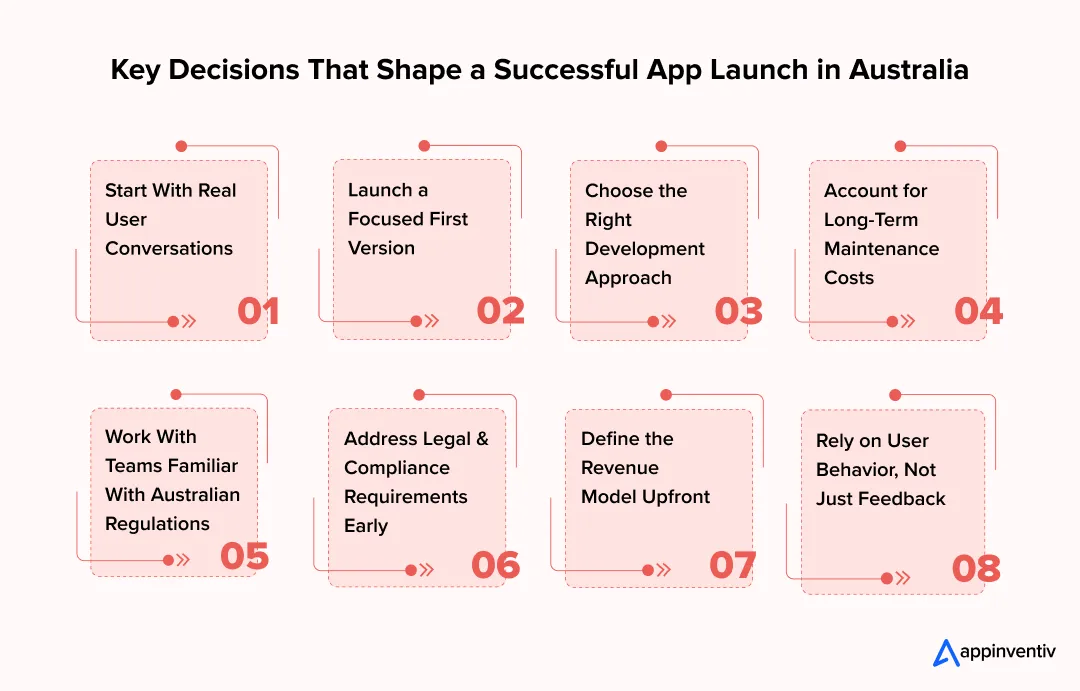
- Talk to Users First: Before diving into mobile app development in Australia, talk to real people. If nobody’s frustrated by the problem, your app won’t matter. Validate demand before you write a single line of code.
- Ship Something Basic: Don’t overbuild. If you’re exploring how to develop an app idea in Australia, focus your first version on solving one specific problem. Everything else can come later.
- Choose Your Build Approach: Deciding how to build an app in Australia depends on your goals. Native apps feel smoother, while cross-platform apps get you to market faster. Pick based on timeline and money, not perfection.
- Plan for Ongoing Costs: Maintenance eats 15-20% of your build budget every year. Hosting, updates, store fees—they add up fast.
- Hire People Who Know Australian Rules: The Legal and Tax Considerations for App Development in Australia are real. Privacy Act compliance isn’t something you figure out later. Neither are accessibility standards. Work with locals who’ve dealt with these before.
- Handle Legal Stuff Early: Retrofitting compliance when you’ve got traction is painful. Do it right from day one. Address these issues before you scale your app idea to launch for Australian businesses.
- Pick Your Revenue Model Now: Subscriptions, purchases, ads—whatever you choose affects how you build. The earlier you decide, the smoother your process to launch an app idea in Australia becomes.
- Trust Behavior Over Feedback: Users tell you one thing and do another. Watch where they click, where they bail. That’s your real data.
Also Read: How to Build a Secure App in Australia in 2025?
How to Develop an App in Australia: Step-by-Step Process
Building an app in Australia isn’t just about writing code—it’s about creating something that meets real needs. Following a structured process to make an app ensures your product stands out, attracts users, and succeeds in a competitive market. Whether you’re a startup or an established company exploring how to develop an app in Australia, this step-by-step guide helps you go from concept to launch.
1. Ideation & Market Research
This is where you slow down before jumping in. If you can’t clearly say what problem your app solves, it’s worth spending more time here.
- Get clear on the problem: Keep it simple. If users don’t “get it” quickly, they won’t stick around.
- Talk to real people: Not friends, not colleagues. People who actually deal with the problem every day.
- Know who you’re building for: Broad categories don’t help much. Specific needs do.
- Look at competitors honestly: Other apps aren’t a bad sign. Their weak spots often show you where to improve.
Doing this properly saves you from having to fix the wrong things later.
2. Planning Your App Development Strategy
Most apps fail because they lack direction. Here’s how to avoid that.
- Set Actual Goals: Define measurable business outcomes, revenue, retention, or acquisition, and align them with your app development features list.
- Pick Your Platform: Native apps run smoothest but require separate iOS and Android builds. Cross-platform frameworks let you ship faster with one codebase. PWAs skip the app stores entirely but have limitations. Your users and timeline determine which makes sense.
- Build on Solid Tech: Choose tools that won’t trap you later, especially if you plan to launch a profitable app later. Can it handle 10x your current user base? Will developers still support it in three years? Trendy frameworks without proper testing age poorly. Boring, proven tech usually wins.
- Launch Small: Strip your feature list to the bare essentials. What’s the one thing users absolutely need? Build that, ship it, and watch what happens. You’ll learn more in two weeks with a live product than in six months of planning.
3. Designing Your App for Success
Design is not about impressing people. It is about making sure they don’t have to think too hard while using your app. When things feel natural, users tend to stay.
- Focus on how it’s used: A good app guides users quietly. If someone needs instructions or feels lost, the experience needs to be simplified.
- Keep the interface familiar: Most users already know how apps work. Don’t fight that. Clear layouts and obvious actions make life easier.
- Test rough versions early: Show a simple prototype to people who haven’t seen the idea before. Where they hesitate is where work is needed.
- Be consistent with your brand: The app should feel like a single, cohesive experience, not a collection of screens.
If people can use your app without thinking about it, the design is doing its job.
Also Read: Importance of UI UX Design in an App Development Process
4. Development Process
Building apps involves constant decisions. Here’s what matters most:
- Choosing Your Development Approach: In-house gives you control but limits your skill set. Outsourcing cuts costs but needs oversight. Hybrid models split the difference. Pick based on what you can actually manage, not what sounds best on paper.
- Work in Iterations: Break the project into two-week chunks. Build something, test it, adjust. This beats spending months on a grand plan that falls apart at launch. Stay flexible—your first assumptions are probably wrong.
- Start With What Works: Build the basics first. Login, core functionality, maybe payments. Skip the nice-to-haves. Launch something useful quickly, then improve based on what users actually do.
- Connect Your Systems: If your app needs to integrate with your CRM, accounting software, or payment processor, it’s crucial to plan these connections early. Adding them later can lead to complications that become harder and more costly to fix as your app scales.
5. Testing & Quality Assurance
Comprehensive testing protects your reputation. Every successful app idea to launch for Australian businesses must undergo unit, integration, usability, and performance testing to ensure smooth functioning before release.
- Types of Testing: You need multiple layers. Unit tests catch broken code. Integration tests identify where different components don’t communicate properly. Usability tests show where users get confused. Performance tests reveal what breaks under load. Skip any of these, and you’ll find out the hard way after launch.
- User Testing: Give your app to people who’ve never seen it before. Watch them use it without helping. They’ll find problems you’d never think to look for. Beta testers are brutal—and that’s exactly what you need before real customers show up.
- Bug Fixing and Polishing: Every test surfaces issues. Some are critical. Others are annoying. Fix the critical ones immediately. The annoying ones add up fast, so don’t ignore them either. A slow app or one that crashes occasionally will tank your ratings before you can fix it.
Testing isn’t glamorous, but it’s what separates the apps people use from the ones they delete.
6. Launching Your App
This is where all your planning meets execution. Prepare ASO assets, finalize compliance documents, and choose the right launch strategy for your app in Australia to maximize visibility. Here’s how to set your app up for the best start.
- Preparing for Launch: Before submitting to app stores, triple-check the basics. Your ASO needs work—keywords, screenshots, description. Privacy policy and terms aren’t optional. Miss these, and you’re looking at rejections and delays.
- Go-to-Market Strategy: Nobody discovers apps by accident anymore. Line up your launch tactics beforehand—whether that’s press outreach, influencer partnerships, or paid ads. Building some anticipation beats launching into silence.
- Launching the MVP: Get something working into users’ hands quickly. Your assumptions about what people want are probably half wrong. Real usage data beats months of internal debate. Launch MVP, learn fast, iterate.
7. Post-Launch & Scaling
Getting the app live is not the end of the work. It’s the point where you finally see how people actually use it.
- Pay attention to behaviour: Downloads matter, but what really counts is whether people come back and spend time in the app. Those patterns tell you what’s worth improving.
- Let users guide you: Users are quick to point out what feels off. Give them simple ways to share feedback and take it seriously.
- Keep adjusting: Small fixes and regular improvements usually matter more than big redesigns. Most apps improve through steady, quiet updates.
- Be ready to grow: If usage starts picking up, the app needs to handle it without slowing down. Thinking about scale early saves a lot of stress later.
The apps that last are usually the ones that keep learning after launch, not the ones that treat it as the finish line.
Also Read: Step-by-Step Guide to Digital Tipping Platform Development for Australia: Features, Costs & ROI
Our step-by-step guide gives you the blueprint, but the execution is key. Let our team of experienced developers help you navigate the process and bring your app to life.

Key Features to Include When Developing an App in Australia
When teams talk about features, the conversation often gets crowded very quickly. Everyone has ideas. Most of them sound useful. In practice, Australian users tend to reward apps that feel steady and easy, not ones that try to do everything at once.
A few features consistently make the difference.
- A straightforward first experience: When someone opens your app for the first time, they should understand its value almost immediately. Long sign-up flows or too many permission requests early on usually push people away.
- Performance that doesn’t get in the way: Users notice lag far more than they notice clever features. If an app feels slow or crashes, it rarely gets a second chance. Stability matters more than polish in the early stages.
- Basic but reliable security: You don’t need enterprise-level complexity on day one, but you do need to handle logins, sessions, and user data responsibly. Trust is built quietly, often without users even realising it.
- Graceful behaviour when the network isn’t perfect: Not everyone is always on strong connections. Apps that fail completely when the signal drops feel fragile. Small things, like saving progress locally, go a long way.
- An easy way to get help or give feedback: Users like knowing there’s a way to reach someone when something goes wrong. Even a simple contact option makes the app feel more dependable.
- A structure that allows growth: Features will change. Some will be removed. Others will be added. Building with flexibility in mind keeps those changes manageable later.
In the end, developing an app in Australia is less about ticking feature boxes and more about building something people are comfortable using again and again. Reliable apps tend to win quietly.
How Much Does It Cost to Develop an App in Australia?
When you’re thinking about developing an app in Australia, the first question is often, “How much is this going to cost?” The truth is, it depends on several factors, but here’s a general breakdown to help you get an idea.
Cost Breakdown
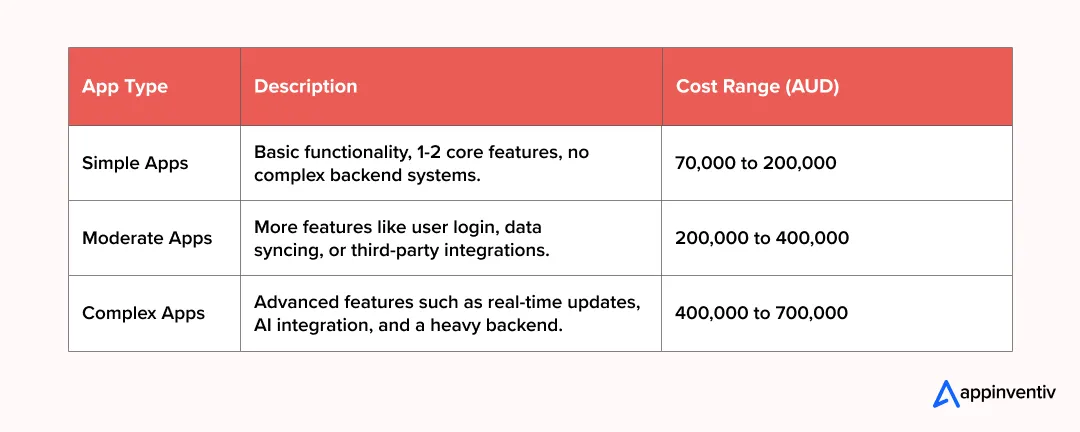
The mobile app development cost in Australia can vary significantly based on the complexity of the app. Here’s the cost breakdown:
Factors Affecting Cost
People often ask, “So what does it really cost to make an app in Australia?” The truth is, it depends on a few things, and the price shifts quite a bit based on what you’re trying to build.
Platform choice
One of the first things you decide is where the app should run. If you choose a native app, you are essentially building two separate apps, which makes it more expensive. Cross-platform is a bit kinder on the budget, since you can use a single codebase for both iOS and Android. And if you go with a PWA, it usually costs even less because it is closer to a website that behaves like an app.
How detailed does the app need to be
Costs start creeping up as your idea gets more complicated. A simple app with a few screens stays on the lower side. But the moment you add things like real-time updates, in-app logic, payments, or anything involving AI, the effort jumps. Bigger ideas simply take more hours to build.
Who is actually building it?
Experience plays a big role, too. Developers in Australia who know what they are doing, especially those who can handle AI or tricky integrations, usually charge more. But they also build things in a way that does not fall apart later. Sometimes paying a little extra upfront saves you from having to fix the same problems again and again.
Compliance and Regulatory Considerations for App Development in Australia
Compliance usually isn’t what founders want to think about when they’re excited about an app idea. Most people would rather talk about features, growth, or launch dates. But in Australia, compliance has a way of showing up whether you plan for it or not.
If you’re working through how to develop an app idea in Australia, it’s better to face this early. Fixing compliance issues later is slower, more expensive, and often stressful.
There are a few areas that almost every app here has to deal with.
- User data and privacy: If your app collects anything personal, even something simple like an email address or usage data, you’re covered by the Privacy Act 1988. Users expect to know what’s being collected and why. You don’t need legal jargon, but you do need clarity. Copy-paste privacy policies tend to cause more problems than they solve.
- Payments, subscriptions, and refunds: The moment money is involved, expectations change. Australian users are quick to lose trust if pricing is confusing or cancellations feel deliberately hard. Australian Consumer Law makes it clear that transparency matters. Many apps get negative reviews here simply because this part was rushed.
- Basic security hygiene: Even early-stage apps are expected to protect user data properly. Things like encrypted storage, secure APIs, and sensible access controls are no longer “enterprise extras.” They are baseline expectations, especially during app store reviews.
- Extra rules for certain industries: Some apps have more to think about than others. Health, fintech, and education apps in Australia often include additional requirements for data handling. These are much easier to design for upfront than retrofit once users are already active.
The simplest way to handle compliance is to stop treating it as a final checkbox. When it’s part of your planning and building decisions, everything else becomes easier. Your launch is smoother, approvals are faster, and users trust your product sooner.
In the Australian market, that trust matters more than most people realise.
Also Read: How Much Does It Cost to Build a Calorie Counting App Like Cronometer in Australia
Common Mistakes to Avoid When Developing an App Idea
If you have ever tried to turn an app idea into a real app, you know how the excitement slowly turns into a mix of confusion and “wait, why is this so complicated?” Most of us hit the same potholes without even realising it. A few small things, if you keep an eye on them early, really save you later.
Trying to build too much too soon
This happens almost every time. You get the idea, energy is high, and suddenly, the first version has way too many features. It slows the whole thing down. Most of those parts aren’t even needed at the beginning. A tiny version that proves the idea is usually enough to get going.
Skipping the market part because you think you already know
Many startups skip market validation, thinking they already understand their audience. But without proper research, your ideas for an app might miss the mark. Understanding local trends and user behavior is crucial before you start development.
Guessing the budget and timelines
From the outside, app development looks simple. Once you start, there is always something unexpected. A bug, a feature you didn’t think about, something that takes longer. Leaving yourself some space in the budget and timeline keeps you calmer and prevents rushed decisions.
Not giving UX enough importance.
Even a brilliant idea can fall flat if the app feels clunky. People uninstall quickly. A simple, clean experience usually works better than adding more features. If a user can open your app and figure it out without thinking too much, that alone puts you ahead.
Thinking launch day is the finish line.
Developing an app isn’t a one-time job. Successful startups that launch an app idea in Australia know growth continues after launch. Regular updates, new features, and performance tweaks help retain users and maintain visibility in app stores.
In the end, the process to build an app in Australia is less about speed and more about continuous learning. If you stay patient and keep learning from users, the idea has a real chance of becoming meaningful.
Also Read: How to Secure App Funding in Australia?
Challenges with Mobile App Development in Australia and How to Overcome Them
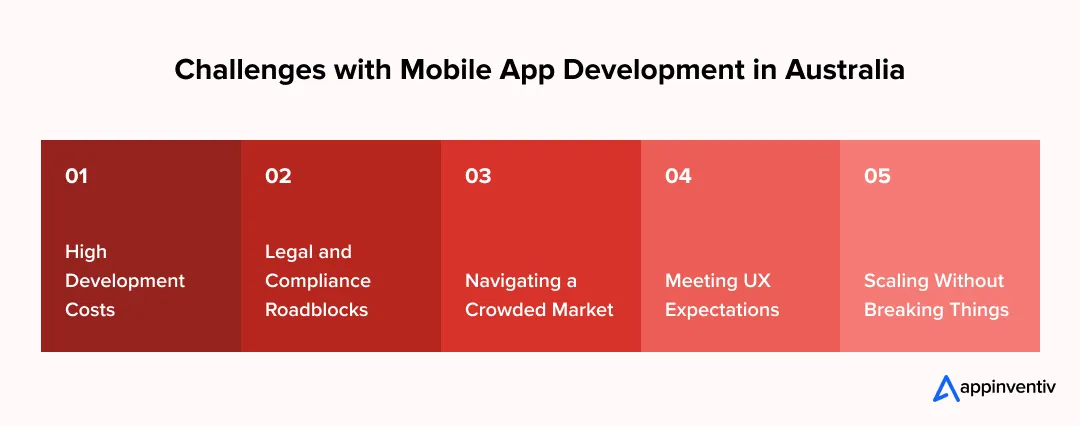
Building an app in Australia can be exciting, but once you get into it, you start to notice things no one warns you about. Costs, rules, expectations, competition, it all adds up. Knowing what you’re walking into makes the whole journey a lot smoother.
1. High Development Costs
This is usually the first reality check. App development here is expensive. Sometimes the numbers feel a bit shocking, especially when you hear that even a basic app can start around forty thousand and climb from there.
The safest way to handle this is to avoid building everything at once. Start with an MVP, something simple that proves your idea. You can always add more later after you see how people react to it.
2. Legal and Compliance Roadblocks
Australia takes data privacy seriously, and you feel that the moment you start dealing with user information. The Legal and Tax Considerations for App Development in Australia include adhering to the Privacy Act and ensuring secure data handling. It can feel complicated if you are new to it.
The easiest way to avoid trouble is to work with someone who understands the local rules. It might seem like an extra step, but it helps keep you from bigger problems later.
3. A Crowded Market
The Australian app space is busy. New apps show up every week, and it sometimes feels like every idea already exists. The only real way to stand out is to understand your users better than others do.
Spend time learning what they actually struggle with. If your app solves a real problem, people notice.
4. Meeting UX Expectations
Users here are quite picky, in a good way. If your app feels slow or confusing, they leave quickly. UX is not just design; it is how the whole thing feels when someone uses it.
Testing a little more, asking for honest feedback, and fixing small things early make a much bigger difference than most people expect.
5. Growing Without Breaking Things
If your app starts doing well, the next challenge arrives quietly. More users, more traffic, more demands. Suddenly, the system that felt fine at the start begins to feel tight. It helps to think about scaling early instead of waiting for things to break. Planning for growth does not mean overbuilding; it just means staying prepared.
In the end, the Australian market is tough but very rewarding if you handle these challenges with a clear head. When you stay flexible, listen to users, and keep improving steadily, your app has a far better chance of making it.
Partner with Appinventiv to overcome challenges, scale your app, and stay ahead of the competition in the Australian market.

Future Trends and Innovation in Australian App Development
App development changes so fast that sometimes it feels like you blink and the whole industry has moved a step ahead. What looked modern last year starts to feel a bit outdated now. And honestly, that is why it helps to pay attention to the new tech coming in.
Things like AI, IoT, AR, VR, and 5G used to be buzzwords, but they are now at the core of how apps are built and experienced. AI helps apps understand users better, while 5G network ensures lightning-fast performance. If you’re wondering how to build an app with AI to improve user experiences, now is the time to integrate it. With AI, apps can predict user behavior, offer personalized content, and even automate tasks, making them smarter and more efficient.
And you can see how the local app scene is changing. Most businesses here think mobile first because that is where users spend most of their time. Cloud setups are becoming normal because they keep things flexible. Even small AI touches, nothing fancy, just smarter suggestions or slightly smoother steps, make the whole experience feel smoother. Apps that adopt these things early just feel better to users.
For businesses looking to stay ahead, knowing how to develop an app from scratch with these technologies will give you an edge.
Also Read: The Critical Role of SIEM in Securing Your Applications Against Modern Threats in Australia
How Appinventiv Can Help You in Building an App in Australia
At Appinventiv, we do not merely create applications; we build custom digital solutions that align with your business objectives. As trusted app developers in Australia, we have extensive experience developing mobile apps and a proven track record of success with leading international brands, including Domino’s, KFC, Pizza Hut, and more.
Our experts are familiar with the specifics of the Australian market and collaborate with you to develop applications that address local needs and remain competitive in a competitive environment. No matter what your work objectives are, be it to improve the performance of your operations, increase customer interaction, or achieve the next-gen product, Appinventiv can help to bring your vision to life.
With a thorough understanding of industry trends, local legislation, and user expectations, we will help you create an app that not only works but also succeeds in the Australian market. We can help you take the lead and develop an application that sets new trends. Let’s talk!
FAQs
Q. How much does it cost to develop an app in Australia?
A. The cost of developing an app in Australia depends on its complexity. For a simple app, you can expect to pay between AUD 70,000 and AUD 200,000. Moderate apps with more features may cost AUD 200,000 to AUD 400,000, while complex apps can range from AUD 400,000 to AUD 700,000. Factors like platform choice, app features, and developer expertise all influence the final cost.
Q. How long does it take to develop an app in Australia?
A. The timeline for app development in Australia varies. A simple app might take 2 to 3 months, while a more complex one can take 6 months or longer. The process depends on the features, the platforms (iOS/Android), and how quickly feedback and revisions are incorporated.
Q. How do you develop an app?
A. To develop an app, you need to start by defining your idea, conducting market research, and setting clear goals. Next, choose your platform (native, cross-platform, or PWA), select a tech stack, and plan the development process. From there, focus on user experience (UX) and user interface (UI) design, and then develop the app. After testing, launch your MVP (Minimum Viable Product) and gather feedback for future updates.
Q. How do I monetize my app?
A. There are several ways to monetize an app in Australia. You can choose from in-app purchases, subscriptions, or ad-based revenue. Many startups also offer freemium models, where the app is free to download but users pay for premium features. Make sure the monetization strategy aligns with your target audience and the value your app provides.
Q. How to make an app secure while building it in Australia?
A. Security is crucial when developing an app in Australia, especially with local data protection laws like the Privacy Act 1988. To ensure your app is secure, use encryption, secure APIs, and strong authentication. Regular security audits and staying up to date with the latest security standards will help protect your users’ data and build trust in your app.

- In just 2 mins you will get a response
- Your idea is 100% protected by our Non Disclosure Agreement.

How Much Does It Cost to Build a Calorie Counting App Like Cronometer in Australia
Key takeaways: Building a calorie counting app with Cronometer-level accuracy in Australia typically costs between AUD 70,000 and AUD 700,000+, depending on data depth, compliance posture, and analytics sophistication. Underestimating compliance, data licensing, and post-launch governance is the most common cause of budget overruns for Australian nutrition platforms. The hard cost driver is not screens.…

MVP to Market: Realistic Cost, Timelines & Tech Stack for MVP App Development in Australia
Key takeaways: MVP development costs in Australia typically land between AUD 50,000 and AUD 200,000+, driven by integration depth, security, and delivery shape. Time-to-market can vary from 8 to 20 weeks, influenced by integrations, compliance, and feature scope. Choosing the architecture and best tech stack for building mvp app early reduces rebuild risk when traction…

Step-by-Step Guide to Digital Tipping Platform Development for Australia: Features, Costs & ROI
Key takeaways: Digital tipping is now a system-level decision Once tips move through digital payments, they intersect with payroll, reporting, and workforce trust. Informal handling does not scale. Sector-specific design determines success Cafés, restaurants, hotels, delivery services, and franchises each require different allocation logic and operational controls to reflect how work is delivered. Cost reflects…