




























How to Build an Urgent Care App? A Step-by-Step Process, Features and Costs


- Perfect Time for Urgent Care Apps: Market Landscape
- Value Creation: How Urgent Care App Development Transform Healthcare Delivery
- Core Features That Urgent Care Apps Must Include
- Advanced Features That Take an Urgent Care App Beyond the Basics
- Seven-Stage Development Process for Urgent Care Applications
- Investment Guide: What Does an Urgent Care App Really Cost?
- Navigating Healthcare Regulations and Security Requirements
- Proven Success Models: How Top Apps Achieved Market Leadership
- Problem-Solving Guide: Tackling Healthcare App Challenges
- Excellence Framework: Best Practices That Drive Results
- The Future of Urgent Care Apps: What Healthcare Providers Can Expect in the Next Few Years
- Why Choose AppInventiv for Your Urgent Care App Development
- FAQs

Key takeaways:
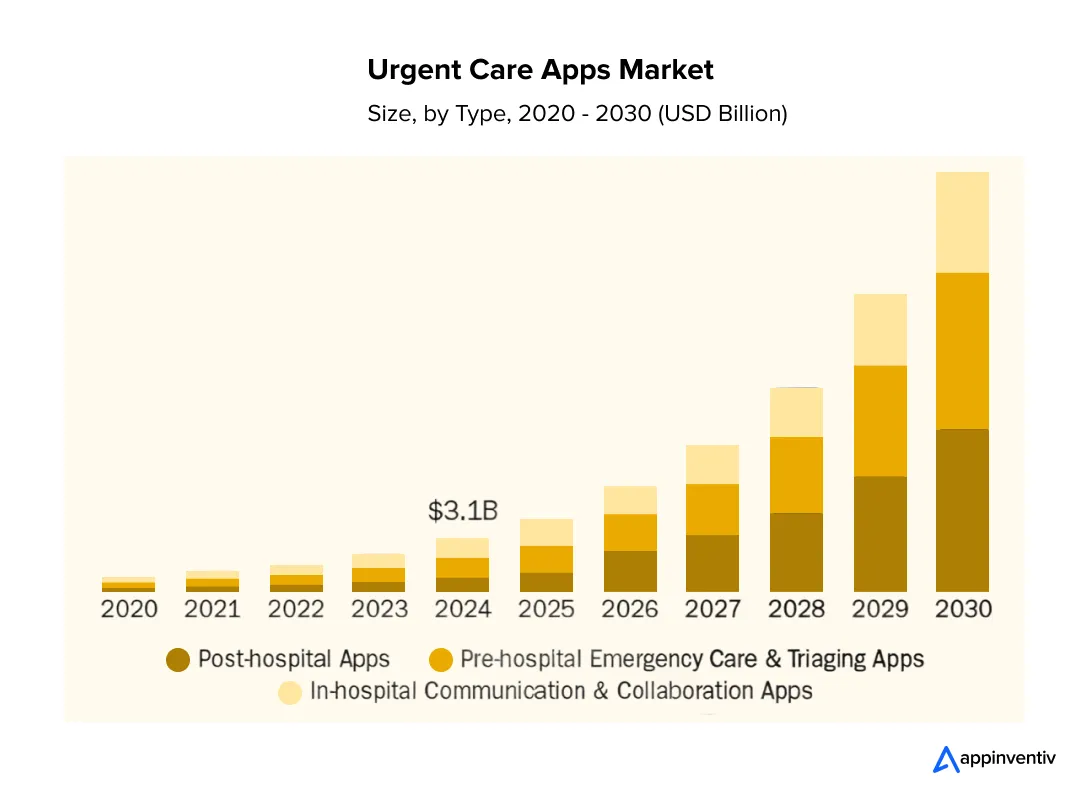
- With more people turning to digital healthcare, the urgent care app market is expected to touch $3.1 billion by 2024 and continue growing fast through 2030.
- Apps that offer easy scheduling, video consultations, EHR access, and quick insurance handling tend to attract more users and keep them coming back.
- Developing an urgent care app can cost anywhere between $30,000 and $400,000, depending on the features, design, and technology you choose.
- AI will play an operational role rather than a diagnostic one, helping clinics route patients, manage demand, and balance provider capacity during peak hours.
Picture this: A patient wakes up at 2 AM with chest pain-not severe enough for the ER, but too worrying to ignore. Their nearest urgent care center won’t open until morning. At that moment, what they need isn’t paperwork, long queues, or guesswork. They need instant medical access. Today’s urgent care ecosystem is built on speed, but the traditional model can’t match the pace of modern demand. The result? Overloaded centers, delayed treatment, frustrated patients, and revenue leakage for healthcare providers.
That pressure is rising fast. Digital touchpoints have quietly become the first place people turn when they’re unsure about symptoms, need quick guidance, or want to avoid unnecessary ER trips. The days when urgent care centers relied only on walk-ins or phone calls are gone. Patients now expect healthcare to be available the moment they need it, not only during operating hours.
Healthcare leaders have taken notice. We’re seeing hospitals, specialty clinics, and private operators invest heavily in urgent care app development-not as a side project, but as a core pillar of their growth strategy. When built correctly, these apps aren’t just appointment schedulers-they route the right patient to the right clinician at the right time, automate triage, streamline billing and EHR workflows, and unlock new recurring revenue pathways.
So if you’re asking, “How do we build an urgent care app that patients actually rely on-and clinicians actually enjoy using?” you’re exactly where you should be. In this urgent care app development guide, we’ll break down:
- The proven step-by-step process to develop a patient-first urgent care app
- The essential urgent care app features that distinguish high-performers from basic check-in tools
- Realistic cost ranges-what drives the cost to build an urgent care app, and how to control it without compromising quality
- Current market trends that define what patients and providers expect
Let’s build urgent care apps that don’t just respond fast-but respond smart.
Let’s build the product that keeps your healthcare practice one step ahead.
Perfect Time for Urgent Care Apps: Market Landscape
The urgent care app market is growing at rates we haven’t seen before. Patient preferences keep shifting, with technology advancing as well. According to Grand View Research, the global urgent care app market was valued at $3.10 billion in 2024. Growth projections sit at a CAGR of 42.7% from 2024 to 2030, leading to a market size of $25.23 billion by 2030.
Several trends are shaping the urgent care app development landscape. Patients want digital-first healthcare now. They prefer digital solutions for medical needs that aren’t emergencies, and this preference has gained real momentum.
According to McKinsey’s 2025 US healthcare outlook, the industry is rapidly shifting from hospital-based acute care to lower-cost non-acute settings such as outpatient, home health, and technology-enabled care. This shift puts urgent care – especially virtual and hybrid models – at the center of access and cost optimization.
Thus, the timing couldn’t be better for providers and healthcare operators. As non-acute care continues to absorb a larger share of patient demand, digital urgent care is becoming one of the most scalable, margin-positive entry points in healthcare. Organizations that build an urgent care app now aren’t simply adding convenience – they’re future-proofing patient acquisition, unlocking new revenue pathways, and reducing operational strain on high-cost hospital settings.
Value Creation: How Urgent Care App Development Transform Healthcare Delivery
The benefits of urgent care app development extend far beyond initial patient satisfaction, creating measurable value for healthcare organizations through improved efficiency, increased revenue, and enhanced patient outcomes.
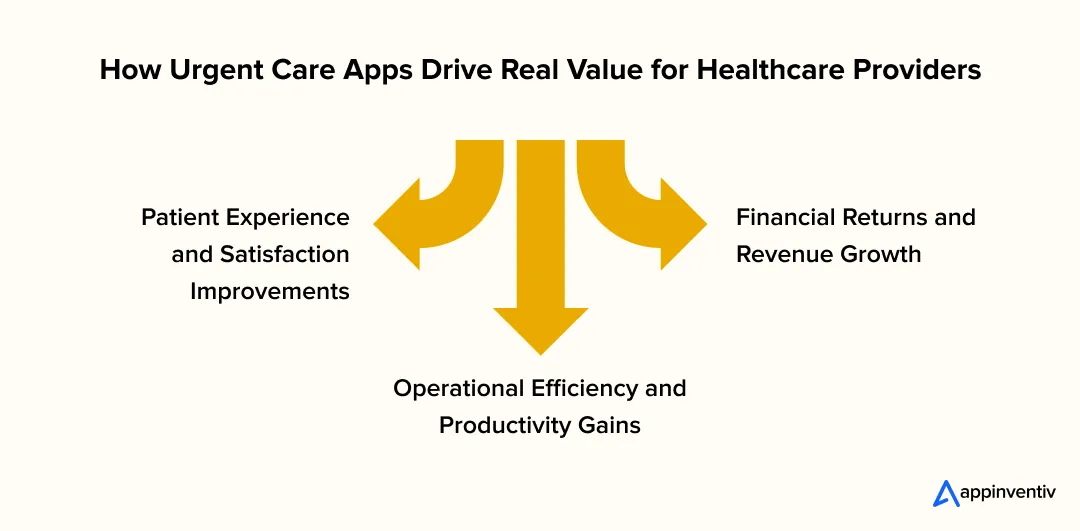
Patient Experience and Satisfaction Improvements
Patient experience improvements represent the most visible benefits of urgent care app implementation. Reduced wait times occur as patients can check in remotely. They receive real-time updates about their appointment status. This eliminates time spent in crowded waiting rooms. 24/7 accessibility through virtual consultations and appointment scheduling provides patients with healthcare access around the clock. This improves satisfaction and health outcomes.
Better health outcomes result from easier access to care. This leads to earlier intervention and better treatment compliance rates. Enhanced communication through secure messaging enables ongoing communication between patients and providers. This improves care coordination and patient engagement.
Operational Efficiency and Productivity Gains
Operational efficiency gains provide substantial value for healthcare organizations seeking to optimize their resources and improve service delivery:
- Streamlined check-in processes reduce administrative burden
- Optimized resource allocation through real-time data
- Reduced no-show rates from automated reminders
- Enhanced data collection through digital forms
- Improved staff productivity and job satisfaction
Financial Returns and Revenue Growth
Financial benefits typically provide compelling return on investment for healthcare organizations implementing comprehensive urgent care apps. Increased patient volume results from convenient access. This attracts new patients and retains existing ones who might otherwise seek care elsewhere. Revenue growth occurs through extended service hours via telemedicine. Improved operational efficiency allows providers to see more patients. Cost reduction comes from decreased administrative overhead and improved operational efficiency across multiple areas. Insurance reimbursement for telehealth services creates new revenue streams. Many digital health services are now covered by insurance plans.
The long-term benefits continue to compound over time. Organizations gather more data as time passes. They refine their processes. They expand their digital capabilities. Patient loyalty increases as convenient digital services create stronger relationships between patients and providers.
Core Features That Urgent Care Apps Must Include
When planning how to create an urgent care app, understanding the must-have features is crucial for success. These features form the foundation of any effective urgent care application. They directly impact user adoption and satisfaction.
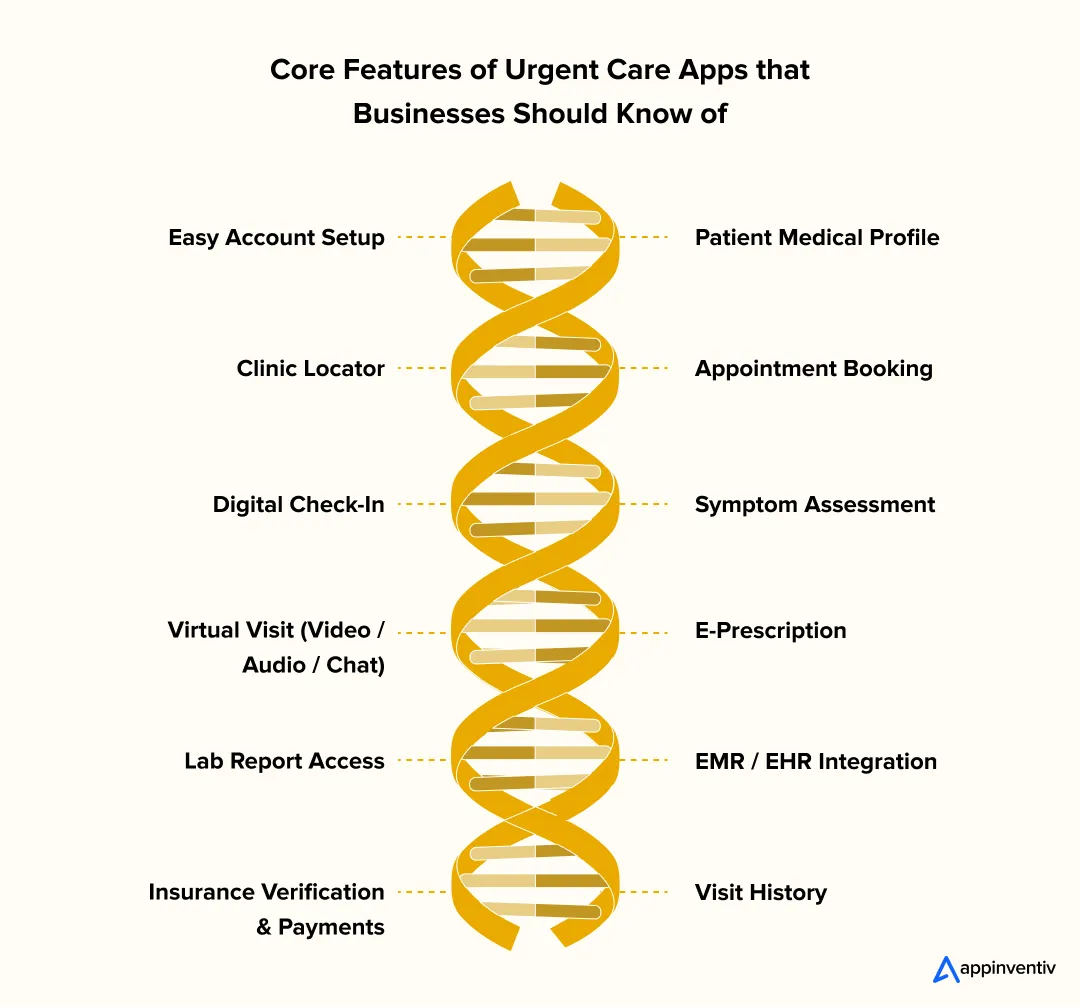
Easy Account Setup
A quick way for patients to sign up using phone, email, or social login. It prevents friction when someone is already unwell or anxious.
Patient Medical Profile
Stores basic health information – allergies, medications, chronic conditions, past diagnoses, and insurance details – so the provider has context before the visit begins.
Clinic Locator
Uses location services to show nearby urgent care centers, along with operating hours, services, accepted insurance, and expected wait times.
Appointment Booking
Lets patients lock in a visit time for either an in-person appointment or a virtual consultation without calling the clinic.
Digital Check-In
Allows patients to fill intake forms and upload documents before arriving, shortening the time spent in the lobby.
Symptom Assessment
Guides patients through a set of questions to determine urgency and direct them to the right type of visit. It also helps clinicians prepare in advance.
Virtual Visit (Video / Audio / Chat)
Connects patients with providers remotely for non-emergency issues – common infections, rashes, injuries, fever, medication guidance, etc.
E-Prescription
Enables the provider to send digital prescriptions to the patient’s preferred pharmacy or share them inside the app instantly.
Lab Report Access
Patients can check test results within the app instead of waiting for phone calls or email threads.
EMR / EHR Integration
Pulls relevant medical history from connected systems so providers aren’t working with incomplete information.
Insurance Verification & Payments
Checks eligibility, displays estimated costs upfront, and supports online payments for uninsured visits or co-pays.
Visit History
A simple record of all past visits, including doctor notes, reports, and prescriptions, so patients have everything documented in one place.
Advanced Features That Take an Urgent Care App Beyond the Basics
Not all urgent care apps are built the same. Once the fundamentals are in place, these advanced capabilities make the difference between a basic check-in tool and a platform that truly improves clinical efficiency, patient satisfaction, and revenue performance. The features below are what higher-performing urgent care operators are investing in today.
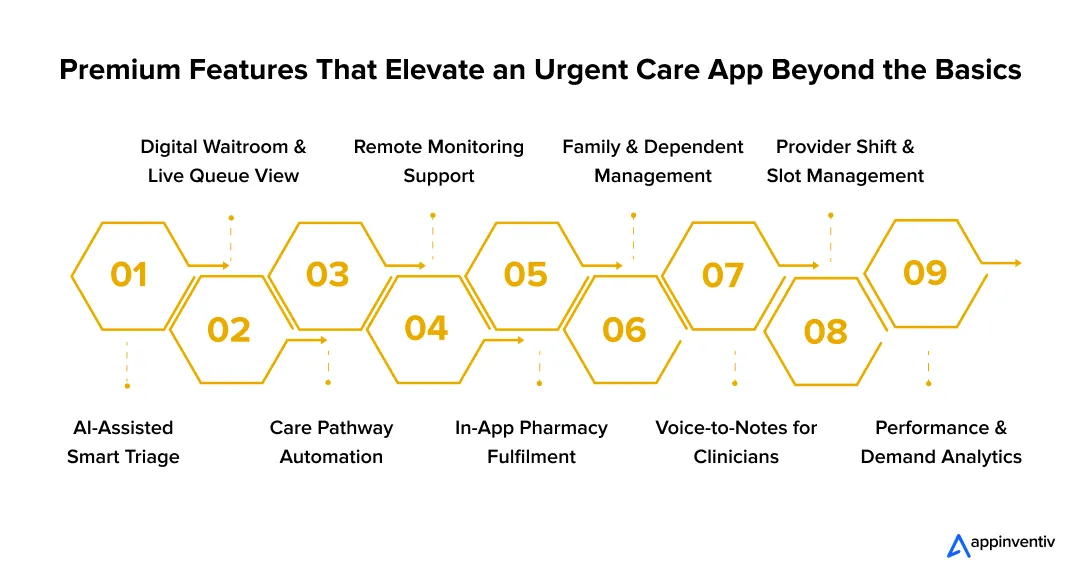
AI-Assisted Smart Triage
Patients answer a few questions about their symptoms and the app suggests the right care route. It cuts down on unnecessary in-person visits and helps the clinic see the urgent cases first.
Digital Waitroom & Live Queue View
Instead of sitting in the lobby and wondering when they’ll be called, patients can join a virtual queue and see their position in line on their phone. They get a notification when it’s almost their turn.
Care Pathway Automation
After the visit, the app nudges the patient toward the next steps – follow-up appointment, lab test, specialist visit or medication check-in – without the staff manually coordinating everything.
Remote Monitoring Support
For patients who need follow-up but not hospitalization, the app can collect readings from home devices like glucose meters, oximeters or BP cuffs. The care team is alerted only when numbers fall outside a safe range.
Pharmacy fulfilment inside the app
Once the provider sends the prescription, the patient can choose home delivery or pickup from a nearby pharmacy immediately. No extra phone calls, no paper slips.
Family & Dependent Management
One account can be used to manage care for children, elderly parents or dependents. A small thing – but the difference between chaos and convenience for caregivers.
Voice-to-Notes for Clinicians
Doctors speak their notes instead of typing everything. The app converts speech into text and stores it in the patient file. It cuts documentation time and lets them stay focused on clinical work.
Provider Shift & Slot Management
If the clinic gets crowded, the scheduling system adjusts available slots and reallocates providers automatically. No whiteboards, no back-and-forth discussions at the front desk.
Performance & Demand Analytics
Shows trends like peak hours, repeat cases, wait times, no-shows, provider workload, and revenue gaps. The goal isn’t reporting – it’s helping the clinic run smoother week over week.
Seven-Stage Development Process for Urgent Care Applications
Successful urgent care mobile app development is a structured approach spanning six critical phases. This systematic development process ensures regulatory compliance, user satisfaction, and operational efficiency while also reducing risks and development costs throughout the project lifecycle. Let’s look at the steps to develop urgent care app in detail below:
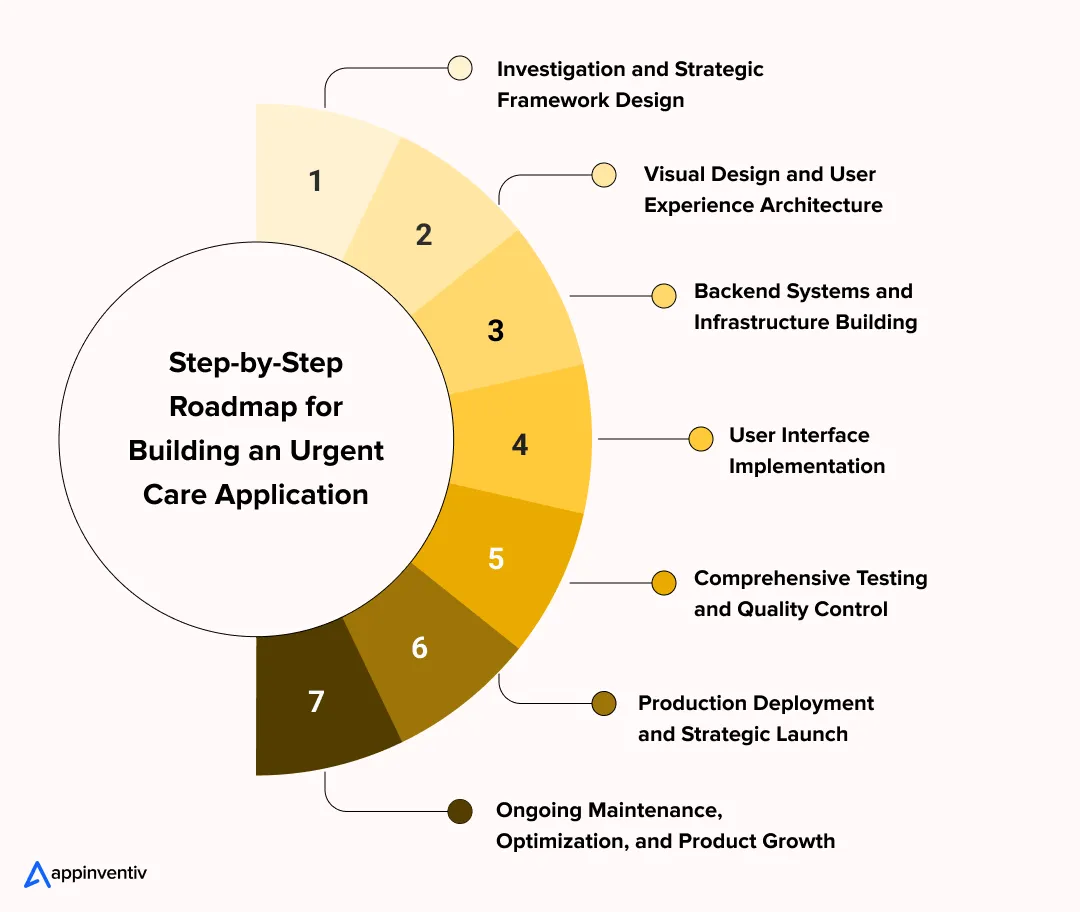
Phase 1: Investigation and Strategic Framework Design
Understanding the urgent care app development process helps you plan effectively and allocate resources appropriately. Each phase of development requires thorough attention to detail and specialized expertise to ensure successful outcomes.
The first phase involves market research and planning, which typically takes 2-3 weeks and forms the foundation of your entire project. During this phase, you need to analyze competitor apps and identify gaps in the market. Conduct user surveys and focus groups to understand patient needs better. Define your app’s unique selling points and value proposition clearly. Create detailed project requirements and specifications. Establish budget and timeline parameters for the entire development process.
Phase 2: Visual Design and User Experience Architecture
UI/UX design and prototyping play a crucial role in user adoption and satisfaction. The design phase focuses on creating intuitive, accessible interfaces that work seamlessly across different devices and user demographics. This process includes user journey mapping and wireframe creation. Visual design development and branding alignment happen next. Interactive prototype creation follows for stakeholder review. Usability testing and design refinement occur based on feedback received. Accessibility compliance verification ensures your app serves all users effectively.
Professional healthcare mobile app development services emphasize the importance of user-centric design. Even non-tech-savvy patients should be able to navigate the app effortlessly. The design phase directly impacts user retention and satisfaction, making it essential to invest adequate time and resources in creating exceptional user experiences. This stage of how to create an urgent care app development requires close collaboration between designers and healthcare professionals.
Phase 3: Backend Systems and Infrastructure Building
Backend development and database architecture form the backbone of your urgent care app. This technical phase involves several critical components:
- Database design and optimization for healthcare data
- API development and third-party integrations with existing systems
- Security protocol implementation to protect patient information
- Scalability planning and architecture setup to handle growth
- Cloud infrastructure configuration for reliable performance
Related: Quick Guide on Mobile App Backend Development
Phase 4: User Interface Implementation
Frontend development focuses on creating the user-facing components that patients and healthcare providers interact with daily. This phase encompasses hybrid or native app development based on your target audience and needs. Feature implementation and testing happens across different devices to ensure consistency. Performance optimization ensures fast loading times throughout the application. Device compatibility testing covers various smartphones and tablets in the market. User interface refinement occurs based on testing feedback from real users.
Must Read: Cross Platform App Development Frameworks in 2025
Phase 5: Comprehensive Testing and Quality Control
Integration and testing represent critical phases that ensure all components work together seamlessly. This comprehensive testing includes API integration testing to verify all systems communicate properly with each other. Security vulnerability assessments protect patient data from potential threats. Performance and load testing ensures the system can handle peak usage periods effectively. User acceptance testing involves real healthcare providers and patients in the evaluation process. Compliance verification covers HIPAA, GDPR, and other relevant regulations that apply.
Phase 6: Production Deployment and Strategic Launch
The final phase involves deployment and launch, which includes app store submission and approval processes. Production environment setup and monitoring come next in the sequence. Monitoring system implementation tracks ongoing performance across the platform. User training and documentation serve both staff and patients effectively. Marketing campaign execution drives user adoption after launch.
Phase 7: Ongoing Maintenance, Optimization, and Product Growth
After launch, the focus shifts to continuous improvement. This stage includes bug fixes, regulatory updates, security patching, feature enhancements, speed and performance upgrades, support for new OS versions and devices, and roadmap development based on user feedback and clinic requirements. Urgent care apps grow over time – not at launch – and long-term optimization ensures they stay reliable under real clinical pressure.
When you partner with an experienced healthcare mobile app development services partner, you gain access to specialized expertise that can streamline the entire process. Development time gets reduced significantly as a result. Compliance with healthcare regulations gets ensured from day one of development. Following this guide on how to build an urgent care app keeps your project on track and ensures all requirements get met properly.
Investment Guide: What Does an Urgent Care App Really Cost?
Understanding the cost to build an urgent care app helps you plan your budget effectively and make informed decisions about features and functionality. Development costs vary significantly based on complexity, features, geographic location, and chosen development approach.
Development Complexity and Pricing Tiers
Development complexity directly impacts your overall investment requirements. A basic app (MVP) with simple appointment booking and information display typically costs between $30,000 and $60,000. These applications include fundamental features like user registration, basic scheduling, and contact information. They lack advanced integrations and sophisticated functionality though.
Moderate complexity applications cost more. Telemedicine capabilities, payment processing, and EHR integration push the range from $80,000 to $200,000 generally. These apps provide comprehensive urgent care functionality.
- Video consultations and secure messaging get included
- Insurance processing and payment handling work seamlessly
- Basic analytics and reporting capabilities are part of the package
- Integration with existing healthcare systems happens at this level
- Multi-location support and management features round things out.
Advanced applications require bigger investments. AI-powered diagnosis assistance, complex integrations with multiple healthcare systems, and comprehensive analytics platforms typically need $250,000 to $400,000 or more. These sophisticated solutions often include machine learning algorithms. Advanced reporting capabilities get built in. Extensive customization options become available as well with the other features.
Factors That Impact the Cost of Building an Urgent Care App
The urgent care mobile app development cost goes up or down based on how deep the features go, how many systems the app connects to, and the level of security and reliability healthcare teams expect. There isn’t one flat price – the investment shifts based on real choices made during planning.
Number and depth of features
A simple booking-only app is much cheaper than a platform with video calls, insurance verification, follow-ups, and digital prescriptions. The more clinical workflows the app takes on, the bigger the engineering effort.
Integrations with hospital systems
Apps that only store data locally cost less. When the app needs to talk to EHRs, lab systems, billing software, or pharmacy systems, the complexity rises because every connection must be secure, stable, and compliant.
Telemedicine and real-time communication
Adding video consultations, chat support, secure file uploads, and real-time notifications increases cost due to the need for strict security and smooth performance even during peak hours.
Compliance and security needs
Healthcare apps cannot cut corners on data security. Meeting HIPAA, GDPR, and regional medical data laws requires encryption, secure authentication, audit trails, and regular security audits – all of which add to the budget but are non-negotiable.
Design and user experience depth
If the goal is only functional screens, the cost is lower. If the app requires polished UI, accessibility for elderly users, smooth onboarding, and mobile-first navigation, more time and design effort go into it.
Technology stack and platform choice
Building for iOS only costs one amount. Building for Android as well doubles the testing and development work. Cross-platform frameworks can balance cost, but the final choice depends on expected performance and long-term scale.
Timeline and delivery speed
A relaxed timeline costs less because work can be paced. Programs that need fast go-live, parallel work streams, and large teams working together increase the budget because resources scale up to match urgency.
Ongoing Operational Expenses
Beyond initial urgent care app development costs, consider recurring operational expenses that impact your total cost to build an urgent care app:
- Cloud hosting and infrastructure: $500-5,000+ monthly
- Third-party API subscriptions: $200-2,000+ monthly
- Maintenance and updates: 15-20% of initial development cost annually
- Security audits and compliance: $10,000-50,000 annually
- Staff training and support: $5,000-20,000 annually
Hidden costs often catch organizations off guard during the development and launch process. App store fees and commissions can impact ongoing revenue, while legal compliance and certification costs add to initial expenses.
Furthermore, marketing and user acquisition require substantial investment to drive adoption, and staff training and onboarding ensure successful implementation. Customer support infrastructure becomes essential as your user base grows.
We’ve already solved the hard parts – compliance, integrations and clinical workflows.

Navigating Healthcare Regulations and Security Requirements
Healthcare apps operate in a heavily regulated environment, making compliance a critical success factor. Understanding these requirements is essential when planning how to build an urgent care app that meets all legal standards while protecting patient information and maintaining trust.
HIPAA Compliance Framework
HIPAA compliance requirements set strict standards for protecting patient health information and apply to nearly every healthcare app that handles patient data. Administrative safeguards mean having solid policies, procedures, and training programs that help each staff member know their duties with patient information. Physical safeguards include facility access controls and workstation security measures that keep unauthorized people away from patient data. Technical safeguards use access controls, audit controls, and data encryption that guard patient information when it moves or sits in storage.
Recommended: HIPAA Compliant App Development in 2026: A Complete Guide
FDA Regulatory Categories
FDA regulations may apply depending on your app’s functionality and the type of medical services it provides. The regulatory landscape includes several categories:
- Class I medical devices: Basic health apps with minimal risk
- Class II medical devices: Apps providing medical advice or diagnosis assistance
- Software as Medical Device (SaMD): Apps performing actual medical functions
- Clinical decision support software: Apps helping healthcare providers make treatment decisions
Security best practices protect both your organization and patients from data breaches and cyber threats. Multi-layered encryption for data at rest and in transit keeps patient information safe throughout its entire lifecycle. Regular security audits and vulnerability assessments help you spot potential weaknesses. You can fix these before hackers find them. Secure authentication and authorization protocols block unauthorized access to sensitive information. Incident response and breach notification procedures matter too. They help you respond quickly when security incidents happen.
Proven Success Models: How Top Apps Achieved Market Leadership
Examining successful urgent care app examples provides valuable insights into what works in the market and how different approaches can achieve significant results. These real-world applications demonstrate effective strategies for patient engagement, operational efficiency, and business growth.
CVS MinuteClinic
CVS MinuteClinic grew by making care easy to reach, not just during an emergency, but whenever someone needs medical attention. Video visits are available day and night through the CVS Pharmacy app, and people can book appointments instead of waiting in line at the clinic. All visit details flow into Epic, which means primary care doctors can stay in the loop without the patient having to explain everything again. Because everything is connected and simple, CVS has been able to support millions of visits a year and expand into cities where many people don’t have regular access to a primary care doctor.
GoHealth Urgent Care
GoHealth took a different route. They didn’t separate walk-in care and virtual visits – they blended them into one experience. A patient can start with an online consultation and, if needed, easily switch to an in-person visit without repeating their information. Their symptom tool helps people understand what level of care makes sense instead of guessing. GoHealth’s tie-ins with employer health plans and insurance companies remove payment confusion, which is usually a big reason people delay care. The result is faster treatment and less pressure on physical centers.
CareNow
CareNow succeeded by focusing on everyday annoyances that make urgent care feel stressful. Their Web Check-In lets patients wait at home instead of in the lobby. Text alerts call them in only when a clinician is ready. Prices are shown upfront, which removes the awkward conversation about “how much will this cost.” If a patient needs more specialized treatment, CareNow can connect them directly to HCA Healthcare hospitals without the patient having to figure it out alone. The formula is simple: respect people’s time, reduce uncertainty and make care easy to move through.
These apps didn’t become popular because they had a long feature list. They worked because the people building them understood the reality of clinical work, patient expectations, insurance and technology in healthcare. That’s what separates a decent app from one that becomes a core part of the care experience.
An urgent care app development services partner like Appinventiv knows how to build around EHR systems, compliance rules, security requirements and the day-to-day challenges inside a clinic. That knowledge can be the difference between an app that gets used once and an app that becomes the place patients always go first when they need help.
Problem-Solving Guide: Tackling Healthcare App Challenges
Understanding the challenges in urgent care app development helps you prepare for potential obstacles and develop effective solutions that ensure project success. Healthcare app development presents unique complexities that require specialized expertise and careful planning.
| Challenge | How it impacts urgent care organizations | How to resolve it |
|---|---|---|
| No clarity on clinical workflows | Development stalls because no one knows whose job is being digitised or which step comes first | Run workshops with doctors, nurses, billing, and admin teams to map the exact patient journey before writing code |
| Over-engineering the MVP | App becomes expensive and slow to launch because everything is built in one go | Launch a small set of high-usage features first (booking, virtual consults, check-in, prescriptions) and scale from there |
| EHR and PMS integrations | Data sits in silos and clinical staff continue manual updates | Build an API gateway so the app exchanges patient data (FHIR) with the hospital EHR and practice management system automatically |
| Weak triage logic | Patients choose the wrong visit type or provider, causing wait-time spikes and complaints | Add simple guided triage questions that recommend the right care path before the visit is booked |
| High telemedicine traffic | Video calls drop during peak hours and staff can’t rely on the platform | Use healthcare-grade video APIs and cloud auto-scaling so calls stay stable even during rush hours |
| Slow load times and app crashes | Drop-offs increase and frontline staff return to phone calls | Optimise backend performance and app caching so urgent care tasks respond instantly |
| Lack of role-based access | Security risk because staff, providers, and front desk teams see unnecessary information | Set up strict role-based access so each user only sees what they need to perform their job |
| Confusing front desk tools | Intake coordinators take longer to register patients and update the queue | Build simple dashboards with booking view, queue status, insurance checks, and visit notes in one place |
| Insurance and eligibility mismatches | Payments get delayed and billing chases patients after the visit | Add eligibility checks and co-pay visibility before the visit is confirmed |
| No walk-in queue management | Waiting room becomes chaotic and manual spreadsheets return | Add live wait-time tracking and allow patients to “join the queue” digitally when they are on the way |
| No plan for peak seasons | The system breaks during flu season or spikes in infections | Design flexible server capacity and proactive load testing during development |
| Healthcare compliance gaps | Launch delays, legal exposure, and rejection from enterprise partnerships | Build with medical data rules in mind from day one (HIPAA, GDPR, PDPL, PCI-DSS depending on geography) |
| Limited healthcare analytics | Management can’t see bottlenecks or track provider utilisation | Add dashboards for wait times, most booked visit types, telehealth adoption, cancellations, staff utilization |
| No continuity of care | Urgent care becomes a one-time episode instead of a revenue-returning service | Enable follow-ups, care reminders, prescription refills, and chronic care pathways inside the app |
Excellence Framework: Best Practices That Drive Results
Implementing best practices for urgent care app development ensures your application delivers maximum value to both patients and healthcare providers while achieving sustainable business success.
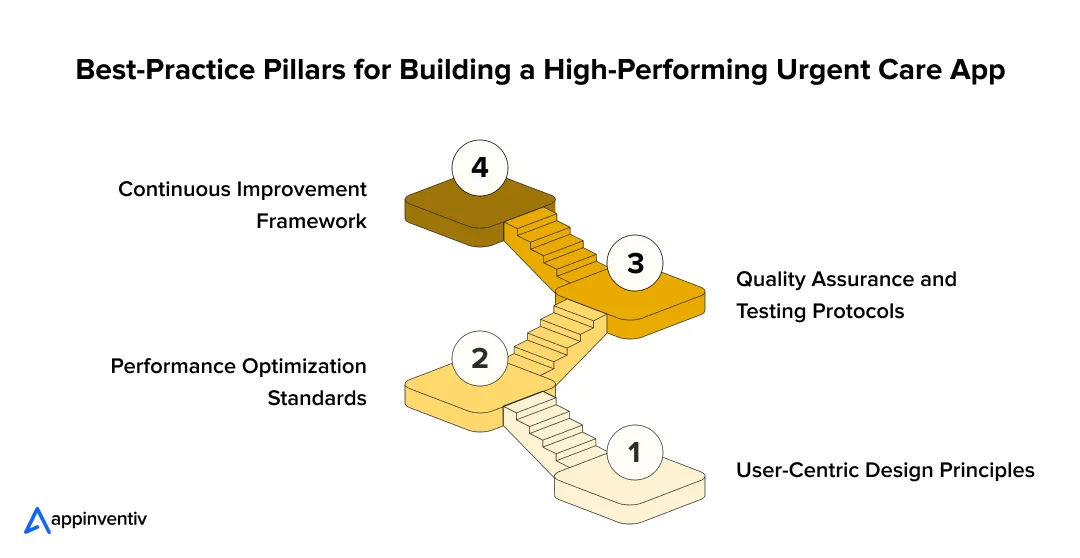
User-Centric Design Principles
User-centric design principles must guide every aspect of your app development process. Intuitive navigation means designing interfaces that patients of all ages can learn quickly, regardless of technical skills. You need familiar design patterns, clear labeling, and logical information architecture. These should match how patients naturally think about healthcare services.
Accessibility compliance makes your app work for users with disabilities and follow ADA guidelines. This expands your potential user base. It shows you’re committed to inclusive healthcare delivery. Mobile-first design approaches optimize for smartphones while keeping desktop compatibility intact. Most patients will access your services primarily through their phones.
Performance Optimization Standards
Performance optimization ensures your urgent care app functions reliably under all conditions and usage scenarios:
- Fast loading times for emergency situations
- Offline functionality for key features
- Cross-platform compatibility across devices
- Regular performance monitoring and optimization
- Scalable architecture for growing user bases
Quality Assurance and Testing Protocols
Quality assurance and testing need comprehensive approaches that tackle healthcare applications’ unique requirements. Functional testing checks that every feature works correctly across different scenarios and use cases. Patients must complete critical tasks like booking appointments and refilling prescriptions without issues. Security testing uses regular penetration testing and vulnerability assessments to protect patient data. It keeps you compliant with healthcare regulations.
Usability testing brings real healthcare providers and patients into the testing process. Your app will match actual workflow needs and meet patient expectations. Compliance testing maintains ongoing adherence to healthcare regulations and standards. This shields your organization from legal and financial risks.
Continuous Improvement Framework
Continuous improvement strategies help your urgent care app adapt as patient needs shift and healthcare trends change. Regular updates mean scheduling consistent feature releases and bug fixes. Your app stays current and actually works properly. User feedback integration requires you to actively gather patient suggestions and act on them. This shows patients you’re serious about their satisfaction and getting better.
When you hire urgent care app developers with healthcare expertise, you’re getting teams who know these practices inside out. They’ll apply them throughout your entire development cycle. Your app wins both immediate traction and stays viable for years.
The Future of Urgent Care Apps: What Healthcare Providers Can Expect in the Next Few Years
Urgent care apps won’t just make it easier for patients to book visits – they will reshape how clinics operate and how revenue is generated. The shift ahead is about running urgent care centers like digitally enabled businesses, with stronger predictability, lower overhead, and tighter patient relationships.
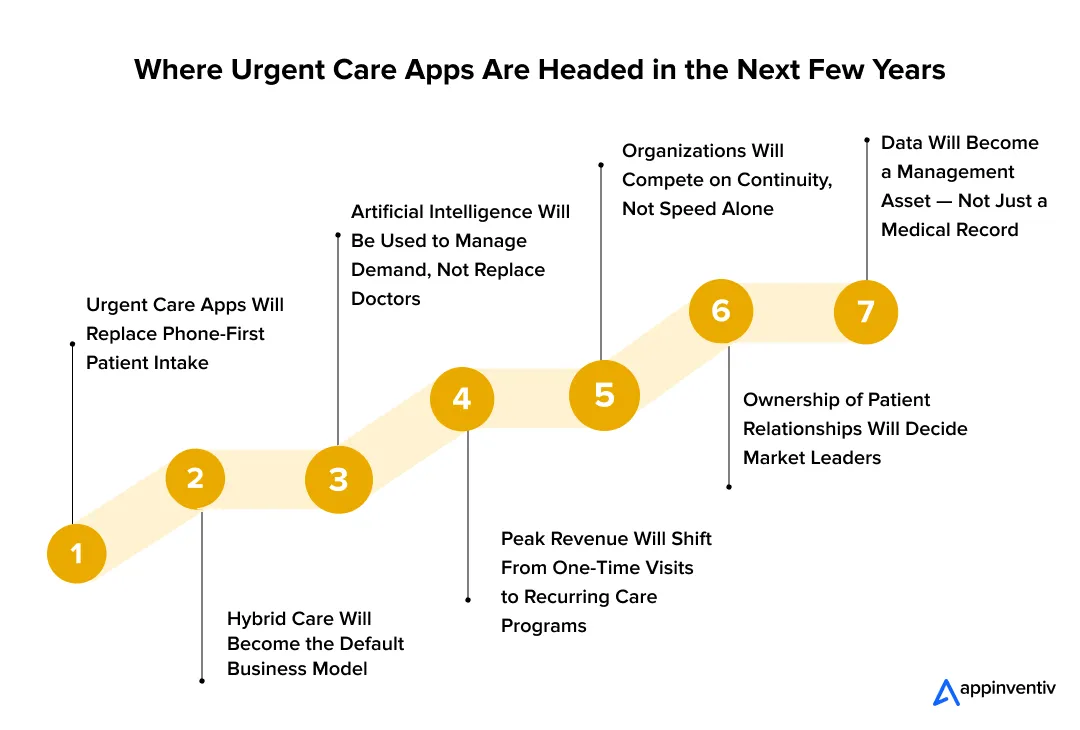
Urgent Care Apps Will Replace Phone-First Patient Intake
Today, most urgent care centers still rely on phone calls for scheduling, visit updates, and follow-up coordination. Over the next few years, the app will become the primary entry point. Clinics that still depend on phone-first workflows will see higher overhead and slower throughput compared to those that automate intake through the app.
Hybrid Care Will Become the Default Business Model
The industry will move away from purely walk-in or purely telemedicine models. Urgent care centers will grow fastest with hybrid scheduling – patients are triaged digitally, start virtual care when appropriate, and switch to in-person when needed. This flexibility will become essential for growth and retention.
Artificial Intelligence Will Be Used to Manage Demand, Not Replace Doctors
AI won’t diagnose patients independently – but it will become a core operational tool. It will route patients based on symptoms, expected case duration, and provider availability. This means fewer peak-hour backlogs, fewer idle providers during slow hours, and better use of staff time across the day.
Recommended: How is AI in Healthcare Transforming the Industry?
Peak Revenue Will Shift From One-Time Visits to Recurring Care Programs
As urgent care apps mature, the financial model will change. Clinics that rely only on single-visit appointments will struggle. Clinics that use apps to drive recurring revenue – follow-ups, care plans, pharmacy refills, chronic care check-ins, and preventive visits – will see higher lifetime value per patient and more predictable monthly revenue.
Organizations Will Compete on Continuity, Not Speed Alone
Right now, the competitive angle in urgent care is “fast access.” In the future, the differentiator will be “continuous guidance.” The winners will be the clinics that stay present in the patient’s life – reminders, automated check-ins, medication adherence, and outcome tracking – even after the visit is over.
Ownership of Patient Relationships Will Decide Market Leaders
Urgent care centers that depend on aggregators and third-party platforms will lose patient ownership and margins over time. Centers that use their own apps to build direct relationships will control loyalty, data, and recurring revenue. Patient ownership will become the new competitive moat.
Data Will Become a Management Asset – Not Just a Medical Record
Leadership teams will rely on app analytics to guide business decisions: staffing models, seasonal planning, slot optimization, pricing adjustments, employer partnerships, and service expansion. Urgent care apps will function as operational intelligence systems, not just digital appointment books.
Why Choose AppInventiv for Your Urgent Care App Development
With over a decade of proven expertise in healthcare mobile app development services, AppInventiv stands as your trusted partner for creating cutting-edge urgent care applications that transform patient experiences and drive measurable business outcomes.
Our impressive portfolio includes successful collaborations with healthcare clients like Health-e-People, Soniphi, and DiabeticU, demonstrating our deep understanding of complex healthcare workflows and regulatory requirements. We recently helped YouCoMM revolutionize in-hospital patient communication by developing a custom healthcare app that enables real-time medical assistance through voice commands and gestures, resulting in 60% improvement in nurses’ response time and adoption across 3+ hospital chains.
AppInventiv’s commitment to excellence is validated by prestigious industry recognitions:
- Consecutive Deloitte Tech Fast 50 Awards (2023 & 2024) – #1 ranking in Digital & Cloud Tech category
- ISO 27001 and ISO 9001 certified healthcare software development company
- Strategic partnerships with AWS, Azure, and Google Cloud Platform
Our agile methodology and transparent development approach ensure you receive not just a product, but a strategic advantage that positions your healthcare organization at the forefront of digital innovation.
Our team of 1,600+ technology professionals has successfully delivered over 3,000 projects across 35+ industries, helping clients secure $950 million in funding. Our experts are known to combine technical excellence with healthcare domain expertise to build HIPAA-compliant, scalable urgent care solutions that exceed expectations and drive sustainable growth.
Ready to transform your healthcare delivery with a cutting-edge urgent care app? Partner with AppInventiv today and join the ranks of successful healthcare organizations revolutionizing patient care through innovative technology.
FAQs
Q. How long does it take to build an urgent care app?
A. The timeline for urgent care app development typically ranges from 6-12 months, depending on complexity and features. Basic apps with essential functionalities like appointment booking and patient profiles take 6-8 months to complete. Comprehensive solutions that include telemedicine, EHR integration, and advanced analytics need 10-12 months of development work. Several factors affect the timeline, including regulatory compliance requirements, third-party integrations, and testing phases that can extend the schedule.
Q. What does it realistically cost to build an urgent care app?
A. The price depends on how deep the app goes. A simple version with features like appointment booking and patient profiles usually ranges between $30,000 and $60,000. A more complete platform with telemedicine, payments, and EHR integration typically falls between $80,000 and $200,000. Advanced products that include AI-assisted triage, complex analytics, and multiple system integrations can reach $250,000 to $400,000 or more. It’s also important to plan for ongoing costs after launch – maintenance, updates, and new features as patient usage grows.
Q. Which APIs are needed for an urgent care app?
A. Essential APIs for urgent care apps include EHR integration APIs like Epic and Cerner, payment processing APIs such as Stripe and PayPal, mapping and location APIs from Google Maps, and video calling APIs for telemedicine like Twilio and Agora.io. Push notification services, insurance verification APIs, authentication APIs, cloud storage APIs, and healthcare-specific APIs for lab results and prescription management complete the essential integrations you need.
You’ll also need authentication APIs to secure user access. Cloud storage APIs manage patient data and documents safely. Healthcare-specific APIs for lab results and prescription management round out the functionality you need for a complete solution.
Q. How to test and deploy urgent care app before launch?
A. Testing involves multiple phases to ensure quality. Run functional testing for all features to verify they work correctly. Do security testing to meet HIPAA compliance requirements. Conduct usability testing with real healthcare providers and patients to gather feedback. Run performance testing under different load conditions and verify compliance with regulations.
Deployment includes several important steps to follow. Set up a staging environment first to test everything safely. Submit your app to app stores and configure the production environment. Train your staff on the system and start with a phased rollout to limited user groups before full launch.
Q. How to ensure urgent care apps can handle high user traffic?
A. Set up cloud-based infrastructure with auto-scaling capabilities to handle growth. Use content delivery networks (CDNs) for faster loading times across regions. Optimize database queries and add caching strategies to improve speed. Run load testing to find bottlenecks before they become problems. Design a microservices architecture for better resource distribution across systems. You also need monitoring tools to track performance in real-time. Have backup plans ready for traffic spikes during health emergencies or seasonal demands.

- In just 2 mins you will get a response
- Your idea is 100% protected by our Non Disclosure Agreement.

How to Build a Custom Pediatric EMR and EHR System?
Key takeaways: Clinical Precision: Custom systems accommodate pediatric-specific data points like percentile curves and weight-based longitudinal dosing. Interoperability: Seamless data exchange via HL7 FHIR ensures your practice stays connected to pharmacies, labs, and state registries. Regulatory Resilience: Built-in compliance with HIPAA, HITECH, and MACRA/MIPS reduces legal friction. Enhanced Engagement: Parent portals reduce administrative overhead by…

Change Management in Healthcare: Principles, Processes, and Models
Key Takeaways Change in healthcare fails quietly when ownership, workflow alignment, and follow-through are missing. Successful change management in healthcare focuses on adoption, not just system implementation. Clinical workflows and workforce capacity determine whether transformation sticks or stalls. Governance, clear accountability, and post-go-live support matter more than the model used. Sustainable healthcare transformation depends on…

A Practical Guide to Building Your Mental Health Chatbot - Use Cases, Cost, & ROI
Key takeaways: Mental health chatbots work when they know their limits. They’re most useful as a gentle first step, not as a stand-in for real care. Good chatbot design is more about judgment than AI. Clear boundaries, calm responses, and safety matter more than smart language models. Enterprises invest in chatbots to make support easier…