































How to Hire an Offshore Development Team in 2026


- Why Companies Hire Offshore Development Teams in 2026
- Choosing the Right Global Delivery Model in 2026
- How to Hire Offshore Development Teams in 2026: Step-by-Step Hiring Framework
- Where to Find Offshore Development Teams in 2026
- Location to Find Offshore Development Teams
- Risk, Compliance, and Governance in Offshore Hiring
- Cost of Hiring an Offshore Development Team in 2026
- Scaling Offshore Teams Without Losing Quality or Control
- Offshore Hiring Pitfalls Enterprises Must Avoid in 2026
- How Appinventiv Helps Build and Scale Offshore Teams

Key Takeaways
- Hiring offshore in 2026 is an operating-model decision, not a cost shortcut. Start by defining what work you want to offshore and why.
- How you structure ownership, governance, and communication matters more than where the offshore team is located.
- The best way to hire an offshore development team is to test delivery fit early through pilots, rather than relying on portfolios or promises.
- Cost, location, and engagement model should follow clarity on scope and accountability, not the other way around.
- Advanced AI engines deliver automated rebalancing, tax optimization, and data-driven portfolio governance.
- Enterprises that succeed offshore treat teams as extensions of their delivery engine rather than as external vendors.
Hiring offshore in 2026 is rarely about saving a few dollars anymore. Most teams that hire an offshore development team do so because local hiring simply cannot keep up with delivery pressure. Timelines are tighter. Skill gaps are real. And software work no longer fits neatly within a single geography. Recent reports show that by 2026, nearly 80% of workers whose jobs can be done remotely will be engaged in hybrid or fully remote work arrangements, a trend that is reshaping how companies access global talent and structure distributed teams.
The hard part is not access to talent. There is no shortage of offshore developers to hire, or of options, if you are looking for an offshore development team online. The real challenge is choosing well. Separating teams that can genuinely integrate into your way of working from those that stay transactional is where many companies struggle. This is also where the challenges in hiring offshore development teams tend to surface later than expected.
This guide is written for leaders who want offshore delivery to hold up over time. Whether you are planning to hire an offshore dedicated software development team, evaluating whether to hire an offshore development firm, or deciding how to hire an enterprise offshore development team for long-term execution, early decisions matter far more than the vendor pitch. The sections ahead focus on what actually works in 2026.
Before you speak to vendors or compare regions, it helps to pressure-test whether offshore is the right delivery model for your product, timelines, and risk profile.

Why Companies Hire Offshore Development Teams in 2026
In 2026, companies hire offshore teams because building software has become harder to sustain with local hiring alone. When businesses hire an offshore development team, it is usually a response to delivery pressure, not a cost experiment. Roadmaps keep expanding while hiring cycles slow down.
Many organizations hire offshore developers to access skills they cannot hire fast enough locally. Others do it to maintain steady execution without stretching internal teams too thin. These are some of the most common benefits of hiring offshore development teams today:
- Scaling delivery without adding permanent headcount
- Accessing experienced engineers in specialized domains
- Keeping long-term product work moving consistently
- Allowing internal teams to focus on decisions rather than the backlog
For most companies, offshore is no longer about offshoring work. It is about extending the delivery engine without losing control.
Also Read: Hire Remote Team of Developers: Why, When and How
Choosing the Right Global Delivery Model in 2026
Most offshore problems start before a single software developer is hired. When teams decide to hire an offshore development team, they often begin with cost comparisons or vendor shortlists. That skips the real decision. Offshore hiring is not about geography. It is about how work actually gets done.
Many teams hire offshore developers because local hiring slows them down. Offshore works best when work is ongoing, and ownership stays clear. When everything is urgent and constantly changing, it struggles.
Different models exist for a reason:
- Offshore works well for steady execution
- Nearshore helps when collaboration is frequent
- Onshore remains critical for regulation or core IP
Most companies now mix these models. Many hire an offshore dedicated software development team for execution while keeping product ownership close to the business. If you are looking for an offshore development team, the key test is simple: can this team plug into how your organization already plans, reviews, and ships work?
Also Read: Hire a Dedicated Development Team in 2026
How to Hire Offshore Development Teams in 2026: Step-by-Step Hiring Framework
Offshore hiring often fails for very ordinary reasons. Not because teams lack skill, but because expectations are unclear from the start. If you are thinking seriously about how to hire offshore development teams in 2026, the most important work happens before the first conversation with a vendor.
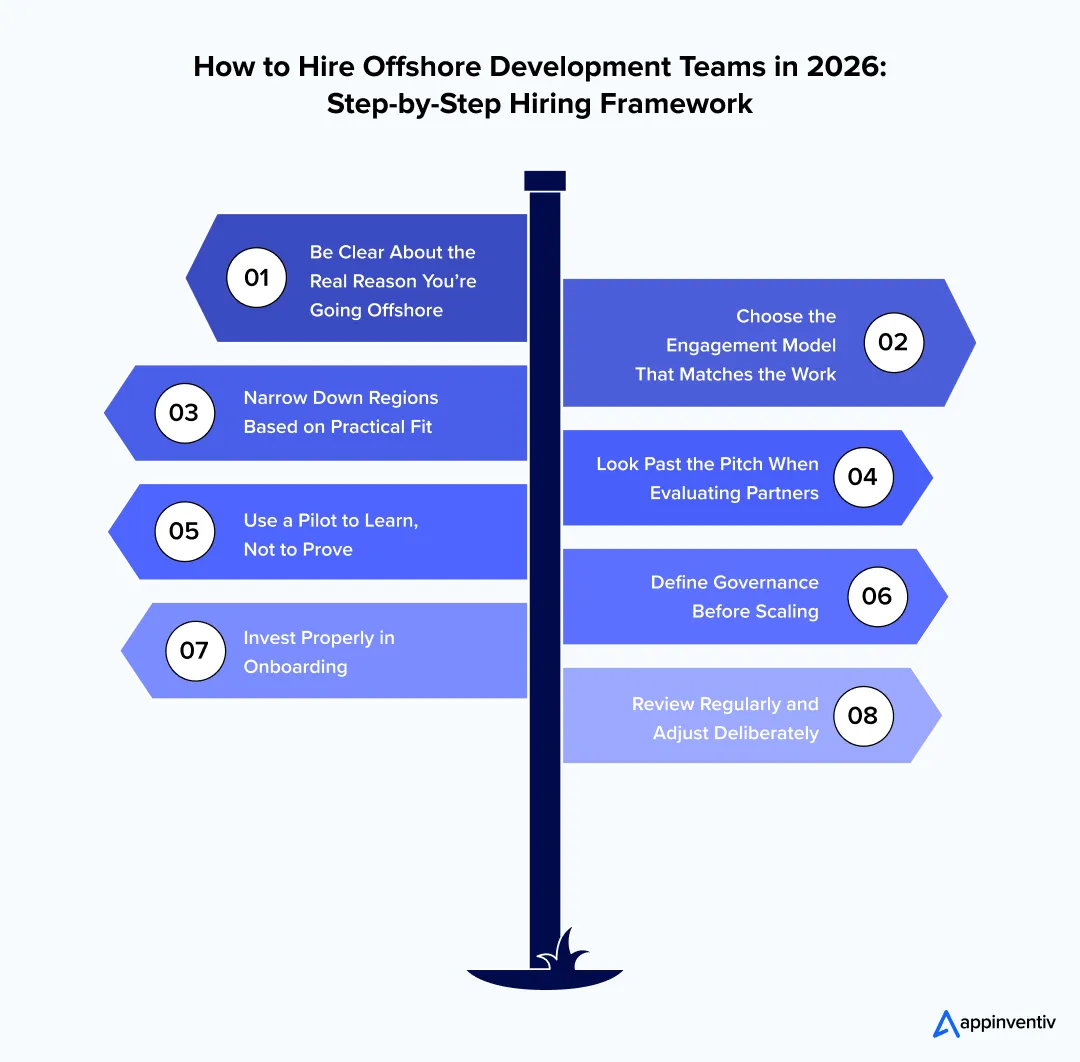
Step 1: Be Clear About the Real Reason You’re Going Offshore
Before you try to hire an offshore development team, pause and define the problem you are actually solving. Offshore works very differently depending on intent.
Some teams need speed. Others need continuity. Some are filling skill gaps. Others want long-term ownership. If this isn’t clear internally, it won’t be clear to the team you hire.
Questions worth settling early:
- Is this about scaling delivery or accessing specific expertise?
- Is the work short-term or expected to run for years?
- Will this team touch critical systems or core IP?
Most offshore issues trace back to confusion here.
Step 2: Choose the Engagement Model That Matches the Work
In 2026, companies don’t simply hire people. They choose operating models. If you plan to hire an offshore dedicated software development team, commit to ownership and continuity. Half-embedded models rarely work.
Common approaches include:
- A dedicated offshore development team for ongoing execution
- Staff augmentation for temporary capacity gaps
- Project-based delivery for tightly defined scopes
If you plan to hire an offshore dedicated software development team, treat it as a real extension of your organization. Blurred ownership and half-commitments usually create friction later.
Step 3: Narrow Down Regions Based on Practical Fit
Location still matters, just not in the way most comparison tables suggest. Cost differences matter less than working rhythm and communication habits.
When deciding on a location to find offshore development teams, consider working rhythm, not just cost.
- How much time-zone overlap do you actually need
- Comfort with written communication and documentation
- Depth of experience in your specific technology stack
This is one of those decisions that feels minor early on, but shows up daily once work begins.
Step 4: Look Past the Pitch When Evaluating Partners
Whether you hire an offshore development agency, hire an offshore development firm, or plan to hire an offshore development company, delivery maturity matters more than the sales deck. This is where hiring reliable offshore partners actually begins.
What matters more:
- How delivery is managed week to week
- Who takes responsibility when priorities change
- How quality issues are handled, not explained away
If your goal is hiring reliable offshore partners, this is where confidence is either built or lost.
Step 5: Use a Pilot to Learn, Not to Prove
A short pilot reveals far more than interviews alone. This step is especially useful when you plan to hire offshore developers for long-term work.
During a pilot, watch for:
- How clearly the team communicates
- How they respond to feedback
- Whether quality improves after the first iteration
Strong teams adjust quickly. Weaker ones tend to defend early decisions.
Step 6: Define Governance Before Scaling
Contracts protect interests, but governance protects outcomes. If you are looking to hire an enterprise offshore development team, clarity here is non-negotiable.
Set expectations around:
- Who owns delivery decisions
- How progress is reviewed and reported
- What “good enough” quality actually means
This is what keeps offshore teams stable as scope and pressure increase.
Step 7: Invest Properly in Onboarding
Once companies hire offshore developers, onboarding is often rushed. That is a mistake. Context saves time later.
Effective onboarding covers:
- Product goals and trade-offs
- Decision boundaries
- How success is measured, not just what needs to be built
Teams with context make fewer assumptions and better calls.
Step 8: Review Regularly and Adjust Deliberately
Offshore hiring is not a set-and-forget decision. Teams change, and Products evolve.
Revisit regularly:
- Delivery pace and quality trends
- Communication gaps
- Whether the setup still fits current priorities
This is how offshore teams mature into dependable delivery partners rather than become brittle under growth.
When done thoughtfully, hiring offshore in 2026 is not about outsourcing responsibility. It is about extending your delivery capability in a way that remains predictable, accountable, and aligned with how your business actually operates.
Also Read: Hiring Offshore AI Developers? Here’s How to Hire the Best
Knowing how to hire is one thing. Another is making the structure hold up in real delivery conditions. A short discussion can help validate your approach before you commit.

Where to Find Offshore Development Teams in 2026
Finding an offshore team in 2026 is rarely about discovering some hidden platform. It usually comes down to knowing which channels tend to produce teams that can actually stick around and deliver. Most companies don’t rely on just one source. They mix a couple, based on how much certainty they need.
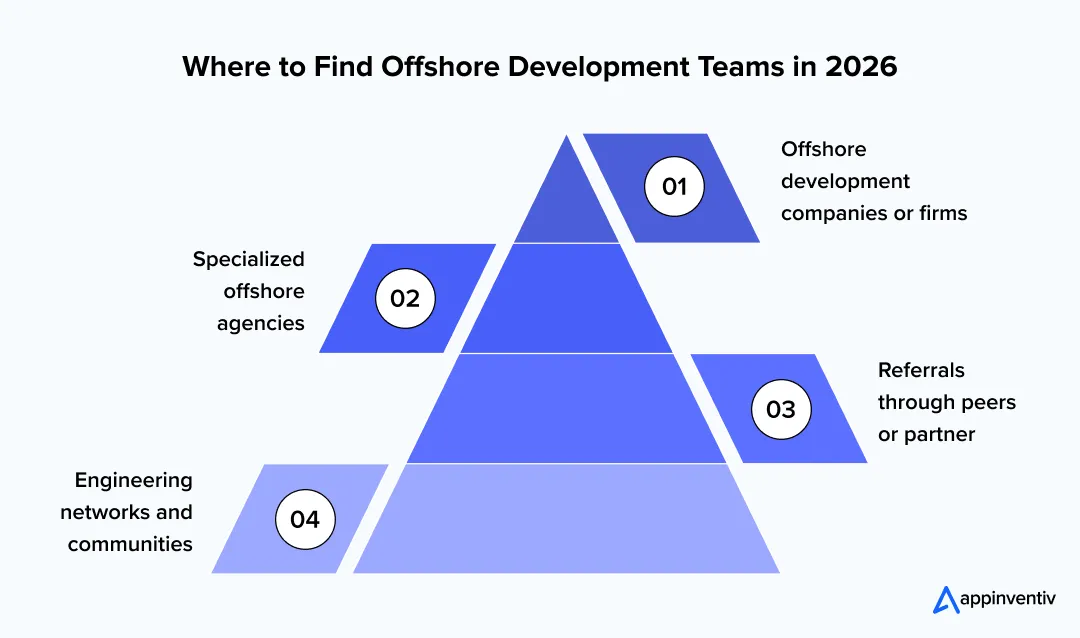
Places teams commonly look:
- Offshore development companies or firms: A common starting point when continuity and accountability matter. These teams are easier to scale and easier to manage over time.
- Specialized offshore agencies: Helpful when you need a very specific skill set, though delivery quality still needs to be tested early.
- Referrals through peers or partners: Slower, but often more reliable. Shared context reduces surprises later.
- Engineering networks and communities: Can work well if you already have strong technical leadership in place.
No matter where you find an offshore development team, the result usually depends on the same things. Clear ownership and honest communication. And the willingness to start small before committing long-term.
Location to Find Offshore Development Teams
Location still matters in offshore hiring, but not for the reasons it used to. In 2026, companies choosing where to hire an offshore development team are less focused on geography and more focused on how smoothly teams can collaborate over time.
Different regions tend to suit different working styles:
- Asia is often chosen for scale and long-term execution, especially when teams need to grow steadily.
- Eastern Europe appeals to companies that value strong engineering depth and structured delivery practices.
- Latin America works well when time-zone overlap and faster real-time collaboration are priorities.
What matters more than the region itself:
- Communication clarity and documentation habits
- Delivery maturity and technical leadership
- Ability to align with your team’s working rhythm
The right location is rarely the “best-ranked” one. It is the one that lets your offshore team plug into your process without constant adjustment. When that fit is right, location becomes a strength instead of a constraint.
Also Read: How to Hire an Agile Software Development Team
Risk, Compliance, and Governance in Offshore Hiring
Risk in offshore hiring rarely shows up on day one. It usually appears later, when delivery speeds up, scope shifts, or systems become more critical. That is why risk, compliance, and governance need to be thought through before you scale, not after issues surface.
When companies hire an offshore development team, the biggest risks are often less technical and more structural. Unclear ownership, loose access controls, and vague expectations tend to create more damage than skill gaps.
Key risk areas to address early:
- Data security and access control: Define who can access what, and under which conditions. Offshore teams should never operate with open-ended system access.
- IP ownership and confidentiality: Contracts matter, but so do processes. Make ownership, reuse rights, and confidentiality expectations explicit from the start.
- Regulatory and compliance exposure: If your product touches regulated data or markets, ensure offshore teams understand compliance boundaries, not just coding tasks.
Governance is what keeps offshore delivery steady over time. Without it, even strong teams drift. Good governance usually includes:
- Clear delivery ownership and escalation paths
- Regular, predictable reporting rhythms
- Shared quality benchmarks and review standards
For enterprises, especially, offshore success depends less on trust than on clarity. When teams know where responsibility begins and ends, offshore delivery becomes predictable rather than risky.
Cost of Hiring an Offshore Development Team in 2026
By 2026, the cost conversation around offshore hiring has matured. Most leaders no longer ask whether offshore is cheaper in absolute terms. The real question is whether the cost of hiring an offshore development team makes sense for the level of reliability, speed, and ownership the business expects. When companies plan to hire offshore, cost still matters, but it rarely stands alone.
At a practical level, the cost of hiring an offshore development team is shaped by a few consistent factors:
- The seniority mix of the team, not just total headcount
- The complexity of the technology stack and domain
- The engagement model, whether dedicated, project-based, or staff augmentation
- The level of governance, security, and quality control required
This is where many estimates fall short. Teams that focus solely on hourly rates often underestimate the actual cost of steady delivery.
In 2026, offshore development team pricing continues to vary by region. Asia, Eastern Europe, and Latin America remain common choices, but pricing differences alone rarely explain performance gaps. In practice, offshore development team pricing reflects delivery maturity, communication discipline, and leadership depth far more than geography.
Hidden costs are where offshore budgets quietly expand:
- Extra management time is spent aligning poorly integrated teams
- Rework caused by unclear requirements or rushed onboarding
- Late investments in security, tooling, and compliance
For most enterprises, the right offshore cost is not the lowest available rate. It is the cost that delivers predictable progress without constant course correction. When offshore teams are structured well, spending becomes easier to justify because outcomes are stable, timelines hold, and accountability is clear.
Scaling Offshore Teams Without Losing Quality or Control
Scaling offshore teams is where most setups are tested. Adding people is easy. Preserving quality, ownership, and delivery discipline is not. When organizations hire an offshore development team and then expand too quickly, the cracks usually show up in coordination rather than capability.
Enterprises that plan to hire an offshore development team often see early wins through speed. At scale, however, speed alone becomes misleading. Without a clear structure and measurement, teams can ship more code while weakening reliability and increasing rework.
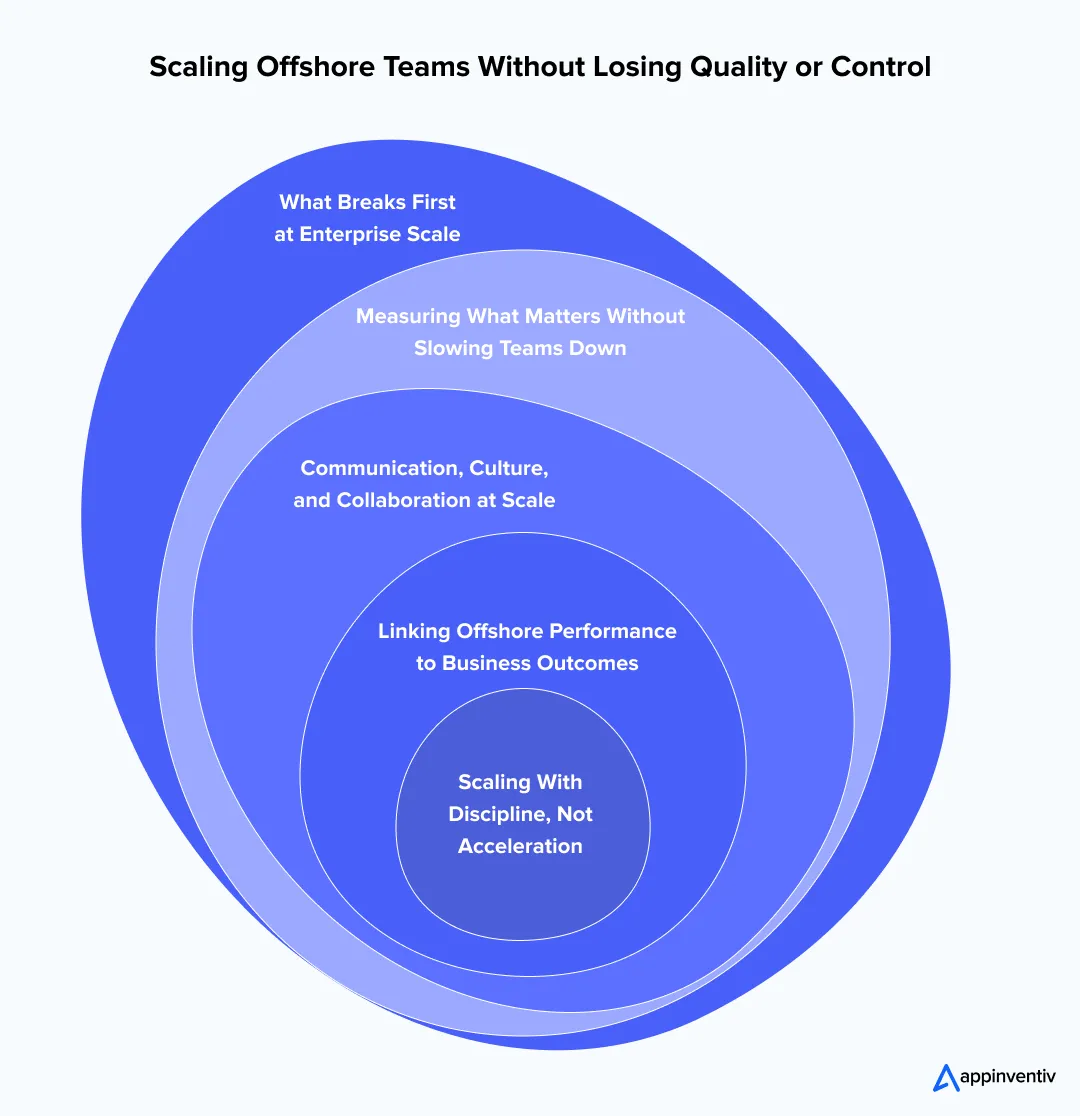
1. What Breaks First at Enterprise Scale
As offshore teams grow, risk surfaces in predictable places. These are also some of the most common challenges in hiring offshore development teams that show up later, not during onboarding.
Enterprise teams should watch for:
- Declining code consistency across teams
- Unclear ownership as responsibilities spread
- Slower decision cycles caused by coordination gaps
If these signals are ignored, quality erosion follows quickly.
2. Measuring What Matters Without Slowing Teams Down
Enterprise measurement should highlight trends, not individual output. The goal is early visibility, not micromanagement.
High-value metrics include:
- Delivery stability (predictable releases, sprint completion trends)
- Quality signals (defect patterns, rework rates)
- Team continuity (attrition, onboarding velocity)
These metrics matter whether you hire offshore developers directly or hire an offshore dedicated software development team through a partner.
3. Communication, Culture, and Collaboration at Scale
As offshore teams scale, communication friction becomes the silent risk. Tools alone do not solve it. Structure does.
Enterprises that scale well usually:
- Define clear communication rhythms instead of relying on ad-hoc updates
- Treat offshore teams as part of the delivery organization, not as vendors
- Reinforce written documentation to reduce dependency on meetings
This is especially important for companies looking for an offshore development team that can stay effective as the scope grows.
4. Linking Offshore Performance to Business Outcomes
At enterprise scale, offshore success must directly translate into business results. Activity metrics alone are insufficient.
Leaders should track:
- Improvements in time-to-market
- Reduction in internal delivery bottlenecks
- Ability to scale product development without increasing risk
If offshore growth does not improve these outcomes, structure or governance needs adjustment.
5. Scaling With Discipline, Not Acceleration
Healthy enterprise teams scale deliberately. Capacity increases only when ownership, governance, and measurement can absorb it.
Effective practices include:
- Establishing strong offshore technical leadership
- Reinforcing onboarding before expanding headcount
- Reviewing structure and metrics at defined growth points
Organizations that scale offshore teams with this discipline are far more successful at hiring reliable offshore partners and turning distributed delivery into a long-term advantage rather than an operational liability.
Also Read: How to Effectively Manage an Offshore Software Development Team?
Offshore Hiring Pitfalls Enterprises Must Avoid in 2026
Most offshore failures do not happen because teams lack technical ability. They happen because early decisions were made too quickly. When enterprises hire an offshore development team without enough clarity around ownership, governance, and expectations, small gaps tend to compound as delivery pressure increases.
One of the most common pitfalls is hiring for speed without alignment. Teams rush to hire offshore developers to meet deadlines, but skip the work required to define roles, decision boundaries, and communication norms. The result is often a team that completes tasks but struggles to deliver outcomes that matter to the business.
Other mistakes show up repeatedly in enterprise offshore setups:
- Optimizing only for cost: Focusing on the lowest rate often backfires. While offshore development team pricing matters, predictability and quality matter more. Cost overruns usually come later through rework, delays, and added management effort.
- Treating offshore teams as vendors, not partners: This is especially damaging when companies hire an offshore dedicated software development team for long-term work. Teams kept at arm’s length rarely develop ownership or accountability.
- Weak onboarding and context sharing: Many organizations assume offshore teams will “figure it out.” Without product context, priorities, and constraints, teams default to following tickets instead of making informed decisions. This is a common issue for companies looking to quickly find an offshore development team.
- Unclear ownership and governance: When no one owns delivery end-to-end, issues bounce between teams. This often happens when enterprises hire an offshore development agency or hire an offshore development firm without defining accountability beyond the contract.
- Skipping pilots and early validation: Long-term commitments made without testing delivery fit often lead to slow exits and sunk costs. Even when hiring reliable offshore partners, a short pilot reveals far more than presentations or references.
- Scaling too fast, too soon: Adding headcount before communication and review processes mature usually creates friction instead of momentum. This is one of the most overlooked challenges in hiring offshore development teams at enterprise scale.
Offshore hiring works best when expectations are explicit and structure grows alongside the team. Enterprises that avoid these pitfalls do not just find better partners. They build offshore delivery models that stay stable as complexity increases and business priorities shift.
Also Read: A Complete Guide to Hiring a Developer for a Startup in 2026
Most offshore issues surface late, after contracts are signed and teams scale. A second perspective can help spot structural risks early and course-correct with confidence.

How Appinventiv Helps Build and Scale Offshore Teams
Most teams reach out to Appinventiv after they have already tried offshore once. Sometimes it went well for a bit. Sometimes it didn’t. What usually becomes clear is that offshore only works when the basics are handled properly. Our offshore software development services are built around that idea. Having worked across 35+ industries, we’ve seen how small setup decisions quietly shape long-term delivery.
As offshore teams grow, the problems change. Hiring stops being the issue. Coordination takes over. Context gets thinner. Ownership becomes unclear. That is where many offshore setups begin to slow down. With 1600+ tech evangelists and over 3000 solutions designed and delivered, Appinventiv often steps in at this stage to help teams steady communication, improve onboarding, and bring offshore engineers closer to the real product goals.
If you’re planning to build or scale an offshore team in 2026, the early structure will matter more than it seems. Small gaps tend to show up later, usually under pressure. Whether you are starting fresh or trying to stabilize an offshore setup that already feels stretched, Appinventiv brings experience backed by a 95% client satisfaction rate. If it helps, we’re always open to a straightforward conversation about what’s working, what isn’t, and where offshore realistically fits into your delivery plans. Let’s connect!
FAQs
Q. What is an offshore development team?
A. An offshore development team is a group of engineers based in another country who work as an extension of your in-house team. When companies hire an offshore development team successfully, these teams are involved long term, understand the product context, and share ownership of delivery rather than operating as a task-based vendor.
Q. How much do offshore developers cost?
A. There is no single rate. The cost of hiring an offshore development team depends on region, seniority, and delivery model. In 2026, offshore development team pricing is influenced more by team maturity and communication quality than hourly rates alone. Lower rates often lead to higher total costs due to rework and oversight.
Q. Why hire an offshore development team in 2026?
A. Companies hire offshore teams in 2026 to sustain delivery speed, access specialized skills, and scale without adding permanent headcount. The benefits of hiring offshore development teams include flexibility, continuity on long-term products, and the ability to keep internal teams focused on strategy and decision-making.
Q. What’s the difference between offshore and nearshore software development companies?
A. The difference usually comes down to collaboration style and operating rhythm. Companies that hire an offshore development team often do so for scale and long-term execution, where steady delivery matters more than constant real-time interaction. Nearshore software development companies, on the other hand, sit closer in time zones and are often chosen when daily collaboration is critical. Both models can work well. The key is understanding how to choose an offshore development team or nearshore partner based on the type of work, not just location.
Q. Offshore development team cost vs in-house team: which makes more sense?
A. The answer depends on how much flexibility and speed you need. In-house teams offer tighter control but come with higher fixed costs, longer hiring cycles, and less room to scale quickly. The cost of hiring an offshore development team is usually lower in comparison, especially for sustained execution, but value comes from structure rather than rates alone. Many enterprises combine both approaches, keeping strategic ownership in-house while using offshore teams for ongoing development, where offshore development team pricing offers more predictability at scale.

- In just 2 mins you will get a response
- Your idea is 100% protected by our Non Disclosure Agreement.

Key takeaways: Real-time AML systems detect and act on suspicious transactions within seconds, reducing financial risk across high-volume, cross-border environments in the UAE. Event-driven architectures with AI models improve detection accuracy while reducing false alerts, enabling faster investigations and better operational efficiency. UAE compliance demands audit-ready systems with explainable decisions, real-time reporting, and alignment across…

Maritime Insurance Claim Software Development for UAE Ports, Insurers, and Logistics Networks
Key takeaways: Manual claims management is too slow for the UAE’s high-volume ports; digital solutions streamline processes and reduce errors. Maritime insurance claim software centralizes data, automates workflows, and ensures compliance with UAE regulations and Takaful principles. Real-time integration with port and vessel systems enables faster claim registration, validation, and settlement. Advanced analytics and risk…

How to Build a Student Management System in Australia?
Key takeaways: Australia’s tightening regulatory landscape (TEQSA, ASQA, CRICOS) makes student management system development in Australia a compliance-driven necessity, not just a digital upgrade. Monetisation models such as SaaS subscriptions, institutional licensing, white-label partnerships, and hybrid pricing offer scalable commercial opportunities in Australia’s expanding EdTech market. Addressing challenges early - data privacy, legacy migration, multilingual…