





























Enterprise AI Integration in the Middle East: Scaling with Expert Architects


- Where Middle Eastern Enterprises Stand in Their AI Journey
- Shaping Scalable AI in the Middle East: Top Priorities for MENA CEOs
- Enterprise AI Integration Framework in the Middle East
- AI Integration Readiness Checklist for MENA Enterprises
- Common Challenges in Enterprise AI Integration in the Middle East and How to Overcome Them
- Regional AI Trends Driving the GCC Digital Economy
- Partner with Appinventiv for Enterprise AI Integration in the Middle East
- FAQs

- Middle Eastern enterprises lead in AI adoption, driven by strong government support and investment in digital infrastructure.
- Successful AI integration requires robust data governance, compliance with local regulations, and tailored architectural design.
- Addressing talent gaps, localization needs, and legacy system challenges is crucial for scalable AI deployments.
- Systems integrators and big data architects play a pivotal role in transforming national AI strategies into enterprise-ready solutions.
- Continuous optimization, ethical AI practices, and cross-sector collaboration ensure long-term, sustainable AI impact.
The artificial intelligence marks a change of another level in the Middle Eastern region, where large-scale transformation agendas have long been pursued. In the United Arab Emirates, Saudi Arabia, or Qatar, AI has ceased to exist in solitary innovation labs and has entered into national economic policy.
The National AI Strategy 2031 of the UAE makes artificial intelligence a significant source of GDP and efficiency of the state sector, whereas the Saudi Arabian system of Vision 2030 ultimately makes AI a component of industrial diversification and digital sovereignty.
Across the region, governments are reinforcing their AI-powered agendas through deliberate and sustained investment in research institutions, academic programs, and advanced digital infrastructure. These efforts are not limited to policy statements. For instance,
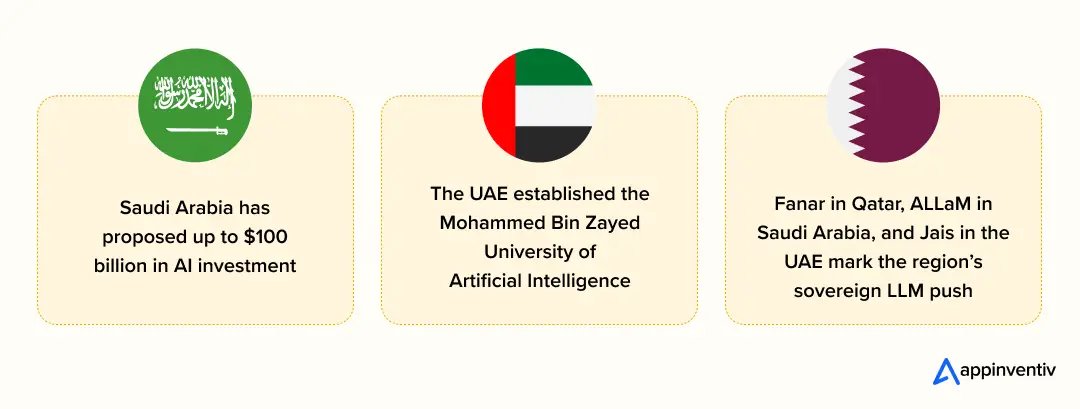
Such undertakings are not solitary technology projects. They are an indication of a conscious attempt by governments of the MENA to influence the development of AI in accordance with the priorities of the country, its domestic regulation, and the economic diversification agenda.
This direction is consolidated by strategic partnerships with international technology companies. To illustrate, the growth of hyperscale cloud ecosystems in Qatar and Saudi Arabia has enhanced AI compute in the region, establishing the basis of an enterprise-level deployment in domains.
As national ambition accelerates, the pressure now shifts to enterprises. Organizations must translate policy momentum into operational systems that are secure, interoperable, and scalable. In response, governments are building structural capacity.
This blog will explore the role of enterprise AI integration in the Middle East, focusing less on model choice and more on architectural discipline. We shall discuss how contemporary systems integrators and big data designers can have a determining role in changing ambitious national AI plans into viable commercial, scalable and secure enterprise platforms.
Take the lead in enterprise AI integration in the Middle East before competitors catch up

Where Middle Eastern Enterprises Stand in Their AI Journey
To understand where enterprises truly stand, several regional studies have examined how organizations in the UAE and Saudi Arabia are adopting artificial intelligence in practice, not just in principle. The findings show a gap between ambition and execution. While leadership teams speak confidently about transformation, structured enterprise AI Integration is still uneven across various sectors in the Middle East. Many firms are experimenting, but fewer have embedded AI into daily operations in a disciplined way.
Long-term progress depends on a disciplined AI integration architecture for enterprises. Data governance, infrastructure planning, and lifecycle controls determine whether AI remains experimental or becomes institutionalized.
To better understand this progression, it is helpful to examine the maturity levels that define how organizations move from isolated experimentation to enterprise-wide integration.
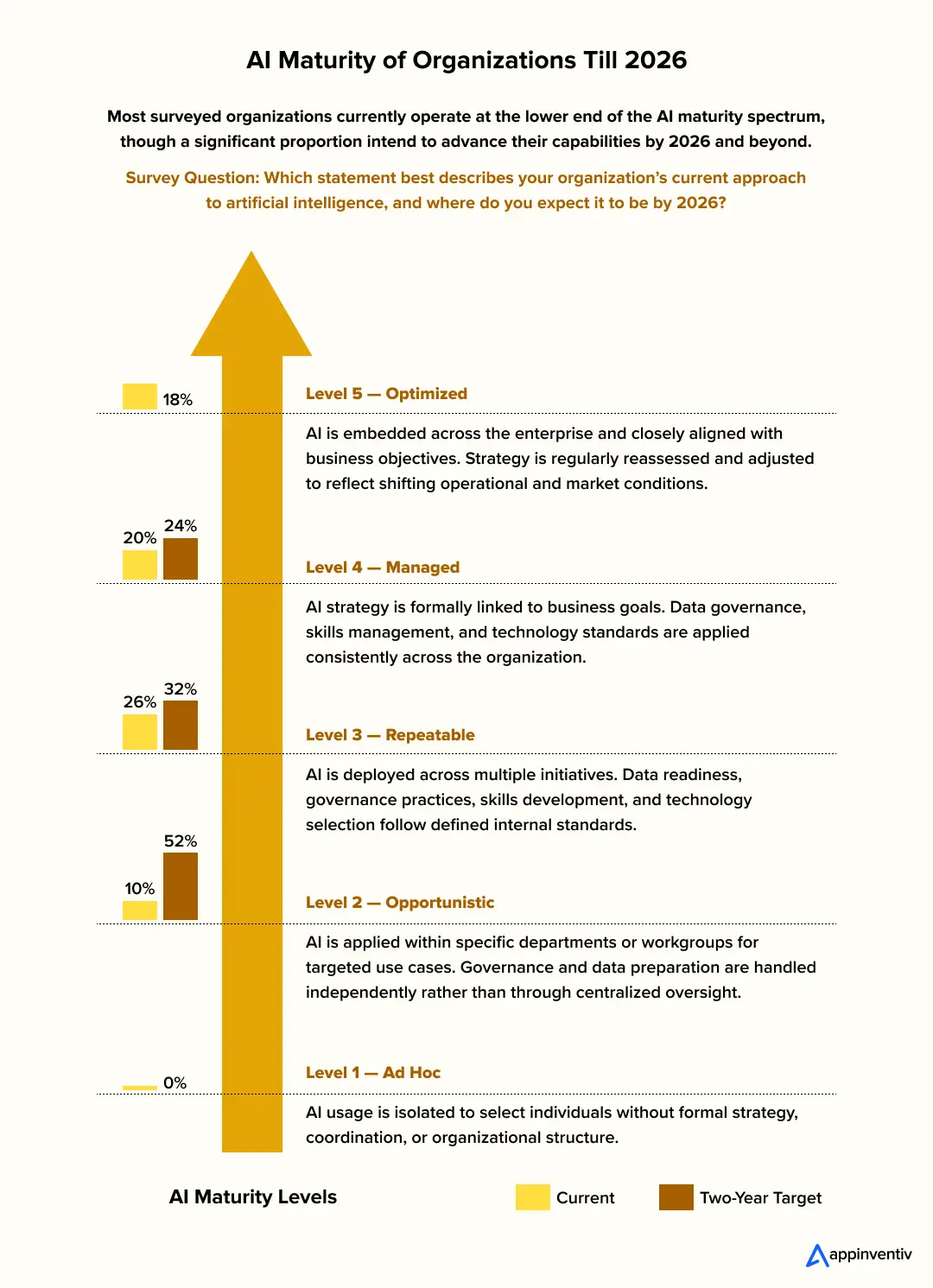
In practical terms, companies moving beyond experimentation often rely on external AI integration services from Middle East providers. Internal IT teams may understand infrastructure, yet large-scale AI applications require coordination across compliance, security, data engineering, and operations. That coordination does not emerge automatically. It takes deliberate design, repeated testing, and sometimes external technical depth to stabilize early deployments.
Shaping Scalable AI in the Middle East: Top Priorities for MENA CEOs
In MENA, numerous businesses are eager about AI, but not all have been successful in bringing it to practice. It is not always successful to scale AI solely through technology, but it is important to organize its purposeful work in accordance with business requirements and to take into account structural preparedness.

Scale Using a Strength Hybrid Cloud Strategy
Hybrid cloud is not an upgrade but is essential infrastructure. Other challenges to companies include AI integration with legacy systems and local regulations, with the increasing availability of hyperscalers in Qatar, Saudi Arabia, and the UAE, and regional data operators such as Khazna, contributing to the development of sovereign-ready capacity.
This foundation is the foundation of enterprise AI integration in the Middle East, which allows companies to expand safely and yet in compliance.
Modernize Data Architecture
46% of MENA CEOs identify modern data architecture, including data fabric and data mesh models, as a top priority (Source: e&g 25 IBM Report V09). The condition of working with fragmented or scattered data, or with frequent differences in local rules across markets, continues to be prevalent in many organizations.
It is essential to establish standard AI data governance and visibility of all sources of data. These measures will be the key to successful AI system integration in the Middle East, enabling projects to operate without bottlenecks at all times.
Focus on AI-First Transition by prioritising Talent
Recruiting, developing, and retaining AI experts is a complex task that must be addressed. Governments are launching programs to impart technical skills, but the companies will have to build teams in-house to facilitate sustainable enterprise AI deployment in the Middle East, closing the knowledge divide between business demands and technical prowess.
Making AI Responsible
Responsible AI is not merely a risk avoidance issue. Establishing audit, oversight and governance will keep projects in line and will develop trust. This method influences the AI integration architecture for enterprises, and organizations can develop AI in a quantifiable and secure manner.
Capitalize on Governmental Momentum
The ecosystem in the GCC is being moved by national AI programs. The organizations that are compatible with these policies, local associates and the wider strategic targets can contribute to the enterprise AI transformation in the Middle East, constructing projects that are scalable, coordinated, and effective.
Also Read: AI Innovations in Dubai: Accelerating Business Growth
Enterprise AI Integration Framework in the Middle East
The adoption of AI in the Gulf is conditioned by the presence of sovereign data laws, investment in the development of hyper-scale infrastructure, and government-supported digital initiatives. An organized policy-sensitive model is hence necessary. A seven-stage structure based on regional realities, as below, is anchored by a critical capability in each stage.
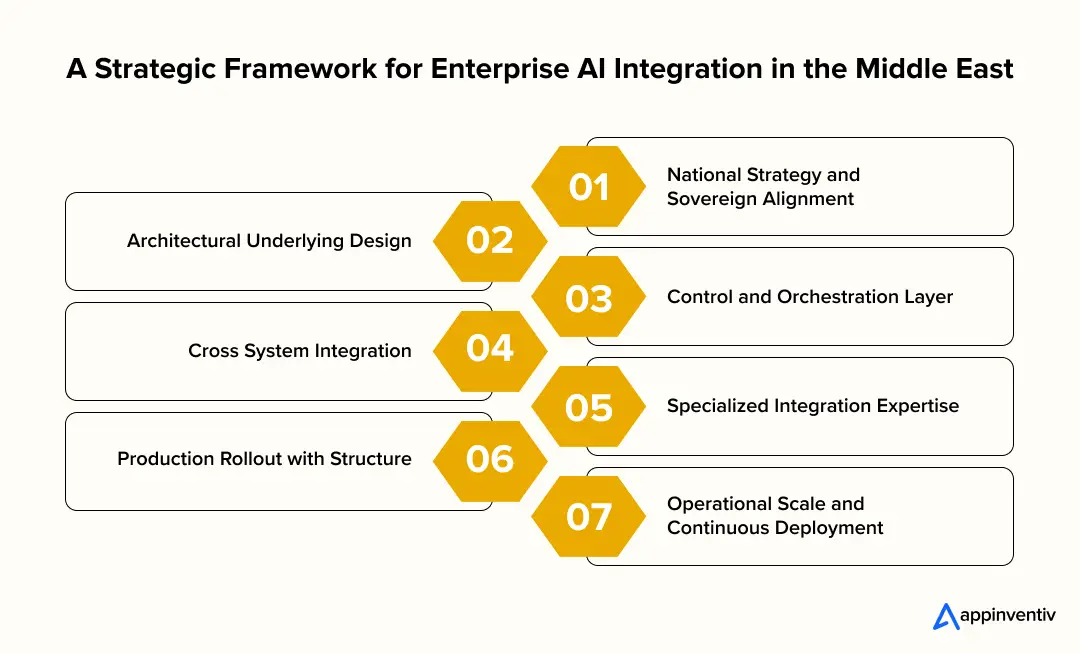
Stage 1: National Strategy and Sovereign Alignment
The first step to enterprise AI Integration in the Middle East is an official alignment with national AI agendas and sector regulators. Organizations have to measure the effectiveness of suggested AI systems in meeting the economy’s diversification requirements and the government’s modernization objectives.
At this stage, the data residency, limits on cross-border transfers, and cybersecurity controls are elucidated. Approval delays among the downstream are avoided through executive sponsorship and regulatory mapping.
Stage 2: Architectural Underlying Design
A structured enterprise AI integration framework defines how data, compute, and governance layers interact. Architects decide to use either centralized data lakes or federated architectures between ministries and subsidiaries.
Proper role-based access policies and lineage tracking systems are instilled early. This architectural transparency leads to risk reduction in scale-up.
Stage 3: Control and Orchestration Layer
A model execution, workflow automation, and system interoperability are coordinated by an AI orchestration platform in an enterprise environment. Middle Eastern firms using hybrid sovereign cloud stacks distribute their workloads safely and efficiently with orchestration.
It also brings about uniformity in monitoring and logging. Scaling is also volatile and expensive without orchestration.
Stage 4: Cross System Integration
Effective AI systems integration in the Middle East initiatives unifies ERP platforms, analytics engines, CRM systems, and external APIs. Middleware layers and standardized schemas are applied in the integration teams so as to break down data silos.
Real-time pipelines and batch pipelines are designed to run efficiently on enterprise load. This phase provides AI systems with the capability to operate within the departments as opposed to an isolated application.
Stage 5: Specialized Integration Expertise
Large-scale programs often depend on AI systems integrator services Middle East providers with regional regulatory knowledge. These professionals negotiate the sector compliance provisions in banking, healthcare, energy, and government.
They ensure safe API gateways and interoperability standards in line with local cybersecurity systems. They are familiar with their region, which lowers execution risk.
Stage 6: Production Rollout with Structure
A disciplined enterprise AI deployment roadmap controls the process of model transition between pilot and enterprise scale. Formalized prior to expansion are validation checkpoints, bias testing, performance audits and security reviews.
Infrastructure capacity planning will ensure that GPU, storage, and network resources can handle full production loads.
Stage 7: Operational Scale and Continuous Deployment
Sustained enterprise AI deployment in Middle East programs requires lifecycle management and continuous optimization. Models are retrained on localized datasets and trained on Arabic language or climate-specific variables, depending on the need.
Councils of governance assess performance based on KPI of the business. This last phase grounds AI alteration of the enterprise over the long-term instead of experimentation over the short-term.
AI Integration Readiness Checklist for MENA Enterprises
Enterprise AI adoption in the Gulf is shaped by sovereign data rules, sector regulators, Arabic language needs, and Khaleeji user expectations. Integration must also reflect regional payment systems, government digitalisation programs, and the multi-entity structures common across family conglomerates and state-backed enterprises. Here’s a checklist to guide the process:
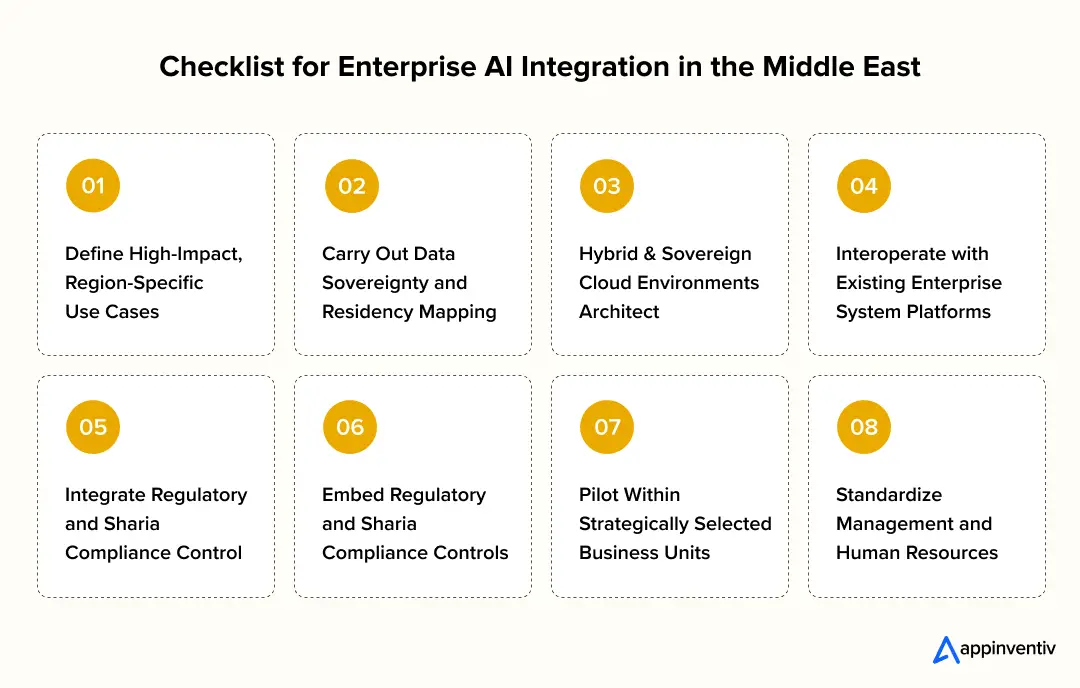
Define High-Impact, Region-Specific Use Cases
Find AI use cases that fit Gulf market realities, such as AI fraud detection for Mada or STC Pay, predictive maintenance for energy infrastructure, customer intelligence in Arabic, or auto-compliance in Islamic finance.
Enterprise AI integration in the Middle East should start with operational priorities based on local regulatory controls and consumer behavior rather than imported use cases.
Carry Out Data Sovereignty and Residency Mapping
Audit data storage, processing, and transfer of enterprise data. Numerous Gulf regulators require in-country or sovereign cloud hosting for sensitive financial, healthcare, and government workloads.
The structured data audit would include classifying Arabic and bilingual data, checking lineage, and ensuring that cross-border flows do not violate any domestic data protection regulations.
Hybrid and Sovereign Cloud Environments Architect
Integration layers of design that operate between private data centers, regional hyperscale cloud zones and sovereign cloud infrastructures. Workload isolation, encrypted service meshes, and API orchestration are necessary for government contracts and critical infrastructure. It must expect scale between multi-subsidiary business units typical of the GCC.
Interoperate with Existing Enterprise System Platforms
Large Middle Eastern businesses tend to have in place well-established ERP, banking cores, as well as sector platforms, which are highly customized.
AI systems integration in the Middle East initiatives must account for legacy middleware constraints, Arabic interface layers, and strict change management to prevent disruption across finance, utilities, and logistics operations.
Integrate Regulatory and Sharia Compliance Control
AI decision systems in parts of the economy, such as banking and insurance, must comply with local financial authority regulations and, where applicable, with Sharia governance regulatory requirements.
The integration architecture should be constructed with model explainability, audit logs and workflow approvals to support regulatory scrutiny.
Embed Regulatory and Sharia Compliance Controls
At the interface between AI, payments, and user onboarding, regional systems such as Mada, STC Pay, and UAE PASS must be integrated alongside other national payment and digital identity platforms.
The deployment should be designed to incorporate latency, fraud monitoring and biometric authentication standards.
Pilot Within Strategically Selected Business Units
Start with contained environments like monitoring of energy assets, automating Arabic customer service, or an intelligent document management system to support government tenders.
Manageable pilots enable confirmation of performance to regional data, along with Khaleeji user expectations, prior to enterprise-wide implementation.
Standardize Management and Human Resources
Create in-house AI councils comprising IT leadership, cybersecurity teams, compliance officers, and business heads. Create Arabic-language training and executive reporting dashboards.
The Gulf requires long-term change based on internal capacity building as opposed to the reliance on constant external supply.
Also Read: AI Readiness in UAE: How Can Enterprises Assess Their Maturity Before Scaling AI
Common Challenges in Enterprise AI Integration in the Middle East and How to Overcome Them
Enterprise AI integration in the Middle East is shaped by strict data residency laws, sector regulators, and sovereign cloud mandates that directly influence system design. Here are some of the key challenges organizations encounter, along with practical solutions to address them effectively.
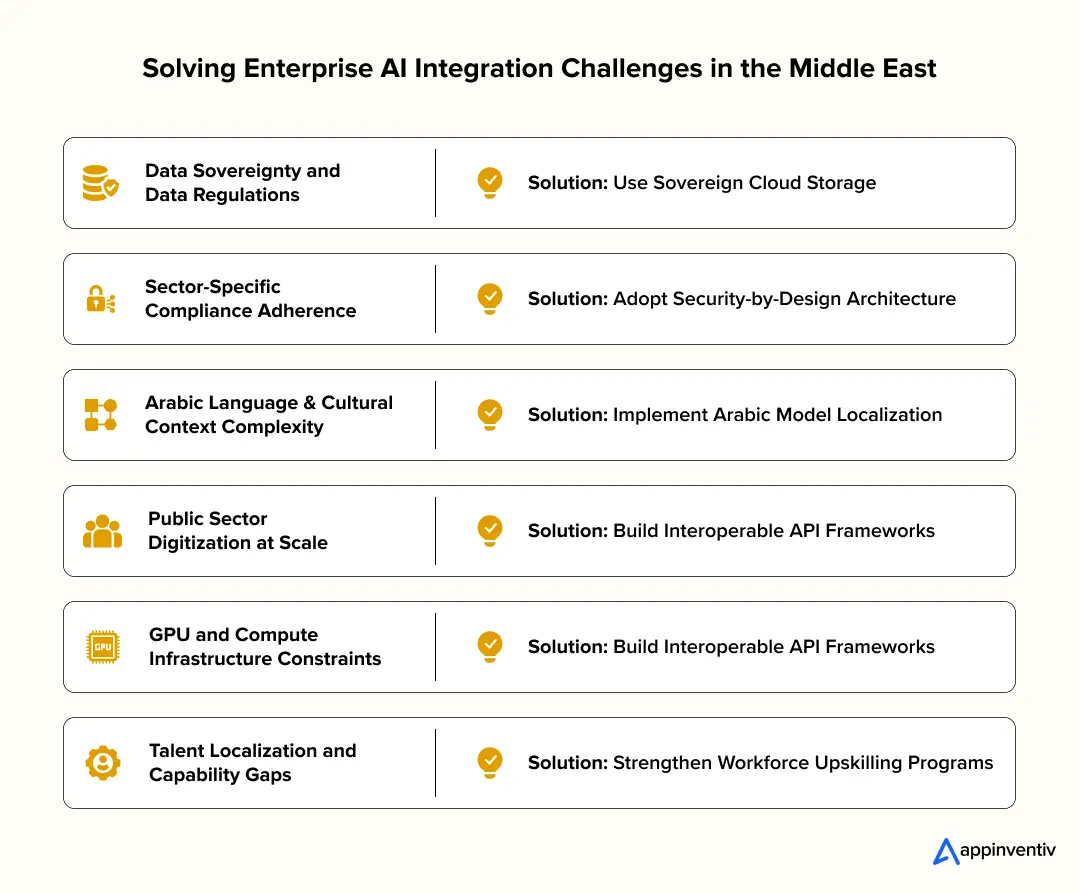
Data Sovereignty and Data Regulations
The Saudi Arabian and UAE countries provide a robust data governance framework aligned with national security and digital sovereignty. The Saudi Data and AI Authority and the UAE Artificial Intelligence Office encourage the use of AI, but have high compliance standards. Independent data protection regimes are also applicable in types of financial free zones, like in DIFC.
How to overcome it: Prior to deployment, enterprises are required to match AI workloads with national cybersecurity controls, sector regulators, and residency regulations. Storing sensitive information in certified sovereign cloud systems and integration of audit trails into AI structure is the guarantee of regulatory compliance since the first day of operation.
Sector-Specific Compliance Adherence
Layered compliance frameworks exist in AI projects in oil and gas, government services, and banking. The National Cybersecurity Authority in Saudi Arabia exists to offer guidance in the configuration of infrastructure. The national AI agenda in Qatar also incorporates the modernization of the use of AI in the quality of life services.
How to overcome it: Some of the integration strategies should have a security-by-design architecture, encryption standards and documented risk assessment. During the system design, regulatory consultation should be done as opposed to after the deployment.
Arabic Language and Cultural Context Complexity
In the Arabic NLP, there are technical issues that do not exist in English-dominant markets. Various dialects in the Gulf influence the accuracy of chatbot models, sentiment analysis, and autonomous public services. Large language models that are imported do not work well without localization.
How to overcome it: The organizations are supposed to fine-tune or train models using region-specific data, such as Modern Standard Arabic and dialect corpora. Constant checking with live regional information enhances contextual reliability.
Public Sector Digitization at Scale
The governments of the region are directly incorporating AI into e-government portals, smart city platforms, and digital identity systems. The national initiatives within frameworks like the Qatar National AI Strategy focus on coordination among ministries rather than on tools that operate independently.
How to overcome it: The business dealing with government agencies and departments has to develop an interoperable API and common data standards between ministries. Fragmentation is minimized by centralized orchestration and federated data governance models.
GPU with Compute Constraint Infrastructure Expansion
The Gulf has invested heavy on the hyperscale data centers; however, the demand for AI compute, particularly the GPU compute, is increasing at a high rate. Businesses that are scaled at predictive analytics or generative AI models can face resource constraints.
How to overcome it: The enterprise AI deployment roadmap should be able to incorporate capacity planning. Combining sovereign cloud technology with approved hyperscaler alliances is a way to allocate workloads effectively, without breaching controls over national data.
Talent Localization and Capability Gaps
Despite strong executive interest in AI, AI and MLOps capabilities remain uneven across industries, with many organizations still lacking mature data engineering practices and operational AI pipelines. Governments promote workforce nationalization and local capability creation, which has the potential to slow deployment speed, which is based on rapid outsourcing.
How to overcome it: Business organizations ought to incorporate institutionalized knowledge transfer and reskilling systems into systems integration contracts. The introduction of internal AI governance councils can be a guarantee of long-term sustainability instead of relying on external vendors.
Let our experts help you overcome these challenges and build scalable, compliant AI systems

Regional AI Trends Driving the GCC Digital Economy
The use of artificial intelligence in the Middle East is in the fast continuum of strategic intent to actual implementation based on the priorities of the region, sovereign platforms, and industry-specific needs. The following trends relate to the development of AI as a Gulf-specific phenomenon.
Emergence of Localised and Arabic-Centric Model
Gulf countries are investing in AI models trained on local languages and contexts. The GCC governments are supporting the creation of Arabic-specific systems that can support local users better than the generic global models. This transition enhances the customer experience within the government portals, banking interfaces, and digitally-intended services, where the dialect and cultural understanding are critical.
Increasing Enterprise Deployment/Readiness Gaps
A significant share of Middle Eastern companies indicate having an active AI implementation, but only a minor part of them have implemented it at the business-functional level. Issues like talent deficit, infrastructure imbalances, and governance risk are influencing the way organisations are focusing more on practical implementation than on experimentation.
Artificial Intelligence Regional Infrastructure Growth
The Gulf is turning into a significant computing and data centre hub with huge investments put into it by global cloud providers and sovereign programs. These expansions can be supported by the AI backbone needed to make large-scale enterprises adopt AI with the backing of international technology giants, despite the geopolitical pressures that these expansions place on local infrastructure.
Convergence Telecom and AI Infrastructure
There is an upward trend of AI integration in telecommunication and network systems. AI is being used by operators in the Middle East to optimize 5G performance, automate network planning, and minimise energy consumption in the operations of infrastructure. The networks powered by AI are also helping smart city projects and IoT development, which are one of the strategic priorities of Gulf governments.
Intelligent Consumer and Public Services
AI is transforming the experience of the population and consumers in the regions, and it can be used in virtual government services, mobility, and customer support. Efforts like autonomous transport pilots and AI-based service delivery are on the rise, with cities in the UAE and Saudi Arabia working towards a digital government.
Knowledge Exchange and Strategic Events
Hyperspecialized regional AI conferences and forums, such as AI Everything Middle East is drawing world decision-makers and shapers. The platforms are used to speed up cross-border partnerships, investment, and ecosystem development throughout the MENA.
Partner with Appinventiv for Enterprise AI Integration in the Middle East
Across the GCC, governments are moving from strategy papers to infrastructure execution. Saudi Arabia is expanding sovereign AI capability through state-backed investment and national data platforms. The UAE is embedding AI across digital government, mobility, and industrial systems. Qatar continues strengthening its ecosystem through research funding and cloud expansion. The next stage will center on enterprise-scale deployment across energy, finance, logistics, healthcare, and public administration.
As AI transitions from experimentation to regulated, production-grade environments, enterprises require disciplined integration, mature data governance, and infrastructure aligned with sovereign requirements. Appinventiv supports this shift by architecting and implementing enterprise AI systems that connect with legacy ERP platforms, regional financial ecosystems, and secure cloud environments.
As an established AI development company in Dubai, our work demonstrates applied execution at scale. For Americana ALMP, we engineered a real-time operational command system that doubled last-mile delivery efficiency and improved ground accuracy fourfold.

For MyExec, we developed a multi-agent RAG platform delivering contextual business intelligence without reliance on consultants. With JobGet, we built an AI-powered hiring platform that surpassed 2 million downloads and secured $52 million in Series B funding. For Mudra, we deployed an AI budget management chatbot now adopted in more than 12 countries.
Appinventiv partners with Middle East enterprises from strategic design to full-stack development, AI integration, cloud deployment, and governance structuring, supported by structured AI consulting services in Middle East markets.
If your organization is preparing to operationalize AI within a regulated Gulf environment, we are ready to support the journey. Contact us to begin the discussion.
FAQs
Q. Why is enterprise AI integration gaining momentum in the Middle East?
A. The pace of enterprise AI integration in the Middle East is rising as a result of state-sponsored digital strategies, sovereign cloud growth and sector modernization requirements. The governments of the Gulf are integrating AI within government services, finance, and energy. The robust capital expenditure, regulatory visibility, and infrastructure advancement have shifted AI past the experimentation phase to formal enterprise-wide adoption.
Q. What role do systems integrators play in AI deployments?
A. Systems integrators play a critical role in AI deployments. Here’s what they do:
- Architecture Alignment: Assign AI cases to enterprise IT infrastructure and regulatory boundaries.
- System Interoperability: Integrate ERP, CRM, analytics, and AI models via APIs and middleware.
- Deployment Governance: Put in place lifecycle, lifecycle monitoring and compliance controls.
- Operational Scaling: Enhance the consistency of performance between hybrid cloud and on-premise environments.
Q. Why are data architects critical for enterprise AI implementation?
A. The pipelines, governance frameworks, and storage structures that render AI systems to scale or stall are designed by data architects. They collaborate with IT systems integrators in the UAE to consolidate scattered datasets and enforce data quality policies. The absence of disciplined architecture means that AI models will be unable to work with inconsistent inputs and provide consistent enterprise results.
Q. How much does enterprise AI integration cost in the Middle East?
A. AI integration cost in the Middle East depends on the industry, the complexity of infrastructure and the compliance. In the UAE, mid-sized deployments typically range from AED 550,000 to 1.8 million, which is approximately $150,000 to $500,000. Large-scale programs in regulated industries such as banking or energy often range from AED 3.7 million to 18 million+ or $1 million to $5 million+, including infrastructure, integration, governance, and ongoing support.
To know about the exact cost of enterprise AI integration in the Middle East, connect with our experts today.
Also Read: How Much Does It Cost to Build an AI App in Dubai?
Q. How to integrate AI into enterprise systems in the Middle East?
A. Here are the steps to integrate AI into enterprise systems:
- Ensure AI integration use cases comply with industry regulations and domestic data-residency regulations.
- Typically, a system data audit should be conducted, which includes governance, ownership, and security classification.
- Plan a scalable integration architecture that complies with legacy ERP and core systems.
- Choose sovereign, hybrid, or regional cloud infrastructure based on compliance requirements.
- Introduce API-based connectivity and safeguard middleware to enable system interoperability.
- Develop model governance, audit logging, and cybersecurity.
- Pilot in a controlled business unit and then roll out into the enterprise.
- Establish internal AI control and uninterrupted performance management.
Q. Should enterprises build in-house AI integration teams or outsource?
A. Build vs outsource decision in AI integration is based on scale, regulatory sensitivity and internal expertise. Megabanks and government agencies can develop a hybrid structure that combines internal governance teams with external system integrators.
Medium-sized companies might outsource at the very beginning due to the need for speed and technical expertise. Sustainability is typically built on the gradual development of internal capabilities over the long term.
Q. What industries in the Middle East are investing most in enterprise AI integration?
A. Here are some of the top industries in the Middle East that are investing in enterprise AI integration:
Banking and Financial Services: AI is used for hyperpersonalized banking for ME users, credit analytics, regulatory reporting automation, and real-time fraud detection.
Oil and Gas: Enterprises apply AI to reservoir modeling, predictive maintenance, and operational efficiency improvement.
Government and Smart Cities: AI supports government initiatives like crafting digital identity platforms, automated public services, and data-driven urban planning.
Healthcare: Hospitals and providers use AI for clinical decision support and patient workflow optimization.
Telecommunications: Telecom operators deploy AI for customer analytics and network performance management.
Q. How long does enterprise AI integration take?
A. Integration of AI into enterprises is a timeline that is subject to infrastructure maturity and regulatory authorities. Pilot implementations can be done between three and six months. Enterprise implementation across all departments can take between 9 and 18 months. Programs that may include legacy modernization, sovereign immigration, or multi-country compliance needs may take more than a year and a half. Developed roadmaps minimize delays and rework.
Q. How do government policies shape enterprise AI integration in the Middle East?
A. Middle East government policy has a direct influence on the manner in which AI systems are designed, hosted, and governed by the enterprises. Each deployment decision is affected by data residency laws, sectoral regulators, and sovereign cloud mandates. Enterprise AI integration in the Middle East is then driven by compliance and national economic priorities, not by experimentation alone.
Key AI Policies in the Middle East
- UAE National Strategy for Artificial Intelligence 2031
- Saudi Arabia Vision 2030 Digital Transformation Framework
- Qatar National AI Strategy
- Saudi Data and AI Authority regulatory framework
- UAE Data Protection Law and sector-specific AI governance mandates
The Gulf is characterized by government control in terms of execution. Those enterprises that align architecture, governance, and infrastructure with national policy are in a better position to scale AI securely and sustainably.

- In just 2 mins you will get a response
- Your idea is 100% protected by our Non Disclosure Agreement.

How Much Does It Cost to Build a Conversational AI Chatbot in the UAE?
Key Takeaways AI chatbot development in the UAE typically costs AED 150,000–1,470,000 ($40K–$400K), based on complexity. Backend integration and compliance drive cost more than the chatbot interface itself. Arabic NLP, UAE hosting, and PDPL requirements increase budget and engineering effort. LLM + RAG enterprise chatbots sit at the higher end due to integration and infrastructure…

AI Inventory Management in Australia: Benefits, Use Cases, and Implementation Strategies
Key takeaways: Traditional ERP planning reacts to history; AI predicts demand shifts, reallocates stock dynamically, and prevents costly stockouts across distributed Australian networks. AI in inventory management in Australia typically reduces inventory levels 20–40% while maintaining service targets, unlocking significant working capital across multi-state operations. Enterprise implementations usually range from AUD 70,000 to AUD 700,000+,…

How to Hire RAG Architects for Enterprise AI
Key takeaways: Define your RAG architecture scope to avoid misaligned hiring decisions Identify end-to-end architectural ownership across retrieval, governance, and scaling Evaluate deep technical capabilities beyond prompt engineering and tools Validate governance and compliance readiness at the retrieval layer Test system-level thinking through real-world failure scenarios Choose the right hiring model based on scale, risk,…









