
































AI for Telecom: Business Benefits, Use Cases, Costs, and Implementation

 Share -



- 01Why AI for Telecom Is Gaining Business Investment
- 02Key AI Use Cases in Telecom With Real-World Examples
- 03Business Benefits of AI in Telecom: Where to Measure the Return
- 04Predictive AI, Generative AI, and AI Agents: Choosing the Right AI Approach for Your Telecom Business
- 05What Needs to Connect Behind a Working Telecom AI Solution?
- 06Which Telecom AI Use Case Should Businesses Implement First?
- 07How to Implement AI for Telecommunications Around Your Business Requirements
- 08Understanding the Cost and ROI of AI for Telecom
- 09Challenges of AI in Telecom and How to Address Them
- 10The Future of AI in Telecom Industry: What Businesses Should Prepare For
- 11How Appinventiv Helps Telecom Businesses Turn AI Into Production Systems
- 12FAQs

Key takeaways:
- The global artificial intelligence in telecommunication market is projected to grow from $6.4 billion in 2026 to $46.2 billion by 2033.
- AI for telecom is expanding across network operations, customer service, fraud prevention, revenue assurance, field service, and enterprise workflows
- Predictive AI, generative AI, and AI agents solve different telecom problems and can increasingly work together.
- OSS, BSS, CRM, billing, service inventory, and network integrations are central to production-scale AI.
- The business case should connect AI with operating outcomes such as reduced costs, faster activation, lower energy use, improved service quality, and protected revenue.
- Data quality, legacy systems, cybersecurity, regulatory compliance, and operational ownership remain important deployment challenges.
A broadband customer reports slow speeds. The contact center opens a ticket. Network operations see congestion in the area. The retention team sees an account approaching renewal.
Each team has part of the answer. The customer still has a problem.
For the operator, fixing this requires connecting network conditions with customer records and the teams responsible for taking action. AI for telecom can help bring that information together, support diagnosis, and guide the next step.
But where should your business start?
The answer depends on where recurring problems cost you most and whether your teams can act on better information. Repeated technician visits may justify predictive maintenance. Orders stuck between sales and provisioning may call for automated validation. Billing enquiries may need an assistant that can explain account details accurately.
Each application comes with its own data requirements, integrations, costs, and limits on automation. Those requirements deserve attention before you commit to a platform or development budget.
This guide helps telecom leaders evaluate the available options. It examines business benefits, practical use cases, and deployment examples, then covers how to select a first project, connect existing systems, estimate returns, and address implementation challenges.
Get a clearer view of where AI can justify investment across your network, customer, and operational priorities.

Why AI for Telecom Is Gaining Business Investment
Telecom businesses have several reasons to consider AI: rising service demands, recurring operational costs, and delays across disconnected systems. The investment question is where it can make a measurable difference.
Grand View Research projects the global artificial intelligence in telecommunication market to grow from $6.4 billion in 2026 to $46.2 billion by 2033, at a CAGR of 32.5%. Customer analytics accounted for 28.5% of the market in 2025, reflecting the commercial importance of understanding customer behavior and service needs.
Operator investment is also moving closer to daily operations. NVIDIA’s 2026 telecom survey found that 65% of operators said AI was driving network automation, while 60% of respondents said their organizations were using or assessing generative AI.
For businesses evaluating Artificial Intelligence, these developments bring different options into consideration:
| Investment Area | Business Opportunity to Evaluate |
|---|---|
| Network operations | Apply AI to fault investigation, capacity planning, and energy management. |
| Customer operations | Give service teams better account context and help customers resolve recurring enquiries. |
| Commercial and back-office workflows | Address billing discrepancies, order corrections, and delays before service activation. |
The right starting point will differ by operator. A business managing its own network may prioritize reliability and energy expenditure. An MVNO may find greater value in billing support or retention. For an enterprise connectivity provider, reducing activation delays could be the more pressing opportunity.
The following use cases explain how these applications work, where they fit, and what telecom businesses can expect them to improve.
Key AI Use Cases in Telecom With Real-World Examples
The most useful AI/ML use cases in telecom connect a recurring problem with better information and a practical response. The applications below explain where each solution fits, how teams can use it, and what outcomes deserve attention.
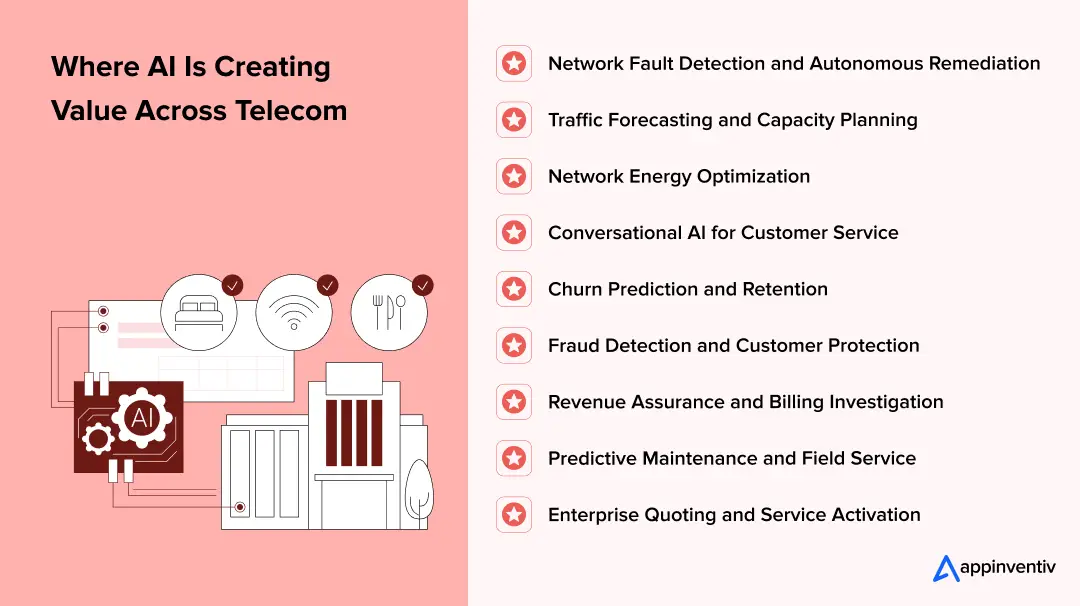
Network Fault Detection and Autonomous Remediation
When one incident generates alarms across several assets, engineers can spend valuable time separating symptoms from causes. AI can correlate network topology, performance data, traffic patterns, and historical incidents to help teams identify likely causes and prioritize investigation.
Start with diagnostic support where engineers need better evidence. Where corrective procedures are established, the solution can also recommend or execute approved actions.
Best fit: Operators whose teams repeatedly investigate similar alarms across disconnected monitoring systems.
Real-world example: Deutsche Telekom’s RAN Guardian Agent monitors performance anomalies and can initiate corrective measures. In February 2026, the company reported more than 100 autonomous remediation actions during its first month and a reduction in major-event management time from hours to around a minute.
Traffic Forecasting and Capacity Planning
Capacity decisions become difficult when teams cannot distinguish sustained demand growth from temporary peaks. Predictive AI can assess traffic by location, time, customer mix, and planned events to identify where additional resources may be needed.
This application of AI in telecommunication helps planners compare expected demand with available capacity before committing to expansion. It can also support resource allocation around events or recurring periods of congestion.
Best fit: Operators facing recurring congestion in some locations while capacity remains underused elsewhere.
Real-world example: Deutsche Telekom said its RAN Guardian Agent identified roughly 237,000 events for 2026, supporting capacity assessments around affected mobile sites before and during periods of high demand.
Network Energy Optimization
Network resources do not experience equal demand throughout the day. AI can forecast usage and help adjust selected resources while maintaining defined service-performance requirements.
For your business, the deployment needs to connect energy decisions with network conditions. Teams should be able to assess savings alongside throughput, congestion, and service quality before expanding the scope.
Best fit: Operators with significant network energy expenditure and equipment that supports controlled resource adjustments.
Real-world example: Ericsson reports commercial deployments of its Automated Energy Saver at Telstra and Malaysia’s DNB. The solution activates or deactivates radio resources according to user throughput, balancing energy use with network experience.
Conversational AI for Customer Service
Billing questions and troubleshooting requests often require advisers to search several systems before answering. Conversational AI in telecom can bring approved knowledge together with authenticated account information to support more relevant responses.
Businesses can deploy customer-facing assistance, adviser support, or both. Start with enquiries where the application can retrieve reliable information, explain the issue, and complete the permitted next step or transfer the case with sufficient context.
Best fit: Customer-service operations handling large volumes of recurring enquiries that require account-specific information.
Real-world example: Vodafone’s generative AI-powered SuperTOBi operates across eight countries and handles around 1.5 million customer conversations each month. Vodafone describes it as an evolution of its earlier TOBi chatbot, capable of handling more complex customer tasks.
Churn Prediction and Retention
A churn score becomes useful when a retention team knows what to do next. AI can combine service quality, complaint history, billing issues, plan suitability, and contract timing to identify accounts needing attention.
The response should address the underlying problem. A customer experiencing repeated outages may need a technical resolution before a retention offer has any value. Another may need a plan that better matches their usage.
Best fit: Businesses with connected customer and service records, plus teams that can act on the reasons behind likely churn.
Real-world example: Sri Lankan operator Dialog Axiata built a home broadband churn prediction model using Amazon SageMaker. It combines customer demographics, network usage, and outage data to predict churn 45 days in advance. Teams use those predictions to target at-risk customers with personalized retention campaigns, connecting risk scores with specific interventions.
Fraud Detection and Customer Protection
Unusual calling patterns, identity changes, device behavior, and account activity can signal potential fraud. AI can assess these signals together, helping strengthen fraud detection in telecom and prioritize the cases that require investigation.
The response should still match the level of risk. A suspicious event might trigger additional verification, a customer warning, or specialist review, while higher-impact restrictions require stronger evidence and clear escalation procedures.
Best fit: Operators whose fraud teams face high alert volumes or struggle to detect patterns across separate systems.
Real-world example: In May 2025, Airtel introduced an AI-powered fraud detection solution to identify and block malicious websites. The system checks internet traffic against global threat repositories and Airtel’s own threat database. When customers attempt to access a flagged website, it blocks the page and displays an explanation, turning threat detection into a direct customer-protection action.
Revenue Assurance and Billing Investigation
Revenue leakage can appear between service ordering, provisioning, usage collection, rating, and billing. AI can compare records across these systems and flag discrepancies that warrant closer investigation.
Rule-based checks still work well for known billing issues, while machine learning becomes useful when patterns are harder to define or case volumes are too high for manual review.
Best fit: Operators dealing with complex billing environments, high transaction volumes, or recurring leakage across provisioning and charging systems.
Real-world example: stc selected Subex’s integrated Revenue Assurance and Fraud Management platform to strengthen revenue protection and risk management. The solution uses analytics and automation to improve visibility into potential leakage and help teams prioritize assurance activities.
Predictive Maintenance and Field Service
AI can combine equipment condition, fault history, technician skills, spare parts, location, and service commitments to improve maintenance and dispatch decisions.
Predictive models can also identify equipment that shows signs of deterioration before a full failure occurs, helping operators reduce avoidable downtime and prepare field teams more effectively.
Best fit: Operators managing large network footprints, high maintenance volumes, or frequent repeat visits caused by incomplete fault information.
Real-world example: Telefónica Germany has used AI-driven predictive maintenance as part of its move toward more autonomous network operations. TM Forum reported prediction accuracy above 80%, a reduction of more than 22% in network trouble tickets, and repair-time improvements of at least 10%.
Enterprise Quoting and Service Activation
Enterprise telecom deals often involve multiple sites, products, SLAs, technical dependencies, and commercial conditions. AI can help interpret customer requirements, identify missing information, and compare requests against available product and infrastructure data.
Best fit: Enterprise telecom providers dealing with complex multi-site orders, long quotation cycles, or high provisioning fallout after contracts are signed.
Real-world example: BT has backed a TM Forum Catalyst focused on AI-powered enterprise sales for complex connectivity services. The proof of concept uses AI to interpret customer requirements, configure services and pricing, validate infrastructure compatibility, generate quotes, and move orders toward provisioning with fewer manual handoffs.
Bring us the network, customer, revenue, or operations problem. We’ll help map where AI fits, what it needs to connect with, and what a viable first deployment could look like.

Business Benefits of AI in Telecom: Where to Measure the Return
Telecom operators can assess returns through fewer repeat service calls, faster fault resolution, lower network energy costs, and reduced revenue leakage. These improvements show where AI affects operating margins and service quality, helping teams justify further investment.
The benefits of AI in telecom should therefore be assessed against the current process, including any additional review, support, and maintenance the solution requires.
| Business Benefit | How It Creates Value | What Your Business Should Measure |
|---|---|---|
| Lower operating expenditure | Reduces repeat investigations, unnecessary technician visits, and avoidable energy consumption. | Cost per resolved case, repeat-visit expenditure, and energy spend, including ongoing AI costs. |
| Better network reliability | Helps teams identify faults and restore affected services sooner. | Restoration time, affected customer minutes, and incident recurrence. |
| Stronger customer retention | Supports interventions that address service problems, billing issues, or unsuitable plans. | Churn and retained margin after accounting for discounts and intervention costs. |
| Better capital allocation | Gives planners stronger demand evidence when deciding where to add capacity. | Utilization, congestion, and whether deferred upgrades continue to meet service requirements. |
| Faster enterprise revenue | Reduces corrections and delays between quotation, provisioning, activation, and billing. | Activation time, order fallout, and time to the first accurate bill. |
| Greater workforce capacity | Reduces searching, summarizing, and repetitive processing so teams can handle more work. | Cases completed, backlog, rework, and time spent checking AI outputs. |
These measures need to be read together. Shorter handling times offer limited value if customers call back about unresolved issues. Lower energy expenditure needs to be assessed alongside network performance. Higher employee throughput should account for any work transferred to reviewers or downstream teams.
To assess the impact of AI in your industry operations, give each deployment a primary business measure and a service-quality measure. For telecom billing assistance, that could mean lower cost per resolved enquiry alongside stable or improved first-contact resolution.
This gives budget owners a clearer basis for deciding whether to expand the solution, adjust the workflow, or address a problem before further investment.
Predictive AI, Generative AI, and AI Agents: Choosing the Right AI Approach for Your Telecom Business
Selecting the right AI approach for your business starts with the task you need the system to perform. Forecasting demand, explaining a bill, and coordinating service activation require different capabilities. Choosing the approach early helps define the data, integrations, and controls your project will need.
Interest in generative AI in telecom should not make a language model the default for every application. Use the required output to guide the decision.
| If Your Business Needs To | Approach to Consider | What to Establish Before Investing |
|---|---|---|
| Predict demand, equipment failure, or likely churn | Predictive AI | Whether historical records contain reliable signals and whether teams can act on the predictions. |
| Explain information, summarize incidents, or draft responses | Generative AI | Which approved sources the system will use and how teams will check accuracy. |
| Coordinate tasks and execute permitted actions across systems | AI agents | Which actions are allowed, where approval is required, and how failed transactions will be recovered. |
| Apply fixed checks or follow a stable sequence | Conventional automation | Whether clear rules can complete the task reliably without a model. |
Some workflows need a combination. For fault management, a predictive model could flag abnormal behavior, generative AI could summarize the supporting evidence, and an agent could create a ticket or request approval for a corrective action.
Each component should earn its place in the design. If engineers only need help investigating faults, automated remediation can remain outside the first release. That keeps the initial scope focused on the problem you are ready to solve.
As the role of AI in telecommunications industry workflows expands toward execution, define access and authority separately. A system permitted to explain a billing discrepancy does not automatically need permission to change the account.
What Needs to Connect Behind a Working Telecom AI Solution?
AI for telecommunications depends on the systems around the model. Customer information may sit in CRM, network data in OSS, commercial information in BSS, and additional context across billing, service inventory, workforce, ticketing, and knowledge platforms.
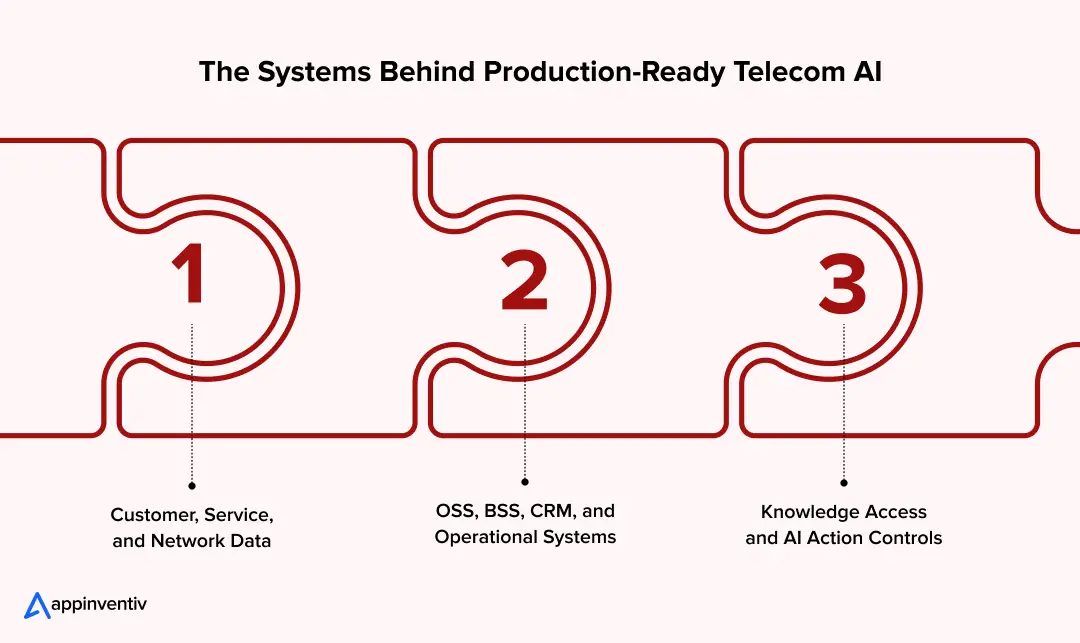
Customer, Service, and Network Data
A subscriber can have several services, while a service may depend on multiple network assets. Enterprise customers add locations, SLAs, contacts, and contractual relationships.
Those connections need to be accurate enough for the use case. Otherwise, an outage assistant may connect the wrong network incident with an account or a churn system may overlook the service problem influencing a customer.
OSS, BSS, CRM, and Operational Systems
Many AI and telecommunications use cases cross system boundaries. Customer assistance may require billing, CRM, product, and network information. Revenue assurance may compare provisioning with charging. Field-service AI can depend on workforce, inventory, asset, and ticketing systems.
A well-defined OSS architecture for telecom automation helps connect network and service operations with these workflows. Integration design needs to establish which platform remains authoritative when records disagree and how actions are confirmed after execution.
Knowledge Access and AI Action Controls
Generative AI can retrieve product information, procedures, troubleshooting guides, and other approved knowledge. That access should remain separate from permission to perform business actions.
An employee assistant reading an account carries a different risk from an agent changing a plan or network configuration. Access controls, validation, approvals, and audit logs should reflect that difference.
Which Telecom AI Use Case Should Businesses Implement First?
There is no universal first project. An MNO facing high network energy expenditure has different priorities from an MVNO dealing with billing enquiries or an enterprise connectivity provider struggling with activation delays.
A practical shortlist can be compared across four factors:
- Economic exposure: How much recurring cost, lost margin, or delayed revenue does the problem create?
- Data readiness: Are sufficiently complete and permitted records available?
- Ability to intervene: Can the organization change the outcome after receiving the AI output?
- Failure impact: What happens when the model or agent gets the decision wrong?
This can justify starting with a comparatively modest use case when it creates reusable integrations, evaluation methods, or governance capabilities. It can also justify postponing an attractive project when an essential data or system dependency is not ready.
The objective is to build a commercial sequence of AI investments rather than a collection of unrelated pilots.
How to Implement AI for Telecommunications Around Your Business Requirements
Implementing AI for telecommunications requires agreement on the workflow, the expected result, and the conditions for deployment. Before development begins, your business and delivery teams should understand what the first release will cover and how they will judge its performance.
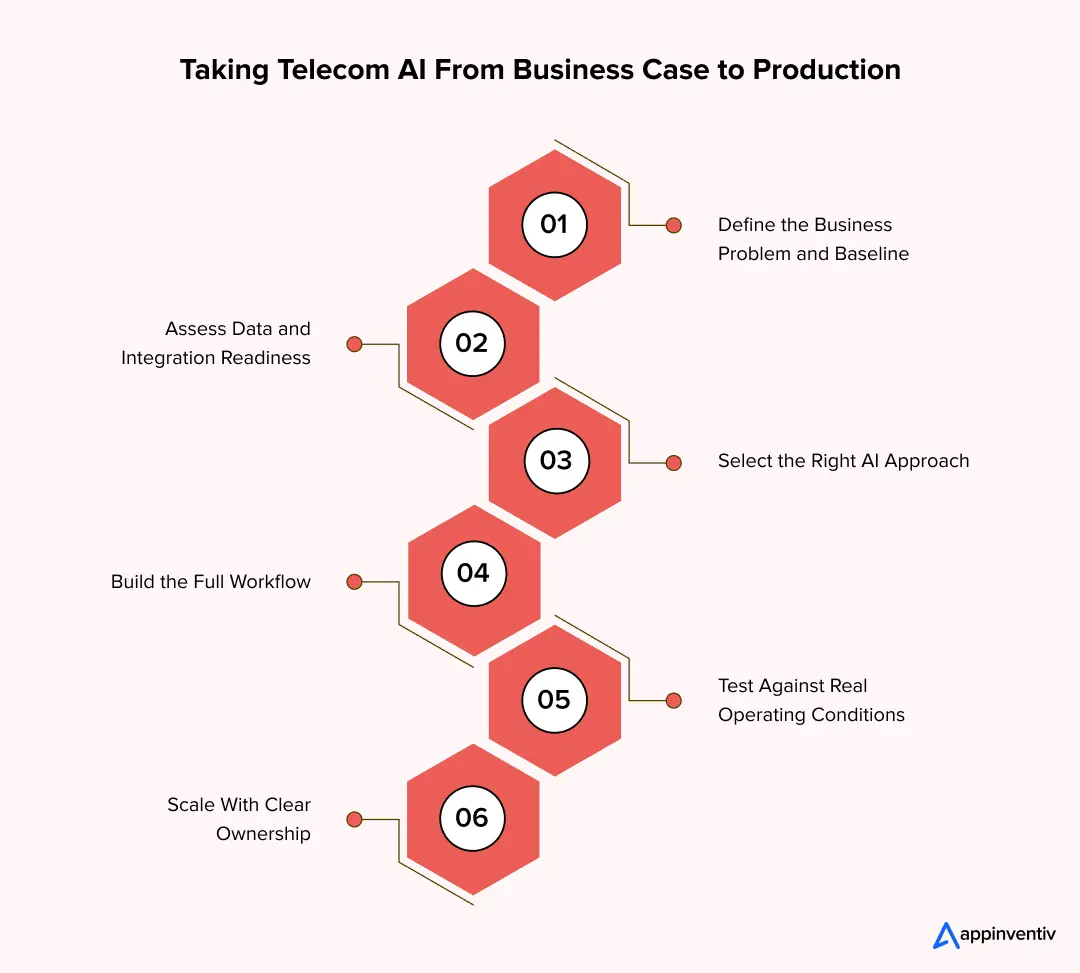
1. Define the Business Problem and Baseline
Choose a specific process with an accountable business owner. “Improve customer service” leaves too much open. Reducing repeat contacts about billing discrepancies gives the project a clearer scope.
Measure current volumes, resolution times, costs, and service outcomes. Agree on the improvement required to justify further investment, along with the service-quality limits the solution must respect.
2. Assess Data and Integration Readiness
Validate the records and interfaces required for the selected workflow. Check whether customer, service, network, and billing information can be connected accurately and accessed with appropriate permissions.
Test representative records and API responses before finalizing the estimate. Document missing fields, inconsistent identifiers, and access restrictions so the delivery plan includes the work needed to resolve them.
3. Select the Right AI Approach
Match the technology to the task. Forecasting may require predictive models; document analysis may suit generative AI. Agents become relevant when the solution must coordinate permitted actions across systems.
Compare the proposed approach with existing platform capabilities and conventional automation. Assess accuracy, response time, operating cost, and maintenance requirements before committing to the architecture.
4. Build the Full Workflow
Define what happens from the initial request through to confirmed completion. Include authentication, information retrieval, approvals, system actions, and escalation.
Decide how staff will handle incomplete records, unavailable systems, or uncertain outputs. For network applications, begin with recommendations or shadow operation where appropriate, allowing engineers to assess proposed actions before granting execution permissions.
5. Test Against Real Operating Conditions
Use cases that reflect your actual operation, including unusual tariffs, incomplete account histories, multilingual enquiries, and peak demand. Include failures in connected systems.
Compare results with the existing process and inspect differences across customer groups or service types. A strong average should not hide repeated failures in a smaller but commercially important segment.
6. Scale With Clear Ownership
Expand when the deployment meets the agreed business and service criteria. Review the additional integration work, support capacity, and operating expenditure required for each new region or workflow.
Assign responsibility for source updates, model performance, integration failures, and employee feedback. The handover should also define who can pause automated actions and how teams will maintain service while a problem is resolved.
See how we engineer telecom platforms and integrations that connect customer, billing, service, network, and operational workflows.

Understanding the Cost and ROI of AI for Telecom
Budgeting for AI for telecommunications starts with defining what the solution must access, analyze, and execute. An assistant retrieving approved technical documents has a different scope from an agent that updates customer accounts or changes network settings.
As an indicative planning range, AI application development cost can start around $40,000 and reach $500,000 or more. This is a broad development estimate, not a fixed telecom project price. Extensive legacy integration, data remediation, infrastructure requirements, and multi-market deployment can take operator programs beyond that range.
Before comparing proposals, confirm that each estimate covers the same workflow, integrations, operating volumes, and post-launch responsibilities.
What Drives Telecom AI Development Cost?
The cost of artificial intelligence in telecom depends on the work required to make the application reliable within your operating environment. Major cost components include:
- Data preparation: Cleaning records, connecting customer and service identifiers, and addressing missing information.
- System integration: Building and testing connections with OSS, BSS, CRM, billing, network, and workforce platforms.
- AI and application development: Configuring models, developing business logic, and creating interfaces for employees or customers.
- Security and action controls: Implementing authentication, permissions, approvals, and audit trails.
- Evaluation and deployment: Testing real operating scenarios, preparing teams, and rolling out the application.
- Ongoing operation: Paying for infrastructure, model usage, monitoring, human review, maintenance, and support.
Ask for one-time delivery costs and recurring operating expenses separately. Usage assumptions also matter: an estimate based on a small pilot may not reflect the cost of serving multiple teams or markets.
Existing platform capabilities may reduce development work. Missing APIs, inconsistent service inventories, or proprietary interfaces can add effort that needs to appear explicitly in the proposal.
How Should Telecom Companies Calculate ROI?
Start with a measurable change in the existing process. Establish which costs are avoidable, which gains create additional capacity, and which improvements bring revenue forward.
Consider an illustrative field-service deployment:
| Financial Measure | Illustrative Calculation |
|---|---|
| Repeat visits avoided annually | 2,000 |
| Avoidable cost per visit | $100 |
| Gross annual benefit | $200,000 |
| Annual operation and review costs | $80,000 |
| Net annual benefit | $120,000 |
| Initial investment | $180,000 |
| Simple payback after reaching the expected benefit level | 18 months |
These figures illustrate the calculation and are not telecom benchmarks. The payback period assumes the expected savings continue at a steady rate; rollout delays or slower adoption would extend it.
Check whether the financial benefit can actually be realized. Fewer technician visits may reduce travel and contractor expenditure, while employee time saved may create capacity without immediately lowering payroll costs.
Account for work transferred to other teams, ongoing AI expenses, and correction effort. Then compare a conservative adoption scenario with the expected case. This helps budget owners understand how much the return depends on usage, performance, and operating costs.
Challenges of AI in Telecom and How to Address Them
The challenges of AI in telecom affect project scope, operating costs, and the reliability of the finished solution. Before committing to deployment, identify which issues your team can resolve internally and which require support from your development partner or platform vendors.
For businesses investing in AI for telecom, the following areas deserve attention during planning and throughout operation.
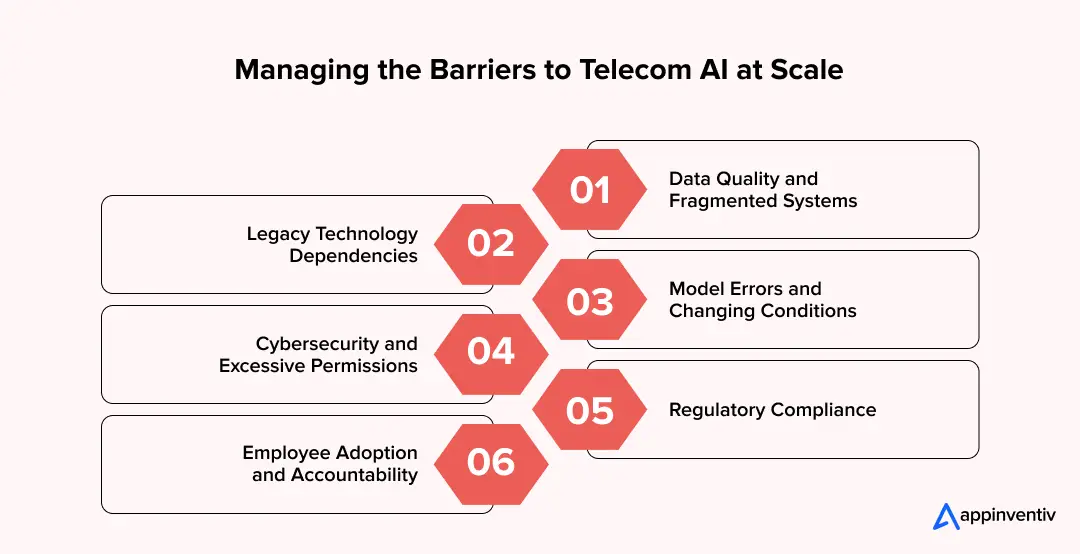
Data Quality and Fragmented Systems
Customer, service, and network records may be individually accurate but poorly connected. An application can retrieve the correct account details yet associate them with the wrong service or asset.
Test these relationships against the workflow you intend to automate. Assign responsibility for correcting missing identifiers, outdated records, and inconsistent mappings. Include that remediation work in the project scope, with clear ownership after launch.
Legacy Technology Dependencies
Existing telecom platforms may limit which information an AI application can retrieve or which actions it can perform. A documented API may lack essential fields, support insufficient transaction volumes, or require additional vendor permissions.
Validate the required interfaces before agreeing on a delivery date. Where access is limited, decide whether to build an adapter, reduce the initial scope, or wait for a platform upgrade. Make vendor dependencies visible in the implementation plan.
[Also Read: How to Fast-Track Legacy Application Modernization with Artificial Intelligence]
Model Errors and Changing Conditions
Generative AI can produce incorrect explanations, while predictive models can become less reliable after tariff revisions, network expansion, or changes in customer behavior.
Define acceptable performance for the specific task and establish how uncertain outputs will reach a human reviewer. Reassess the solution when important operating conditions change. Monitor correction effort and downstream outcomes alongside model accuracy to see whether employees are absorbing hidden work.
Cybersecurity and Excessive Permissions
An incorrect output becomes more consequential when the application can change customer accounts or network settings. Broad permissions can expose more systems and records than the workflow requires.
Restrict access by role and task. Validate action parameters, require approval for higher-impact changes, and record what the application requested and what the receiving system executed. Customer messages and retrieved documents should never determine the application’s authority.
Regulatory Compliance
Regulatory compliance for AI in telecom needs to be assessed for the markets served, the information processed, and the decisions or actions involved. Requirements may differ between customer assistance, employee support, and network operations.
Bring legal, compliance, and security teams into the design review. Establish applicable obligations for data use, retention, processing locations, and automated interactions. Translate their findings into specific requirements that developers can implement and reviewers can test.
[Also Read: AI Regulation and Compliance in the US – Navigating the Legal Intricacies of Software Development]
Employee Adoption and Accountability
Employees need to understand when to use the application, when to question its output, and how to escalate a problem. A tool that adds checking work or misses essential context can struggle to gain regular use.
Involve frontline teams in testing and examine why they reject or correct recommendations. Assign owners for knowledge updates, integration issues, and performance reviews. Staff should also know who can pause automated actions and which process to follow while the issue is resolved.
The Future of AI in Telecom Industry: What Businesses Should Prepare For
Long-term planning for implementing the best AI practices for telecom businesses needs to account for how today’s applications could expand. An assistant introduced for one team may eventually support several departments, while a recommendation tool may gain permission to execute selected actions.
The future of AI in telecom industry operations will depend partly on whether operators build the integrations, controls, and internal expertise needed for that progression. These developments can help guide those decisions.
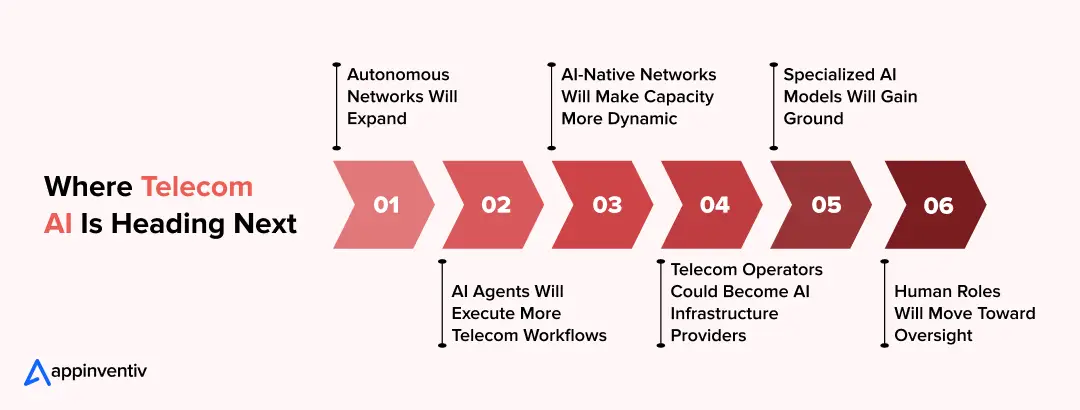
Autonomous Networks Will Expand
Network automation can become more useful as systems coordinate information across radio access, transport, core, and service domains. However, expanding automated decisions also increases the importance of understanding dependencies between them.
For your business, the preparation starts with accurate network inventories and consistent operating procedures. Establish which actions can be reversed, how teams will verify recovery, and when engineers must take control before extending autonomy.
AI Agents Will Execute More Telecom Workflows
Agents can coordinate tasks across customer service, billing, provisioning, and network operations. Their practical scope depends on the actions connected systems support and the authority your business grants them.
Prepare by defining reusable permissions, approval rules, and transaction checks. These foundations can help additional workflows adopt agents without creating a separate control model for every deployment.
AI-Native Networks Will Make Capacity More Dynamic
AI-native approaches aim to bring resource allocation closer to changing demand. For operators, the opportunity is to adjust capacity more responsively while maintaining service commitments.
Assess whether your infrastructure provides sufficiently timely telemetry and supports controlled configuration changes. Future flexibility will depend on both decision-making capability and the network’s ability to carry out those decisions reliably.
Telecom Operators Could Become AI Infrastructure Providers
Connectivity, distributed infrastructure, and enterprise relationships could support services such as edge inference and managed AI environments. This creates a potential commercial role for operators beyond improving their own operations.
Evaluate these opportunities against identifiable customer demand. Deployment location, latency, available capacity, support responsibilities, and service economics will determine which offerings your business can deliver profitably.
Specialized AI Models Will Gain Ground
Focused telecom applications may benefit from smaller or specialized models, depending on their performance and operating requirements. General-purpose AI models will still have a role, making model selection an ongoing architectural decision.
As AI innovation in telecom develops, compare options using your own evaluation cases. Assess task accuracy, response time, infrastructure needs, and maintenance effort. Keep business logic and integrations sufficiently independent to allow model changes without rebuilding the entire application.
Human Roles Will Move Toward Oversight
As routine work becomes more automated, employees may spend more time reviewing exceptions, investigating failures, and supervising system actions. Those responsibilities require practical training and clear authority.
Plan how roles, escalation procedures, and performance measures will change alongside deployment. Engineers and service teams need enough visibility to understand an automated decision and intervene when the operating situation demands it.
How Appinventiv Helps Telecom Businesses Turn AI Into Production Systems
Appinventiv helps telecom businesses turn operational problems into AI applications with defined scope, system integrations, and measurable outcomes. As an AI development company, we can help you implement AI around your workflows and deployment requirements.
Identify High-Value AI Opportunities
We assess your processes, data, and system dependencies to select a practical first use case and agree on success measures.
Build the Right AI Solution for the Use Case
Our teams develop predictive models, generative AI applications, and agents according to the task, required accuracy, and permitted actions.
Integrate AI With Your Telecom Ecosystem
Through our telecom software development services, we connect AI with relevant OSS, BSS, CRM, billing, and network platforms.
Build for Secure, Controlled Deployment
Access controls, approvals, audit logs, and exception handling form part of the design. Testing establishes where automation can operate and when employees should intervene.
Scale From Focused Use Cases to Wider AI Adoption
We build reusable integrations and evaluation methods so proven applications can expand across teams, workflows, and markets.
Bring us the workflow you want to improve. We’ll help define the solution, delivery requirements, and measures that will determine its value.
For a leading telecom company, we built a centralized data analytics platform that brought together fragmented records covering more than 90 million customers. Our team used AI/ML tools to optimize over 50 million transactional data points and organized information around customer behavior and preferences. Interactive dashboards made those insights accessible across departments.
The project delivered an 85% increase in data quality and accessibility and a 26% reduction in licensing, hardware, and maintenance costs, demonstrating how AI, data engineering, and system integration can work together to address telecom business needs.
Get in touch with us to assess your telecom AI use case and map the scope, integrations, and investment needed to put it into operation.
FAQs
Q. How can AI improve network efficiency in telecom?
A. AI for telecom can help businesses forecast demand, investigate faults, support customers, detect fraud, and resolve billing discrepancies. Predictive models identify patterns, while generative AI in telecom supports knowledge retrieval, customer conversations, incident summaries, and document analysis.
Practical applications of artificial intelligence in telecommunications include:
- Forecasting traffic to support capacity allocation.
- Identifying network anomalies and prioritizing fault investigation.
- Adjusting selected network resources to demand.
- Helping advisers explain bills and troubleshoot service issues.
- Coordinating approved tasks across support, billing, and provisioning systems.
Assess results through business and service measures together, such as cost per resolved enquiry, restoration time, energy consumption, and repeat contacts. The level of automation should reflect the consequences of an incorrect action.
Q. What data should a telecom business prepare before investing in AI?
A. The data required depends on the workflow. A billing assistant may need account details, invoices, tariff information, and approved policies. A fault-detection solution may require network telemetry, asset relationships, incident records, and maintenance history.
Before development, confirm that:
- Records contain consistent customer, service, and asset identifiers.
- Relevant information is sufficiently complete and current.
- Access permissions support the intended use.
- Existing interfaces provide the required information at usable speeds.
- Named owners can correct records and maintain source information.
Prepare the data needed for the first deployment, then expand that scope as additional use cases are approved.
Q. How should telecom businesses decide whether to expand an AI pilot?
A. Expand when the pilot demonstrates a useful operating improvement under representative conditions and the wider deployment has a viable cost model. Model accuracy alone is insufficient.
Compare pilot results with the existing process, including:
- Improvement in the target outcome, such as fewer repeat visits or faster activation.
- Service quality and the frequency of errors requiring correction.
- Employee adoption and time spent reviewing outputs.
- Ongoing infrastructure, model usage, and support costs.
- Additional integrations and staffing needed for wider deployment.
If the results depend on frequent manual intervention or unusually clean data, address those limitations before extending the solution.
Q. What are common generative AI use cases in telecom?
A. Common generative AI use cases in telecom include customer-service assistants, employee copilots, troubleshooting support, incident summaries, knowledge retrieval, proposal drafting, and document analysis.
The best starting points tend to have clear source information and well-defined boundaries. A knowledge assistant working with approved technical documents, for example, is easier to control than an autonomous application that can change customer or network settings.
Q. What are the challenges of AI in telecom?
A. The major challenges of AI in telecom include fragmented data, legacy integration, model errors, cybersecurity risks, changing network conditions, regulatory requirements, and employee adoption.
For production deployments, operators also need to address:
- Data ownership and quality
- AI and API monitoring
- Human escalation
- Action permissions
- Model drift
- Recovery from failed actions
- Responsibility for ongoing corrections
These requirements become more important as AI moves from producing recommendations to executing tasks.
Q. Can AI integrate with existing telecom OSS and BSS platforms?
A. Yes. AI applications can work with existing OSS, BSS, CRM, billing, service inventory, and other telecom platforms where suitable interfaces and permissions are available.
The implementation may require APIs, adapters, event streams, data mapping, or additional integration layers. Operators should validate the actual fields, volumes, latency, and actions available through existing interfaces before committing to the final architecture.
Q. Should telecom companies buy an AI platform or build a custom solution?
A. Existing platforms can suit standardized workflows where requirements align closely with available functionality. Custom development becomes more relevant when an operator needs proprietary network data, complex OSS/BSS integration, telecom-specific business logic, differentiated customer experiences, or tighter control over AI actions.
A hybrid model is also common. Telecom businesses can use established models, cloud infrastructure, or AI platforms underneath a custom application and integration layer, allowing them to reuse mature technology without forcing their operating model into a generic product.


Fast 2-minute response, fully NDA-protected.

AI Data Integration: How to Connect, Clean and Prepare Data for AI
Key takeaways: AI initiatives fail when fragmented, poor-quality data reaches models without sufficient context, controls or ownership. AI-ready pipelines must connect, clean, enrich, govern and continuously monitor data across its lifecycle. Real-time processing matters when AI decisions depend on current transactions, events, inventory or operational conditions. Data architecture should follow the AI use case, balancing…

AI Agent Governance: How to Govern Autonomous AI Across Business Systems
Key takeaways: AI agents require controls at the action, identity, data, tool, and workflow levels. Every enterprise agent should have a registered owner, an approved purpose, and a defined risk tier. Access must be based on the agent’s task rather than inherited from a human user or shared service account. High-impact actions need real-time policy…

'I.D.E.A.S.' - The Five Pillar Framework to Ace AI-Native Enterprise Apps in 2027
Key takeaways: AI-native enterprise apps are moving beyond AI agents toward intelligent, adaptive, autonomous and context-aware digital capabilities that can operate across mobile, web, voice, wearables and emerging interfaces. The I.D.E.A.S. framework for AI enterprise apps in 2027 - Interactive Intent, Decisioning Autonomously, Experiential System Design, Adaptive Execution, and Security Layered. Context intelligence and reusable…