





















Top IoT Trends That Every Entrepreneur Must Know in 2026

 Share -



Key takeaways:
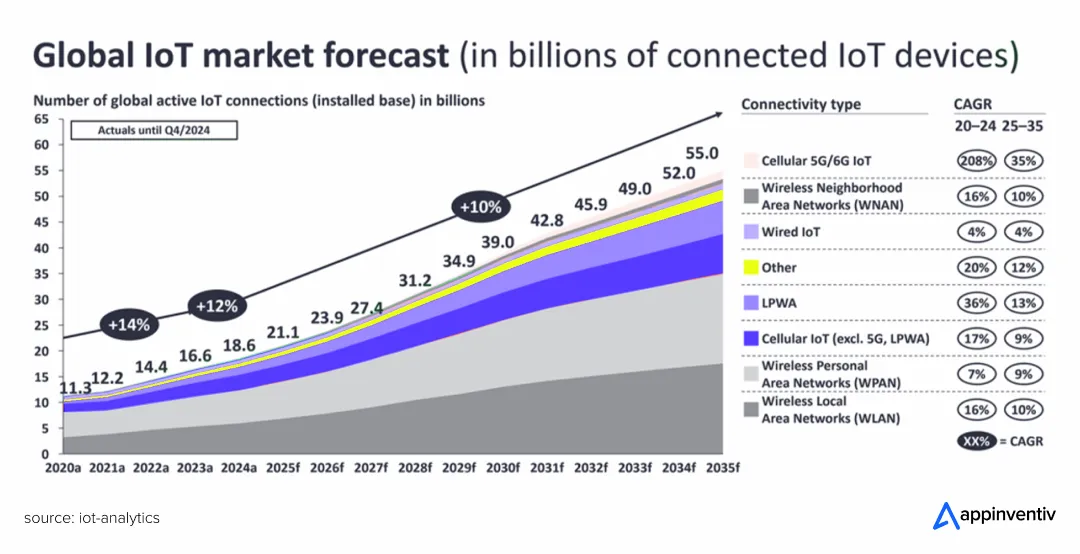
- IoT Growth: IoT devices are projected to reach 39 billion by 2030, driving massive opportunities across industries.c
- Smart Cities: IoT is key to developing smarter, more efficient cities, improving everything from traffic to energy management.
- Cross-Industry Impact: IoT is revolutionizing sectors like retail, healthcare, and manufacturing, boosting efficiency and personalization.
- AI & IoT: AI is enhancing IoT devices, making them smarter, more adaptable, and better able to improve business operations.
- Sustainability: IoT is helping businesses reduce waste, optimize energy, and meet sustainability goals.
IoT – the concept that started taking root decades ago has today not just gone mainstream but also made a presence across industries and the globe.
With its market size poised to reach $3 trillion by the end of this decade, entrepreneurs and businesses from all corners of the world are finding opportunities to enter the segment.
In this article, we will examine the trends and advantages of the Internet of Things, including cybersecurity and cloud and edge computing, which will serve as a torchbearer for businesses looking to expand into this area.
And since we are well past the stage where we address what IoT is and how IoT works, and what the advantages of IoT are, let us jump straight to IoT app development trends in the world.
But before that, here’s a quick synopsis of the top IoT trends to set the tone of the article.
Explore how your business can tap into the $3 trillion IoT market and stay ahead with the latest IoT trends and technologies.
IoT Market Trends: Snapshot
The Internet of Things has moved well past the hype cycle. We’re actually watching it change how different industries operate and where companies find room to grow. It’s affecting the nuts and bolts of daily operations—how teams interact with customers, how workflows get streamlined, how efficiency gets measured. Plenty of organizations are putting real money behind this technology, which tells you something about where things are headed.
Market Size & Growth Projections
As per Mordor Intelligence, the IoT market is projected to reach $2.7 trillion by decade’s end. Those numbers aren’t just about selling more sensors and devices; they reflect how IoT is transforming business and gone from “interesting experiment” to “can’t really run our business without it” for many companies.
We could be dealing with 38 billion IoT connections by 2030. That’s the kind of scale that touches almost everything- from how people manage their homes to how entire supply chains function, as per the recent study.
Enterprise Impact
- Cost Savings & Efficiency: Companies implementing IoT are seeing measurable returns. Take routine tasks off people’s plates, iron out workflow inefficiencies, and spot failing equipment before it breaks down; all of this translates to reduced costs and higher productivity. CFOs aren’t dealing in abstracts here. They can pull up budget reports and show exactly where savings materialized.
- Scalability & Flexibility: Expanding your business shouldn’t require tearing everything down and rebuilding from scratch. With IoT, you can layer on new capabilities and scale up without overhauling core systems every time you grow. Real-time visibility into what’s actually happening means managers can act on information now, not three days later when the weekly report lands. That responsiveness counts, especially when rivals are just as hungry to capture market share.
- Business Transformation: The real breakthroughs happen when you get separate systems working together. Manufacturing plants are adjusting production based on real-time data streams rather than guesswork. Retailers are personalizing the shopping experience in ways customers actually appreciate rather than find intrusive. Service providers are resolving problems their clients don’t even know they have yet. IoT opens the door to reconsidering the basics of how you operate and deliver value, possibilities that weren’t on the table ten years ago.
21 Recent IoT Trends to Watch in 2026
The IoT landscape is evolving rapidly, with exciting developments on the horizon. These recent IoT market trends promise to revolutionize industries, drive innovation, and open up new opportunities for businesses to scale and succeed in the coming years.
1. Rise in the Number of Types of IoT devices
It’s not just that more things are getting connected; the kinds of things going online are expanding, too. From smart home gadgets to industrial sensors, the range of connected devices is growing and becoming smarter.
- Looking ahead, some estimates suggest that over 40 billion devices could be online by the early 2030s.
- As IoT connectivity trends grow, so does the variety of devices: voice assistants, GPS trackers, smart bands, smart locks, smoke alarms, smart doorbells, home Wi‑Fi systems, wearables, IoT‑based security systems, and the list goes on.
It is not just the number of connected devices that is on the rise, but also the types of devices. Here are the different IoT device types that are expected to go mainstream this year:
- Voice Assistants
- GPS Trackers
- Smart Bands or Fitness Bands.
- Smart Locks
- Smart Smoke Alarms
- Amazon Dash button
- Smoke Detectors
- Child Monitor
- Doorbell Cameras
- Home Mesh Wi-Fi Systems
- Fitness Devices
- Wearables
- IoT-based Security Systems
- Security Cameras
2. Consumer IoT (CIoT) and Industrial IoT (IIoT)
Examples of IoT ecosystems like CIoT and IIoT are gaining traction. CIoT is an IoT ecosystem that assists organizations with improving user experience by utilizing “insight” on users’ Internet-connected gadgets.
The customer IoT market has been active for the past five years and is showing signs of slowing. The Industrial Internet of Things, on the other hand, will gain more attention as more companies adopt modern industrial systems that align with IoT industry trends. Utilizing industrial IoT can reduce the likelihood of unexpected disruptions in data transmission, information processing, or centralized administration.
3. Smart Homes Will Become the Norm
Even people who dismissed smart homes as devices for pretentious youngsters are now finding it difficult to ignore the capabilities the technology offers. IoT future trends point to a sharp rise in demand for connected home devices. As this demand grows, it will fuel the production of new trends in IoT devices.
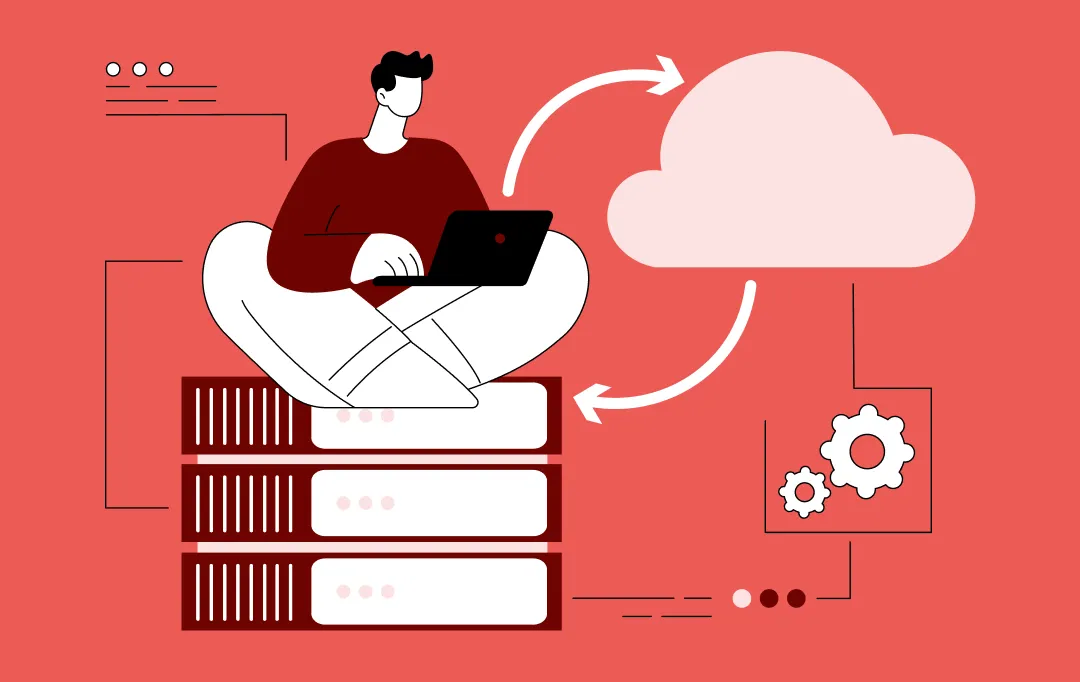
4. Cloud & Edge Computing
For a long time, IoT devices have relied on the cloud to store their data. But the IoT application development industry is now beginning to wonder about the implications of storing, calculating, and analyzing data to the limit.
They are demanding that, instead of sending data from IoT devices to the cloud, the data be first transferred to local devices closer to the edge of the network. This local storage helps in sorting, filtering, and calculating data, and in sending part or all of the data to the cloud, thus reducing network traffic.
Edge computing offers a series of benefits to an iot application development company and developers, which makes it one of the key emerging trends in IoT technology –
- Better management of a large amount of data that every device sends
- Lowered dependency on cloud, helping apps perform faster with reduced latency
- IoT-based mobile apps consume less bandwidth.
5. A Greater Focus on IoT Security
With adoption on the rise, more and more devices are being connected to the Internet of Things. As the network expands, the volume of data grows, and more information is at risk. In fact, the security vulnerability has also become a prominent answer to what the challenges are in the IoT domain. IoT security trends are expected to intensify, particularly as data volumes increase.
This greater use of IoT tools and technologies must be accompanied by a greater boost to IoT security awareness and training. The year to come will see machine-to-machine authentication overlapping, biometric logins becoming a norm, and technology combinations like IoT and big data, machine learning, and artificial intelligence being used to eliminate data infractions. Blockchain will address issues like scalability and high costs, while boosting data security in current IoT and smart device trends.
6. Greater Personalization
There would hardly be any industry left that has incorporated IoT in its offerings and is not taking advantage of personalization. With the help of beacons and sensors, the retail domain will be able to deliver next-level service offerings through the use of IoT technology. Likewise, sectors like Healthcare and Edutech will also be able to deliver customized value offerings to their end customers.
This time can also be seen as a golden period for marketers looking to make a unique impact on their customers.
7. Incorporation of Artificial Intelligence, Big Data, and Machine Learning
There was a time when the goal of IoT was to collect data from multiple sources. But today, the intent has become to not just collect data but also extract useful information from it.
Incorporation of next-gen technologies like Big Data, Artificial Intelligence, and Machine Learning will define the trends and impacts of IoT in the coming time.
Using the data analytics tools in the connected devices, businesses will be able to make decisions around both predictive and preventive measures. And soon it will become a part of the latest Internet of Things trends, both in the present time and the future.
8. Blockchain for IoT Security and BaaS will Become Mainstream
Although an extension of the security section, the integration of IoT and Blockchain deserves special attention from Blockchain development companies.
There are some pestering issues that IoT faces, which have been adversely affecting the overall IoT growth trends and its mass adoption – Scalability, High Cost, Security, etc., being a few of them. A majority of these issues can be traced back to the centralized network.
Being centralized, there is minimal to no guarantee of security, especially since the data is held by a single party.
Blockchain, being decentralized, eliminates the issues of lack of security and control being with one party. The plethora of benefits that the combination of IoT and Blockchain offers makes it one of the most important trends in IoT technology.
9. Smart Cities Will Start Flourishing
Smart cities, once a futuristic idea, are rapidly taking shape. By 2032, the smart city technologies market is set to reach US $1.95 trillion.
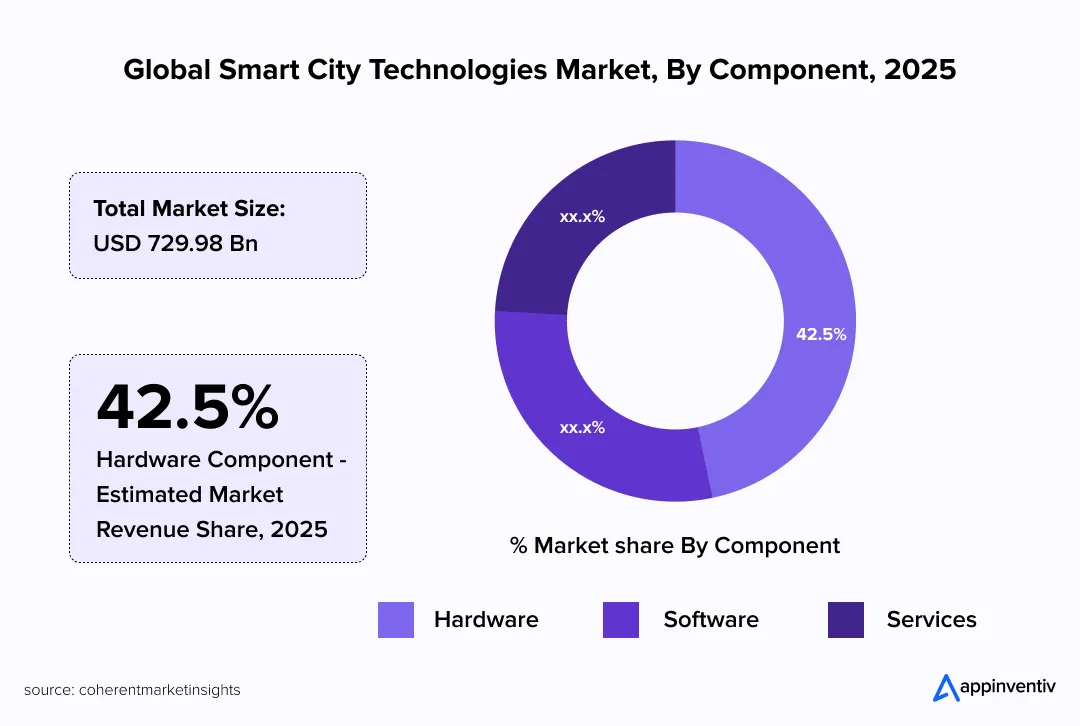
IoT is at the core of this transformation, enabling real-time data collection and automation across urban services. From optimizing traffic flow to enhancing energy efficiency, IoT is revolutionizing how cities operate, improving the quality of life and driving sustainability. As governments and businesses invest in smart infrastructure, these technologies will create more connected, efficient, and eco-friendly cities.
Also Read: Applications of Mobile Apps for the Internet of Things (IoT)
10. IoT for Sustainable Business Practices
IoT has become a powerful lever for companies seeking to meet their environmental targets. The technology gives them a clearer picture of what’s actually happening in their operations and concrete options for reducing waste and resource use.
- Waste Management: When you put sensors on dumpsters and throughout waste collection systems, you start seeing patterns you missed before. Companies can identify which locations generate the most waste, adjust pickup schedules so trucks aren’t running half-empty routes, and determine where materials are being tossed that could be reused or recycled. Less garbage going out means lower disposal fees, and often it highlights inefficiencies elsewhere in the operation.
- Smart Agriculture: Farmers have started installing sensors throughout their fields to measure factors such as soil moisture, nutrient deficiencies, and crop development. Rather than running irrigation systems across entire acreages on a fixed timer, they’re targeting specific areas that actually need water. The same principle applies to fertilizers and pest control. You use less of everything, your water bills drop, and, in many cases, the harvest actually improves because plants get exactly what they need instead of a one-size-fits-all treatment.
- Carbon Footprint Reduction: Energy monitors installed throughout a facility show you, in plain terms, where electricity is being wasted unnecessarily. Could be office lights left on overnight, cooling systems working overtime in storage areas, or machinery that keeps running during breaks. Once these waste points become visible, they’re usually pretty easy to address. Fix enough of them, and the company’s total energy draw and carbon output go down noticeably.
11. SaaS will Emerge as the Norm
It is impossible to discuss the technology without mentioning the benefits of cloud computing for IoT. By making data accessible in real time, SaaS will be explored by a number of businesses as part of the Internet of Things trends in 2026.
The time to come will see more cloud vendors entering the picture to become an active part of the dependency that mass IoT adoption will bring.
12. Unified IoT Framework & Industry Standards
Getting IoT devices from different vendors to work together is still a pain point. Each manufacturer tends to use their own protocols and systems, which means equipment that should connect often doesn’t, at least not without extra work.
Blockchain is being tested as one solution. It lets devices verify interactions on a shared ledger without a central controller, which could help address security and trust issues. But it’s still early, and we’re figuring out whether it scales.
Industry groups are also pushing common standards so devices can communicate regardless of who made them. When companies actually use these standards, expanding systems becomes much simpler.
The reality is we’ll probably need both, standard protocols for everyday communication, and something like blockchain, where extra security matters. Right now, these compatibility issues are one of the main things keeping businesses from bigger IoT rollouts.
13. Increased Consumer Adoption
IoT isn’t just an industrial thing anymore; it’s everywhere. Analysts expect about 21 billion connected devices worldwide by the end of this year, and that figure could reach 39 billion within five years, according to IoT Analytics. A few things are pushing this along:
People are simply buying this stuff. Smart thermostats, video doorbells, fitness bands, you can pick these up at Target now. What seemed like gadgets for early adopters a few years back are now sitting on regular store shelves and in millions of homes.
The gap between consumer and business IoT is shrinking. If someone controls their home temperature from their phone, they’re going to wonder why they can’t do the same with their office building’s climate system. Consumer expectations are bleeding into enterprise requirements.
Here’s what matters for businesses: customers now assume things will be connected. Whether you’re making kitchen appliances, managing commercial real estate, or running a service company, people expect apps, remote control, and data visibility. IoT features aren’t a premium add-on anymore; they’re what people consider normal. If your product or service doesn’t have that connectivity, you’re already behind the curve.
14. Location Tracking and Wireless Sensing will Become a lot More Relevant
One of the major IoT Mobile App Development Trends will be seen in efficient tracking of location and wireless sensing.
With 5G prepared to come to the forefront, apps will get new capabilities on these fronts. According to Gartner, wireless sensing will be used for the creation of drones and virtual assistants, in addition to being helpful in object recognition and medical diagnostics.
15. Greater Efficiency and Personalization in Customer Service
There are several use cases of how IoT is shaping the future of better customer service. Given the major focus on the back end of IoT and Big Data convergence, customer experience is poised to become much more personalized in the coming time. The combination of both is what would help in achieving a true omni-channel customer experience, which is a need of every modern-day business, irrespective of what industry they belong to.
16. Voice will Become the New Mode of Communication
Voice search, already highly hyped, will see new demand flourish this year. This time, it will be about IoT devices – summoning them and connecting them with other devices.
This operation has been carried out by algorithms, but starting this year, you will see it becoming voice-centric.
17. Predictive Maintenance will Witness a Rise
The next-gen manufacturing tools will use built-in sensors and advanced programming to perform predictive analytics and forecast potential issues much before they actually happen.
This will not just lower downtime, but data-based predictive analytics will also eliminate guesswork from preventive maintenance strategies. It will enable engineers to schedule and then initiate maintenance when the machines are dormant.
18. Automotive Revolutionizing the Interaction Between Cars and People
The adoption of IoT in the automotive sector has driven significant advances in fleet management, connected cars, maintenance systems, and in-vehicle infotainment and telematics.
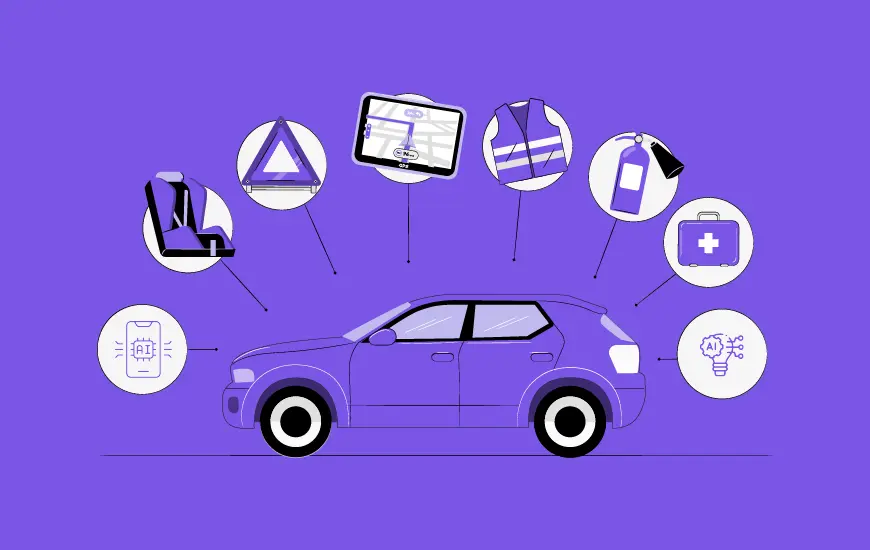
An idea of autonomous cars is basically based on the establishment of the IoT; autonomous vehicles are about connectivity. This implies that the vehicle is remotely controlled via IoT, and that automated vehicles are a forthcoming reality.
An IoT car support system assists an individual in taking essential steps to prevent the vehicle from an abrupt breakdown. Like dashboard indicators on a vehicle, this framework alerts the driver to potential breakdowns. In any case, the alarms are sent to the driver’s phone before the issue even happens. This assists the driver with making cost-effective and efficient strides to evade component failure while driving.
19. Better Workforce Management
The use of headlights to record hours is expected to become an ordinary practice. Headlights are normally used to send messages to customers through smartphones. Reducing costs will increase the use of beacons in managing the workforce. Beacons can be utilized to monitor personal and scheduled tasks. All the information from these frameworks can be used promptly to populate performance management solutions.
Beacons can generally be used to screen for employee safety. This applies to circumstances in which appropriate safety equipment should be used. The health sector can utilize signals to screen the activities of doctors, medical professionals and nurses. This incorporates access to medical records and the use of medical equipment. IoT is quite possibly the most important subversive method available.
20. IoT and Sustainability
IoT is giving companies actual tools to shrink their environmental footprint. Instead of guessing where resources are being wasted, businesses can now see it in real time and take action.
- Smart Grids: Power companies are threading sensors throughout their distribution networks to match electricity generation with real demand. Rather than keeping plants running at full bore all the time, just in case, operators can now dial things up or down based on actual usage. This matters especially for solar and wind energy, which don’t produce steady output; the grid can adapt to those fluctuations instead of defaulting back to fossil fuels every time the wind dies down.
- Energy Efficiency: When you install sensors on equipment throughout a factory or office building, you start to see waste you never knew existed. Maybe there’s a compressor running at full speed all weekend when nobody’s there. Or the heating system in one wing is cranking while the cooling system fights it in the adjacent space. Once these problems become visible, they’re usually not that hard to fix, and the savings show up immediately on the next utility bill.
- Carbon Reduction: Calculating carbon emissions used to involve a lot of educated guesswork and quarterly estimates. Now companies can track fuel burn, electricity draw, and other emission sources as they happen. That continuous measurement makes it clear which operations are the biggest contributors and where reduction efforts will actually move the needle, rather than just look good in a press release.
- Green Building: Office buildings with connected systems can turn lights off in empty conference rooms, heat or cool specific floors based on who’s actually working there, and catch plumbing leaks while they’re still small. None of this is revolutionary on its own, but when you add it all up across a year in a large building, you’re talking about real reductions in energy use and water waste.
What makes this different from past sustainability efforts is that everything’s measurable now. You’re not hoping your initiatives work; you can pull up a dashboard to see whether they are.
21. DeFi and IoT Integration
Pairing decentralized finance with IoT is enabling new, practical business models, particularly in underutilized assets and insurance.
Construction companies and farms are testing systems that automatically rent out idle equipment through smart contracts. The machine reports its status, the blockchain handles payment and access, and owners earn from gear that would otherwise sit unused.
On the insurance side, premiums are starting to reflect actual usage rather than broad estimates. Fleet operators can get rates tied to real driving data, hard braking, routes taken, and maintenance history, all captured by onboard sensors. When a claim comes in, much of the supporting evidence is already timestamped and verified, which speeds up payouts.
Finance departments like this because it reduces paperwork, settles transactions faster, and creates records that are hard to dispute. For businesses sitting on expensive physical assets, squeezing more revenue out of downtime or trimming insurance costs can make a real difference.
The catch is that regulations haven’t kept pace. Liability questions, data ownership disputes, and cross-border enforcement remain unresolved. Companies testing these models need to weigh the operational gains against the legal gray areas.
These IoT technology trends for 2026 that you just read are only the tip of the iceberg. The adoption of the technology would go beyond changing the lives of millions through connection.
On the note of changing lives, let us look at the prospective industries IoT will touch in the coming year and how they will become new trends in IoT.
Now that you’ve explored the latest trends, it’s time to bring them to life for your business.

Industries That Will Be Affected by IoT in 2026
Although there are a plethora of industries that will witness IoT redefining their processes, there are a few that will play on the front foot when the emerging trends in IoT are being defined.
A. Consumer Electronics
The functionality of the IoT ecosystem depends entirely on the devices it interacts with. While there are already a number of IoT-driven consumer devices on the market, more will come in the near future.
Here are some of the device types that will go mainstream in the coming time –
- Next-gen locks to secure vehicles, homes, and other personal belongings
- Smart appliances that regulate power consumption
- AI-driven thermostats that adjust room temperature according to the weather outside.
B. Healthcare
The IoT trends in healthcare will touch every single aspect of the sector. IoT implementation in healthcare will affect not just the software but also the hardware systems of the industry.
Several new personal healthcare devices, like wearables,s will enter the market, enabling consumers to monitor their own health. Another Internet of Things trend in the healthcare sector will be seen in several hardware devices coming into existence, allowing medical officials to track staff and patients while monitoring the medical equipment.
C. Manufacturing
The industry is one of the major sectors to become a part of the industrial IoT trends 2026. Manufacturers from across the globe have already started investing in embedded devices for monitoring assets and equipment.
Commonly called smart manufacturing, the use of IoT in manufacturing improved the productivity and efficiency of operations.
Also Read: Automotive IoT: Benefits, Applications, and Real Examples
D. Automotive
When you think about where the next wave of IoT momentum is going to come from, look no further than the automotive and industrial sectors. These aren’t just niche categories; they’re the engines powering much of IoT’s expansion over the coming years.
For business leaders, what this means is clear: If you’re in automotive or heavy asset industries, you’re uniquely positioned to benefit from the surge in connected devices, smart sensors, and data‑driven operations. Think smart vehicles sending real‑time diagnostics, factories running predictive maintenance, and logistics systems monitoring vehicle health without human intervention.
E. Financial service
With users opening up to the idea of conducting their financial services on different devices, the IoT trends in the financial domain will become too prevalent to ignore by financial software development companies.
The time to come will see the introduction of smart cash points having connected vending machines that would allow consumers to take loans, accept deposits, transfer money, and undertake a plethora of other financial transactions straight from a device.
Apart from new financial models, the IoT trends in the insurance industry will come to the forefront, with the industry expanding its offerings to accommodate the risks and needs of connected devices and ecosystems.
F. Retail
The IoT trends in retail will see the industry combine physical and e-commerce. Instead of visiting the stores, consumers will soon be able to try on outfits at home through the power of Virtual Reality. The grocery industry will also witness an overhaul with IoT changing food consumption, farming, and the overall supply chain.
The time is coming when Omni-Channel retail will be powered by IoT app trends.
G. Energy
The incorporation of IoT in the energy sector will lead to the industry becoming a lot more efficient and streamlined in terms of energy management. The impact of IoT in the energy sector will be majorly seen in the following areas through the mode of smart cities and smart homes –
- Cost Saving
- Better energy consumption and management
- New data source offering transparency in the system.
H. Education and training
The last but very impactful trend in IoT applications will be seen in the training and education domain. In the time to come, IoT will become a very important skill that a modern-day engineer or marketer should understand. Noting the heightened rise, we are going to see more course lineups aiming at IoT-specific studies.
We will also see businesses invest in boot-camp courses within offices to give their employees an exposure to the technology in action.
Challenges Of IoT
At present, there are four fundamental drivers of the IoT market: the ever-growing Internet connectivity, smartphone devices, and sensor devices with lower costs, and great investments are filling the IoT. Also, there are four challenges for the growth of the IoT market: worries about cybersecurity, privacy, and application process issues. Innovation is yet scattered.
The Internet of Things is facing problems in many areas such as IT, Healthcare, Data Analytics and so on. Let’s discuss some of the challenges.
Scalability
Billions of internet-enabled devices are associated in an enormous network where large volumes of information need to be processed. The system that stores and examines the information from IoT gadgets should be scalable. In the present period of IoT evolution, everyday objects are associated with one another through the Internet. The raw information acquired from these gadgets needs enormous data analysis and cloud storage for understanding helpful information.
Interoperability
Technological principles across many regions remain divided. These technologies should be joined to help us build a typical structure and the standard for IoT gadgets, as the standardization cycle is still lacking interoperability of IoT. This absence of interoperability is preventing us from moving towards the vision of an associated, everyday interoperable smart item.
Connectivity issues
In its present form, the IoT uses a centralized, server-client model to give availability to the different servers, workstations and systems. This is very productive, since the IoT is still in its earliest stages. What happens when billions of devices are all using the network simultaneously?
Connect with our IoT app development experts to explore customized solutions that drive seamless integration and secure growth for your business.
How Appinventiv Can Help You Leverage IoT for Business Success
While the above-mentioned emerging IoT technology trends will be a good starting point, you will still need someone to help you get started with a full-fledged business in the IoT sector. That’s where Appinventiv’s IoT app development services come in.
We step in when you’ve got an IoT idea but need help with execution. Our developers build systems around what your business actually needs; we’re not handing you off-the-shelf software and telling you to make it work.
We’ve done projects in retail, healthcare, manufacturing, and several other areas. The process usually starts with us learning what’s not working in your current setup, looking at the systems you already have, and then building something that fits into that environment without forcing you to rip everything out.
Maybe you need sensors feeding data into your existing dashboard. Maybe it’s a fully networked system of connected devices across multiple locations. Whatever the scope, we’re focused on results you can point to, lower costs, faster processes, and better information for your team.
If you’re thinking about an IoT project and want to talk through whether it makes sense, get in touch. We’ll lay out what’s feasible given your budget, timeline, and technical environment.
FAQs
Q. How big is the IoT market?
A. The global Internet of Things (IoT) market has grown far beyond its early estimates. By 2026, the market is projected to cross USD 1 trillion, driven by large-scale adoption across manufacturing, healthcare, logistics, energy, and smart infrastructure. Growth is being fueled by advances in cloud computing, edge analytics, AI integration, and enterprise digital transformation initiatives. Long-term forecasts indicate the IoT market is on track to approach USD 1.6–2 trillion by the end of the decade, as connected systems become core business infrastructure rather than experimental technology.
Q. What is the IoT system?
A. IoT is an ecosystem of several interrelated digital and mechanical machines, computing devices, animals or people, or objects, that are given unique identifiers (UIDs) and the capability to transfer data over the network without the need for any form of human-to-computer or human-to-human interaction.
Q. What are the characteristics of the Internet of Things?
A. There are primarily six elements that come together to define the characteristics of the Internet of Things:
- Connectivity
- Intelligence
- Sensing
- Heterogeneity
- Data
- Dynamic Nature
- Communication
- Energy
- Ecosystem
- Security
Q. What is IoT?
A. The Internet of Things (IoT) refers to the network of connected devices that communicate and share data over the internet. These devices range from everyday items like smart thermostats and fitness trackers to industrial tools and machinery. As IoT market trends evolve, more devices are being integrated, enabling seamless connectivity and automation across various industries.
Q. What are the most promising IoT trends for businesses in 2026?
A. As we look towards 2026 IoT trends, several innovations are expected to revolutionize industries. Key trends include the rise of IoT-based security systems, smart cities, and edge computing to reduce latency. Additionally, IoT industry trends such as the integration of AI with IoT devices for enhanced data analysis and decision-making will create new business opportunities. These trends will empower businesses to improve efficiency, security, and customer experiences.
Q. How will AI and IoT integration shape the future of smart devices?
A. The integration of AI and IoT will drastically enhance the capabilities of smart devices. Through the use of machine learning, IoT devices can now learn from data, make autonomous decisions, and offer predictive insights. For instance, smart homes will use IoT devices that automatically adjust lighting, heating, and security settings based on user behavior. IoT market trends indicate that this convergence will lead to more AI-powered IoT protocols, enabling businesses to offer more personalized, automated solutions.
Q. Which industries will benefit most from upcoming IoT innovations?
A. IoT innovations are poised to impact a wide range of industries, but the retail, manufacturing, and healthcare sectors stand to gain the most. In retail, IoT will enable smart shelves, inventory tracking, and personalized shopping experiences. Manufacturing will benefit from smart sensors for predictive maintenance and streamlined operations. Meanwhile, healthcare will see advancements with wearable devices and IoT-based health monitors that provide real-time data on patient health.
Q. What emerging technologies are driving the next wave of IoT growth?
A. Emerging technologies such as 5G connectivity, edge computing, and AI are fueling the next wave of IoT growth. With faster and more reliable networks, IoT devices will be able to process data more efficiently, enabling near-instant decision-making. AI-powered IoT protocols will enhance data analysis, offering actionable insights for businesses. Furthermore, blockchain technology is expected to improve IoT security trends and enable better IoT monetization market trends by ensuring secure and decentralized operations.
Q. How can enterprises leverage IoT trends to gain a competitive advantage?
A. Enterprises can capitalize on IoT trends by adopting smart systems and real-time data analytics to enhance operational efficiency, reduce costs, and improve customer experiences. By investing in IoT-based security systems, edge computing, and AI-powered IoT devices, businesses can streamline operations and respond faster to market changes. IoT industry trends show that those who innovate early will gain a significant competitive advantage, as they can leverage IoT technology for automation, personalization, and smarter decision-making.


Fast 2-minute response, fully NDA-protected.

IoT In Education for Enterprises: Financial Impact, Risks, and Roadmap
Key takeaways: Integrating IoT in education becomes an infrastructure investment as operational costs, compliance pressures, and visibility gaps intensify. Five-year ROI depends on baseline operational data, disciplined architecture, and structured financial modeling. Predictable TCO requires upfront planning across hardware, connectivity, cloud, maintenance, and governance costs. Secure IoT deployments demand zero-trust architecture, strong device identity, and…

IoT in Wearables: An Enterprise Guide to Architecture, Integration, and Scalable Deployment
Key Takeaways IoT wearables are shifting from pilot projects to enterprise infrastructure across the healthcare, industrial, and logistics sectors. Secure integration, compliance readiness, and data architecture determine wearable success more than device hardware alone. Continuous wearable data enables predictive healthcare, workforce safety optimization, and new enterprise operational intelligence capabilities. AI-driven analytics are transforming wearable data…

IoT in Mining: Modernizing Operations for Enterprise Efficiency and Safety
Key takeaways: The Internet of Things in mining turns scattered operational signals into live, decision-ready visibility across fleets, fixed plants, people, and the environment. The biggest wins usually show up first in uptime, then in safety response, and finally in energy and process stability. “More data” does not automatically mean better performance. Value comes when…