















Data Mining in Healthcare – Benefits, use cases, examples, techniques

- How Data Mining Works in Healthcare (Techniques & Architecture)
- Benefits of Data Mining for Healthcare Organizations
- High Impact Use Cases of Data Mining for Healthcare
- Real World Examples of Data Mining in Healthcare
- Step-by-Step Guide to Implement Data Mining in Healthcare
- Challenges of Data Mining in Healthcare & How to Overcome Them
- Future Trends of Data Mining in Healthcare
- How Appinventiv Can Help You Transform Healthcare with Data Mining
- FAQs

Key Takeaways
- Data mining in healthcare turns scattered hospital data into insights that improve care quality and reduce operational waste.
- Healthcare teams use data mining to predict risks early, personalize treatments, and cut readmissions.
- Hospitals improve efficiency by forecasting staffing needs, reducing billing errors, and preventing fraud with data-driven systems.
- Real-world use cases include early sepsis detection, RPM risk alerts, readmission prediction, and payer fraud detection.
- Scaling data mining starts small. Connect your data, pick one high-impact problem, and build toward AI-powered decision-making.
Walk into any hospital today, and you’ll see data everywhere, on screens, dashboards, and flowing between systems. Things like electronic health records, billing software, wearables, and lab reports are stacking up fast. But having all that data is one thing; understanding it is another.
That’s where data mining in healthcare comes in. It helps cut through all the noise and find the patterns that matter most, things that can improve care, cut waste, and make daily operations run smoother.
The opportunity here is huge. According to Grand View Research, the healthcare analytics market is expected to hit $198.79 billion by 2033. The message is clear: the future will belong to those who can use their data, not just store it.
And some organizations are already leading the way. They’re using data mining for healthcare to spot which patients need more attention, reduce costs without cutting corners on care, and make processes more efficient. Whether you’re just starting with data mining in the healthcare industry or already using it, there’s plenty of insight here that can make a real difference.
If you’re exploring ways to make your data work smarter, our team can help you chart the right path.h
How Data Mining Works in Healthcare (Techniques & Architecture)
Data mining helps healthcare teams turn scattered medical information into clear patterns and actionable insights. It’s how hospitals move from reactive care to smarter, faster decision-making.
Techniques That Make It Work
Several proven methods help healthcare teams extract meaning from complex datasets:
- Grouping and categorization- help clinicians sort patients based on risk or shared clinical traits. It’s a simple idea, but incredibly useful: high-risk patients get attention sooner, and hospitals can allocate staff and resources where they matter most.
- Pattern recognition- uncovers similarities that aren’t obvious on the surface. It might reveal why certain patients respond well to a treatment while others don’t, or highlight hidden factors behind recurring complications. These insights often spark improvements in care plans.
- Forward-looking analysis shifts teams from reacting to anticipating. Instead of waiting for an issue to escalate, hospitals can spot patients who may be at higher risk of readmission or complications and step in early.
- Outlier identification focuses on the unusual cases, the data points that break the trend. These outliers may indicate billing errors, rare clinical conditions, or unexpected treatment responses that warrant closer review.
Building the Right Infrastructure
All this does not occur without the appropriate technical background. The healthcare systems require infrastructure capable of supporting such capabilities:
- SCentralized storage gives healthcare teams one place to keep everything they need: patient records, operational data, and readings from external systems, all side by side. There’s no pressure to force every piece of information into a strict format right away, which makes it much easier to grow, organize, and analyze the data as the hospital’s needs change.
- Advanced analytical tools do the heavy lifting. Such systems can rapidly process large amounts of information, identify patterns of interest, and assist care teams in acting on the results without being bogged down in manual analysis.
- Scalable operations and information sharing across locations and departments, enabled by flexible technology platforms, allow one to avoid reinventing the wheel every time they implement changes.
- The most important feature may be connected systems. Once your different systems can be connected in their EHR, lab systems, imaging databases, and automated billing software, you can get rid of the silos of data that keep you in the realm of what could have worked. It is not the whole picture without this connectivity.
Benefits of Data Mining for Healthcare Organizations
Most healthcare systems are drowning in information. Patient records, test results, insurance claims, prescription histories, it’s everywhere. The problem isn’t access to data anymore. It’s knowing what to do with it all.
Here’s what changes when organizations get this right.
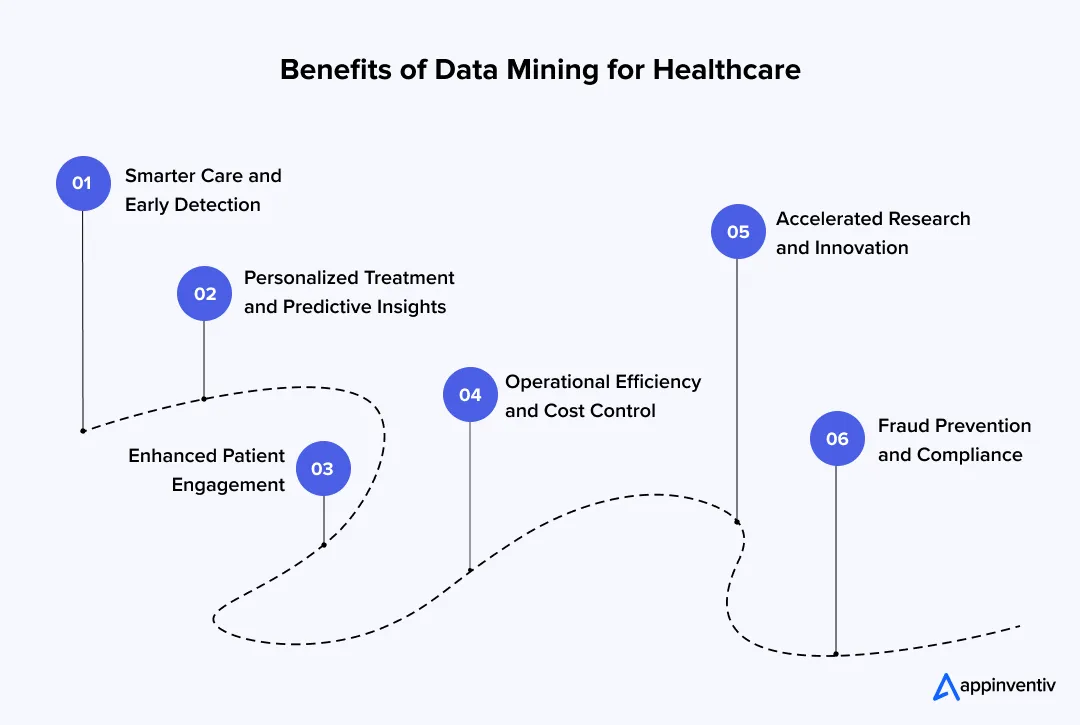
Smarter Care and Early Detection
Doctors and nurses are looking after so many patients, each with their own health struggles. It’s just not possible to catch every little sign or risk factor by manually going through each chart. But when you start looking at patterns across many patients, things begin to stand out that might have been overlooked.
Take a patient’s lab results, their medications, and recent vitals—together, these could point to a heart issue before it’s obvious. Or a combination of factors could show early signs of diabetes, even when standard tests haven’t picked it up yet. This isn’t just a “what if”—it’s happening right now in hospitals. The real breakthrough is acting on what’s already in front of you, before waiting for a crisis to happen.
Personalized Treatment and Predictive Insights
Medicine has always involved some degree of trial and error, but it doesn’t have to stay that way. When you look at outcomes data from patients with similar conditions, ages, and health histories, clear patterns emerge about what actually works.
This isn’t about replacing clinical judgment. It’s about giving providers better information to work with. Which medication typically performs best for this patient profile? When do similar patients tend to need additional interventions? What risk factors show up most consistently in poor outcomes? Answering these questions with data rather than intuition means fewer complications and better results.
Operational Efficiency and Cost Control
The administrative side of healthcare has just as much to gain. Emergency departments that can anticipate volume patterns staff appropriately, rather than scrambling. Supply chains that understand usage trends avoid both shortages and excess inventory. Medical Scheduling systems that account for procedure duration patterns reduce wait times and maximise utilisation.
These improvements add up quickly. Better resource allocation means lower costs, yes, but it also means patients spend less time waiting and staff experience less unnecessary stress. The operational benefits directly support better care delivery.
Fraud Prevention and Compliance
Healthcare billing can be a real tedious task. The system’s so complicated that honest mistakes can happen, and unfortunately, there’s also room for fraud to slip through. Things like claims that don’t quite match expectations, duplicate charges sneaking through, or coding errors that just keep piling up waste time and money.
The good news? A smart, thorough review of billing data can catch those mistakes early, things that auditors might take months to uncover. It’s the same with clinical processes. If a treatment or documentation is off from the usual standards, spotting it early prevents small issues from growing into bigger problems down the road, whether it’s regulatory violations or patient safety risks.
Also Read: AI Agents in Fraud Detection: Revolutionizing Financial
Enhanced Patient Engagement
Patients today want to be part of the conversation—they don’t want to just follow orders. Data mining makes that possible. It’s not about sending random reminders, but ones that truly matter, creating wellness plans that actually fit into everyday life, and helping doctors track how well treatments are working. The outcome? Happier patients and better results.
And it’s more than just automating tasks. Data helps make everything feel personal—from scheduling an appointment to a friendly follow-up call. When patients feel like their doctor actually knows them, they trust more and take better care of themselves.
Accelerated Research and Innovation
Here’s the real game-changer: the same data helping patients today is also paving the way for tomorrow’s medical breakthroughs. Data mining speeds up clinical trials, shows which treatments work best for different people, and helps researchers find new therapies much faster than traditional methods.
By connecting everything from genetics to patient records to real-world outcomes, researchers are discovering answers in what feels like no time at all. The result? Shorter wait times, lower costs, and life-saving treatments are getting to patients faster. That’s the real impact.
High Impact Use Cases of Data Mining for Healthcare
We hear a lot about healthcare data these days, but the real story isn’t in how much of it exists; it’s in what we do with it. That’s where data mining in healthcare quietly changes everything. Hospitals, insurers, and even telehealth providers are finally learning to use their data as a decision-making tool, not just a storage problem. Here’s what that looks like in action.
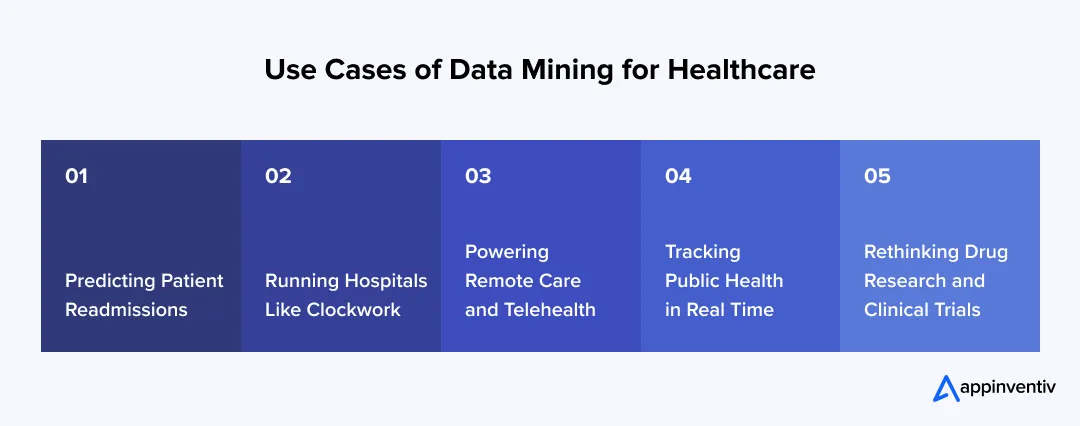
1. Predicting Patient Readmissions
Imagine being able to tell which patients might land back in the hospital before it even happens. That’s not science fiction, it’s one of the most common applications of data mining in healthcare today.
By analyzing patterns in healthcare data mining, things like medical history, lab results, and demographics, hospitals can flag high-risk patients and take preventive steps. It’s a shift from reactive to proactive care, and it saves time, money, and most importantly, lives.
2. Tracking Public Health in Real Time
When a flu outbreak hits, or a new virus spreads, speed matters. Governments and health systems use data mining healthcare models to study infection trends, travel data, and vaccination rates.
These data mining in healthcare examples help predict where cases might surge next so resources, doctors, beds, and medicines get there before the wave does. It’s population health on fast-forward.
3. Running Hospitals Like Clockwork
Hospitals never really stop moving. One department slows down just as another hits full speed. With so much happening, small delays can easily ripple through the system.
That’s where data mining helps. When administrators can see real patterns, like when the ER is likely to get crowded or when patients tend to cancel at the last minute, they can plan ahead instead of reacting in the moment.
It’s a quiet change but a powerful one. Patients get seen faster, rooms open up sooner, and nurses spend more time with people instead of chasing paperwork. The whole place just starts running with a little less chaos.
4. Rethinking Drug Research and Clinical Trials
In drug research, time isn’t just money — it’s lives. The sooner you know whether something works, the faster you can move to the next stage.
Data mining speeds that up by digging through years of research and trial data to spot patterns that human teams might miss. It highlights which combinations show promise and which could pose risks before they become bigger problems.
That means fewer dead ends, faster progress, and safer treatments reaching patients without years of unnecessary delay. It doesn’t make the work easy, but it makes it a lot more focused.
5. Powering Remote Care and Telehealth
Remote care or remote patient monitoring is one of the most exciting use cases of data mining in healthcare. With smart devices and wearables constantly sending patient data, data mining healthcare tools analyze it in real time.
If a patient’s vitals spike or drop, doctors can intervene early, sometimes before the patient even realizes something’s wrong. It’s continuous care without the hospital walls
When the right data flows to the right tools, clinicians get clearer insights, and patients feel the difference. Explore how our medical software expertise supports that shift.
Real World Examples of Data Mining in Healthcare
Data mining is already part of everyday care, from busy ICUs to large health networks. These examples show how hospitals are using it to catch risks sooner, improve care, and help teams work with a little less pressure.
1. Predictive readmission risk model at Kaiser Permanente
Kaiser Permanente’s Transitions Program is a simple idea that makes a real difference. Instead of sending every patient home with the same plan, their system looks for people who might have a tougher time after discharge. It pieces together things like past stays, current symptoms, and small health cues that usually get buried in the chart.
When someone is flagged, the team steps in a bit earlier—maybe a nurse calls sooner, maybe the patient gets a home-monitoring device, or maybe someone helps book the follow-up visit they’re likely to miss. These aren’t dramatic interventions, but they add up.
And the result? Fewer patients landing back in the hospital. Roughly a 10% drop in readmissions, simply because the right people got a little extra attention instead of slipping through the cracks.E
2) Readmission prediction models that actually deploy
Hospitals continue to use data mining for healthcare to curb 30-day readmissions. A 2025 PLOS ONE study combined clinical text with EHR signals (ClinicalT5 + structured data) to lift prediction accuracy for readmissions, useful for targeting transition-of-care resources. In Latin America, a 200-bed community hospital validated a readmission model in real-world conditions, underscoring that data mining applications in healthcare aren’t just for academic medical centers.
3) Fraud detection and payment integrity at payer scale
Insurers are leaning on big data and data mining in healthcare to spot suspicious billing patterns sooner. A 2025 KPMG brief highlights an at-scale claims-management case where AI standardizes massive billing corpora, accelerates reviews, and strengthens fraud detection, tangible benefits of data mining in healthcare on the P&L.
4) Remote patient monitoring (RPM) that predicts trouble, not just logs it
For chronic-care and post-discharge patients, medical data mining on RPM streams (weight, BP, SpO₂, etc.) is shifting teams from reactive calls to proactive outreach. A 2025 open-access study showed how integrating Iot based remote patient monitoring features into ML models improves early-risk detection, practical data mining healthcare that reduces avoidable ED visits.
5) Trauma ICUs: mobile app for early sepsis calls
In major-trauma ICUs, a validated AI platform (with a clinician-facing mobile app) predicted sepsis risk. It explained contributing factors, demonstrating how data-mining techniques in healthcare can be productized for daily rounds, not just for papers.
6) Health-e-People: Bringing scattered health info into one place
With Health-e-People, we worked on a problem almost everyone runs into: health data scattered across apps, devices, and old records. The platform pulls everything together, from medical history to fitness logs and daily habits, so users can track symptoms, vitals, and patterns without digging through multiple sources.
For clinicians, this creates a clearer picture. For patients, it feels more in control. Behind it all, we built secure pipelines that handle sensitive data safely and turn raw information into insights people can actually use.
7) Soniphi: Using voice to understand wellness
Soniphi takes a less traditional route. Instead of relying on wearables or sensors, it studies voice frequencies to map emotional and physiological patterns. Each short recording produces thousands of data points, and our engine processes them to deliver personal wellness insights.
It’s a good example of how data mining in healthcare can stretch beyond standard clinical data, mixing science, behaviour, and accessible technology to offer something genuinely new.
Step-by-Step Guide to Implement Data Mining in Healthcare
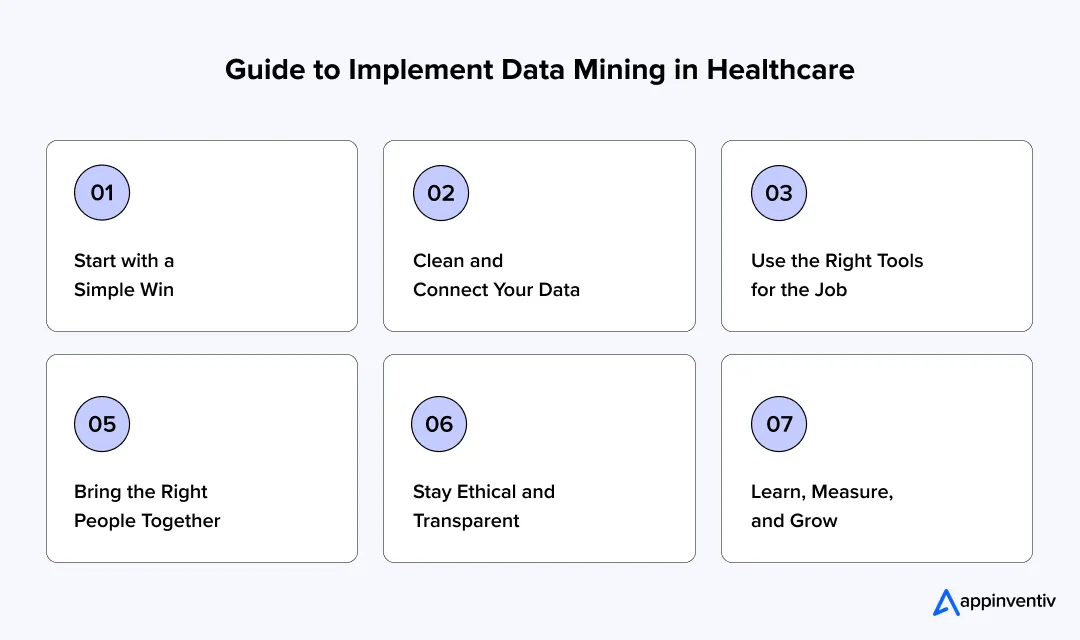
Implementing S data mining in healthcare isn’t about adding more software or building complex dashboards. It’s about taking small, practical steps that show real results, and then expanding from there. Here’s how most forward-thinking healthcare organisations are approaching it.
1. Start with a Simple Win
You don’t have to overhaul everything at once. Pick one issue that matters, like patient readmissions or billing errors, and use data mining for healthcare to fix it. Once people see the difference it makes, support for bigger projects follows naturally.
2. Clean and Connect Your Data
Most healthcare data lives in silos, EHRs, lab systems, insurance portals, and devices that don’t communicate. Before you scale, make sure your systems connect. A solid data foundation enables healthcare data mining to deliver accurate and usable insights.
3. Use the Right Tools for the Job
Healthcare teams need different tools for different jobs. Clinicians might use decision-support features or algorithms to spot changes in patient recovery, while ops teams rely on billing analytics and cost tools to catch errors or inefficiencies. The key is choosing tools that make life easier, not harder—systems that help teams work smarter without getting in the way.
4. Bring the Right People Together
Technology alone can’t scale. Data scientists, IT teams, and clinicians need to work side by side. Analysts find patterns, and doctors interpret them. When everyone’s on the same page, data mining healthcare becomes part of daily decision-making, not a side project.
5. Stay Ethical and Transparent
Every healthcare organisation handles sensitive information. Complying with HIPAA, GDPR, and other standards isn’t just a requirement—it’s a way to earn and keep trust. Responsible use of big data and data mining in healthcare protects patients and strengthens your organization’s reputation.
6. Learn, Measure, and Grow
Data mining becomes powerful only when you treat it like a living process. Once you start watching what changes—maybe patients move through the system faster, doctors get clearer insights, or your teams spend less time wrestling with paperwork—you begin to see the real impact. These small improvements are your feedback loop. They tell you what’s working, what isn’t, and how to shape a healthcare data mining model that evolves the same way your hospital does: one step at a time, grounded in real experience.
Challenges of Data Mining in Healthcare & How to Overcome Them
Anyone who has spent time inside a hospital knows why tech projects hit roadblocks. It’s rarely the idea that slows things down. It’s the day itself. Nurses moving nonstop, doctors racing from room to room, admin staff buried in forms, phones ringing without a break, and computer systems that look like they were built in different eras.
Add strict privacy rules on top of all that, and even a simple project can start to feel impossible.
Data mining can help — a lot — but getting value out of it means dealing with the messy parts first. These are the challenges almost every team faces, along with ways to move past them without compromising patient care.
1. Data That Doesn’t Talk to Each Other
Hospitals collect a huge amount of information, but most of it sits in different places. One system stores lab results, another handles appointments, billing software has its own format, and wearables add even more data that rarely connects to anything.
So when teams try to analyze something, they’re looking at five different versions of the story.
How to fix it: Start small by picking one or two systems and cleaning them up. Remove duplicates, match formats, and bring the basics into a single shared location.
Once the information lines up, the bigger patterns start to show themselves — usually much faster than people expect.
2. Privacy and Compliance Pressure
Healthcare doesn’t get “oops” moments. One data issue is enough to break trust, and nobody wants to be responsible for that. With HIPAA, GDPR, and internal audits hanging over every decision, people become cautious. Sometimes too cautious, and projects slow to a crawl.
How to fix it: Build privacy rules into the foundation instead of adding them at the end. Mask unnecessary details, encrypt anything that moves, and set permission levels so people only see what they’re supposed to.
It also helps to be open about how the data is handled. Once teams understand the protections in place, the nervousness drops, and everyone becomes more comfortable working with the data.
Also Read: Healthcare Data Security: Challenges & Best Practices
3. The Skills Gap
Technology alone can’t interpret a patient’s story. Many hospitals struggle to find people who understand both medicine and analytics.
How to fix it: Connect your data experts with your doctors. Analysts see trends; clinicians give them context. That’s where medical data mining becomes practical, when the data makes sense to the people who use it.
4. Getting Everyone Onboard
New tools can feel like extra work for people already stretched thin. Change doesn’t come easy in healthcare.
How to fix it: Don’t start with a massive overhaul. Choose one project that proves the value of data mining healthcare- maybe cutting readmission rates or reducing claim rejections. When the impact is visible, buy-in follows naturally.
5. Making Insights Actionable
Numbers alone don’t save lives; interpretation does. Sometimes insights from data mining in the healthcare industry look impressive on paper, but don’t lead to action.
How to fix it: Always validate analytics with clinicians. Let data inform, not dictate. When insights are tested in real care settings, they lead to smarter, safer decisions.
Future Trends of Data Mining in Healthcare
Imagine walking into a hospital five years from now and noticing something subtle yet game-changing: the dashboards don’t just show yesterday’s numbers. Instead, they whisper what might happen next. That’s the promise of data mining in healthcare. Let’s dive into the future of data mining in healthcare-
- Soon, data mining for healthcare will run quietly in the background of care, triggered by sensors, wearables, and even home-monitoring devices. Instead of waiting for a patient to walk into a clinic, systems will nudge caregivers when a patient actually might need help.
- We’re moving beyond just tracking metrics; clinical data mining will start blending with genomics, lifestyle data, and social health indicators. In practice, this means your system might spot a risk long before symptoms show up, making care far more proactive.
- Because of big data and data mining in healthcare, ecosystems will shift. Instead of data sitting in silos (EHRs, labs, devices), it will move seamlessly, securely, and ethically, so insights show up where they matter most.
- The tools will look familiar but act smarter. Medical data mining isn’t just crunching numbers; it’s mixing AI and domain knowledge so clinicians don’t hunt for patterns, they’re handed what matters.
- And for those leading this change? The future of data mining in healthcare means strategy, not just technology. Leaders who understand the blend of ethics, privacy, and impact will win because bleeding-edge tools mean nothing if trust is broken.
Explore how our team blends AI, data analytics, and healthcare IT consulting to create secure, scalable solutions that make a real impact.
How Appinventiv Can Help You Transform Healthcare with Data Mining
At Appinventiv, we help healthcare teams make sense of their data, turning complex numbers into clear, actionable decisions. Over the years, through our healthcare IT consulting services, we’ve learned that technology alone doesn’t transform healthcare. It’s how that technology fits into real workflows, real people, and real patient journeys that makes the difference.
We build solutions that blend data mining in healthcare with AI, automation, and predictive analytics. Whether it’s connecting existing systems or designing something entirely new, our medical software development service experts create secure, scalable platforms that actually make work easier for clinicians and better for patients.
Take YouCOMM, for example, a smart in-hospital communication app we built for patients who need help fast. They can call for medical assistance through touch, voice commands, or even gestures, and it’s making a huge difference.
So, whether you want to build intelligent data mining applications in healthcare, upgrade your IT ecosystem, or just need a partner who understands how to bring tech and compassion together, we’re here to help you move faster and care smarter. Let’s talk
FAQs
Q. What is data mining in healthcare?
A. Data mining in healthcare is the process of analyzing large volumes of patient and operational data to uncover useful patterns, trends, and insights. It helps healthcare providers make data-driven decisions, improve diagnosis accuracy, reduce costs, and deliver more personalized care.
Q. How is data mining used in healthcare?
A. Hospitals and health systems use data mining for healthcare in several ways, from predicting patient readmissions and detecting insurance fraud to optimizing resource allocation and treatment planning. For instance, clinical data mining can identify early signs of chronic conditions, while medical data mining helps in analyzing lab results and imaging data for faster, more precise decisions.
Q. Why is data mining so important in healthcare?
A. Because it turns raw data into insights that save lives and money. Data mining in the healthcare industry helps hospitals predict patient needs, manage workloads, and detect inefficiencies that manual processes often miss. It’s a cornerstone of digital transformation and a key driver of smarter, evidence-based care.
Q. How can data mining improve healthcare business performance?
A. When done right, healthcare data mining directly improves operational and financial outcomes. It streamlines workflows, reduces diagnostic errors, and enables better forecasting for staffing and inventory. In short, it helps healthcare organizations work faster, cut waste, and boost both patient satisfaction and profitability.
Q. How can you integrate data mining into your healthcare solution?
A. Start by identifying where data can make the biggest impact, patient care, billing, or resource management. With expert healthcare IT consulting services, you can design a roadmap that connects your existing systems and applies data mining techniques in healthcare using AI and predictive analytics. The goal is to make your data work for you, not the other way around.
Q. How should you hire a team with experience in data-mining algorithms?
A. Look for a technology partner experienced in both medical software development services and real-world healthcare operations. The ideal team should understand compliance standards like HIPAA and have hands-on expertise in building data mining applications in healthcare. Appinventiv, for example, has delivered solutions such as YouCOMM, a patient-communication app that improved hospital response times by 60%, a clear sign of what the right team can achieve.

- In just 2 mins you will get a response
- Your idea is 100% protected by our Non Disclosure Agreement.
How To Develop a Sustainable Healthcare System?
Key Takeaways Rising costs and climate pressure make building a sustainable healthcare system a core business and risk strategy decision. Learn the key principles of sustainable healthcare system development, including prevention, efficiency, equity, and social sustainability. See how AI, data platforms, and a sustainable digital system in healthcare cut waste, improve outcomes, and stabilize workforce…
EHR Implementation for Healthcare Providers: Process, Features, and Total Cost Analysis
Key takeaways: A clear EHR implementation guide keeps teams on track and prevents delays. The full EHR implementation process includes planning, setup, moving data, training staff, and regular updates. The right features handle clinical work, billing, reports, and compliance for large healthcare organizations. EHR implementation costs vary based on design, integrations, data migration, training hours,…
Medical Device Software Integration: A Strategic Buyer’s Guide for Healthcare Enterprises
Key takeaways: Medical device software integration is a governance decision first. Define data ownership, clinical workflows, and regulatory scope before writing a single API. Build on recognized standards from the outset. FHIR, DICOM, and IEEE 11073 reduce ambiguity and simplify long-term scaling. Expect validation and security to drive real cost. Documentation, testing, and firmware controls…