




























A Quick Guide to Mood Tracking App Development for Entrepreneurs

 Share -



- 01What is Driving Investment in Mood Tracking App Development
- 02How to Build a Mood Tracking App: Step-by-Step Guide
- 03Must-Have Features for a Daily Mood Tracking App
- 04Modern Tech Stack for Mood Tracking App Development
- 05Future Technology Trends in Mood Tracking Apps
- 06How to Earn Money From Mood Tracking App Development?
- 07Where Mood Tracking App Projects Go Wrong
- 08Mood Tracking App Development Cost Estimation
- 09Factors Which May Influence Investment
- 10Turn Your Mood Tracking App Idea into Reality with Appinventiv
- 11FAQs

Key Takeaways
- Mental health apps are on the rise in demand and the global mental health app market is projected to reach $17.5 billion by 2030, due to the growing awareness and the need to make mental health solutions more readily available.
- Effective mood tracking applications are based on user-oriented design, which implies the use of quick mood check-ins, personalized insights, and extensive privacy controls to guarantee long-term engagement and confidence.
- Incorporating new technology, such as AI, wearables, and IoT, will help improve the analysis of mood and provide predictive information as well as a more holistic picture of the well-being of a user.
- In-app purchases, subscriptions, and enterprise licensing are monetization strategies that can be used to generate sustainable income and ensure user experience and data security.
- Proper planning of features, data privacy and cost of development is necessary to prevent the pitfalls that are common and achieve a scalable, impactful mood tracking solution.
Emotional burnout does not always manifest itself immediately. It develops silently in the day-to-day stress, unfavorable habits and raw ideas. The actual difficulty is that the majority of individuals fail to observe the trend in a timely manner. It impacts work, relationships, or overall well-being before it is even visible. This is one reason why mental health or mood tracking app development is gaining traction on both the consumer and enterprise fronts.
A recent case emphasizes this change. The Child Mind Institute presented Mirror, a journaling application aimed at teenagers, who often struggle to express emotions in public or social settings (Source: ETIH). The app does not pressure users to share, but rather provides a space for personal writing, voice notes, and reflection. Over time, it helps users monitor emotional patterns and identify changes that would otherwise go unnoticed. Its focus is not only on monitoring moods but also on developing a safe, systematic way to process them.
Such a strategy is why additional organizations are investing in mood-monitoring and health-and-wellness applications. The point is in the ability to convert minor, routine inputs into substantial insight before problems get out of hand.
In this blog, we will deconstruct the process of creating a mood tracking app, what features are important, what technologies are involved and what considerations of cost shape the final product.
Craft a mood tracking app that reflects real emotional patterns and delivers meaningful support.

What is Driving Investment in Mood Tracking App Development
Stakeholders are shifting to mood tracking and wellness platforms since the demand is no longer speculative, but can be measured at scale. The global mental health apps market is expected to grow to nearly $17.5 billion in 2030, with an annual growth rate of over 14% (Source: GVR). This increase is associated with greater awareness and a transition to accessible, app-based assistance through various types of mental health app development.
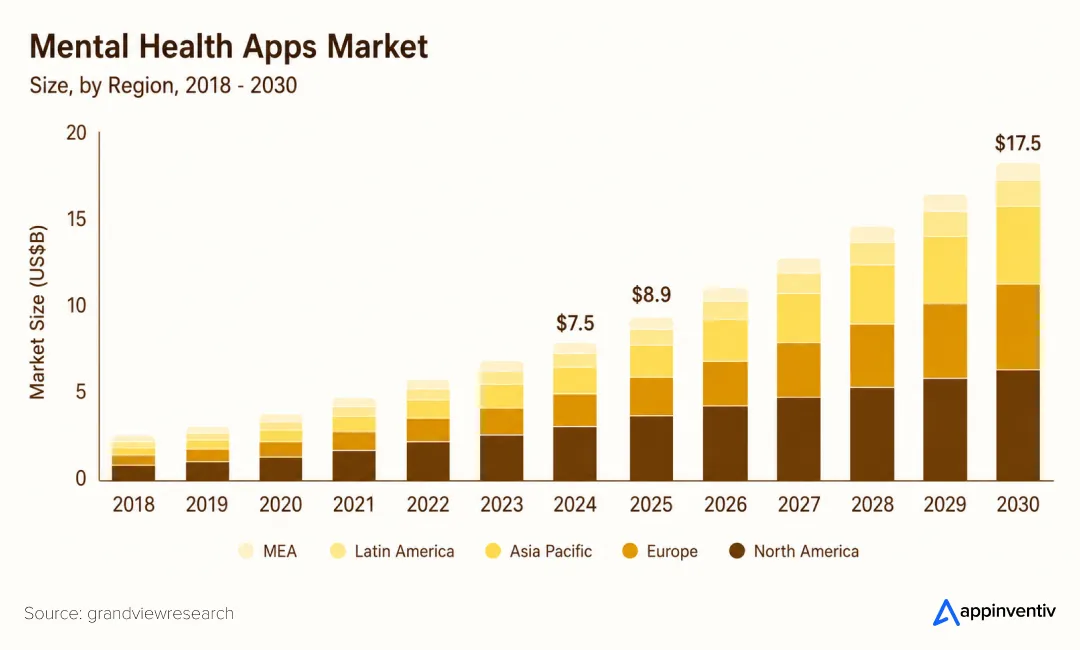
Meanwhile, the background health information reveals the extent to which the issue has proliferated. In the U.S., approximately one in four adults has had a mental illness in the last year, and approximately 19% has been diagnosed with depression at some point in their lives.
This applies to businesses and product teams, but is less a case of trend-following and more a case of recognizing a need. Mental health issues are now becoming apparent both at the individual and at the population levels, with recent surveys showing that approximately 1 out of 3 high school students is experiencing poor mental health.
Mood tracking applications provide a systematic approach to capturing and recording daily emotional data and converting it into early warning signs, enabling users and organizations to act before things go out of hand. These apps are increasingly being used as a convenient component of broader healthcare and workplace systems, rather than as single-user tools.
How to Build a Mood Tracking App: Step-by-Step Guide
Building a mood tracking app requires a clear understanding of user behavior, data handling, and long-term engagement. Here are the steps to create a mood tracking app that stands out in the crowd.
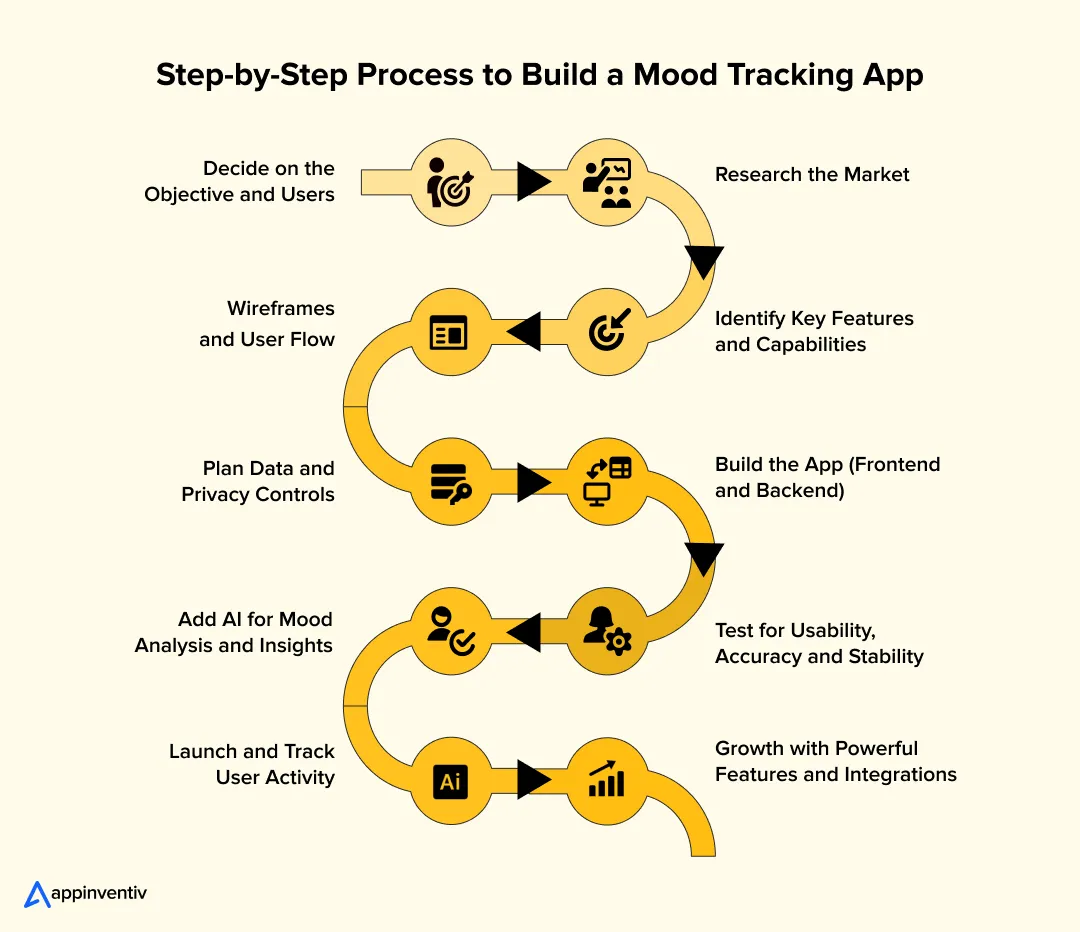
Step 1: Decide on the Objective and Users
It’s crucial to understand the purpose of the app and its target audience before you start coding. This guides all subsequent choices, from features to user interface choices. Without a clear goal, you can end up with an app with too many features and without enough value to make it useful.
- Identify target users (individual users, clinicians, enterprises)
- Identify critical outcomes (mood tracking, behaviour change, prevention)
Having a clear focus ensures the emotions tracking app development is based on user needs, not developer guesses.
Step 2: Research the Market
Thorough market research allows you to see what’s currently available and what users may be missing. The aim here is not to mimic features, but to spot opportunities to solve users’ problems.
- What do the top competitors offer?
- What do reviews say about bugs?
- Do you need to consider special needs like teen users and the neurodivergent?
This informs how you market your product, which helps you build a mood tracking app that stands out and has a value proposition.
Step 3: Wireframes and User Flow
With a clear concept, turn it into a visual structure. The app wireframes are a template of how the user will navigate the app, from the initial onboarding process to entering their mood. Keep user-friendliness and emotional safety in mind.
- Design onboarding, mood log, insights and settings pages
- Determine various emotional check-in flows for user types
- Consider accessibility and inclusive design
You’re not focusing on visual design here; rather, you are focusing on flow. An effective structure helps in developing a mood tracking app more efficiently and prevents high costs later.
Step 4: Identify Key Features and Capabilities
Now that you have a structure, decide on the features that will be part of the initial release. This will help maintain focus while providing value to the user.
- Include core features like mood tracking, journaling and mood history
- Offer tagging for activities, sleep or social events
- Include gentle reminders to encourage daily use without burnout
A focused feature set avoids complexity and facilitates gradual user growth.
Step 5: Plan Data and Privacy Controls
The app will store personal, sensitive data, so data management needs to be carefully considered. The emotional data must be safe and controlled by the user
- Decide how mood logs, notes and other behavioural data will be stored and accessed
- Use encryption technology and secure authentication
- Allow export, control and deletion of data
Robust privacy measures lay the foundation for long-term trust and risk mitigation as user numbers increase.
Step 6: Build the App (Frontend and Backend)
Development integrates UI design with system design. The aim is to create a seamless user experience with a solid backend.
- Employ Flutter or React Native for platform-independent apps
- Create APIs using Node.js orNET for data processing and analytics
- Create databases like PostgreSQL or MongoDB
Keeping the code modular makes it easier to update and add new features.
Step 7: Add AI for Mood Analysis and Insights
Providing intelligence makes the app more than just a journal but a helpful companion. AI-powered mental health detection capabilities should provide insight, not complexity
- Apply natural language processing to writing
- Recognize patterns of behaviour or mood
- Provide specific recommendations for users
The focus here should be on clarity so as to avoid confusion.
Step 8: Test for Usability, Accuracy and Stability
Before the app is released, try out the app in various scenarios to make sure it is stable and user-friendly. This stage must account for both technical robustness and the emotional sensitivity of user interactions.
- Perform usability testing for efficient, intuitive mood tracking
- Test AI recommendations for accuracy and relevance
- Perform performance and security testing
Testing is essential to fine-tune functionality and AI-based user experience.
Step 9: Launch and Track User Activity
The launch phase offers a real-world view of user interaction. This phase shifts focus from assumptions to observable behavior and measurable outcomes.
- Monitor usage statistics like daily logs and frequency of use
- Detect onboarding or feature engagement drop-off points
- Gather user feedback via in-app feedback or reviews
This informs continuous improvements and new features.
Step 10: Growth with Powerful Features and Integrations
As users are added, add features in a measured manner. Growth should be driven by observed user behavior and clear demand for added functionality.
- Link with smart devices for sleep and physical activity data
- Add or introduce guided wellness programs or habit trackers
- Add analytics for long-term trends
Here, the app becomes a more integrated solution while remaining user-friendly.
Must-Have Features for a Daily Mood Tracking App
These elements are the backbone of a daily mood tracker. They are not add-ons, but core requirements to make the app usable, reliable and useful to use every day. When implemented effectively, this list of mood tracking app features makes the experience smooth, routine and provides data that may later be used for more in-depth analysis and personalization.
| Feature | Purpose |
|---|---|
| Quick Mood Check-In | Offer a quick method of recording moods, such as by tapping icons or a five-point scale. This should take less than a few seconds to help users complete mood logs without disrupting their activities. |
| Context Capture (Notes or Prompts) | Provide a way for users to record a short description of context. A few words help give context and enhance future reflection. |
| Timeline View | Organize entries by day and week. This allows users to identify patterns such as regular stressful periods or low moods. |
| Smart Reminders | Help users stay on track with customizable reminders. The timing should be adjustable to help users develop a routine without it feeling too much. |
| Link to Activities | Allow users to link moods to activities like work, exercise and social events. This helps establish cause and effect. |
| Trend Summaries | Provide quick summaries such as average moods per week or most common moods. These summaries help simplify the data. |
| Flexible Mood Framework | Allow users to set up or tailor mood categories. Everyone has different emotional terms they use, so this enhances accuracy. |
| Account and Access Control | Support secure login features like passwords or biometrics. This protects your data and instills trust. |
| Data Ownership and Control | Offer tools to export, manage or delete data. Allow users to manage their data. |
| AI-Based Sentiment Analysis | Read journal entries to assess sentiment and mood changes. This is more accurate than manual entries and aids in detecting patterns that may be missed. |
| Predictive Mood Insights | Analyze past data to predict mood based on activity history, such as sleep, physical activity, or stress. This enables users to proactively address issues. |
| Integration with Wearables and Health Data | Log sleep patterns, heart rate and exercise through connected devices. This provides objective evidence to enhance mood associations. |
| Voice and Conversational Interfaces | Enable users to input mood or journal data via voice, making it more convenient and flexible. |
Also Read: 21 Advanced Mental Health App Features
Modern Tech Stack for Mood Tracking App Development
A real-world mood tracking system is more than a mobile application. It is a data product that includes real-time data capture, secure data storage, analytics and machine learning components. The following stack is representative of how the latest wellness products are built with scalable architecture and future features in mind.
| Layer | Technologies | Purpose |
|---|---|---|
| Mobile Client | Flutter (Bloc/Riverpod) or React Native (TypeScript) | Cross-platform user interface with robust state management for real-time mood tracking, journaling and offline capabilities. |
| Admin / Analytics Dashboard | React.js, Next.js | For clinicians and other enterprise dashboards and behavioral analytics. |
| RESTful API | .NET Core or Node.js (NestJS).NET Core | Service layer for authentication, mood events, journaling, and separation of business logic. |
| Transactional Data Store | PostgreSQL (w/ TimescaleDB) | Efficiently stores time-series mood data for analysis and monitoring. |
| Unstructured Data Store | MongoDB or DynamoDB | Stores journal entries, notes and dynamic emotion data. |
| Caching / Performance | Redis | Enhances query performance for commonly accessed mood history and mood analytics. |
| AI / ML Processing Layer | Python, TensorFlow, PyTorch, Hugging Face Transformers | Provides sentiment analysis, emotion classification, and mood prediction. |
| Event Pipeline / Event Streaming | Apache Kafka / AWS Kinesis | Real-time mood event streaming for analytics and training. |
| Cloud Providers | AWS (preferable) / GCP / Azure | Distributed deployment with containerized services, object storage and managed databases. |
| Container Orchestration & CI/CD | Docker, Kubernetes, GitHub Actions | Containerized applications, scaling and CI/CD workflows. |
| Security & Login | JWT / OAuth 2.0, AWS Cognito, Auth0 | Enables secure user login, access control, and secure session storage. |
| Notifications System | Firebase Cloud Messaging, AWS SNS | Manages reminders, nudges, and alerts for engagement. |
| Analytics & Monitoring | Mixpanel, Amplitude, Grafana, Prometheus | Provides user analytics, retention, system monitoring, and patterns of emotional engagement. |
| Data Privacy & Compliance | Encryption (AES-256), GDPR-ready data controls | Provides secure management of sensitive emotional data, with user control over data storage and deletion. |
Future Technology Trends in Mood Tracking Apps
A mood tracking app can be enhanced by advanced technologies to go from a simple diary-like tool to an interactive, responsive system. These can enhance the accuracy, personalization, user engagement, and responsiveness of a mood tracking app. Here are some of the top future trends of mood tracking apps:
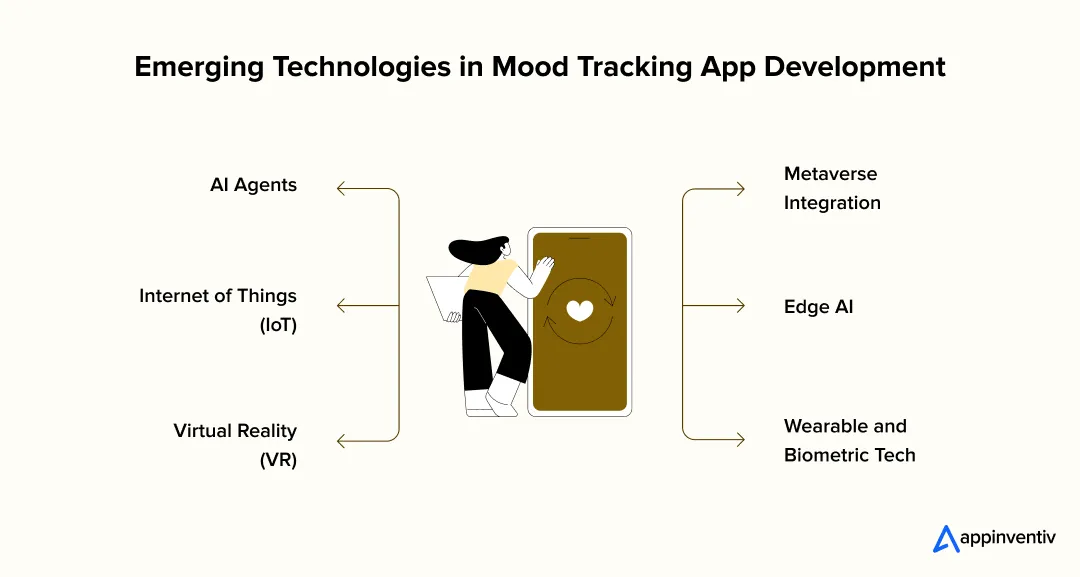
AI Agents
AI agents in healthcare go a step further by functioning autonomously. They can track mood fluctuations, send timely prompts, recommend strategies, and even adjust notification frequency based on user interaction.
One eighth of U.S. adolescents and young adults use AI chatbots as a mental support tool, with the highest rate of usage among the ages of 18 to 21. This indicates that the AI chat interface will definitely play a role in the development of mood tracking apps, particularly in providing personalized insights and directions.
Internet of Things (IoT)
IoT enables the app to gather real-world data from devices such as smart watches, fitness bands or sleep monitors. This data might include heart rate, sleep patterns, and activity metrics to link physical health with emotional health.
The IoT devices like wearables and smart home sensors allow to continuously and in real-time monitor physiological and behavioral signals. Other researchers state that diagnostic accuracy can be 95% to detect anxiety and depression.
Virtual Reality (VR)
VR can allow for immersive relaxation or therapy-based scenarios. People can immerse themselves in a relaxing environment that alleviates stress or anxiety, making it an active rather than passive process.
Virtual reality in mental health is becoming a therapeutic intervention, and research indicates anxiety reduction of 25.8% and mood improvement of 7.3% per session. This places VR as a feasible supplement to the state-of-the-art mood tracking systems.
Metaverse Integration
In more sophisticated setups, mood monitoring can include virtual social interactions through metaverse environment. Users can connect in virtual wellness communities or participate in interactive wellness sessions in virtual environments.
Edge AI
Edge AI uses the user’s device, rather than the cloud, to process data. This increases the responsiveness and security, particularly when dealing with highly sensitive data about emotions for a mood monitoring application.
Wearable and Biometric Tech
Wearable technology in healthtech offer real-time physiological metrics like heart rate variability, stress and sleep patterns. This helps build a more complete emotional profile. More than 65% of consumers would like wearable technology that provides a mental health monitoring feature. This increasing demand underscores a shift toward more integrated, sensor-based mood-tracking ecosystems.
Let our specialists help you integrate advanced technologies to deliver meaningful insights and better outcomes.

How to Earn Money From Mood Tracking App Development?
A mood tracking app can generate steady revenue when monetization is aligned with user experience and trust. Here are some of the key mood tracking app monetization strategies:
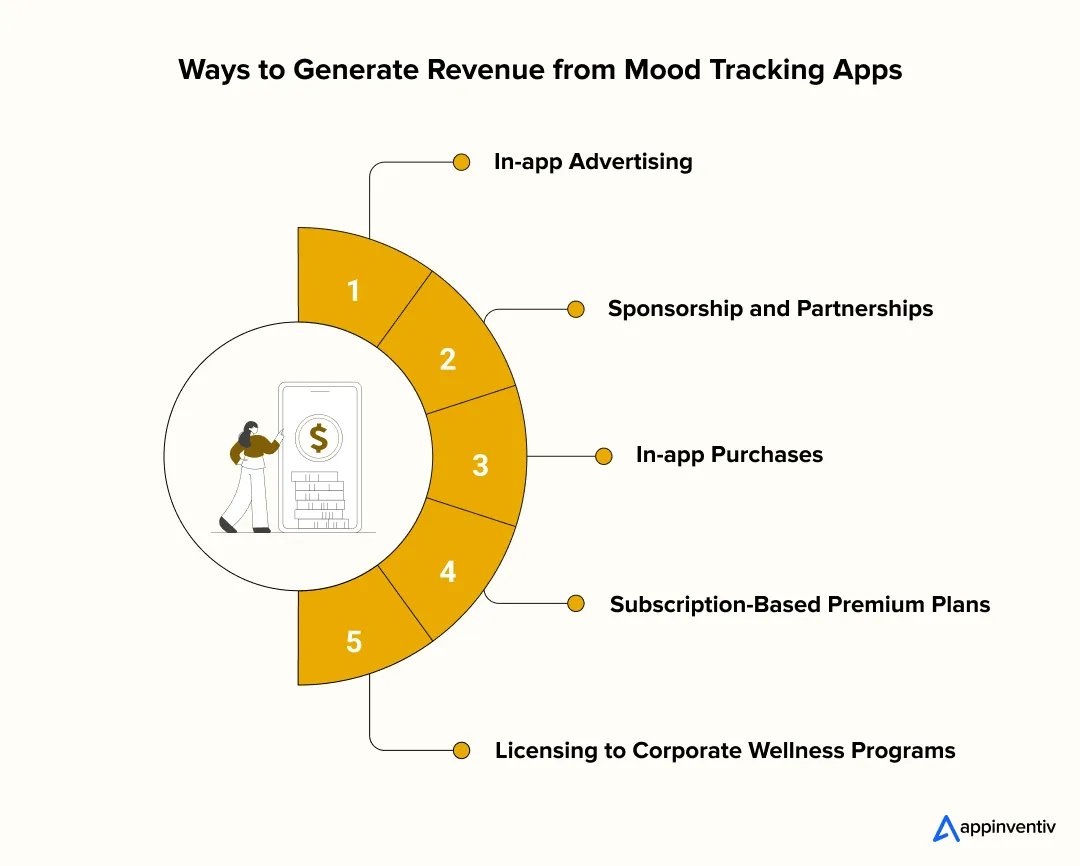
1. In-app Advertising
In-app advertising is one of the easiest yet profitable ways that every reputable wellness software company recommends.
Under this app monetization strategy, you display a third-party advertisement within your app interface. Based on user interactions in terms of views, clicks, and actual conversions, you get an amount of money from your third-party partner.
2. Sponsorship and Partnerships
Another way to earn money from your Android and iOS mood tracking app is to get into partnerships and sponsorships with reputed healthcare and wellness organizations. These organizations will access user data in real-time from your platform and other related insights and provide you with a hefty amount in return.
[Note: The user’s personal information is not shared with anyone without their consent.]
3. In-app Purchases
In-app purchases are also one of the best ways to make some profits from investing in the best mood tracking app development. This method of app monetization, available both on Android and iOS, lets entrepreneurs earn money in return for the use of mood tracker apps’ exceptional features, like buying additional features (including buying new emoticons), getting filtered reports of their annual record, and much more.
4. Subscription-Based Premium Plans
Subscription revenue offers a regular income from recurring charges for premium features. This is a common feature in mood tracking apps where advanced analysis and personalisation make a difference.
This may include insights generated by artificial intelligence (AI), long-term mood reports, and wellness programs. It may also provide routines to help manage emotional well-being. This approach is more effective if the app provides ongoing insights and updates, rather than static features.
5. Licensing to Corporate Wellness Programs
Enterprise licensing is a good way to monetise corporate well-being solutions when creating a mood tracking app. These product help businesses promote employee well-being and mitigate stress.
It provides corporate subscriptions, team emotional dashboards and aggregated well-being data for planning. This can work well if the model is developed as a scalable enterprise mental wellness solution.
Where Mood Tracking App Projects Go Wrong
Even strong ideas can lose direction if key areas are overlooked. Below are some of the most common failure points seen during custom mood tracking app development challenges, especially in the early stages of growth.
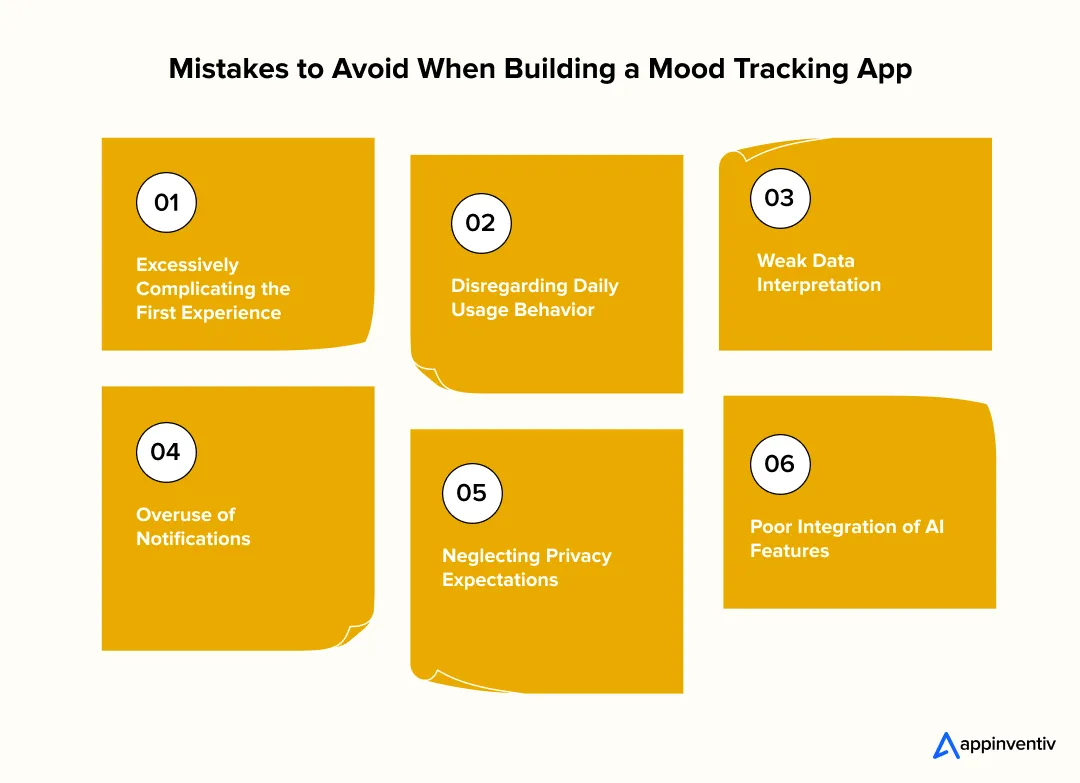
Excessively Complicating the First Experience
One of the pitfalls is attempting to do more in the initial encounter. Users could be overwhelmed by long onboarding flows, excessive questions, or heavy-featured screens. When the majority open a mood app, they are seeking something fast, non-strenuous, etc. When the initial check-in is a job, it is a rare chance that they will come back. However, a clean entry point with minimal input tends to do a lot better.
Disregarding Daily Usage Behavior
Repeat is key to the success of a mood tracking app. When it takes more than several seconds to log a mood, users will start to skip it. Minor delays, additional steps, or vague navigation become irritating. This habit loop is broken over time. Applications that are unsuccessful in this category usually experience a steep decline in usage in the first week.
Weak Data Interpretation
A lot of mood tracking apps gather a lot of data and do not provide it in a significant manner. Displaying raw entries without context is not going to be helpful to users in understanding their emotional patterns. Users desire easy summaries, trends on the surface, and easily digestible conclusions. Otherwise, the app will be passive and have little incentive to keep using it.
Overuse of Notifications
Push notifications are supposed to help in ensuring consistency, but overindulgence in notifications can do the reverse. When users are interrupted or pressured, they will either mute alerts or uninstall the app. Successful systems change frequency based on the user’s behavior, rather than sending regular prompts daily.
Neglecting Privacy Expectations
Emotional data is personal, and users know that. When the app fails to provide a clear way on how the data is stored, used or protected, trust is lost in no time. Inadequate control over the data or vague policies may result in the user abandoning the app altogether. Transparency is not an option in the products that require personal reflection.
Poor Integration of AI Features
AI is usually included as a marquee feature, but it does not provide any actual value. Mood summaries or incorrect sentiment analysis at the generic level decrease credibility. Users can easily inform when insights become redundant or not relevant to their contributions. AI is not able to show superficial statements but rather provide clear, relevant observations that can be improved over time.
Mood Tracking App Development Cost Estimation
The cost of a mood-tracking app is never fixed, as it generally ranges from $40,000 to $500,000. It changes depending on the feature depth, data processing requirements, AI capabilities, and the extent of integration necessary. A basic tracking application can stay in a relatively low budget, whereas a data-driven platform with analytics and AI can go into a much higher range.
Breakdown of Key Costs
These cost elements represent the key areas of investment that are necessary to design, build and scale a modern mood tracking application.
| Cost Component | Description | Estimated Costs (USD) |
|---|---|---|
| UI/UX Design | User flows, wireframes, emotional design, accessibility | $20,000 – $40,000 |
| Android and iOS Mobile App Development | Frontend development, core features | $30,000 – $100,000 |
| Backend Development | APIs, database configuration, authentication, business logic | $20,000 – $80,000 |
| Data Engineering | Data structuring, storage design, mood logs, journaling pipelines | $15,000 – $60,000 |
| AI, Sentiment Analysis | NLP models, mood classification, pattern detection | $30,000 – $120,000 |
| Cloud Infrastructure | Hosting, storage, compute, scaling | $10,000 – $70,000/year |
| Wearables, health APIs, notifications, analytics tools | Wearables, health APIs, notifications, analytics tools | $10,000 – $50,000 |
| Security & Compliance | Encryption, access control, data privacy configuration | $10,000 – $50,000 |
| Testing & QA | Functional testing, usability testing, performance checks | $8,000 – $30,000 |
| Maintenance & Updates | Bug fixes, feature updates, optimization | $15,000 – $80,000 per year |
Estimated Build Cost (Total)
The overall price will be determined by the distance that the product will be after basic tracking. Applications that purely focus on journaling and logging will remain at the bottom, whereas applications with AI insights and integrations will be at the top.
| Scale of Deployment | Approx Total Build Cost |
|---|---|
| Basic mood tracking app | $40,000 – $90,000 |
| Mid-level app with analytics | $90,000 – $200,000 |
| Advanced AI-driven platform | $200,000 – $500,000+ |
Factors Which May Influence Investment
Data Quality: Poorly structured or inconsistent data makes it more difficult to clean and prepare.
Feature Complexity: Such sophisticated capabilities as AI analytics and personalization have a profound impact on development intensity.
Integration Scope: Integration with wearables, health platforms, or third-party APIs will contribute to both build and maintenance costs.
AI Model Approach: Custom-trained models are more costly than custom-built APIs, yet are more precise and controlled.
Platform Coverage: Android, iOS, and web platform support add to the development time and cost.
Infrastructure Requirements: Scalable systems and real-time processing require increased investment in cloud and backend.
Security and Compliance: Processing sensitive emotional information will require additional encryption, access controls, and regulations.
Development Team’s Location: Prices vary based on the area’s development rates and team members’ knowledge. Businesses often hire mood tracking app developer teams from different regions to balance cost efficiency with technical quality.
Maintenance and Updates: Continuous upgrades, bug fixes and performance optimization are also subject to long-term costs.
Avoid guesswork by aligning your budget with the right scope from the start.

Turn Your Mood Tracking App Idea into Reality with Appinventiv
Mood tracking has ceased to be a niche behavior and is now a practical means of managing both the overall and the daily well-being. It assists users in associating feelings with routines, sleep, work, and interpersonal relationships. In the long run, this awareness is helpful in making better decisions and intervening early to prevent the escalation of problems.
As a reputed mental health application development company, we at Appinventiv build intuitive mood tracking solutions that combine intuitive design with data-driven insights, helping businesses deliver meaningful and clinically relevant user experiences.
In the future, the purpose of technology can only become even greater. The way these applications are working is already being influenced by AI-driven insights, wearable integration, and real-time analytics. The future systems will not only be able to record moods but also be able to interpret them, predict changes and give small, timely actions. This will make mood tracker apps more of a continuous support system, not a passive tool.
To the businesses venturing into this space, it is not just the idea but also the execution. Appinventiv has experience in creating scalable healthcare solutions, supported by case studies, including YouComm, Health-e-People, DiabeticU, and Soniphi.
Our medical app development services demonstrate a pragmatic grasp of data management, user experience, and compliance in sensitive settings through the projects we worked on.
When you want to know how to build a mood tracker app or plan to initiate one or scale up an existing product, having the right team can help make the process more predictable. Connect with our experts to bring your idea to life as a dependable, user-friendly solution.
FAQs
Q. How does a mood tracker app work?
A. Here’s how a mood tracker app functions:
- User onboarding and profile setup: To build a mood tracking app, the process begins with simple onboarding. Users create a profile, set preferences, and define tracking goals such as stress, sleep, or anxiety patterns.
- Mood logging interface: The app provides an easy input method, such as emojis, sliders, or short notes. Users log their mood daily, sometimes with added context like activities, location, or sleep quality.
- Data collection and storage: Each entry is stored securely in the backend. Over time, the system builds a structured dataset of emotional patterns linked to user behavior.
- Analytics and pattern recognition: The app processes historical data to identify trends. It may highlight triggers, recurring emotional states, or correlations between habits and mood shifts.
- Insights and feedback loop: Users receive summaries, charts, and suggestions. Some apps integrate reminders or journaling prompts to encourage consistent tracking.
- Integration with health tools: Advanced solutions connect with wearables or health apps to enrich insights using sleep, heart rate, or activity data.
Q. What are the top benefits of a HIPAA-compliant mood tracking app?
A. Here are some of the benefits of developing a mood tracking app that is HIPAA-compliant:
1. Strong data privacy and protection
A HIPAA compliant mood tracking app ensures sensitive mental health data is encrypted and handled under strict regulatory standards. This reduces risk of data misuse and builds user trust.
2. Secure data storage and transmission
All user information is protected during storage and transfer. This is critical for apps handling personal health records and emotional data.
3. Increased user confidence
Users are more likely to engage consistently when they know their data is handled responsibly. This directly improves retention and data accuracy.
4. Eligibility for healthcare integration
Compliance allows integration with hospitals, therapists, and insurance systems. It opens the door to clinical use and partnerships.
5. Legal risk reduction
Following HIPAA guidelines helps avoid penalties and legal complications related to data breaches or improper handling.
6. Scalable and enterprise-ready architecture
Such apps are built with structured security frameworks, making them suitable for expansion into larger healthcare ecosystems.
Q. How much does it cost to build a mood tracking app?
A. The cost depends on features, integrations, and compliance requirements. A basic version may start around $40,000, while advanced apps with AI insights and healthcare integration can exceed $500,000. Factors such as platform, design complexity, and backend infrastructure also affect pricing. Connect with a mood tracking app development company like Appinventiv to get a complete cost estimation.
Q. How long does it take to build a mood app?
A. Development timelines vary based on scope and feature depth. A simple app with core tracking features can take 3 to 4 months, while a fully featured solution with analytics, integrations, and compliance layers may take 6 to 9 months. In most cases, mood tracker app development services usually take around this range, depending on customization and testing requirements.


Fast 2-minute response, fully NDA-protected.

Wearable Data Integration: Connecting Multiple Devices to a Unified Health Platform
Key takeaways: Device support should reflect the measurements your service needs, the people using it, and the decisions those readings inform. A unified health data platform must preserve source, timing, and measurement context while resolving duplicate records. Phone health platforms, manufacturer APIs, and direct device connections serve different integration needs. Clinical workflows require agreed review…

Sleep Tracker App Development: Features, Wearable Integration, AI, and Compliance
Key takeaways: Sleep tracking presents opportunities across consumer wellness, fitness, healthcare, employee wellness, senior care, and infant-care markets. Successful products combine actionable insights, wearable connectivity, user-friendly reports, privacy controls, and clearly differentiated experiences. HealthKit, Health Connect, and direct device APIs provide different data depths, costs, limitations, and maintenance requirements. AI supports sleep-stage estimation and personalization,…

Diet and Nutrition App Development: Process, Features, Cost, and Technology Stack
Key Takeaways Diet and nutrition tracking app development goes past basic calorie counters with verified food databases, custom meal schedules, AI tools, wearable device links, and corporate manager tools. Structure database models around raw food items, serving portions, nutrient facts, recipes, software links, and regional diet rules. Pair computer vision models, recommendation algorithms, language engines,…